Question bank

Q&A: practice questions with answers

Search questions on any topic. Filter by exam category, exam, subject and topic, try the question, then open the answer and explanation.

Courses – airGurukul

20,719 questions found.

Q14061.
Ayush ranked 44th from the top and 25th from the bottom in his class. How many students are there in his class?
आयुष अपनी कक्षा में ऊपर से 44वें और नीचे से 25वें स्थान पर है। उसकी कक्षा में कितने विद्यार्थी हैं?
  1. A68
  2. B66
  3. C67
  4. D69
Show answer

Concept: Total students =(rank from top)+(rank from bottom)−1.

  1. Rank from top =44, from bottom =25.
  2. Total =44+25−1=68.

Trick: Add the two ranks and subtract 1 (Ayush himself is counted in both).

Answer: (A) 68

अवधारणा: कुल छात्र =(ऊपर से रैंक)+(नीचे से रैंक)−1।

  1. ऊपर से रैंक =44, नीचे से =25।
  2. कुल =44+25−1=68।

ट्रिक: दोनों रैंक जोड़कर 1 घटाएँ (आयुष स्वयं दोनों में गिना गया है)।

उत्तर: (A) 68
RRB NTPC Undergraduate CBT 1General Intelligence and ReasoningRankingRRB NTPC Undergraduate CBT 1 2025 · 8 May Shift 1 →
Q14062.
Which of the following options should come in place of the ‘?’ in the given series based on the English alphabetical order?
N 32, I 25, D 18, Y 11, ?
अंग्रेज़ी वर्णमाला क्रम के आधार पर दी गई शृंखला में '?' के स्थान पर निम्नलिखित में से कौन-सा विकल्प आना चाहिए?
N 32, I 25, D 18, Y 11, ?
  1. AT 4
  2. BZ 4
  3. CS 4
  4. DY 4
Show answer

Concept: Treat the letters and the numbers as two separate series.

  1. Letters: N(14) → I(9) → D(4) → Y(25) : each −5 (D−5 = −1 → wrap to 25 = Y). Next: Y(25)−5 = 20 → T.
  2. Numbers: 32 → 25 → 18 → 11 : each −7. Next: 11−7=4.
  3. So the next term is T 4.

Trick: Going backwards past A, add 26: 4−5=−1⇒−1+26=25 (Y).

Answer: (A) T 4

अवधारणा: अक्षरों और संख्याओं को दो अलग श्रृंखलाओं की तरह देखें।

  1. अक्षर: N(14) → I(9) → D(4) → Y(25) : हर बार −5 (D−5 = −1 → चक्र में 25 = Y)। अगला: Y(25)−5 = 20 → T।
  2. संख्याएँ: 32 → 25 → 18 → 11 : हर बार −7। अगला: 11−7=4।
  3. अत: अगला पद T 4।

ट्रिक: A से पीछे जाने पर 26 जोड़ें: 4−5=−1⇒−1+26=25 (Y)।

उत्तर: (A) T 4

RRB NTPC Undergraduate CBT 1General Intelligence and ReasoningLetter–number seriesRRB NTPC Undergraduate CBT 1 2025 · 8 May Shift 1 →
Q14063.
Based on the English alphabetical order, three of the following four letter-cluster pairs are alike in a certain way and thus form a group. Which is the one that does not belong to that group? (Note: The odd one out is not based on the number of
consonants/vowels or their position in the letter cluster.)
अंग्रेज़ी वर्णमाला क्रम के आधार पर, निम्नलिखित चार अक्षर-समूह युग्मों में से तीन किसी निश्चित प्रकार से एक समान हैं और इस प्रकार एक समूह बनाते हैं। वह कौन-सा है जो उस समूह से संबंधित नहीं है? (नोट: असंगत युग्म अक्षर-समूह में व्यंजनों/स्वरों की संख्या या उनकी
स्थिति पर आधारित नहीं है।)
  1. AFE−IH
  2. BLK−ON
  3. CCB−FE
  4. DKJ−MO
Show answer

Concept: Compare corresponding letters of the two clusters in each pair and find the jump.

  1. FE−IH : F→I (+3), E→H (+3).
  2. LK−ON : L→O (+3), K→N (+3). CB−FE : C→F (+3), B→E (+3).
  3. KJ−MO : K→M (+2), J→O (+5) – breaks the pattern.

Trick: In three pairs the second cluster is simply "each letter + 3"; the odd pair has unequal jumps.

Answer: (D) KJ−MO

अवधारणा: प्रत्येक जोड़े में दोनों क्लस्टर के संगत अक्षरों की तुलना कर अंतर निकालें।

  1. FE−IH : F→I (+3), E→H (+3)।
  2. LK−ON : L→O (+3), K→N (+3)। CB−FE : C→F (+3), B→E (+3)।
  3. KJ−MO : K→M (+2), J→O (+5) – पैटर्न टूटता है।

ट्रिक: तीन जोड़ों में दूसरा क्लस्टर "हर अक्षर + 3" है; विषम जोड़े में अंतर असमान है।

उत्तर: (D) KJ−MO

RRB NTPC Undergraduate CBT 1General Intelligence and ReasoningLetter-cluster analogy (odd one out)RRB NTPC Undergraduate CBT 1 2025 · 8 May Shift 1 →
Q14064.
Each vowel in the word REFERTILIZES is changed to the second letter immediately following it in the English alphabetical order, and each consonant is changed to the second letter immediately preceding it in the English alphabetical order. Which of the following letters will appear exactly twice in the group of letters thus formed?
शब्द REFERTILIZES के प्रत्येक स्वर को अंग्रेज़ी वर्णमाला क्रम में उसके ठीक बाद आने वाले दूसरे अक्षर से बदल दिया जाता है, और प्रत्येक व्यंजन को अंग्रेज़ी वर्णमाला क्रम में उसके ठीक पहले आने वाले दूसरे अक्षर से बदल दिया जाता है। इस प्रकार बने अक्षर-समूह में निम्नलिखित में से कौन-सा अक्षर ठीक दो बार आएगा?
  1. AR
  2. BK
  3. CX
  4. DG
Show answer

Concept: Vowel → +2 in the alphabet, consonant → −2. Convert every letter of REFERTILIZES and count.

  1. R→P, E→G, F→D, E→G, R→P, T→R, I→K, L→J, I→K, Z→X, E→G, S→Q.
  2. New group: P G D G P R K J K X G Q.
  3. Counts: G = 3, P = 2, K = 2, R = 1, X = 1. Among the options only K appears exactly twice.

Trick: Convert letter by letter in order and tally only the letters given in the options.

Answer: (B) K

अवधारणा: स्वर → वर्णमाला में +2, व्यंजन → −2। REFERTILIZES के हर अक्षर को बदलकर गिनें।

  1. R→P, E→G, F→D, E→G, R→P, T→R, I→K, L→J, I→K, Z→X, E→G, S→Q।
  2. नया समूह: P G D G P R K J K X G Q।
  3. गिनती: G = 3, P = 2, K = 2, R = 1, X = 1। विकल्पों में केवल K ठीक दो बार आता है।

ट्रिक: क्रम से एक-एक अक्षर बदलें और केवल विकल्पों में दिए अक्षरों की गिनती करें।

उत्तर: (B) K

RRB NTPC Undergraduate CBT 1General Intelligence and ReasoningLetter manipulationRRB NTPC Undergraduate CBT 1 2025 · 8 May Shift 1 →
Q14065.
KY 1 is related to MU 17 in a certain way. In the same way, FI 8 is related to HE 24. To which of the following is RF 3 related, following the same logic?
KY 1 किसी निश्चित प्रकार से MU 17 से संबंधित है। उसी प्रकार, FI 8, HE 24 से संबंधित है। समान तर्क का अनुसरण करते हुए, RF 3 निम्नलिखित में से किससे संबंधित है?
  1. AKL 5
  2. BKJ 7
  3. CTB 19
  4. DYG 9
Show answer

Concept: Find the rule for letters and number separately from both given pairs, then apply it.

  1. KY 1 → MU 17: K→M (+2), Y→U (−4), 1→17 (+16).
  2. FI 8 → HE 24: F→H (+2), I→E (−4), 8→24 (+16). Rule confirmed.
  3. RF 3: R+2 = T, F−4 = B, 3+16=19 → TB 19.

Trick: Verify the rule on both examples before applying; here (+2, −4, +16).

Answer: (C) TB 19

अवधारणा: दोनों दिए गए जोड़ों से अक्षरों और संख्या का नियम अलग-अलग निकालें, फिर लागू करें।

  1. KY 1 → MU 17: K→M (+2), Y→U (−4), 1→17 (+16)।
  2. FI 8 → HE 24: F→H (+2), I→E (−4), 8→24 (+16)। नियम पुष्ट।
  3. RF 3: R+2 = T, F−4 = B, 3+16=19 → TB 19।

ट्रिक: नियम को दोनों उदाहरणों पर जाँचकर ही लागू करें; यहाँ (+2, −4, +16)।

उत्तर: (C) TB 19

RRB NTPC Undergraduate CBT 1General Intelligence and ReasoningLetter–number analogyRRB NTPC Undergraduate CBT 1 2025 · 8 May Shift 1 →
Q14066.
Read the given statement(s) and conclusions carefully. Assuming that the information given in the statements is true, even if it appears to be at variance with commonly known facts, decide which of the given conclusions logically follow(s) from the statement(s).
Statements:
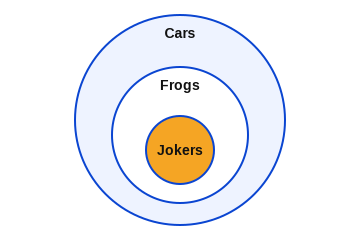
All jokers are frogs.
All frogs are cars.
Conclusions:
(I) Some cars are frogs.
(II) All jokers are cars.
दिए गए कथन(कथनों) और निष्कर्षों को ध्यानपूर्वक पढ़िए। यह मानते हुए कि कथनों में दी गई जानकारी सत्य है, भले ही वह सामान्यतः ज्ञात तथ्यों से भिन्न प्रतीत होती हो, निर्णय कीजिए कि दिए गए निष्कर्षों में से कौन-सा/कौन-से निष्कर्ष कथन(कथनों) का तार्किक रूप से अनुसरण करता है/करते हैं।
कथन:
सभी जोकर, मेंढक हैं।
सभी मेंढक, कार हैं।
निष्कर्ष:
(I) कुछ कार, मेंढक हैं।
(II) सभी जोकर, कार हैं।
  1. ANeither conclusion (I) nor (II) followsन तो निष्कर्ष (I) और न ही (II) अनुसरण करता है
  2. BBoth conclusions (I) and (II) followनिष्कर्ष (I) और (II) दोनों अनुसरण करते हैं
  3. COnly conclusion (II) followsकेवल निष्कर्ष (II) अनुसरण करता है
  4. DOnly conclusion (I) followsकेवल निष्कर्ष (I) अनुसरण करता है
Show answer

Concept: "All A are B" + "All B are C" ⇒ "All A are C". Also, "All B are C" lets us conclude "Some C are B".

  1. Jokers ⊂ Frogs ⊂ Cars, so all jokers are cars – conclusion II follows.
  2. Since every frog is a car, the frogs are a part of the cars, so some cars are frogs – conclusion I follows.

Trick: Two "All" statements chained give "All"; and every "All A are B" also gives "Some B are A".

Answer: (B) Both conclusions (I) and (II) follow

अवधारणा: "सभी A, B हैं" + "सभी B, C हैं" ⇒ "सभी A, C हैं"। साथ ही "सभी B, C हैं" से "कुछ C, B हैं" निकलता है।

  1. Jokers ⊂ Frogs ⊂ Cars, अत: सभी jokers, cars हैं – निष्कर्ष II सही।
  2. हर frog एक car है, इसलिए frogs, cars का हिस्सा हैं → कुछ cars, frogs हैं – निष्कर्ष I सही।

ट्रिक: दो "सभी" कथन जोड़ने पर "सभी" मिलता है; और हर "सभी A, B हैं" से "कुछ B, A हैं" भी निकलता है।

उत्तर: (B) निष्कर्ष (I) और (II) दोनों अनुसरण करते हैं

RRB NTPC Undergraduate CBT 1General Intelligence and ReasoningSyllogismRRB NTPC Undergraduate CBT 1 2025 · 8 May Shift 1 →
Q14067.
What should come in place of ‘?’ in the given series?
8 9 17 26 90 115 ?
दी गई शृंखला में '?' के स्थान पर क्या आना चाहिए?
8 9 17 26 90 115 ?
  1. A313
  2. B331
  3. C198
  4. D231
Show answer

Concept: Look at the differences between consecutive terms; here they alternate between squares and cubes.

  1. Differences: 9−8=1, 17−9=8, 26−17=9, 90−26=64, 115−90=25.
  2. Pattern: 12,23,32,43,52 → next difference 63=216.
  3. Next term =115+216=331.

Trick: Differences 1, 8, 9, 64, 25 – odd positions are squares, even positions cubes.

Answer: (B) 331

अवधारणा: क्रमागत पदों के अंतर देखें; यहाँ अंतर वर्ग और घन के बीच बारी-बारी बदलते हैं।

  1. अंतर: 9−8=1, 17−9=8, 26−17=9, 90−26=64, 115−90=25।
  2. पैटर्न: 12,23,32,43,52 → अगला अंतर 63=216।
  3. अगला पद =115+216=331।

ट्रिक: अंतर 1, 8, 9, 64, 25 – विषम स्थान पर वर्ग, सम स्थान पर घन।

उत्तर: (B) 331

RRB NTPC Undergraduate CBT 1General Intelligence and ReasoningNumber seriesRRB NTPC Undergraduate CBT 1 2025 · 8 May Shift 1 →
Q14068.
Refer to the following series and answer the question. (All numbers are single digit numbers only. Counting has to be done from left to right).
(Left) 2 9 3 3 8 4 7 2 4 2 8 9 9 7 4 9 9 4 6 7 7 (Right)
How many such odd digits are there each of which is immediately preceded by an odd digit and also immediately followed by a perfect square?
(NOTE: 1 is also a perfect square)
निम्नलिखित शृंखला को देखिए और प्रश्न का उत्तर दीजिए। (सभी संख्याएँ केवल एक अंक की संख्याएँ हैं। गिनती बाएँ से दाएँ की जानी है।)
(बाएँ) 2 9 3 3 8 4 7 2 4 2 8 9 9 7 4 9 9 4 6 7 7 (दाएँ)
ऐसे कितने विषम अंक हैं जिनमें से प्रत्येक के ठीक पहले एक विषम अंक है और ठीक बाद में एक पूर्ण वर्ग है?
(नोट: 1 भी एक पूर्ण वर्ग है)
  1. AThreeतीन
  2. BTwoदो
  3. CFourचार
  4. DOneएक
Show answer

Concept: We need an odd digit whose left neighbour is odd and right neighbour is a perfect square (1, 4 or 9). Scan odd–odd–square triplets.

  1. Series: 2 9 3 3 8 4 7 2 4 2 8 9 9 7 4 9 9 4 6 7 7.
  2. 9 7 4 (positions 13–15): 7 is odd, preceded by 9 (odd), followed by 4 (square) ✓.
  3. 9 9 4 (positions 16–18): 9 odd, preceded by 9, followed by 4 ✓.
  4. Other odd digits fail: e.g. 9 3 3 (next 3 not a square), 4 7 2 (preceded by even).

Trick: First mark the squares (1, 4, 9) in the series, then check only the digit just before each one.

Answer: (B) Two

अवधारणा: ऐसा विषम अंक चाहिए जिसके बाएँ विषम अंक और दाएँ पूर्ण वर्ग (1, 4 या 9) हो। विषम–विषम–वर्ग त्रिक खोजें।

  1. श्रृंखला: 2 9 3 3 8 4 7 2 4 2 8 9 9 7 4 9 9 4 6 7 7।
  2. 9 7 4 (स्थान 13–15): 7 विषम, पहले 9 (विषम), बाद में 4 (वर्ग) ✓।
  3. 9 9 4 (स्थान 16–18): 9 विषम, पहले 9, बाद में 4 ✓।
  4. अन्य विषम अंक शर्त पूरी नहीं करते: जैसे 9 3 3 (अगला 3 वर्ग नहीं), 4 7 2 (पहले सम अंक)।

ट्रिक: पहले श्रृंखला में वर्ग (1, 4, 9) चिह्नित करें, फिर केवल उनसे ठीक पहले वाले अंक की जाँच करें।

उत्तर: (B) दो

RRB NTPC Undergraduate CBT 1General Intelligence and ReasoningNumber series countingRRB NTPC Undergraduate CBT 1 2025 · 8 May Shift 1 →
Q14069.
In the following number-pairs, the second number is obtained by applying certain mathematical operations to the first number. Select the set in which the numbers are related in the same way as are the numbers of the following sets.
(NOTE: Operations should be performed on the whole numbers, without breaking down the numbers into their constituent digits. E.g. 13 – Operations on 13 such as adding / subtracting / multiplying etc. to 13 can be performed. Breaking down 13 into 1 and 3 and then performing mathematical operations on 1 and 3 is not allowed.)
18, 109
17, 103
निम्नलिखित संख्या-युग्मों में, दूसरी संख्या पहली संख्या पर कुछ निश्चित गणितीय संक्रियाएँ करके प्राप्त की गई है। उस समुच्चय का चयन कीजिए जिसमें संख्याएँ उसी प्रकार संबंधित हैं जिस प्रकार निम्नलिखित समुच्चयों की संख्याएँ संबंधित हैं।
(नोट: संक्रियाएँ पूर्ण संख्याओं पर की जानी चाहिए, संख्याओं को उनके घटक अंकों में तोड़े बिना। उदाहरण: 13 – 13 पर संक्रियाएँ जैसे 13 में जोड़ना / घटाना / गुणा करना आदि की जा सकती हैं। 13 को 1 और 3 में तोड़कर फिर 1 और 3 पर गणितीय संक्रियाएँ करने की अनुमति नहीं है।)
18, 109
17, 103
  1. A26, 130
  2. B24, 155
  3. C22, 133
  4. D19, 116
Show answer

Concept: Find one operation on the whole first number that gives the second in both given pairs.

  1. 18×6+1=109 and 17×6+1=103 → rule: second =6×first+1.
  2. Check options: 22×6+1=133 ✓.
  3. Others fail: 26→157 (not 130), 24→145 (not 155), 19→115 (not 116).

Trick: Second ÷ first ≈ 6 in both pairs → try 6n±k.

Answer: (C) 22, 133

अवधारणा: पहली संख्या (पूरी) पर ऐसी संक्रिया खोजें जो दोनों जोड़ों में दूसरी संख्या दे।

  1. 18×6+1=109 और 17×6+1=103 → नियम: दूसरी =6×पहली+1।
  2. विकल्प जाँचें: 22×6+1=133 ✓।
  3. बाकी गलत: 26→157 (130 नहीं), 24→145 (155 नहीं), 19→115 (116 नहीं)।

ट्रिक: दोनों जोड़ों में दूसरी ÷ पहली ≈ 6 → 6n±k आज़माएँ।

उत्तर: (C) 22, 133

RRB NTPC Undergraduate CBT 1General Intelligence and ReasoningNumber analogyRRB NTPC Undergraduate CBT 1 2025 · 8 May Shift 1 →
Q14070.
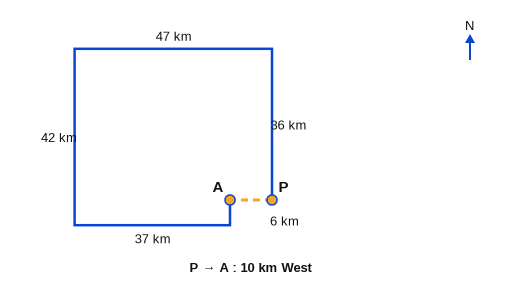
Mr. Yorly starts from Point A and drives 6 km towards South. He then takes a right turn, drives 37 km, turns right and drives 42 km. He then takes a right turn and drives 47 km. He takes a final right turn, drives 36 km and stops at Point P. How far (shortest distance) and towards which direction should he drive in order to reach Point A again?
(All turns are 90 degrees turns only unless specified.)
श्री योर्ली बिंदु A से चलना शुरू करते हैं और दक्षिण की ओर 6 km गाड़ी चलाते हैं। फिर वे दाएँ मुड़ते हैं, 37 km गाड़ी चलाते हैं, दाएँ मुड़ते हैं और 42 km गाड़ी चलाते हैं। फिर वे दाएँ मुड़ते हैं और 47 km गाड़ी चलाते हैं। वे अंतिम बार दाएँ मुड़ते हैं, 36 km गाड़ी चलाते हैं और बिंदु P पर रुकते हैं। पुनः बिंदु A पर पहुँचने के लिए उन्हें कितनी दूर (न्यूनतम दूरी) और किस दिशा में गाड़ी चलानी चाहिए?
(जब तक अन्यथा निर्दिष्ट न हो, सभी मोड़ केवल 90 डिग्री के मोड़ हैं।)
  1. A10 km to the Westपश्चिम की ओर 10 km
  2. B11 km to the Northउत्तर की ओर 11 km
  3. C12 km to the Eastपूर्व की ओर 12 km
  4. D15 km to the Southदक्षिण की ओर 15 km
Show answer

Concept: Take A as origin, track east–west and north–south displacements separately. Facing South, a right turn means West; facing West, right = North; facing North, right = East; facing East, right = South.

  1. 6 km South → (0, −6). Right → 37 km West → (−37, −6). Right → 42 km North → (−37, 36).
  2. Right → 47 km East → (10, 36). Right → 36 km South → P = (10, 0).
  3. P is 10 km east of A on the same east–west line, so he must drive 10 km West to reach A.

Trick: Net E–W =47−37=10 km east; net N–S =42−6−36=0 → straight back West.

Answer: (A) 10 km to the West

अवधारणा: A को मूल बिंदु मानकर पूर्व–पश्चिम और उत्तर–दक्षिण विस्थापन अलग-अलग गिनें। दक्षिण मुख में दायाँ मोड़ = पश्चिम; पश्चिम मुख में दायाँ = उत्तर; उत्तर में दायाँ = पूर्व; पूर्व में दायाँ = दक्षिण।

  1. 6 km दक्षिण → (0, −6)। दाएँ → 37 km पश्चिम → (−37, −6)। दाएँ → 42 km उत्तर → (−37, 36)।
  2. दाएँ → 47 km पूर्व → (10, 36)। दाएँ → 36 km दक्षिण → P = (10, 0)।
  3. P, A से 10 km पूर्व में उसी रेखा पर है, अत: A पहुँचने के लिए 10 km पश्चिम चलना होगा।

ट्रिक: शुद्ध पू–प =47−37=10 km पूर्व; शुद्ध उ–द =42−6−36=0 → सीधे पश्चिम लौटें।

उत्तर: (A) 10 km पश्चिम की ओर

RRB NTPC Undergraduate CBT 1General Intelligence and ReasoningDirection and distanceRRB NTPC Undergraduate CBT 1 2025 · 8 May Shift 1 →
Q14071.
If 2 is added to each odd digit and 1 is subtracted from each even digit in the number 82135746, then what will be the difference between the first digit from the right end and the first digit from the left end in the new number thus formed?
यदि संख्या 82135746 के प्रत्येक विषम अंक में 2 जोड़ा जाए और प्रत्येक सम अंक में से 1 घटाया जाए, तो इस प्रकार बनी नई संख्या में दाएँ छोर से पहले अंक और बाएँ छोर से पहले अंक के बीच का अंतर क्या होगा?
  1. A2
  2. B6
  3. C8
  4. D4
Show answer

Concept: Apply the rule digit by digit: odd digit +2, even digit −1, then read the required digits of the new number.

  1. 8 2 1 3 5 7 4 6 → 7 1 3 5 7 9 3 5.
  2. New number: 71357935. First from left = 7, first from right = 5.
  3. Difference =7−5=2.

Trick: Only the two end digits are asked – convert just 8 (→7) and 6 (→5) to save time.

Answer: (A) 2

अवधारणा: नियम अंक-दर-अंक लगाएँ: विषम अंक +2, सम अंक −1, फिर नई संख्या के माँगे गए अंक पढ़ें।

  1. 8 2 1 3 5 7 4 6 → 7 1 3 5 7 9 3 5।
  2. नई संख्या: 71357935। बाएँ से पहला = 7, दाएँ से पहला = 5।
  3. अंतर =7−5=2।

ट्रिक: केवल दोनों सिरों के अंक पूछे गए हैं – समय बचाने के लिए सिर्फ 8 (→7) और 6 (→5) बदलें।

उत्तर: (A) 2

RRB NTPC Undergraduate CBT 1General Intelligence and ReasoningDigit manipulationRRB NTPC Undergraduate CBT 1 2025 · 8 May Shift 1 →
Q14072.
If 1 is added to each odd digit and 2 is subtracted from each even digit in the number 51748623, then how many digits will appear more than once in the new number thus formed?
यदि संख्या 51748623 के प्रत्येक विषम अंक में 1 जोड़ा जाए और प्रत्येक सम अंक में से 2 घटाया जाए, तो इस प्रकार बनी नई संख्या में कितने अंक एक से अधिक बार आएँगे?
  1. AFourचार
  2. BTwoदो
  3. CThreeतीन
  4. DOneएक
Show answer

Concept: Odd digit +1, even digit −2; then count which digits repeat in the new number.

  1. 5 1 7 4 8 6 2 3 → 6 2 8 2 6 4 0 4.
  2. New number: 62826404.
  3. Frequency: 6 → 3 times, 2 → 2 times, 4 → 2 times, 8 → 1, 0 → 1. Digits appearing more than once: 6, 2, 4 → three.

Trick: Write the new digits and tick off repeats; count distinct repeated digits, not total repetitions.

Answer: (C) Three

अवधारणा: विषम अंक +1, सम अंक −2; फिर नई संख्या में कौन-से अंक दोहराए गए हैं, गिनें।

  1. 5 1 7 4 8 6 2 3 → 6 2 8 2 6 4 0 4।
  2. नई संख्या: 62826404।
  3. आवृत्ति: 6 → 3 बार, 2 → 2 बार, 4 → 2 बार, 8 → 1, 0 → 1। एक से अधिक बार आने वाले अंक: 6, 2, 4 → तीन।

ट्रिक: नए अंक लिखकर दोहराव पर निशान लगाएँ; अलग-अलग दोहराए गए अंक गिनें, कुल दोहराव नहीं।

उत्तर: (C) तीन

RRB NTPC Undergraduate CBT 1General Intelligence and ReasoningDigit manipulationRRB NTPC Undergraduate CBT 1 2025 · 8 May Shift 1 →
Q14073.
BFGJ is related to GKLO in a certain way based on the English alphabetical order. In the same way, HKMN is related to MPRS.
To which of the following is ORTU related, following the same logic?
अंग्रेज़ी वर्णमाला क्रम के आधार पर BFGJ किसी निश्चित प्रकार से GKLO से संबंधित है। उसी प्रकार, HKMN, MPRS से संबंधित है।
समान तर्क का अनुसरण करते हुए, ORTU निम्नलिखित में से किससे संबंधित है?
  1. AQEIY
  2. BTWYZ
  3. CUXZA
  4. DSVXY
Show answer

Concept: Compare each letter of the first cluster with the corresponding letter of the second.

  1. BFGJ → GKLO: B→G, F→K, G→L, J→O – every letter +5.
  2. HKMN → MPRS: H→M, K→P, M→R, N→S – again +5.
  3. ORTU: O+5 = T, R+5 = W, T+5 = Y, U+5 = Z → TWYZ.

Trick: Same shift for all four letters – check with the first letter only, then confirm with one more.

Answer: (B) TWYZ

अवधारणा: पहले क्लस्टर के हर अक्षर की तुलना दूसरे क्लस्टर के संगत अक्षर से करें।

  1. BFGJ → GKLO: B→G, F→K, G→L, J→O – हर अक्षर +5।
  2. HKMN → MPRS: H→M, K→P, M→R, N→S – फिर +5।
  3. ORTU: O+5 = T, R+5 = W, T+5 = Y, U+5 = Z → TWYZ।

ट्रिक: चारों अक्षरों पर एक ही शिफ्ट – पहले अक्षर से जाँचें, फिर एक और से पुष्टि करें।

उत्तर: (B) TWYZ

RRB NTPC Undergraduate CBT 1General Intelligence and ReasoningLetter-cluster analogyRRB NTPC Undergraduate CBT 1 2025 · 8 May Shift 1 →
Q14074.
What should come in place of ‘?’ in the given series?
7 ? 19 31 47 67
दी गई शृंखला में '?' के स्थान पर क्या आना चाहिए?
7 ? 19 31 47 67
  1. A11
  2. B16
  3. C14
  4. D18
Show answer

Concept: Use the known terms to find the pattern of differences, then fill the gap.

  1. 31−19=12, 47−31=16, 67−47=20 → differences increase by 4.
  2. So the differences before 12 are 8 and 4: ?=19−8=11 and 11−7=4 ✓.
  3. Series: 7, 11, 19, 31, 47, 67 with differences 4, 8, 12, 16, 20.

Trick: When the missing term is in the middle, work from the right-hand known terms backwards.

Answer: (A) 11

अवधारणा: ज्ञात पदों से अंतरों का पैटर्न निकालें, फिर रिक्त स्थान भरें।

  1. 31−19=12, 47−31=16, 67−47=20 → अंतर 4-4 बढ़ रहे हैं।
  2. अत: 12 से पहले के अंतर 8 और 4 हैं: ?=19−8=11 और 11−7=4 ✓।
  3. श्रृंखला: 7, 11, 19, 31, 47, 67 जिसके अंतर 4, 8, 12, 16, 20 हैं।

ट्रिक: जब लुप्त पद बीच में हो, दाईं ओर के ज्ञात पदों से पीछे की ओर चलें।

उत्तर: (A) 11

RRB NTPC Undergraduate CBT 1General Intelligence and ReasoningNumber seriesRRB NTPC Undergraduate CBT 1 2025 · 8 May Shift 1 →
Q14075.
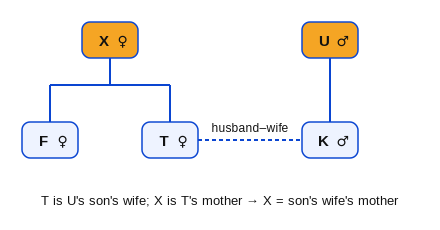
X is the mother of F. F is the sister of T. U is the father of K. K is the husband of T. How is X related to U?
X, F की माँ है। F, T की बहन है। U, K का पिता है। K, T का पति है। X, U से किस प्रकार संबंधित है?
  1. ASon's wife's motherपुत्र की पत्नी की माँ
  2. BMotherमाँ
  3. CDaughterपुत्री
  4. DSon's wife's sisterपुत्र की पत्नी की बहन
Show answer

Concept: Draw the family tree from U's side and find where X stands.

  1. U is the father of K; K is the husband of T → T is U's son's wife (daughter-in-law).
  2. F is the sister of T and X is the mother of F → X is also the mother of T.
  3. Therefore X is the mother of U's son's wife → son's wife's mother.

Trick: Siblings share parents – "mother of F" is automatically "mother of T".

Answer: (A) Son's wife's mother

अवधारणा: U की ओर से परिवार वृक्ष बनाएँ और X का स्थान देखें।

  1. U, K का पिता है; K, T का पति है → T, U के पुत्र की पत्नी (बहू) है।
  2. F, T की बहन है और X, F की माँ है → X, T की भी माँ है।
  3. अत: X, U के पुत्र की पत्नी की माँ है → पुत्र की पत्नी की माँ (समधिन)।

ट्रिक: भाई-बहन के माता-पिता समान होते हैं – "F की माँ" स्वत: "T की माँ" है।

उत्तर: (A) पुत्र की पत्नी की माँ

RRB NTPC Undergraduate CBT 1General Intelligence and ReasoningBlood relationsRRB NTPC Undergraduate CBT 1 2025 · 8 May Shift 1 →
Q14076.
Based on the English alphabetical order, three of the following four letter-cluster pairs are alike in a certain way and thus form a group. Which is the one that does not belong to that group?
(Note: The odd one out is not based on the number of consonants/vowels or their position in the letter-cluster.)
अंग्रेज़ी वर्णमाला क्रम के आधार पर, निम्नलिखित चार अक्षर-समूह युग्मों में से तीन किसी निश्चित प्रकार से एक समान हैं और इस प्रकार एक समूह बनाते हैं। वह कौन-सा है जो उस समूह से संबंधित नहीं है?
(नोट: असंगत युग्म अक्षर-समूह में व्यंजनों/स्वरों की संख्या या उनकी स्थिति पर आधारित नहीं है।)
  1. AAE - GK
  2. BDH - JN
  3. CKO - QV
  4. DHL - NR
Show answer

Concept: Find the jump from the first cluster to the second for each letter position.

  1. AE−GK : A→G (+6), E→K (+6). DH−JN : D→J (+6), H→N (+6). HL−NR : H→N (+6), L→R (+6).
  2. KO−QV : K→Q (+6) but O→V (+7) – not the same.

Trick: Within each cluster the two letters also differ by 4 (A–E, G–K …), but in QV they differ by 5 – a quick give-away.

Answer: (C) KO - QV

अवधारणा: हर अक्षर-स्थान के लिए पहले क्लस्टर से दूसरे तक का अंतर निकालें।

  1. AE−GK : A→G (+6), E→K (+6)। DH−JN : D→J (+6), H→N (+6)। HL−NR : H→N (+6), L→R (+6)।
  2. KO−QV : K→Q (+6) पर O→V (+7) – समान नहीं।

ट्रिक: हर क्लस्टर के भीतर भी दोनों अक्षरों में 4 का अंतर है (A–E, G–K …), पर QV में 5 – तुरंत पकड़ में आता है।

उत्तर: (C) KO - QV

RRB NTPC Undergraduate CBT 1General Intelligence and ReasoningLetter-cluster analogy (odd one out)RRB NTPC Undergraduate CBT 1 2025 · 8 May Shift 1 →
Q14077.
Based on the alphabetical order, three of the following four are alike in a certain way and thus form a group. Which is the one that does not belong to that group?
(Note: The odd man out is not based on the number of consonants/vowels or their position in the letter cluster.)
वर्णमाला क्रम के आधार पर, निम्नलिखित चार में से तीन किसी निश्चित प्रकार से एक समान हैं और इस प्रकार एक समूह बनाते हैं। वह कौन-सा है जो उस समूह से संबंधित नहीं है?
(नोट: असंगत अक्षर-समूह, अक्षर-समूह में व्यंजनों/स्वरों की संख्या या उनकी स्थिति पर आधारित नहीं है।)
  1. APNK
  2. BDAY
  3. COLJ
  4. DNKI
Show answer

Concept: Look at the gaps between consecutive letters inside each cluster (cyclic alphabet).

  1. DAY : D(4)→A(1) = −3, A(1)→Y(25) = −2 (going back past A). OLJ : 15→12 = −3, 12→10 = −2. NKI : 14→11 = −3, 11→9 = −2.
  2. PNK : P(16)→N(14) = −2, N(14)→K(11) = −3 – the order of the jumps is reversed.

Trick: Pattern (−3, −2) in three clusters; PNK is (−2, −3) → odd one out.

Answer: (A) PNK

अवधारणा: हर क्लस्टर के भीतर क्रमागत अक्षरों के अंतर देखें (वर्णमाला चक्रीय)।

  1. DAY : D(4)→A(1) = −3, A(1)→Y(25) = −2 (A से पीछे)। OLJ : 15→12 = −3, 12→10 = −2। NKI : 14→11 = −3, 11→9 = −2।
  2. PNK : P(16)→N(14) = −2, N(14)→K(11) = −3 – अंतरों का क्रम उल्टा है।

ट्रिक: तीन क्लस्टर में पैटर्न (−3, −2); PNK में (−2, −3) → विषम।

उत्तर: (A) PNK

RRB NTPC Undergraduate CBT 1General Intelligence and ReasoningLetter-cluster classificationRRB NTPC Undergraduate CBT 1 2025 · 8 May Shift 1 →
Q14078.
Each of the digits in the number 84157639 is arranged in ascending order from left to right. The position of how many digits will remain unchanged as compared to that in the original number?
संख्या 84157639 के प्रत्येक अंक को बाएँ से दाएँ आरोही क्रम में व्यवस्थित किया जाता है। मूल संख्या की तुलना में कितने अंकों की स्थिति अपरिवर्तित रहेगी?
  1. AOneएक
  2. BTwoदो
  3. CNoneकोई नहीं
  4. DThreeतीन
Show answer

Concept: Write the original and the ascending-order number one below the other and compare position by position.

  1. Original: 8 4 1 5 7 6 3 9.
  2. Ascending: 1 3 4 5 6 7 8 9.
  3. Position 4 (5 = 5) and position 8 (9 = 9) match; all others differ → two digits unchanged.

Trick: The largest digit at the right end (9) always stays – start counting from there.

Answer: (B) Two

अवधारणा: मूल संख्या और आरोही क्रम वाली संख्या को एक के नीचे एक लिखकर स्थान-दर-स्थान तुलना करें।

  1. मूल: 8 4 1 5 7 6 3 9।
  2. आरोही: 1 3 4 5 6 7 8 9।
  3. स्थान 4 (5 = 5) और स्थान 8 (9 = 9) मेल खाते हैं; बाकी बदल गए → दो अंक अपरिवर्तित।

ट्रिक: दाएँ सिरे पर सबसे बड़ा अंक (9) हमेशा वहीं रहता है – वहीं से गिनना शुरू करें।

उत्तर: (B) दो

RRB NTPC Undergraduate CBT 1General Intelligence and ReasoningDigit rearrangementRRB NTPC Undergraduate CBT 1 2025 · 8 May Shift 1 →
Q14079.
LM 5 is related to NL -14 in a certain way. In the same way, JK 9 is related to LJ -10. To which of the following is UV 11 related, following the same logic?
LM 5 किसी निश्चित प्रकार से NL -14 से संबंधित है। उसी प्रकार, JK 9, LJ -10 से संबंधित है। समान तर्क का अनुसरण करते हुए, UV 11 निम्नलिखित में से किससे संबंधित है?
  1. ANJ 9
  2. BGT 3
  3. CWU -8
  4. DYT -7
Show answer

Concept: Find separate rules for the two letters and the number from both given pairs.

  1. LM 5 → NL −14: L→N (+2), M→L (−1), 5→−14 i.e. 5−19=−14.
  2. JK 9 → LJ −10: J→L (+2), K→J (−1), 9−19=−10. Rule confirmed.
  3. UV 11: U+2 = W, V−1 = U, 11−19=−8 → WU −8.

Trick: Letters (+2, −1) and number −19; only one option starts with WU.

Answer: (C) WU -8

अवधारणा: दोनों दिए गए जोड़ों से दोनों अक्षरों और संख्या के नियम अलग-अलग निकालें।

  1. LM 5 → NL −14: L→N (+2), M→L (−1), 5→−14 अर्थात 5−19=−14।
  2. JK 9 → LJ −10: J→L (+2), K→J (−1), 9−19=−10। नियम पुष्ट।
  3. UV 11: U+2 = W, V−1 = U, 11−19=−8 → WU −8।

ट्रिक: अक्षर (+2, −1) और संख्या −19; केवल एक विकल्प WU से शुरू होता है।

उत्तर: (C) WU -8

RRB NTPC Undergraduate CBT 1General Intelligence and ReasoningLetter–number analogyRRB NTPC Undergraduate CBT 1 2025 · 8 May Shift 1 →
Q14080.
Which of the following letter-number clusters will replace the question mark (?) in the given series to make it logically complete?
HWR66 , MBW78 , RGB90 , WLG102 , ?
दी गई शृंखला को तार्किक रूप से पूर्ण करने के लिए निम्नलिखित में से कौन-सा अक्षर-संख्या समूह प्रश्नचिह्न (?) के स्थान पर आएगा?
HWR66 , MBW78 , RGB90 , WLG102 , ?
  1. ABOL114
  2. BBQM114
  3. CEQL114
  4. DBQL114
Show answer

Concept: Treat each letter position and the number as separate series.

  1. 1st letters H→M→R→W (+5 each) → next B (W+5 wraps past Z).
  2. 2nd letters W→B→G→L (+5) → Q; 3rd letters R→W→B→G (+5) → L.
  3. Numbers 66, 78, 90, 102 (+12) → 102+12=114. Term: BQL114.

Trick: Each new cluster is the previous one shifted by 5; the number rises by 12.

Answer: (D) BQL114

अवधारणा: हर अक्षर-स्थान और संख्या को अलग श्रृंखला मानें।

  1. पहले अक्षर H→M→R→W (हर बार +5) → अगला B (W+5, Z के बाद चक्र)।
  2. दूसरे अक्षर W→B→G→L (+5) → Q; तीसरे अक्षर R→W→B→G (+5) → L।
  3. संख्याएँ 66, 78, 90, 102 (+12) → 102+12=114। पद: BQL114।

ट्रिक: हर नया क्लस्टर पिछले से 5 आगे; संख्या 12 बढ़ती है।

उत्तर: (D) BQL114

RRB NTPC Undergraduate CBT 1General Intelligence and ReasoningLetter–number seriesRRB NTPC Undergraduate CBT 1 2025 · 8 May Shift 1 →