Question bank

Q&A: practice questions with answers

Search questions on any topic. Filter by exam category, exam, subject and topic, try the question, then open the answer and explanation.

Courses – airGurukul

20,719 questions found.

Q14161.
What will come in place of the question mark (?) in the following equation if ‘+’ and ‘−’ are interchanged and ‘×’ and ‘÷’ are interchanged?
215 − 147 ÷ 110 + 1604 × 4 = ?
यदि '+' और '−' को आपस में बदल दिया जाए तथा '×' और '÷' को आपस में बदल दिया जाए, तो निम्नलिखित समीकरण में प्रश्नचिह्न (?) के स्थान पर क्या आएगा?
215 − 147 ÷ 110 + 1604 × 4 = ?
  1. A18588
  2. B15984
  3. C14948
  4. D19584
Show answer

Concept: Swap the signs as instructed, then apply BODMAS.

  1. After interchanging: 215+147×110−1604÷4.
  2. 147×110=16170 and 1604÷4=401.
  3. 215+16170−401=15984.

Trick: Rewrite the whole expression with new signs first – never swap and calculate at the same time.

Answer: (B) 15984

अवधारणा: निर्देशानुसार चिह्न बदलें, फिर BODMAS लगाएँ।

  1. चिह्न बदलने पर: 215+147×110−1604÷4।
  2. 147×110=16170 और 1604÷4=401।
  3. 215+16170−401=15984।

ट्रिक: पहले पूरा व्यंजक नए चिह्नों से लिख लें – बदलना और गणना एक साथ न करें।

उत्तर: (B) 15984
RRB NTPC Undergraduate CBT 1General Intelligence and ReasoningMathematical OperationsRRB NTPC Undergraduate CBT 1 2025 · 7 May Shift 3 →
Q14162.
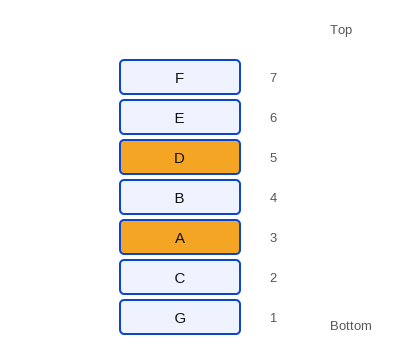
Seven boxes A, B, C, D, E, F and G are kept one over the other but not necessarily in the same order. Only two boxes are kept below A. Only one box is kept above E. Only one box is kept between E and B. C is kept immediately above G. D is kept at some place below F. How many boxes are kept between A and D?
सात बक्से A, B, C, D, E, F और G एक के ऊपर एक रखे गए हैं, लेकिन आवश्यक नहीं कि इसी क्रम में हों। A के नीचे केवल दो बक्से रखे हैं। E के ऊपर केवल एक बक्सा रखा है। E और B के बीच केवल एक बक्सा रखा है। C, G के ठीक ऊपर रखा है। D, F के नीचे किसी स्थान पर रखा है। A और D के बीच कितने बक्से रखे हैं?
  1. A3
  2. B1
  3. C2
  4. D4
Show answer

Concept: Number positions 1 (bottom) to 7 (top); fix the 'only' clues first.

  1. Two boxes below A → A = 3. One box above E → E = 6. One box between E and B → B = 4.
  2. Free places 1, 2, 5, 7 for C, D, F, G. C immediately above G needs consecutive places → G = 1, C = 2.
  3. D below F → D = 5, F = 7. Between A (3) and D (5) there is only B → 1 box.

Trick: Boxes between positions a and b =|a−b|−1=5−3−1=1.

Answer: (B) 1

अवधारणा: स्थान 1 (नीचे) से 7 (ऊपर) तक क्रमांकित करें; 'केवल' वाले संकेत पहले लगाएँ।

  1. A के नीचे दो बॉक्स → A = 3। E के ऊपर एक → E = 6। E और B के बीच एक → B = 4।
  2. खाली स्थान 1, 2, 5, 7 C, D, F, G के लिए। C ठीक G के ऊपर, लगातार स्थान चाहिए → G = 1, C = 2।
  3. D F के नीचे → D = 5, F = 7। A (3) और D (5) के बीच केवल B → 1 बॉक्स।

ट्रिक: स्थान a और b के बीच बॉक्स =|a−b|−1=5−3−1=1।

उत्तर: (B) 1

RRB NTPC Undergraduate CBT 1General Intelligence and ReasoningBox ArrangementRRB NTPC Undergraduate CBT 1 2025 · 7 May Shift 3 →
Q14163.
What should come in place of ‘?’ in the given series?
20 ? 38 56 80 110
दी गई श्रृंखला में '?' के स्थान पर क्या आना चाहिए?
20 ? 38 56 80 110
  1. A22
  2. B24
  3. C32
  4. D26
Show answer

Concept: When the unknown is early in the series, work out the differences from the known terms at the end.

  1. 110−80=30, 80−56=24, 56−38=18 → differences fall by 6 each step: next (earlier) differences are 12 and 6.
  2. ?=38−12=26; check: 26−20=6 ✓.
  3. Series: 20,26,38,56,80,110 with differences 6,12,18,24,30.

Trick: Differences that are multiples of one number (6,12,18,…) – spot the table of 6.

Answer: (D) 26

अवधारणा: जब अज्ञात पद शुरू में हो, तो अंत के ज्ञात पदों से अंतर निकालें।

  1. 110−80=30, 80−56=24, 56−38=18 → अंतर हर कदम 6 घटता है: पहले के अंतर 12 और 6।
  2. ?=38−12=26; जाँच: 26−20=6 ✓।
  3. श्रृंखला: 20,26,38,56,80,110, अंतर 6,12,18,24,30।

ट्रिक: अंतर एक ही संख्या के गुणज (6,12,18,…) – 6 का पहाड़ा पहचानें।

उत्तर: (D) 26

RRB NTPC Undergraduate CBT 1General Intelligence and ReasoningNumber SeriesRRB NTPC Undergraduate CBT 1 2025 · 7 May Shift 3 →
Q14164.
In the following number-pairs, the second number is obtained by applying certain mathematical operations to the first number. Select the set in which the numbers are related in the same way as are the numbers of the following sets.
(NOTE: Operations should be performed on the whole numbers, without breaking down the numbers into their constituent digits. E.g. 13 – Operations on 13 such as adding / subtracting / multiplying etc. to 13 can be performed. Breaking down 13 into 1 and 3 and then performing mathematical operations on 1 and 3 is not allowed.)
18, 325
19, 362
निम्नलिखित संख्या-युग्मों में, दूसरी संख्या पहली संख्या पर कुछ निश्चित गणितीय संक्रियाएँ करके प्राप्त की गई है। उस समुच्चय का चयन कीजिए जिसमें संख्याएँ उसी प्रकार संबंधित हैं जिस प्रकार निम्नलिखित समुच्चयों की संख्याएँ संबंधित हैं।
(नोट: संक्रियाएँ पूर्ण संख्याओं पर की जानी चाहिए, संख्याओं को उनके घटक अंकों में तोड़े बिना। उदाहरण के लिए 13 – 13 पर संक्रियाएँ जैसे 13 में जोड़ना / घटाना / गुणा करना आदि की जा सकती हैं। 13 को 1 और 3 में तोड़कर फिर 1 और 3 पर गणितीय संक्रियाएँ करने की अनुमति नहीं है।)
18, 325
19, 362
  1. A14, 196
  2. B21, 440
  3. C22, 485
  4. D20, 399
Show answer

Concept: Find one operation on the whole first number that gives the second in both given pairs.

  1. 182=324, 324+1=325 ✓; 192=361, 361+1=362 ✓. Rule: second = first2+1.
  2. Option C: 222+1=484+1=485 ✓.
  3. Others: 142+1=197≠196; 212+1=442≠440; 202+1=401≠399.

Trick: When the second number is close to a perfect square, test n2±k first.

Answer: (C) 22, 485

अवधारणा: पूरी पहली संख्या पर एक ऐसी संक्रिया खोजें जो दोनों दिए जोड़ों में दूसरी संख्या दे।

  1. 182=324, 324+1=325 ✓; 192=361, 361+1=362 ✓। नियम: दूसरी = पहली2+1।
  2. विकल्प C: 222+1=484+1=485 ✓।
  3. अन्य: 142+1=197≠196; 212+1=442≠440; 202+1=401≠399।

ट्रिक: दूसरी संख्या पूर्ण वर्ग के पास हो तो पहले n2±k जाँचें।

उत्तर: (C) 22, 485

RRB NTPC Undergraduate CBT 1General Intelligence and ReasoningNumber AnalogyRRB NTPC Undergraduate CBT 1 2025 · 7 May Shift 3 →
Q14165.
Each of the digits in the number 3147856 is arranged in ascending order from left to right. The position of how many digits will remain unchanged as compared to that in the original number?
संख्या 3147856 के प्रत्येक अंक को बाएँ से दाएँ आरोही क्रम में व्यवस्थित किया जाता है। मूल संख्या की तुलना में कितने अंकों की स्थिति अपरिवर्तित रहेगी?
  1. AOneएक
  2. BTwoदो
  3. CThreeतीन
  4. DNoneकोई नहीं
Show answer

Concept: Sort the digits in ascending order and compare position by position with the original.

  1. Original: 3 1 4 7 8 5 6; ascending: 1 3 4 5 6 7 8.
  2. Position-wise: 3→1, 1→3, 4→4, 7→5, 8→6, 5→7, 6→8.
  3. Only the digit 4 (third place) stays where it was.

Trick: Write the two rows one below the other and tick the matching columns.

Answer: (A) One

अवधारणा: अंकों को आरोही क्रम में लिखें और मूल संख्या से स्थान-दर-स्थान मिलाएँ।

  1. मूल: 3 1 4 7 8 5 6; आरोही: 1 3 4 5 6 7 8।
  2. स्थान-वार: 3→1, 1→3, 4→4, 7→5, 8→6, 5→7, 6→8।
  3. केवल अंक 4 (तीसरा स्थान) अपनी जगह रहता है।

ट्रिक: दोनों पंक्तियाँ एक के नीचे एक लिखकर मिलते स्तंभों पर टिक लगाएँ।

उत्तर: (A) One

RRB NTPC Undergraduate CBT 1General Intelligence and ReasoningDigit ArrangementRRB NTPC Undergraduate CBT 1 2025 · 7 May Shift 3 →
Q14166.
​Based on the English alphabetical order, three of the following four letter-clusters are alike in a certain way and thus form a group. Which is the one that DOES NOT belong to that group?
(Note: The odd one out is not based on the number of consonants/vowels or their position in the letter-cluster.)
अंग्रेज़ी वर्णमाला क्रम के आधार पर, निम्नलिखित चार अक्षर-समूहों में से तीन किसी निश्चित प्रकार से समान हैं और इस प्रकार एक समूह बनाते हैं। वह कौन-सा है जो उस समूह से संबंधित नहीं है?
(नोट: असंगत अक्षर-समूह व्यंजनों/स्वरों की संख्या या अक्षर-समूह में उनकी स्थिति पर आधारित नहीं है।)
  1. AGDH
  2. BDAF
  3. CMJN
  4. DJGK
Show answer

Concept: Check the gaps between the letters inside each cluster.

  1. GDH: G(7) → D(4) is −3, G → H is +1. MJN: −3,+1. JGK: −3,+1.
  2. DAF: D(4) → A(1) is −3, but D → F(6) is +2 – breaks the pattern.

Trick: Compare the first and third letters first – in three clusters they are neighbours (G-H, M-N, J-K); D-F are not.

Answer: (B) DAF

अवधारणा: हर समूह के भीतर अक्षरों के बीच का अंतर जाँचें।

  1. GDH: G(7) → D(4) = −3, G → H = +1। MJN: −3,+1। JGK: −3,+1।
  2. DAF: D(4) → A(1) = −3, पर D → F(6) = +2 – पैटर्न टूटता है।

ट्रिक: पहले और तीसरे अक्षर मिलाएँ – तीन समूहों में वे पड़ोसी हैं (G-H, M-N, J-K); D-F नहीं।

उत्तर: (B) DAF

RRB NTPC Undergraduate CBT 1General Intelligence and ReasoningLetter Cluster – Odd One OutRRB NTPC Undergraduate CBT 1 2025 · 7 May Shift 3 →
Q14167.
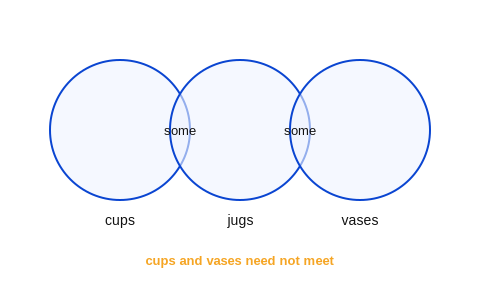
Read the given statements and conclusions carefully. You have to take the given statements to be true even if they seem to be at variance from commonly known facts. You have to decide which conclusions logically follow/s from the given statements. Statements: Some cups are jugs. Some jugs are vases.
Conclusion (I) : Some cups are vases
Conclusion (II) : All vases are jugs
दिए गए कथनों और निष्कर्षों को ध्यानपूर्वक पढ़िए। आपको दिए गए कथनों को सत्य मानना है, भले ही वे सामान्यतः ज्ञात तथ्यों से भिन्न प्रतीत होते हों। आपको यह निर्णय करना है कि दिए गए कथनों से कौन-सा/से निष्कर्ष तार्किक रूप से अनुसरण करता/करते है/हैं। कथन: कुछ कप, जग हैं। कुछ जग, फूलदान हैं।
निष्कर्ष (I) : कुछ कप, फूलदान हैं
निष्कर्ष (II) : सभी फूलदान, जग हैं
  1. ABoth conclusions (I) and (II) followनिष्कर्ष (I) और (II) दोनों अनुसरण करते हैं
  2. BOnly conclusion (I) followsकेवल निष्कर्ष (I) अनुसरण करता है
  3. CNeither conclusion (I) nor (II) followsन तो निष्कर्ष (I) और न ही (II) अनुसरण करता है
  4. DOnly conclusion (II) followsकेवल निष्कर्ष (II) अनुसरण करता है
Show answer

Concept: Two particular ('Some') premises never give a definite conclusion; draw the Venn diagram to confirm.

  1. Cups and jugs overlap, jugs and vases overlap – but cups and vases may or may not touch, so 'Some cups are vases' is not certain. (I) does not follow.
  2. 'All vases are jugs' is a universal claim; the premise only says some jugs are vases. (II) does not follow.

Trick: Some + Some = No conclusion; a 'Some' premise can never prove an 'All' conclusion.

Answer: (C) Neither conclusion (I) nor (II) follows

अवधारणा: दो 'कुछ' (Some) वाले कथन कभी निश्चित निष्कर्ष नहीं देते; Venn आरेख से पुष्टि करें।

  1. Cups और Jugs ओवरलैप, Jugs और Vases ओवरलैप – पर Cups और Vases का मिलना ज़रूरी नहीं, अतः 'कुछ cups vases हैं' निश्चित नहीं। (I) नहीं निकलता।
  2. 'सभी vases jugs हैं' सार्वभौमिक दावा है; कथन केवल कहता है कुछ jugs vases हैं। (II) नहीं निकलता।

ट्रिक: Some + Some = कोई निष्कर्ष नहीं; 'Some' कथन कभी 'All' निष्कर्ष सिद्ध नहीं कर सकता।

उत्तर: (C) Neither conclusion (I) nor (II) follows

RRB NTPC Undergraduate CBT 1General Intelligence and ReasoningSyllogismRRB NTPC Undergraduate CBT 1 2025 · 7 May Shift 3 →
Q14168.
IP 18 is related to KL 4 in a certain way. In the same way, KL 16 is related to MH 2. To which of the following is AT 9 related, following the same logic?
IP 18, KL 4 से किसी निश्चित प्रकार से संबंधित है। उसी प्रकार, KL 16, MH 2 से संबंधित है। समान तर्क का अनुसरण करते हुए, AT 9 निम्नलिखित में से किससे संबंधित है?
  1. ATR -1
  2. BBK -9
  3. CJO -6
  4. DCP -5
Show answer

Concept: Treat letters and the number separately and find the rule from both given pairs.

  1. IP 18 → KL 4: I+2 = K, P−4 = L, 18−14=4.
  2. KL 16 → MH 2: K+2 = M, L−4 = H, 16−14=2 – same rule.
  3. AT 9: A+2 = C, T−4 = P, 9−14=−5 → CP −5.

Trick: Verify the rule on the second pair before applying it – here the number rule is 'subtract 14', not 'divide'.

Answer: (D) CP -5

अवधारणा: अक्षरों और संख्या को अलग-अलग लेकर दोनों दिए जोड़ों से नियम निकालें।

  1. IP 18 → KL 4: I+2 = K, P−4 = L, 18−14=4।
  2. KL 16 → MH 2: K+2 = M, L−4 = H, 16−14=2 – वही नियम।
  3. AT 9: A+2 = C, T−4 = P, 9−14=−5 → CP −5।

ट्रिक: नियम को दूसरे जोड़े पर जाँचकर ही लगाएँ – यहाँ संख्या का नियम 'घटाओ 14' है, 'भाग' नहीं।

उत्तर: (D) CP -5

RRB NTPC Undergraduate CBT 1General Intelligence and ReasoningLetter-Number AnalogyRRB NTPC Undergraduate CBT 1 2025 · 7 May Shift 3 →
Q14169.
Read the given statement(s) and conclusions carefully. Assuming that the information given in the statements is true, even if it appears to be at variance with commonly known facts, decide which of the given conclusions logically follow(s) from the statement(s).
Statements:
Some papers are rains.
All rains are trees.
Conclusions:
(I) Some papers are trees.
(II) All trees are rains.
दिए गए कथन(नों) और निष्कर्षों को ध्यानपूर्वक पढ़िए। यह मानते हुए कि कथनों में दी गई जानकारी सत्य है, भले ही वह सामान्यतः ज्ञात तथ्यों से भिन्न प्रतीत होती हो, निर्णय कीजिए कि दिए गए निष्कर्षों में से कौन-सा/से कथन(नों) से तार्किक रूप से अनुसरण करता/करते है/हैं।
कथन:
कुछ कागज़, बारिशें हैं।
सभी बारिशें, पेड़ हैं।
निष्कर्ष:
(I) कुछ कागज़, पेड़ हैं।
(II) सभी पेड़, बारिशें हैं।
  1. ABoth conclusions (I) and (II) followनिष्कर्ष (I) और (II) दोनों अनुसरण करते हैं
  2. BOnly conclusion (II) followsकेवल निष्कर्ष (II) अनुसरण करता है
  3. CNeither conclusion (I) nor (II) followsन तो निष्कर्ष (I) और न ही (II) अनुसरण करता है
  4. DOnly conclusion (I) followsकेवल निष्कर्ष (I) अनुसरण करता है
Show answer

Concept: 'Some A are B' + 'All B are C' gives 'Some A are C'; the converse of 'All' is only 'Some'.

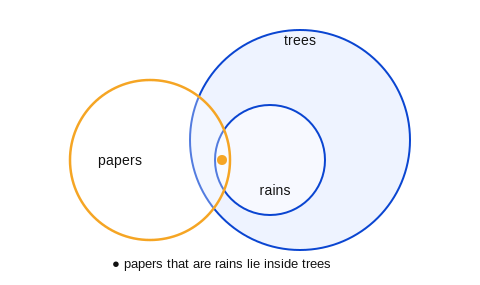
  1. The papers that are rains lie inside rains, and all rains lie inside trees → those papers are trees. (I) follows.
  2. 'All rains are trees' does not mean all trees are rains – trees may exist outside rains. (II) does not follow.

Trick: Some + All (middle term shared) = Some; reversing 'All A are B' gives only 'Some B are A'.

Answer: (D) Only conclusion (I) follows

अवधारणा: 'कुछ A, B हैं' + 'सभी B, C हैं' से 'कुछ A, C हैं' निकलता है; 'All' का विलोम केवल 'Some' होता है।

  1. जो papers rains हैं वे rains के अंदर हैं और सभी rains trees के अंदर → वे papers trees हैं। (I) निकलता है।
  2. 'सभी rains trees हैं' का अर्थ यह नहीं कि सभी trees rains हैं – trees rains के बाहर भी हो सकते हैं। (II) नहीं निकलता।

ट्रिक: Some + All (मध्य पद साझा) = Some; 'All A are B' को उलटने पर केवल 'Some B are A' मिलता है।

उत्तर: (D) Only conclusion (I) follows

RRB NTPC Undergraduate CBT 1General Intelligence and ReasoningSyllogismRRB NTPC Undergraduate CBT 1 2025 · 7 May Shift 3 →
Q14170.
In the following triad, each group of letters is related to the subsequent one following a certain logic. Select, from the given options, the one which follows the same logic. ROSE - RSEO - OSRE
JUGS - JGSU - UGJS
निम्नलिखित त्रिक (triad) में, अक्षरों का प्रत्येक समूह एक निश्चित तर्क के अनुसार अगले समूह से संबंधित है। दिए गए विकल्पों में से उसका चयन कीजिए जो समान तर्क का अनुसरण करता है। ROSE - RSEO - OSRE
JUGS - JGSU - UGJS
  1. APING - PNGI - INPG
  2. BLADY - LDYA - ALYD
  3. CCOLD - OCLD - OLDC
  4. DBOND - BNOD - DNOB
Show answer

Concept: Track the position numbers of letters at each step; the same position-shuffle must apply in the option.

  1. ROSE (1234) → RSEO = positions 1, 3, 4, 2. Then RSEO (1234) → OSRE = positions 4, 2, 1, 3. JUGS → JGSU (1,3,4,2) → UGJS (4,2,1,3) ✓.
  2. PING → positions 1,3,4,2 = P N G I ✓; PNGI → positions 4,2,1,3 = I N P G ✓.
  3. LADY → LDYA ✓ but 4,2,1,3 gives A D L Y, not ALYD; COLD and BOND fail at the first step.

Trick: Step 1 keeps the first letter fixed – options C and D are eliminated instantly.

Answer: (A) PING - PNGI - INPG

अवधारणा: हर चरण में अक्षरों की स्थिति-संख्या नोट करें; विकल्प में वही स्थिति-बदलाव लागू होना चाहिए।

  1. ROSE (1234) → RSEO = स्थितियाँ 1, 3, 4, 2। फिर RSEO (1234) → OSRE = स्थितियाँ 4, 2, 1, 3। JUGS → JGSU (1,3,4,2) → UGJS (4,2,1,3) ✓।
  2. PING → 1,3,4,2 = P N G I ✓; PNGI → 4,2,1,3 = I N P G ✓।
  3. LADY → LDYA ✓ पर 4,2,1,3 से A D L Y बनता है, ALYD नहीं; COLD और BOND पहले चरण में ही गलत।

ट्रिक: चरण 1 में पहला अक्षर अपनी जगह रहता है – विकल्प C और D तुरंत कट जाते हैं।

उत्तर: (A) PING - PNGI - INPG

RRB NTPC Undergraduate CBT 1General Intelligence and ReasoningLetter RearrangementRRB NTPC Undergraduate CBT 1 2025 · 7 May Shift 3 →
Q14171.
Based on the English alphabetical order, three of the following four are alike in a certain way and thus form a group. Which is the one that does not belong to that group? (Note: The odd man out is not based on the number of consonants/vowels or their position in the letter cluster.)
अंग्रेज़ी वर्णमाला क्रम के आधार पर, निम्नलिखित चार में से तीन किसी निश्चित प्रकार से समान हैं और इस प्रकार एक समूह बनाते हैं। वह कौन-सा है जो उस समूह से संबंधित नहीं है? (नोट: असंगत अक्षर-समूह व्यंजनों/स्वरों की संख्या या अक्षर-समूह में उनकी स्थिति पर आधारित नहीं है।)
  1. APMO
  2. BXTW
  3. CFBE
  4. DJFI
Show answer

Concept: Compare the gaps from the first letter to the other two letters in each cluster.

  1. XTW: X(24) → T(20) is −4, X → W(23) is −1. FBE: −4,−1. JFI: −4,−1.
  2. PMO: P(16) → M(13) is −3, P → O(15) is −1 – the first gap differs.

Trick: First letter minus 4 = second letter in three clusters (X-T, F-B, J-F); P-M is only 3 apart.

Answer: (A) PMO

अवधारणा: हर समूह में पहले अक्षर से बाकी दो अक्षरों तक का अंतर मिलाएँ।

  1. XTW: X(24) → T(20) = −4, X → W(23) = −1। FBE: −4,−1। JFI: −4,−1।
  2. PMO: P(16) → M(13) = −3, P → O(15) = −1 – पहला अंतर अलग है।

ट्रिक: तीन समूहों में पहला अक्षर −4 = दूसरा अक्षर (X-T, F-B, J-F); P-M में अंतर केवल 3।

उत्तर: (A) PMO

RRB NTPC Undergraduate CBT 1General Intelligence and ReasoningLetter Cluster – Odd One OutRRB NTPC Undergraduate CBT 1 2025 · 7 May Shift 3 →
Q14172.
Each of the digits in the number 3516472 is arranged in the ascending order from left to right. The position(s) of how many digits will remain unchanged as compared to that in the original number?
संख्या 3516472 के प्रत्येक अंक को बाएँ से दाएँ आरोही क्रम में व्यवस्थित किया जाता है। मूल संख्या की तुलना में कितने अंकों की स्थिति अपरिवर्तित रहेगी?
  1. ATwoदो
  2. BOneएक
  3. CThreeतीन
  4. DZeroशून्य
Show answer

Concept: Sort the digits in ascending order and compare each position with the original number.

  1. Original: 3 5 1 6 4 7 2; ascending: 1 2 3 4 5 6 7.
  2. Position-wise: 3→1, 5→2, 1→3, 6→4, 4→5, 7→6, 2→7 – no column matches.
  3. So zero digits keep their position.

Trick: With digits 1–7 the sorted number is always 1234567 – just check whether digit d sits at place d in the original.

Answer: (D) Zero

अवधारणा: अंकों को आरोही क्रम में लिखें और हर स्थान मूल संख्या से मिलाएँ।

  1. मूल: 3 5 1 6 4 7 2; आरोही: 1 2 3 4 5 6 7।
  2. स्थान-वार: 3→1, 5→2, 1→3, 6→4, 4→5, 7→6, 2→7 – कोई स्तंभ नहीं मिलता।
  3. अतः शून्य अंक अपनी जगह रहते हैं।

ट्रिक: अंक 1–7 हों तो क्रमबद्ध संख्या हमेशा 1234567 होती है – बस देखें कि मूल में अंक d स्थान d पर है या नहीं।

उत्तर: (D) Zero

RRB NTPC Undergraduate CBT 1General Intelligence and ReasoningDigit ArrangementRRB NTPC Undergraduate CBT 1 2025 · 7 May Shift 3 →
Q14173.
In a certain code language, ‘PRIME’ is coded as ‘37862’ and ‘REMAP’ is coded as ‘87423’. What is the code for ‘A’ in the given code language?
एक निश्चित कूट भाषा में, 'PRIME' को '37862' लिखा जाता है और 'REMAP' को '87423' लिखा जाता है। दी गई कूट भाषा में 'A' का कूट क्या है?
  1. A3
  2. B4
  3. C7
  4. D2
Show answer

Concept: Letters common to both words get the codes common to both; the leftover letter gets the leftover digit.

  1. PRIME = 37862 and REMAP = 87423 share the letters P, R, M, E and the digits 3, 7, 8, 2.
  2. In PRIME the extra letter is I → extra digit 6. In REMAP the extra letter is A → extra digit 4.

Trick: Cancel common letters against common digits – whatever remains is the answer.

Answer: (B) 4

अवधारणा: दोनों शब्दों में साझा अक्षरों को साझा कोड मिलते हैं; बचा अक्षर = बचा अंक।

  1. PRIME = 37862 और REMAP = 87423 में साझा अक्षर P, R, M, E और साझा अंक 3, 7, 8, 2 हैं।
  2. PRIME में अतिरिक्त अक्षर I → अतिरिक्त अंक 6। REMAP में अतिरिक्त अक्षर A → अतिरिक्त अंक 4।

ट्रिक: साझा अक्षरों को साझा अंकों से काट दें – जो बचे वही उत्तर।

उत्तर: (B) 4

RRB NTPC Undergraduate CBT 1General Intelligence and ReasoningCoding-DecodingRRB NTPC Undergraduate CBT 1 2025 · 7 May Shift 3 →
Q14174.
Select the triad which follows the same pattern as that followed by the two triads given below. Both triads follow the same pattern.
JL – MO – PR
EG – HJ – KM
उस त्रिक (triad) का चयन कीजिए जो नीचे दिए गए दो त्रिकों द्वारा अनुसरण किए गए पैटर्न का ही अनुसरण करता है। दोनों त्रिक समान पैटर्न का अनुसरण करते हैं।
JL – MO – PR
EG – HJ – KM
  1. ACH – GK – JO
  2. BDP – GS – JU
  3. CNF – RJ – TL
  4. DMO – PR – SU
Show answer

Concept: Find the pattern within each pair and between consecutive pairs.

  1. JL – MO – PR: inside each pair the gap is +2 (J→L, M→O, P→R); first letters J, M, P go +3. EG – HJ – KM: same (+2 inside, +3 across).
  2. MO – PR – SU: M→O +2, P→R +2, S→U +2; M, P, S go +3 ✓.
  3. CH, DP, NF have internal gaps of 5, 12, −8 – they fail at once.

Trick: Check the internal gap of the first pair only – three options are out in one look.

Answer: (D) MO – PR – SU

अवधारणा: हर जोड़े के भीतर और लगातार जोड़ों के बीच का पैटर्न खोजें।

  1. JL – MO – PR: हर जोड़े में अंतर +2 (J→L, M→O, P→R); पहले अक्षर J, M, P में +3। EG – HJ – KM: वही (+2 भीतर, +3 आगे)।
  2. MO – PR – SU: M→O +2, P→R +2, S→U +2; M, P, S में +3 ✓।
  3. CH, DP, NF के भीतरी अंतर 5, 12, −8 – तुरंत गलत।

ट्रिक: केवल पहले जोड़े का भीतरी अंतर देखें – तीन विकल्प एक नज़र में बाहर।

उत्तर: (D) MO – PR – SU

RRB NTPC Undergraduate CBT 1General Intelligence and ReasoningLetter Triad PatternRRB NTPC Undergraduate CBT 1 2025 · 7 May Shift 3 →
Q14175.
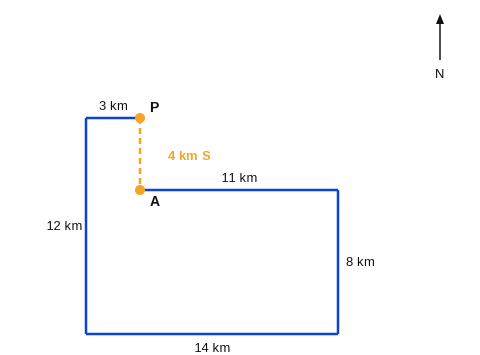
Neha starts from Point A and drives 11 km towards the east. She then takes a right turn, drives 8 km, turns right and drives 14 km. She then takes a right turn and drives 12 km. She takes a final right turn, drives 3 km and stops at Point P. How far (shortest distance) and towards which direction should she drive in order to reach Point A again? (All turns are 90-degree turns only unless specified.)
नेहा बिंदु A से चलना शुरू करती है और पूर्व की ओर 11 km गाड़ी चलाती है। फिर वह दाएँ मुड़ती है, 8 km चलती है, दाएँ मुड़ती है और 14 km चलती है। फिर वह दाएँ मुड़ती है और 12 km चलती है। अंत में वह दाएँ मुड़ती है, 3 km चलती है और बिंदु P पर रुक जाती है। बिंदु A पर पुनः पहुँचने के लिए उसे कितनी दूर (न्यूनतम दूरी) और किस दिशा में गाड़ी चलानी चाहिए? (जब तक अन्यथा न कहा जाए, सभी मोड़ केवल 90 डिग्री के हैं।)
  1. A4 km to the south4 km दक्षिण की ओर
  2. B2 km to the north2 km उत्तर की ओर
  3. C3 km to the south3 km दक्षिण की ओर
  4. D1 km to the north1 km उत्तर की ओर
Show answer

Concept: Take A as origin; a right turn from east → south → west → north → east. Track east-west and north-south totals separately.

  1. East 11 → right (south) 8 → right (west) 14 → right (north) 12 → right (east) 3.
  2. East-west: 11−14+3=0 km, so P is directly above/below A. North-south: −8+12=+4 km north.
  3. P is 4 km north of A, so she must drive 4 km south to reach A.

Trick: Net E–W =0 means the answer is purely north or south – just net the N–S legs.

Answer: (A) 4 km to the south

अवधारणा: A को मूल बिंदु लें; पूर्व से दायाँ मोड़ → दक्षिण → पश्चिम → उत्तर → पूर्व। पूर्व-पश्चिम और उत्तर-दक्षिण योग अलग-अलग रखें।

  1. पूर्व 11 → दायाँ (दक्षिण) 8 → दायाँ (पश्चिम) 14 → दायाँ (उत्तर) 12 → दायाँ (पूर्व) 3।
  2. पूर्व-पश्चिम: 11−14+3=0 km, अतः P ठीक A के ऊपर/नीचे है। उत्तर-दक्षिण: −8+12=+4 km उत्तर।
  3. P, A से 4 km उत्तर में है, अतः A पहुँचने के लिए 4 km दक्षिण चलना होगा।

ट्रिक: शुद्ध E–W =0 का मतलब उत्तर या दक्षिण ही उत्तर है – बस N–S भाग जोड़ें।

उत्तर: (A) 4 km to the south

RRB NTPC Undergraduate CBT 1General Intelligence and ReasoningDirection SenseRRB NTPC Undergraduate CBT 1 2025 · 7 May Shift 3 →
Q14176.
What should come in place of the question mark (?) in the given series to make it logically complete?
MU1, NQ4, PN16, SL64, ?
दी गई श्रृंखला को तार्किक रूप से पूर्ण करने के लिए प्रश्नचिह्न (?) के स्थान पर क्या आना चाहिए?
MU1, NQ4, PN16, SL64, ?
  1. ARJ256
  2. BSJ258
  3. CSK256
  4. DWK256
Show answer

Concept: Treat the first letter, second letter and number as three separate series.

  1. First letters M, N, P, S: +1,+2,+3 → next +4: S + 4 = W.
  2. Second letters U, Q, N, L: −4,−3,−2 → next −1: L − 1 = K.
  3. Numbers 1,4,16,64: ×4 → 256. Term = WK256.

Trick: Only option D starts with W – the first-letter series alone settles it.

Answer: (D) WK256

अवधारणा: पहला अक्षर, दूसरा अक्षर और संख्या – तीन अलग श्रृंखलाएँ मानें।

  1. पहले अक्षर M, N, P, S: +1,+2,+3 → अगला +4: S + 4 = W।
  2. दूसरे अक्षर U, Q, N, L: −4,−3,−2 → अगला −1: L − 1 = K।
  3. संख्याएँ 1,4,16,64: ×4 → 256। पद = WK256।

ट्रिक: केवल विकल्प D W से शुरू होता है – पहले अक्षर की श्रृंखला ही फैसला कर देती है।

उत्तर: (D) WK256

RRB NTPC Undergraduate CBT 1General Intelligence and ReasoningAlphanumeric SeriesRRB NTPC Undergraduate CBT 1 2025 · 7 May Shift 3 →
Q14177.
Each vowel in the word CURRENT is changed to the letter immediately following it in the English alphabetical order and each consonant is changed to the letter immediately preceding it in the English alphabetical order. Which of the following letters will be fourth from the left in the new group of letters thus formed?
शब्द CURRENT के प्रत्येक स्वर को अंग्रेज़ी वर्णमाला क्रम में उसके ठीक बाद वाले अक्षर में बदल दिया जाता है और प्रत्येक व्यंजन को अंग्रेज़ी वर्णमाला क्रम में उसके ठीक पहले वाले अक्षर में बदल दिया जाता है। इस प्रकार बने नए अक्षर-समूह में बाएँ से चौथा अक्षर निम्नलिखित में से कौन-सा होगा?
  1. AP
  2. BQ
  3. CR
  4. DS
Show answer

Concept: Vowels move one step forward, consonants one step back; then read the required position.

  1. CURRENT: C→B, U→V, R→Q, R→Q, E→F, N→M, T→S.
  2. New group: B V Q Q F M S.
  3. Fourth from the left = Q.

Trick: Only the 4th letter is asked – the 4th letter of CURRENT is R (consonant) → R − 1 = Q. No need to convert the whole word.

Answer: (B) Q

अवधारणा: स्वर एक कदम आगे, व्यंजन एक कदम पीछे; फिर माँगा गया स्थान पढ़ें।

  1. CURRENT: C→B, U→V, R→Q, R→Q, E→F, N→M, T→S।
  2. नया समूह: B V Q Q F M S।
  3. बाएँ से चौथा = Q।

ट्रिक: केवल चौथा अक्षर पूछा है – CURRENT का चौथा अक्षर R (व्यंजन) → R − 1 = Q। पूरा शब्द बदलने की ज़रूरत नहीं।

उत्तर: (B) Q

RRB NTPC Undergraduate CBT 1General Intelligence and ReasoningLetter CodingRRB NTPC Undergraduate CBT 1 2025 · 7 May Shift 3 →
Q14178.
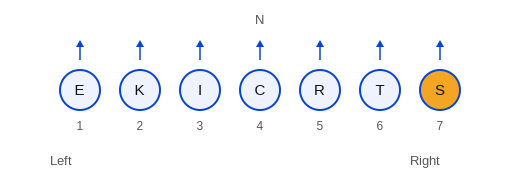
Seven people, S, T, I, C, K, E and R, are sitting in a row, facing north. Only E sits to the left of K. Only four people sit between E and T. Only C sits between I and R, and I is not an immediate neighbor of T. Who sits at the extreme right of the line?
सात व्यक्ति S, T, I, C, K, E और R एक पंक्ति में उत्तर की ओर मुख करके बैठे हैं। K के बाएँ केवल E बैठा है। E और T के बीच केवल चार व्यक्ति बैठे हैं। I और R के बीच केवल C बैठा है, और I, T का निकटतम पड़ोसी नहीं है। पंक्ति के सबसे दाएँ छोर पर कौन बैठा है?
  1. AS
  2. BE
  3. CK
  4. DI
Show answer

Concept: Number seats 1–7 from the left (all face north, so right = higher number).

  1. 'Only E sits to the left of K' → E = 1, K = 2. Four people between E and T → T = 6.
  2. I, C, R are consecutive with C in the middle; free seats 3, 4, 5, 7 → they take 3, 4, 5. I is not next to T (6) → I = 3, C = 4, R = 5.
  3. S takes the last seat, 7 – the extreme right.

Trick: 'Only X sits to the left of Y' pins X and Y to seats 1 and 2 – the strongest clue, start there.

Answer: (A) S

अवधारणा: बाएँ से सीटें 1–7 क्रमांकित करें (सब उत्तर की ओर, अतः दाएँ = बड़ी संख्या)।

  1. 'K के बाएँ केवल E बैठा है' → E = 1, K = 2। E और T के बीच चार लोग → T = 6।
  2. I, C, R लगातार हैं, C बीच में; खाली सीटें 3, 4, 5, 7 → वे 3, 4, 5 लेते हैं। I T (6) का पड़ोसी नहीं → I = 3, C = 4, R = 5।
  3. S अंतिम सीट 7 पर – दाएँ छोर।

ट्रिक: 'Y के बाएँ केवल X' X और Y को सीट 1 और 2 पर जड़ देता है – सबसे मज़बूत संकेत, वहीं से शुरू करें।

उत्तर: (A) S

RRB NTPC Undergraduate CBT 1General Intelligence and ReasoningLinear Seating ArrangementRRB NTPC Undergraduate CBT 1 2025 · 7 May Shift 3 →
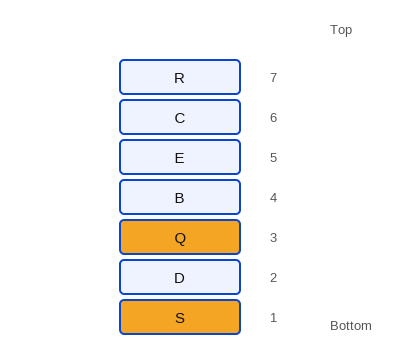
Q14179.
Seven boxes B, C, D, E, Q, R and S are kept one over the other but not necessarily in the same order. Only five boxes are kept above D. Only three boxes are kept between D and C. Only four boxes are kept between C and S. Only E is kept between C and B. R is kept at one of the positions above C. How many boxes are kept between Q and S?
सात बक्से B, C, D, E, Q, R और S एक के ऊपर एक रखे गए हैं, लेकिन आवश्यक नहीं कि इसी क्रम में हों। D के ऊपर केवल पाँच बक्से रखे हैं। D और C के बीच केवल तीन बक्से रखे हैं। C और S के बीच केवल चार बक्से रखे हैं। C और B के बीच केवल E रखा है। R, C के ऊपर किसी एक स्थान पर रखा है। Q और S के बीच कितने बक्से रखे हैं?
  1. AThreeतीन
  2. BOneएक
  3. CFourचार
  4. DTwoदो
Show answer

Concept: Number positions 1 (bottom) to 7 (top) and convert each 'between' clue into a distance.

  1. Five boxes above D → D = 2. Three between D and C → C = 6. Four between C and S → S = 1.
  2. Only E between C and B → B = 4, E = 5 (B = 8 is impossible). R above C → R = 7.
  3. Q takes the last place, 3. Between Q (3) and S (1) there is only D → one box.

Trick: 'n boxes between' = distance n+1; choose the side that stays within 1–7.

Answer: (B) One

अवधारणा: स्थान 1 (नीचे) से 7 (ऊपर) तक क्रमांकित करें और हर 'बीच में' संकेत को दूरी में बदलें।

  1. D के ऊपर पाँच बॉक्स → D = 2। D और C के बीच तीन → C = 6। C और S के बीच चार → S = 1।
  2. C और B के बीच केवल E → B = 4, E = 5 (B = 8 संभव नहीं)। R C के ऊपर → R = 7।
  3. Q अंतिम स्थान 3 पर। Q (3) और S (1) के बीच केवल D → एक बॉक्स।

ट्रिक: 'n बॉक्स बीच में' = दूरी n+1; वही दिशा चुनें जो 1–7 के भीतर रहे।

उत्तर: (B) One

RRB NTPC Undergraduate CBT 1General Intelligence and ReasoningBox ArrangementRRB NTPC Undergraduate CBT 1 2025 · 7 May Shift 3 →
Q14180.
In a certain code language,
A + B means ‘A is the son of B’,
A – B means ‘A is the brother of B’,
A x B means ‘A is the wife of B’ and
A ÷ B means ‘A is the father of B’.
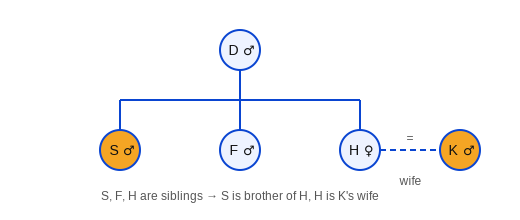
Based on the above, how is S related to K if ‘S + D ÷ F – H x K’?
एक निश्चित कूट भाषा में,
A + B का अर्थ है 'A, B का पुत्र है',
A – B का अर्थ है 'A, B का भाई है',
A x B का अर्थ है 'A, B की पत्नी है' और
A ÷ B का अर्थ है 'A, B का पिता है'।
उपरोक्त के आधार पर, यदि 'S + D ÷ F – H x K' है, तो S, K से किस प्रकार संबंधित है?
  1. AWife's brotherपत्नी का भाई
  2. BFatherपिता
  3. CBrotherभाई
  4. DWife's fatherपत्नी का पिता
Show answer

Concept: Decode the expression pair by pair, then build the family tree.

  1. S + D: S is the son of D. D ÷ F: D is the father of F → S and F are siblings. F – H: F is the brother of H → H is also D's child, so S is H's brother.
  2. H × K: H is the wife of K.
  3. So S is the brother of K's wife → K's wife's brother (brother-in-law).

Trick: Gender from the code: 'son', 'brother' make S, F male; 'wife' makes H female – then the relation reads off the tree.

Answer: (A) Wife's brother

अवधारणा: व्यंजक को जोड़ी-जोड़ी खोलें, फिर वंश-वृक्ष बनाएँ।

  1. S + D: S, D का पुत्र। D ÷ F: D, F का पिता → S और F भाई-बहन। F – H: F, H का भाई → H भी D की संतान, अतः S, H का भाई।
  2. H × K: H, K की पत्नी।
  3. अतः S, K की पत्नी का भाई → साला (wife's brother)।

ट्रिक: कोड से लिंग: 'पुत्र', 'भाई' से S, F पुरुष; 'पत्नी' से H स्त्री – फिर संबंध वृक्ष से सीधे पढ़ें।

उत्तर: (A) Wife's brother

RRB NTPC Undergraduate CBT 1General Intelligence and ReasoningBlood RelationsRRB NTPC Undergraduate CBT 1 2025 · 7 May Shift 3 →