Question bank

Q&A: practice questions with answers

Search questions on any topic. Filter by exam category, exam, subject and topic, try the question, then open the answer and explanation.

Courses – airGurukul

20,719 questions found.

Q14241.
A retailer buys 60 pens and sells them at the purchase price of 72 pens. Determine his profit percentage.
एक खुदरा विक्रेता 60 पेन खरीदता है और उन्हें 72 पेन के क्रय मूल्य पर बेच देता है। उसका लाभ प्रतिशत ज्ञात कीजिए।
  1. A12%
  2. B15%
  3. C16%
  4. D20%
Show answer

Concept: When SP of m articles = CP of n articles, profit%=n−mm×100.

  1. CP of 60 pens is recovered as CP of 72 pens: gain =72−60=12 pens
  2. Profit%=1260×100=20%

Trick: Profit is always on cost: 1260, not 1272 (which gives the wrong 16.67%).

Answer: (D) 20%

अवधारणा: जब m वस्तुओं का SP = n वस्तुओं का CP, तो लाभ%=n−mm×100।

  1. 60 पेनों की लागत के बदले 72 पेनों की लागत मिली: लाभ =72−60=12 पेन
  2. लाभ%=1260×100=20%

ट्रिक: लाभ सदैव लागत पर: 1260, न कि 1272 (जो गलत 16.67% देता है)।

उत्तर: (D) 20%

RRB NTPC Undergraduate CBT 1MathematicsProfit and LossRRB NTPC Undergraduate CBT 1 2025 · 7 May Shift 2 →
Q14242.
A transaction code 92419 is not divisible by 13. To make it divisible by 13, the least digit should be appended at the end of the number. What is that digit?
एक लेन-देन कोड 92419, 13 से विभाज्य नहीं है। इसे 13 से विभाज्य बनाने के लिए संख्या के अंत में सबसे छोटा कौन-सा अंक जोड़ा जाना चाहिए? वह अंक क्या है?
  1. A6
  2. B2
  3. C5
  4. D4
Show answer

Concept: Appending digit d gives 92419×10+d=924190+d; find the remainder of 924190 on division by 13.

  1. 924190÷13: 13×71091=924183, remainder =7
  2. Need 7+d divisible by 13 ⇒d=6
  3. 924196=13×71092 ✓

Trick: Remainder r after appending ⇒ digit =13−r (if r≠0).

Answer: (A) 6

अवधारणा: अंक d जोड़ने पर संख्या 92419×10+d=924190+d; 924190 को 13 से भाग देने पर शेष निकालें।

  1. 924190÷13: 13×71091=924183, शेष =7
  2. 7+d को 13 से विभाज्य होना चाहिए ⇒d=6
  3. 924196=13×71092 ✓

ट्रिक: अंक जोड़ने के बाद शेष r हो तो अंक =13−r (r≠0 पर)।

उत्तर: (A) 6

RRB NTPC Undergraduate CBT 1MathematicsDivisibility by 13RRB NTPC Undergraduate CBT 1 2025 · 7 May Shift 2 →
Q14243.
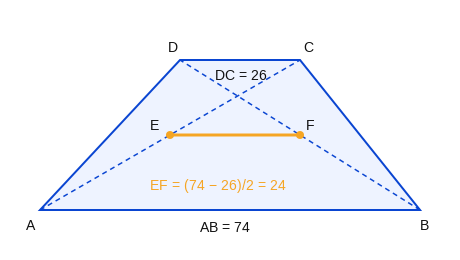
ABCD is a quadrilateral in which AB ∥ DC, and E and F are the mid points of the diagonals AC and BD, respectively. If AB = 74 cm, BC = 91 cm, DC = 26 cm, and AD = 39 cm, then what is the length (in cm) of EF?
ABCD एक चतुर्भुज है जिसमें AB ∥ DC है, और E तथा F क्रमशः विकर्णों AC और BD के मध्य-बिंदु हैं। यदि AB = 74 cm, BC = 91 cm, DC = 26 cm और AD = 39 cm है, तो EF की लंबाई (cm में) क्या है?
  1. A25
  2. B22
  3. C21
  4. D24
Show answer

Concept: In a trapezium with parallel sides a and b, the segment joining the midpoints of the diagonals is parallel to them and equals a−b2.

  1. AB=74, DC=26 (parallel sides)
  2. EF=74−262=482=24 cm
  3. The sides BC=91 and AD=39 are not needed.

Trick: Midpoints of non-parallel sides →a+b2; midpoints of diagonals →a−b2.

Answer: (D) 24

अवधारणा: समलंब में समांतर भुजाएँ a और b हों तो विकर्णों के मध्यबिंदुओं को मिलाने वाला खंड उनके समांतर और a−b2 के बराबर होता है।

  1. AB=74, DC=26 (समांतर भुजाएँ)
  2. EF=74−262=482=24 cm
  3. भुजाएँ BC=91 और AD=39 की आवश्यकता नहीं।

ट्रिक: असमांतर भुजाओं के मध्यबिंदु →a+b2; विकर्णों के मध्यबिंदु →a−b2।

उत्तर: (D) 24

RRB NTPC Undergraduate CBT 1MathematicsTrapezium – Midpoints of DiagonalsRRB NTPC Undergraduate CBT 1 2025 · 7 May Shift 2 →
Q14244.
A train runs at 72 km/h for 3 hours and then at 60 km/h for 1.5 hours. What is the average speed of the train?
एक रेलगाड़ी 3 घंटे तक 72 km/h की चाल से और फिर 1.5 घंटे तक 60 km/h की चाल से चलती है। रेलगाड़ी की औसत चाल क्या है?
  1. A65 km/h
  2. B66 km/h
  3. C68 km/h
  4. D67 km/h
Show answer

Concept: Average speed =total distancetotal time.

  1. Distance =72×3+60×1.5=216+90=306 km
  2. Time =3+1.5=4.5 h
  3. Average speed =3064.5=68 km/h

Trick: Weighted by time 3:1.5=2:1: 2×72+603=68.

Answer: (C) 68 km/h

अवधारणा: औसत चाल =कुल दूरीकुल समय।

  1. दूरी =72×3+60×1.5=216+90=306 km
  2. समय =3+1.5=4.5 h
  3. औसत चाल =3064.5=68 km/h

ट्रिक: समय के भार 3:1.5=2:1 से: 2×72+603=68।

उत्तर: (C) 68 km/h

RRB NTPC Undergraduate CBT 1MathematicsAverage SpeedRRB NTPC Undergraduate CBT 1 2025 · 7 May Shift 2 →
Q14245.
If the principal is ₹1000, the rate is 5% per annum, and the time is 2 years, what is the simple interest?
यदि मूलधन ₹1000, दर 5% वार्षिक और समय 2 वर्ष है, तो साधारण ब्याज क्या है?
  1. A₹100
  2. B₹200
  3. C₹50
  4. D₹500
Show answer

Concept: SI=P×R×T100.

  1. SI=1000×5×2100=100

Trick: 5% of 1000 is 50 per year; two years give ₹100.

Answer: (A) ₹100

अवधारणा: SI=P×R×T100।

  1. SI=1000×5×2100=100

ट्रिक: 1000 का 5% = 50 प्रति वर्ष; दो वर्ष में ₹100।

उत्तर: (A) ₹100

RRB NTPC Undergraduate CBT 1MathematicsSimple InterestRRB NTPC Undergraduate CBT 1 2025 · 7 May Shift 2 →
Q14246.
If 5 and 10 are given, what is the third proportional to these numbers?
यदि 5 और 10 दिए गए हैं, तो इन संख्याओं का तृतीयानुपाती (third proportional) क्या है?
  1. A30
  2. B15
  3. C25
  4. D20
Show answer

Concept: Third proportional to a and b is c with a:b=b:c, i.e. c=b2a.

  1. c=1025=1005=20

Trick: 5→10 is doubling, so 10→20.

Answer: (D) 20

अवधारणा: a और b का तृतीयानुपाती c है जहाँ a:b=b:c, अर्थात c=b2a।

  1. c=1025=1005=20

ट्रिक: 5→10 दुगुना है, अतः 10→20।

उत्तर: (D) 20

RRB NTPC Undergraduate CBT 1MathematicsThird ProportionalRRB NTPC Undergraduate CBT 1 2025 · 7 May Shift 2 →
Q14247.
Evaluate 243 + (-7)3 + (-17)3
243 + (-7)3 + (-17)3 का मान ज्ञात कीजिए
  1. A8345
  2. B8396
  3. C8450
  4. D8568
Show answer

Concept: If a+b+c=0, then a3+b3+c3=3abc.

  1. 24+(−7)+(−17)=0
  2. 3abc=3×24×(−7)×(−17)=3×24×119
  3. =72×119=8568

Trick: Check the sum first – if zero, never cube the numbers.

Answer: (D) 8568

अवधारणा: यदि a+b+c=0, तो a3+b3+c3=3abc।

  1. 24+(−7)+(−17)=0
  2. 3abc=3×24×(−7)×(−17)=3×24×119
  3. =72×119=8568

ट्रिक: पहले योग जाँचें – शून्य हो तो घन निकालने की ज़रूरत नहीं।

उत्तर: (D) 8568

RRB NTPC Undergraduate CBT 1MathematicsAlgebraic Identity (a³+b³+c³)RRB NTPC Undergraduate CBT 1 2025 · 7 May Shift 2 →
Q14248.
Trains from Delhi, Lucknow, and Jaipur depart every 12 minutes, 18 minutes, and 27 minutes, respectively. If all depart together at 6:00 am, when will they depart together again?
दिल्ली, लखनऊ और जयपुर से रेलगाड़ियाँ क्रमशः प्रत्येक 12 मिनट, 18 मिनट और 27 मिनट पर रवाना होती हैं। यदि सभी सुबह 6:00 बजे एक साथ रवाना होती हैं, तो वे पुनः एक साथ कब रवाना होंगी?
  1. A7:40 amसुबह 7:40 बजे
  2. B7:36 amसुबह 7:36 बजे
  3. C7:48 amसुबह 7:48 बजे
  4. D7:24 amसुबह 7:24 बजे
Show answer

Concept: They depart together again after the LCM of the intervals.

  1. 12=22×3, 18=2×32, 27=33
  2. LCM =22×33=108 min =1 h 48 min
  3. 6:00+1:48=7:48 am

Trick: LCM must be a multiple of 27 and 4: 108.

Answer: (C) 7:48 am

अवधारणा: अंतरालों के ल.स. के बाद वे फिर एक साथ छूटेंगी।

  1. 12=22×3, 18=2×32, 27=33
  2. ल.स. =22×33=108 मिनट =1 घं. 48 मि.
  3. 6:00+1:48=7:48 am

ट्रिक: ल.स. 27 और 4 दोनों का गुणज होना चाहिए: 108।

उत्तर: (C) 7:48 am

RRB NTPC Undergraduate CBT 1MathematicsLCM – Time IntervalsRRB NTPC Undergraduate CBT 1 2025 · 7 May Shift 2 →
Q14249.
The sum of two numbers is 72. If the larger number is increased by 8 and the smaller number is decreased by 6, then the resulting numbers are in the ratio 3 : 2, respectively. Find the smaller of the original two numbers.
दो संख्याओं का योग 72 है। यदि बड़ी संख्या में 8 की वृद्धि की जाए और छोटी संख्या में 6 की कमी की जाए, तो परिणामी संख्याएँ क्रमशः 3 : 2 के अनुपात में हो जाती हैं। मूल दो संख्याओं में से छोटी संख्या ज्ञात कीजिए।
  1. A35.6
  2. B32.5
  3. C34.2
  4. D35
Show answer

Concept: Let the numbers be L and S with L+S=72; set up the ratio equation.

  1. L+8S−6=32⇒2L+16=3S−18
  2. Put L=72−S: 144−2S+16=3S−18⇒5S=178
  3. S=35.6

Trick: Total after change =72+8−6=74; smaller changed =25×74=29.6, so S=29.6+6=35.6.

Answer: (A) 35.6

अवधारणा: संख्याएँ L और S, L+S=72; अनुपात समीकरण बनाएँ।

  1. L+8S−6=32⇒2L+16=3S−18
  2. L=72−S रखें: 144−2S+16=3S−18⇒5S=178
  3. S=35.6

ट्रिक: परिवर्तन के बाद योग =72+8−6=74; छोटी नई संख्या =25×74=29.6, अतः S=29.6+6=35.6।

उत्तर: (A) 35.6

RRB NTPC Undergraduate CBT 1MathematicsRatio – Linear EquationsRRB NTPC Undergraduate CBT 1 2025 · 7 May Shift 2 →
Q14250.
If 40% of a number exceeds 25% of it by 36, then the number is:
यदि किसी संख्या का 40%, उसके 25% से 36 अधिक है, तो वह संख्या है:
  1. A240
  2. B280
  3. C220
  4. D260
Show answer

Concept: Difference of percentages of the same number equals a percentage of it.

  1. 40%−25%=15% of the number =36
  2. Number =36×10015=240

Trick: 15%→36, so 5%→12 and 100%→240.

Answer: (A) 240

अवधारणा: एक ही संख्या के प्रतिशतों का अंतर भी उसी का प्रतिशत होता है।

  1. 40%−25%=15% संख्या का =36
  2. संख्या =36×10015=240

ट्रिक: 15%→36, अतः 5%→12 और 100%→240।

उत्तर: (A) 240

RRB NTPC Undergraduate CBT 1MathematicsPercentageRRB NTPC Undergraduate CBT 1 2025 · 7 May Shift 2 →
Q14251.
A shopkeeper offers the following schemes on toys of the same marked price. (A) Successive discounts of 44% and 12% on any number of toys bought.
(B) Successive discounts of 18%, 43% and 23% on any number of toys bought. (C) 8% discount on the first 4 toys and 38% discount on each toy thereon.
(D) On buying ten items, the customer is billed for only seven items.
A customer wants to buy 10 toys. Which of the above schemes is the least beneficial to her?
एक दुकानदार समान अंकित मूल्य वाले खिलौनों पर निम्नलिखित योजनाएँ प्रस्तुत करता है। (A) खरीदे गए किसी भी संख्या के खिलौनों पर 44% और 12% की क्रमिक छूट।
(B) खरीदे गए किसी भी संख्या के खिलौनों पर 18%, 43% और 23% की क्रमिक छूट। (C) पहले 4 खिलौनों पर 8% की छूट और उसके बाद प्रत्येक खिलौने पर 38% की छूट।
(D) दस वस्तुएँ खरीदने पर ग्राहक से केवल सात वस्तुओं का बिल लिया जाता है।
एक ग्राहक 10 खिलौने खरीदना चाहती है। उपरोक्त योजनाओं में से कौन-सी उसके लिए सबसे कम लाभकारी है?
  1. AB
  2. BA
  3. CC
  4. DD
Show answer

Concept: Compute the fraction of marked price actually paid for 10 toys; the scheme with the highest payment is least beneficial.

  1. (A) 0.56×0.88=0.4928→ pays 49.3%
  2. (B) 0.82×0.57×0.77≈0.36→ pays 36%
  3. (C) 4×0.92+6×0.6210=3.68+3.7210=0.74→ pays 74%
  4. (D) pays for 7 of 10 →70%

Trick: Only (C) and (D) are close; 74%>70%, so (C) costs the most.

Answer: (C) C

अवधारणा: 10 खिलौनों के लिए अंकित मूल्य का वास्तव में चुकाया भाग निकालें; जिसमें सबसे अधिक भुगतान, वह सबसे कम लाभदायक।

  1. (A) 0.56×0.88=0.4928→ भुगतान 49.3%
  2. (B) 0.82×0.57×0.77≈0.36→ भुगतान 36%
  3. (C) 4×0.92+6×0.6210=3.68+3.7210=0.74→ भुगतान 74%
  4. (D) 10 में से 7 का भुगतान →70%

ट्रिक: केवल (C) और (D) पास-पास हैं; 74%>70%, अतः (C) सबसे महँगी।

उत्तर: (C) C

RRB NTPC Undergraduate CBT 1MathematicsComparing Discount SchemesRRB NTPC Undergraduate CBT 1 2025 · 7 May Shift 2 →
Q14252.
The average of k numbers is x. If 48 is subtracted from each of any two of the numbers, then we get (x-12) as the new average. Find the value of k.
k संख्याओं का औसत x है। यदि इनमें से किन्हीं दो संख्याओं में से प्रत्येक में से 48 घटा दिया जाए, तो नया औसत (x-12) प्राप्त होता है। k का मान ज्ञात कीजिए।
  1. A8
  2. B10
  3. C3
  4. D5
Show answer

Concept: Decrease in average =total decreasek.

  1. Total decrease =48×2=96
  2. New average =x−12⇒96k=12
  3. k=8

Trick: Average falls by 12 while sum falls by 96 ⇒96÷12=8 numbers.

Answer: (A) 8

अवधारणा: औसत में कमी =कुल कमीk।

  1. कुल कमी =48×2=96
  2. नया औसत =x−12⇒96k=12
  3. k=8

ट्रिक: योग 96 घटा और औसत 12 घटा ⇒96÷12=8 संख्याएँ।

उत्तर: (A) 8

RRB NTPC Undergraduate CBT 1MathematicsAverage – Change in SumRRB NTPC Undergraduate CBT 1 2025 · 7 May Shift 2 →
Q14253.
The speeds of two cars are in the ratio 5 : 7. The faster car covers 140 km in 2 hours. How much distance will the slower car cover in the same time?
दो कारों की चालों का अनुपात 5 : 7 है। तेज़ कार 2 घंटे में 140 km की दूरी तय करती है। धीमी कार उतने ही समय में कितनी दूरी तय करेगी?
  1. A140 km
  2. B90 km
  3. C100 km
  4. D70 km
Show answer

Concept: In equal time, distance ∝ speed.

  1. Faster car: 140 km corresponds to ratio part 7, so one part =20 km
  2. Slower car: 5×20=100 km

Trick: Distances in the same time are in the ratio 5:7 directly.

Answer: (C) 100 km

अवधारणा: समान समय में दूरी ∝ चाल।

  1. तेज़ कार: 140 km अनुपात के 7 भाग, अतः एक भाग =20 km
  2. धीमी कार: 5×20=100 km

ट्रिक: समान समय में दूरियाँ सीधे 5:7 के अनुपात में।

उत्तर: (C) 100 km

RRB NTPC Undergraduate CBT 1MathematicsRatio of SpeedsRRB NTPC Undergraduate CBT 1 2025 · 7 May Shift 2 →
Q14254.
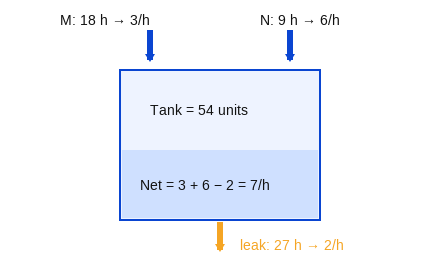
A tank is being filled by two taps, M and N. M fills the tank completely in 18 hours and N fills it in 9 hours. A leakage at the bottom of the tank can empty the completely filled tank in 27 hours. How long will it take to fill the empty tank completely if both taps are opened while the leakage continues?
एक टंकी को दो नलों, M और N, द्वारा भरा जा रहा है। M टंकी को 18 घंटे में पूरी तरह भरता है और N इसे 9 घंटे में भरता है। टंकी के तल में एक रिसाव पूरी भरी हुई टंकी को 27 घंटे में खाली कर सकता है। यदि रिसाव जारी रहते हुए दोनों नल खोल दिए जाएँ, तो खाली टंकी को पूरी तरह भरने में कितना समय लगेगा?
  1. A647 hours647 घंटे
  2. B757 hours757 घंटे
  3. C657 hours657 घंटे
  4. D737 hours737 घंटे
Show answer

Concept: Take tank capacity = LCM of times as units; add inlet rates, subtract the leak.

  1. Capacity =LCM(18,9,27)=54 units
  2. M =3/h, N =6/h, leak =−2/h; net =3+6−2=7/h
  3. Time =547=757 hours

Trick: Without the leak it takes 6 h; the leak slows it, so the answer must exceed 6 h – rules out nothing but confirms direction.

Answer: (B) 757 hours

अवधारणा: टंकी की क्षमता = समयों का ल.स. इकाई मानें; भरने की दरें जोड़ें, रिसाव घटाएँ।

  1. क्षमता =ल.स.(18,9,27)=54 इकाई
  2. M =3/h, N =6/h, रिसाव =−2/h; शुद्ध =3+6−2=7/h
  3. समय =547=757 घंटे

ट्रिक: बिना रिसाव 6 घंटे लगते; रिसाव से समय बढ़ेगा, अतः उत्तर 6 घंटे से अधिक होना चाहिए।

उत्तर: (B) 757 hours

RRB NTPC Undergraduate CBT 1MathematicsPipes and Cisterns – LeakRRB NTPC Undergraduate CBT 1 2025 · 7 May Shift 2 →
Q14255.
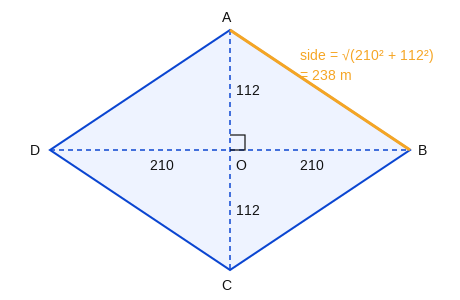
The diagonals of a rhombus-shaped field are 224 m and 420 m long. What is the perimeter (in m) of the field?
एक समचतुर्भुजाकार खेत के विकर्ण 224 m और 420 m लंबे हैं। खेत का परिमाप (m में) क्या है?
  1. A952
  2. B922
  3. C904
  4. D944
Show answer

Concept: Diagonals of a rhombus bisect each other at right angles; side =(d12)2+(d22)2.

  1. Half-diagonals =112 m and 210 m
  2. Side =1122+2102=12544+44100=56644=238 m
  3. Perimeter =4×238=952 m

Trick: 112:210=8:15, a Pythagorean triplet (8,15,17) scaled by 14 ⇒ side =17×14=238.

Answer: (A) 952

अवधारणा: समचतुर्भुज के विकर्ण एक-दूसरे को समकोण पर समद्विभाजित करते हैं; भुजा =(d12)2+(d22)2।

  1. अर्ध-विकर्ण =112 m और 210 m
  2. भुजा =1122+2102=12544+44100=56644=238 m
  3. परिमाप =4×238=952 m

ट्रिक: 112:210=8:15, पाइथागोरस त्रिक (8,15,17) का 14 गुना ⇒ भुजा =17×14=238।

उत्तर: (A) 952

RRB NTPC Undergraduate CBT 1MathematicsRhombus – PerimeterRRB NTPC Undergraduate CBT 1 2025 · 7 May Shift 2 →
Q14256.
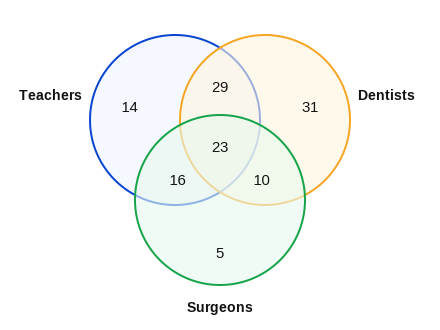
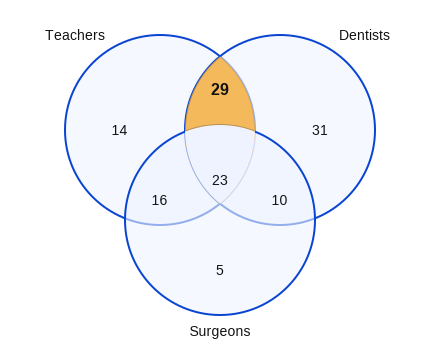
Study the given diagram carefully and answer the question. The numbers in different sections indicate the number of persons. (NOTE: You have to take the given data to be true even if it seems to be at variance from commonly known facts.)
How many such Teachers are there who are also Dentists but not Surgeons?
दिए गए आरेख का ध्यानपूर्वक अध्ययन कीजिए और प्रश्न का उत्तर दीजिए। विभिन्न भागों में दी गई संख्याएँ व्यक्तियों की संख्या दर्शाती हैं। (नोट: आपको दिए गए आँकड़ों को सत्य मानना है, भले ही वे सामान्यतः ज्ञात तथ्यों से भिन्न प्रतीत होते हों।)
ऐसे कितने शिक्षक (Teachers) हैं जो दंत चिकित्सक (Dentists) भी हैं परंतु शल्य चिकित्सक (Surgeons) नहीं हैं?
  1. A14
  2. B5
  3. C29
  4. D16
Show answer

Concept: In a three-circle Venn diagram, "Teachers who are also Dentists but not Surgeons" is the part of the Teacher–Dentist overlap that lies outside the Surgeons circle.

  1. The Teachers and Dentists circles overlap in two regions: one inside Surgeons (23) and one outside Surgeons (29).
  2. We need only the region outside the Surgeons circle → 29.
  3. 14 = only Teachers, 16 = Teachers and Surgeons only, 5 = only Surgeons – none of these fit the condition.

Trick: "A and B but not C" → take the A∩B lens and drop the central (all-three) number.

Answer: (C) 29

अवधारणा: तीन वृत्तों के वेन आरेख में "ऐसे Teachers जो Dentists भी हैं पर Surgeons नहीं" = Teacher–Dentist के उभयनिष्ठ भाग का वह हिस्सा जो Surgeons वृत्त के बाहर है।

  1. Teachers और Dentists वृत्त दो क्षेत्रों में मिलते हैं: एक Surgeons के अंदर (23) और एक Surgeons के बाहर (29)।
  2. हमें केवल Surgeons वृत्त से बाहर वाला क्षेत्र चाहिए → 29।
  3. 14 = केवल Teachers, 16 = Teachers और Surgeons, 5 = केवल Surgeons – ये शर्त पूरी नहीं करते।

ट्रिक: "A और B पर C नहीं" → A∩B वाला हिस्सा लें और बीच वाली (तीनों की) संख्या छोड़ दें।

उत्तर: (C) 29

RRB NTPC Undergraduate CBT 1General Intelligence and ReasoningVenn diagram – reading regionsRRB NTPC Undergraduate CBT 1 2025 · 7 May Shift 2 →
Q14257.
What should come in place of '?' in the given series based on the English alphabetical order?
MFJ JCG GZD DWA ?
अंग्रेज़ी वर्णमाला क्रम के आधार पर दी गई शृंखला में '?' के स्थान पर क्या आना चाहिए?
MFJ JCG GZD DWA ?
  1. AAKR
  2. BATZ
  3. CATX
  4. DASY
Show answer

Concept: Write the alphabet positions and check how each letter of a cluster moves to the next cluster.

  1. 1st letters: M(13) → J(10) → G(7) → D(4) → ? : each time −3, so next = A(1).
  2. 2nd letters: F(6) → C(3) → Z(26) → W(23) → ? : −3 each, so next = T(20).
  3. 3rd letters: J(10) → G(7) → D(4) → A(1) → ? : −3, so next = X(24).
  4. Required cluster = ATX.

Trick: All three letters fall by 3 – check only one letter of each option: the first letter must be A and the last must be X.

Answer: (C) ATX

अवधारणा: अक्षरों के स्थान (position) लिखें और देखें कि हर अक्षर अगले समूह में कितना बदलता है।

  1. पहले अक्षर: M(13) → J(10) → G(7) → D(4) → ? : हर बार −3, अतः अगला A(1)।
  2. दूसरे अक्षर: F(6) → C(3) → Z(26) → W(23) → ? : −3, अतः T(20)।
  3. तीसरे अक्षर: J(10) → G(7) → D(4) → A(1) → ? : −3, अतः X(24)।
  4. अभीष्ट समूह = ATX।

ट्रिक: तीनों अक्षर 3 घटते हैं – विकल्पों में केवल पहला अक्षर A और अंतिम X जाँचें।

उत्तर: (C) ATX

RRB NTPC Undergraduate CBT 1General Intelligence and ReasoningLetter-cluster seriesRRB NTPC Undergraduate CBT 1 2025 · 7 May Shift 2 →
Q14258.
Each of the digits in the number 52178436 is arranged in ascending order from left to right. What will be the sum of the digits that are third from the left and third from the right in the number thus formed?
संख्या 52178436 के प्रत्येक अंक को बाएँ से दाएँ आरोही क्रम में व्यवस्थित किया जाता है। इस प्रकार बनी संख्या में बाएँ से तीसरे और दाएँ से तीसरे अंकों का योग क्या होगा?
  1. A11
  2. B8
  3. C9
  4. D10
Show answer

Concept: Rearrange the digits in increasing order and then count positions from both ends.

  1. Digits of 52178436 in ascending order: 1 2 3 4 5 6 7 8.
  2. Third from the left = 3; third from the right = 6.
  3. Sum =3+6=9.

Trick: The eight digits here are exactly 1–8, so the ascending number is simply 12345678 – no sorting effort needed.

Answer: (C) 9

अवधारणा: अंकों को बढ़ते क्रम में लिखें और फिर दोनों सिरों से स्थान गिनें।

  1. 52178436 के अंक आरोही क्रम में: 1 2 3 4 5 6 7 8।
  2. बाएँ से तीसरा = 3; दाएँ से तीसरा = 6।
  3. योग =3+6=9।

ट्रिक: यहाँ आठों अंक ठीक 1–8 हैं, इसलिए आरोही संख्या सीधे 12345678 है – छाँटने की ज़रूरत नहीं।

उत्तर: (C) 9

RRB NTPC Undergraduate CBT 1General Intelligence and ReasoningDigit arrangementRRB NTPC Undergraduate CBT 1 2025 · 7 May Shift 2 →
Q14259.
Each of the digits in the number 36857219 is arranged in the ascending order from left to right. What will be the sum of the digits which are second from the left and third from the right in the new number thus formed?
संख्या 36857219 के प्रत्येक अंक को बाएँ से दाएँ आरोही क्रम में व्यवस्थित किया जाता है। इस प्रकार बनी नई संख्या में बाएँ से दूसरे और दाएँ से तीसरे अंकों का योग क्या होगा?
  1. A11
  2. B9
  3. C10
  4. D8
Show answer

Concept: Sort the digits in ascending order, then read the required positions.

  1. Digits of 36857219 in ascending order: 1 2 3 5 6 7 8 9 (note: no 4).
  2. Second from the left = 2; third from the right = 7.
  3. Sum =2+7=9.

Trick: Write the sorted digits in a line and count from the right by pointing with a finger – most errors come from miscounting "third from the right".

Answer: (B) 9

अवधारणा: अंकों को आरोही क्रम में लगाएँ और फिर माँगे गए स्थान पढ़ें।

  1. 36857219 के अंक आरोही क्रम में: 1 2 3 5 6 7 8 9 (ध्यान दें: 4 नहीं है)।
  2. बाएँ से दूसरा = 2; दाएँ से तीसरा = 7।
  3. योग =2+7=9।

ट्रिक: छाँटे हुए अंक एक पंक्ति में लिखकर दाएँ से उँगली रखकर गिनें – ज़्यादातर गलती "दाएँ से तीसरा" गिनने में होती है।

उत्तर: (B) 9

RRB NTPC Undergraduate CBT 1General Intelligence and ReasoningDigit arrangementRRB NTPC Undergraduate CBT 1 2025 · 7 May Shift 2 →
Q14260.
Refer to the following letter series and answer the question that follows. Counting to be done from left to right only.
(Left) K D D U R V U D E C Q D V A D R D G D E D Z D J (Right)
How many such D’s are there, each of which is immediately preceded by a vowel and also immediately followed by a consonant?
निम्नलिखित अक्षर शृंखला को देखिए और उसके बाद दिए गए प्रश्न का उत्तर दीजिए। गिनती केवल बाएँ से दाएँ की जानी है।
(बाएँ) K D D U R V U D E C Q D V A D R D G D E D Z D J (दाएँ)
ऐसे कितने D हैं, जिनमें से प्रत्येक के ठीक पहले एक स्वर और ठीक बाद एक व्यंजन है?
  1. AFourचार
  2. BTwoदो
  3. CThreeतीन
  4. DFiveपाँच
Show answer

Concept: Check every D in the series: the letter just before it must be a vowel (A, E, I, O, U) and the letter just after it must be a consonant.

  1. Series: K D D U R V U D E C Q D V A D R D G D E D Z D J.
  2. D's with a vowel before them: UDE (after it is E, a vowel – rejected), ADR (R is a consonant – accepted), EDZ (Z is a consonant – accepted).
  3. All other D's have a consonant before them (K, D, Q, R, G, Z) – rejected.
  4. Count = 2.

Trick: First underline the vowels (U, U, E, A, E) – only the D's right after a vowel need checking.

Answer: (B) Two

अवधारणा: श्रृंखला के हर D को जाँचें: ठीक पहले का अक्षर स्वर (A, E, I, O, U) और ठीक बाद का अक्षर व्यंजन होना चाहिए।

  1. श्रृंखला: K D D U R V U D E C Q D V A D R D G D E D Z D J।
  2. जिन D से पहले स्वर है: UDE (बाद में E स्वर – अस्वीकृत), ADR (R व्यंजन – स्वीकृत), EDZ (Z व्यंजन – स्वीकृत)।
  3. बाकी सभी D से पहले व्यंजन (K, D, Q, R, G, Z) हैं – अस्वीकृत।
  4. संख्या = 2।

ट्रिक: पहले स्वरों (U, U, E, A, E) को रेखांकित करें – केवल स्वर के ठीक बाद वाले D जाँचने हैं।

उत्तर: (B) दो (Two)

RRB NTPC Undergraduate CBT 1General Intelligence and ReasoningLetter series – counting with conditionsRRB NTPC Undergraduate CBT 1 2025 · 7 May Shift 2 →