Question bank

Q&A: practice questions with answers

Search questions on any topic. Filter by exam category, exam, subject and topic, try the question, then open the answer and explanation.

Courses – airGurukul

20,719 questions found.

Q14341.
Two taps can fill a cistern in 2 hours and 37 hours, respectively. A third tap can empty it in 37 hours. How long (in hours) will it take to fill half of the empty cistern if all the taps are opened together?
दो नल एक हौज़ को क्रमशः 2 घंटे और 37 घंटे में भर सकते हैं। एक तीसरा नल इसे 37 घंटे में खाली कर सकता है। यदि सभी नल एक साथ खोल दिए जाएँ, तो खाली हौज़ का आधा भाग भरने में कितना समय (घंटों में) लगेगा?
  1. A3
  2. B1
  3. C2
  4. D4
Show answer

Concept: Net rate = sum of filling rates − emptying rate.

  1. Net per hour =12+137−137=12.
  2. Half cistern =12÷12=1 hour.

Trick: The 37-hour filler and the 37-hour emptier cancel each other – only the 2-hour tap matters.

Answer: (B) 1

अवधारणा: शुद्ध दर = भरने की दरों का योग − खाली करने की दर।

  1. प्रति घंटा शुद्ध =12+137−137=12।
  2. आधी टंकी =12÷12=1 घंटा।

ट्रिक: 37 घंटे वाला भरने वाला और 37 घंटे वाला खाली करने वाला नल एक-दूसरे को काट देते हैं – केवल 2 घंटे वाला नल मायने रखता है।

उत्तर: (B) 1
RRB NTPC Undergraduate CBT 1MathematicsPipes and CisternsRRB NTPC Undergraduate CBT 1 2025 · 7 May Shift 1 →
Q14342.
The ratio of two numbers is 3 : 5. If 6 is subtracted from each, the resulting numbers are in the ratio 1 : 2. Find the difference between the two original numbers.
दो संख्याओं का अनुपात 3 : 5 है। यदि प्रत्येक में से 6 घटाया जाए, तो प्राप्त संख्याएँ 1 : 2 के अनुपात में हो जाती हैं। दोनों मूल संख्याओं के बीच का अंतर ज्ञात कीजिए।
  1. A14
  2. B16
  3. C10
  4. D12
Show answer

Concept: Let the numbers be 3x and 5x and use the new ratio.

  1. 3x−65x−6=12 ⟹ 6x−12=5x−6 ⟹ x=6.
  2. Numbers: 18 and 30; difference =12.

Trick: Difference =2x; once x=6, answer =12 directly.

Answer: (D) 12

अवधारणा: संख्याएँ 3x और 5x मानकर नया अनुपात लगाएँ।

  1. 3x−65x−6=12 ⟹ 6x−12=5x−6 ⟹ x=6।
  2. संख्याएँ: 18 और 30; अंतर =12।

ट्रिक: अंतर =2x; x=6 मिलते ही उत्तर =12।

उत्तर: (D) 12

RRB NTPC Undergraduate CBT 1MathematicsRatio and ProportionRRB NTPC Undergraduate CBT 1 2025 · 7 May Shift 1 →
Q14343.
If a two-digit number has a digit sum of 9 and adding 27 reverses its digits, determine the unit digit of the number.
यदि किसी दो अंकों की संख्या के अंकों का योग 9 है और उसमें 27 जोड़ने पर उसके अंक पलट जाते हैं, तो उस संख्या का इकाई अंक ज्ञात कीजिए।
  1. A3
  2. B5
  3. C4
  4. D6
Show answer

Concept: Number =10a+b; reversing gives 10b+a, and the difference is 9(b−a).

  1. 9(b−a)=27 ⟹ b−a=3.
  2. a+b=9 ⟹ b=6, a=3; number =36.
  3. Unit digit =6 (check: 36+27=63).

Trick: Adding 9k reverses digits ⟹ digits differ by k (here k=3).

Answer: (D) 6

अवधारणा: संख्या =10a+b; पलटने पर 10b+a, अंतर 9(b−a)।

  1. 9(b−a)=27 ⟹ b−a=3।
  2. a+b=9 ⟹ b=6, a=3; संख्या =36।
  3. इकाई अंक =6 (जाँच: 36+27=63)।

ट्रिक: 9k जोड़ने पर अंक पलटें ⟹ अंकों का अंतर k (यहाँ k=3)।

उत्तर: (D) 6

RRB NTPC Undergraduate CBT 1MathematicsNumber System – DigitsRRB NTPC Undergraduate CBT 1 2025 · 7 May Shift 1 →
Q14344.
Simplify the following expression using the BODMAS rule:
34+(56×910)−23
BODMAS नियम का प्रयोग करके निम्नलिखित व्यंजक को सरल कीजिए:
34+(56×910)−23
  1. A35
  2. B65
  3. C135
  4. D56
Show answer

Concept: Bracket first, then multiplication, then addition/subtraction left to right.

  1. 56×910=4560=34.
  2. 34+34=32.
  3. 32−23=9−46=56.

Trick: Cancel before multiplying: 56×910=12×32.

Answer: (D) 56

अवधारणा: पहले कोष्ठक, फिर गुणा, फिर बाएँ से दाएँ जोड़/घटाव।

  1. 56×910=4560=34।
  2. 34+34=32।
  3. 32−23=9−46=56।

ट्रिक: गुणा से पहले काटें: 56×910=12×32।

उत्तर: (D) 56

RRB NTPC Undergraduate CBT 1MathematicsSimplification – BODMASRRB NTPC Undergraduate CBT 1 2025 · 7 May Shift 1 →
Q14345.
The arithmetic mean of the first 15 numbers is 82. The mean is reduced by 6 when one of the numbers is removed. Find the number that is excluded?
प्रथम 15 संख्याओं का समांतर माध्य 82 है। एक संख्या हटा देने पर माध्य 6 कम हो जाता है। हटाई गई संख्या ज्ञात कीजिए।
  1. A142
  2. B100
  3. C166
  4. D164
Show answer

Concept: Excluded number = old total − new total.

  1. Old total =15×82=1230.
  2. New mean =76, new total =14×76=1064.
  3. Excluded =1230−1064=166.

Trick: Removed number = new mean + (fall in mean × original count) =76+6×15=166.

Answer: (C) 166

अवधारणा: हटाई गई संख्या = पुराना योग − नया योग।

  1. पुराना योग =15×82=1230।
  2. नया औसत =76, नया योग =14×76=1064।
  3. हटाई संख्या =1230−1064=166।

ट्रिक: हटाई संख्या = नया औसत + (औसत में कमी × मूल संख्या) =76+6×15=166।

उत्तर: (C) 166

RRB NTPC Undergraduate CBT 1MathematicsAverageRRB NTPC Undergraduate CBT 1 2025 · 7 May Shift 1 →
Q14346.
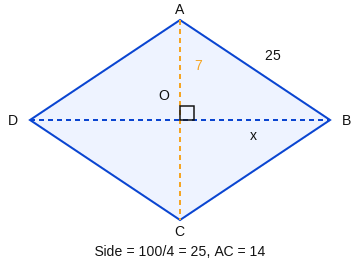
The perimeter of a rhombus is 100 meters and one of its diagonals is 14 meters long. What is the length of the other diagonal?
एक समचतुर्भुज का परिमाप 100 मीटर है और उसका एक विकर्ण 14 मीटर लंबा है। दूसरे विकर्ण की लंबाई क्या है?
  1. A48 meters48 मीटर
  2. B40 meters40 मीटर
  3. C42 meters42 मीटर
  4. D50 meters50 मीटर
Show answer

Concept: Diagonals of a rhombus bisect each other at right angles, so each side is the hypotenuse of a right triangle with legs = half-diagonals.

  1. Side =1004=25 m; half of given diagonal =7 m.
  2. Half of other diagonal =252−72=576=24 m.
  3. Other diagonal =2×24=48 m.

Yaad rakhein: (7,24,25) is a Pythagorean triplet.

Answer: (A) 48 meters

अवधारणा: समचतुर्भुज के विकर्ण एक-दूसरे को समकोण पर समद्विभाजित करते हैं, अतः भुजा उस समकोण त्रिभुज का कर्ण है जिसकी भुजाएँ अर्ध-विकर्ण हैं।

  1. भुजा =1004=25 m; दिए विकर्ण का आधा =7 m।
  2. दूसरे विकर्ण का आधा =252−72=576=24 m।
  3. दूसरा विकर्ण =2×24=48 m।

याद रखें: (7,24,25) पाइथागोरस त्रिक है।

उत्तर: (A) 48 मीटर

RRB NTPC Undergraduate CBT 1MathematicsRhombusRRB NTPC Undergraduate CBT 1 2025 · 7 May Shift 1 →
Q14347.
Which of the ratios given below is the greatest among them?
नीचे दिए गए अनुपातों में से कौन-सा अनुपात सबसे बड़ा है?
  1. A5 : 8
  2. B3 : 5
  3. C7 : 11
  4. D4 : 7
Show answer

Concept: Convert each ratio to a decimal and compare.

  1. 58=0.625, 35=0.6, 711≈0.636, 47≈0.571.
  2. Greatest =711.

Trick: Compare 58 and 711 by cross-multiplying: 5×11=55<7×8=56, so 711 is bigger.

Answer: (C) 7 : 11

अवधारणा: प्रत्येक अनुपात को दशमलव में बदलकर तुलना करें।

  1. 58=0.625, 35=0.6, 711≈0.636, 47≈0.571।
  2. सबसे बड़ा =711।

ट्रिक: 58 और 711 की वज्र-गुणन से तुलना: 5×11=55<7×8=56, अतः 711 बड़ा।

उत्तर: (C) 7 : 11

RRB NTPC Undergraduate CBT 1MathematicsComparison of RatiosRRB NTPC Undergraduate CBT 1 2025 · 7 May Shift 1 →
Q14348.
If 4sinθ+cosecθ=4, 0∘<θ<90∘, then the value of sin3θ+cos3θ is
यदि 4sinθ+cosecθ=4, 0∘<θ<90∘ है, तो sin3θ+cos3θ का मान है
  1. A-1
  2. B0
  3. C1
  4. D2
Show answer

Concept: Multiply by sinθ to get a perfect square in sinθ.

  1. 4sinθ+1sinθ=4 ⟹ 4sin2θ−4sinθ+1=0 ⟹ (2sinθ−1)2=0.
  2. sinθ=12 ⟹ θ=30∘.
  3. sin90∘+cos90∘=1+0=1.

Trick: x+1x=2 type (here 2sinθ+12sinθ=2) forces x=1, i.e. 2sinθ=1.

Answer: (C) 1

अवधारणा: sinθ से गुणा करने पर sinθ में पूर्ण वर्ग बनता है।

  1. 4sinθ+1sinθ=4 ⟹ 4sin2θ−4sinθ+1=0 ⟹ (2sinθ−1)2=0।
  2. sinθ=12 ⟹ θ=30∘।
  3. sin90∘+cos90∘=1+0=1।

ट्रिक: x+1x=2 प्रकार (यहाँ 2sinθ+12sinθ=2) से x=1, अर्थात 2sinθ=1।

उत्तर: (C) 1

RRB NTPC Undergraduate CBT 1MathematicsTrigonometryRRB NTPC Undergraduate CBT 1 2025 · 7 May Shift 1 →
Q14349.
In a class, the average score of 8 boys is 56 and the average score of 4 girls is 80. What is the average score of all 12 students?
एक कक्षा में 8 लड़कों का औसत प्राप्तांक 56 और 4 लड़कियों का औसत प्राप्तांक 80 है। सभी 12 विद्यार्थियों का औसत प्राप्तांक क्या है?
  1. A62
  2. B66
  3. C68
  4. D64
Show answer

Concept: Combined average =total of all scorestotal students.

  1. Boys total =8×56=448; girls total =4×80=320.
  2. Average =76812=64.

Trick: Ratio 8:4=2:1, so the average lies 13 of the way from 56 to 80: 56+8=64.

Answer: (D) 64

अवधारणा: संयुक्त औसत =सभी अंकों का योगकुल विद्यार्थी।

  1. लड़कों का योग =8×56=448; लड़कियों का =4×80=320।
  2. औसत =76812=64।

ट्रिक: अनुपात 8:4=2:1, अतः औसत 56 से 80 की ओर 13 दूरी पर: 56+8=64।

उत्तर: (D) 64

RRB NTPC Undergraduate CBT 1MathematicsWeighted AverageRRB NTPC Undergraduate CBT 1 2025 · 7 May Shift 1 →
Q14350.
The 7-digit number 46A484B is divisible by 24. What is the minimum value of (A + B)?
7 अंकों की संख्या 46A484B, 24 से विभाज्य है। (A + B) का न्यूनतम मान क्या है?
  1. A6
  2. B3
  3. C1
  4. D4
Show answer

Concept: Divisible by 24 ⟺ divisible by both 8 and 3.

  1. By 8: last three digits 84B must be divisible by 8 ⟹ B=0 (840) or B=8 (848).
  2. By 3: digit sum =4+6+A+4+8+4+B=26+A+B must be a multiple of 3.
  3. With B=0: A=1 works (27) ⟹ A+B=1, the minimum.

Trick: Try the smallest B first; the smallest A that fixes the digit sum gives the minimum.

Answer: (C) 1

अवधारणा: 24 से विभाज्य ⟺ 8 और 3 दोनों से विभाज्य।

  1. 8 से: अंतिम तीन अंक 84B 8 से विभाज्य ⟹ B=0 (840) या B=8 (848)।
  2. 3 से: अंकों का योग =4+6+A+4+8+4+B=26+A+B, 3 का गुणज।
  3. B=0 पर A=1 (27) ⟹ A+B=1, न्यूनतम।

ट्रिक: पहले सबसे छोटा B लें; अंक-योग ठीक करने वाला सबसे छोटा A न्यूनतम देता है।

उत्तर: (C) 1

RRB NTPC Undergraduate CBT 1MathematicsDivisibilityRRB NTPC Undergraduate CBT 1 2025 · 7 May Shift 1 →
Q14351.
Simplify: {1233÷122}÷(37×149+311)+28÷3125 of 258
सरल कीजिए: {1233÷122}÷(37×149+311)+28÷3125 of 258
  1. A431
  2. B536
  3. C738
  4. D524
Show answer

Concept: Solve brackets first; "of" means multiplication and is done before ÷.

  1. 1233÷122=1233×212=233.
  2. 37×149+311=23+311=3133; so 233÷3133=231.
  3. 3125 of 258=318; 28÷318=231.
  4. Total =231+231=431.

Trick: Both halves reduce to 231 – the 33s and 8s cancel neatly.

Answer: (A) 431

अवधारणा: पहले कोष्ठक हल करें; "of" का अर्थ गुणा है और यह ÷ से पहले होता है।

  1. 1233÷122=1233×212=233।
  2. 37×149+311=23+311=3133; अतः 233÷3133=231।
  3. 3125 of 258=318; 28÷318=231।
  4. कुल =231+231=431।

ट्रिक: दोनों भाग 231 पर आते हैं – 33 और 8 आपस में कट जाते हैं।

उत्तर: (A) 431

RRB NTPC Undergraduate CBT 1MathematicsSimplification – BODMASRRB NTPC Undergraduate CBT 1 2025 · 7 May Shift 1 →
Q14352.
Sunil purchased a microwave oven for ₹7,000. He spent ₹400 on its transportation and ₹600 on repairs. He sold the oven for ₹9,800. What is his percentage profit on total investment?
सुनील ने ₹7,000 में एक माइक्रोवेव ओवन खरीदा। उसने इसके परिवहन पर ₹400 और मरम्मत पर ₹600 खर्च किए। उसने ओवन को ₹9,800 में बेच दिया। कुल निवेश पर उसका प्रतिशत लाभ क्या है?
  1. A22.5%
  2. B23.5%
  3. C20.5%
  4. D21.5%
Show answer

Concept: Total cost includes overheads (transport, repair).

  1. Total CP =7000+400+600=8000.
  2. Profit =9800−8000=1800.
  3. Profit% =18008000×100=22.5%.

Trick: 18008000=940=22.5%.

Answer: (A) 22.5%

अवधारणा: कुल लागत में ऊपरी खर्च (परिवहन, मरम्मत) शामिल होते हैं।

  1. कुल CP =7000+400+600=8000।
  2. लाभ =9800−8000=1800।
  3. लाभ% =18008000×100=22.5%।

ट्रिक: 18008000=940=22.5%।

उत्तर: (A) 22.5%

RRB NTPC Undergraduate CBT 1MathematicsProfit and LossRRB NTPC Undergraduate CBT 1 2025 · 7 May Shift 1 →
Q14353.
A and B invest in a business in the ratio 5 : 7. After 4 months, C joins the business with an investment equal to the amount invested by A. At the end of one year, the total profit is ₹92,000. Find the sum (in ₹) of the shares of partners B and C.
A और B एक व्यवसाय में 5 : 7 के अनुपात में निवेश करते हैं। 4 महीने बाद, C, A द्वारा निवेशित राशि के बराबर निवेश के साथ व्यवसाय में शामिल हो जाता है। एक वर्ष के अंत में कुल लाभ ₹92,000 है। साझेदार B और C के हिस्सों का योग (₹ में) ज्ञात कीजिए।
  1. A₹66,800
  2. B₹49,600
  3. C₹62,000
  4. D₹64,400
Show answer

Concept: Profit is shared in the ratio of (investment × time).

  1. A : B : C =5×12:7×12:5×8=60:84:40=15:21:10.
  2. Total parts =46; B + C =31 parts.
  3. Share =3146×92000=31×2000=62000.

Trick: 92000÷46=2000 exactly – a clean sign the ratio is right.

Answer: (C) ₹62,000

अवधारणा: लाभ (निवेश × समय) के अनुपात में बँटता है।

  1. A : B : C =5×12:7×12:5×8=60:84:40=15:21:10।
  2. कुल भाग =46; B + C =31 भाग।
  3. हिस्सा =3146×92000=31×2000=62000।

ट्रिक: 92000÷46=2000 पूरा-पूरा – अनुपात सही होने का संकेत।

उत्तर: (C) ₹62,000

RRB NTPC Undergraduate CBT 1MathematicsPartnershipRRB NTPC Undergraduate CBT 1 2025 · 7 May Shift 1 →
Q14354.
Which of the following numbers is completely divisible by 6?
निम्नलिखित में से कौन-सी संख्या 6 से पूर्णतः विभाज्य है?
  1. A5,47,821
  2. B7,53,216
  3. C8,91,452
  4. D6,42,538
Show answer

Concept: Divisible by 6 ⟺ even (by 2) and digit sum divisible by 3.

  1. Only 7,53,216 and 8,91,452 are even.
  2. 7+5+3+2+1+6=24 ✓ (multiple of 3); 8+9+1+4+5+2=29 ✗.

Trick: Eliminate odd numbers first, then check digit sums only for the rest.

Answer: (B) 7,53,216

अवधारणा: 6 से विभाज्य ⟺ सम (2 से) और अंकों का योग 3 से विभाज्य।

  1. केवल 7,53,216 और 8,91,452 सम हैं।
  2. 7+5+3+2+1+6=24 ✓ (3 का गुणज); 8+9+1+4+5+2=29 ✗।

ट्रिक: पहले विषम संख्याएँ हटाएँ, फिर शेष के अंक-योग देखें।

उत्तर: (B) 7,53,216

RRB NTPC Undergraduate CBT 1MathematicsDivisibilityRRB NTPC Undergraduate CBT 1 2025 · 7 May Shift 1 →
Q14355.
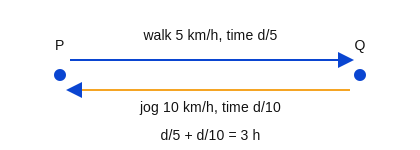
A person walks from point P to Q at 5 km/hr and returns from Q to P along the same route jogging at 10 km/hr. If the total time taken is 3 hours, what is the distance between P and Q?
एक व्यक्ति बिंदु P से Q तक 5 km/hr की चाल से पैदल जाता है और उसी मार्ग से Q से P तक 10 km/hr की चाल से जॉगिंग करते हुए लौटता है। यदि कुल लिया गया समय 3 घंटे है, तो P और Q के बीच की दूरी क्या है?
  1. A10 km
  2. B5 km
  3. C15 km
  4. D20 km
Show answer

Concept: Same distance both ways; total time =d5+d10.

  1. d5+d10=3d10=3.
  2. d=10 km.

Trick: Average speed =2×5×1015=203 km/h; round trip =203×3=20 km ⟹ one way 10 km.

Answer: (A) 10 km

अवधारणा: दोनों ओर समान दूरी; कुल समय =d5+d10।

  1. d5+d10=3d10=3।
  2. d=10 km।

ट्रिक: औसत चाल =2×5×1015=203 km/h; आना-जाना =203×3=20 km ⟹ एक ओर 10 km।

उत्तर: (A) 10 km

RRB NTPC Undergraduate CBT 1MathematicsSpeed, Time and DistanceRRB NTPC Undergraduate CBT 1 2025 · 7 May Shift 1 →
Q14356.
Refer to the following series and answer the question. (Counting to be done from left to right only.) (all numbers are single digit numbers only.)
(Left) 9 2 3 1 4 5 6 8 5 4 3 2 1 9 3 4 5 6 7 8 1 2 9 8 3 4 5 2 6 8 2 (Right)
How many such even digits are there, each of which is immediately preceded by a perfect square and immediately followed by an odd digit? (NOTE: 1 is also a perfect square.)
निम्नलिखित श्रृंखला को देखिए और प्रश्न का उत्तर दीजिए। (गिनती केवल बाएँ से दाएँ की ओर की जानी है।) (सभी संख्याएँ केवल एक अंक की संख्याएँ हैं।)
(बायाँ) 9 2 3 1 4 5 6 8 5 4 3 2 1 9 3 4 5 6 7 8 1 2 9 8 3 4 5 2 6 8 2 (दायाँ)
ऐसे कितने सम अंक हैं, जिनमें से प्रत्येक के ठीक पहले एक पूर्ण वर्ग और ठीक बाद एक विषम अंक है? (नोट: 1 भी एक पूर्ण वर्ग है।)
  1. AThreeतीन
  2. BMore than threeतीन से अधिक
  3. CTwoदो
  4. DOneएक
Show answer

Concept: Check every even digit: the digit just before it must be a perfect square (1, 4, 9) and the digit just after it must be odd.

  1. Series: 9 2 3 1 4 5 6 8 5 4 3 2 1 9 3 4 5 6 7 8 1 2 9 8 3 4 5 2 6 8 2.
  2. 9–2–3 ✓, 1–4–5 ✓, 1–2–9 ✓, 9–8–3 ✓.
  3. Other even digits are preceded by 5, 6, 3, 7, 2 or 8 (not squares), so they fail.
  4. Total = 4, i.e. more than three.

Trick: Scan only the evens and look one step left for 1, 4 or 9 – this cuts the checking to a few digits.

Answer: (B) More than three

अवधारणा: हर सम अंक जाँचें: उसके ठीक पहले पूर्ण वर्ग (1, 4, 9) और ठीक बाद विषम अंक होना चाहिए।

  1. श्रृंखला: 9 2 3 1 4 5 6 8 5 4 3 2 1 9 3 4 5 6 7 8 1 2 9 8 3 4 5 2 6 8 2।
  2. 9–2–3 ✓, 1–4–5 ✓, 1–2–9 ✓, 9–8–3 ✓।
  3. बाकी सम अंकों से पहले 5, 6, 3, 7, 2 या 8 हैं (वर्ग नहीं), अतः वे नहीं गिने जाते।
  4. कुल = 4, यानी तीन से अधिक।

ट्रिक: केवल सम अंकों को देखें और एक कदम बाएँ 1, 4 या 9 खोजें – जाँच कुछ ही अंकों तक सिमट जाती है।

उत्तर: (B) More than three (तीन से अधिक)

RRB NTPC Undergraduate CBT 1General Intelligence and ReasoningNumber Series CountingRRB NTPC Undergraduate CBT 1 2025 · 7 May Shift 1 →
Q14357.
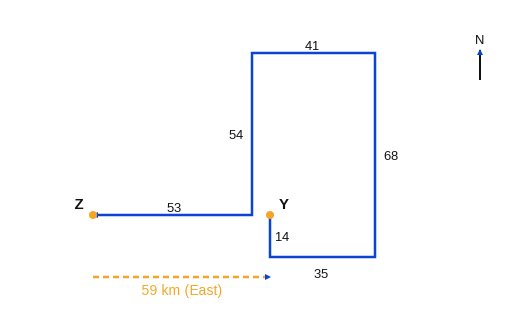
Amit starts from Point Y and drives 14 km towards South. He then turns left and drives 35 km, takes a left and drives 68 km. He then takes a left turn and drives 41 km. He takes a left turn, drives 54 km, turns right and drives 53 km to stop at Point Z. How far (shortest distance) and towards which direction should he drive in order to reach Point Y again? (All turns are 90° turns only unless specified.)
अमित बिंदु Y से चलना शुरू करता है और दक्षिण की ओर 14 km गाड़ी चलाता है। फिर वह बाएँ मुड़ता है और 35 km गाड़ी चलाता है, फिर बाएँ मुड़कर 68 km गाड़ी चलाता है। इसके बाद वह बाएँ मुड़ता है और 41 km गाड़ी चलाता है। वह बाएँ मुड़ता है, 54 km गाड़ी चलाता है, दाएँ मुड़ता है और 53 km गाड़ी चलाकर बिंदु Z पर रुक जाता है। बिंदु Y पर पुनः पहुँचने के लिए उसे कितनी दूर (न्यूनतम दूरी) और किस दिशा में गाड़ी चलानी चाहिए? (जब तक अन्यथा न कहा जाए, सभी मोड़ केवल 90° के हैं।)
  1. A57 km towards east57 km पूर्व की ओर
  2. B56 km towards west56 km पश्चिम की ओर
  3. C61 km towards west61 km पश्चिम की ओर
  4. D59 km towards east59 km पूर्व की ओर
Show answer

Concept: Plot the path on coordinates (East = +x, North = +y) and read the final position relative to the start.

  1. Y(0,0) → South 14 → (0,−14) → left (East) 35 → (35,−14) → left (North) 68 → (35,54).
  2. Left (West) 41 → (−6,54) → left (South) 54 → (−6,0) → right (West) 53 → Z(−59,0).
  3. Z is 59 km due west of Y, so Amit must drive 59 km towards East to reach Y.

Trick: Net N–S: −14+68−54=0; net E–W: +35−41−53=−59. Zero in one axis means the answer is a straight line along the other.

Answer: (D) 59 km towards east

अवधारणा: पथ को निर्देशांकों पर बनाएँ (पूर्व = +x, उत्तर = +y) और अंतिम स्थिति को प्रारंभ के सापेक्ष पढ़ें।

  1. Y(0,0) → दक्षिण 14 → (0,−14) → बाएँ (पूर्व) 35 → (35,−14) → बाएँ (उत्तर) 68 → (35,54)।
  2. बाएँ (पश्चिम) 41 → (−6,54) → बाएँ (दक्षिण) 54 → (−6,0) → दाएँ (पश्चिम) 53 → Z(−59,0)।
  3. Z, Y से ठीक 59 km पश्चिम में है, अतः Y पहुँचने के लिए अमित को 59 km पूर्व की ओर चलना होगा।

ट्रिक: शुद्ध उ–द: −14+68−54=0; शुद्ध पू–प: +35−41−53=−59। एक अक्ष में शून्य हो तो उत्तर दूसरी अक्ष पर सीधी रेखा है।

उत्तर: (D) 59 km पूर्व की ओर

RRB NTPC Undergraduate CBT 1General Intelligence and ReasoningDirection and DistanceRRB NTPC Undergraduate CBT 1 2025 · 7 May Shift 1 →
Q14358.
What should come in place of ? in the given series based on the English alphabetical order?
SQU TRV USW VTX ?
अंग्रेज़ी वर्णमाला क्रम के आधार पर दी गई श्रृंखला में ? के स्थान पर क्या आना चाहिए?
SQU TRV USW VTX ?
  1. AWVX
  2. BWUY
  3. CWXZ
  4. DWTX
Show answer

Concept: Compare the same position of consecutive clusters to find the shift.

  1. 1st letters: S → T → U → V → W (+1 each).
  2. 2nd letters: Q → R → S → T → U (+1 each).
  3. 3rd letters: U → V → W → X → Y (+1 each).
  4. Next cluster = WUY.

Trick: Each cluster is simply the previous one with every letter moved one step ahead.

Answer: (B) WUY

अवधारणा: क्रमागत समूहों के समान स्थान के अक्षरों की तुलना कर पैटर्न पहचानें।

  1. पहले अक्षर: S → T → U → V → W (हर बार +1)।
  2. दूसरे अक्षर: Q → R → S → T → U (+1)।
  3. तीसरे अक्षर: U → V → W → X → Y (+1)।
  4. अगला समूह = WUY।

ट्रिक: हर समूह पिछले समूह का हर अक्षर एक कदम आगे बढ़ाने से बनता है।

उत्तर: (B) WUY

RRB NTPC Undergraduate CBT 1General Intelligence and ReasoningLetter SeriesRRB NTPC Undergraduate CBT 1 2025 · 7 May Shift 1 →
Q14359.
If 2 is added to each even digit and 2 is subtracted from each odd digit in the number 5973642, then what will be the sum of all the even digits in the new number thus formed?
यदि संख्या 5973642 के प्रत्येक सम अंक में 2 जोड़ा जाए और प्रत्येक विषम अंक में से 2 घटाया जाए, तो इस प्रकार बनी नई संख्या के सभी सम अंकों का योग क्या होगा?
  1. A24
  2. B20
  3. C16
  4. D18
Show answer

Concept: Apply the rule to each digit separately, then pick the even digits of the new number.

  1. 5973642: odd digits −2 → 5→3, 9→7, 7→5, 3→1; even digits +2 → 6→8, 4→6, 2→4.
  2. New number = 3751864.
  3. Even digits: 8, 6, 4 → sum =8+6+4=18.

Trick: Odd −2 stays odd and even +2 stays even, so only the original even digits (6, 4, 2) matter: (6+4+2)+2×3=18.

Answer: (D) 18

अवधारणा: नियम हर अंक पर अलग-अलग लगाएँ, फिर नई संख्या के सम अंक चुनें।

  1. 5973642: विषम अंक −2 → 5→3, 9→7, 7→5, 3→1; सम अंक +2 → 6→8, 4→6, 2→4।
  2. नई संख्या = 3751864।
  3. सम अंक: 8, 6, 4 → योग =8+6+4=18।

ट्रिक: विषम −2 विषम ही रहता है और सम +2 सम ही, अतः केवल मूल सम अंक (6, 4, 2) देखें: (6+4+2)+2×3=18।

उत्तर: (D) 18

RRB NTPC Undergraduate CBT 1General Intelligence and ReasoningDigit OperationsRRB NTPC Undergraduate CBT 1 2025 · 7 May Shift 1 →
Q14360.
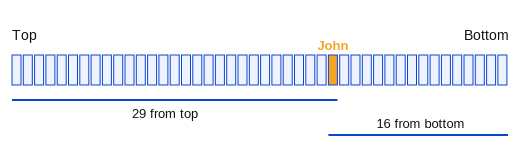
John ranked 16th from the bottom and 29th from the top in his class. How many students are there in his class?
जॉन का अपनी कक्षा में नीचे से 16वाँ और ऊपर से 29वाँ स्थान है। उसकी कक्षा में कितने विद्यार्थी हैं?
  1. A43
  2. B41
  3. C44
  4. D42
Show answer

Concept: Total = rank from top + rank from bottom −1 (the person is counted twice).

  1. Rank from top =29, from bottom =16.
  2. Total students =29+16−1=44.

Trick: Add the two ranks and subtract 1 – never forget the −1.

Answer: (C) 44

अवधारणा: कुल = ऊपर से क्रम + नीचे से क्रम −1 (व्यक्ति दो बार गिना जाता है)।

  1. ऊपर से क्रम =29, नीचे से =16।
  2. कुल छात्र =29+16−1=44।

ट्रिक: दोनों क्रम जोड़कर 1 घटाएँ – −1 कभी न भूलें।

उत्तर: (C) 44

RRB NTPC Undergraduate CBT 1General Intelligence and ReasoningRankingRRB NTPC Undergraduate CBT 1 2025 · 7 May Shift 1 →