Question bank

Q&A: practice questions with answers

Search questions on any topic. Filter by exam category, exam, subject and topic, try the question, then open the answer and explanation.

Courses – airGurukul

20,719 questions found.

Q14361.
What will come in place of the question mark (?) in the following equation if ‘+’ and ‘÷’ are interchanged and ‘−’ and ‘×’ are interchanged?
603 + 9 × 18 − 6 ÷ 56 = ?
यदि ‘+’ और ‘÷’ को आपस में बदल दिया जाए तथा ‘−’ और ‘×’ को आपस में बदल दिया जाए, तो निम्नलिखित समीकरण में प्रश्नवाचक चिह्न (?) के स्थान पर क्या आएगा?
603 + 9 × 18 − 6 ÷ 56 = ?
  1. A11
  2. B20
  3. C16
  4. D15
Show answer

Concept: Interchange the signs as instructed, then apply BODMAS.

  1. 603 + 9 × 18 − 6 ÷ 56 becomes 603÷9−18×6+56.
  2. 603÷9=67 and 18×6=108.
  3. 67−108+56=15.

Trick: Rewrite the whole expression with new signs first; only then calculate – mixing the two steps causes errors.

Answer: (D) 15

अवधारणा: निर्देशानुसार चिह्न बदलें, फिर BODMAS लगाएँ।

  1. 603 + 9 × 18 − 6 ÷ 56 बनता है 603÷9−18×6+56।
  2. 603÷9=67 और 18×6=108।
  3. 67−108+56=15।

ट्रिक: पहले पूरा व्यंजक नए चिह्नों से लिखें, फिर हल करें – दोनों चरण मिलाने से गलती होती है।

उत्तर: (D) 15
RRB NTPC Undergraduate CBT 1General Intelligence and ReasoningMathematical OperationsRRB NTPC Undergraduate CBT 1 2025 · 7 May Shift 1 →
Q14362.
In a certain code language, ‘NORM’ is coded as ‘7341’ and ‘ROME’ is coded as ‘3748’. What is the code for ‘E’ in the given code language?
एक निश्चित कूट भाषा में, ‘NORM’ को ‘7341’ और ‘ROME’ को ‘3748’ के रूप में कूटबद्ध किया जाता है। दी गई कूट भाषा में ‘E’ का कूट क्या है?
  1. A4
  2. B7
  3. C3
  4. D8
Show answer

Concept: Letters common to both words get the common digits; the leftover letter gets the leftover digit.

  1. NORM → 7341 and ROME → 3748 share the letters R, O, M and the digits 7, 3, 4.
  2. In NORM the extra letter N ↔ extra digit 1; in ROME the extra letter E ↔ extra digit 8.

Trick: Cancel the common letters and common digits – whatever remains pairs up directly.

Answer: (D) 8

अवधारणा: दोनों शब्दों में समान अक्षरों को समान अंक मिलते हैं; बचा हुआ अक्षर बचे हुए अंक से जुड़ता है।

  1. NORM → 7341 और ROME → 3748 में अक्षर R, O, M और अंक 7, 3, 4 समान हैं।
  2. NORM में अतिरिक्त अक्षर N ↔ अतिरिक्त अंक 1; ROME में अतिरिक्त अक्षर E ↔ अतिरिक्त अंक 8।

ट्रिक: समान अक्षर और समान अंक काट दें – जो बचे वे सीधे जोड़ी बनाते हैं।

उत्तर: (D) 8

RRB NTPC Undergraduate CBT 1General Intelligence and ReasoningCoding–DecodingRRB NTPC Undergraduate CBT 1 2025 · 7 May Shift 1 →
Q14363.
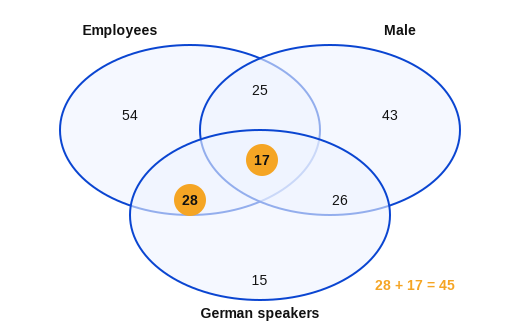
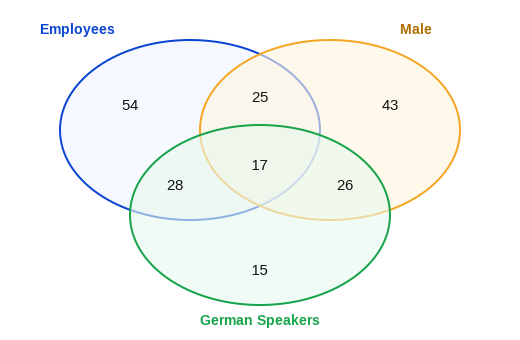
Study the given diagram carefully and answer the question. The numbers in different sections indicate the number of persons working in an organization. (NOTE: You have to take the given data to be true even if it seems to be at variance from commonly known facts.)

How many such employees are there who also speak German?
दिए गए आरेख का ध्यानपूर्वक अध्ययन कीजिए और प्रश्न का उत्तर दीजिए। विभिन्न खंडों में दी गई संख्याएँ एक संगठन में कार्यरत व्यक्तियों की संख्या दर्शाती हैं। (नोट: आपको दिए गए आँकड़ों को सत्य मानना है, भले ही वे सामान्यतः ज्ञात तथ्यों से भिन्न प्रतीत होते हों।)

ऐसे कितने कर्मचारी हैं जो जर्मन भी बोलते हैं?
  1. A43
  2. B45
  3. C41
  4. D28
Show answer

Concept: "Employees who also speak German" = the regions common to the Employees circle and the German-speakers circle (whether male or not).

  1. Employees ∩ German only (not male) =28.
  2. Employees ∩ German ∩ Male =17.
  3. Required =28+17=45.

Trick: The overlap of two circles is always made of two pieces – the part inside the third circle and the part outside it. Add both.

Answer: (B) 45

अवधारणा: "जर्मन बोलने वाले कर्मचारी" = Employees वृत्त और German speakers वृत्त के साझा भाग (पुरुष हों या न हों)।

  1. Employees ∩ German केवल (पुरुष नहीं) =28।
  2. Employees ∩ German ∩ Male =17।
  3. अभीष्ट =28+17=45।

ट्रिक: दो वृत्तों का उभयनिष्ठ भाग हमेशा दो टुकड़ों से बनता है – तीसरे वृत्त के अंदर वाला और बाहर वाला। दोनों जोड़ें।

उत्तर: (B) 45

RRB NTPC Undergraduate CBT 1General Intelligence and ReasoningVenn DiagramRRB NTPC Undergraduate CBT 1 2025 · 7 May Shift 1 →
Q14364.
Each letter in the word LANGUID is arranged in the English alphabetical order. How many letters are there in the English alphabetical order between the letter which is second from the left and the one which is fourth from the right in the new letter cluster thus formed?
शब्द LANGUID के प्रत्येक अक्षर को अंग्रेज़ी वर्णमाला क्रम में व्यवस्थित किया जाता है। इस प्रकार बने नए अक्षर-समूह में बाएँ से दूसरे अक्षर और दाएँ से चौथे अक्षर के बीच अंग्रेज़ी वर्णमाला क्रम में कितने अक्षर हैं?
  1. A7
  2. B5
  3. C4
  4. D3
Show answer

Concept: Arrange the letters alphabetically, locate the two positions, then count letters strictly between them in the alphabet.

  1. LANGUID → A, D, G, I, L, N, U.
  2. Second from left = D; fourth from right (of 7) = 4th from left = I.
  3. Between D(4) and I(9): E, F, G, H =9−4−1=4 letters.

Trick: Letters between two positions = difference of their place values −1.

Answer: (C) 4

अवधारणा: अक्षरों को वर्णक्रम में लगाएँ, दोनों स्थान पहचानें, फिर वर्णमाला में उनके बीच के अक्षर गिनें।

  1. LANGUID → A, D, G, I, L, N, U।
  2. बाएँ से दूसरा = D; दाएँ से चौथा (7 में) = बाएँ से चौथा = I।
  3. D(4) और I(9) के बीच: E, F, G, H =9−4−1=4 अक्षर।

ट्रिक: दो अक्षरों के बीच के अक्षर = उनके स्थान-मानों का अंतर −1।

उत्तर: (C) 4

RRB NTPC Undergraduate CBT 1General Intelligence and ReasoningAlphabet TestRRB NTPC Undergraduate CBT 1 2025 · 7 May Shift 1 →
Q14365.
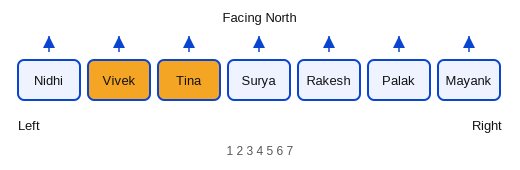
Seven people, Mayank, Nidhi, Palak, Rakesh, Surya, Tina and Vivek, are sitting in a row, facing north. Only two people sit to the right of Rakesh. Nidhi sits to the immediate left of Vivek and Vivek sits third to the left of Rakesh. Palak sits third to the right of Tina, but Palak does not sit at any extreme ends. Rakesh is not an immediate neighbour of Mayank. How many people sit between Tina and Vivek?
सात व्यक्ति, मयंक, निधि, पलक, राकेश, सूर्या, टीना और विवेक, एक पंक्ति में उत्तर की ओर मुख करके बैठे हैं। राकेश के दाएँ केवल दो व्यक्ति बैठे हैं। निधि, विवेक के ठीक बाएँ बैठी है और विवेक, राकेश के बाएँ तीसरे स्थान पर बैठा है। पलक, टीना के दाएँ तीसरे स्थान पर बैठी है, लेकिन पलक किसी भी अंतिम छोर पर नहीं बैठी है। राकेश, मयंक का निकटतम पड़ोसी नहीं है। टीना और विवेक के बीच कितने व्यक्ति बैठे हैं?
  1. AThreeतीन
  2. BOneएक
  3. CNoneकोई नहीं
  4. DTwoदो
Show answer

Concept: Number the seats 1–7 from left to right (all face north, so right = higher number) and place people from the most definite clue.

  1. Only two to the right of Rakesh → Rakesh at 5. Vivek third to the left of Rakesh → Vivek at 2; Nidhi immediately left → Nidhi at 1.
  2. Palak is third to the right of Tina and not at an end → Tina 3, Palak 6 (Tina 4 would put Palak at 7, an end).
  3. Mayank is not next to Rakesh → Mayank 7, Surya 4.
  4. Order: Nidhi, Vivek, Tina, Surya, Rakesh, Palak, Mayank. Tina (3) and Vivek (2) are adjacent → none between.

Trick: Start with "only two to the right of" – it fixes a seat instantly and the rest falls in place.

Answer: (C) None

अवधारणा: सीटें बाएँ से दाएँ 1–7 क्रमांकित करें (सभी उत्तर मुख, अतः दाएँ = बड़ी संख्या) और सबसे निश्चित संकेत से शुरू करें।

  1. राकेश के दाएँ केवल दो → राकेश 5 पर। विवेक राकेश के बाएँ तीसरा → विवेक 2; निधि ठीक बाएँ → निधि 1।
  2. पलक टीना के दाएँ तीसरी और छोर पर नहीं → टीना 3, पलक 6 (टीना 4 होने पर पलक 7 यानी छोर पर आती)।
  3. मयंक राकेश का पड़ोसी नहीं → मयंक 7, सूर्या 4।
  4. क्रम: निधि, विवेक, टीना, सूर्या, राकेश, पलक, मयंक। टीना (3) और विवेक (2) सटे हैं → बीच में कोई नहीं।

ट्रिक: "दाएँ केवल दो लोग" जैसे संकेत से शुरू करें – यह सीट तुरंत तय कर देता है और बाकी अपने आप बैठ जाते हैं।

उत्तर: (C) None (कोई नहीं)

RRB NTPC Undergraduate CBT 1General Intelligence and ReasoningLinear Seating ArrangementRRB NTPC Undergraduate CBT 1 2025 · 7 May Shift 1 →
Q14366.
AEHB is related to FJMG in a certain way based on the English alphabetical order. In the same way, DHKE is related to IMPJ. To which of the following is GKNH related, following the same logic?
अंग्रेज़ी वर्णमाला क्रम के आधार पर AEHB, FJMG से एक निश्चित प्रकार से संबंधित है। उसी प्रकार, DHKE, IMPJ से संबंधित है। समान तर्क का अनुसरण करते हुए, GKNH निम्नलिखित में से किससे संबंधित है?
  1. ALPSM
  2. BPLMS
  3. CPLSM
  4. DLPMS
Show answer

Concept: Find the position shift applied to each letter of the first cluster.

  1. AEHB → FJMG: A(1)→F(6), E(5)→J(10), H(8)→M(13), B(2)→G(7): each +5.
  2. Check DHKE → IMPJ: D→I, H→M, K→P, E→J: +5 ✓.
  3. GKNH: G(7)→L(12), K(11)→P(16), N(14)→S(19), H(8)→M(13) → LPSM.

Trick: When all letters move by the same amount, just add it to each place value – no need to compare option by option.

Answer: (A) LPSM

अवधारणा: पहले समूह के हर अक्षर पर लगाया गया स्थान-परिवर्तन खोजें।

  1. AEHB → FJMG: A(1)→F(6), E(5)→J(10), H(8)→M(13), B(2)→G(7): हर एक +5।
  2. जाँच DHKE → IMPJ: D→I, H→M, K→P, E→J: +5 ✓।
  3. GKNH: G(7)→L(12), K(11)→P(16), N(14)→S(19), H(8)→M(13) → LPSM।

ट्रिक: जब सभी अक्षर समान कदम चलें, हर स्थान-मान में वही जोड़ दें – विकल्प-दर-विकल्प मिलाने की ज़रूरत नहीं।

उत्तर: (A) LPSM

RRB NTPC Undergraduate CBT 1General Intelligence and ReasoningLetter AnalogyRRB NTPC Undergraduate CBT 1 2025 · 7 May Shift 1 →
Q14367.
Based on the English alphabetical order, three of the following four letter-cluster pairs are alike in a certain way and thus form a group. Which is the one that does not belong to that group? (Note: The odd one out is not based on the number of
consonants/vowels or their position in the letter cluster.)
अंग्रेज़ी वर्णमाला क्रम के आधार पर, निम्नलिखित चार अक्षर-समूह युग्मों में से तीन एक निश्चित प्रकार से समान हैं और इस प्रकार एक समूह बनाते हैं। वह कौन-सा है जो उस समूह से संबंधित नहीं है? (नोट: असंगत युग्म अक्षर-समूह में
व्यंजनों/स्वरों की संख्या या उनकी स्थिति पर आधारित नहीं है।)
  1. ARO-VT
  2. BLI-PN
  3. CPM-TR
  4. DNK-RO
Show answer

Concept: Compare corresponding letters of each pair using place values.

  1. RO–VT: R(18)→V(22) +4, O(15)→T(20) +5.
  2. LI–PN: L→P +4, I→N +5. PM–TR: P→T +4, M→R +5.
  3. NK–RO: N(14)→R(18) +4, K(11)→O(15) +4 – pattern breaks (+4,+4 instead of +4,+5).

Trick: Write the two differences for every option; the one with a different pair of numbers is the odd one.

Answer: (D) NK-RO

अवधारणा: स्थान-मानों से हर युग्म के संगत अक्षरों की तुलना करें।

  1. RO–VT: R(18)→V(22) +4, O(15)→T(20) +5।
  2. LI–PN: L→P +4, I→N +5। PM–TR: P→T +4, M→R +5।
  3. NK–RO: N(14)→R(18) +4, K(11)→O(15) +4 – पैटर्न टूटता है (+4,+5 की जगह +4,+4)।

ट्रिक: हर विकल्प के दोनों अंतर लिखें; जिसकी संख्या-जोड़ी अलग हो वही विषम है।

उत्तर: (D) NK-RO

RRB NTPC Undergraduate CBT 1General Intelligence and ReasoningOdd One Out (Letter Pairs)RRB NTPC Undergraduate CBT 1 2025 · 7 May Shift 1 →
Q14368.
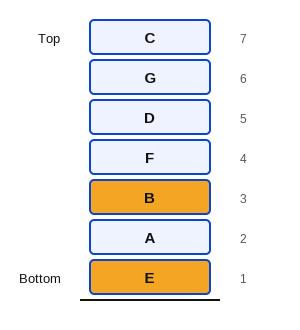
Seven boxes A, B, C, D, E, F and G are kept one over the other but not necessarily in the same order. A is kept second from the bottom. Only three boxes are kept between A and G. E is kept at one of the positions below A. Only D is kept between G and F. C is kept at one of the positions above G. How many boxes are kept between B and E?
सात बक्से A, B, C, D, E, F और G एक के ऊपर एक रखे गए हैं, लेकिन आवश्यक नहीं कि इसी क्रम में हों। A नीचे से दूसरे स्थान पर रखा है। A और G के बीच केवल तीन बक्से रखे हैं। E, A से नीचे किसी एक स्थान पर रखा है। G और F के बीच केवल D रखा है। C, G से ऊपर किसी एक स्थान पर रखा है। B और E के बीच कितने बक्से रखे हैं?
  1. A1
  2. B2
  3. C4
  4. D3
Show answer

Concept: Number positions 1 (bottom) to 7 (top) and fix boxes from the definite clues.

  1. A is second from bottom → A at 2. Three boxes between A and G → G at 6.
  2. E is below A → E at 1. C is above G → C at 7.
  3. Only D between G and F → F at 4, D at 5. The last box B takes 3.
  4. Bottom to top: E, A, B, F, D, G, C. Between B(3) and E(1) there is exactly 1 box (A).

Trick: "Second from bottom" plus "three between" pins two boxes at once – always start with such numeric clues.

Answer: (A) 1

अवधारणा: स्थान 1 (नीचे) से 7 (ऊपर) क्रमांकित करें और निश्चित संकेतों से बॉक्स तय करें।

  1. A नीचे से दूसरा → A स्थान 2 पर। A और G के बीच तीन बॉक्स → G स्थान 6।
  2. E, A से नीचे → E स्थान 1। C, G से ऊपर → C स्थान 7।
  3. G और F के बीच केवल D → F स्थान 4, D स्थान 5। बचा B स्थान 3 पर।
  4. नीचे से ऊपर: E, A, B, F, D, G, C। B(3) और E(1) के बीच ठीक 1 बॉक्स (A)।

ट्रिक: "नीचे से दूसरा" और "बीच में तीन" एक साथ दो बॉक्स तय कर देते हैं – ऐसे संख्यात्मक संकेतों से शुरुआत करें।

उत्तर: (A) 1

RRB NTPC Undergraduate CBT 1General Intelligence and ReasoningBox ArrangementRRB NTPC Undergraduate CBT 1 2025 · 7 May Shift 1 →
Q14369.
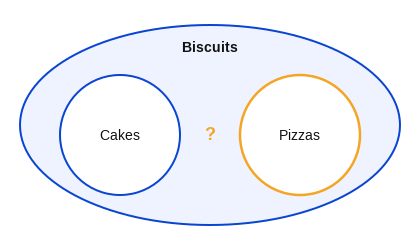
Read the given statements and conclusions carefully. You have to take the given statements to be true even if they seem to be at variance from commonly known facts. You have to decide which conclusions logically follow/s from the given statements. Statements: All cakes are biscuits. All pizzas are biscuits.
Conclusion (I) : Some cakes are pizzas
Conclusion (II) : Some biscuits are pizzas
दिए गए कथनों और निष्कर्षों को ध्यानपूर्वक पढ़िए। आपको दिए गए कथनों को सत्य मानना है, भले ही वे सामान्यतः ज्ञात तथ्यों से भिन्न प्रतीत होते हों। आपको यह निर्णय करना है कि कौन-सा/से निष्कर्ष दिए गए कथनों का तार्किक रूप से अनुसरण करता/करते है/हैं। कथन: सभी केक, बिस्कुट हैं। सभी पिज़्ज़ा, बिस्कुट हैं।
निष्कर्ष (I) : कुछ केक, पिज़्ज़ा हैं
निष्कर्ष (II) : कुछ बिस्कुट, पिज़्ज़ा हैं
  1. ABoth conclusions (I) and (II) followनिष्कर्ष (I) और (II) दोनों अनुसरण करते हैं
  2. BOnly conclusion (I) followsकेवल निष्कर्ष (I) अनुसरण करता है
  3. COnly conclusion (II) followsकेवल निष्कर्ष (II) अनुसरण करता है
  4. DNeither conclusion (I) nor (II) followsन तो निष्कर्ष (I) और न ही (II) अनुसरण करता है
Show answer

Concept: Draw the Venn diagram of the statements; a conclusion follows only if it is true in every possible diagram.

  1. Cakes and pizzas are both inside Biscuits, but nothing links cakes to pizzas – they may or may not overlap. So (I) "Some cakes are pizzas" does not follow.
  2. All pizzas are biscuits ⇒ at least those pizzas are biscuits ⇒ "Some biscuits are pizzas" definitely follows (II ✓).

Trick: "All A are B" always gives "Some B are A" (conversion), but two "All … are B" statements never connect A with the other subset.

Answer: (C) Only conclusion (II) follows

अवधारणा: कथनों का वेन आरेख बनाएँ; निष्कर्ष तभी सही है जब वह हर संभव आरेख में सत्य हो।

  1. Cakes और pizzas दोनों Biscuits के अंदर हैं, पर cakes और pizzas को जोड़ने वाला कुछ नहीं – वे मिल भी सकते हैं, नहीं भी। अतः (I) "Some cakes are pizzas" नहीं निकलता।
  2. All pizzas are biscuits ⇒ कम से कम वे pizzas तो biscuits हैं ⇒ "Some biscuits are pizzas" निश्चित रूप से सही (II ✓)।

ट्रिक: "All A are B" से हमेशा "Some B are A" निकलता है (रूपांतरण), पर दो "All … are B" कथन A को दूसरे उपसमूह से कभी नहीं जोड़ते।

उत्तर: (C) केवल निष्कर्ष (II) सही है

RRB NTPC Undergraduate CBT 1General Intelligence and ReasoningSyllogismRRB NTPC Undergraduate CBT 1 2025 · 7 May Shift 1 →
Q14370.
Uvx ranked 14th from the top and 79th from the bottom in his class. How many students are there in his class?
Uvx का अपनी कक्षा में ऊपर से 14वाँ और नीचे से 79वाँ स्थान है। उसकी कक्षा में कितने विद्यार्थी हैं?
  1. A93
  2. B92
  3. C90
  4. D91
Show answer

Concept: Total = rank from top + rank from bottom −1.

  1. Rank from top =14, rank from bottom =79.
  2. Total students =14+79−1=92.

Trick: Both ranks count the same person, so subtract 1 once.

Answer: (B) 92

अवधारणा: कुल = ऊपर से क्रम + नीचे से क्रम −1।

  1. ऊपर से क्रम =14, नीचे से क्रम =79।
  2. कुल छात्र =14+79−1=92।

ट्रिक: दोनों क्रमों में वही व्यक्ति गिना गया है, इसलिए एक बार 1 घटाएँ।

उत्तर: (B) 92

RRB NTPC Undergraduate CBT 1General Intelligence and ReasoningRankingRRB NTPC Undergraduate CBT 1 2025 · 7 May Shift 1 →
Q14371.
In a certain code language, ‘chest shirt coal’ is coded as 'ym aw xu' and ‘coal lake pig’ is coded as ‘aw yh ky’. How is ‘coal’ coded in the given language?
एक निश्चित कूट भाषा में, ‘chest shirt coal’ को 'ym aw xu' और ‘coal lake pig’ को ‘aw yh ky’ के रूप में कूटबद्ध किया जाता है। दी गई भाषा में ‘coal’ को किस प्रकार कूटबद्ध किया जाता है?
  1. Aym
  2. Baw
  3. Cyh
  4. Dxu
Show answer

Concept: A word common to two sentences has the code common to both coded sentences.

  1. "chest shirt coal" → ym aw xu; "coal lake pig" → aw yh ky.
  2. Only "coal" appears in both sentences and only "aw" appears in both codes.
  3. Hence coal = aw.

Trick: Match the common word with the common code – one glance is enough.

Answer: (B) aw

अवधारणा: दो वाक्यों में समान शब्द का कूट दोनों कूट-वाक्यों में समान होता है।

  1. "chest shirt coal" → ym aw xu; "coal lake pig" → aw yh ky।
  2. दोनों वाक्यों में केवल "coal" समान है और दोनों कूटों में केवल "aw" समान है।
  3. अतः coal = aw।

ट्रिक: समान शब्द को समान कूट से मिलाएँ – एक नज़र काफी है।

उत्तर: (B) aw

RRB NTPC Undergraduate CBT 1General Intelligence and ReasoningCoding–DecodingRRB NTPC Undergraduate CBT 1 2025 · 7 May Shift 1 →
Q14372.
In a certain code language,
A + B means ‘A is the son of B’,
A – B means ‘A is the brother of B’,
A x B means ‘A is the wife of B’ and
A ÷ B means ‘A is the father of B’.
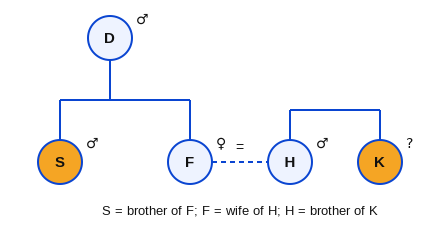
Based on the above, how is S related to K if ‘S + D ÷ F x H – K’?
एक निश्चित कूट भाषा में,
A + B का अर्थ है ‘A, B का पुत्र है’,
A – B का अर्थ है ‘A, B का भाई है’,
A x B का अर्थ है ‘A, B की पत्नी है’ और
A ÷ B का अर्थ है ‘A, B का पिता है’।
उपरोक्त के आधार पर, यदि ‘S + D ÷ F x H – K’ है, तो S का K से क्या संबंध है?
  1. ABrother's wife's fatherभाई की पत्नी का पिता
  2. BWife's brotherपत्नी का भाई
  3. CWife's fatherपत्नी का पिता
  4. DBrother's wife's brotherभाई की पत्नी का भाई
Show answer

Concept: Decode the expression pair by pair and draw the family tree.

  1. S + D: S is the son of D. D ÷ F: D is the father of F → S and F are siblings (S is F's brother).
  2. F × H: F is the wife of H. H – K: H is the brother of K.
  3. So K's brother is H, H's wife is F, and F's brother is S → S is K's brother's wife's brother.

Trick: Read the answer backwards from K: K → brother (H) → wife (F) → brother (S).

Answer: (D) Brother's wife's brother

अवधारणा: व्यंजक को जोड़ी-दर-जोड़ी डिकोड करें और वंश-वृक्ष बनाएँ।

  1. S + D: S, D का पुत्र। D ÷ F: D, F का पिता → S और F भाई-बहन (S, F का भाई)।
  2. F × H: F, H की पत्नी। H – K: H, K का भाई।
  3. अतः K का भाई H, H की पत्नी F, और F का भाई S → S, K के भाई की पत्नी का भाई है।

ट्रिक: उत्तर K से उल्टा पढ़ें: K → भाई (H) → पत्नी (F) → भाई (S)।

उत्तर: (D) Brother's wife's brother (भाई की पत्नी का भाई)

RRB NTPC Undergraduate CBT 1General Intelligence and ReasoningBlood Relations (Coded)RRB NTPC Undergraduate CBT 1 2025 · 7 May Shift 1 →
Q14373.
KH 13 is related to ID 2 in a certain way. In the same way, LO 9 is related to JK −2. To which of the following is LJ 7 related, following the same logic?
KH 13, ID 2 से एक निश्चित प्रकार से संबंधित है। उसी प्रकार, LO 9, JK −2 से संबंधित है। समान तर्क का अनुसरण करते हुए, LJ 7 निम्नलिखित में से किससे संबंधित है?
  1. AJG −6
  2. BKF −4
  3. CKG −6
  4. DJF −4
Show answer

Concept: Find separate rules for the two letters and the number.

  1. KH 13 → ID 2: K(11)→I(9) is −2; H(8)→D(4) is −4; 13−11=2.
  2. LO 9 → JK −2: L→J −2; O(15)→K(11) −4; 9−11=−2 ✓.
  3. LJ 7: L→J, J(10)→F(6), 7−11=−4 → JF −4.

Trick: Rule: 1st letter −2, 2nd letter −4, number −11.

Answer: (D) JF −4

अवधारणा: दोनों अक्षरों और संख्या के लिए अलग-अलग नियम खोजें।

  1. KH 13 → ID 2: K(11)→I(9) यानी −2; H(8)→D(4) यानी −4; 13−11=2।
  2. LO 9 → JK −2: L→J −2; O(15)→K(11) −4; 9−11=−2 ✓।
  3. LJ 7: L→J, J(10)→F(6), 7−11=−4 → JF −4।

ट्रिक: नियम: पहला अक्षर −2, दूसरा अक्षर −4, संख्या −11।

उत्तर: (D) JF −4

RRB NTPC Undergraduate CBT 1General Intelligence and ReasoningLetter–Number AnalogyRRB NTPC Undergraduate CBT 1 2025 · 7 May Shift 1 →
Q14374.
Based on the English alphabetical order, three of the following four letter-cluster pairs are alike in a certain way and thus form a group. Which is the one that does not belong to that group? (Note: The odd one out is not based on the number of
consonants/vowels or their position in the letter cluster.)
अंग्रेज़ी वर्णमाला क्रम के आधार पर, निम्नलिखित चार अक्षर-समूह युग्मों में से तीन एक निश्चित प्रकार से समान हैं और इस प्रकार एक समूह बनाते हैं। वह कौन-सा है जो उस समूह से संबंधित नहीं है? (नोट: असंगत युग्म अक्षर-समूह में
व्यंजनों/स्वरों की संख्या या उनकी स्थिति पर आधारित नहीं है।)
  1. ARP−NL
  2. BLJ−HF
  3. COM−KI
  4. DEC−ZA
Show answer

Concept: Compare corresponding letters of each pair by place value.

  1. RP−NL: R(18)→N(14) −4, P(16)→L(12) −4.
  2. LJ−HF: L→H −4, J→F −4. OM−KI: O→K −4, M→I −4.
  3. EC−ZA: E(5)→Z(26) is −5 (cyclic), C(3)→A(1) is −2 – the pattern breaks.

Trick: Three options follow the same (−4,−4) rule; the one that does not is the odd one.

Answer: (D) EC−ZA

अवधारणा: स्थान-मान से हर युग्म के संगत अक्षरों की तुलना करें।

  1. RP−NL: R(18)→N(14) −4, P(16)→L(12) −4।
  2. LJ−HF: L→H −4, J→F −4। OM−KI: O→K −4, M→I −4।
  3. EC−ZA: E(5)→Z(26) यानी −5 (चक्रीय), C(3)→A(1) यानी −2 – पैटर्न टूटता है।

ट्रिक: तीन विकल्प एक ही (−4,−4) नियम पर चलते हैं; जो नहीं चलता वही विषम है।

उत्तर: (D) EC−ZA

RRB NTPC Undergraduate CBT 1General Intelligence and ReasoningOdd One Out (Letter Pairs)RRB NTPC Undergraduate CBT 1 2025 · 7 May Shift 1 →
Q14375.
Each vowel in the word TRAJECTORIES is changed to the second letter immediately following it in the English alphabetical order, and each consonant is changed to the second letter immediately preceding it in the English alphabetical order. How many letters will appear exactly twice in the new group of letters thus formed?
शब्द TRAJECTORIES के प्रत्येक स्वर को अंग्रेज़ी वर्णमाला क्रम में उसके ठीक बाद आने वाले दूसरे अक्षर में बदल दिया जाता है, और प्रत्येक व्यंजन को अंग्रेज़ी वर्णमाला क्रम में उसके ठीक पहले आने वाले दूसरे अक्षर में बदल दिया जाता है। इस प्रकार बने नए अक्षर-समूह में कितने अक्षर ठीक दो बार आएँगे?
  1. ATwoदो
  2. BOneएक
  3. CThreeतीन
  4. DFourचार
Show answer

Concept: Vowels move +2, consonants move −2; then count repeated letters.

  1. TRAJECTORIES → T→R, R→P, A→C, J→H, E→G, C→A, T→R, O→Q, R→P, I→K, E→G, S→Q.
  2. New group: R P C H G A R Q P K G Q.
  3. Counts: R–2, P–2, G–2, Q–2; C, H, A, K once each → four letters appear exactly twice.

Trick: Letters that were already repeated in the word (T, R, E, O/… ) stay repeated after a uniform shift – T,T→R,R; R,R→P,P; E,E→G,G; and O→Q joins S→Q.

Answer: (D) Four

अवधारणा: स्वर +2, व्यंजन −2 बदलें; फिर दोहराए गए अक्षर गिनें।

  1. TRAJECTORIES → T→R, R→P, A→C, J→H, E→G, C→A, T→R, O→Q, R→P, I→K, E→G, S→Q।
  2. नया समूह: R P C H G A R Q P K G Q।
  3. गिनती: R–2, P–2, G–2, Q–2; C, H, A, K एक-एक बार → चार अक्षर ठीक दो बार आते हैं।

ट्रिक: शब्द में पहले से दोहराए अक्षर समान परिवर्तन के बाद भी दोहराए रहते हैं – T,T→R,R; R,R→P,P; E,E→G,G; और O→Q, S→Q से मिल जाता है।

उत्तर: (D) Four (चार)

RRB NTPC Undergraduate CBT 1General Intelligence and ReasoningWord Formation (Letter Shift)RRB NTPC Undergraduate CBT 1 2025 · 7 May Shift 1 →
Q14376.
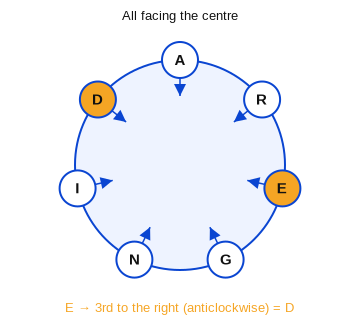
R, E, A, D, I, N and G are sitting around a circular table, facing the centre of the table. Only two people sit between N and R when counted from the left of R. G sits third to the left of A. D sits to the immediate right of A. D sits second to the left of N. I is not an immediate neighbor of G.
Who sits third to the right of E?
R, E, A, D, I, N और G एक वृत्ताकार मेज़ के चारों ओर मेज़ के केंद्र की ओर मुख करके बैठे हैं। R के बाएँ से गिनने पर N और R के बीच केवल दो व्यक्ति बैठे हैं। G, A के बाएँ तीसरे स्थान पर बैठा है। D, A के ठीक दाएँ बैठा है। D, N के बाएँ दूसरे स्थान पर बैठा है। I, G का निकटतम पड़ोसी नहीं है।
E के दाएँ तीसरे स्थान पर कौन बैठा है?
  1. AD
  2. BA
  3. CR
  4. DG
Show answer

Concept: When everyone faces the centre, "left" means clockwise and "right" means anticlockwise.

  1. Fix A. D is immediately right of A; G is third to the left of A.
  2. D is second to the left of N → N is two seats right of D. Check: from the left of R, two people then N → R sits next to A on A's left side (between A and E).
  3. Remaining E and I: I is not next to G, so I sits between N and D, E between R and G.
  4. Clockwise: A, R, E, G, N, I, D. Third to the right (anticlockwise) of E: R, A, D.

Trick: Facing centre → left = clockwise. Fix one person and count seats; verify every clue at the end.

Answer: (A) D

अवधारणा: जब सभी केंद्र की ओर मुख किए हों, "बाएँ" = दक्षिणावर्त (clockwise) और "दाएँ" = वामावर्त।

  1. A को स्थिर करें। D, A के ठीक दाएँ; G, A के बाएँ तीसरा।
  2. D, N के बाएँ दूसरा → N, D से दो सीट दाएँ। जाँच: R के बाएँ से गिनने पर दो लोग फिर N → R, A के बाएँ सटकर (A और E के बीच) बैठा है।
  3. बचे E और I: I, G का पड़ोसी नहीं, अतः I, N और D के बीच; E, R और G के बीच।
  4. दक्षिणावर्त: A, R, E, G, N, I, D। E के दाएँ (वामावर्त) तीसरा: R, A, D।

ट्रिक: केंद्र की ओर मुख → बाएँ = दक्षिणावर्त। एक व्यक्ति स्थिर कर सीटें गिनें; अंत में हर संकेत जाँचें।

उत्तर: (A) D

RRB NTPC Undergraduate CBT 1General Intelligence and ReasoningCircular Seating ArrangementRRB NTPC Undergraduate CBT 1 2025 · 7 May Shift 1 →
Q14377.
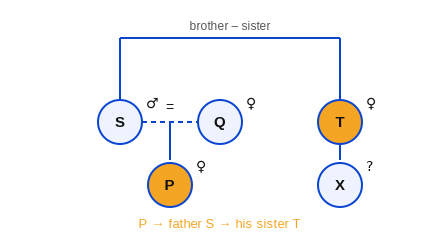
P is the daughter of Q. Q is the wife of S. T is the mother of X. T is the sister of S. How is T related to P?
P, Q की पुत्री है। Q, S की पत्नी है। T, X की माता है। T, S की बहन है। T का P से क्या संबंध है?
  1. ASisterबहन
  2. BFather's sisterपिता की बहन
  3. CHusband's sisterपति की बहन
  4. DMotherमाता
Show answer

Concept: Build the family tree step by step.

  1. P is the daughter of Q, and Q is the wife of S → S is P's father.
  2. T is the sister of S → T is the sister of P's father.
  3. Hence T is P's father's sister (bua). The clue about X is extra information.

Trick: Ignore extra persons (X here) – trace only the chain from P to T.

Answer: (B) Father's sister

अवधारणा: वंश-वृक्ष चरण-दर-चरण बनाएँ।

  1. P, Q की पुत्री और Q, S की पत्नी → S, P का पिता।
  2. T, S की बहन → T, P के पिता की बहन।
  3. अतः T, P की बुआ (father's sister) है। X वाला संकेत अतिरिक्त जानकारी है।

ट्रिक: अतिरिक्त व्यक्तियों (यहाँ X) को छोड़ें – केवल P से T तक की कड़ी देखें।

उत्तर: (B) Father's sister (बुआ)

RRB NTPC Undergraduate CBT 1General Intelligence and ReasoningBlood RelationsRRB NTPC Undergraduate CBT 1 2025 · 7 May Shift 1 →
Q14378.
​Based on the English alphabetical order, three of the following four letter-clusters are alike in a certain way and thus form a group. Which is the one that DOES NOT belong to that group? (Note: The odd one out is not based on the number of consonants/vowels or their position in the letter-cluster.)
अंग्रेज़ी वर्णमाला क्रम के आधार पर, निम्नलिखित चार अक्षर-समूहों में से तीन एक निश्चित प्रकार से समान हैं और इस प्रकार एक समूह बनाते हैं। वह कौन-सा है जो उस समूह से संबंधित नहीं है? (नोट: असंगत अक्षर-समूह, अक्षर-समूह में व्यंजनों/स्वरों की संख्या या उनकी स्थिति पर आधारित नहीं है।)
  1. AMJP
  2. BJGM
  3. CURY
  4. DQNT
Show answer

Concept: Compare the gaps between consecutive letters of each cluster.

  1. MJP: M(13)→J(10) −3, J→P(16) +6.
  2. JGM: J(10)→G(7) −3, G→M(13) +6. QNT: Q(17)→N(14) −3, N→T(20) +6.
  3. URY: U(21)→R(18) −3, R→Y(25) +7 – breaks the (−3,+6) pattern.

Trick: Write the two differences for each cluster; the odd set shows up instantly.

Answer: (C) URY

अवधारणा: हर समूह के क्रमागत अक्षरों के बीच के अंतर की तुलना करें।

  1. MJP: M(13)→J(10) −3, J→P(16) +6।
  2. JGM: J(10)→G(7) −3, G→M(13) +6। QNT: Q(17)→N(14) −3, N→T(20) +6।
  3. URY: U(21)→R(18) −3, R→Y(25) +7 – (−3,+6) पैटर्न टूटता है।

ट्रिक: हर समूह के दोनों अंतर लिखें; विषम समूह तुरंत दिख जाता है।

उत्तर: (C) URY

RRB NTPC Undergraduate CBT 1General Intelligence and ReasoningOdd One Out (Letter Clusters)RRB NTPC Undergraduate CBT 1 2025 · 7 May Shift 1 →
Q14379.
Which of the following options should come in place of the ‘?’ in the given series based on the English alphabetical order?
G 5, M 12, S 19, Y 26, ?
अंग्रेज़ी वर्णमाला क्रम के आधार पर दी गई श्रृंखला में ‘?’ के स्थान पर निम्नलिखित में से कौन-सा विकल्प आना चाहिए?
G 5, M 12, S 19, Y 26, ?
  1. AD 33
  2. BJ 33
  3. CA 33
  4. DE 33
Show answer

Concept: Treat the letters and the numbers as two separate series.

  1. Letters: G(7) → M(13) → S(19) → Y(25) → each +6; 25+6=31, and 31−26=5 → E.
  2. Numbers: 5, 12, 19, 26 → each +7 → 26+7=33.
  3. Next term = E 33.

Trick: After Z the alphabet wraps around – subtract 26 to find the letter.

Answer: (D) E 33

अवधारणा: अक्षरों और संख्याओं को दो अलग श्रृंखलाएँ मानें।

  1. अक्षर: G(7) → M(13) → S(19) → Y(25) → हर बार +6; 25+6=31, और 31−26=5 → E।
  2. संख्याएँ: 5, 12, 19, 26 → हर बार +7 → 26+7=33।
  3. अगला पद = E 33।

ट्रिक: Z के बाद वर्णमाला घूमकर A से शुरू होती है – अक्षर पाने के लिए 26 घटाएँ।

उत्तर: (D) E 33

RRB NTPC Undergraduate CBT 1General Intelligence and ReasoningLetter–Number SeriesRRB NTPC Undergraduate CBT 1 2025 · 7 May Shift 1 →
Q14380.
Which of the following letter-number clusters will replace the question mark (?) in the given series to make it logically complete?
MCK 10, PFN 13, SIQ 16, VLT 19, ?
दी गई श्रृंखला को तार्किक रूप से पूर्ण करने के लिए निम्नलिखित में से कौन-सा अक्षर-संख्या समूह प्रश्नवाचक चिह्न (?) का स्थान लेगा?
MCK 10, PFN 13, SIQ 16, VLT 19, ?
  1. AYOW 22
  2. BXPW 24
  3. CXOV 22
  4. DYPV 22
Show answer

Concept: Check each letter position and the number separately.

  1. 1st letters: M, P, S, V → +3 → Y. 2nd letters: C, F, I, L → +3 → O. 3rd letters: K, N, Q, T → +3 → W.
  2. Numbers: 10, 13, 16, 19 → +3 → 22.
  3. Next term = YOW 22.

Trick: Everything moves by +3 here – a uniform shift is the most common NTPC pattern.

Answer: (A) YOW 22

अवधारणा: हर अक्षर-स्थान और संख्या को अलग-अलग जाँचें।

  1. पहले अक्षर: M, P, S, V → +3 → Y। दूसरे: C, F, I, L → +3 → O। तीसरे: K, N, Q, T → +3 → W।
  2. संख्याएँ: 10, 13, 16, 19 → +3 → 22।
  3. अगला पद = YOW 22।

ट्रिक: यहाँ सब कुछ +3 चलता है – समान परिवर्तन NTPC का सबसे आम पैटर्न है।

उत्तर: (A) YOW 22

RRB NTPC Undergraduate CBT 1General Intelligence and ReasoningLetter–Number SeriesRRB NTPC Undergraduate CBT 1 2025 · 7 May Shift 1 →