Question bank

Q&A: practice questions with answers

Search questions on any topic. Filter by exam category, exam, subject and topic, try the question, then open the answer and explanation.

Courses – airGurukul

20,719 questions found.

Q14441.
In a division sum, the divisor is 3 times the quotient and 8 times the remainder. If the remainder is 12, what is the dividend?
एक भाग के प्रश्न में भाजक, भागफल का 3 गुना और शेषफल का 8 गुना है। यदि शेषफल 12 है, तो भाज्य क्या है?
  1. A3048
  2. B3084
  3. C3072
  4. D3066
Show answer

Concept: Dividend =Divisor×Quotient+Remainder.

  1. Remainder =12; divisor =8×12=96.
  2. Divisor =3× quotient ⇒ quotient =963=32.
  3. Dividend =96×32+12=3072+12=3084.

Trick: 96×32=96×30+96×2=2880+192=3072; add the remainder 12 → 3084 (ends in 4, so options A/C/D are out).

Answer: (B) 3084

अवधारणा: भाज्य =भाजक×भागफल+शेषफल।

  1. शेषफल =12; भाजक =8×12=96।
  2. भाजक =3× भागफल ⇒ भागफल =963=32।
  3. भाज्य =96×32+12=3072+12=3084।

ट्रिक: 96×32=96×30+96×2=2880+192=3072; शेषफल 12 जोड़ें → 3084 (अंत में 4, अतः विकल्प A/C/D बाहर)।

उत्तर: (B) 3084
RRB NTPC Undergraduate CBT 2MathematicsNumber System – Division AlgorithmRRB NTPC Undergraduate CBT 2 2025 · 17 Sep Shift 1 →
Q14442.
Consider the data set: 4, 8, 6, 5, 3, 9. Find the variance.
आँकड़ों के समुच्चय 4, 8, 6, 5, 3, 9 पर विचार कीजिए। प्रसरण (variance) ज्ञात कीजिए।
  1. A15136
  2. B16135
  3. C16136
  4. D15135
Show answer

Concept: Variance σ2=∑xi2n−x¯2 (population variance, n=6).

  1. ∑x=4+8+6+5+3+9=35, so x¯=356.
  2. ∑x2=16+64+36+25+9+81=231.
  3. σ2=2316−(356)2=231×6−122536=1386−122536=16136.

Trick: Keep the mean as a fraction (356) instead of a decimal; the denominator 36 appears directly, which eliminates options B and D.

Answer: (C) 16136

अवधारणा: प्रसरण σ2=∑xi2n−x¯2 (समष्टि प्रसरण, n=6)।

  1. ∑x=4+8+6+5+3+9=35, अतः x¯=356।
  2. ∑x2=16+64+36+25+9+81=231।
  3. σ2=2316−(356)2=231×6−122536=1386−122536=16136।

ट्रिक: माध्य को दशमलव की बजाय भिन्न (356) में रखें; हर 36 सीधे आता है, जिससे विकल्प B और D हट जाते हैं।

उत्तर: (C) 16136

RRB NTPC Undergraduate CBT 2MathematicsStatistics – VarianceRRB NTPC Undergraduate CBT 2 2025 · 17 Sep Shift 1 →
Q14443.
A shopkeeper expects a gain of 40% on his cost price. If in a week, his sale proceeds were ₹3,955, what was his profit (in ₹)?
एक दुकानदार अपने क्रय मूल्य पर 40% लाभ की अपेक्षा करता है। यदि एक सप्ताह में उसकी बिक्री से प्राप्त राशि ₹3,955 थी, तो उसका लाभ (₹ में) क्या था?
  1. A1,130
  2. B1,133
  3. C1,129
  4. D1,132
Show answer

Concept: If gain is 40% on CP, then SP=140100×CP, so Profit=40140×SP=27×SP.

  1. Sale proceeds (SP) = ₹3,955.
  2. CP =3955×100140=39551.4= ₹2,825.
  3. Profit =3955−2825= ₹1,130.

Trick: Profit =27×3955=2×565=1130 (since 3955÷7=565).

Answer: (A) 1,130

अवधारणा: यदि CP पर 40% लाभ है तो SP=140100×CP, अतः लाभ=40140×SP=27×SP।

  1. बिक्री राशि (SP) = ₹3,955।
  2. CP =3955×100140=39551.4= ₹2,825।
  3. लाभ =3955−2825= ₹1,130।

ट्रिक: लाभ =27×3955=2×565=1130 (क्योंकि 3955÷7=565)।

उत्तर: (A) 1,130

RRB NTPC Undergraduate CBT 2MathematicsProfit and LossRRB NTPC Undergraduate CBT 2 2025 · 17 Sep Shift 1 →
Q14444.
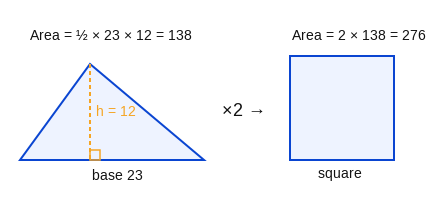
Find the area of a square, which has twice the area of a triangle whose base length is 23 cm and corresponding height is 12 cm.
एक ऐसे वर्ग का क्षेत्रफल ज्ञात कीजिए जिसका क्षेत्रफल उस त्रिभुज के क्षेत्रफल का दोगुना है, जिसके आधार की लंबाई 23 cm और संगत ऊँचाई 12 cm है।
  1. A256 cm2
  2. B204 cm2
  3. C218 cm2
  4. D276 cm2
Show answer

Concept: Area of triangle =12×base×height; the square's area is twice this.

  1. Triangle area =12×23×12=138cm2.
  2. Square area =2×138=276cm2.
  3. (Its side would be 276≈16.6 cm, but only the area is asked.)

Trick: Twice the triangle's area is simply base×height=23×12=276 – no halving needed.

Answer: (D) 276cm2

अवधारणा: त्रिभुज का क्षेत्रफल =12×आधार×ऊँचाई; वर्ग का क्षेत्रफल इसका दोगुना है।

  1. त्रिभुज का क्षेत्रफल =12×23×12=138cm2।
  2. वर्ग का क्षेत्रफल =2×138=276cm2।
  3. (इसकी भुजा 276≈16.6 cm होगी, पर केवल क्षेत्रफल पूछा है।)

ट्रिक: त्रिभुज के क्षेत्रफल का दोगुना = आधार×ऊँचाई=23×12=276 – आधा करने की ज़रूरत ही नहीं।

उत्तर: (D) 276cm2

RRB NTPC Undergraduate CBT 2MathematicsMensuration – AreaRRB NTPC Undergraduate CBT 2 2025 · 17 Sep Shift 1 →
Q14445.
If 5siny+cosy=13siny, find the value of tany.
यदि 5siny+cosy=13siny है, तो tany का मान ज्ञात कीजिए।
  1. A−6−1312
  2. B−5−1317
  3. C−5−1312
  4. D−5−1322
Show answer

Concept: Divide the whole equation by siny to get coty, then invert and rationalise.

  1. 5siny+cosy=13siny⇒cosy=(13−5)siny.
  2. tany=sinycosy=113−5.
  3. Rationalise: 113−5×13+513+5=13+513−25=13+5−12=−5−1312.

Trick: Since 13<5, cosy and siny have opposite signs, so tany must be negative with denominator 25−13=12 – only option C matches.

Answer: (C) −5−1312

अवधारणा: पूरे समीकरण को siny से भाग देकर coty निकालें, फिर उलटकर परिमेयकरण (rationalise) करें।

  1. 5siny+cosy=13siny⇒cosy=(13−5)siny।
  2. tany=sinycosy=113−5।
  3. परिमेयकरण: 113−5×13+513+5=13+513−25=13+5−12=−5−1312।

ट्रिक: चूँकि 13<5, cosy और siny के चिह्न विपरीत हैं, अतः tany ऋणात्मक होगा और हर 25−13=12 – केवल विकल्प C मेल खाता है।

उत्तर: (C) −5−1312

RRB NTPC Undergraduate CBT 2MathematicsTrigonometry – IdentitiesRRB NTPC Undergraduate CBT 2 2025 · 17 Sep Shift 1 →
Q14446.
Find the fourth proportional to 20.5, 21.5 and 22.5.
20.5, 21.5 और 22.5 का चतुर्थानुपाती ज्ञात कीजिए।
  1. A20.5
  2. B22
  3. C24
  4. D23.5
Show answer

Concept: Fourth proportional to a,b,c is x with a:b=c:x, so x=b×ca. With powers of the same base, add/subtract exponents.

  1. x=21.5×22.520.5
  2. =21.5+2.5−0.5=23.5

Trick: Fourth proportional = (2nd × 3rd) ÷ 1st. For same base: multiply → add powers, divide → subtract powers.

Answer: (D) 23.5

अवधारणा: a,b,c का चतुर्थानुपाती (fourth proportional) x है जहाँ a:b=c:x, अतः x=b×ca। समान आधार की घातों में घातांक जोड़ते/घटाते हैं।

  1. x=21.5×22.520.5
  2. =21.5+2.5−0.5=23.5

ट्रिक: चतुर्थानुपाती = (दूसरा × तीसरा) ÷ पहला। समान आधार: गुणा → घात जोड़ें, भाग → घात घटाएँ।

उत्तर: (D) 23.5

RRB NTPC Undergraduate CBT 2MathematicsProportionRRB NTPC Undergraduate CBT 2 2025 · 17 Sep Shift 1 →
Q14447.
Evaluate: (−37) + (−56) ÷ (−3) × 3
मान ज्ञात कीजिए: (−37) + (−56) ÷ (−3) × 3
  1. A21
  2. B15
  3. C19
  4. D17
Show answer

Concept: Apply BODMAS: division and multiplication (left to right) before addition.

  1. (−56)÷(−3)=563, then 563×3=56
  2. (−37)+56=19

Trick: Negative ÷ negative = positive. The ÷3 and ×3 cancel, leaving −37+56.

Answer: (C) 19

अवधारणा: BODMAS लागू करें: जोड़ से पहले भाग और गुणा (बाएँ से दाएँ)।

  1. (−56)÷(−3)=563, फिर 563×3=56
  2. (−37)+56=19

ट्रिक: ऋण ÷ ऋण = धन। ÷3 और ×3 कट जाते हैं, बचता है −37+56।

उत्तर: (C) 19

RRB NTPC Undergraduate CBT 2MathematicsSimplification (BODMAS)RRB NTPC Undergraduate CBT 2 2025 · 17 Sep Shift 1 →
Q14448.
7% of a number is what percentage of the 9% of the same number? (Rounded off to two decimal places.)
किसी संख्या का 7%, उसी संख्या के 9% का कितना प्रतिशत है? (दो दशमलव स्थानों तक पूर्णांकित)
  1. A43.75%
  2. B21.87%
  3. C78.57%
  4. D77.78%
Show answer

Concept: Required percentage =partwhole×100; the number itself cancels out.

  1. 7% of N9% of N×100=79×100
  2. =77.777…%≈77.78%

Trick: Such questions never depend on the number — just divide the two percentages: 79=0.7778.

Answer: (D) 77.78%

अवधारणा: अभीष्ट प्रतिशत =भागपूर्ण×100; संख्या स्वयं कट जाती है।

  1. N का 7%N का 9%×100=79×100
  2. =77.777…%≈77.78%

ट्रिक: ऐसे प्रश्न संख्या पर निर्भर नहीं करते — बस दोनों प्रतिशतों का भाग करें: 79=0.7778।

उत्तर: (D) 77.78%

RRB NTPC Undergraduate CBT 2MathematicsPercentageRRB NTPC Undergraduate CBT 2 2025 · 17 Sep Shift 1 →
Q14449.
Find the total number of prime factors of the number 58×67×114.
संख्या 58×67×114 के अभाज्य गुणनखंडों की कुल संख्या ज्ञात कीजिए।
  1. A26
  2. B22
  3. C28
  4. D30
Show answer

Concept: Write every base as a product of primes; the total number of prime factors is the sum of all exponents (counted with repetition).

  1. 67=(2×3)7=27×37
  2. N=58×27×37×114
  3. Total prime factors =8+7+7+4=26

Trick: Only 6 is composite here — split it first. (Distinct primes would be 4; total prime factors counts repetition.)

Answer: (A) 26

अवधारणा: हर आधार को अभाज्य संख्याओं के गुणनफल में लिखें; कुल अभाज्य गुणनखंड = सभी घातांकों का योग (पुनरावृत्ति सहित)।

  1. 67=(2×3)7=27×37
  2. N=58×27×37×114
  3. कुल अभाज्य गुणनखंड =8+7+7+4=26

ट्रिक: यहाँ केवल 6 भाज्य है — उसे पहले तोड़ें। (भिन्न अभाज्य 4 होते; 'कुल' में पुनरावृत्ति गिनी जाती है।)

उत्तर: (A) 26

RRB NTPC Undergraduate CBT 2MathematicsNumber System – Prime FactorsRRB NTPC Undergraduate CBT 2 2025 · 17 Sep Shift 1 →
Q14450.
If 25% of A is equal to 40% of B, and 30% of B is equal to 45% of C, then A:B:C is:
यदि A का 25%, B के 40% के बराबर है और B का 30%, C के 45% के बराबर है, तो A:B:C है:
  1. A8:5:3
  2. B12:9:7
  3. C24:14:9
  4. D24:15:10
Show answer

Concept: Convert each percentage relation into a ratio, then combine by making the common term (B) equal.

  1. 25%A=40%B⇒AB=4025=85
  2. 30%B=45%C⇒BC=4530=32
  3. Make B equal: A:B=24:15, B:C=15:10 → A:B:C=24:15:10

Trick: pA=qB gives A:B=q:p (the numbers swap sides).

Answer: (D) 24:15:10

अवधारणा: हर प्रतिशत संबंध को अनुपात में बदलें, फिर उभयनिष्ठ पद (B) को बराबर करके जोड़ें।

  1. 25%A=40%B⇒AB=4025=85
  2. 30%B=45%C⇒BC=4530=32
  3. B बराबर करें: A:B=24:15, B:C=15:10 → A:B:C=24:15:10

ट्रिक: pA=qB से A:B=q:p (संख्याएँ पक्ष बदल लेती हैं)।

उत्तर: (D) 24:15:10

RRB NTPC Undergraduate CBT 2MathematicsRatioRRB NTPC Undergraduate CBT 2 2025 · 17 Sep Shift 1 →
Q14451.
If the average of three numbers is 15 and two of the numbers are 10 and 20, what is the third number?
यदि तीन संख्याओं का औसत 15 है और उनमें से दो संख्याएँ 10 और 20 हैं, तो तीसरी संख्या क्या है?
  1. A10
  2. B15
  3. C20
  4. D25
Show answer

Concept: Sum = average × number of terms.

  1. Sum of three numbers =15×3=45
  2. Third number =45−(10+20)=15

Trick: If two numbers average to the given mean (here 10+202=15), the third must equal the mean itself.

Answer: (B) 15

अवधारणा: योग = औसत × पदों की संख्या।

  1. तीन संख्याओं का योग =15×3=45
  2. तीसरी संख्या =45−(10+20)=15

ट्रिक: यदि दो संख्याओं का औसत दिए गए औसत के बराबर है (यहाँ 10+202=15), तो तीसरी संख्या भी औसत ही होगी।

उत्तर: (B) 15

RRB NTPC Undergraduate CBT 2MathematicsAverageRRB NTPC Undergraduate CBT 2 2025 · 17 Sep Shift 1 →
Q14452.
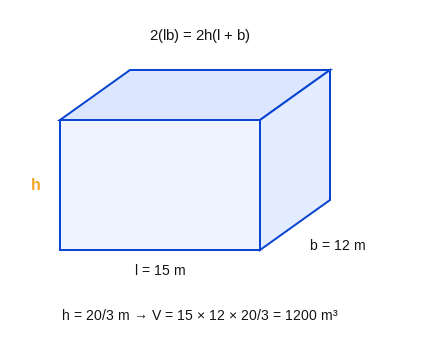
A water tank is of cuboidal shape having length 15 m and breadth 12 m. The sum of the area of the floor and ceiling of the tank is same as the area of four walls of the tank. How many liters of rainwater can be collected in this tank?
एक पानी की टंकी घनाभाकार है जिसकी लंबाई 15 m और चौड़ाई 12 m है। टंकी के फर्श और छत के क्षेत्रफलों का योग टंकी की चारों दीवारों के क्षेत्रफल के बराबर है। इस टंकी में कितने लीटर वर्षा जल एकत्र किया जा सकता है?
  1. A1000 × 102 liters1000 × 102 लीटर
  2. B1200 × 102 liters1200 × 102 लीटर
  3. C1200 litres1200 लीटर
  4. D1200 × 103 liters1200 × 103 लीटर
Show answer

Concept: Floor + ceiling =2lb; four walls =2h(l+b). Volume =lbh, and 1m3=1000 litres.

  1. 2×15×12=2h(15+12)⇒360=54h⇒h=203m
  2. Volume =15×12×203=1200m3
  3. =1200×1000=1200×103 litres

Trick: Floor + ceiling = walls ⇒ h=lbl+b. Then always convert m³ → litres by ×1000.

Answer: (D) 1200×103 liters

अवधारणा: फर्श + छत =2lb; चार दीवारें =2h(l+b)। आयतन =lbh, और 1m3=1000 लीटर।

  1. 2×15×12=2h(15+12)⇒360=54h⇒h=203m
  2. आयतन =15×12×203=1200m3
  3. =1200×1000=1200×103 लीटर

ट्रिक: फर्श + छत = दीवारें ⇒ h=lbl+b। फिर m³ → लीटर के लिए ×1000 करें।

उत्तर: (D) 1200×103 लीटर

RRB NTPC Undergraduate CBT 2MathematicsMensuration – CuboidRRB NTPC Undergraduate CBT 2 2025 · 17 Sep Shift 1 →
Q14453.
A, B and C together can complete a certain work in 37 days. B and C together can complete the same work in 74 days. B is 50% more efficient than A. A, B and C work together for 28 days. B alone will complete the remaining work in:
A, B और C मिलकर एक निश्चित कार्य को 37 दिनों में पूरा कर सकते हैं। B और C मिलकर उसी कार्य को 74 दिनों में पूरा कर सकते हैं। B, A से 50% अधिक कार्यकुशल है। A, B और C 28 दिनों तक एक साथ कार्य करते हैं। शेष कार्य को B अकेले कितने दिनों में पूरा करेगा?
  1. A9 days9 दिन
  2. B13 days13 दिन
  3. C12 days12 दिन
  4. D14 days14 दिन
Show answer

Concept: Work per day =1days. Efficiency of B =1.5× efficiency of A.

  1. A's one-day work =137−174=174
  2. B's one-day work =32×174=3148
  3. Work done in 28 days =2837, remaining =937
  4. B alone: 937÷3148=937×1483=12 days

Trick: Take total work =148 units: group does 4/day, A does 2/day, B does 3/day. Remaining 148−28×4=36 units ⇒36÷3=12 days.

Answer: (C) 12 days

अवधारणा: प्रतिदिन कार्य =1दिन। B की दक्षता =1.5× A की दक्षता।

  1. A का एक दिन का कार्य =137−174=174
  2. B का एक दिन का कार्य =32×174=3148
  3. 28 दिन में कार्य =2837, शेष =937
  4. B अकेला: 937÷3148=937×1483=12 दिन

ट्रिक: कुल कार्य =148 इकाई लें: समूह 4/दिन, A 2/दिन, B 3/दिन। शेष 148−28×4=36 इकाई ⇒36÷3=12 दिन।

उत्तर: (C) 12 दिन

RRB NTPC Undergraduate CBT 2MathematicsTime and WorkRRB NTPC Undergraduate CBT 2 2025 · 17 Sep Shift 1 →
Q14454.
Evaluate: 11 − 12 ÷ 12 × 8
मान ज्ञात कीजिए: 11 − 12 ÷ 12 × 8
  1. A3
  2. B4
  3. C2
  4. D1
Show answer

Concept: Division and multiplication first (left to right), then subtraction.

  1. 12÷12=1, then 1×8=8
  2. 11−8=3

Trick: Never subtract first: 11−12 is the classic trap. Resolve the ÷ and × chain before touching −.

Answer: (A) 3

अवधारणा: पहले भाग और गुणा (बाएँ से दाएँ), फिर घटाव।

  1. 12÷12=1, फिर 1×8=8
  2. 11−8=3

ट्रिक: पहले घटाना मत: 11−12 आम जाल है। − से पहले ÷ और × की श्रृंखला हल करें।

उत्तर: (A) 3

RRB NTPC Undergraduate CBT 2MathematicsSimplification (BODMAS)RRB NTPC Undergraduate CBT 2 2025 · 17 Sep Shift 1 →
Q14455.
A cyclist travels the first 30 km at 20 km/h, the next 50 km at 25 km/h, and the final 20 km at 10 km/h. What is the cyclist's average speed for the entire 100 km trip (round off to the nearest integer)?
एक साइकिल सवार पहले 30 km की दूरी 20 km/h की चाल से, अगले 50 km की दूरी 25 km/h की चाल से और अंतिम 20 km की दूरी 10 km/h की चाल से तय करता है। पूरी 100 km की यात्रा के लिए साइकिल सवार की औसत चाल क्या है (निकटतम पूर्णांक तक पूर्णांकित)?
  1. A18 km/h
  2. B20 km/h
  3. C19 km/h
  4. D21 km/h
Show answer

Concept: Average speed =total distancetotal time (never the average of speeds).

  1. Times: 3020=1.5 h, 5025=2 h, 2010=2 h → total 5.5 h
  2. Average speed =1005.5=18.18≈18km/h

Trick: Different distances at different speeds → compute each time separately; the slow 10 km/h stretch pulls the average well below 20.

Answer: (A) 18 km/h

अवधारणा: औसत चाल =कुल दूरीकुल समय (चालों का औसत कभी नहीं)।

  1. समय: 3020=1.5 h, 5025=2 h, 2010=2 h → कुल 5.5 h
  2. औसत चाल =1005.5=18.18≈18km/h

ट्रिक: अलग-अलग दूरियाँ अलग चालों पर → हर भाग का समय अलग निकालें; धीमा 10 km/h वाला हिस्सा औसत को 20 से काफी नीचे खींच देता है।

उत्तर: (A) 18 km/h

RRB NTPC Undergraduate CBT 2MathematicsSpeed – Average SpeedRRB NTPC Undergraduate CBT 2 2025 · 17 Sep Shift 1 →
Q14456.
If 5 workers, working 8 hours a day for 12 days, produce 2400 units, then how many units will 10 workers, working 8 hours a day for 12 days, produce, assuming the productivity of each worker remains constant?
यदि 5 श्रमिक, प्रतिदिन 8 घंटे काम करते हुए 12 दिनों में 2400 इकाइयाँ बनाते हैं, तो 10 श्रमिक, प्रतिदिन 8 घंटे काम करते हुए 12 दिनों में कितनी इकाइयाँ बनाएँगे, यह मानते हुए कि प्रत्येक श्रमिक की उत्पादकता स्थिर रहती है?
  1. A3600 units3600 इकाइयाँ
  2. B4800 units4800 इकाइयाँ
  3. C6000 units6000 इकाइयाँ
  4. D2400 units2400 इकाइयाँ
Show answer

Concept: Units produced ∝ workers × hours × days.

  1. Hours and days unchanged; workers doubled (5→10)
  2. Units =2400×105=4800

Trick: M1H1D1W1=M2H2D2W2 — change only the quantity that changed.

Answer: (B) 4800 units

अवधारणा: उत्पादित इकाइयाँ ∝ श्रमिक × घंटे × दिन।

  1. घंटे और दिन समान; श्रमिक दोगुने (5→10)
  2. इकाइयाँ =2400×105=4800

ट्रिक: M1H1D1W1=M2H2D2W2 — केवल वही राशि बदलें जो बदली है।

उत्तर: (B) 4800 इकाई

RRB NTPC Undergraduate CBT 2MathematicsChain Rule (Work)RRB NTPC Undergraduate CBT 2 2025 · 17 Sep Shift 1 →
Q14457.
Krish has ₹1,352, which he divides between his two sons, Veer and Nitin. Both invest their respective amounts at an annual compound interest rate of 8%. If the amounts accumulated by Veer after 18 years and by Nitin after 19 years are equal, how much money (in ₹) did Krish give to Nitin?
कृष के पास ₹1,352 हैं, जिन्हें वह अपने दो पुत्रों वीर और नितिन के बीच बाँटता है। दोनों अपनी-अपनी राशि 8% वार्षिक चक्रवृद्धि ब्याज की दर से निवेश करते हैं। यदि 18 वर्ष बाद वीर द्वारा और 19 वर्ष बाद नितिन द्वारा संचित राशियाँ बराबर हैं, तो कृष ने नितिन को कितनी राशि (₹ में) दी?
  1. A702
  2. B802
  3. C500
  4. D650
Show answer

Concept: Amount =P(1+r100)n. Equal amounts after different years ⇒ principals are in inverse ratio of the extra growth.

  1. V(1.08)18=N(1.08)19⇒V=1.08N
  2. V:N=108:100=27:25
  3. Nitin's share =2552×1352=25×26=650

Trick: One extra year of CI at r% ⇒ shares are (100+r):100. At 8%: 27:25; 1352÷52=26.

Answer: (D) 650

अवधारणा: मिश्रधन =P(1+r100)n। अलग-अलग वर्षों बाद बराबर मिश्रधन ⇒ मूलधन अतिरिक्त वृद्धि के व्युत्क्रम अनुपात में।

  1. V(1.08)18=N(1.08)19⇒V=1.08N
  2. V:N=108:100=27:25
  3. नितिन का भाग =2552×1352=25×26=650

ट्रिक: r% पर एक अतिरिक्त वर्ष ⇒ भाग (100+r):100। 8% पर 27:25; 1352÷52=26।

उत्तर: (D) 650

RRB NTPC Undergraduate CBT 2MathematicsCompound InterestRRB NTPC Undergraduate CBT 2 2025 · 17 Sep Shift 1 →
Q14458.
The monthly incomes of two friends Mohan and David are in the ratio 6 : 8, respectively and each of them saves ₹51,000 every month. If the ratio of their monthly expenditure is 2 : 4, find the monthly income of Mohan (in ₹).
दो मित्रों मोहन और डेविड की मासिक आय क्रमशः 6 : 8 के अनुपात में है और उनमें से प्रत्येक हर महीने ₹51,000 बचाता है। यदि उनके मासिक व्यय का अनुपात 2 : 4 है, तो मोहन की मासिक आय (₹ में) ज्ञात कीजिए।
  1. A76,500
  2. B77,500
  3. C1,07,100
  4. D75,500
Show answer

Concept: Expenditure = Income − Savings. Set incomes as 6x,8x and use the expenditure ratio.

  1. 6x−510008x−51000=24=12
  2. 12x−102000=8x−51000⇒4x=51000⇒x=12750
  3. Mohan's income =6×12750=76,500

Trick: Equal savings: income difference = expenditure difference. Incomes differ by 2x, expenditures by y (ratio 1:2) ⇒ y=2x, 6x−y=51000⇒x=12750.

Answer: (A) 76,500

अवधारणा: व्यय = आय − बचत। आय 6x,8x मानें और व्यय अनुपात का प्रयोग करें।

  1. 6x−510008x−51000=24=12
  2. 12x−102000=8x−51000⇒4x=51000⇒x=12750
  3. मोहन की आय =6×12750=76,500

ट्रिक: बराबर बचत: आय का अंतर = व्यय का अंतर। आय का अंतर 2x, व्यय y (अनुपात 1:2) ⇒ y=2x, 6x−y=51000⇒x=12750।

उत्तर: (A) 76,500

RRB NTPC Undergraduate CBT 2MathematicsRatio – Income & ExpenditureRRB NTPC Undergraduate CBT 2 2025 · 17 Sep Shift 1 →
Q14459.
A gun is fired at a distance of 1.45 km from a place. The sound was heard after 5 seconds. The speed (m/s) at which sound travels is?
किसी स्थान से 1.45 km की दूरी पर एक बंदूक चलाई जाती है। उसकी आवाज़ 5 सेकंड बाद सुनाई दी। ध्वनि किस चाल (m/s) से चलती है?
  1. A290 m/s
  2. B145 m/s
  3. C240 m/s
  4. D300 m/s
Show answer

Concept: Speed =distancetime; convert km to metres first.

  1. 1.45km=1450m
  2. Speed =14505=290m/s

Trick: Match units before dividing: km → m (×1000). 1450÷5=290.

Answer: (A) 290 m/s

अवधारणा: चाल =दूरीसमय; पहले km को m में बदलें।

  1. 1.45km=1450m
  2. चाल =14505=290m/s

ट्रिक: भाग देने से पहले इकाइयाँ मिलाएँ: km → m (×1000)। 1450÷5=290।

उत्तर: (A) 290 m/s

RRB NTPC Undergraduate CBT 2MathematicsSpeed, Distance, TimeRRB NTPC Undergraduate CBT 2 2025 · 17 Sep Shift 1 →
Q14460.
A laptop is marked at ₹45,000. A shopkeeper offers a discount of 25% on the marked price. After the discount, the laptop is sold with an additional 10% tax on the selling price. What is the final price of the laptop after the discount and tax?
एक लैपटॉप का अंकित मूल्य ₹45,000 है। एक दुकानदार अंकित मूल्य पर 25% की छूट देता है। छूट के बाद, लैपटॉप को विक्रय मूल्य पर 10% अतिरिक्त कर के साथ बेचा जाता है। छूट और कर के बाद लैपटॉप का अंतिम मूल्य क्या है?
  1. A₹33,750
  2. B₹37,125
  3. C₹37,500
  4. D₹34,650
Show answer

Concept: Successive changes multiply: price ×(1−discount)×(1+tax).

  1. After 25% discount: 45000×34=33750
  2. After 10% tax: 33750×1.1=37125

Trick: −25% then +10% is a net −17.5% (by a+b+ab100): 45000×0.825=37125.

Answer: (B) ₹37,125

अवधारणा: क्रमिक परिवर्तन गुणा होते हैं: मूल्य ×(1−छूट)×(1+कर)।

  1. 25% छूट के बाद: 45000×34=33750
  2. 10% कर के बाद: 33750×1.1=37125

ट्रिक: −25% फिर +10% = कुल −17.5% (a+b+ab100 से): 45000×0.825=37125।

उत्तर: (B) ₹37,125

RRB NTPC Undergraduate CBT 2MathematicsDiscount and TaxRRB NTPC Undergraduate CBT 2 2025 · 17 Sep Shift 1 →