Question bank

Q&A: practice questions with answers

Search questions on any topic. Filter by exam category, exam, subject and topic, try the question, then open the answer and explanation.

Courses – airGurukul

20,719 questions found.

Q14461.
A shopkeeper professes to sell his goods at a 5% loss but uses a false balance and gains 40%. The actual weight (rounded off to one decimal place) he uses for 1 kg is:
एक दुकानदार अपना माल 5% हानि पर बेचने का दावा करता है, लेकिन गलत तराज़ू का उपयोग करता है और 40% लाभ कमाता है। 1 kg के लिए वह वास्तव में जो भार (एक दशमलव स्थान तक पूर्णांकित) उपयोग करता है, वह है:
  1. A675.3 gm
  2. B680.9 gm
  3. C678.6 gm
  4. D682.8 gm
Show answer

Concept: Selling at a 5% 'loss' means SP =0.95× CP of 1 kg. Actual gain 40% means true cost of goods given =SP1.4.

  1. SP of '1 kg' =0.95C (C = cost of a real kg)
  2. True cost of goods handed over =0.95C1.4=0.6786C
  3. Weight given =0.6786×1000≈678.6 g

Trick: False-weight formula: weight used=1000×100−loss%100+gain%=1000×95140.

Answer: (C) 678.6 gm

अवधारणा: 5% 'हानि' पर बेचना यानी SP =0.95× 1 kg का CP। वास्तविक 40% लाभ यानी दिए गए माल की असली लागत =SP1.4।

  1. '1 kg' का SP =0.95C (C = असली 1 kg की लागत)
  2. दिए गए माल की असली लागत =0.95C1.4=0.6786C
  3. दिया गया भार =0.6786×1000≈678.6 g

ट्रिक: गलत बाट सूत्र: प्रयुक्त भार=1000×100−हानि%100+लाभ%=1000×95140।

उत्तर: (C) 678.6 gm

RRB NTPC Undergraduate CBT 2MathematicsProfit & Loss – False WeightRRB NTPC Undergraduate CBT 2 2025 · 17 Sep Shift 1 →
Q14462.
How many spherical lead shots of radius 3 cm can be made out of a solid cuboid of lead having dimensions 54 cm × 44 cm × 30 cm? (Take π=227)
54 cm × 44 cm × 30 cm विमाओं वाले सीसे के एक ठोस घनाभ से 3 cm त्रिज्या की कितनी गोलाकार सीसे की गोलियाँ बनाई जा सकती हैं? (π=227 लीजिए)
  1. A620
  2. B640
  3. C630
  4. D600
Show answer

Concept: Number of shots =volume of cuboidvolume of one sphere, sphere volume =43πr3.

  1. Cuboid =54×44×30=71280cm3
  2. One shot =43×227×27=7927cm3
  3. N=71280×7792=90×7=630

Trick: Cancel before multiplying: 71280÷792=90 (since 792×90=71280), then ×7.

Answer: (C) 630

अवधारणा: गोलियों की संख्या =घनाभ का आयतनएक गोले का आयतन, गोले का आयतन =43πr3।

  1. घनाभ =54×44×30=71280cm3
  2. एक गोली =43×227×27=7927cm3
  3. N=71280×7792=90×7=630

ट्रिक: गुणा से पहले काटें: 71280÷792=90 (792×90=71280), फिर ×7।

उत्तर: (C) 630

RRB NTPC Undergraduate CBT 2MathematicsMensuration – Volume ConversionRRB NTPC Undergraduate CBT 2 2025 · 17 Sep Shift 1 →
Q14463.
Arrange the ratios in the ascending order: 6:7, 11:12, 21:23, 31:35, 43:45.
अनुपातों को आरोही क्रम में व्यवस्थित कीजिए: 6:7, 11:12, 21:23, 31:35, 43:45.
  1. A6:7, 31:35, 21:23, 11:12, 43:45
  2. B6:7, 31:35, 11:12, 21:23, 43:45
  3. C6:7, 31:35, 11:12, 43:45, 21:23
  4. D6:7, 11:12, 21:23, 31:35, 43:45
Show answer

Concept: Compare each ratio by its decimal value, or by how far it is below 1.

  1. 67=0.857, 3135=0.886, 2123=0.913, 1112=0.917, 4345=0.956
  2. Ascending: 6:7<31:35<21:23<11:12<43:45

Trick: Each ratio is 1−kd: deficits 17,435,223,112,245. Larger deficit ⇒ smaller ratio. Watch 21:23 vs 11:12: 223=0.087>112=0.083.

Answer: (A) 6:7, 31:35, 21:23, 11:12, 43:45

अवधारणा: हर अनुपात की तुलना दशमलव मान से, या 1 से कितना कम है, उससे करें।

  1. 67=0.857, 3135=0.886, 2123=0.913, 1112=0.917, 4345=0.956
  2. आरोही क्रम: 6:7<31:35<21:23<11:12<43:45

ट्रिक: हर अनुपात 1−kd है: कमी 17,435,223,112,245। बड़ी कमी ⇒ छोटा अनुपात। 21:23 बनाम 11:12 ध्यान दें: 223=0.087>112=0.083।

उत्तर: (A) 6:7, 31:35, 21:23, 11:12, 43:45

RRB NTPC Undergraduate CBT 2MathematicsComparison of RatiosRRB NTPC Undergraduate CBT 2 2025 · 17 Sep Shift 1 →
Q14464.
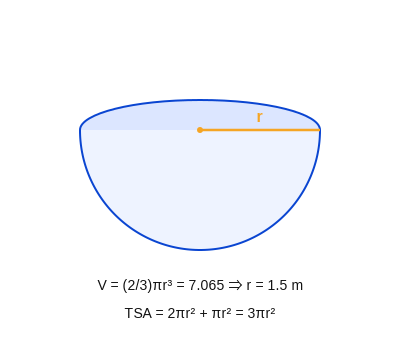
Find the total surface area of a hemispherical bowl whose volume is 7.065m3. (Take π=3.14)
एक अर्धगोलाकार कटोरे का कुल पृष्ठीय क्षेत्रफल ज्ञात कीजिए जिसका आयतन 7.065m3 है। (π=3.14 लीजिए)
  1. A21.195 m2
  2. B18.125 m2
  3. C28.365 m2
  4. D35.125 m2
Show answer

Concept: Hemisphere: volume =23πr3, total surface area =3πr2 (curved 2πr2 + flat top πr2).

  1. 23×3.14×r3=7.065⇒r3=7.065×36.28=3.375
  2. r=1.5m
  3. TSA =3×3.14×(1.5)2=3×3.14×2.25=21.195m2

Trick: 3.375=1.53 is worth memorising (like 0.125=0.53). Check with options: TSA of a hemisphere =3πr2, not 2πr2.

Answer: (A) 21.195 m²

अवधारणा: अर्धगोला: आयतन =23πr3, कुल पृष्ठीय क्षेत्रफल =3πr2 (वक्र 2πr2 + ऊपरी समतल πr2)।

  1. 23×3.14×r3=7.065⇒r3=7.065×36.28=3.375
  2. r=1.5m
  3. TSA =3×3.14×(1.5)2=3×3.14×2.25=21.195m2

ट्रिक: 3.375=1.53 याद रखें (जैसे 0.125=0.53)। अर्धगोले का TSA =3πr2 है, 2πr2 नहीं।

उत्तर: (A) 21.195 m²

RRB NTPC Undergraduate CBT 2MathematicsMensuration – HemisphereRRB NTPC Undergraduate CBT 2 2025 · 17 Sep Shift 1 →
Q14465.
A student's marks were incorrectly entered as 68 instead of 59. Due to this, the average marks of the class got increase by 1.8. What is the number of students in the class?
एक विद्यार्थी के अंक गलती से 59 के स्थान पर 68 दर्ज कर दिए गए। इसके कारण कक्षा के औसत अंकों में 1.8 की वृद्धि हो गई। कक्षा में विद्यार्थियों की संख्या क्या है?
  1. A7
  2. B4
  3. C6
  4. D5
Show answer

Concept: Change in total = change in average × number of students.

  1. Excess entered =68−59=9
  2. n×1.8=9⇒n=5

Trick: Wrong-entry questions: n=difference of entrieschange in average.

Answer: (D) 5

अवधारणा: कुल में परिवर्तन = औसत में परिवर्तन × विद्यार्थियों की संख्या।

  1. अधिक दर्ज अंक =68−59=9
  2. n×1.8=9⇒n=5

ट्रिक: गलत प्रविष्टि वाले प्रश्न: n=प्रविष्टियों का अंतरऔसत में परिवर्तन।

उत्तर: (D) 5

RRB NTPC Undergraduate CBT 2MathematicsAverage – Error CorrectionRRB NTPC Undergraduate CBT 2 2025 · 17 Sep Shift 1 →
Q14466.
A stationery shop sells notebooks and pens. Suppose 5 notebooks and 3 pens cost ₹146, whereas 7 notebooks and 2 pens cost ₹178. If a student buys 4 notebooks and 6 pens, how much will the student pay?
एक स्टेशनरी की दुकान नोटबुक और पेन बेचती है। मान लीजिए 5 नोटबुक और 3 पेन का मूल्य ₹146 है, जबकि 7 नोटबुक और 2 पेन का मूल्य ₹178 है। यदि एक विद्यार्थी 4 नोटबुक और 6 पेन खरीदता है, तो वह कितना भुगतान करेगा?
  1. A₹176
  2. B₹160
  3. C₹168
  4. D₹154
Show answer

Concept: Form two equations in notebook price n and pen price p and solve by elimination.

  1. 5n+3p=146 … (i), 7n+2p=178 … (ii)
  2. (i)×2 − (ii)×3: 10n+6p−21n−6p=292−534⇒−11n=−242⇒n=22
  3. 3p=146−110=36⇒p=12
  4. Cost =4×22+6×12=88+72=160

Trick: Check: 5(22)+3(12)=110+36=146 ✓. Options differ a lot, so finding n alone almost settles it.

Answer: (B) ₹160

अवधारणा: नोटबुक का मूल्य n और पेन का p मानकर दो समीकरण बनाएँ और विलोपन से हल करें।

  1. 5n+3p=146 … (i), 7n+2p=178 … (ii)
  2. (i)×2 − (ii)×3: 10n+6p−21n−6p=292−534⇒−11n=−242⇒n=22
  3. 3p=146−110=36⇒p=12
  4. लागत =4×22+6×12=88+72=160

ट्रिक: जाँच: 5(22)+3(12)=110+36=146 ✓। विकल्प काफी अलग हैं, इसलिए n मिलते ही उत्तर लगभग तय हो जाता है।

उत्तर: (B) ₹160

RRB NTPC Undergraduate CBT 2MathematicsLinear EquationsRRB NTPC Undergraduate CBT 2 2025 · 17 Sep Shift 1 →
Q14467.
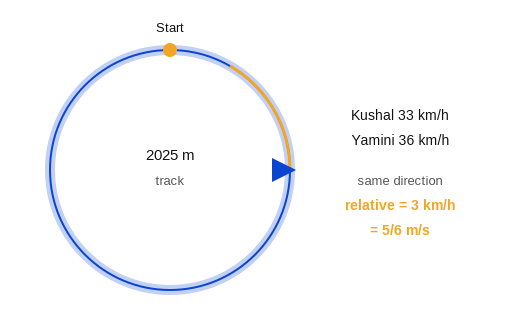
In a circular race of 2025 m, Kushal and Yamini start from the same point and at the same time with speeds of 33 km/h and 36 km/h, respectively. After how long will they meet again for the first time on the track when they are running in the same direction?
2025 m की एक वृत्ताकार दौड़ में, कुशल और यामिनी एक ही बिंदु से एक ही समय पर क्रमशः 33 km/h और 36 km/h की चाल से दौड़ना शुरू करते हैं। एक ही दिशा में दौड़ते हुए वे ट्रैक पर पहली बार पुनः कितने समय बाद मिलेंगे?
  1. A2426 seconds2426 सेकंड
  2. B2430 seconds2430 सेकंड
  3. C2438 seconds2438 सेकंड
  4. D2434 seconds2434 सेकंड
Show answer

Concept: Same direction: first meeting time =track lengthrelative speed (the faster one gains a full lap).

  1. Relative speed =36−33=3km/h=3×518=56m/s
  2. Time =20255/6=2025×65=2430 s

Trick: km/h → m/s: multiply by 518. Opposite directions would use the sum 69 km/h instead.

Answer: (B) 2430 seconds

अवधारणा: समान दिशा: पहली बार मिलने का समय =पथ की लंबाईसापेक्ष चाल (तेज़ धावक एक पूरा चक्कर आगे निकलता है)।

  1. सापेक्ष चाल =36−33=3km/h=3×518=56m/s
  2. समय =20255/6=2025×65=2430 s

ट्रिक: km/h → m/s: 518 से गुणा। विपरीत दिशा में योग 69 km/h लिया जाता।

उत्तर: (B) 2430 सेकंड

RRB NTPC Undergraduate CBT 2MathematicsCircular Track – Meeting TimeRRB NTPC Undergraduate CBT 2 2025 · 17 Sep Shift 1 →
Q14468.
A team of 24 workers is assigned to finish a task in 15 days. After working for 1 day, 8 workers quit. Assuming all workers are equally efficient, how many additional days will the remaining workers need to complete the rest of the task?
24 श्रमिकों की एक टीम को एक कार्य 15 दिनों में पूरा करने के लिए नियुक्त किया जाता है। 1 दिन काम करने के बाद 8 श्रमिक काम छोड़ देते हैं। यह मानते हुए कि सभी श्रमिक समान रूप से कार्यकुशल हैं, शेष श्रमिकों को बचे हुए कार्य को पूरा करने के लिए कितने अतिरिक्त दिनों की आवश्यकता होगी?
  1. A25 days25 दिन
  2. B21 days21 दिन
  3. C18 days18 दिन
  4. D28 days28 दिन
Show answer

Concept: Total work in man-days stays fixed: men×days.

  1. Total work =24×15=360 man-days
  2. Done in day 1: 24; remaining =336
  3. Remaining workers =16: days =33616=21

Trick: 'Additional days' here means days needed from now with 16 workers — 21 (not 21−14=7 extra over schedule).

Answer: (B) 21 days

अवधारणा: कुल कार्य श्रमिक-दिन में स्थिर रहता है: श्रमिक×दिन।

  1. कुल कार्य =24×15=360 श्रमिक-दिन
  2. पहले दिन हुआ: 24; शेष =336
  3. शेष श्रमिक =16: दिन =33616=21

ट्रिक: यहाँ 'अतिरिक्त दिन' का अर्थ अब से 16 श्रमिकों को लगने वाले दिन — 21 (योजना से 21−14=7 अधिक नहीं)।

उत्तर: (B) 21 दिन

RRB NTPC Undergraduate CBT 2MathematicsTime and Work – Man-daysRRB NTPC Undergraduate CBT 2 2025 · 17 Sep Shift 1 →
Q14469.
The mean of a data is 41 and its median is 50. The mode (using empirical relation) of the data is:
किसी आँकड़े का माध्य 41 और माध्यिका 50 है। आँकड़े का बहुलक (आनुभविक संबंध का उपयोग करते हुए) है:
  1. A91
  2. B68
  3. C150
  4. D156
Show answer

Concept: Empirical relation: Mode=3Median−2Mean.

  1. Mode=3×50−2×41
  2. =150−82=68

Yaad rakhein: Mean − Mode =3(Mean−Median). Remember '3 median, 2 mean'.

Answer: (B) 68

अवधारणा: आनुभविक संबंध: बहुलक=3माध्यिका−2माध्य।

  1. बहुलक=3×50−2×41
  2. =150−82=68

याद रखें: माध्य − बहुलक =3(माध्य−माध्यिका)। याद रखें '3 माध्यिका, 2 माध्य'।

उत्तर: (B) 68

RRB NTPC Undergraduate CBT 2MathematicsStatistics – Empirical RelationRRB NTPC Undergraduate CBT 2 2025 · 17 Sep Shift 1 →
Q14470.
A and B complete a piece of work in 24 days. If A alone can complete it in 60 days, then in how many days can B alone complete one-fourth of the same work?
A और B एक कार्य को 24 दिनों में पूरा करते हैं। यदि A अकेला उसे 60 दिनों में पूरा कर सकता है, तो B अकेला उसी कार्य का एक-चौथाई भाग कितने दिनों में पूरा कर सकता है?
  1. A12
  2. B8
  3. C9
  4. D10
Show answer

Concept: B's one-day work = (A+B)'s − A's.

  1. 124−160=5−2120=140 ⇒ B alone takes 40 days
  2. One-fourth of the work: 404=10 days

Trick: LCM method: work =120; A+B =5/day, A =2/day, B =3/day; 14 work =30 units ⇒10 days.

Answer: (D) 10

अवधारणा: B का एक दिन का कार्य = (A+B) का − A का।

  1. 124−160=5−2120=140 ⇒ B अकेला 40 दिन लेता है
  2. एक-चौथाई कार्य: 404=10 दिन

ट्रिक: LCM विधि: कार्य =120; A+B =5/दिन, A =2/दिन, B =3/दिन; 14 कार्य =30 इकाई ⇒10 दिन।

उत्तर: (D) 10

RRB NTPC Undergraduate CBT 2MathematicsTime and WorkRRB NTPC Undergraduate CBT 2 2025 · 17 Sep Shift 1 →
Q14471.
What should come in place of the question mark (?) in the given series?
74 75 67 94 30 ?
दी गई श्रृंखला में प्रश्नवाचक चिह्न (?) के स्थान पर क्या आना चाहिए?
74 75 67 94 30 ?
  1. A155
  2. B264
  3. C246
  4. D165
Show answer

Concept: Differences follow cubes with alternating signs.

  1. 74→75: +13; 75→67: −23; 67→94: +33; 94→30: −43
  2. Next: 30+53=30+125=155

Trick: When terms jump up and down, check alternating +/− of squares or cubes: 1,8,27,64,125.

Answer: (A) 155

अवधारणा: अंतर एकांतर चिह्नों वाले घन हैं।

  1. 74→75: +13; 75→67: −23; 67→94: +33; 94→30: −43
  2. अगला: 30+53=30+125=155

ट्रिक: जब पद ऊपर-नीचे कूदें, तो वर्गों या घनों के एकांतर +/− जाँचें: 1,8,27,64,125।

उत्तर: (A) 155

RRB NTPC Undergraduate CBT 2General Intelligence and ReasoningNumber SeriesRRB NTPC Undergraduate CBT 2 2025 · 17 Sep Shift 1 →
Q14472.
Based on the English alphabetical order, three of the following four letter-cluster pairs are alike in a certain way and thus form a group. Which is the one that does not belong to that group? (Note: The odd man out is not based on the number of consonants/vowels or their position in the letter-cluster.)
अंग्रेज़ी वर्णमाला क्रम के आधार पर, निम्नलिखित चार अक्षर-समूह युग्मों में से तीन एक निश्चित प्रकार से समान हैं और इस प्रकार एक समूह बनाते हैं। वह कौन-सा है जो उस समूह से संबंधित नहीं है? (नोट: विषम युग्म व्यंजनों/स्वरों की संख्या या अक्षर-समूह में उनकी स्थिति पर आधारित नहीं है।)
  1. ASX - UA
  2. BJP - LS
  3. CMI - OL
  4. DTC - VE
Show answer

Concept: Compare the letter shifts from the first cluster to the second in each pair.

  1. SX–UA: S+2=U, X+3=A; JP–LS: J+2=L, P+3=S; MI–OL: M+2=O, I+3=L — pattern (+2, +3)
  2. TC–VE: T+2=V, C+2=E — pattern (+2, +2), different

Trick: Write place values (A=1 … Z=26) and subtract position-wise; the pair with a different difference set is the odd one.

Answer: (D) TC - VE

अवधारणा: हर जोड़े में पहले समूह से दूसरे तक अक्षरों की शिफ्ट की तुलना करें।

  1. SX–UA: S+2=U, X+3=A; JP–LS: J+2=L, P+3=S; MI–OL: M+2=O, I+3=L — पैटर्न (+2, +3)
  2. TC–VE: T+2=V, C+2=E — पैटर्न (+2, +2), अलग

ट्रिक: स्थानीय मान (A=1 … Z=26) लिखकर स्थान-वार घटाएँ; जिस जोड़े का अंतर-सेट अलग हो वही विषम है।

उत्तर: (D) TC - VE

RRB NTPC Undergraduate CBT 2General Intelligence and ReasoningLetter Analogy – Odd One OutRRB NTPC Undergraduate CBT 2 2025 · 17 Sep Shift 1 →
Q14473.
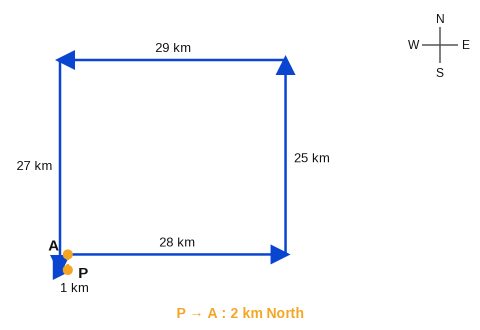
Sumit starts from Point A and drives 28 km towards East. He then takes a left turn, drives 25 km, turns left and drives 29 km. He then takes a left turn and drives 27 km. He takes a final left turn, drives 1 km and stops at Point P. How far (shortest distance) and towards which direction should he drive in order to reach Point A again? (All turns are 90-degree turns only unless specified.)
सुमित बिंदु A से चलना शुरू करता है और पूर्व की ओर 28 km गाड़ी चलाता है। फिर वह बाएँ मुड़ता है, 25 km चलता है, बाएँ मुड़ता है और 29 km चलता है। फिर वह बाएँ मुड़ता है और 27 km चलता है। वह अंतिम बार बाएँ मुड़ता है, 1 km चलता है और बिंदु P पर रुक जाता है। बिंदु A पर पुनः पहुँचने के लिए उसे कितनी दूर (न्यूनतम दूरी) और किस दिशा में गाड़ी चलानी चाहिए? (जब तक अन्यथा निर्दिष्ट न हो, सभी मोड़ केवल 90 डिग्री के मोड़ हैं।)
  1. A1 km to the West1 km पश्चिम की ओर
  2. B4 km to the South4 km दक्षिण की ओर
  3. C3 km to the East3 km पूर्व की ओर
  4. D2 km to the North2 km उत्तर की ओर
Show answer

Concept: Track the position on a grid; each left turn rotates East→North→West→South→East.

  1. Start A(0,0) → 28 km East (28,0) → 25 km North (28,25) → 29 km West (−1,25)
  2. → 27 km South (−1,−2) → 1 km East: P(0,−2)
  3. P is 2 km directly South of A, so he must drive 2 km North

Trick: Net East–West: 28−29+1=0; net North–South: 25−27=−2. Zero sideways offset ⇒ answer is purely North/South.

Answer: (D) 2 km to the North

अवधारणा: ग्रिड पर स्थिति ट्रैक करें; हर बायाँ मोड़ पूर्व→उत्तर→पश्चिम→दक्षिण→पूर्व घुमाता है।

  1. प्रारंभ A(0,0) → 28 km पूर्व (28,0) → 25 km उत्तर (28,25) → 29 km पश्चिम (−1,25)
  2. → 27 km दक्षिण (−1,−2) → 1 km पूर्व: P(0,−2)
  3. P, A से ठीक 2 km दक्षिण में है, अतः 2 km उत्तर चलना होगा

ट्रिक: शुद्ध पूर्व–पश्चिम: 28−29+1=0; शुद्ध उत्तर–दक्षिण: 25−27=−2। बगल का विस्थापन शून्य ⇒ उत्तर केवल उत्तर/दक्षिण में।

उत्तर: (D) 2 km उत्तर की ओर

RRB NTPC Undergraduate CBT 2General Intelligence and ReasoningDirection SenseRRB NTPC Undergraduate CBT 2 2025 · 17 Sep Shift 1 →
Q14474.
If ‘P’ stands for ‘×’, ‘Q’ stands for ‘÷’, ‘R’ stands for ‘−’ and ‘S’ stands for ‘+’, what will come in place of the question mark (?) in the following equation?
12 P 9 S (98 Q 7) P 3 R 25 = ?
यदि ‘P’ का अर्थ ‘×’, ‘Q’ का अर्थ ‘÷’, ‘R’ का अर्थ ‘−’ और ‘S’ का अर्थ ‘+’ है, तो निम्नलिखित समीकरण में प्रश्नवाचक चिह्न (?) के स्थान पर क्या आएगा?
12 P 9 S (98 Q 7) P 3 R 25 = ?
  1. A133
  2. B142
  3. C198
  4. D125
Show answer

Concept: Substitute the symbols and apply BODMAS.

  1. 12×9+(98÷7)×3−25
  2. =108+14×3−25=108+42−25=125

Trick: Rewrite the whole expression in symbols first, then solve — never substitute and compute term by term.

Answer: (D) 125

अवधारणा: प्रतीक बदलें और BODMAS लागू करें।

  1. 12×9+(98÷7)×3−25
  2. =108+14×3−25=108+42−25=125

ट्रिक: पहले पूरे व्यंजक को चिह्नों में लिखें, फिर हल करें — पद-दर-पद बदलकर गणना न करें।

उत्तर: (D) 125

RRB NTPC Undergraduate CBT 2General Intelligence and ReasoningMathematical OperationsRRB NTPC Undergraduate CBT 2 2025 · 17 Sep Shift 1 →
Q14475.
Refer to the following letter and symbol series and answer the question that follows.
(Left) M K * J & H ^ G % F $ D # S @ S ! Z + ? N (Right)
If all the letters are dropped from the series, which of the following will be ninth from the right?
निम्नलिखित अक्षर और प्रतीक श्रृंखला को देखिए और उसके बाद दिए गए प्रश्न का उत्तर दीजिए।
(बाएँ) M K * J & H ^ G % F $ D # S @ S ! Z + ? N (दाएँ)
यदि श्रृंखला से सभी अक्षर हटा दिए जाएँ, तो निम्नलिखित में से कौन-सा दाएँ से नौवाँ होगा?
  1. A&
  2. B%
  3. C@
  4. D#
Show answer

Concept: Remove all letters, then count from the right in the remaining series.

  1. Remaining symbols (left to right): * & ^ % $ # @ ! + ? — 10 symbols
  2. 9th from the right = 2nd from the left = &

Trick: nth from right =(N−n+1)th from left: 10−9+1=2.

Answer: (A) &

अवधारणा: सभी अक्षर हटाएँ, फिर शेष श्रृंखला में दाएँ से गिनें।

  1. शेष प्रतीक (बाएँ से दाएँ): * & ^ % $ # @ ! + ? — 10 प्रतीक
  2. दाएँ से 9वाँ = बाएँ से 2रा = &

ट्रिक: दाएँ से nवाँ = बाएँ से (N−n+1)वाँ: 10−9+1=2।

उत्तर: (A) &

RRB NTPC Undergraduate CBT 2General Intelligence and ReasoningSymbol SeriesRRB NTPC Undergraduate CBT 2 2025 · 17 Sep Shift 1 →
Q14476.
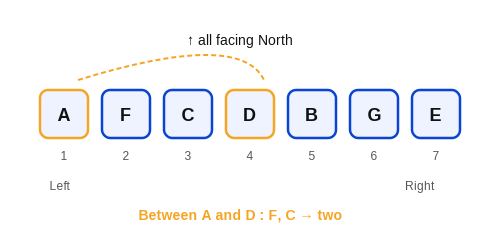
Seven people, A, B, C, D, E, F and G, are sitting in a straight line, facing north. Only two people are sitting to the left of C. Only four people are sitting between F and E. B is sitting second to the right of C. B is not an immediate neighbour of A. D is sitting to the immediate right of C. F is sitting to the immediate right of A. How many people are sitting between A and D?
सात व्यक्ति A, B, C, D, E, F और G एक सीधी पंक्ति में उत्तर की ओर मुख करके बैठे हैं। C के बाईं ओर केवल दो व्यक्ति बैठे हैं। F और E के बीच केवल चार व्यक्ति बैठे हैं। B, C के दाईं ओर दूसरे स्थान पर बैठा है। B, A का निकटतम पड़ोसी नहीं है। D, C के ठीक दाईं ओर बैठा है। F, A के ठीक दाईं ओर बैठा है। A और D के बीच कितने व्यक्ति बैठे हैं?
  1. ATwoदो
  2. BNoneकोई नहीं
  3. COneएक
  4. DThreeतीन
Show answer

Concept: Number seats 1–7 from left (all face north, so left/right are the usual).

  1. Two people left of C ⇒ C = 3; D immediately right ⇒ D = 4; B second right of C ⇒ B = 5
  2. Four between F and E ⇒ (F,E) at 1&6 or 2&7; F is immediately right of A ⇒ A = 1, F = 2, E = 7; G = 6
  3. Row: A F C D B G E. Between A(1) and D(4): F and C ⇒ two

Trick: Start with the fixed-position clue ('only two to the left of C'); such definite clues anchor the whole row.

Answer: (A) Two

अवधारणा: बाएँ से सीटें 1–7 क्रमांकित करें (सब उत्तर की ओर, अतः बाएँ/दाएँ सामान्य)।

  1. C के बाएँ दो ⇒ C = 3; D ठीक दाएँ ⇒ D = 4; B, C के दाएँ दूसरा ⇒ B = 5
  2. F और E के बीच चार ⇒ (F,E) 1&6 या 2&7 पर; F, A के ठीक दाएँ ⇒ A = 1, F = 2, E = 7; G = 6
  3. पंक्ति: A F C D B G E। A(1) और D(4) के बीच: F और C ⇒ दो

ट्रिक: निश्चित-स्थिति वाले सुराग ('C के बाएँ केवल दो') से शुरू करें; ऐसे सुराग पूरी पंक्ति को तय कर देते हैं।

उत्तर: (A) दो

RRB NTPC Undergraduate CBT 2General Intelligence and ReasoningLinear Seating ArrangementRRB NTPC Undergraduate CBT 2 2025 · 17 Sep Shift 1 →
Q14477.
If ‘A’ stands for ‘÷’, ‘B’ stands for ‘×’, ‘C’ stands for ‘+’ and ‘D’ stands for ‘−’, what will come in place of the question mark (?) in the following equation?
67 C 3 B 19 C (84 A 2) D 6 = ?
यदि ‘A’ का अर्थ ‘÷’, ‘B’ का अर्थ ‘×’, ‘C’ का अर्थ ‘+’ और ‘D’ का अर्थ ‘−’ है, तो निम्नलिखित समीकरण में प्रश्नवाचक चिह्न (?) के स्थान पर क्या आएगा?
67 C 3 B 19 C (84 A 2) D 6 = ?
  1. A172
  2. B154
  3. C160
  4. D173
Show answer

Concept: Substitute the letters by the given operators and apply BODMAS.

  1. 67+3×19+(84÷2)−6
  2. =67+57+42−6=160

Trick: Do the bracket and the multiplication first (84÷2=42, 3×19=57), then add/subtract left to right.

Answer: (C) 160

अवधारणा: अक्षरों के स्थान पर दिए गए संकारक रखें और BODMAS लागू करें।

  1. 67+3×19+(84÷2)−6
  2. =67+57+42−6=160

ट्रिक: पहले कोष्ठक और गुणा (84÷2=42, 3×19=57), फिर बाएँ से दाएँ जोड़/घटाव।

उत्तर: (C) 160

RRB NTPC Undergraduate CBT 2General Intelligence and ReasoningMathematical OperationsRRB NTPC Undergraduate CBT 2 2025 · 17 Sep Shift 1 →
Q14478.
Below are given two sets of numbers. In each set of numbers, a certain
mathematical operation on first number results in the second number. Similarly, certain mathematical operation on second number results in the third number and so on. Which of the given options follows the same set of operations as in question? (NOTE : Operations should be performed on the whole numbers, without breaking down the numbers into its constituent digits. E.g. 13 – Operations on 13 such as adding /subtracting /multiplying etc. to 13 can be performed. Breaking down 13 into 1 and 3 and then performing mathematical operations on 1 and 3 is not allowed.)
3 – 9 – 27 – 32 ;
4 – 16 – 48 – 53
नीचे संख्याओं के दो समुच्चय दिए गए हैं। संख्याओं के प्रत्येक समुच्चय में, पहली संख्या पर एक निश्चित
गणितीय संक्रिया करने पर दूसरी संख्या प्राप्त होती है। इसी प्रकार, दूसरी संख्या पर निश्चित गणितीय संक्रिया करने पर तीसरी संख्या प्राप्त होती है, और इसी प्रकार आगे भी। दिए गए विकल्पों में से कौन-सा प्रश्न में दी गई संक्रियाओं के समान समुच्चय का पालन करता है? (नोट: संक्रियाएँ पूर्ण संख्याओं पर की जानी चाहिए, संख्याओं को उनके घटक अंकों में तोड़े बिना। उदाहरण के लिए 13 – 13 पर संक्रियाएँ जैसे 13 में जोड़ना/घटाना/गुणा करना आदि की जा सकती हैं। 13 को 1 और 3 में तोड़कर फिर 1 और 3 पर गणितीय संक्रियाएँ करने की अनुमति नहीं है।)
3 – 9 – 27 – 32 ;
4 – 16 – 48 – 53
  1. A7 -49-98-145
  2. B5 -25-75-80
  3. C8-64-128-150
  4. D6-36-72-80
Show answer

Concept: Find the chain of operations in the given sets and test each option.

  1. 3→9 (n2), 9→27 (×3), 27→32 (+5); 4→16 (n2), 16→48 (×3), 48→53 (+5)
  2. Option B: 52=25, 25×3=75, 75+5=80 ✓
  3. Others fail: 7→49→147 (not 98), 8→64→192 (not 128), 6→36→108 (not 72)

Trick: Pattern is square → ×3 → +5. Check the second step first — it eliminates A, C, D instantly.

Answer: (B) 5 -25-75-80

अवधारणा: दिए गए सेटों में संक्रियाओं की श्रृंखला पहचानें और हर विकल्प जाँचें।

  1. 3→9 (n2), 9→27 (×3), 27→32 (+5); 4→16 (n2), 16→48 (×3), 48→53 (+5)
  2. विकल्प B: 52=25, 25×3=75, 75+5=80 ✓
  3. बाकी असफल: 7→49→147 (98 नहीं), 8→64→192 (128 नहीं), 6→36→108 (72 नहीं)

ट्रिक: पैटर्न: वर्ग → ×3 → +5। दूसरा चरण पहले जाँचें — A, C, D तुरंत कट जाते हैं।

उत्तर: (B) 5 -25-75-80

RRB NTPC Undergraduate CBT 2General Intelligence and ReasoningNumber Analogy (operations)RRB NTPC Undergraduate CBT 2 2025 · 17 Sep Shift 1 →
Q14479.
Select the pair which follows the same pattern as that followed by the two pairs given below. Both pairs follow the same pattern.
LIF : HEB
WUH : SQD
उस युग्म का चयन कीजिए जो नीचे दिए गए दो युग्मों द्वारा अनुसरण किए गए पैटर्न के समान पैटर्न का अनुसरण करता है। दोनों युग्म समान पैटर्न का अनुसरण करते हैं।
LIF : HEB
WUH : SQD
  1. AHRP : DOL
  2. BJLG : EGC
  3. CKOT : GKQ
  4. DTQV : PMR
Show answer

Concept: Each letter of the first cluster moves back by 4 to give the second cluster.

  1. LIF → HEB: L−4=H, I−4=E, F−4=B; WUH → SQD: W−4=S, U−4=Q, H−4=D
  2. TQV → PMR: T−4=P, Q−4=M, V−4=R ✓
  3. HRP → DOL fails (R−4=N, not O); KOT → GKQ fails (T−4=P, not Q)

Trick: Check the letter that differs: in option A the middle letter and in C the last letter break the −4 rule.

Answer: (D) TQV : PMR

अवधारणा: पहले समूह का हर अक्षर 4 पीछे जाकर दूसरा समूह बनाता है।

  1. LIF → HEB: L−4=H, I−4=E, F−4=B; WUH → SQD: W−4=S, U−4=Q, H−4=D
  2. TQV → PMR: T−4=P, Q−4=M, V−4=R ✓
  3. HRP → DOL गलत (R−4=N, O नहीं); KOT → GKQ गलत (T−4=P, Q नहीं)

ट्रिक: अलग अक्षर जाँचें: विकल्प A में बीच का और C में अंतिम अक्षर −4 नियम तोड़ता है।

उत्तर: (D) TQV : PMR

RRB NTPC Undergraduate CBT 2General Intelligence and ReasoningLetter AnalogyRRB NTPC Undergraduate CBT 2 2025 · 17 Sep Shift 1 →
Q14480.
Which of the following letter-number clusters will replace the question mark (?) in the given series to make it logically complete?
WOG 147, BKB 163, GGW 179, LCR 195, QYM 211, ?
निम्नलिखित में से कौन-सा अक्षर-संख्या समूह दी गई श्रृंखला को तार्किक रूप से पूर्ण करने के लिए प्रश्नवाचक चिह्न (?) का स्थान लेगा?
WOG 147, BKB 163, GGW 179, LCR 195, QYM 211, ?
  1. AWVG 225
  2. BVWG 225
  3. CUTF 227
  4. DVUH 227
Show answer

Concept: Track each position separately: letters by shift, numbers by difference.

  1. 1st letters W, B, G, L, Q: +5 each ⇒ Q+5 = V
  2. 2nd letters O, K, G, C, Y: −4 each ⇒ Y−4 = U
  3. 3rd letters G, B, W, R, M: −5 each ⇒ M−5 = H; numbers +16 ⇒ 211+16 = 227

Trick: Only VUH 227 matches all four parts; WVG/VWG with 225 fail on the number alone.

Answer: (D) VUH 227

अवधारणा: हर स्थान को अलग देखें: अक्षर शिफ्ट से, संख्याएँ अंतर से।

  1. पहले अक्षर W, B, G, L, Q: हर बार +5 ⇒ Q+5 = V
  2. दूसरे अक्षर O, K, G, C, Y: −4 ⇒ Y−4 = U
  3. तीसरे अक्षर G, B, W, R, M: −5 ⇒ M−5 = H; संख्याएँ +16 ⇒ 211+16 = 227

ट्रिक: केवल VUH 227 चारों भागों में सही है; WVG/VWG 225 संख्या से ही कट जाते हैं।

उत्तर: (D) VUH 227

RRB NTPC Undergraduate CBT 2General Intelligence and ReasoningLetter–Number SeriesRRB NTPC Undergraduate CBT 2 2025 · 17 Sep Shift 1 →