Question bank

Q&A: practice questions with answers

Search questions on any topic. Filter by exam category, exam, subject and topic, try the question, then open the answer and explanation.

Courses – airGurukul

20,719 questions found.

Q14601.
Based on the alphabetical order, three of the following four are alike in a certain way and thus form a group. Which is the one that does not belong to that group?
(Note: The odd man out is not based on the number of consonants/vowels or their position in the letter cluster.)
अंग्रेज़ी वर्णमाला क्रम के आधार पर, निम्नलिखित चार में से तीन एक निश्चित प्रकार से समान हैं और इस प्रकार एक समूह बनाते हैं। वह कौन-सा है, जो उस समूह से संबंधित नहीं है?
(नोट: असंगत का निर्धारण व्यंजनों/स्वरों की संख्या या अक्षर-समूह में उनकी स्थिति के आधार पर नहीं किया गया है।)
  1. ARUP
  2. BORM
  3. CGJE
  4. DLMK
Show answer

Concept: Convert letters to their alphabet numbers and look at the gaps between consecutive letters.

  1. RUP: 18, 21, 16 → +3, −5.
  2. ORM: 15, 18, 13 → +3, −5. GJE: 7, 10, 5 → +3, −5.
  3. LMK: 12, 13, 11 → +1, −2 – different pattern.

Trick: In three-letter clusters, write the two gaps (with sign) under each option; the odd one shows a different pair.

Answer: (D) LMK

अवधारणा: अक्षरों को उनके वर्णमाला क्रमांक में बदलें और क्रमागत अक्षरों के अंतर देखें।

  1. RUP: 18, 21, 16 → +3, −5।
  2. ORM: 15, 18, 13 → +3, −5। GJE: 7, 10, 5 → +3, −5।
  3. LMK: 12, 13, 11 → +1, −2 – अलग पैटर्न।

ट्रिक: तीन-अक्षरी समूहों में हर विकल्प के नीचे दोनों अंतर (चिह्न सहित) लिखें; विषम विकल्प अलग जोड़ी दिखाता है।

उत्तर: (D) LMK
RRB NTPC Graduate CBT 2General Intelligence and ReasoningOdd one out – letter clustersRRB NTPC Graduate CBT 2 2025 · 10 Jul Shift 1 →
Q14602.
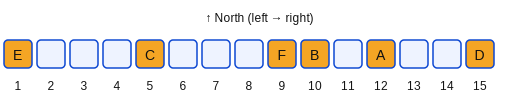
A certain number of people are sitting in a row, facing north. E sits at the extreme left end of the row. Exactly seven people sit between E and F. A sits third to right of F. Exactly four people sit between C and B. C sits exactly in between E and F. Exactly four people sit between B and D. D sits at one of the extreme ends. What is the total number of people seated in the row?
कुछ व्यक्ति एक पंक्ति में उत्तर की ओर मुख करके बैठे हैं। E पंक्ति के सबसे बाएँ छोर पर बैठा है। E और F के बीच ठीक सात व्यक्ति बैठे हैं। A, F के दाएँ से तीसरे स्थान पर बैठा है। C और B के बीच ठीक चार व्यक्ति बैठे हैं। C, E और F के ठीक बीच में बैठा है। B और D के बीच ठीक चार व्यक्ति बैठे हैं। D किसी एक छोर पर बैठा है। पंक्ति में बैठे व्यक्तियों की कुल संख्या कितनी है?
  1. A8
  2. B12
  3. C15
  4. D10
Show answer

Concept: Number seats from the left end (position 1) and place people one clue at a time; the last position fixed by "extreme end" gives the total.

  1. E = 1. Seven between E and F → F = 9. A is 3rd to the right of F → A = 12.
  2. C is exactly between E and F → C = 5. Four between C and B → B = 10 (B = 0 impossible).
  3. Four between B and D → D = 15 (D = 5 is taken by C). D is at an extreme end, so the row ends at 15.

Trick: When the total is unknown, never guess it – anchor at the given end and let the farthest person define the length.

Answer: (C) 15

अवधारणा: बाएँ छोर से सीटों को नंबर दें (स्थिति 1) और एक-एक संकेत से लोगों को रखें; "छोर" से तय अंतिम स्थिति ही कुल संख्या है।

  1. E = 1। E और F के बीच सात → F = 9। A, F के दाएँ तीसरा → A = 12।
  2. C ठीक E और F के बीच → C = 5। C और B के बीच चार → B = 10 (B = 0 असंभव)।
  3. B और D के बीच चार → D = 15 (D = 5 पर C है)। D छोर पर है, अतः पंक्ति 15 पर समाप्त।

ट्रिक: कुल संख्या अज्ञात हो तो अनुमान न लगाएँ – दिए गए छोर से शुरू करें, सबसे दूर का व्यक्ति लंबाई तय करेगा।

उत्तर: (C) 15

RRB NTPC Graduate CBT 2General Intelligence and ReasoningLinear seating – unknown countRRB NTPC Graduate CBT 2 2025 · 10 Jul Shift 1 →
Q14603.
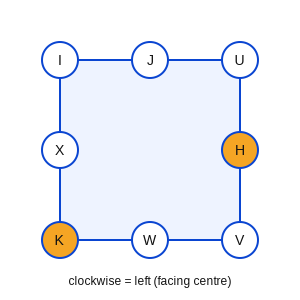
H, I, J, K, U, V, W and X are sitting around a square table facing the centre of the table. Four of them are sitting at the corners while four are sitting at the exact centre of the sides.
Only three people sit between J and W. J does not sit at any of the corners. I sits third to the left of W. H sits second to the left of J. V is an immediate neighbour of both W and H. U is an immediate neighbor of J. X sits second to the left of W.
How many people sit between K and H when counted from the left of K?
H, I, J, K, U, V, W और X एक वर्गाकार मेज़ के चारों ओर मेज़ के केंद्र की ओर मुख करके बैठे हैं। उनमें से चार कोनों पर बैठे हैं जबकि चार भुजाओं के ठीक मध्य में बैठे हैं।
J और W के बीच केवल तीन व्यक्ति बैठे हैं। J किसी भी कोने पर नहीं बैठा है। I, W के बाएँ से तीसरे स्थान पर बैठा है। H, J के बाएँ से दूसरे स्थान पर बैठा है। V, W और H दोनों का निकटतम पड़ोसी है। U, J का निकटतम पड़ोसी है। X, W के बाएँ से दूसरे स्थान पर बैठा है।
K के बाएँ से गिनने पर K और H के बीच कितने व्यक्ति बैठे हैं?
  1. AOneएक
  2. BThreeतीन
  3. CFourचार
  4. DTwoदो
Show answer

Concept: Number seats 1–8 clockwise. Facing the centre: left = clockwise, right = anticlockwise. "Only three between J and W" means they sit opposite each other.

  1. Put J at a mid-side seat (seat 2) → W opposite at seat 6. I is 3rd to the left of W → seat 1. H is 2nd to the left of J → seat 4.
  2. V touches both W (6) and H (4) → seat 5. U touches J → seat 3 (seat 1 is I). X is 2nd to the left of W → seat 8. K gets seat 7.
  3. From K (7) counting leftwards (clockwise) to H (4): X, I, J, U → four people.

Trick: "Only three between A and B" in an 8-seat circle always means A and B are face to face – place that pair first.

Answer: (C) Four

अवधारणा: सीटों को घड़ी की दिशा में 1–8 नंबर दें। केंद्र की ओर मुख: बाएँ = घड़ी की दिशा, दाएँ = विपरीत। "J और W के बीच केवल तीन" का अर्थ वे आमने-सामने हैं।

  1. J को भुजा-मध्य सीट (सीट 2) पर रखें → W सामने सीट 6 पर। I, W के बाएँ तीसरा → सीट 1। H, J के बाएँ दूसरा → सीट 4।
  2. V, W (6) और H (4) दोनों से सटा → सीट 5। U, J से सटा → सीट 3 (सीट 1 पर I)। X, W के बाएँ दूसरा → सीट 8। K को सीट 7।
  3. K (7) से बाएँ (घड़ी की दिशा) H (4) तक: X, I, J, U → चार लोग।

ट्रिक: 8 सीटों के वृत्त में "A और B के बीच केवल तीन" का मतलब हमेशा आमने-सामने – इस जोड़ी को सबसे पहले रखें।

उत्तर: (C) Four

RRB NTPC Graduate CBT 2General Intelligence and ReasoningSquare-table seatingRRB NTPC Graduate CBT 2 2025 · 10 Jul Shift 1 →
Q14604.
If 'A' stands for '÷', 'B' stands for '×', 'C' stands for '+' and 'D' stands for '−', what will come in place of '?' in the following equation?
24 C 16 D 8 A 4 B 2 = ?
यदि 'A' का अर्थ '÷', 'B' का अर्थ '×', 'C' का अर्थ '+' और 'D' का अर्थ '−' है, तो निम्नलिखित समीकरण में '?' के स्थान पर क्या आएगा?
24 C 16 D 8 A 4 B 2 = ?
  1. A40
  2. B32
  3. C36
  4. D28
Show answer

Concept: Substitute the letters by their operators, then apply BODMAS.

  1. 24 C 16 D 8 A 4 B 2 → 24+16−8÷4×2.
  2. 8÷4=2, then 2×2=4 (÷ and × left to right).
  3. 24+16−4=36.

Trick: Write the decoded expression on paper before computing; most errors come from mixing D (−) and A (÷).

Answer: (C) 36

अवधारणा: अक्षरों की जगह उनके संकारक रखें, फिर BODMAS लगाएँ।

  1. 24 C 16 D 8 A 4 B 2 → 24+16−8÷4×2।
  2. 8÷4=2, फिर 2×2=4 (÷ और × बाएँ से दाएँ)।
  3. 24+16−4=36।

ट्रिक: गणना से पहले डिकोड किया व्यंजक कागज़ पर लिखें; अधिकांश गलतियाँ D (−) और A (÷) के मिलने से होती हैं।

उत्तर: (C) 36

RRB NTPC Graduate CBT 2General Intelligence and ReasoningCoded operationsRRB NTPC Graduate CBT 2 2025 · 10 Jul Shift 1 →
Q14605.
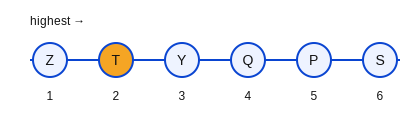
P, Q, S, T, Y and Z each scored different marks.
Only two people have scored more than Y. Only S has scored less than P. T has scored more than Q but less than Z.
How many people have scored more than T?
P, Q, S, T, Y और Z में से प्रत्येक ने अलग-अलग अंक प्राप्त किए।
Y से अधिक अंक केवल दो व्यक्तियों ने प्राप्त किए हैं। P से कम अंक केवल S ने प्राप्त किए हैं। T ने Q से अधिक लेकिन Z से कम अंक प्राप्त किए हैं।
T से अधिक अंक कितने व्यक्तियों ने प्राप्त किए हैं?
  1. ATwoदो
  2. BThreeतीन
  3. COneएक
  4. DFourचार
Show answer

Concept: Rank the six from highest (1) to lowest (6) using the absolute clues first.

  1. "Only two scored more than Y" → Y is 3rd. "Only S scored less than P" → P 5th, S 6th.
  2. Z, T, Q remain for ranks 1, 2, 4 with Z > T > Q → Z 1st, T 2nd, Q 4th.
  3. Only Z scored more than T → one person.

Trick: Count the slots: once Y, P, S are fixed, only three slots remain and the chain Z > T > Q drops straight into them.

Answer: (C) One

अवधारणा: छह लोगों को सबसे अधिक (1) से सबसे कम (6) तक रैंक दें, पहले निश्चित संकेत लगाएँ।

  1. "Y से अधिक केवल दो" → Y तीसरा। "P से कम केवल S" → P पाँचवाँ, S छठा।
  2. Z, T, Q के लिए रैंक 1, 2, 4 बचे; Z > T > Q → Z पहला, T दूसरा, Q चौथा।
  3. T से अधिक केवल Z → एक व्यक्ति।

ट्रिक: स्थान गिनें: Y, P, S तय होते ही केवल तीन स्थान बचते हैं और श्रृंखला Z > T > Q सीधे उनमें बैठ जाती है।

उत्तर: (C) One

RRB NTPC Graduate CBT 2General Intelligence and ReasoningOrder & ranking – marksRRB NTPC Graduate CBT 2 2025 · 10 Jul Shift 1 →
Q14606.
What will come in the place of ‘?’ in the following equation if ‘+’ and ‘–‘ are interchanged and ‘x’ and ‘÷’ are interchanged?
42 x 3 – 25 ÷ 5 + (56 x 8) ÷ 2 – 24 = ?
यदि ‘+’ और ‘–’ को आपस में बदल दिया जाए तथा ‘x’ और ‘÷’ को आपस में बदल दिया जाए, तो निम्नलिखित समीकरण में ‘?’ के स्थान पर क्या आएगा?
42 x 3 – 25 ÷ 5 + (56 x 8) ÷ 2 – 24 = ?
  1. A149
  2. B158
  3. C132
  4. D167
Show answer

Concept: Swap + with − and × with ÷, then apply BODMAS (bracket first).

  1. New expression: 42÷3+25×5−(56÷8)×2+24.
  2. 56÷8=7; 42÷3=14; 25×5=125; 7×2=14.
  3. 14+125−14+24=149.

Trick: Notice +14 and −14 cancel, leaving 125+24=149 at a glance.

Answer: (A) 149

अवधारणा: + को − से और × को ÷ से बदलें, फिर BODMAS लगाएँ (कोष्ठक पहले)।

  1. नया व्यंजक: 42÷3+25×5−(56÷8)×2+24।
  2. 56÷8=7; 42÷3=14; 25×5=125; 7×2=14।
  3. 14+125−14+24=149।

ट्रिक: ध्यान दें +14 और −14 कट जाते हैं, बचता है 125+24=149 – एक नज़र में।

उत्तर: (A) 149

RRB NTPC Graduate CBT 2General Intelligence and ReasoningMathematical operations – interchangeRRB NTPC Graduate CBT 2 2025 · 10 Jul Shift 1 →
Q14607.
If ‘P’ stands for ‘×’ , ‘Q’ stands for ‘÷’, ‘R’ stands for ‘-’ and ‘S’ stands for ‘+’ , what will come in place of the question mark ‘?’ in the following equation?
(42 Q 6) P 5 S 7 P 11 R (64 Q 8) P 2 R 5 P 6 = ?
यदि ‘P’ का अर्थ ‘×’, ‘Q’ का अर्थ ‘÷’, ‘R’ का अर्थ ‘-’ और ‘S’ का अर्थ ‘+’ है, तो निम्नलिखित समीकरण में प्रश्नचिह्न ‘?’ के स्थान पर क्या आएगा?
(42 Q 6) P 5 S 7 P 11 R (64 Q 8) P 2 R 5 P 6 = ?
  1. A62
  2. B42
  3. C54
  4. D66
Show answer

Concept: Decode P = ×, Q = ÷, R = −, S = +, then solve brackets first and apply BODMAS.

  1. Expression: (42÷6)×5+7×11−(64÷8)×2−5×6.
  2. Brackets: 42÷6=7, 64÷8=8. Products: 7×5=35, 7×11=77, 8×2=16, 5×6=30.
  3. 35+77−16−30=66.

Trick: Group the positives (35+77=112) and negatives (16+30=46): 112−46=66.

Answer: (D) 66

अवधारणा: P = ×, Q = ÷, R = −, S = + डिकोड करें, फिर कोष्ठक पहले और BODMAS लगाएँ।

  1. व्यंजक: (42÷6)×5+7×11−(64÷8)×2−5×6।
  2. कोष्ठक: 42÷6=7, 64÷8=8। गुणनफल: 7×5=35, 7×11=77, 8×2=16, 5×6=30।
  3. 35+77−16−30=66।

ट्रिक: धनात्मक (35+77=112) और ऋणात्मक (16+30=46) समूह बनाएँ: 112−46=66।

उत्तर: (D) 66

RRB NTPC Graduate CBT 2General Intelligence and ReasoningCoded operationsRRB NTPC Graduate CBT 2 2025 · 10 Jul Shift 1 →
Q14608.
This question is based on the given words.
(Left) TON TAR DEV TAB (Right)
How many letters are there between the second letter of the second word from the right and the second letter of the first word from the left as per the English alphabetical order?
यह प्रश्न दिए गए शब्दों पर आधारित है।
(बाएँ) TON TAR DEV TAB (दाएँ)
अंग्रेज़ी वर्णमाला क्रम के अनुसार, दाएँ से दूसरे शब्द के दूसरे अक्षर और बाएँ से पहले शब्द के दूसरे अक्षर के बीच कितने अक्षर हैं?
  1. A7
  2. B6
  3. C8
  4. D9
Show answer

Concept: Locate the words from the stated side, pick the required letters, then count the letters strictly between them in the alphabet.

  1. Second word from the right = DEV → second letter E (5th in alphabet).
  2. First word from the left = TON → second letter O (15th).
  3. Letters between E and O: F G H I J K L M N =15−5−1=9.

Trick: Letters strictly between positions p and q =|p−q|−1; keep the alphabet numbers (EJOTY: 5, 10, 15, 20, 25) handy.

Answer: (D) 9

अवधारणा: बताई गई दिशा से शब्द चुनें, अभीष्ट अक्षर निकालें, फिर वर्णमाला में उनके बीच के अक्षर गिनें।

  1. दाएँ से दूसरा शब्द = DEV → दूसरा अक्षर E (वर्णमाला में 5वाँ)।
  2. बाएँ से पहला शब्द = TON → दूसरा अक्षर O (15वाँ)।
  3. E और O के बीच अक्षर: F G H I J K L M N =15−5−1=9।

ट्रिक: स्थिति p और q के ठीक बीच अक्षर =|p−q|−1; वर्णमाला क्रमांक (EJOTY: 5, 10, 15, 20, 25) याद रखें।

उत्तर: (D) 9

RRB NTPC Graduate CBT 2General Intelligence and ReasoningWord-based letter countingRRB NTPC Graduate CBT 2 2025 · 10 Jul Shift 1 →
Q14609.
9 is related to 117 following a certain logic. Following the same logic, 12 is related to 156. To which of the following is 17 related, following the same logic?
(NOTE : Operations should be performed on the whole numbers, without breaking down the numbers into its constituent digits. E.g. 13 – Operations on 13 such as adding /subtracting /multiplying etc. to 13 can be performed. Breaking down 13 into 1 and 3 and then performing mathematical operations on 1 and 3 is not allowed.)
9 एक निश्चित तर्क के अनुसार 117 से संबंधित है। समान तर्क के अनुसार, 12, 156 से संबंधित है। समान तर्क के अनुसार, 17 निम्नलिखित में से किससे संबंधित है?
(नोट: संक्रियाएँ पूर्ण संख्याओं पर की जानी चाहिए, संख्याओं को उनके घटक अंकों में तोड़े बिना। उदाहरण के लिए 13 – 13 पर संक्रियाएँ जैसे 13 में जोड़ना/घटाना/गुणा करना आदि की जा सकती हैं। 13 को 1 और 3 में तोड़कर फिर 1 और 3 पर गणितीय संक्रियाएँ करने की अनुमति नहीं है।)
  1. A186
  2. B197
  3. C221
  4. D201
Show answer

Concept: Find one operation that converts both given numbers to their partners.

  1. 9→117: 117÷9=13. 12→156: 156÷12=13. So the rule is "multiply by 13".
  2. 17×13=221.

Trick: When the second number is much larger, try division first – a common quotient (here 13) reveals the rule instantly.

Answer: (C) 221

अवधारणा: ऐसी एक संक्रिया खोजें जो दोनों दी गई संख्याओं को उनके जोड़ीदार में बदल दे।

  1. 9→117: 117÷9=13। 12→156: 156÷12=13। अतः नियम "13 से गुणा"।
  2. 17×13=221।

ट्रिक: जब दूसरी संख्या काफ़ी बड़ी हो, पहले भाग आज़माएँ – समान भागफल (यहाँ 13) नियम तुरंत बता देता है।

उत्तर: (C) 221

RRB NTPC Graduate CBT 2General Intelligence and ReasoningNumber analogyRRB NTPC Graduate CBT 2 2025 · 10 Jul Shift 1 →
Q14610.
What should come in place of ‘?’ in the given series?
111, 223, 449, 903, 1813, ?
दी गई शृंखला में ‘?’ के स्थान पर क्या आना चाहिए?
111, 223, 449, 903, 1813, ?
  1. A3635
  2. B3536
  3. C3630
  4. D3036
Show answer

Concept: Each term is roughly double the previous one, so test "×2 + something".

  1. 111×2+1=223, 223×2+3=449, 449×2+5=903, 903×2+7=1813.
  2. The added numbers are consecutive odd numbers 1, 3, 5, 7 → next is 9.
  3. 1813×2+9=3635.

Trick: If a series nearly doubles, compute 2×previous and see what is left over – the leftovers form the hidden pattern.

Answer: (A) 3635

अवधारणा: हर पद पिछले का लगभग दुगुना है, अतः "×2 + कुछ" जाँचें।

  1. 111×2+1=223, 223×2+3=449, 449×2+5=903, 903×2+7=1813।
  2. जोड़ी गई संख्याएँ क्रमागत विषम 1, 3, 5, 7 → अगली 9।
  3. 1813×2+9=3635।

ट्रिक: श्रृंखला लगभग दुगुनी हो तो पिछले का 2× निकालकर बचा हुआ देखें – बचा हुआ ही छिपा पैटर्न है।

उत्तर: (A) 3635

RRB NTPC Graduate CBT 2General Intelligence and ReasoningNumber seriesRRB NTPC Graduate CBT 2 2025 · 10 Jul Shift 1 →
Q14611.
Refer to the following letter, number, symbol series and answer the question. Counting to be done from left to right only.
(Left) Y 7 H # 4 B Q $ 3 L 9 @ N 8 X Z * & T 2 R (Right)
How many such symbols are there which are immediately preceded by a number and also immediately followed by a letter?
निम्नलिखित अक्षर, संख्या, प्रतीक शृंखला को देखिए और प्रश्न का उत्तर दीजिए। गणना केवल बाएँ से दाएँ की ओर की जानी है।
(बाएँ) Y 7 H # 4 B Q $ 3 L 9 @ N 8 X Z * & T 2 R (दाएँ)
ऐसे कितने प्रतीक हैं, जिनके ठीक पहले एक संख्या है और ठीक बाद एक अक्षर है?
  1. ANoneकोई नहीं
  2. BThreeतीन
  3. CTwoदो
  4. DOneएक
Show answer

Concept: For each symbol check: left neighbour a number, right neighbour a letter.

  1. Symbols: #, $, @, *, &.
  2. # → 7, 4 (number, number) ✗; $ → Q, 3 ✗; * → Z, & ✗; & → *, T ✗.
  3. @ → 9 (number) and N (letter) ✓.
  4. Only one such symbol.

Trick: Mark the symbols first, then read "number – symbol – letter" as a three-piece window around each.

Answer: (D) One

अवधारणा: हर प्रतीक के लिए जाँचें: बायाँ पड़ोसी संख्या, दायाँ पड़ोसी अक्षर।

  1. प्रतीक: #, $, @, *, &।
  2. # → 7, 4 (संख्या, संख्या) ✗; $ → Q, 3 ✗; * → Z, & ✗; & → *, T ✗।
  3. @ → 9 (संख्या) और N (अक्षर) ✓।
  4. ऐसा केवल एक प्रतीक।

ट्रिक: पहले प्रतीक चिह्नित करें, फिर हर एक के चारों ओर "संख्या – प्रतीक – अक्षर" की तीन-टुकड़ा खिड़की पढ़ें।

उत्तर: (D) One

RRB NTPC Graduate CBT 2General Intelligence and ReasoningAlphanumeric seriesRRB NTPC Graduate CBT 2 2025 · 10 Jul Shift 1 →
Q14612.
In a certain code language,
A+ B means ‘A is the mother of B’,
A – B means ‘A is the brother of B’,
A x B means ‘A is the wife of B’,
A % B means ‘A is the father of B’, and
A # B means ‘A is the daughter of B’.
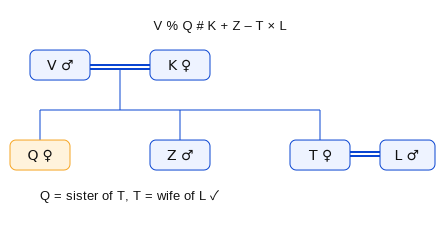
Which of the following means that Q is the sister of the wife of L?
I. V % Q # K + Z – T x L
I. V + Q # K % Z – T + L
I. V # K x Q % L + T # Z
V. V + Q # G – Z % T + L
एक निश्चित कूट भाषा में,
A+ B का अर्थ है ‘A, B की माता है’,
A – B का अर्थ है ‘A, B का भाई है’,
A x B का अर्थ है ‘A, B की पत्नी है’,
A % B का अर्थ है ‘A, B का पिता है’, और
A # B का अर्थ है ‘A, B की पुत्री है’।
निम्नलिखित में से किसका अर्थ है कि Q, L की पत्नी की बहन है?
I. V % Q # K + Z – T x L
I. V + Q # K % Z – T + L
I. V # K x Q % L + T # Z
V. V + Q # G – Z % T + L
  1. ABoth I and IIII और III दोनों
  2. BOnly IVकेवल IV
  3. COnly Iकेवल I
  4. DBoth II and IVII और IV दोनों
Show answer

Concept: Decode each expression pair by pair and draw the family tree; we need Q = sister of (wife of L).

  1. I: V father of Q; Q daughter of K; K mother of Z; Z brother of T; T wife of L. So Q, Z, T are K's children ⇒ Q is sister of T, and T is L's wife ✓.
  2. II: T + L means T is the mother of L, not wife ✗. III: Q % L makes Q a father (male) ✗. IV: T + L again makes T the mother of L ✗.

Trick: First check the last link with L: only “× L” (wife of L) can satisfy the condition – that kills II, III and IV at once.

Answer: (C) Only I

अवधारणा: हर व्यंजक को जोड़ी-दर-जोड़ी डिकोड कर वंश-वृक्ष बनाएँ; चाहिए Q = (L की पत्नी) की बहन।

  1. I: V, Q का पिता; Q, K की पुत्री; K, Z की माँ; Z, T का भाई; T, L की पत्नी। अतः Q, Z, T तीनों K की संतान ⇒ Q, T की बहन है और T, L की पत्नी ✓।
  2. II: T + L का अर्थ T, L की माँ है, पत्नी नहीं ✗। III: Q % L से Q पिता (पुरुष) बनता है ✗। IV: T + L फिर T को L की माँ बनाता है ✗।

ट्रिक: पहले L वाली अंतिम कड़ी देखें: केवल “× L” (L की पत्नी) ही शर्त पूरी कर सकती है – इससे II, III, IV एक साथ कट जाते हैं।

उत्तर: (C) Only I

RRB NTPC Graduate CBT 2General Intelligence and ReasoningBlood Relations – CodedRRB NTPC Graduate CBT 2 2025 · 10 Jul Shift 1 →
Q14613.
CM24 is related to HR26 in a certain way based on the English alphabetical order. In the same way, AT15 is related to FY17. To which of the following is CR12 related, following the same logic?
अंग्रेज़ी वर्णमाला क्रम के आधार पर CM24 एक निश्चित प्रकार से HR26 से संबंधित है। उसी प्रकार, AT15, FY17 से संबंधित है। समान तर्क के अनुसार, CR12 निम्नलिखित में से किससे संबंधित है?
  1. AHW14
  2. BIW14
  3. CIV14
  4. DHV14
Show answer

Concept: Find the uniform shift applied to each letter and the number.

  1. CM24 → HR26: C +5= H, M +5= R, 24+2=26.
  2. AT15 → FY17: A +5= F, T +5= Y, 15+2=17 – same rule.
  3. CR12 → C +5= H, R +5= W, 12+2=14 ⇒ HW14.

Trick: Use positions: C=3, R=18 → 8 (H), 23 (W).

Answer: (A) HW14

अवधारणा: हर अक्षर और संख्या पर लगने वाला समान परिवर्तन खोजें।

  1. CM24 → HR26: C +5= H, M +5= R, 24+2=26।
  2. AT15 → FY17: A +5= F, T +5= Y, 15+2=17 – वही नियम।
  3. CR12 → C +5= H, R +5= W, 12+2=14 ⇒ HW14।

ट्रिक: स्थान मान लें: C=3, R=18 → 8 (H), 23 (W)।

उत्तर: (A) HW14

RRB NTPC Graduate CBT 2General Intelligence and ReasoningLetter-Number AnalogyRRB NTPC Graduate CBT 2 2025 · 10 Jul Shift 1 →
Q14614.
Which of the following letter-number clusters will replace the question mark (?) in the given series to make it logically complete?
LTP25 MUQ36 NVR47 OWS58 ?
निम्नलिखित में से कौन-सा अक्षर-संख्या समूह दी गई शृंखला में प्रश्नचिह्न (?) के स्थान पर आकर उसे तार्किक रूप से पूर्ण करेगा?
LTP25 MUQ36 NVR47 OWS58 ?
  1. APXU69
  2. BPXT69
  3. CPXT68
  4. DPXU68
Show answer

Concept: Track each letter position and the number separately.

  1. 1st letters L, M, N, O → next P; 2nd letters T, U, V, W → X; 3rd letters P, Q, R, S → T.
  2. Numbers 25, 36, 47, 58 increase by 11 → 69.
  3. Required term: PXT69.

Trick: Every letter moves +1 and the number +11; options with U or 68 break the pattern.

Answer: (B) PXT69

अवधारणा: हर अक्षर-स्थान और संख्या को अलग-अलग देखें।

  1. पहले अक्षर L, M, N, O → अगला P; दूसरे T, U, V, W → X; तीसरे P, Q, R, S → T।
  2. संख्याएँ 25, 36, 47, 58 में +11 → 69।
  3. अभीष्ट पद: PXT69।

ट्रिक: हर अक्षर +1 और संख्या +11; U या 68 वाले विकल्प पैटर्न तोड़ते हैं।

उत्तर: (B) PXT69

RRB NTPC Graduate CBT 2General Intelligence and ReasoningAlphanumeric SeriesRRB NTPC Graduate CBT 2 2025 · 10 Jul Shift 1 →
Q14615.
In this question, a group of number/symbol is coded using letter codes as per the codes given below and the conditions which follow. The correct combination of codes following the conditions is your answer. If none of the conditions follow, then codes for the respective Number/Symbol to be followed directly as given in the table.
Number/symbol3$51@%2&+7#846 CodeWIDMOHZTGSUEXV Conditions:
(i) If both first and last elements are symbols, the codes for these two (the first and the last elements) are to be interchanged.
(ii) If the first element is an odd number and the last an even number, the first and last elements are to be coded as ©.
(iii) If both second and third elements are perfect squares, the third element is to be coded as the code for the second element.
What is the code for the following number-symbol group?
3 % @ 1 4
इस प्रश्न में, संख्या/प्रतीक के एक समूह को नीचे दिए गए कूटों और उसके बाद दी गई शर्तों के अनुसार अक्षर कूटों का उपयोग करके कूटबद्ध किया गया है। शर्तों का पालन करते हुए कूटों का सही संयोजन आपका उत्तर है। यदि कोई भी शर्त लागू नहीं होती है, तो संबंधित संख्या/प्रतीक के कूट सीधे तालिका में दिए अनुसार लिए जाने हैं।
संख्या/प्रतीक3$51@%2&+7#846 कूटWIDMOHZTGSUEXV शर्तें:
(i) यदि पहला और अंतिम दोनों तत्व प्रतीक हैं, तो इन दोनों (पहले और अंतिम तत्व) के कूट आपस में बदल दिए जाने हैं।
(ii) यदि पहला तत्व एक विषम संख्या है और अंतिम तत्व एक सम संख्या है, तो पहले और अंतिम तत्वों को © के रूप में कूटबद्ध किया जाना है।
(iii) यदि दूसरा और तीसरा दोनों तत्व पूर्ण वर्ग हैं, तो तीसरे तत्व को दूसरे तत्व के कूट के रूप में कूटबद्ध किया जाना है।
निम्नलिखित संख्या-प्रतीक समूह का कूट क्या है?
3 % @ 1 4
  1. A© H O M ©
  2. B© M O H ©
  3. CW H O M X
  4. DW M O H ©
Show answer

Concept: First test the conditions on the first/last and second/third elements, then code the rest from the table.

  1. Group: 3 % @ 1 4. First element 3 is odd, last element 4 is even ⇒ condition (ii): both coded as ©.
  2. Second (%) and third (@) are symbols, not perfect squares ⇒ (iii) does not apply; (i) fails as 3 and 4 are not symbols.
  3. Table codes: % → H, @ → O, 1 → M. Code: © H O M ©.

Trick: Check the odd-even condition first – once © appears at both ends, only options A and B survive; then % = H decides.

Answer: (A) © H O M ©

अवधारणा: पहले पहले/अंतिम और दूसरे/तीसरे तत्वों पर शर्तें जाँचें, फिर बाकी को तालिका से कोड करें।

  1. समूह: 3 % @ 1 4। पहला तत्व 3 विषम, अंतिम 4 सम ⇒ शर्त (ii): दोनों का कोड ©।
  2. दूसरा (%) और तीसरा (@) प्रतीक हैं, पूर्ण वर्ग नहीं ⇒ (iii) लागू नहीं; (i) भी नहीं क्योंकि 3 और 4 प्रतीक नहीं।
  3. तालिका: % → H, @ → O, 1 → M। कोड: © H O M ©।

ट्रिक: पहले विषम-सम शर्त देखें – दोनों सिरों पर © आते ही केवल A और B बचते हैं; फिर % = H निर्णय कर देता है।

उत्तर: (A) © H O M ©

RRB NTPC Graduate CBT 2General Intelligence and ReasoningCoding-Decoding with ConditionsRRB NTPC Graduate CBT 2 2025 · 10 Jul Shift 1 →
Q14616.
Which of the following letter-number clusters will replace the question mark (?) in the given series to make it logically complete?
KDW 25, NGZ 35, QJC 55, TMF 95, WPI 175, ?
निम्नलिखित में से कौन-सा अक्षर-संख्या समूह दी गई शृंखला में प्रश्नचिह्न (?) के स्थान पर आकर उसे तार्किक रूप से पूर्ण करेगा?
KDW 25, NGZ 35, QJC 55, TMF 95, WPI 175, ?
  1. ALSL 335
  2. BZML 335
  3. CZSL 335
  4. DZSG 335
Show answer

Concept: Letters and numbers follow separate patterns.

  1. Each letter moves +3: K→N→Q→T→W→Z; D→G→J→M→P→S; W→Z→C→F→I→L.
  2. Numbers 25, 35, 55, 95, 175: differences 10, 20, 40, 80 (doubling) → next +160 ⇒ 175+160=335.
  3. Term: ZSL 335.

Trick: Only option C has all three letters shifted by +3 (Z, S, L).

Answer: (C) ZSL 335

अवधारणा: अक्षर और संख्याएँ अलग-अलग पैटर्न पर चलती हैं।

  1. हर अक्षर +3: K→N→Q→T→W→Z; D→G→J→M→P→S; W→Z→C→F→I→L।
  2. संख्याएँ 25, 35, 55, 95, 175: अंतर 10, 20, 40, 80 (दोगुना) → अगला +160 ⇒ 175+160=335।
  3. पद: ZSL 335।

ट्रिक: केवल विकल्प C में तीनों अक्षर +3 से बढ़े हैं (Z, S, L)।

उत्तर: (C) ZSL 335

RRB NTPC Graduate CBT 2General Intelligence and ReasoningAlphanumeric SeriesRRB NTPC Graduate CBT 2 2025 · 10 Jul Shift 1 →
Q14617.
This question is based on the five, three-digit numbers given below.
(Left) 715 438 961 127 821 (Right)
(Example- 697 – First digit = 6, second digit = 9 and third digit = 7)
NOTE - All operations to be done from left to right.
What will be the resultant if third digit of the highest number is added to the second digit of lowest number?
यह प्रश्न नीचे दी गई पाँच, तीन-अंकीय संख्याओं पर आधारित है।
(बाएँ) 715 438 961 127 821 (दाएँ)
(उदाहरण- 697 – पहला अंक = 6, दूसरा अंक = 9 और तीसरा अंक = 7)
नोट - सभी संक्रियाएँ बाएँ से दाएँ की ओर की जानी हैं।
यदि सबसे बड़ी संख्या के तीसरे अंक को सबसे छोटी संख्या के दूसरे अंक में जोड़ा जाए, तो परिणाम क्या होगा?
  1. A10
  2. B9
  3. C6
  4. D3
Show answer

Concept: Identify the required numbers, pick the asked digits and add.

  1. Numbers: 715, 438, 961, 127, 821. Highest =961, its third digit =1.
  2. Lowest =127, its second digit =2.
  3. 1+2=3.

Trick: Compare only the first digits to spot the highest (9) and lowest (1) numbers instantly.

Answer: (D) 3

अवधारणा: अभीष्ट संख्याएँ पहचानें, पूछे गए अंक लें और जोड़ें।

  1. संख्याएँ: 715, 438, 961, 127, 821। सबसे बड़ी =961, तीसरा अंक =1।
  2. सबसे छोटी =127, दूसरा अंक =2।
  3. 1+2=3।

ट्रिक: केवल पहले अंक देखकर सबसे बड़ी (9) और सबसे छोटी (1) संख्या तुरंत पहचानें।

उत्तर: (D) 3

RRB NTPC Graduate CBT 2General Intelligence and ReasoningNumber ArrangementRRB NTPC Graduate CBT 2 2025 · 10 Jul Shift 1 →
Q14618.
Below are given two sets of numbers. In each set of numbers, a certain mathematical operation on first number results in the second number. Similarly, certain mathematical operation on second number results in the third number and so on. Which of the given options follows the same set of operations as that followed in the question?
(NOTE : Operations should be performed on the whole numbers, without breaking down the numbers into its constitute digits. E.g. 13 - Operations on 13 such as adding / subtracting / multiplying etc. to 13 can be performed. Breaking down 13 into 1 and 3 and then performing mathematical operations on 1 and 3 is not allowed.)
5 – 5 – 25 - 125;
4 – 4 – 16 – 64
नीचे संख्याओं के दो समुच्चय दिए गए हैं। संख्याओं के प्रत्येक समुच्चय में, पहली संख्या पर एक निश्चित गणितीय संक्रिया करने से दूसरी संख्या प्राप्त होती है। इसी प्रकार, दूसरी संख्या पर एक निश्चित गणितीय संक्रिया करने से तीसरी संख्या प्राप्त होती है, और इसी प्रकार आगे भी। दिए गए विकल्पों में से कौन-सा प्रश्न में अनुसरण की गई संक्रियाओं के समान समुच्चय का अनुसरण करता है?
(नोट: संक्रियाएँ पूर्ण संख्याओं पर की जानी चाहिए, संख्याओं को उनके घटक अंकों में तोड़े बिना। उदाहरण के लिए 13 - 13 पर संक्रियाएँ जैसे 13 में जोड़ना / घटाना / गुणा करना आदि की जा सकती हैं। 13 को 1 और 3 में तोड़कर फिर 1 और 3 पर गणितीय संक्रियाएँ करने की अनुमति नहीं है।)
5 – 5 – 25 - 125;
4 – 4 – 16 – 64
  1. A7 – 7 – 49 – 94
  2. B8 – 8 – 64 – 520
  3. C6 – 6 – 36 – 216
  4. D3 – 3 – 9 – 36
Show answer

Concept: Find the operation linking consecutive numbers and test it on each option.

  1. 5→5→25→125: ×1, ×5, ×5 (powers of 5: 5,52,53). 4→4→16→64: ×1, ×4, ×4.
  2. Rule: n, n, n2, n3. Option C: 6, 6, 36, 216 ✓.
  3. A ends in 94 (should be 343), B in 520 (512), D in 36 (27).

Trick: Last term must be a perfect cube of the first: 63=216.

Answer: (C) 6 – 6 – 36 – 216

अवधारणा: क्रमागत संख्याओं को जोड़ने वाली संक्रिया खोजें और हर विकल्प पर परखें।

  1. 5→5→25→125: ×1, ×5, ×5 (5 की घातें: 5,52,53)। 4→4→16→64: ×1, ×4, ×4।
  2. नियम: n, n, n2, n3। विकल्प C: 6, 6, 36, 216 ✓।
  3. A का अंत 94 (होना चाहिए 343), B का 520 (512), D का 36 (27)।

ट्रिक: अंतिम पद पहले पद का पूर्ण घन होना चाहिए: 63=216।

उत्तर: (C) 6 – 6 – 36 – 216

RRB NTPC Graduate CBT 2General Intelligence and ReasoningNumber Operations – AnalogyRRB NTPC Graduate CBT 2 2025 · 10 Jul Shift 1 →
Q14619.
Based on the English alphabetical order, three of the following four letter-clusters are alike in a certain way and thus form a group. Which is the one that does not belong to that group?
(Note: The odd one out is not based on the number of consonants/vowels or their position in the letter-cluster.)
अंग्रेज़ी वर्णमाला क्रम के आधार पर, निम्नलिखित चार अक्षर-समूहों में से तीन एक निश्चित प्रकार से समान हैं और इस प्रकार एक समूह बनाते हैं। वह कौन-सा है, जो उस समूह से संबंधित नहीं है?
(नोट: असंगत का निर्धारण व्यंजनों/स्वरों की संख्या या अक्षर-समूह में उनकी स्थिति के आधार पर नहीं किया गया है।)
  1. AHMP
  2. BJOR
  3. COSV
  4. DDIL
Show answer

Concept: Compare the gaps between consecutive letters in each cluster.

  1. HMP: H(8)→M(13) +5, M→P(16) +3. JOR: +5,+3. DIL: D(4)→I(9) +5, I→L(12) +3.
  2. OSV: O(15)→S(19) +4, S→V(22) +3 – the first gap is different.

Trick: Write positions and take differences; the pattern +5,+3 breaks only in OSV.

Answer: (C) OSV

अवधारणा: हर समूह में क्रमागत अक्षरों के बीच का अंतर तुलना करें।

  1. HMP: H(8)→M(13) +5, M→P(16) +3। JOR: +5,+3। DIL: D(4)→I(9) +5, I→L(12) +3।
  2. OSV: O(15)→S(19) +4, S→V(22) +3 – पहला अंतर अलग है।

ट्रिक: स्थान मान लिखकर अंतर निकालें; +5,+3 का पैटर्न केवल OSV में टूटता है।

उत्तर: (C) OSV

RRB NTPC Graduate CBT 2General Intelligence and ReasoningOdd One Out – Letter ClustersRRB NTPC Graduate CBT 2 2025 · 10 Jul Shift 1 →
Q14620.
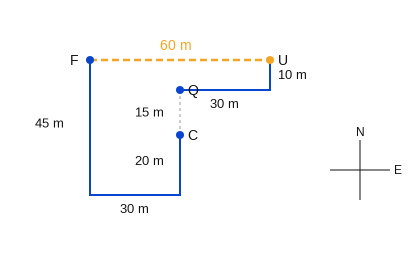
Omaira starts from point F and walks 45 m towards south. She takes a left turn, walks 30 m and then takes a left turn, walks 20 m, reaches point C and stops. Anjan starts from point Q which is 15 m towards the north of point C. He walks 30 m towards east, takes a left turn, walks 10 m and stops at point U. What is the shortest distance between point F and point U? (All turns are 90° turns only.)
ओमाइरा बिंदु F से चलना शुरू करती है और दक्षिण की ओर 45 m चलती है। वह बाएँ मुड़ती है, 30 m चलती है और फिर बाएँ मुड़ती है, 20 m चलती है, बिंदु C पर पहुँचती है और रुक जाती है। अंजन बिंदु Q से चलना शुरू करता है, जो बिंदु C के उत्तर में 15 m की दूरी पर है। वह पूर्व की ओर 30 m चलता है, बाएँ मुड़ता है, 10 m चलता है और बिंदु U पर रुक जाता है। बिंदु F और बिंदु U के बीच की न्यूनतम दूरी कितनी है? (सभी मोड़ केवल 90° के मोड़ हैं।)
  1. A35 m
  2. B25 m
  3. C75 m
  4. D60 m
Show answer

Concept: Plot the moves on a grid with F as origin (east +x, north +y), then use the Pythagoras theorem if needed.

  1. Omaira: F(0,0) → 45 m south (0,−45) → left = east 30 m (30,−45) → left = north 20 m ⇒ C(30,−25).
  2. Q is 15 m north of C ⇒ Q(30,−10). Anjan: east 30 m (60,−10) → left = north 10 m ⇒ U(60,0).
  3. F and U lie on the same horizontal line, so FU =60 m.

Trick: Net vertical shift of U: −45+20+15+10=0 ⇒ U is level with F; just add the eastward moves 30+30=60.

Answer: (D) 60 m

अवधारणा: F को मूल बिंदु मानकर (पूर्व +x, उत्तर +y) चालों को ग्रिड पर आँकें; ज़रूरत हो तो पाइथागोरस लगाएँ।

  1. ओमैरा: F(0,0) → 45 m दक्षिण (0,−45) → बाएँ = पूर्व 30 m (30,−45) → बाएँ = उत्तर 20 m ⇒ C(30,−25)।
  2. Q, C से 15 m उत्तर ⇒ Q(30,−10)। अंजन: पूर्व 30 m (60,−10) → बाएँ = उत्तर 10 m ⇒ U(60,0)।
  3. F और U एक ही क्षैतिज रेखा पर हैं, अतः FU =60 m।

ट्रिक: U का शुद्ध ऊर्ध्वाधर विस्थापन: −45+20+15+10=0 ⇒ U, F की सीध में; बस पूर्वी चालें जोड़ें 30+30=60।

उत्तर: (D) 60 m

RRB NTPC Graduate CBT 2General Intelligence and ReasoningDirection and DistanceRRB NTPC Graduate CBT 2 2025 · 10 Jul Shift 1 →