Question bank

Q&A: practice questions with answers

Search questions on any topic. Filter by exam category, exam, subject and topic, try the question, then open the answer and explanation.

Courses – airGurukul

20,719 questions found.

Q14661.
In response to Cyclone Ditwah in 2025, India expanded which humanitarian mission to deliver aid to Sri Lanka by deploying additional Indian Navy warships?
2025 में चक्रवात दितवाह (Ditwah) के प्रत्युत्तर में, भारत ने श्रीलंका को सहायता पहुँचाने के लिए भारतीय नौसेना के अतिरिक्त युद्धपोत तैनात करके किस मानवीय मिशन का विस्तार किया?
  1. AOperation Samudra Setuऑपरेशन समुद्र सेतु
  2. BOperation Sagar Bandhuऑपरेशन सागर बंधु
  3. COperation Maitriऑपरेशन मैत्री
  4. DOperation Vanilaऑपरेशन वनीला
Show answer

Concept: After Cyclone Ditwah devastated Sri Lanka in late November 2025, India launched Operation Sagar Bandhu, sending relief material, NDRF teams and Indian Navy ships (INS Vikrant, INS Udaygiri, INS Sukanya among others).

  1. The operation was expanded with additional warships and IAF aircraft carrying food, medicines and rescue teams.
  2. Operation Samudra Setu (2020) repatriated Indians during COVID-19; Operation Maitri (2015) was for the Nepal earthquake; Operation Vanilla (2020) aided Madagascar after Cyclone Diane.

Yaad rakhein: Ditwah (Sri Lanka, 2025) → Sagar Bandhu ("friend across the sea").

Answer: (B) Operation Sagar Bandhu

अवधारणा: नवंबर 2025 के अंत में चक्रवात दित्वाह से श्रीलंका में भारी तबाही के बाद भारत ने ऑपरेशन सागर बंधु शुरू किया – राहत सामग्री, NDRF टीमें और नौसेना के पोत (INS विक्रांत, INS उदयगिरि, INS सुकन्या आदि) भेजे।

  1. अभियान को अतिरिक्त युद्धपोतों और वायुसेना विमानों से विस्तार दिया गया, जो भोजन, दवाएँ और बचाव दल ले गए।
  2. ऑपरेशन समुद्र सेतु (2020) COVID-19 में भारतीयों की वापसी; ऑपरेशन मैत्री (2015) नेपाल भूकंप; ऑपरेशन वनीला (2020) चक्रवात डायने के बाद मेडागास्कर की सहायता।

याद रखें: दित्वाह (श्रीलंका, 2025) → सागर बंधु।

उत्तर: (B) Operation Sagar Bandhu
RRB NTPC Graduate CBT 1General AwarenessCurrent Affairs – Humanitarian OperationsRRB NTPC Graduate CBT 1 2025 · 27 Mar Shift 3 →
Q14662.
Which of the following elements in the periodic table is NOT classified as a metal?
आवर्त सारणी के निम्नलिखित में से किस तत्व को धातु के रूप में वर्गीकृत नहीं किया जाता है?
  1. ASodiumसोडियम
  2. BPotassiumपोटैशियम
  3. CSulfurसल्फर
  4. DCalciumकैल्शियम
Show answer

Concept: Sodium (Na), potassium (K) and calcium (Ca) are s-block metals – soft, lustrous, good conductors, form basic oxides.

  1. Sulfur (S, atomic number 16) is a p-block non-metal: brittle yellow solid, poor conductor, forms the acidic oxide SO2.
  2. Na and K are alkali metals (Group 1); Ca is an alkaline-earth metal (Group 2).

Yaad rakhein: Non-metal oxides are acidic (SO2, CO2); metal oxides are basic (Na2O, CaO).

Answer: (C) Sulfur

अवधारणा: सोडियम (Na), पोटैशियम (K) और कैल्शियम (Ca) s-ब्लॉक धातुएँ हैं – मुलायम, चमकदार, अच्छी चालक, क्षारीय ऑक्साइड बनाती हैं।

  1. सल्फर (S, परमाणु क्रमांक 16) p-ब्लॉक अधातु है: भंगुर पीला ठोस, कुचालक, अम्लीय ऑक्साइड SO2 बनाता है।
  2. Na और K क्षार धातुएँ (समूह 1); Ca क्षारीय मृदा धातु (समूह 2)।

याद रखें: अधातु ऑक्साइड अम्लीय (SO2, CO2); धातु ऑक्साइड क्षारीय (Na2O, CaO)।

उत्तर: (C) Sulfur

RRB NTPC Graduate CBT 1General AwarenessChemistry – Metals and Non-metalsRRB NTPC Graduate CBT 1 2025 · 27 Mar Shift 3 →
Q14663.
The foundational understanding of the law of inertia was established through the experiments of which physicist?
जड़त्व के नियम की आधारभूत समझ किस भौतिक विज्ञानी के प्रयोगों के माध्यम से स्थापित हुई?
  1. AArchimedesआर्किमिडीज़
  2. BAlbert Einsteinअल्बर्ट आइंस्टीन
  3. CGalileo Galileiगैलीलियो गैलिली
  4. DMichael Faradayमाइकल फैराडे
Show answer

Concept: Galileo Galilei, through his inclined-plane experiments, showed that a body keeps moving at constant velocity unless a force (like friction) acts on it – the idea of inertia.

  1. Newton later stated it formally as his First Law of Motion, which is why it is also called the law of inertia.
  2. Archimedes – buoyancy and levers; Faraday – electromagnetic induction; Einstein – relativity.

Yaad rakhein: Inertia: idea by Galileo, law by Newton.

Answer: (C) Galileo Galilei

अवधारणा: गैलीलियो गैलिली ने आनत तल (inclined plane) के प्रयोगों से दिखाया कि कोई वस्तु तब तक एकसमान वेग से चलती रहती है जब तक उस पर कोई बल (जैसे घर्षण) न लगे – यही जड़त्व (inertia) का विचार है।

  1. न्यूटन ने बाद में इसे अपने गति के प्रथम नियम के रूप में औपचारिक रूप दिया, इसलिए इसे जड़त्व का नियम भी कहते हैं।
  2. आर्किमिडीज़ – उत्प्लावन और उत्तोलक; फैराडे – विद्युत-चुंबकीय प्रेरण; आइंस्टीन – सापेक्षता।

याद रखें: जड़त्व: विचार गैलीलियो का, नियम न्यूटन का।

उत्तर: (C) Galileo Galilei

RRB NTPC Graduate CBT 1General AwarenessPhysics – Law of InertiaRRB NTPC Graduate CBT 1 2025 · 27 Mar Shift 3 →
Q14664.
Under Article 275 of the Constitution, the sums provided by the Parliament as grants-in- aid to states are required to be charged on which fund?
संविधान के अनुच्छेद 275 के अंतर्गत, संसद द्वारा राज्यों को सहायता अनुदान के रूप में दी जाने वाली राशियाँ किस निधि पर भारित होनी आवश्यक हैं?
  1. APublic Account of Indiaभारत का लोक लेखा
  2. BContingency Fund of Indiaभारत की आकस्मिकता निधि
  3. CConsolidated Fund of Indiaभारत की संचित निधि
  4. DState Emergency Fundराज्य आपातकालीन निधि
Show answer

Concept: Article 275 provides statutory grants-in-aid from the Union to states in need; the sums are charged on the Consolidated Fund of India.

  1. Being "charged" means they do not need an annual vote of Parliament (unlike Article 282 discretionary grants).
  2. Contingency Fund (Art. 267) is for unforeseen expenditure; Public Account (Art. 266(2)) holds money the government keeps as banker (PF, small savings); there is no "State Emergency Fund".

Yaad rakhein: Art. 275 = statutory grants (on Finance Commission advice); Art. 282 = discretionary grants.

Answer: (C) Consolidated Fund of India

अवधारणा: अनुच्छेद 275 ज़रूरतमंद राज्यों को संघ से सांविधिक सहायता अनुदान देता है; ये राशियाँ भारत की संचित निधि पर भारित होती हैं।

  1. "भारित" होने का अर्थ है कि इन्हें संसद के वार्षिक मतदान की आवश्यकता नहीं (अनुच्छेद 282 के विवेकाधीन अनुदानों से भिन्न)।
  2. आकस्मिकता निधि (अनु. 267) अप्रत्याशित खर्च के लिए; लोक लेखा (अनु. 266(2)) में सरकार बैंकर के रूप में रखी राशि (PF, लघु बचत); "State Emergency Fund" जैसा कुछ नहीं है।

याद रखें: अनु. 275 = सांविधिक अनुदान (वित्त आयोग की सलाह पर); अनु. 282 = विवेकाधीन अनुदान।

उत्तर: (C) Consolidated Fund of India

RRB NTPC Graduate CBT 1General AwarenessPolity – Centre–State FinanceRRB NTPC Graduate CBT 1 2025 · 27 Mar Shift 3 →
Q14665.
Which of the following samitis was founded by Ashwini Kumar Dutt in Barisal?
निम्नलिखित में से किस समिति की स्थापना अश्विनी कुमार दत्त ने बारिसाल में की थी?
  1. AAnushilan Samitiअनुशीलन समिति
  2. BSwadesh Bandhab Samitiस्वदेश बांधव समिति
  3. CJugantar Samitiयुगांतर समिति
  4. DBharat Mata Samitiभारत माता समिति
Show answer

Concept: During the Swadeshi movement (1905) Ashwini Kumar Dutta founded the Swadesh Bandhab Samiti in Barisal (now Bangladesh), the most effective of the Swadeshi volunteer bodies, with 159 branches.

  1. It organised boycott of foreign goods, settled village disputes and did famine relief; the British banned it in 1908.
  2. Anushilan Samiti was founded in Calcutta (Satish Chandra Basu/P. Mitra, 1902) and Jugantar emerged from it (Barindra Ghosh); "Bharat Mata Samiti" was a Punjab society of Ajit Singh.

Yaad rakhein: Barisal → Ashwini Kumar Dutta → Swadesh Bandhab Samiti.

Answer: (B) Swadesh Bandhab Samiti

अवधारणा: स्वदेशी आंदोलन (1905) के दौरान अश्विनी कुमार दत्त ने बारिसाल (अब बांग्लादेश) में स्वदेश बांधव समिति की स्थापना की – 159 शाखाओं वाली, स्वदेशी स्वयंसेवी संस्थाओं में सबसे प्रभावी।

  1. इसने विदेशी वस्तुओं का बहिष्कार, गाँव के विवादों का निपटारा और अकाल राहत का काम किया; अंग्रेज़ों ने 1908 में इस पर प्रतिबंध लगाया।
  2. अनुशीलन समिति कलकत्ता में बनी (सतीश चंद्र बसु/पी. मित्रा, 1902) और युगांतर उसी से निकली (बारींद्र घोष); "भारत माता समिति" पंजाब में अजीत सिंह की संस्था थी।

याद रखें: बारिसाल → अश्विनी कुमार दत्त → स्वदेश बांधव समिति।

उत्तर: (B) Swadesh Bandhab Samiti

RRB NTPC Graduate CBT 1General AwarenessModern History – Swadeshi MovementRRB NTPC Graduate CBT 1 2025 · 27 Mar Shift 3 →
Q14666.
The ratio of boys to girls in two sections A and B of a class is the same. Section A comprises of 36 boys and 24 girls. If there are 28 girls in section B, how many boys are there in that section?
एक कक्षा के दो वर्गों A और B में लड़कों और लड़कियों का अनुपात समान है। वर्ग A में 36 लड़के और 24 लड़कियाँ हैं। यदि वर्ग B में 28 लड़कियाँ हैं, तो उस वर्ग में कितने लड़के हैं?
  1. A48
  2. B40
  3. C45
  4. D42
Show answer

Concept: Same ratio → boysgirls is equal in both sections.

  1. Section A: 36:24=3:2.
  2. Section B: boys28=32 → boys =3×282=42.

Trick: 2 parts = 28 → 1 part = 14 → 3 parts = 42.

Answer: (D) 42

अवधारणा: समान अनुपात → दोनों सेक्शनों में लड़केलड़कियाँ बराबर।

  1. सेक्शन A: 36:24=3:2।
  2. सेक्शन B: लड़के28=32 → लड़के =3×282=42।

ट्रिक: 2 भाग = 28 → 1 भाग = 14 → 3 भाग = 42।

उत्तर: (D) 42

RRB NTPC Graduate CBT 1MathematicsRatio and ProportionRRB NTPC Graduate CBT 1 2025 · 27 Mar Shift 3 →
Q14667.
Evaluate: (-9) - (-56) ÷ (-14) + (-4) × 9
मान ज्ञात कीजिए: (-9) - (-56) ÷ (-14) + (-4) × 9
  1. A-49
  2. B-51
  3. C-52
  4. D-48
Show answer

Concept: BODMAS – division and multiplication first, then addition/subtraction from left to right.

  1. (−56)÷(−14)=4 and (−4)×9=−36.
  2. Expression =(−9)−4+(−36)=−13−36=−49.

Trick: Negative ÷ negative = positive; keep the signs of each piece before combining.

Answer: (A) −49

अवधारणा: BODMAS – पहले भाग व गुणा, फिर बाएँ से दाएँ जोड़/घटाव।

  1. (−56)÷(−14)=4 तथा (−4)×9=−36।
  2. व्यंजक =(−9)−4+(−36)=−13−36=−49।

ट्रिक: ऋण ÷ ऋण = धन; हर भाग का चिह्न तय करके ही जोड़ें।

उत्तर: (A) −49

RRB NTPC Graduate CBT 1MathematicsSimplification (BODMAS)RRB NTPC Graduate CBT 1 2025 · 27 Mar Shift 3 →
Q14668.
What value must be assigned to A so that the 8-digit number 493A9132 is divisible by 9?
A का क्या मान होना चाहिए ताकि 8 अंकों की संख्या 493A9132, 9 से विभाज्य हो?
  1. A5
  2. B9
  3. C7
  4. D2
Show answer

Concept: A number is divisible by 9 if its digit sum is a multiple of 9.

  1. Digit sum =4+9+3+A+9+1+3+2=31+A.
  2. Nearest multiple of 9 above 31 is 36 → A=5.

Trick: 31→36 needs 5; A=9 would give 40 (not a multiple of 9).

Answer: (A) 5

अवधारणा: संख्या 9 से विभाज्य है यदि अंकों का योग 9 का गुणज हो।

  1. अंक योग =4+9+3+A+9+1+3+2=31+A।
  2. 31 से ऊपर 9 का निकटतम गुणज 36 → A=5।

ट्रिक: 31→36 के लिए 5 चाहिए; A=9 से 40 आता (9 का गुणज नहीं)।

उत्तर: (A) 5

RRB NTPC Graduate CBT 1MathematicsDivisibility Rule of 9RRB NTPC Graduate CBT 1 2025 · 27 Mar Shift 3 →
Q14669.
Form the quadratic equation whose roots are 3 and –2.
वह द्विघात समीकरण बनाइए जिसके मूल 3 और –2 हैं।
  1. Ax² + x + 6 = 0
  2. Bx² – x – 6 = 0
  3. Cx² – x + 6 = 0
  4. Dx² + x – 6 = 0
Show answer

Concept: Equation with roots α,β: x2−(α+β)x+αβ=0.

  1. Sum =3+(−2)=1, product =3×(−2)=−6.
  2. Equation: x2−x−6=0.

Trick: Check: (x−3)(x+2)=x2−x−6.

Answer: (B) x2−x−6=0

अवधारणा: मूल α,β वाला समीकरण: x2−(α+β)x+αβ=0।

  1. योग =3+(−2)=1, गुणनफल =3×(−2)=−6।
  2. समीकरण: x2−x−6=0।

ट्रिक: जाँच: (x−3)(x+2)=x2−x−6।

उत्तर: (B) x2−x−6=0

RRB NTPC Graduate CBT 1MathematicsQuadratic EquationsRRB NTPC Graduate CBT 1 2025 · 27 Mar Shift 3 →
Q14670.
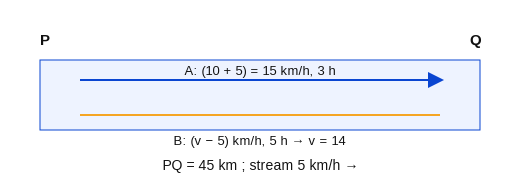
Boat A, whose speed in still water is 10 km/h, goes downstream from city P to city Q in 3 hours. Boat B goes from city Q to city P in 5 hours. What will be the time taken (in hours) by boat B to travel from city P to city Q, if the speed of the stream is 5 km/h?
नाव A, जिसकी शांत जल में चाल 10 km/h है, धारा के अनुकूल शहर P से शहर Q तक 3 घंटे में जाती है। नाव B शहर Q से शहर P तक 5 घंटे में जाती है। यदि धारा की चाल 5 km/h है, तो नाव B द्वारा शहर P से शहर Q तक जाने में लिया गया समय (घंटों में) क्या होगा?
  1. A3415
  2. B3
  3. C2719
  4. D4
Show answer

Concept: Downstream speed =u+v, upstream speed =u−v (u = still-water speed, v = stream speed).

  1. Boat A downstream: (10+5)×3=45km = distance PQ.
  2. Boat B upstream (Q→P): 455=9km/h=u−5 → u=14km/h.
  3. Boat B downstream (P→Q): 14+5=19km/h → time =4519=2719 h.

Trick: Downstream − upstream =2v=10 → B's downstream speed = 9+10=19 directly.

Answer: (C) 2719

अवधारणा: अनुप्रवाह चाल =u+v, ऊर्ध्वप्रवाह चाल =u−v (u = शांत जल में चाल, v = धारा की चाल)।

  1. नाव A अनुप्रवाह: (10+5)×3=45km = दूरी PQ।
  2. नाव B ऊर्ध्वप्रवाह (Q→P): 455=9km/h=u−5 → u=14km/h।
  3. नाव B अनुप्रवाह (P→Q): 14+5=19km/h → समय =4519=2719 घंटे।

ट्रिक: अनुप्रवाह − ऊर्ध्वप्रवाह =2v=10 → B की अनुप्रवाह चाल सीधे 9+10=19।

उत्तर: (C) 2719

RRB NTPC Graduate CBT 1MathematicsBoats and StreamsRRB NTPC Graduate CBT 1 2025 · 27 Mar Shift 3 →
Q14671.
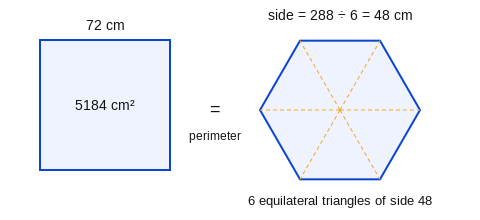
The area of a square is 5184 cm2. Its perimeter is equal to the perimeter of a regular hexagon. What is the area (in cm2) of the hexagon?
एक वर्ग का क्षेत्रफल 5184 cm2 है। इसका परिमाप एक सम षट्भुज के परिमाप के बराबर है। षट्भुज का क्षेत्रफल (cm2 में) क्या है?
  1. A3434
  2. B34323
  3. C3472
  4. D34563
Show answer

Concept: Area of regular hexagon =332a2 (six equilateral triangles).

  1. Square side =5184=72cm; perimeter =288cm.
  2. Hexagon side a=2886=48cm.
  3. Area =332×482=332×2304=34563cm2.

Trick: 722=5184 is worth memorising; hexagon side = 23 of square side.

Answer: (D) 34563

अवधारणा: सम षट्भुज का क्षेत्रफल =332a2 (छह समबाहु त्रिभुज)।

  1. वर्ग की भुजा =5184=72cm; परिमाप =288cm।
  2. षट्भुज की भुजा a=2886=48cm।
  3. क्षेत्रफल =332×482=332×2304=34563cm2।

ट्रिक: 722=5184 याद रखें; षट्भुज की भुजा = वर्ग की भुजा का 23।

उत्तर: (D) 34563

RRB NTPC Graduate CBT 1MathematicsMensuration – HexagonRRB NTPC Graduate CBT 1 2025 · 27 Mar Shift 3 →
Q14672.
Select the correct option.
सही विकल्प चुनिए।
  1. AThe diagonals of a square are equal and bisect each other.एक वर्ग के विकर्ण बराबर होते हैं और एक-दूसरे को समद्विभाजित करते हैं।
  2. BThe diagonals of a square are not equal and bisect each other.एक वर्ग के विकर्ण बराबर नहीं होते हैं और एक-दूसरे को समद्विभाजित करते हैं।
  3. CThe diagonals of a square are not equal and do not bisect each other.एक वर्ग के विकर्ण बराबर नहीं होते हैं और एक-दूसरे को समद्विभाजित नहीं करते हैं।
  4. DThe diagonals of a square are equal and do not bisect each other.एक वर्ग के विकर्ण बराबर होते हैं और एक-दूसरे को समद्विभाजित नहीं करते हैं।
Show answer

Concept: A square is both a rectangle and a rhombus, so it inherits the diagonal properties of both.

  1. Rectangle property: diagonals are equal.
  2. Parallelogram/rhombus property: diagonals bisect each other (and in a square also at 90∘).

Yaad rakhein: Square diagonals – equal, bisect each other, perpendicular, and bisect the vertex angles.

Answer: (A) The diagonals of a square are equal and bisect each other.

अवधारणा: वर्ग आयत भी है और समचतुर्भुज भी, अतः दोनों के विकर्ण-गुण इसमें होते हैं।

  1. आयत का गुण: विकर्ण बराबर होते हैं।
  2. समांतर चतुर्भुज/समचतुर्भुज का गुण: विकर्ण एक-दूसरे को समद्विभाजित करते हैं (वर्ग में 90∘ पर भी)।

याद रखें: वर्ग के विकर्ण – बराबर, समद्विभाजक, लंबवत, और शीर्ष कोणों को भी समद्विभाजित करते हैं।

उत्तर: (A) The diagonals of a square are equal and bisect each other.

RRB NTPC Graduate CBT 1MathematicsProperties of QuadrilateralsRRB NTPC Graduate CBT 1 2025 · 27 Mar Shift 3 →
Q14673.
The marks obtained by 12 students out of 50 are 24, 25, 32, 23, 40, 27, 30, 25, 20, 15, 16, 45. Find the median marks.
12 विद्यार्थियों द्वारा 50 में से प्राप्त अंक 24, 25, 32, 23, 40, 27, 30, 25, 20, 15, 16, 45 हैं। माध्यिका अंक ज्ञात कीजिए।
  1. A23
  2. B25
  3. C27
  4. D24
Show answer

Concept: For even n, median = average of the n2th and (n2+1)th values after sorting.

  1. Sorted: 15, 16, 20, 23, 24, 25, 25, 27, 30, 32, 40, 45.
  2. n=12 → 6th and 7th values are 25 and 25 → median =25+252=25.

Trick: Always sort first – the raw order is a trap.

Answer: (B) 25

अवधारणा: सम n के लिए माध्यिका = क्रमबद्ध करने के बाद n2वें और (n2+1)वें मानों का औसत।

  1. क्रमबद्ध: 15, 16, 20, 23, 24, 25, 25, 27, 30, 32, 40, 45।
  2. n=12 → 6वाँ और 7वाँ मान 25 और 25 → माध्यिका =25+252=25।

ट्रिक: पहले हमेशा क्रमबद्ध करें – मूल क्रम एक जाल है।

उत्तर: (B) 25

RRB NTPC Graduate CBT 1MathematicsStatistics – MedianRRB NTPC Graduate CBT 1 2025 · 27 Mar Shift 3 →
Q14674.
A shopkeeper purchased 67 dozens of articles at the rate of ₹300 per dozen. He sold each one of them at the rate of ₹34. What percentage profit did he make?
एक दुकानदार ने ₹300 प्रति दर्जन की दर से 67 दर्जन वस्तुएँ खरीदीं। उसने उनमें से प्रत्येक को ₹34 की दर से बेच दिया। उसे कितने प्रतिशत लाभ हुआ?
  1. A37%
  2. B38%
  3. C34%
  4. D36%
Show answer

Concept: Profit % =SP−CPCP×100; compare per article.

  1. CP per article =30012=25 rupees; SP per article = ₹34.
  2. Profit =34−25=9 → 925×100=36%.

Trick: The "67 dozens" is irrelevant – percentage profit is the same per article.

Answer: (D) 36%

अवधारणा: लाभ % =SP−CPCP×100; प्रति वस्तु तुलना करें।

  1. प्रति वस्तु CP =30012=25 रुपये; प्रति वस्तु SP = ₹34।
  2. लाभ =34−25=9 → 925×100=36%।

ट्रिक: "67 दर्जन" अनावश्यक है – प्रतिशत लाभ प्रति वस्तु समान रहता है।

उत्तर: (D) 36%

RRB NTPC Graduate CBT 1MathematicsProfit and LossRRB NTPC Graduate CBT 1 2025 · 27 Mar Shift 3 →
Q14675.
If the mean of the following data is 45, find the value of X.
Class20-3030-4040-5050-6060-70
Frequency49192521X
यदि निम्नलिखित आँकड़ों का माध्य 45 है, तो X का मान ज्ञात कीजिए।
वर्ग20-3030-4040-5050-6060-70
बारंबारता49192521X
  1. A42
  2. B48
  3. C26
  4. D32
Show answer

Concept: Mean =∑fixi∑fi, with xi = class mid-point.

  1. Mid-points 25, 35, 45, 55, 65; frequencies 49, 19, 25, 21, X.
  2. ∑fixi=1225+665+1125+1155+65X=4170+65X; ∑fi=114+X.
  3. 4170+65X114+X=45 → 4170+65X=5130+45X → 20X=960 → X=48.

Trick: Use deviations from assumed mean 45: 49(−20)+19(−10)+0+21(10)+20X=0 → −980−190+210+20X=0 → X=48.

Answer: (B) 48

अवधारणा: माध्य =∑fixi∑fi, जहाँ xi = वर्ग मध्य-बिंदु।

  1. मध्य-बिंदु 25, 35, 45, 55, 65; बारंबारताएँ 49, 19, 25, 21, X।
  2. ∑fixi=1225+665+1125+1155+65X=4170+65X; ∑fi=114+X।
  3. 4170+65X114+X=45 → 4170+65X=5130+45X → 20X=960 → X=48।

ट्रिक: कल्पित माध्य 45 से विचलन लें: 49(−20)+19(−10)+0+21(10)+20X=0 → X=48।

उत्तर: (B) 48

RRB NTPC Graduate CBT 1MathematicsStatistics – Mean of Grouped DataRRB NTPC Graduate CBT 1 2025 · 27 Mar Shift 3 →
Q14676.
What is the value of csc263∘+3sec256∘−3cot234∘−tan227∘?
csc263∘+3sec256∘−3cot234∘−tan227∘ का मान क्या है?
  1. A4
  2. B3
  3. C2
  4. D1
Show answer

Concept: tan(90∘−θ)=cotθ, cot(90∘−θ)=tanθ; identities csc2θ−cot2θ=1, sec2θ−tan2θ=1.

  1. tan227∘=cot263∘ → csc263∘−tan227∘=csc263∘−cot263∘=1.
  2. cot234∘=tan256∘ → 3sec256∘−3cot234∘=3(sec256∘−tan256∘)=3.
  3. Total =1+3=4.

Trick: Pair angles adding to 90∘ (63+27, 56+34) and convert to one angle.

Answer: (A) 4

अवधारणा: tan(90∘−θ)=cotθ, cot(90∘−θ)=tanθ; सर्वसमिकाएँ csc2θ−cot2θ=1, sec2θ−tan2θ=1।

  1. tan227∘=cot263∘ → csc263∘−tan227∘=csc263∘−cot263∘=1।
  2. cot234∘=tan256∘ → 3sec256∘−3cot234∘=3(sec256∘−tan256∘)=3।
  3. कुल =1+3=4।

ट्रिक: 90∘ बनाने वाले कोण जोड़ें (63+27, 56+34) और एक कोण में बदलें।

उत्तर: (A) 4

RRB NTPC Graduate CBT 1MathematicsTrigonometry – Complementary AnglesRRB NTPC Graduate CBT 1 2025 · 27 Mar Shift 3 →
Q14677.
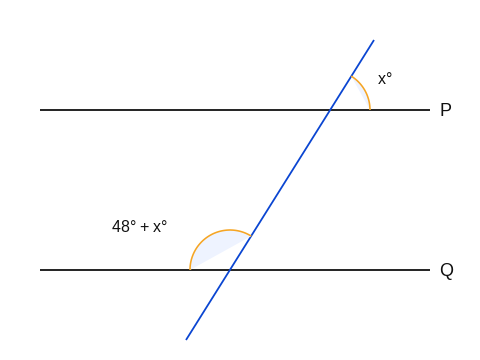
In the given figure, find the value of x if P ∥ Q is given.
दी गई आकृति में, यदि P ∥ Q दिया गया है, तो x का मान ज्ञात कीजिए।
  1. A66
  2. B68
  3. C72
  4. D70
Show answer

Concept: When a transversal cuts parallel lines, co-interior (same-side interior) angles are supplementary.

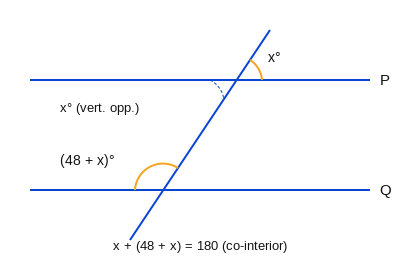
  1. The angle x∘ marked above P equals its vertically opposite angle below P (on the opposite side of the transversal).
  2. That angle and (48+x)∘ at Q lie between the parallels on the same side → co-interior: x+48+x=180.
  3. 2x=132 → x=66.

Trick: One acute + one obtuse angle at parallel lines always add to 180∘.

Answer: (A) 66

अवधारणा: तिर्यक रेखा समांतर रेखाओं को काटे तो सह-अंतःकोण (same-side interior) संपूरक होते हैं।

  1. P के ऊपर अंकित कोण x∘ अपने शीर्षाभिमुख कोण (P के नीचे, तिर्यक रेखा के दूसरी ओर) के बराबर है।
  2. वह कोण और Q पर (48+x)∘ समांतर रेखाओं के बीच एक ही ओर हैं → सह-अंतःकोण: x+48+x=180।
  3. 2x=132 → x=66।

ट्रिक: समांतर रेखाओं पर एक न्यूनकोण + एक अधिककोण का योग सदैव 180∘।

उत्तर: (A) 66

RRB NTPC Graduate CBT 1MathematicsLines and Angles – Parallel LinesRRB NTPC Graduate CBT 1 2025 · 27 Mar Shift 3 →
Q14678.
In what duration (in years) will ₹9,000 fetch a simple interest of ₹720 at 4% per annum rate of interest?
4% वार्षिक ब्याज दर पर ₹9,000 पर ₹720 का साधारण ब्याज कितनी अवधि (वर्षों में) में प्राप्त होगा?
  1. A1
  2. B3
  3. C4
  4. D2
Show answer

Concept: SI=P×R×T100.

  1. 720=9000×4×T100=360T.
  2. T=720360=2 years.

Trick: 4% of 9000 = 360 per year → 720 needs 2 years.

Answer: (D) 2

अवधारणा: SI=P×R×T100।

  1. 720=9000×4×T100=360T।
  2. T=720360=2 वर्ष।

ट्रिक: 9000 का 4% = 360 प्रति वर्ष → 720 के लिए 2 वर्ष।

उत्तर: (D) 2

RRB NTPC Graduate CBT 1MathematicsSimple InterestRRB NTPC Graduate CBT 1 2025 · 27 Mar Shift 3 →
Q14679.
Two taps can fill a cistern in 4 hours and 29 hours respectively. A third tap can empty it in 29 hours. How long (in hours) will it take to fill one-fourth of the empty cistern, if all of them are opened together?
दो नल एक टंकी को क्रमशः 4 घंटे और 29 घंटे में भर सकते हैं। एक तीसरा नल इसे 29 घंटे में खाली कर सकता है। यदि इन सभी को एक साथ खोल दिया जाए, तो खाली टंकी का एक-चौथाई भाग भरने में कितना समय (घंटों में) लगेगा?
  1. A3
  2. B1
  3. C2
  4. D4
Show answer

Concept: Net work per hour = sum of filling rates − emptying rate.

  1. Rates: 14+129−129=14 of the cistern per hour.
  2. The second filling tap and the emptying tap cancel each other exactly.
  3. One-fourth of the cistern at 14 per hour ⇒ 1 hour.

Trick: Whenever a filling and an emptying pipe have the same time, strike both out – only the remaining pipe matters.

Answer: (B) 1

अवधारणा: प्रति घंटा नेट कार्य = भरने की दरों का योग − खाली करने की दर।

  1. दरें: 14+129−129=14 टंकी प्रति घंटा।
  2. दूसरा भरने वाला नल और खाली करने वाला नल एक-दूसरे को पूरी तरह काट देते हैं।
  3. टंकी का एक-चौथाई, 14 प्रति घंटा की दर से ⇒ 1 घंटा।

ट्रिक: जब भरने और खाली करने वाले पाइप का समय समान हो, दोनों को काट दें – केवल बचा हुआ पाइप गिनें।

उत्तर: (B) 1

RRB NTPC Graduate CBT 1MathematicsPipes and CisternsRRB NTPC Graduate CBT 1 2025 · 27 Mar Shift 3 →
Q14680.
A dealer buys two articles X and Y for ₹3,500 each. He marks each of them at the same price. He sells X by giving two successive discounts of 45% and 60% and still earns ₹889 as profit. If he sells Y at a single discount of 69%, then what is the profit
percentage on Y?
एक व्यापारी दो वस्तुएँ X और Y प्रत्येक ₹3,500 में खरीदता है। वह दोनों पर समान मूल्य अंकित करता है। वह X को 45% और 60% की दो क्रमिक छूट देकर बेचता है और फिर भी ₹889 का लाभ कमाता है। यदि वह Y को 69% की एकल छूट पर बेचता है, तो Y पर लाभ
प्रतिशत क्या है?
  1. A76.7%
  2. B75.7%
  3. C76%
  4. D75%
Show answer

Concept: Successive discounts multiply: SP=MP×(1−d1)(1−d2). Same marked price for both articles.

  1. SP of X =3500+889=4389.
  2. MP×0.55×0.40=0.22MP=4389⇒MP=19950.
  3. SP of Y =19950×0.31=6184.5; profit =6184.5−3500=2684.5.
  4. Profit% =2684.53500×100=76.7%.

Trick: 45% and 60% off together leave 0.55×0.40=22% of MP – never add discounts.

Answer: (A) 76.7%

अवधारणा: क्रमिक छूट गुणा होती हैं: SP=MP×(1−d1)(1−d2)। दोनों वस्तुओं का अंकित मूल्य समान है।

  1. X का SP =3500+889=4389।
  2. MP×0.55×0.40=0.22MP=4389⇒MP=19950।
  3. Y का SP =19950×0.31=6184.5; लाभ =6184.5−3500=2684.5।
  4. लाभ% =2684.53500×100=76.7%।

ट्रिक: 45% और 60% की छूट मिलकर MP का 0.55×0.40=22% छोड़ती हैं – छूटें कभी जोड़ें नहीं।

उत्तर: (A) 76.7%

RRB NTPC Graduate CBT 1MathematicsSuccessive DiscountsRRB NTPC Graduate CBT 1 2025 · 27 Mar Shift 3 →