Question bank

Q&A: practice questions with answers

Search questions on any topic. Filter by exam category, exam, subject and topic, try the question, then open the answer and explanation.

Courses – airGurukul

20,719 questions found.

Q14781.
Evaluate: 16 + 20 ÷ 4 - 3 × 3
मान ज्ञात कीजिए: 16 + 20 ÷ 4 - 3 × 3
  1. A14
  2. B12
  3. C11
  4. D15
Show answer

Concept: BODMAS – do Division and Multiplication before Addition and Subtraction.

  1. 20÷4=5 and 3×3=9.
  2. Expression becomes 16+5−9.
  3. 21−9=12.

Trick: Never work left to right blindly – circle the ÷ and × parts first.

Answer: (B) 12

अवधारणा: BODMAS – भाग और गुणा पहले, जोड़-घटाव बाद में।

  1. 20÷4=5 और 3×3=9।
  2. व्यंजक बना 16+5−9।
  3. 21−9=12।

ट्रिक: बाएँ से दाएँ सीधे हल न करें – पहले ÷ और × वाले भाग घेरें।

उत्तर: (B) 12
RRB NTPC Graduate CBT 1MathematicsBODMASRRB NTPC Graduate CBT 1 2025 · 27 Mar Shift 2 →
Q14782.
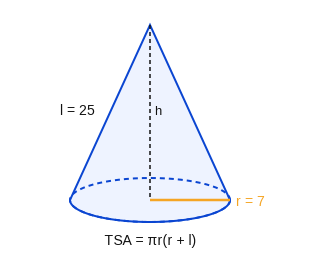
A right circular cone has a radius of 7 cm. Its slant height is 25 cm. What is the total surface area of the cone? (Use π = 22/7)
एक लंब वृत्तीय शंकु की त्रिज्या 7 cm है। इसकी तिर्यक ऊँचाई 25 cm है। शंकु का कुल पृष्ठीय क्षेत्रफल क्या है? (π = 22/7 का प्रयोग कीजिए)
  1. A686cm2
  2. B704cm2
  3. C792cm2
  4. D814cm2
Show answer

Concept: Total surface area of a cone =πrl+πr2=πr(l+r).

  1. r=7 cm, l=25 cm, so l+r=32.
  2. TSA =227×7×32.
  3. =22×32=704cm2.

Trick: With r=7 and π=227, the 7 cancels – TSA is simply 22×(r+l).

Answer: (B) 704cm2

अवधारणा: शंकु का कुल पृष्ठीय क्षेत्रफल =πrl+πr2=πr(l+r)।

  1. r=7 cm, l=25 cm, अतः l+r=32।
  2. TSA =227×7×32।
  3. =22×32=704cm2।

ट्रिक: r=7 और π=227 हो तो 7 कट जाता है – TSA बस 22×(r+l)।

उत्तर: (B) 704cm2

RRB NTPC Graduate CBT 1MathematicsMensuration – coneRRB NTPC Graduate CBT 1 2025 · 27 Mar Shift 2 →
Q14783.
Meenakshi and Meena invest in a business in the ratio 12 : 32. If total profit is ₹2,904, then what is difference between the profit (in ₹) of Meenakshi and Meena?
Meenakshi और Meena एक व्यापार में 12 : 32 के अनुपात में निवेश करती हैं। यदि कुल लाभ ₹2,904 है, तो Meenakshi और Meena के लाभ (₹ में) का अंतर क्या है?
  1. A₹1,320
  2. B₹1,470
  3. C₹1,220
  4. D₹1,270
Show answer

Concept: For equal time, profit is shared in the ratio of investments.

  1. 12:32=3:8, total =11 parts.
  2. 1 part =290411=264.
  3. Difference =(8−3)×264=5×264=1320.

Trick: Difference of profits =difference of ratio termssum×total=511×2904.

Answer: (A) ₹1,320

अवधारणा: समान समय के लिए लाभ निवेश के अनुपात में बँटता है।

  1. 12:32=3:8, कुल =11 भाग।
  2. 1 भाग =290411=264।
  3. अंतर =(8−3)×264=5×264=1320।

ट्रिक: लाभ का अंतर =अनुपात पदों का अंतरयोग×कुल लाभ=511×2904।

उत्तर: (A) ₹1,320

RRB NTPC Graduate CBT 1MathematicsPartnershipRRB NTPC Graduate CBT 1 2025 · 27 Mar Shift 2 →
Q14784.
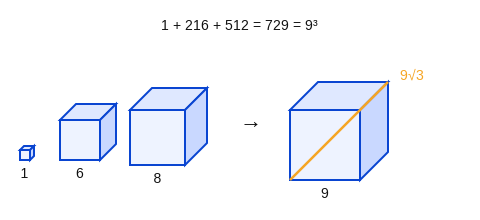
Three solid cubes whose edges measure 1 cm, 6 cm, and 8 cm, respectively, are melted and recast into a single cube. What is the length (in cm) of the diagonal of the cube?
तीन ठोस घनों, जिनके किनारे क्रमशः 1 cm, 6 cm और 8 cm हैं, को पिघलाकर एक एकल घन बनाया जाता है। इस घन के विकर्ण की लंबाई (cm में) क्या है?
  1. A93
  2. B82
  3. C92
  4. D83
Show answer

Concept: Melting preserves volume. Diagonal of a cube =a3.

  1. Total volume =13+63+83=1+216+512=729cm3.
  2. New edge a=7293=9 cm.
  3. Diagonal =93 cm.

Trick: 1,6,8→9 is a famous cube triplet (13+63+83=93), like 3,4,5→6.

Answer: (A) 93

अवधारणा: पिघलाने पर आयतन समान रहता है। घन का विकर्ण =a3।

  1. कुल आयतन =13+63+83=1+216+512=729cm3।
  2. नई भुजा a=7293=9 cm।
  3. विकर्ण =93 cm।

ट्रिक: 1,6,8→9 प्रसिद्ध घन-त्रिक है (13+63+83=93), जैसे 3,4,5→6।

उत्तर: (A) 93

RRB NTPC Graduate CBT 1MathematicsMensuration – cubeRRB NTPC Graduate CBT 1 2025 · 27 Mar Shift 2 →
Q14785.
Two taps can fill a cistern in 4 hours and 26 hours respectively. A third tap can empty it in 26 hours. How long (in hours) will it take to fill one-fourth of the empty cistern, if all of them are opened together?
दो नल एक टंकी को क्रमशः 4 घंटे और 26 घंटे में भर सकते हैं। एक तीसरा नल इसे 26 घंटे में खाली कर सकता है। यदि इन सभी को एक साथ खोल दिया जाए, तो खाली टंकी के एक-चौथाई भाग को भरने में कितना समय (घंटों में) लगेगा?
  1. A2
  2. B1
  3. C4
  4. D3
Show answer

Concept: Add the per-hour work of filling taps and subtract the emptying tap.

  1. Net part filled in 1 hour =14+126−126=14.
  2. So the full cistern fills in 4 hours.
  3. One-fourth of the cistern =14×4=1 hour.

Trick: The 26-hour filler and 26-hour emptier cancel exactly – only the 4-hour tap matters.

Answer: (B) 1

अवधारणा: भरने वाले नलों का प्रति घंटा कार्य जोड़ें और खाली करने वाले का घटाएँ।

  1. 1 घंटे में भरा भाग =14+126−126=14।
  2. अतः पूरी टंकी 4 घंटे में भरती है।
  3. एक-चौथाई टंकी =14×4=1 घंटा।

ट्रिक: 26 घंटे वाला भरने वाला और 26 घंटे वाला खाली करने वाला नल एक-दूसरे को काट देते हैं – केवल 4 घंटे वाला नल मायने रखता है।

उत्तर: (B) 1

RRB NTPC Graduate CBT 1MathematicsPipes and cisternsRRB NTPC Graduate CBT 1 2025 · 27 Mar Shift 2 →
Q14786.
The least common multiple of 64, 128 and A is 4480. The difference between the maximum and minimum possible values of A is:
64, 128 और A का लघुत्तम समापवर्त्य 4480 है। A के अधिकतम और न्यूनतम संभव मानों का अंतर है:
  1. A5444
  2. B4454
  3. C4544
  4. D4445
Show answer

Concept: Factorise the LCM; A must supply every prime factor that 64 and 128 cannot.

  1. 4480=128×35=27×5×7; 64=26, 128=27.
  2. Since 128 already gives 27, A must contain 5×7=35 and may have 2k with 0≤k≤7.
  3. Minimum A =35, maximum A =35×27=4480.
  4. Difference =4480−35=4445.

Trick: Max A is always the LCM itself; Min A = LCM with the powers of 2 already covered by 128 removed.

Answer: (D) 4445

अवधारणा: LCM का गुणनखंड करें; A को वे अभाज्य गुणनखंड देने होंगे जो 64 और 128 नहीं दे सकते।

  1. 4480=128×35=27×5×7; 64=26, 128=27।
  2. 128 पहले ही 27 देता है, अतः A में 5×7=35 होना चाहिए और 2k (0≤k≤7) हो सकता है।
  3. न्यूनतम A =35, अधिकतम A =35×27=4480।
  4. अंतर =4480−35=4445।

ट्रिक: अधिकतम A हमेशा LCM ही होता है; न्यूनतम A = LCM में से 128 द्वारा दी गई 2 की घातें हटाकर।

उत्तर: (D) 4445

RRB NTPC Graduate CBT 1MathematicsLCMRRB NTPC Graduate CBT 1 2025 · 27 Mar Shift 2 →
Q14787.
At what rate per annum will a sum of money become five times itself in 9 years under simple interest?
साधारण ब्याज पर कोई धनराशि 9 वर्षों में स्वयं की पाँच गुनी किस वार्षिक दर पर हो जाएगी?
  1. A4689%
  2. B8889%
  3. C4449%
  4. D4249%
Show answer

Concept: If the sum becomes n times, SI =(n−1)P and R=(n−1)×100T.

  1. Five times ⇒ SI =4P in 9 years.
  2. R=4×1009=4009.
  3. 4009=4449% per annum.

Trick: "n times in T years" ⇒ R×T=(n−1)×100.

Answer: (C) 4449%

अवधारणा: धन n गुना हो तो SI =(n−1)P और R=(n−1)×100T।

  1. पाँच गुना ⇒ SI =4P, 9 वर्षों में।
  2. R=4×1009=4009।
  3. 4009=4449% वार्षिक।

ट्रिक: "T वर्षों में n गुना" ⇒ R×T=(n−1)×100।

उत्तर: (C) 4449%

RRB NTPC Graduate CBT 1MathematicsSimple interestRRB NTPC Graduate CBT 1 2025 · 27 Mar Shift 2 →
Q14788.
If the quadratic equation x2−(2+h)x+h2−4h+4=0 has identical roots, then what are the possible values of h?
यदि द्विघात समीकरण x2−(2+h)x+h2−4h+4=0 के मूल समान (identical) हैं, तो h के संभव मान क्या हैं?
  1. Ah=−1, h=−12
  2. Bh=−23, h=6
  3. Ch=23, h=6
  4. Dh=0, h=−1
Show answer

Concept: ax2+bx+c=0 has identical (equal) roots when the discriminant b2−4ac=0.

  1. Here a=1, b=−(2+h), c=h2−4h+4.
  2. (2+h)2−4(h2−4h+4)=0⇒4+4h+h2−4h2+16h−16=0.
  3. −3h2+20h−12=0⇒3h2−20h+12=0⇒(3h−2)(h−6)=0.
  4. h=23 or h=6.

Trick: Check quickly: h=6 gives x2−8x+16=(x−4)2 ✓.

Answer: (C) h=23, h=6

अवधारणा: ax2+bx+c=0 के मूल समान होते हैं जब विविक्तकर (discriminant) b2−4ac=0।

  1. यहाँ a=1, b=−(2+h), c=h2−4h+4।
  2. (2+h)2−4(h2−4h+4)=0⇒4+4h+h2−4h2+16h−16=0।
  3. −3h2+20h−12=0⇒3h2−20h+12=0⇒(3h−2)(h−6)=0।
  4. h=23 या h=6।

ट्रिक: जल्दी जाँच: h=6 पर x2−8x+16=(x−4)2 ✓।

उत्तर: (C) h=23, h=6

RRB NTPC Graduate CBT 1MathematicsQuadratic equations – equal rootsRRB NTPC Graduate CBT 1 2025 · 27 Mar Shift 2 →
Q14789.
There are 25 members in group A, 32 members in group B and 31 members in group C. All the members of these groups went to a restaurant. The average amounts spent on each member of groups A, B and C are ₹101, ₹249 and ₹269, respectively. The overall average amount (in ₹) spent per member is:
समूह A में 25 सदस्य, समूह B में 32 सदस्य और समूह C में 31 सदस्य हैं। इन समूहों के सभी सदस्य एक रेस्तरां में गए। समूह A, B और C के प्रत्येक सदस्य पर खर्च की गई औसत राशि क्रमशः ₹101, ₹249 और ₹269 है। प्रति सदस्य खर्च की गई समग्र औसत राशि (₹ में) है:
  1. A216
  2. B219
  3. C214
  4. D215
Show answer

Concept: Overall average =total amounttotal members.

  1. Group totals: 25×101=2525, 32×249=7968, 31×269=8339.
  2. Total amount =2525+7968+8339=18832; total members =25+32+31=88.
  3. Average =1883288=214.

Trick: Take 214 as base: deviations 25(−113)+32(35)+31(55)=−2825+1120+1705=0 ✓.

Answer: (C) 214

अवधारणा: कुल औसत =कुल राशिकुल सदस्य।

  1. समूह योग: 25×101=2525, 32×249=7968, 31×269=8339।
  2. कुल राशि =2525+7968+8339=18832; कुल सदस्य =25+32+31=88।
  3. औसत =1883288=214।

ट्रिक: 214 को आधार मानें: विचलन 25(−113)+32(35)+31(55)=−2825+1120+1705=0 ✓।

उत्तर: (C) 214

RRB NTPC Graduate CBT 1MathematicsWeighted averageRRB NTPC Graduate CBT 1 2025 · 27 Mar Shift 2 →
Q14790.
The selling price of 25 books is equal to the cost price of 19 books. Find the loss or gain percentage.
25 पुस्तकों का विक्रय मूल्य 19 पुस्तकों के क्रय मूल्य के बराबर है। हानि या लाभ प्रतिशत ज्ञात कीजिए।
  1. A24% gain24% लाभ
  2. B1006% gain1006% लाभ
  3. C24% loss24% हानि
  4. D1006% loss1006% हानि
Show answer

Concept: If SP of x articles = CP of y articles, then gain/loss%=y−xx×100.

  1. SP of 25 books = CP of 19 books ⇒ SPCP=1925 per book.
  2. SP is less than CP, so it is a loss.
  3. Loss%=25−1925×100=625×100=24%.

Trick: Divide by the number attached to SP (25). More articles sold for the cost of fewer ⇒ loss.

Answer: (C) 24% loss

अवधारणा: यदि x वस्तुओं का SP = y वस्तुओं का CP, तो लाभ/हानि%=y−xx×100।

  1. 25 पुस्तकों का SP = 19 पुस्तकों का CP ⇒ प्रति पुस्तक SPCP=1925।
  2. SP, CP से कम है, अतः हानि।
  3. हानि%=25−1925×100=625×100=24%।

ट्रिक: SP वाली संख्या (25) से भाग दें। ज़्यादा वस्तुएँ कम वस्तुओं की लागत में बिकें ⇒ हानि।

उत्तर: (C) 24% हानि

RRB NTPC Graduate CBT 1MathematicsProfit and lossRRB NTPC Graduate CBT 1 2025 · 27 Mar Shift 2 →
Q14791.
The average of first 13 multiples of 9 is:
9 के प्रथम 13 गुणजों का औसत है:
  1. A13
  2. B58.5
  3. C9
  4. D63
Show answer

Concept: Average of the first n multiples of k =k×n+12.

  1. Here k=9, n=13.
  2. Average =9×13+12=9×7=63.
  3. Check: the multiples 9, 18, …, 117 form an AP; the middle (7th) term =9×7=63.

Trick: For an odd count of terms in AP, the average is simply the middle term.

Answer: (D) 63

अवधारणा: k के पहले n गुणजों का औसत =k×n+12।

  1. यहाँ k=9, n=13।
  2. औसत =9×13+12=9×7=63।
  3. जाँच: 9, 18, …, 117 समांतर श्रेढ़ी है; बीच का (7वाँ) पद =9×7=63।

ट्रिक: AP में पदों की संख्या विषम हो तो औसत = बीच का पद।

उत्तर: (D) 63

RRB NTPC Graduate CBT 1MathematicsAverage of multiplesRRB NTPC Graduate CBT 1 2025 · 27 Mar Shift 2 →
Q14792.
If A's salary is 143% more than that of B, then how much percent is B's salary less than that of A (correct to 2 decimal places)?
यदि A का वेतन B के वेतन से 143% अधिक है, तो B का वेतन A के वेतन से कितने प्रतिशत कम है (दशमलव के 2 स्थानों तक सही)?
  1. A61.92%
  2. B59.64%
  3. C56.62%
  4. D58.85%
Show answer

Concept: If A is x% more than B, then B is x100+x×100% less than A.

  1. Let B = 100, so A = 243.
  2. B is less than A by 143243×100.
  3. 14300243≈58.85%.

Trick: "More" → divide by 100+x; "less" → divide by 100−x. Here 143243, a little under 60%.

Answer: (D) 58.85%

अवधारणा: यदि A, B से x% अधिक है, तो B, A से x100+x×100% कम है।

  1. B = 100 मानें, तो A = 243।
  2. B, A से 143243×100 कम।
  3. 14300243≈58.85%।

ट्रिक: "अधिक" → 100+x से भाग; "कम" → 100−x से भाग। यहाँ 143243, 60% से थोड़ा कम।

उत्तर: (D) 58.85%

RRB NTPC Graduate CBT 1MathematicsPercentage comparisonRRB NTPC Graduate CBT 1 2025 · 27 Mar Shift 2 →
Q14793.
What is the mode of the data given below? [Give your answer correct to 2 decimal places.]
Age in years20-3030-4040-5050-6060-7070-8080-90
No. of patients24292635202310
नीचे दिए गए आँकड़ों का बहुलक (mode) क्या है? [अपना उत्तर दशमलव के 2 स्थानों तक सही दीजिए।]
आयु (वर्षों में)20-3030-4040-5050-6060-7070-8080-90
रोगियों की संख्या24292635202310
  1. A53.75
  2. B55.75
  3. C51.75
  4. D57.75
Show answer

Concept: Mode =l+f1−f02f1−f0−f2×h, where f1 is the highest frequency.

  1. Highest frequency 35 → modal class 50–60; l=50, h=10, f1=35, f0=26, f2=20.
  2. Mode =50+35−2670−26−20×10=50+924×10.
  3. =50+3.75=53.75.

Trick: f0 = frequency just before, f2 = just after the modal class; the answer always lies inside the modal class (50–60).

Answer: (A) 53.75

अवधारणा: बहुलक =l+f1−f02f1−f0−f2×h, जहाँ f1 सबसे बड़ी बारंबारता है।

  1. सबसे बड़ी बारंबारता 35 → बहुलक वर्ग 50–60; l=50, h=10, f1=35, f0=26, f2=20।
  2. बहुलक =50+35−2670−26−20×10=50+924×10।
  3. =50+3.75=53.75।

ट्रिक: f0 = बहुलक वर्ग से ठीक पहले की, f2 = ठीक बाद की बारंबारता; उत्तर हमेशा बहुलक वर्ग (50–60) के अंदर होता है।

उत्तर: (A) 53.75

RRB NTPC Graduate CBT 1MathematicsStatistics – mode of grouped dataRRB NTPC Graduate CBT 1 2025 · 27 Mar Shift 2 →
Q14794.
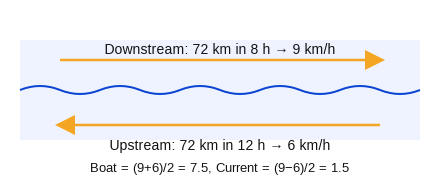
A boat takes 8 hours to row 72 km downstream and 12 hours to row the same distance upstream. Find the boat's rate in still water and the rate of current, respectively.
एक नाव धारा की दिशा में 72 km चलने में 8 घंटे और धारा के विपरीत उतनी ही दूरी चलने में 12 घंटे लेती है। शांत जल में नाव की चाल और धारा की चाल क्रमशः ज्ञात कीजिए।
  1. A7.5 km/hr and 1.5 km/hr7.5 km/hr और 1.5 km/hr
  2. B8.5 km/hr and 2.5 km/hr8.5 km/hr और 2.5 km/hr
  3. C6.5 km/hr and 0.5 km/hr6.5 km/hr और 0.5 km/hr
  4. D9.5 km/hr and 3.5 km/hr9.5 km/hr और 3.5 km/hr
Show answer

Concept: Boat speed =downstream+upstream2, current =downstream−upstream2.

  1. Downstream speed =728=9 km/h.
  2. Upstream speed =7212=6 km/h.
  3. Boat =9+62=7.5 km/h; current =9−62=1.5 km/h.

Trick: Downstream is always the faster one; average of the two = boat, half the gap = stream.

Answer: (A) 7.5 km/hr and 1.5 km/hr

अवधारणा: नाव की चाल =धारा के अनुकूल+धारा के प्रतिकूल2, धारा =अनुकूल−प्रतिकूल2।

  1. अनुकूल चाल =728=9 km/h।
  2. प्रतिकूल चाल =7212=6 km/h।
  3. नाव =9+62=7.5 km/h; धारा =9−62=1.5 km/h।

ट्रिक: अनुकूल चाल हमेशा बड़ी होती है; दोनों का औसत = नाव, अंतर का आधा = धारा।

उत्तर: (A) 7.5 km/hr और 1.5 km/hr

RRB NTPC Graduate CBT 1MathematicsBoats and streamsRRB NTPC Graduate CBT 1 2025 · 27 Mar Shift 2 →
Q14795.
A dealer buys two articles X and Y for ₹2300 each. He marks each of them at the same price. He sells X by giving two successive discounts of 46% and 68% and still earns ₹460 as profit. If he sells Y at a single discount of 73%, then what is the profit
percentage on Y?
एक व्यापारी दो वस्तुएँ X और Y प्रत्येक ₹2300 में खरीदता है। वह दोनों पर समान मूल्य अंकित करता है। वह X को 46% और 68% की दो क्रमागत छूट देकर बेचता है और फिर भी ₹460 का लाभ अर्जित करता है। यदि वह Y को 73% की एकल छूट पर बेचता है, तो Y पर लाभ
प्रतिशत क्या है?
  1. A87.5%
  2. B87%
  3. C86.5%
  4. D86%
Show answer

Concept: Two successive discounts d1,d2 leave (1−d1)(1−d2) of the marked price.

  1. SP of X =2300+460=2760=MP×0.54×0.32=0.1728MP.
  2. SP of Y =0.27MP. Ratio: SPYSPX=0.270.1728=2516.
  3. SPY=2760×2516=4312.5; profit =4312.5−2300=2012.5.
  4. Profit%=2012.52300×100=87.5%.

Trick: Same MP for both – work with the ratio of net multipliers (0.27:0.1728=25:16) instead of finding MP.

Answer: (A) 87.5%

अवधारणा: दो क्रमिक छूट d1,d2 के बाद अंकित मूल्य का (1−d1)(1−d2) भाग बचता है।

  1. X का SP =2300+460=2760=MP×0.54×0.32=0.1728MP।
  2. Y का SP =0.27MP। अनुपात: SPYSPX=0.270.1728=2516।
  3. SPY=2760×2516=4312.5; लाभ =4312.5−2300=2012.5।
  4. लाभ%=2012.52300×100=87.5%।

ट्रिक: दोनों का MP समान – MP निकालने के बजाय शुद्ध गुणकों का अनुपात (0.27:0.1728=25:16) लें।

उत्तर: (A) 87.5%

RRB NTPC Graduate CBT 1MathematicsSuccessive discounts & profitRRB NTPC Graduate CBT 1 2025 · 27 Mar Shift 2 →
Q14796.
In a certain code language, ‘CAST’ is coded as ‘3519’ and ‘SIDE’ is coded as ‘8645’. What is the code for ‘S’ in that language?
एक निश्चित कूट भाषा में, ‘CAST’ को ‘3519’ के रूप में कूटबद्ध किया जाता है और ‘SIDE’ को ‘8645’ के रूप में कूटबद्ध किया जाता है। उस भाषा में ‘S’ का कूट क्या है?
  1. A8
  2. B5
  3. C1
  4. D6
Show answer

Concept: When two coded words share a common letter, the common digit in their codes is that letter's code.

  1. CAST → 3519 and SIDE → 8645.
  2. Common letter in both words: only S.
  3. Common digit in both codes: only 5. So S = 5.

Trick: Match the common letter with the common digit – no need to decode the rest.

Answer: (B) 5

अवधारणा: जब दो कोडित शब्दों में एक अक्षर समान हो, तो दोनों कोड में समान अंक ही उस अक्षर का कोड होता है।

  1. CAST → 3519 और SIDE → 8645।
  2. दोनों शब्दों में समान अक्षर: केवल S।
  3. दोनों कोड में समान अंक: केवल 5। अतः S = 5।

ट्रिक: समान अक्षर को समान अंक से मिलाएँ – बाकी डिकोड करने की ज़रूरत नहीं।

उत्तर: (B) 5

RRB NTPC Graduate CBT 1General Intelligence and ReasoningCoding–decodingRRB NTPC Graduate CBT 1 2025 · 27 Mar Shift 2 →
Q14797.
Which of the given letter-number clusters will replace the question mark (?) in the following series to make it logically complete?
MPW 30 HKR 25 CFM 20 XAH 15 ?
निम्नलिखित श्रृंखला को तार्किक रूप से पूर्ण करने के लिए दिए गए अक्षर-संख्या समूहों में से कौन-सा प्रश्नचिह्न (?) के स्थान पर आएगा?
MPW 30 HKR 25 CFM 20 XAH 15 ?
  1. ABYM 13
  2. BDLV 12
  3. CSVC 10
  4. DZKE 12
Show answer

Concept: Check each letter position separately and the number separately.

  1. 1st letters M, H, C, X → each −5 → X−5 = S.
  2. 2nd letters P, K, F, A → each −5 → V; 3rd letters W, R, M, H → each −5 → C.
  3. Numbers 30, 25, 20, 15 → −5 → 10. Term = SVC 10.

Trick: All three letters move −5 in a loop (A−5 = V, X−5 = S).

Answer: (C) SVC 10

अवधारणा: हर अक्षर की स्थिति और संख्या को अलग-अलग जाँचें।

  1. पहले अक्षर M, H, C, X → हर बार −5 → X−5 = S।
  2. दूसरे अक्षर P, K, F, A → −5 → V; तीसरे अक्षर W, R, M, H → −5 → C।
  3. संख्याएँ 30, 25, 20, 15 → −5 → 10। पद = SVC 10।

ट्रिक: तीनों अक्षर लूप में −5 चलते हैं (A−5 = V, X−5 = S)।

उत्तर: (C) SVC 10

RRB NTPC Graduate CBT 1General Intelligence and ReasoningLetter–number seriesRRB NTPC Graduate CBT 1 2025 · 27 Mar Shift 2 →
Q14798.
Which of the following letter-number clusters will replace the question mark “?” in the given series to make it logically complete?
HAK 8, GYH 11, FWE 14, EUB 17, ?
दी गई श्रृंखला को तार्किक रूप से पूर्ण करने के लिए निम्नलिखित अक्षर-संख्या समूहों में से कौन-सा प्रश्नचिह्न “?” के स्थान पर आएगा?
HAK 8, GYH 11, FWE 14, EUB 17, ?
  1. ADTA 21
  2. BDSY 20
  3. CDSX 20
  4. DCSZ 20
Show answer

Concept: Each letter position follows its own fixed step; the number has a separate pattern.

  1. 1st letters H, G, F, E → −1 → D.
  2. 2nd letters A, Y, W, U → −2 → S; 3rd letters K, H, E, B → −3 → B−3 = Y.
  3. Numbers 8, 11, 14, 17 → +3 → 20. Term = DSY 20.

Trick: Steps are −1,−2,−3 for the three letters – wrap B−3 around Z to get Y.

Answer: (B) DSY 20

अवधारणा: हर अक्षर स्थिति का अपना निश्चित अंतर है; संख्या का पैटर्न अलग है।

  1. पहले अक्षर H, G, F, E → −1 → D।
  2. दूसरे अक्षर A, Y, W, U → −2 → S; तीसरे अक्षर K, H, E, B → −3 → B−3 = Y।
  3. संख्याएँ 8, 11, 14, 17 → +3 → 20। पद = DSY 20।

ट्रिक: तीनों अक्षरों के अंतर −1,−2,−3 हैं – B−3 को Z से घुमाकर Y लें।

उत्तर: (B) DSY 20

RRB NTPC Graduate CBT 1General Intelligence and ReasoningLetter–number seriesRRB NTPC Graduate CBT 1 2025 · 27 Mar Shift 2 →
Q14799.
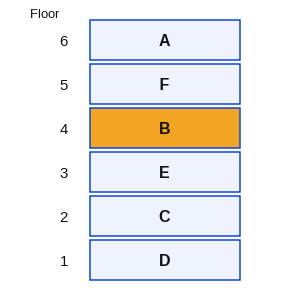
A, B, C, D, E and F live on six different floors of the same building. The lowermost floor in the building is numbered 1, the floor above it is numbered 2 and so on, till the topmost floor, which is numbered 6. C lives on an even-numbered floor but not 6. The sum of the floors on which F and C live is 7. B lives immediately above E. The sum of the floors on which C and D live is 3. How many people live above B?
A, B, C, D, E और F एक ही भवन की छह अलग-अलग मंज़िलों पर रहते हैं। भवन की सबसे निचली मंज़िल की संख्या 1 है, उसके ऊपर की मंज़िल की संख्या 2 है और इसी प्रकार सबसे ऊपरी मंज़िल तक, जिसकी संख्या 6 है। C एक सम-संख्या वाली मंज़िल पर रहता है, लेकिन 6 पर नहीं। F और C जिन मंज़िलों पर रहते हैं, उनकी संख्याओं का योग 7 है। B, E के ठीक ऊपर रहता है। C और D जिन मंज़िलों पर रहते हैं, उनकी संख्याओं का योग 3 है। B के ऊपर कितने व्यक्ति रहते हैं?
  1. AThreeतीन
  2. BTwoदो
  3. COneएक
  4. DFourचार
Show answer

Concept: Fix the most restricted person first, then place the rest using sums.

  1. C is even but not 6 → C = 2 or 4. C + D = 3 → C = 2, D = 1.
  2. F + C = 7 → F = 5.
  3. Left floors 3, 4, 6 for A, B, E; B immediately above E → E = 3, B = 4, A = 6.
  4. Above B (floor 4): F and A → two people.

Trick: A sum of 3 with floor numbers can only be 1 + 2 – such sums fix two people at once.

Answer: (B) Two

अवधारणा: सबसे अधिक शर्त वाले व्यक्ति को पहले रखें, फिर योग से बाकी को।

  1. C सम है पर 6 नहीं → C = 2 या 4। C + D = 3 → C = 2, D = 1।
  2. F + C = 7 → F = 5।
  3. बची मंज़िलें 3, 4, 6 A, B, E के लिए; B ठीक E के ऊपर → E = 3, B = 4, A = 6।
  4. B (मंज़िल 4) के ऊपर: F और A → दो लोग।

ट्रिक: मंज़िलों का योग 3 केवल 1 + 2 हो सकता है – ऐसे योग दो लोगों को एक साथ तय कर देते हैं।

उत्तर: (B) दो (Two)

RRB NTPC Graduate CBT 1General Intelligence and ReasoningFloor puzzleRRB NTPC Graduate CBT 1 2025 · 27 Mar Shift 2 →
Q14800.
In a certain code language,
A + B means ‘A is the mother of B’
A – B means ‘A is the brother of B’
A x B means ‘A is the wife of B’
A % B means ‘A is the father of B’
A # B means ‘A is the daughter of B’
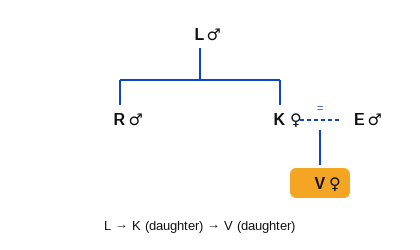
Based on the above, how is V related to L if ‘L % R – K + V # E’?
एक निश्चित कूट भाषा में,
A + B का अर्थ है ‘A, B की माता है’
A – B का अर्थ है ‘A, B का भाई है’
A x B का अर्थ है ‘A, B की पत्नी है’
A % B का अर्थ है ‘A, B का पिता है’
A # B का अर्थ है ‘A, B की पुत्री है’
उपर्युक्त के आधार पर, यदि ‘L % R – K + V # E’ है, तो V का L से क्या संबंध है?
  1. ASister’s sonबहन का पुत्र
  2. BWife’s fatherपत्नी का पिता
  3. CDaughter’s daughterपुत्री की पुत्री
  4. DMother’s brotherमाता का भाई
Show answer

Concept: Decode the expression step by step and build the family tree.

  1. L % R → L is father of R. R – K → R is brother of K, so L is also K's father.
  2. K + V → K is mother of V (K is female). V # E → V is daughter of E (V is female).
  3. So V is the daughter of K, and K is L's daughter → V is L's daughter's daughter.

Trick: "+" (mother) and "#" (daughter) fix genders instantly – use them to decide "daughter's daughter" vs "son's daughter".

Answer: (C) Daughter's daughter

अवधारणा: व्यंजक को चरणबद्ध डिकोड करके वंश-वृक्ष बनाएँ।

  1. L % R → L, R का पिता। R – K → R, K का भाई, अतः L, K का भी पिता।
  2. K + V → K, V की माता (K महिला)। V # E → V, E की पुत्री (V महिला)।
  3. अतः V, K की पुत्री है और K, L की पुत्री → V, L की पुत्री की पुत्री (नातिन)।

ट्रिक: "+" (माता) और "#" (पुत्री) से लिंग तुरंत तय होता है – इससे "पुत्री की पुत्री" और "पुत्र की पुत्री" में भेद करें।

उत्तर: (C) पुत्री की पुत्री (Daughter's daughter)

RRB NTPC Graduate CBT 1General Intelligence and ReasoningBlood relationsRRB NTPC Graduate CBT 1 2025 · 27 Mar Shift 2 →