Question bank

Q&A: practice questions with answers

Search questions on any topic. Filter by exam category, exam, subject and topic, try the question, then open the answer and explanation.

Courses – airGurukul

20,719 questions found.

Q14801.
Refer to the following number and symbol series and answer the question. Counting to be done from left to right only. (All numbers are single-digit numbers only.)
(Left) # $ Ω 2 1 @ 4 & ~ % 8 6 9 + 5 ? £ 3 7 * = (Right)
How many such symbols are there, each of which is immediately preceded by an odd number but not immediately followed by an even number?
निम्नलिखित संख्या और प्रतीक श्रृंखला को देखिए और प्रश्न का उत्तर दीजिए। गिनती केवल बाएँ से दाएँ की जानी है। (सभी संख्याएँ केवल एक-अंकीय संख्याएँ हैं।)
(बाएँ) # $ Ω 2 1 @ 4 & ~ % 8 6 9 + 5 ? £ 3 7 * = (दाएँ)
ऐसे कितने प्रतीक हैं, जिनमें से प्रत्येक के ठीक पहले एक विषम संख्या है, लेकिन ठीक बाद में कोई सम संख्या नहीं है?
  1. AOneएक
  2. BTwoदो
  3. CThreeतीन
  4. DNoneकोई नहीं
Show answer

Concept: Look only at symbols; check the element just before (odd number?) and just after (not even number?).

  1. Series: # $ Ω 2 1 @ 4 & ~ % 8 6 9 + 5 ? £ 3 7 * =.
  2. 1 @ 4 → preceded by odd 1 but followed by even 4 → rejected.
  3. 9 + 5 → yes; 5 ? £ → yes (£ is not an even number); 7 * = → yes.
  4. Count = three.

Trick: "Not followed by an even number" also accepts a symbol or the end of the series after it.

Answer: (C) Three

अवधारणा: केवल प्रतीकों को देखें; ठीक पहले का तत्व (विषम संख्या?) और ठीक बाद का (सम संख्या नहीं?) जाँचें।

  1. शृंखला: # $ Ω 2 1 @ 4 & ~ % 8 6 9 + 5 ? £ 3 7 * =।
  2. 1 @ 4 → पहले विषम 1 पर बाद में सम 4 → अस्वीकृत।
  3. 9 + 5 → हाँ; 5 ? £ → हाँ (£ सम संख्या नहीं है); 7 * = → हाँ।
  4. गिनती = तीन।

ट्रिक: "बाद में सम संख्या नहीं" में बाद में प्रतीक होना या शृंखला का अंत भी मान्य है।

उत्तर: (C) तीन (Three)
RRB NTPC Graduate CBT 1General Intelligence and ReasoningNumber–symbol seriesRRB NTPC Graduate CBT 1 2025 · 27 Mar Shift 2 →
Q14802.
In this question, a question is followed by two statements numbered (I) and (II). You have to decide whether the data provided in the statements are sufficient to answer the question. Read both the statements and decide the appropriate answer.
Question:
Among 5 trees, L, M, N, T and V each having a different height, which tree is the tallest? Statements:
(I) M is taller than only two trees. T is immediately taller than N.
(II) V is taller than N.
इस प्रश्न में, एक प्रश्न के बाद (I) और (II) क्रमांकित दो कथन दिए गए हैं। आपको यह निर्णय करना है कि कथनों में दिए गए आँकड़े प्रश्न का उत्तर देने के लिए पर्याप्त हैं या नहीं। दोनों कथनों को पढ़िए और उचित उत्तर का चयन कीजिए।
प्रश्न:
5 पेड़ों L, M, N, T और V में, जिनमें से प्रत्येक की ऊँचाई अलग-अलग है, कौन-सा पेड़ सबसे ऊँचा है? कथन:
(I) M केवल दो पेड़ों से ऊँचा है। T, N से ठीक ऊँचा है।
(II) V, N से ऊँचा है।
  1. ABoth statements I and II together (and not statement 1 alone or statement II alone) are sufficient to answer the questionकथन I और II दोनों मिलकर (और न कि केवल कथन I या केवल कथन II) प्रश्न का उत्तर देने के लिए पर्याप्त हैं
  2. BData in Statement II alone is sufficient to answer the question while data in statement I is notकेवल कथन II के आँकड़े प्रश्न का उत्तर देने के लिए पर्याप्त हैं, जबकि कथन I के आँकड़े पर्याप्त नहीं हैं
  3. CBoth statements I and II together are NOT sufficient to answer the questionकथन I और II दोनों मिलकर भी प्रश्न का उत्तर देने के लिए पर्याप्त नहीं हैं
  4. DData in Statement I alone is sufficient to answer the question while data in statement II is notकेवल कथन I के आँकड़े प्रश्न का उत्तर देने के लिए पर्याप्त हैं, जबकि कथन II के आँकड़े पर्याप्त नहीं हैं
Show answer

Concept: Test each statement alone, then both together, and see whether exactly one tree can be tallest.

  1. Statement I: M is taller than only two → M is 3rd. T immediately taller than N → (T, N) are (1st, 2nd) or (4th, 5th). Tallest could be T, L or V → not sufficient.
  2. Statement II: V > N alone says nothing about the tallest.
  3. Together: if T, N were 1st, 2nd, V could not be taller than N; so T, N are 4th, 5th, and L, V occupy 1st, 2nd in unknown order → still not sufficient.

Trick: In ranking questions, "taller than only two" pins the middle position – start from there.

Answer: (C) Both statements I and II together are NOT sufficient to answer the question

अवधारणा: हर कथन को अकेले, फिर दोनों को साथ जाँचें कि क्या ठीक एक पेड़ सबसे ऊँचा तय होता है।

  1. कथन I: M केवल दो से लंबा → M तीसरा। T ठीक N से लंबा → (T, N) = (1, 2) या (4, 5)। सबसे लंबा T, L या V हो सकता है → पर्याप्त नहीं।
  2. कथन II: V > N अकेले सबसे लंबे के बारे में कुछ नहीं बताता।
  3. दोनों साथ: यदि T, N पहले-दूसरे होते तो V, N से लंबा नहीं हो सकता; अतः T, N चौथे-पाँचवें और L, V पहले-दूसरे पर अज्ञात क्रम में → फिर भी पर्याप्त नहीं।

ट्रिक: क्रम के प्रश्नों में "केवल दो से लंबा" मध्य स्थान तय करता है – वहीं से शुरू करें।

उत्तर: (C) कथन I और II दोनों मिलकर भी प्रश्न का उत्तर देने के लिए पर्याप्त नहीं हैं

RRB NTPC Graduate CBT 1General Intelligence and ReasoningData sufficiency – rankingRRB NTPC Graduate CBT 1 2025 · 27 Mar Shift 2 →
Q14803.
Select the triads which follows the same pattern as that followed by the two pairs given below. Both pairs follow the same pattern.
AGED-DAGE-EDAG
FAIL-LFAI-ILFA
उस त्रिक (triad) का चयन कीजिए जो नीचे दिए गए दो युग्मों के समान पैटर्न का अनुसरण करता है। दोनों युग्म समान पैटर्न का अनुसरण करते हैं।
AGED-DAGE-EDAG
FAIL-LFAI-ILFA
  1. AFARM-MFAR-FMRA
  2. BKING-GKIN-NGKI
  3. CDEAL-LAED-ALDE
  4. DGIFT-TIGF-FITG
Show answer

Concept: Find the rule of movement from word 1 to word 2 and from word 2 to word 3.

  1. AGED → DAGE → EDAG: each time the last letter moves to the front.
  2. FAIL → LFAI → ILFA: same rule.
  3. KING → GKIN → NGKI follows it exactly; FARM-MFAR-FMRA and the others break at the third word.

Trick: Check the third word first – that is where wrong options usually slip.

Answer: (B) KING-GKIN-NGKI

अवधारणा: शब्द 1 से 2 और शब्द 2 से 3 तक अक्षरों के खिसकने का नियम खोजें।

  1. AGED → DAGE → EDAG: हर बार अंतिम अक्षर आगे आ जाता है।
  2. FAIL → LFAI → ILFA: वही नियम।
  3. KING → GKIN → NGKI इसका ठीक पालन करता है; FARM-MFAR-FMRA और अन्य तीसरे शब्द पर टूट जाते हैं।

ट्रिक: तीसरा शब्द पहले जाँचें – ग़लत विकल्प प्रायः वहीं पकड़े जाते हैं।

उत्तर: (B) KING-GKIN-NGKI

RRB NTPC Graduate CBT 1General Intelligence and ReasoningLetter rearrangementRRB NTPC Graduate CBT 1 2025 · 27 Mar Shift 2 →
Q14804.
Refer to the following number and symbol series and answer the question that follows. Counting to be done from left to right only. All numbers are single-digit numbers only. (Left) \ % * 5 5 / 9 9 / + 7 * # 6 9 6 @ + 7 ? + (Right)
How many such symbols are there, each of which is immediately preceded by a number and also immediately followed by a number?
निम्नलिखित संख्या और प्रतीक श्रृंखला को देखिए और उसके बाद दिए गए प्रश्न का उत्तर दीजिए। गिनती केवल बाएँ से दाएँ की जानी है। सभी संख्याएँ केवल एक-अंकीय संख्याएँ हैं। (बाएँ) \ % * 5 5 / 9 9 / + 7 * # 6 9 6 @ + 7 ? + (दाएँ)
ऐसे कितने प्रतीक हैं, जिनमें से प्रत्येक के ठीक पहले एक संख्या है और ठीक बाद में भी एक संख्या है?
  1. AOneएक
  2. BNoneकोई नहीं
  3. CTwoदो
  4. DThreeतीन
Show answer

Concept: Pick each symbol and check if a number sits on both sides of it.

  1. Series: \ % * 5 5 / 9 9 / + 7 * # 6 9 6 @ + 7 ? +.
  2. 5 / 9 → number on both sides ✓.
  3. 9 / + ✗ (followed by +); 7 * # ✗; 6 @ + ✗; 7 ? + ✗.
  4. Count = one.

Trick: Scan only symbols that have a digit just before them – then check the right side.

Answer: (A) One

अवधारणा: हर प्रतीक को लें और देखें कि उसके दोनों ओर संख्या है या नहीं।

  1. शृंखला: \ % * 5 5 / 9 9 / + 7 * # 6 9 6 @ + 7 ? +।
  2. 5 / 9 → दोनों ओर संख्या ✓।
  3. 9 / + ✗ (बाद में +); 7 * # ✗; 6 @ + ✗; 7 ? + ✗।
  4. गिनती = एक।

ट्रिक: केवल उन प्रतीकों को देखें जिनके ठीक पहले अंक है – फिर दाईं ओर जाँचें।

उत्तर: (A) एक (One)

RRB NTPC Graduate CBT 1General Intelligence and ReasoningNumber–symbol seriesRRB NTPC Graduate CBT 1 2025 · 27 Mar Shift 2 →
Q14805.
Select the triad which follows the same pattern as that followed by the two pairs given below. Both pairs follow the same pattern.
CLAP-APCL-ACPL
DIRT-RTDI-RDTI
उस त्रिक (triad) का चयन कीजिए जो नीचे दिए गए दो युग्मों के समान पैटर्न का अनुसरण करता है। दोनों युग्म समान पैटर्न का अनुसरण करते हैं।
CLAP-APCL-ACPL
DIRT-RTDI-RDTI
  1. AMEAT-ATME-TMAE
  2. BHAIL-LAIH-HIAL
  3. CMADE-DEAM-MAED
  4. DLION-ONLI-OLNI
Show answer

Concept: Find how the four letters move in each step.

  1. CLAP → APCL: the two halves swap (CL|AP → AP|CL). APCL → ACPL: the middle two letters swap.
  2. DIRT → RTDI → RDTI: same two steps.
  3. LION → ONLI (halves swapped) → OLNI (middle swapped) ✓. MEAT → ATME → should be AMTE, not TMAE.

Trick: Step 1 = swap halves, step 2 = swap the 2nd and 3rd letters.

Answer: (D) LION-ONLI-OLNI

अवधारणा: देखें कि हर चरण में चारों अक्षर कैसे खिसकते हैं।

  1. CLAP → APCL: दोनों आधे भाग आपस में बदलते हैं (CL|AP → AP|CL)। APCL → ACPL: बीच के दो अक्षर बदलते हैं।
  2. DIRT → RTDI → RDTI: वही दो चरण।
  3. LION → ONLI (आधे बदले) → OLNI (बीच के बदले) ✓। MEAT → ATME → AMTE होना चाहिए, TMAE नहीं।

ट्रिक: चरण 1 = आधे भाग बदलें, चरण 2 = दूसरा और तीसरा अक्षर बदलें।

उत्तर: (D) LION-ONLI-OLNI

RRB NTPC Graduate CBT 1General Intelligence and ReasoningLetter rearrangementRRB NTPC Graduate CBT 1 2025 · 27 Mar Shift 2 →
Q14806.
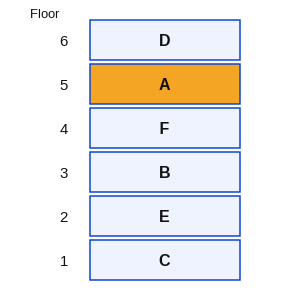
A, B, C, D, E and F live on six different floors of the same building. The lowermost floor in the building is numbered 1, the floor above it is numbered 2, and so on till the topmost floor is numbered 6.
Only four people live between C and D. F lives on an even numbered floor but not on floor number 2. E lives immediately below B but above C. How many people live above A?
A, B, C, D, E और F एक ही भवन की छह अलग-अलग मंज़िलों पर रहते हैं। भवन की सबसे निचली मंज़िल की संख्या 1 है, उसके ऊपर की मंज़िल की संख्या 2 है, और इसी प्रकार सबसे ऊपरी मंज़िल तक, जिसकी संख्या 6 है।
C और D के बीच केवल चार व्यक्ति रहते हैं। F एक सम-संख्या वाली मंज़िल पर रहता है, लेकिन मंज़िल संख्या 2 पर नहीं। E, B के ठीक नीचे लेकिन C के ऊपर रहता है। A के ऊपर कितने व्यक्ति रहते हैं?
  1. AFourचार
  2. BThreeतीन
  3. COneएक
  4. DFiveपाँच
Show answer

Concept: Use the "four people between" clue to fix the extreme floors first.

  1. Four between C and D → they are on floors 1 and 6. E is above C → C = 1, D = 6.
  2. F even, not 2 → F = 4.
  3. E immediately below B with floors 2, 3, 5 left → E = 2, B = 3; A = 5.
  4. Above A (floor 5): only D → one.

Trick: "Only four between" in a 6-floor building always means the two extreme floors.

Answer: (C) One

अवधारणा: "बीच में चार लोग" वाले सुराग से पहले सिरे की मंज़िलें तय करें।

  1. C और D के बीच चार → वे मंज़िल 1 और 6 पर। E, C के ऊपर → C = 1, D = 6।
  2. F सम, 2 नहीं → F = 4।
  3. बची मंज़िलें 2, 3, 5; E ठीक B के नीचे → E = 2, B = 3; A = 5।
  4. A (मंज़िल 5) के ऊपर: केवल D → एक।

ट्रिक: 6 मंज़िलों में "केवल चार बीच में" का मतलब हमेशा दोनों सिरे की मंज़िलें।

उत्तर: (C) एक (One)

RRB NTPC Graduate CBT 1General Intelligence and ReasoningFloor puzzleRRB NTPC Graduate CBT 1 2025 · 27 Mar Shift 2 →
Q14807.
Read the given statements and conclusions carefully. Assuming that the information given in the statements is true, even if it appears to be at variance with commonly known facts, decide which of the given conclusions logically follow(s) from the statements.
Statements:
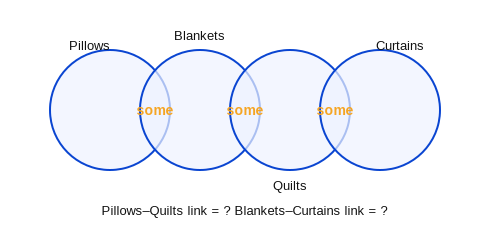
Some pillows are blankets. Some blankets are quilts. Some quilts are curtains. Conclusions:
(I) Some pillows are quilts.
(II) Some blankets are curtains.
दिए गए कथनों और निष्कर्षों को ध्यानपूर्वक पढ़िए। कथनों में दी गई जानकारी को सत्य मानते हुए, भले ही वह सामान्यतः ज्ञात तथ्यों से भिन्न प्रतीत होती हो, निर्णय कीजिए कि दिए गए निष्कर्षों में से कौन-सा/से कथनों का तार्किक रूप से अनुसरण करता/करते है/हैं।
कथन:
कुछ तकिए कंबल हैं। कुछ कंबल रज़ाइयाँ हैं। कुछ रज़ाइयाँ परदे हैं। निष्कर्ष:
(I) कुछ तकिए रज़ाइयाँ हैं।
(II) कुछ कंबल परदे हैं।
  1. AOnly conclusion (II) followsकेवल निष्कर्ष (II) अनुसरण करता है
  2. BBoth conclusions (I) and (II) followनिष्कर्ष (I) और (II) दोनों अनुसरण करते हैं
  3. CNeither conclusion (I) nor (II) followsन तो निष्कर्ष (I) और न ही (II) अनुसरण करता है
  4. DOnly conclusion (I) followsकेवल निष्कर्ष (I) अनुसरण करता है
Show answer

Concept: Two "Some" statements in a chain never give a definite conclusion between the end terms.

  1. Pillows–Blankets, Blankets–Quilts, Quilts–Curtains are all "some" links.
  2. (I) Some pillows are quilts: pillows may touch blankets without touching quilts → not definite.
  3. (II) Some blankets are curtains: same, no direct link → not definite. Hence neither follows.

Trick: Some + Some = No conclusion (I + I rule).

Answer: (C) Neither conclusion (I) nor (II) follows

अवधारणा: शृंखला में दो "कुछ" (Some) कथन सिरे के पदों के बीच कोई निश्चित निष्कर्ष नहीं देते।

  1. तकिए–कंबल, कंबल–रज़ाई, रज़ाई–पर्दे सभी "कुछ" वाले संबंध हैं।
  2. (I) कुछ तकिए रज़ाई हैं: तकिए कंबल से जुड़कर भी रज़ाई से अलग रह सकते हैं → निश्चित नहीं।
  3. (II) कुछ कंबल पर्दे हैं: वही, कोई सीधा संबंध नहीं → निश्चित नहीं। अतः कोई भी नहीं।

ट्रिक: कुछ + कुछ = कोई निष्कर्ष नहीं (I + I नियम)।

उत्तर: (C) न तो निष्कर्ष (I) न ही (II) अनुसरण करता है

RRB NTPC Graduate CBT 1General Intelligence and ReasoningSyllogismRRB NTPC Graduate CBT 1 2025 · 27 Mar Shift 2 →
Q14808.
What should come in place of ‘?’ in the given series?
91 90 86 77 61 ?
दी गई श्रृंखला में ‘?’ के स्थान पर क्या आना चाहिए?
91 90 86 77 61 ?
  1. A36
  2. B41
  3. C40
  4. D39
Show answer

Concept: Look at the differences between consecutive terms.

  1. 91−90=1, 90−86=4, 86−77=9, 77−61=16.
  2. Differences are 12,22,32,42 → next difference 52=25.
  3. 61−25=36.

Trick: Decreasing series with growing gaps → differences are usually perfect squares.

Answer: (A) 36

अवधारणा: क्रमागत पदों के अंतर देखें।

  1. 91−90=1, 90−86=4, 86−77=9, 77−61=16।
  2. अंतर 12,22,32,42 हैं → अगला अंतर 52=25।
  3. 61−25=36।

ट्रिक: घटती शृंखला में बढ़ते अंतर → अंतर प्रायः पूर्ण वर्ग होते हैं।

उत्तर: (A) 36

RRB NTPC Graduate CBT 1General Intelligence and ReasoningNumber seriesRRB NTPC Graduate CBT 1 2025 · 27 Mar Shift 2 →
Q14809.
Select the set in which the numbers are related in the same way as are the numbers of the following sets.
(NOTE : Operations should be performed on the whole numbers, without breaking down the numbers into their constituent digits. E.g. 13 – Operations on 13 such as adding / subtracting / multiplying etc. to 13 can be performed. Breaking down 13 into 1 and 3 and then performing mathematical operations on 1 and 3 is not allowed.)
(11,18,65)
(5,1,8)
उस समुच्चय का चयन कीजिए जिसमें संख्याएँ उसी प्रकार संबंधित हैं जिस प्रकार निम्नलिखित समुच्चयों की संख्याएँ संबंधित हैं।
(नोट : संख्याओं को उनके घटक अंकों में विभाजित किए बिना, पूर्ण संख्याओं पर संक्रियाएँ की जानी चाहिए। उदाहरण के लिए 13 – 13 पर संक्रियाएँ, जैसे 13 में जोड़ना / घटाना / गुणा करना आदि की जा सकती हैं। 13 को 1 और 3 में विभाजित करके फिर 1 और 3 पर गणितीय संक्रियाएँ करने की अनुमति नहीं है।)
(11,18,65)
(5,1,8)
  1. A(25,5,70)
  2. B(7,12,43)
  3. C(82,24,74)
  4. D(33,23,72)
Show answer

Concept: Find one operation on the first two numbers that gives the third in both given sets.

  1. (11,18,65): 11+3×18=11+54=65 ✓.
  2. (5,1,8): 5+3×1=8 ✓. Rule: third = first +3× second.
  3. (7,12,43): 7+36=43 ✓. Others fail: 25+15=40≠70, 82+72≠74, 33+69≠72.

Trick: Test "first + k × second" early – it is a favourite RRB pattern.

Answer: (B) (7,12,43)

अवधारणा: पहली दो संख्याओं पर ऐसी एक संक्रिया खोजें जो दोनों दिए गए समुच्चयों में तीसरी संख्या दे।

  1. (11,18,65): 11+3×18=11+54=65 ✓।
  2. (5,1,8): 5+3×1=8 ✓। नियम: तीसरी = पहली +3× दूसरी।
  3. (7,12,43): 7+36=43 ✓। बाकी असफल: 25+15=40≠70, 82+72≠74, 33+69≠72।

ट्रिक: "पहली + k × दूसरी" जल्दी जाँचें – RRB का पसंदीदा पैटर्न है।

उत्तर: (B) (7,12,43)

RRB NTPC Graduate CBT 1General Intelligence and ReasoningNumber analogyRRB NTPC Graduate CBT 1 2025 · 27 Mar Shift 2 →
Q14810.
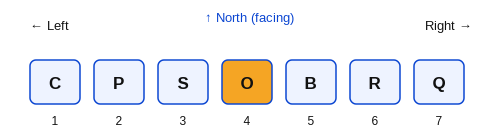
Seven people, B, C, O, P, Q, R and S, are sitting in a straight line, facing north. Only four people sit to the left of B. R sits immediately to the left of Q. Only three people sit between B and C. Both P and O are immediate neighbors of S. P sits immediately to the right of C. How many people sit to the left of O?
सात व्यक्ति B, C, O, P, Q, R और S एक सीधी पंक्ति में उत्तर की ओर मुख करके बैठे हैं। B के बाईं ओर केवल चार व्यक्ति बैठे हैं। R, Q के ठीक बाईं ओर बैठा है। B और C के बीच केवल तीन व्यक्ति बैठे हैं। P और O दोनों S के निकटतम पड़ोसी हैं। P, C के ठीक दाईं ओर बैठा है। O के बाईं ओर कितने व्यक्ति बैठे हैं?
  1. AOneएक
  2. BThreeतीन
  3. CTwoदो
  4. DZeroशून्य
Show answer

Concept: Number the seats 1–7 from the left (all face north, so left/right are the normal directions).

  1. Four people left of B → B = 5. Three between B and C → C = 1.
  2. P immediately right of C → P = 2. S is a neighbour of both P and O → S = 3, O = 4.
  3. R immediately left of Q → R = 6, Q = 7.
  4. Left of O: C, P, S → three.

Trick: Clues with exact counts ("only four to the left") fix absolute seats – use them first.

Answer: (B) Three

अवधारणा: बाईं ओर से सीटों को 1–7 संख्या दें (सब उत्तर की ओर हैं, अतः बायाँ/दायाँ सामान्य दिशा में)।

  1. B के बाईं ओर चार → B = 5। B और C के बीच तीन → C = 1।
  2. P ठीक C के दाएँ → P = 2। S, P और O दोनों का पड़ोसी → S = 3, O = 4।
  3. R ठीक Q के बाएँ → R = 6, Q = 7।
  4. O के बाईं ओर: C, P, S → तीन।

ट्रिक: सटीक गिनती वाले सुराग ("केवल चार बाईं ओर") निश्चित सीट तय करते हैं – उन्हें पहले लें।

उत्तर: (B) तीन (Three)

RRB NTPC Graduate CBT 1General Intelligence and ReasoningLinear seatingRRB NTPC Graduate CBT 1 2025 · 27 Mar Shift 2 →
Q14811.
Based on the English alphabetical order, three of the following four are alike in a certain way and thus form a group. Which is the one that does not belong to that group? (Note: The odd man out is not based on the number of consonants/vowels or their position in the letter cluster)
अंग्रेज़ी वर्णमाला क्रम के आधार पर, निम्नलिखित चार में से तीन एक निश्चित प्रकार से समान हैं और इस प्रकार एक समूह बनाते हैं। वह कौन-सा है जो उस समूह से संबंधित नहीं है? (नोट: असंगत विकल्प व्यंजनों/स्वरों की संख्या या अक्षर-समूह में उनकी स्थिति पर आधारित नहीं है)
  1. AGKN
  2. BDHL
  3. CTXA
  4. DWAD
Show answer

Concept: Write the alphabet gaps between consecutive letters of each cluster.

  1. GKN: G+4=K, K+3=N → (+4,+3).
  2. TXA: T+4=X, X+3=A → (+4,+3); WAD: W+4=A, A+3=D → (+4,+3).
  3. DHL: D+4=H, H+4=L → (+4,+4) → odd one.

Trick: Use positions mod 26 (X=24, +3 → 27 → A) to handle wrap-around quickly.

Answer: (B) DHL

अवधारणा: हर समूह के क्रमागत अक्षरों के बीच वर्णमाला का अंतर लिखें।

  1. GKN: G+4=K, K+3=N → (+4,+3)।
  2. TXA: T+4=X, X+3=A → (+4,+3); WAD: W+4=A, A+3=D → (+4,+3)।
  3. DHL: D+4=H, H+4=L → (+4,+4) → विषम।

ट्रिक: स्थान mod 26 लें (X=24, +3 → 27 → A) ताकि Z के बाद का घुमाव जल्दी हो।

उत्तर: (B) DHL

RRB NTPC Graduate CBT 1General Intelligence and ReasoningOdd one out – lettersRRB NTPC Graduate CBT 1 2025 · 27 Mar Shift 2 →
Q14812.
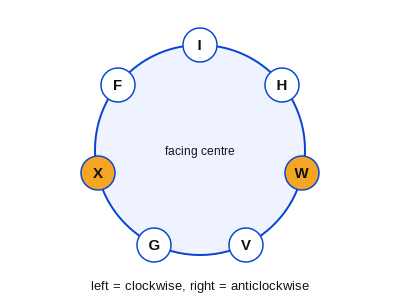
Seven people F, G, H, I, V, W, and X are sitting around a circular table facing the centre of the table. G sits third to the left of H. V sits third to the left of I. F sits to the immediate right of I. F sits second to the left of G. X is not an immediate neighbour of V. Who sits fourth to the right of W?
सात व्यक्ति F, G, H, I, V, W और X एक वृत्ताकार मेज़ के चारों ओर मेज़ के केंद्र की ओर मुख करके बैठे हैं। G, H के बाईं ओर तीसरे स्थान पर बैठा है। V, I के बाईं ओर तीसरे स्थान पर बैठा है। F, I के ठीक दाईं ओर बैठा है। F, G के बाईं ओर दूसरे स्थान पर बैठा है। X, V का निकटतम पड़ोसी नहीं है। W के दाईं ओर चौथे स्थान पर कौन बैठा है?
  1. AX
  2. BG
  3. CF
  4. DV
Show answer

Concept: Facing the centre: "left" = clockwise, "right" = anticlockwise. Fix one person and place others.

  1. Put I at the top. F is immediate right of I → F just anticlockwise of I.
  2. F is 2nd to the left of G → G is 2 places anticlockwise of F. G is 3rd to the left of H → H is 3 places anticlockwise of G (H ends up next to I, clockwise side).
  3. V is 3rd to the left of I → V 3 places clockwise of I. Two seats left; X is not next to V → X takes the seat next to F, W the seat between H and V.
  4. 4th to the right of W (4 anticlockwise) → X.

Trick: Chain the clues through the same person (I → F → G → H) so each new placement is forced.

Answer: (A) X

अवधारणा: केंद्र की ओर मुख: "बायाँ" = दक्षिणावर्त, "दायाँ" = वामावर्त। एक व्यक्ति को स्थिर करके बाकी रखें।

  1. I को ऊपर रखें। F, I के ठीक दाएँ → F, I से ठीक वामावर्त।
  2. F, G के बाएँ दूसरा → G, F से 2 स्थान वामावर्त। G, H के बाएँ तीसरा → H, G से 3 स्थान वामावर्त (H, I के बगल में दक्षिणावर्त ओर आता है)।
  3. V, I के बाएँ तीसरा → V, I से 3 स्थान दक्षिणावर्त। दो सीटें शेष; X, V का पड़ोसी नहीं → X, F के बगल में; W, H और V के बीच।
  4. W के दाएँ चौथा (4 वामावर्त) → X।

ट्रिक: सुरागों को एक ही व्यक्ति से जोड़कर चलें (I → F → G → H) ताकि हर नई स्थिति बाध्य हो।

उत्तर: (A) X

RRB NTPC Graduate CBT 1General Intelligence and ReasoningCircular seatingRRB NTPC Graduate CBT 1 2025 · 27 Mar Shift 2 →
Q14813.
In a certain code language, ‘MELT’ is coded as ‘5431’ and ‘TIME’ is coded as ‘7153’. What is the code for ‘I’ in the given code language?
एक निश्चित कूट भाषा में, ‘MELT’ को ‘5431’ के रूप में कूटबद्ध किया जाता है और ‘TIME’ को ‘7153’ के रूप में कूटबद्ध किया जाता है। दी गई कूट भाषा में ‘I’ का कूट क्या है?
  1. A1
  2. B5
  3. C3
  4. D7
Show answer

Concept: Compare two coded words – common letters get common digits; the leftover letter gets the leftover digit.

  1. MELT = 5431 and TIME = 7153.
  2. Common letters: M, E, T → common digits: 5, 3, 1.
  3. The only extra letter in TIME is I, and the only extra digit is 7. So I = 7.

Trick: Strike out the common letters and common digits – whatever remains pairs up.

Answer: (D) 7

अवधारणा: दो कूट शब्दों की तुलना करें – समान अक्षरों को समान अंक मिलते हैं; बचा हुआ अक्षर = बचा हुआ अंक।

  1. MELT = 5431 और TIME = 7153।
  2. समान अक्षर: M, E, T → समान अंक: 5, 3, 1।
  3. TIME में अतिरिक्त अक्षर केवल I है और अतिरिक्त अंक केवल 7। अतः I = 7।

ट्रिक: समान अक्षर और समान अंक काट दें – जो बचे, वही जोड़ी है।

उत्तर: (D) 7

RRB NTPC Graduate CBT 1General Intelligence and ReasoningCoding-decodingRRB NTPC Graduate CBT 1 2025 · 27 Mar Shift 2 →
Q14814.
Read the given statements and conclusions carefully. Assuming that the information given in the statements is true, even if it appears to be at variance with commonly known facts, decide which of the given conclusion(s) logically follow(s) from the statements.
Statements:
All rats are moles. No mole is a frog. No mole is a donkey.
Conclusions:
(I) No rat is a frog.
(II) Some donkeys are frogs.
दिए गए कथनों और निष्कर्षों को ध्यानपूर्वक पढ़िए। कथनों में दी गई जानकारी को सत्य मानते हुए, भले ही वह सामान्यतः ज्ञात तथ्यों से भिन्न प्रतीत होती हो, निर्णय कीजिए कि दिए गए निष्कर्षों में से कौन-सा/से कथनों का तार्किक रूप से अनुसरण करता/करते है/हैं।
कथन:
सभी चूहे छछूंदर हैं। कोई छछूंदर मेंढक नहीं है। कोई छछूंदर गधा नहीं है।
निष्कर्ष:
(I) कोई चूहा मेंढक नहीं है।
(II) कुछ गधे मेंढक हैं।
  1. AOnly conclusion (I) follows.केवल निष्कर्ष (I) अनुसरण करता है।
  2. BNeither conclusion (I) nor (II) follows.न तो निष्कर्ष (I) और न ही (II) अनुसरण करता है।
  3. CBoth conclusions (I) and (II) follow.निष्कर्ष (I) और (II) दोनों अनुसरण करते हैं।
  4. DOnly conclusion (II) follows.केवल निष्कर्ष (II) अनुसरण करता है।
Show answer

Concept: Draw a Venn diagram for the statements and test each conclusion – it must be true in every possible diagram.

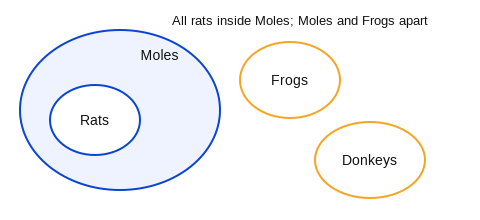
  1. All rats are moles → the Rats circle lies inside Moles.
  2. No mole is a frog → Moles and Frogs do not touch, so Rats (inside Moles) can never touch Frogs. Conclusion (I) No rat is a frog definitely follows.
  3. Nothing links donkeys with frogs – both are only kept away from moles. "Some donkeys are frogs" is possible but not certain, so (II) does not follow.

Trick: All A are B + No B is C ⇒ No A is C (always valid). Two negative statements never give a positive conclusion.

Answer: (A) Only conclusion (I) follows.

अवधारणा: कथनों का वेन आरेख बनाकर हर निष्कर्ष जाँचें – वह हर संभव आरेख में सत्य होना चाहिए।

  1. सभी rats, moles हैं → Rats का वृत्त Moles के अंदर।
  2. कोई mole, frog नहीं → Moles और Frogs अलग; अतः Rats (Moles के अंदर) कभी Frogs को नहीं छू सकते। निष्कर्ष (I) कोई rat, frog नहीं निश्चित रूप से सही।
  3. Donkeys और frogs के बीच कोई संबंध नहीं दिया – दोनों केवल moles से अलग हैं। "कुछ donkeys, frogs हैं" संभव है पर निश्चित नहीं, अतः (II) नहीं निकलता।

ट्रिक: सभी A, B हैं + कोई B, C नहीं ⇒ कोई A, C नहीं (हमेशा सही)। दो नकारात्मक कथनों से कोई सकारात्मक निष्कर्ष नहीं निकलता।

उत्तर: (A) केवल निष्कर्ष (I) अनुसरण करता है।

RRB NTPC Graduate CBT 1General Intelligence and ReasoningSyllogismRRB NTPC Graduate CBT 1 2025 · 27 Mar Shift 2 →
Q14815.
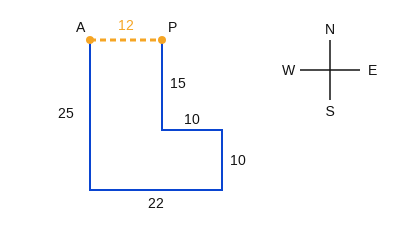
Chetan starts from Point A and drives 25 km towards south. He then takes a left turn, drives 22 km, turns left and drives 10 km. He then takes a left turn and drives 10 km. He takes a final right turn, drives 15 km and stops at Point P. How far (shortest distance) and towards which direction should he drive in order to reach Point A again? (All turns are 90-degree turns only, unless specified.)
Chetan बिंदु A से शुरू करके दक्षिण की ओर 25 km गाड़ी चलाता है। फिर वह बाएँ मुड़ता है, 22 km गाड़ी चलाता है, बाएँ मुड़ता है और 10 km गाड़ी चलाता है। फिर वह बाएँ मुड़ता है और 10 km गाड़ी चलाता है। अंत में वह दाएँ मुड़ता है, 15 km गाड़ी चलाता है और बिंदु P पर रुक जाता है। बिंदु A पर पुनः पहुँचने के लिए उसे कितनी दूर (न्यूनतम दूरी) और किस दिशा में गाड़ी चलानी चाहिए? (सभी मोड़ केवल 90-डिग्री के मोड़ हैं, जब तक अन्यथा निर्दिष्ट न हो।)
  1. A10 km towards eastपूर्व की ओर 10 km
  2. B12 km towards westपश्चिम की ओर 12 km
  3. C25 km towards southदक्षिण की ओर 25 km
  4. D22 km towards northउत्तर की ओर 22 km
Show answer

Concept: Plot the path on a grid (South = down, East = right) and compare the final point with the start.

  1. A → 25 km South → left turn (now East) 22 km → left (North) 10 km → left (West) 10 km → right (North) 15 km = P.
  2. North–South: 25−10−15=0, so P is level with A.
  3. East–West: 22−10=12 km East of A.
  4. To return, Chetan must drive 12 km towards West.

Trick: Facing South, Left = East; facing East, Left = North; facing North, Left = West; facing West, Right = North.

Answer: (B) 12 km towards west

अवधारणा: पथ को ग्रिड पर बनाएँ (दक्षिण = नीचे, पूर्व = दाएँ) और अंतिम बिंदु की तुलना प्रारंभ से करें।

  1. A → 25 km दक्षिण → बायाँ मोड़ (अब पूर्व) 22 km → बायाँ (उत्तर) 10 km → बायाँ (पश्चिम) 10 km → दायाँ (उत्तर) 15 km = P।
  2. उत्तर–दक्षिण: 25−10−15=0, अतः P, A के बराबर स्तर पर है।
  3. पूर्व–पश्चिम: 22−10=12 km, A से पूर्व।
  4. वापस A पहुँचने के लिए 12 km पश्चिम चलना होगा।

ट्रिक: दक्षिण मुख – बायाँ = पूर्व; पूर्व मुख – बायाँ = उत्तर; उत्तर मुख – बायाँ = पश्चिम; पश्चिम मुख – दायाँ = उत्तर।

उत्तर: (B) 12 km पश्चिम की ओर

RRB NTPC Graduate CBT 1General Intelligence and ReasoningDirection senseRRB NTPC Graduate CBT 1 2025 · 27 Mar Shift 2 →
Q14816.
Based on the English alphabetical order, three of the following four are alike in a certain way and thus form a group. Which is the one that does not
belong to that group?
(Note: The odd one out is not based on the number of consonants/vowels or their position in the letter cluster.)
अंग्रेज़ी वर्णमाला क्रम के आधार पर, निम्नलिखित चार में से तीन एक निश्चित प्रकार से समान हैं और इस प्रकार एक समूह बनाते हैं। वह कौन-सा है जो उस समूह से
संबंधित नहीं है?
(नोट: असंगत विकल्प व्यंजनों/स्वरों की संख्या या अक्षर-समूह में उनकी स्थिति पर आधारित नहीं है।)
  1. AFCG
  2. BPMQ
  3. CURV
  4. DRPT
Show answer

Concept: Find the letter-gap pattern inside each cluster using alphabet positions.

  1. FCG: F(6) → C(3) = −3, C → G(7) = +4.
  2. PMQ: P(16) → M(13) = −3, M → Q(17) = +4.
  3. URV: U(21) → R(18) = −3, R → V(22) = +4.
  4. RPT: R(18) → P(16) = −2, P → T(20) = +4 – the first gap breaks the pattern.

Trick: Pattern "−3, +4" means the third letter is always first letter + 1 (G after F, Q after P, V after U); T is not R + 1.

Answer: (D) RPT

अवधारणा: वर्णमाला स्थानों से हर समूह के अंदर अक्षर-अंतर का पैटर्न निकालें।

  1. FCG: F(6) → C(3) = −3, C → G(7) = +4।
  2. PMQ: P(16) → M(13) = −3, M → Q(17) = +4।
  3. URV: U(21) → R(18) = −3, R → V(22) = +4।
  4. RPT: R(18) → P(16) = −2, P → T(20) = +4 – पहला अंतर पैटर्न तोड़ता है।

ट्रिक: "−3, +4" का मतलब तीसरा अक्षर हमेशा पहले अक्षर + 1 (F के बाद G, P के बाद Q, U के बाद V); T, R + 1 नहीं है।

उत्तर: (D) RPT

RRB NTPC Graduate CBT 1General Intelligence and ReasoningLetter cluster – odd one outRRB NTPC Graduate CBT 1 2025 · 27 Mar Shift 2 →
Q14817.
In a certain code language,
A + B means ‘A is the daughter of B’
A – B means ‘A is the brother of B’
A x B means ‘A is the wife of B’
A ÷ B means ‘A is the father of B’
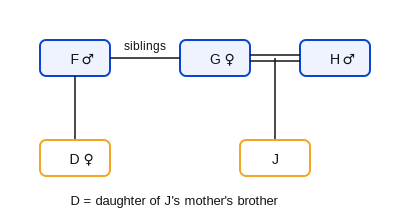
Based on the above, how is D related to J if ‘D + F – G x H ÷ J’?
एक निश्चित कूट भाषा में,
A + B का अर्थ है ‘A, B की पुत्री है’
A – B का अर्थ है ‘A, B का भाई है’
A x B का अर्थ है ‘A, B की पत्नी है’
A ÷ B का अर्थ है ‘A, B का पिता है’
उपर्युक्त के आधार पर, यदि ‘D + F – G x H ÷ J’ है, तो D का J से क्या संबंध है?
  1. AMother's brother's wifeमाता के भाई की पत्नी
  2. BMother's brother's daughterमाता के भाई की पुत्री
  3. CFather's brother's daughterपिता के भाई की पुत्री
  4. DFather's brother's wifeपिता के भाई की पत्नी
Show answer

Concept: Decode each symbol step by step and build the family tree.

  1. D + F: D is the daughter of F. F − G: F is the brother of G.
  2. G × H: G is the wife of H. H ÷ J: H is the father of J → G is J's mother.
  3. F is J's mother's brother (maternal uncle); D is F's daughter.
  4. So D is J's mother's brother's daughter.

Trick: Start from the person asked about (J) and walk backwards along the chain.

Answer: (B) Mother's brother's daughter

अवधारणा: हर संकेत को क्रम से खोलें और वंश वृक्ष बनाएँ।

  1. D + F: D, F की पुत्री। F − G: F, G का भाई।
  2. G × H: G, H की पत्नी। H ÷ J: H, J का पिता → G, J की माँ।
  3. F, J की माँ का भाई (मामा); D, F की पुत्री।
  4. अतः D, J की माँ के भाई की पुत्री है।

ट्रिक: जिस व्यक्ति के बारे में पूछा है (J), उससे शुरू कर शृंखला में पीछे चलें।

उत्तर: (B) माँ के भाई की पुत्री

RRB NTPC Graduate CBT 1General Intelligence and ReasoningBlood relationsRRB NTPC Graduate CBT 1 2025 · 27 Mar Shift 2 →
Q14818.
Each of the digits in the number 9237561 is arranged in ascending order from left to right. The position of how many digits will remain unchanged as compared to that in the original number?
संख्या 9237561 के प्रत्येक अंक को बाएँ से दाएँ आरोही क्रम में व्यवस्थित किया जाता है। मूल संख्या की तुलना में कितने अंकों की स्थिति अपरिवर्तित रहेगी?
  1. ATwoदो
  2. BFourचार
  3. CThreeतीन
  4. DOneएक
Show answer

Concept: Write the original and sorted numbers one below the other and compare position by position.

  1. Original: 9 2 3 7 5 6 1.
  2. Ascending: 1 2 3 5 6 7 9.
  3. Position 2 (2 = 2) and position 3 (3 = 3) match; all others change.
  4. So two digits keep their position.

Trick: Align the two rows vertically – matching columns jump out instantly.

Answer: (A) Two

अवधारणा: मूल और क्रमबद्ध संख्या को एक के नीचे एक लिखकर स्थान-दर-स्थान मिलाएँ।

  1. मूल: 9 2 3 7 5 6 1।
  2. आरोही क्रम: 1 2 3 5 6 7 9।
  3. स्थान 2 (2 = 2) और स्थान 3 (3 = 3) मिलते हैं; बाकी बदल जाते हैं।
  4. अतः दो अंकों का स्थान अपरिवर्तित रहता है।

ट्रिक: दोनों पंक्तियाँ ऊपर-नीचे लिखें – मिलते हुए स्तंभ तुरंत दिख जाते हैं।

उत्तर: (A) दो

RRB NTPC Graduate CBT 1General Intelligence and ReasoningNumber arrangementRRB NTPC Graduate CBT 1 2025 · 27 Mar Shift 2 →
Q14819.
What should come in place of ‘?’ in the given series?
82 80 77 72 65 ?
दी गई श्रृंखला में ‘?’ के स्थान पर क्या आना चाहिए?
82 80 77 72 65 ?
  1. A56
  2. B53
  3. C54
  4. D55
Show answer

Concept: Look at the differences between consecutive terms.

  1. 82→80: −2; 80→77: −3; 77→72: −5; 72→65: −7.
  2. The differences 2, 3, 5, 7 are consecutive prime numbers; next prime is 11.
  3. 65−11=54.

Trick: Differences 2, 3, 5, 7, 11, 13 … = prime series, a favourite in RRB papers.

Answer: (C) 54

अवधारणा: क्रमागत पदों के अंतर देखें।

  1. 82→80: −2; 80→77: −3; 77→72: −5; 72→65: −7।
  2. अंतर 2, 3, 5, 7 क्रमागत अभाज्य संख्याएँ हैं; अगली अभाज्य 11।
  3. 65−11=54।

ट्रिक: अंतर 2, 3, 5, 7, 11, 13 … = अभाज्य श्रृंखला, RRB में बहुत पूछी जाती है।

उत्तर: (C) 54

RRB NTPC Graduate CBT 1General Intelligence and ReasoningNumber seriesRRB NTPC Graduate CBT 1 2025 · 27 Mar Shift 2 →
Q14820.
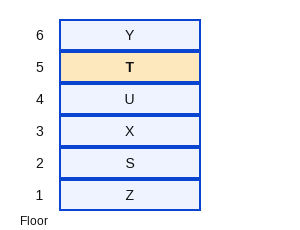
X, Y, Z, S, T and U live on six different floors of the same building. The lowermost floor in the building is numbered 1, the floor above it, number 2, and so on till the topmost floor is numbered 6. U lives on floor number 4. Only two people live between U and Z. Only T lives between U and Y. X lives immediately below U. Who lives on floor number 5?
X, Y, Z, S, T और U एक ही भवन की छह अलग-अलग मंज़िलों पर रहते हैं। भवन की सबसे निचली मंज़िल की संख्या 1 है, उसके ऊपर की मंज़िल की संख्या 2 है, और इसी प्रकार सबसे ऊपरी मंज़िल तक, जिसकी संख्या 6 है। U मंज़िल संख्या 4 पर रहता है। U और Z के बीच केवल दो व्यक्ति रहते हैं। U और Y के बीच केवल T रहता है। X, U के ठीक नीचे रहता है। मंज़िल संख्या 5 पर कौन रहता है?
  1. AY
  2. BX
  3. CS
  4. DT
Show answer

Concept: Fix the definite clue first, then place others by elimination.

  1. U is on floor 4. Two people between U and Z → Z on floor 1 (floor 7 does not exist).
  2. X lives immediately below U → X on floor 3.
  3. Only T between U and Y: either Y on 2 with T on 3 (but 3 is X), or Y on 6 with T on 5. So T = 5, Y = 6.
  4. The remaining person S is on floor 2. Floor 5 → T.

Trick: "Only one person between" gives two cases – kill one using an already fixed floor.

Answer: (D) T

अवधारणा: पहले निश्चित सुराग रखें, फिर बाकी को विलोपन से रखें।

  1. U मंज़िल 4 पर। U और Z के बीच दो लोग → Z मंज़िल 1 पर (मंज़िल 7 है ही नहीं)।
  2. X, U के ठीक नीचे → X मंज़िल 3 पर।
  3. U और Y के बीच केवल T: या तो Y = 2, T = 3 (पर 3 पर X है), या Y = 6, T = 5। अतः T = 5, Y = 6।
  4. बचा S मंज़िल 2 पर। मंज़िल 5 → T।

ट्रिक: "बीच में केवल एक व्यक्ति" से दो स्थितियाँ बनती हैं – पहले से तय मंज़िल से एक को काट दें।

उत्तर: (D) T

RRB NTPC Graduate CBT 1General Intelligence and ReasoningFloor puzzleRRB NTPC Graduate CBT 1 2025 · 27 Mar Shift 2 →