Question bank

Q&A: practice questions with answers

Search questions on any topic. Filter by exam category, exam, subject and topic, try the question, then open the answer and explanation.

Courses – airGurukul

20,719 questions found.

Q15061.
Which of the following programmes aims to increase soil fertility and thereby helps in production of healthy food through organic practices without the use of agro- chemicals?
निम्नलिखित में से कौन-सा कार्यक्रम मृदा की उर्वरता बढ़ाने का लक्ष्य रखता है और इस प्रकार कृषि-रसायनों के उपयोग के बिना जैविक पद्धतियों के माध्यम से स्वस्थ भोजन के उत्पादन में सहायता करता है?
  1. AParamparagat Krishi Vikas Yojanaपरंपरागत कृषि विकास योजना
  2. BPradhan Mantri Fasal Bima Yojanaप्रधानमंत्री फसल बीमा योजना
  3. CPradhan Mantri Kisan MaanDhan Yojanaप्रधानमंत्री किसान मानधन योजना
  4. DRastriya Krishi Vikas Yojanaराष्ट्रीय कृषि विकास योजना
Show answer

Concept: PKVY is the flagship organic-farming scheme of the Government of India.

  1. Paramparagat Krishi Vikas Yojana (PKVY), launched in 2015 under the National Mission for Sustainable Agriculture, promotes cluster-based organic farming with PGS certification, improving soil health and producing chemical-free food.
  2. PMFBY is crop insurance, PM Kisan Maandhan is a farmers' pension scheme and RKVY is a general agriculture-development fund.

Yaad rakhein: "Paramparagat" (traditional) = organic farming; PKVY clusters of 20 ha, ₹31,500/ha over 3 years.

Answer: (A) Paramparagat Krishi Vikas Yojana

अवधारणा: PKVY भारत सरकार की प्रमुख जैविक खेती योजना है।

  1. परंपरागत कृषि विकास योजना (PKVY), 2015 में सतत कृषि राष्ट्रीय मिशन के अंतर्गत शुरू, क्लस्टर आधारित जैविक खेती और PGS प्रमाणन को बढ़ावा देती है – मिट्टी की उर्वरता बढ़ती है और रसायन-मुक्त भोजन मिलता है।
  2. PMFBY फसल बीमा, PM किसान मानधन पेंशन योजना और RKVY सामान्य कृषि-विकास निधि है।

याद रखें: "परंपरागत" = जैविक खेती; PKVY में 20 हेक्टेयर के क्लस्टर, 3 वर्ष में ₹31,500/हेक्टेयर।

उत्तर: (A) परंपरागत कृषि विकास योजना
RRB NTPC Graduate CBT 1General AwarenessOrganic farming schemesRRB NTPC Graduate CBT 1 2025 · 25 Mar Shift 2 →
Q15062.
Which of the following characteristics represents the ability of a computer to work continuously without fatigue?
निम्नलिखित में से कौन-सी विशेषता कंप्यूटर की बिना थकान के निरंतर कार्य करने की क्षमता को दर्शाती है?
  1. ASpeedगति (Speed)
  2. BAccuracyसटीकता (Accuracy)
  3. CDiligenceपरिश्रमशीलता (Diligence)
  4. DVersatilityबहुमुखी प्रतिभा (Versatility)
Show answer

Concept: Basic characteristics of a computer: speed, accuracy, diligence, versatility, storage, automation.

  1. Diligence means a computer can work for hours without tiredness, boredom or loss of concentration, giving the same accuracy throughout.
  2. Speed is fast processing, accuracy is error-free results, versatility is doing many kinds of tasks.

Yaad rakhein: Diligence = no fatigue; Versatility = many tasks.

Answer: (C) Diligence

अवधारणा: कंप्यूटर की मूल विशेषताएँ: गति, शुद्धता, परिश्रमशीलता (diligence), बहुमुखता, भंडारण, स्वचालन।

  1. Diligence का अर्थ है कंप्यूटर घंटों बिना थके, बिना ऊबे, समान शुद्धता से काम कर सकता है।
  2. Speed तेज़ प्रसंस्करण, Accuracy त्रुटि-रहित परिणाम, Versatility अनेक प्रकार के काम करना।

याद रखें: Diligence = थकान नहीं; Versatility = अनेक काम।

उत्तर: (C) Diligence (परिश्रमशीलता)

RRB NTPC Graduate CBT 1General AwarenessCharacteristics of a computerRRB NTPC Graduate CBT 1 2025 · 25 Mar Shift 2 →
Q15063.
What is the primary function of the Alt + Tab keyboard shortcut in Windows?
Windows में Alt + Tab कीबोर्ड शॉर्टकट का प्राथमिक कार्य क्या है?
  1. ATo minimize all open applicationsसभी खुले एप्लिकेशन को मिनिमाइज़ करना
  2. BTo close the currently active windowवर्तमान में सक्रिय विंडो को बंद करना
  3. CTo open Task ManagerTask Manager खोलना
  4. DTo switch between open windowsखुली विंडो के बीच स्विच करना
Show answer

Concept: Windows provides keyboard shortcuts for quick window management.

  1. Alt + Tab shows the open windows and lets you switch between them (keep Alt pressed, tap Tab to move).
  2. Alt + F4 closes the active window; Windows + D minimises all; Ctrl + Shift + Esc opens Task Manager.

Yaad rakhein: Alt+Tab = switch, Alt+F4 = close, Win+D = desktop.

Answer: (D) To switch between open windows

अवधारणा: विंडोज़ में विंडो प्रबंधन के लिए कीबोर्ड शॉर्टकट होते हैं।

  1. Alt + Tab खुली हुई विंडो दिखाता है और उनके बीच स्विच करने देता है (Alt दबाए रखें, Tab से आगे बढ़ें)।
  2. Alt + F4 सक्रिय विंडो बंद करता है; Windows + D सब मिनिमाइज़; Ctrl + Shift + Esc टास्क मैनेजर।

याद रखें: Alt+Tab = स्विच, Alt+F4 = बंद, Win+D = डेस्कटॉप।

उत्तर: (D) खुली विंडो के बीच स्विच करना

RRB NTPC Graduate CBT 1General AwarenessWindows keyboard shortcutsRRB NTPC Graduate CBT 1 2025 · 25 Mar Shift 2 →
Q15064.
As per Census of India 2011, which union territory of India recorded the highest population growth rate?
भारत की जनगणना 2011 के अनुसार, भारत के किस केंद्र-शासित प्रदेश में सबसे अधिक जनसंख्या वृद्धि दर दर्ज की गई?
  1. ADadra and Nagar Haveliदादरा और नगर हवेली
  2. BPuducherryपुडुचेरी
  3. CAndaman and Nicobar Islandsअंडमान और निकोबार द्वीपसमूह
  4. DDaman and Diuदमन और दीव
Show answer

Concept: Census 2011 recorded decadal growth (2001–2011) for every state and UT.

  1. Dadra and Nagar Haveli had the highest growth of all states/UTs: 55.9%, followed by Daman and Diu (53.8%) – both driven by industrial migration.
  2. Puducherry (28.1%) and Andaman & Nicobar (6.9%) grew far less; Nagaland was the only one with negative growth (−0.6%).

Yaad rakhein: Highest growth: DNH (UT) 55.9%, Meghalaya (state) 27.9%; lowest: Nagaland.

Answer: (A) Dadra and Nagar Haveli

अवधारणा: जनगणना 2011 में हर राज्य/UT की दशकीय वृद्धि (2001–2011) दर्ज हुई।

  1. दादरा और नगर हवेली की वृद्धि सबसे अधिक रही: 55.9%, फिर दमन और दीव (53.8%) – दोनों औद्योगिक प्रवास के कारण।
  2. पुदुचेरी (28.1%) और अंडमान-निकोबार (6.9%) काफ़ी कम; नागालैंड एकमात्र ऋणात्मक वृद्धि (−0.6%) वाला।

याद रखें: सर्वाधिक वृद्धि: DNH (UT) 55.9%, मेघालय (राज्य) 27.9%; न्यूनतम: नागालैंड।

उत्तर: (A) दादरा और नगर हवेली

RRB NTPC Graduate CBT 1General AwarenessCensus 2011 – population growthRRB NTPC Graduate CBT 1 2025 · 25 Mar Shift 2 →
Q15065.
Which technique was primarily used to produce flake tools in India during the Middle Palaeolithic culture?
मध्य पुरापाषाण संस्कृति के दौरान भारत में फ्लेक (flake) उपकरण बनाने के लिए मुख्यतः किस तकनीक का उपयोग किया जाता था?
  1. ALevallois techniqueलेवलॉइस (Levallois) तकनीक
  2. BPercussion methodप्रहार (Percussion) विधि
  3. CBlade-tool technologyब्लेड-उपकरण प्रौद्योगिकी
  4. DPressure flakingदाब शल्कन (Pressure flaking)
Show answer

Concept: The Middle Palaeolithic (about 1,00,000–40,000 years ago) in India is a flake-tool culture.

  1. Flakes were struck from specially prepared cores using the Levallois technique (prepared-core technique), giving scrapers, points and borers – typical of Nevasa (Maharashtra) sites.
  2. Blade-tool technology marks the Upper Palaeolithic; pressure flaking is associated with later microliths; simple percussion is the general Lower Palaeolithic method.

Yaad rakhein: Lower = hand-axes/cores; Middle = flakes (Levallois); Upper = blades & burins.

Answer: (A) Levallois technique

अवधारणा: भारत में मध्य पुरापाषाण काल (लगभग 1,00,000–40,000 वर्ष पूर्व) फ्लेक (शल्क) उपकरण संस्कृति है।

  1. विशेष रूप से तैयार कोर से लेवलॉय तकनीक (prepared-core technique) द्वारा फ्लेक निकाले जाते थे – खुरचनी, नोक, बेधक; नेवासा (महाराष्ट्र) जैसे स्थल।
  2. ब्लेड तकनीक उच्च पुरापाषाण की पहचान है; दाब-शल्कन (pressure flaking) बाद के सूक्ष्म-पाषाणों से जुड़ा; साधारण प्रहार निम्न पुरापाषाण की सामान्य विधि।

याद रखें: निम्न = हस्त-कुठार/कोर; मध्य = फ्लेक (लेवलॉय); उच्च = ब्लेड और ब्यूरिन।

उत्तर: (A) लेवलॉय तकनीक

RRB NTPC Graduate CBT 1General AwarenessPrehistoric India – Palaeolithic toolsRRB NTPC Graduate CBT 1 2025 · 25 Mar Shift 2 →
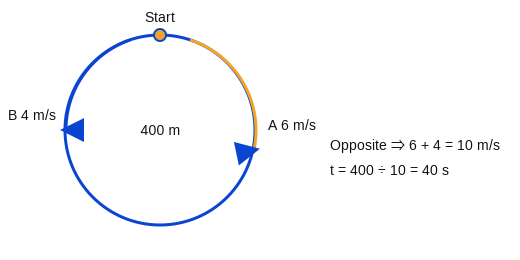
Q15066.
Two people, A and B, start running from the same point on a circular track of length 400 meters, but in opposite directions. A runs at 6 m/s and B at 4 m/s. In how many seconds will they meet for the first time?
दो व्यक्ति, A और B, 400 मीटर लंबे एक वृत्ताकार ट्रैक पर एक ही बिंदु से विपरीत दिशाओं में दौड़ना शुरू करते हैं। A 6 m/s की गति से और B 4 m/s की गति से दौड़ता है। वे पहली बार कितने सेकंड में मिलेंगे?
  1. A50 seconds50 सेकंड
  2. B40 seconds40 सेकंड
  3. C20 seconds20 सेकंड
  4. D30 seconds30 सेकंड
Show answer

Concept: On a circular track, runners moving in opposite directions first meet when together they cover one full lap; relative speed = sum of speeds.

  1. Relative speed =6+4=10m/s.
  2. Time for first meeting =40010=40 s.

Trick: Opposite directions → add speeds; same direction → subtract speeds, and divide the track length by it.

Answer: (B) 40 seconds

अवधारणा: वृत्ताकार ट्रैक पर विपरीत दिशा में दौड़ने वाले पहली बार तब मिलते हैं जब दोनों मिलकर एक पूरा चक्कर (lap) तय कर लें; सापेक्ष चाल = चालों का योग।

  1. सापेक्ष चाल =6+4=10m/s
  2. पहली बार मिलने का समय =40010=40 सेकंड।

ट्रिक: विपरीत दिशा → चालें जोड़ें; समान दिशा → घटाएँ, फिर ट्रैक की लंबाई को उससे भाग दें।

उत्तर: (B) 40 सेकंड

RRB NTPC Graduate CBT 1MathematicsCircular TrackRRB NTPC Graduate CBT 1 2025 · 25 Mar Shift 2 →
Q15067.
At what rate per annum will a sum of money become five times itself in 11 years under simple interest?
साधारण ब्याज पर कोई धनराशि 11 वर्षों में स्वयं की पाँच गुनी किस वार्षिक दर पर हो जाएगी?
  1. A34411%
  2. B72811%
  3. C38811%
  4. D36411%
Show answer

Concept: Under simple interest, if a sum becomes n times, then SI=(n−1)P and R=(n−1)×100T.

  1. Five times ⇒ SI=4P in 11 years.
  2. R=4×10011=40011=36411% per annum.

Trick: "n times in T years" ⇒ R×T=(n−1)×100.

Answer: (D) 36411%

अवधारणा: साधारण ब्याज में यदि धन n गुना हो जाए तो SI=(n−1)P और R=(n−1)×100T।

  1. पाँच गुना ⇒ 11 वर्षों में SI=4P।
  2. R=4×10011=40011=36411% वार्षिक।

ट्रिक: "T वर्ष में n गुना" ⇒ R×T=(n−1)×100।

उत्तर: (D) 36411%

RRB NTPC Graduate CBT 1MathematicsSimple InterestRRB NTPC Graduate CBT 1 2025 · 25 Mar Shift 2 →
Q15068.
Solve the following system of equations:
x+2y+4z=14
x+2y+z=7
2x+y+2z=2
निम्नलिखित समीकरण निकाय को हल कीजिए:
x+2y+4z=14
x+2y+z=7
2x+y+2z=2
  1. Ax=−103, y=3, z=73
  2. Bx=−113, y=3, z=73
  3. Cx=−103, y=4, z=83
  4. Dx=−103, y=4, z=73
Show answer

Concept: Eliminate one variable by subtracting equations that share the same coefficients.

  1. (1) − (2): 3z=7⇒z=73.
  2. From (2): x+2y=7−73=143; from (3): 2x+y=2−143=−83.
  3. 2(x+2y)−(2x+y)=3y=283+83=12⇒y=4.
  4. x=143−8=−103.

Trick: Equations (1) and (2) differ only in z – subtract them first and z falls out instantly.

Answer: (D) x=−103, y=4, z=73

अवधारणा: समान गुणांक वाले समीकरणों को घटाकर एक चर हटाएँ।

  1. (1) − (2): 3z=7⇒z=73।
  2. (2) से: x+2y=7−73=143; (3) से: 2x+y=2−143=−83।
  3. 2(x+2y)−(2x+y)=3y=283+83=12⇒y=4।
  4. x=143−8=−103।

ट्रिक: समीकरण (1) और (2) में केवल z का गुणांक अलग है – पहले इन्हें घटाएँ, z तुरंत मिल जाता है।

उत्तर: (D) x=−103, y=4, z=73

RRB NTPC Graduate CBT 1MathematicsLinear Equations in Three VariablesRRB NTPC Graduate CBT 1 2025 · 25 Mar Shift 2 →
Q15069.
Two taps can fill a cistern in 4 hours and 32 hours respectively. A third tap can empty it in 4 hours. How long (in hours) will it take to fill one-fourth of the empty cistern, if all of them are opened together?
दो नल एक टंकी को क्रमशः 4 घंटे और 32 घंटे में भर सकते हैं। एक तीसरा नल इसे 4 घंटे में खाली कर सकता है। यदि सभी को एक साथ खोल दिया जाए, तो खाली टंकी के एक-चौथाई भाग को भरने में कितना समय (घंटों में) लगेगा?
  1. A32
  2. B8
  3. C24
  4. D16
Show answer

Concept: Net work per hour = sum of filling rates − emptying rate; time for a part = part ÷ net rate.

  1. Net rate =14+132−14=132 cistern/hour.
  2. Full cistern takes 32 h, so one-fourth takes 324=8 h.

Trick: The 4-hour inlet and the 4-hour outlet cancel exactly – only the 32-hour tap matters.

Answer: (B) 8

अवधारणा: प्रति घंटा शुद्ध कार्य = भरने की दरों का योग − खाली करने की दर; भाग भरने का समय = भाग ÷ शुद्ध दर।

  1. शुद्ध दर =14+132−14=132 टंकी/घंटा।
  2. पूरी टंकी 32 घंटे में, अतः एक-चौथाई 324=8 घंटे में।

ट्रिक: 4 घंटे वाला भरने का नल और 4 घंटे वाला खाली करने का नल एक-दूसरे को काट देते हैं – केवल 32 घंटे वाला नल काम करता है।

उत्तर: (B) 8

RRB NTPC Graduate CBT 1MathematicsPipes and CisternsRRB NTPC Graduate CBT 1 2025 · 25 Mar Shift 2 →
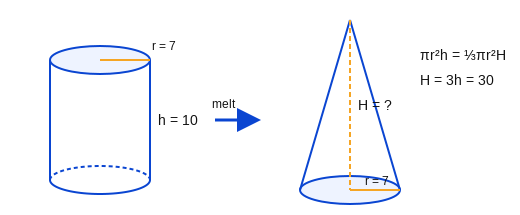
Q15070.
A cylindrical wax block with radius 7 cm and height 10 cm is melted and reshaped into a cone with the same base radius. Find the height of the cone. (Use π=227)
7 cm त्रिज्या और 10 cm ऊँचाई वाले एक बेलनाकार मोम के ब्लॉक को पिघलाकर समान आधार त्रिज्या वाले एक शंकु के आकार में ढाला जाता है। शंकु की ऊँचाई ज्ञात कीजिए। (π=227 का प्रयोग कीजिए)
  1. A18 cm
  2. B30 cm
  3. C25 cm
  4. D20 cm
Show answer

Concept: Melting and recasting keeps the volume same: πr2h=13πr2H.

  1. Same radius cancels on both sides ⇒ h=H3.
  2. H=3h=3×10=30 cm.

Trick: Cone with the same base and volume as a cylinder is always 3 times as tall – no need to use π=227 at all.

Answer: (B) 30 cm

अवधारणा: पिघलाकर नया आकार बनाने पर आयतन समान रहता है: πr2h=13πr2H।

  1. समान त्रिज्या दोनों ओर कट जाती है ⇒ h=H3।
  2. H=3h=3×10=30 cm।

ट्रिक: समान आधार और आयतन वाला शंकु बेलन से सदैव 3 गुना ऊँचा होता है – π=227 की ज़रूरत ही नहीं।

उत्तर: (B) 30 cm

RRB NTPC Graduate CBT 1MathematicsMensuration – Cylinder to ConeRRB NTPC Graduate CBT 1 2025 · 25 Mar Shift 2 →
Q15071.
A typist takes 40 minutes to type 2 pages. How long (in minutes) will he take to type 82 pages?
एक टाइपिस्ट 2 पृष्ठ टाइप करने में 40 मिनट लेता है। 82 पृष्ठ टाइप करने में वह कितना समय (मिनटों में) लेगा?
  1. A1650
  2. B1630
  3. C1645
  4. D1640
Show answer

Concept: Time is directly proportional to the number of pages.

  1. Time per page =402=20 minutes.
  2. For 82 pages: 82×20=1640 minutes.

Trick: 82×20 = 82×2 with a zero = 1640.

Answer: (D) 1640

अवधारणा: समय, पृष्ठों की संख्या के समानुपाती है।

  1. प्रति पृष्ठ समय =402=20 मिनट।
  2. 82 पृष्ठों के लिए: 82×20=1640 मिनट।

ट्रिक: 82×20 = 82×2 के आगे शून्य = 1640।

उत्तर: (D) 1640

RRB NTPC Graduate CBT 1MathematicsUnitary MethodRRB NTPC Graduate CBT 1 2025 · 25 Mar Shift 2 →
Q15072.
There are 52 members in group A, 22 members in group B and 36 members in group C. All the members of these groups went to a restaurant. The average amounts spent on each member of groups A, B and C are ₹420, ₹437 and ₹101, respectively. The overall average amount (in ₹) spent per member is:
समूह A में 52 सदस्य, समूह B में 22 सदस्य और समूह C में 36 सदस्य हैं। इन समूहों के सभी सदस्य एक रेस्तरां में गए। समूह A, B और C के प्रत्येक सदस्य पर खर्च की गई औसत राशि क्रमशः ₹420, ₹437 और ₹101 है। प्रति सदस्य खर्च की गई कुल औसत राशि (₹ में) है:
  1. A323
  2. B319
  3. C322
  4. D320
Show answer

Concept: Overall average =total amounttotal members.

  1. Totals: 52×420=21840, 22×437=9614, 36×101=3636.
  2. Sum =21840+9614+3636=35090; members =52+22+36=110.
  3. Average =35090110=319.

Trick: 35090÷110: drop a zero → 3509÷11=319.

Answer: (B) 319

अवधारणा: कुल औसत =कुल राशिकुल सदस्य।

  1. कुल: 52×420=21840, 22×437=9614, 36×101=3636।
  2. योग =21840+9614+3636=35090; सदस्य =52+22+36=110।
  3. औसत =35090110=319।

ट्रिक: 35090÷110: एक शून्य हटाएँ → 3509÷11=319।

उत्तर: (B) 319

RRB NTPC Graduate CBT 1MathematicsWeighted AverageRRB NTPC Graduate CBT 1 2025 · 25 Mar Shift 2 →
Q15073.
A boat goes 20,000 m upstream and 44,000 m downstream in 8 hours while it goes 15,000 m upstream and 22,000 m downstream in 5 hours. The speed of boat in still water is:
एक नाव 8 घंटे में 20,000 m धारा के प्रतिकूल और 44,000 m धारा के अनुकूल जाती है, जबकि 5 घंटे में 15,000 m धारा के प्रतिकूल और 22,000 m धारा के अनुकूल जाती है। शांत जल में नाव की गति है:
  1. A219 m/s
  2. B349 m/s
  3. C329 m/s
  4. D229 m/s
Show answer

Concept: Let upstream speed =u km/h and downstream speed =d km/h; time =distancespeed. Boat speed =u+d2.

  1. 20u+44d=8 and 15u+22d=5.
  2. Double the second: 30u+44d=10; subtract the first ⇒ 10u=2⇒u=5.
  3. 44d=8−4=4⇒d=11. Boat speed =5+112=8 km/h.
  4. 8×518=209=229 m/s.

Trick: Convert metres to km first (20, 44, 15, 22); km/h → m/s multiply by 518.

Answer: (D) 229 m/s

अवधारणा: धारा के विपरीत चाल =u km/h, धारा के साथ =d km/h; समय =दूरीचाल। नाव की चाल =u+d2।

  1. 20u+44d=8 और 15u+22d=5।
  2. दूसरे को दोगुना करें: 30u+44d=10; पहले को घटाएँ ⇒ 10u=2⇒u=5।
  3. 44d=8−4=4⇒d=11। नाव की चाल =5+112=8 km/h।
  4. 8×518=209=229 m/s।

ट्रिक: पहले मीटर को km में बदलें (20, 44, 15, 22); km/h → m/s के लिए 518 से गुणा।

उत्तर: (D) 229 m/s

RRB NTPC Graduate CBT 1MathematicsBoats and StreamsRRB NTPC Graduate CBT 1 2025 · 25 Mar Shift 2 →
Q15074.
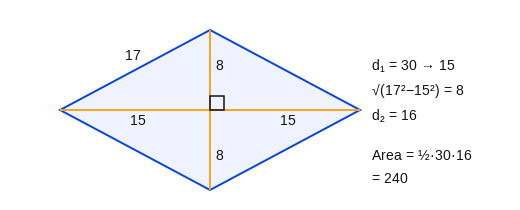
The length of each side of a rhombus is 17 cm and one of the diagonals is 30 cm. What is the area of the rhombus?
एक समचतुर्भुज की प्रत्येक भुजा की लंबाई 17 cm है और इसका एक विकर्ण 30 cm है। समचतुर्भुज का क्षेत्रफल क्या है?
  1. A272 cm2
  2. B510 cm2
  3. C255 cm2
  4. D240 cm2
Show answer

Concept: Diagonals of a rhombus bisect each other at right angles, so half-diagonals and a side form a right triangle; Area =12d1d2.

  1. Half of the given diagonal =15 cm.
  2. Other half-diagonal =172−152=289−225=64=8 cm ⇒ d2=16 cm.
  3. Area =12×30×16=240 cm2.

Trick: 8-15-17 is a Pythagorean triplet – spot it and skip the square root.

Answer: (D) 240 cm2

अवधारणा: समचतुर्भुज के विकर्ण एक-दूसरे को समकोण पर समद्विभाजित करते हैं, अतः आधे विकर्ण और भुजा समकोण त्रिभुज बनाते हैं; क्षेत्रफल =12d1d2।

  1. दिए विकर्ण का आधा =15 cm।
  2. दूसरे विकर्ण का आधा =172−152=289−225=64=8 cm ⇒ d2=16 cm।
  3. क्षेत्रफल =12×30×16=240 cm2।

ट्रिक: 8-15-17 पाइथागोरस त्रिक है – पहचानते ही वर्गमूल की ज़रूरत नहीं।

उत्तर: (D) 240 cm2

RRB NTPC Graduate CBT 1MathematicsArea of RhombusRRB NTPC Graduate CBT 1 2025 · 25 Mar Shift 2 →
Q15075.
A trader marks his goods at a certain price and offers a 10% discount on it. In addition, he runs a scheme where for every 104 articles purchased, 16 articles are given free. If he still makes a profit of 17% on the overall transaction, find out by what percentage the marked price of an article is more than its cost price. Assume the customer pays for only 104 articles.
एक व्यापारी अपने सामान पर एक निश्चित मूल्य अंकित करता है और उस पर 10% की छूट देता है। इसके अतिरिक्त, वह एक योजना चलाता है जिसमें प्रत्येक 104 वस्तुएँ खरीदने पर 16 वस्तुएँ मुफ़्त दी जाती हैं। यदि फिर भी उसे पूरे लेन-देन पर 17% का लाभ होता है, तो ज्ञात कीजिए कि एक वस्तु का अंकित मूल्य उसके क्रय मूल्य से कितने प्रतिशत अधिक है। मान लीजिए कि ग्राहक केवल 104 वस्तुओं का भुगतान करता है।
  1. A60%
  2. B53%
  3. C50%
  4. D44%
Show answer

Concept: Compare money received (on 104 articles at 90% of MP) with cost of articles given away (120 articles).

  1. Let CP of one article =1 and MP =m. Customer pays 104×0.9m=93.6m.
  2. Articles given =104+16=120, cost =120. Profit 17% ⇒ 93.6m=1.17×120=140.4.
  3. m=140.493.6=1.5 ⇒ MP is 50% above CP.

Trick: Use the chain MPCP=120104×1.170.9=1513×1.3=1.5.

Answer: (C) 50%

अवधारणा: प्राप्त राशि (104 वस्तुओं पर MP का 90%) की तुलना दी गई वस्तुओं (120) की लागत से करें।

  1. एक वस्तु का CP =1, MP =m मानें। ग्राहक देता है 104×0.9m=93.6m।
  2. दी गई वस्तुएँ =104+16=120, लागत =120। 17% लाभ ⇒ 93.6m=1.17×120=140.4।
  3. m=140.493.6=1.5 ⇒ MP, CP से 50% अधिक।

ट्रिक: श्रृंखला MPCP=120104×1.170.9=1513×1.3=1.5।

उत्तर: (C) 50%

RRB NTPC Graduate CBT 1MathematicsProfit, Discount and Free ArticlesRRB NTPC Graduate CBT 1 2025 · 25 Mar Shift 2 →
Q15076.
The sum of 12 numbers is 540. Find their average.
12 संख्याओं का योग 540 है। उनका औसत ज्ञात कीजिए।
  1. A46
  2. B43
  3. C44
  4. D45
Show answer

Concept: Average =sumnumber of terms.

  1. Average =54012=45.

Trick: 12×45=540 – check by multiplying back.

Answer: (D) 45

अवधारणा: औसत =योगपदों की संख्या।

  1. औसत =54012=45।

ट्रिक: 12×45=540 – उल्टा गुणा करके जाँचें।

उत्तर: (D) 45

RRB NTPC Graduate CBT 1MathematicsAverageRRB NTPC Graduate CBT 1 2025 · 25 Mar Shift 2 →
Q15077.
A frequency distribution has a mean of 55 and a mode of 50. If the empirical relation holds, what should be the median of the data set? (Round off to two decimal places.)
एक बारंबारता बंटन का माध्य 55 और बहुलक 50 है। यदि आनुभविक संबंध (empirical relation) लागू होता है, तो आँकड़ों की माध्यिका क्या होनी चाहिए? (दो दशमलव स्थानों तक पूर्णांकित कीजिए।)
  1. A53.33
  2. B54.21
  3. C53.86
  4. D54.83
Show answer

Concept: Empirical relation: Mode=3Median−2Mean.

  1. 50=3M−2×55⇒3M=50+110=160.
  2. M=1603=53.33.

Trick: Median always lies between mean and mode, one-third of the way from the mean: 55−53=53.33.

Answer: (A) 53.33

अवधारणा: आनुभविक संबंध: Mode=3Median−2Mean।

  1. 50=3M−2×55⇒3M=50+110=160।
  2. M=1603=53.33।

ट्रिक: माध्यिका सदैव माध्य और बहुलक के बीच, माध्य से एक-तिहाई दूरी पर: 55−53=53.33।

उत्तर: (A) 53.33

RRB NTPC Graduate CBT 1MathematicsMean, Median, ModeRRB NTPC Graduate CBT 1 2025 · 25 Mar Shift 2 →
Q15078.
If 53x+4=(54)105, then find the integral part of x.
यदि 53x+4=(54)105 है, तो x का पूर्णांक भाग ज्ञात कीजिए।
  1. A128
  2. B183
  3. C182
  4. D138
Show answer

Concept: (am)n=amn; equal bases ⇒ equal exponents.

  1. (54)105=5420, so 3x+4=420.
  2. 3x=416⇒x=4163=138.67.
  3. Integral part =138.

Trick: 416÷3: 3×138=414, remainder 2 ⇒ integer part 138.

Answer: (D) 138

अवधारणा: (am)n=amn; आधार समान ⇒ घातांक समान।

  1. (54)105=5420, अतः 3x+4=420।
  2. 3x=416⇒x=4163=138.67।
  3. पूर्णांक भाग =138।

ट्रिक: 416÷3: 3×138=414, शेष 2 ⇒ पूर्णांक भाग 138।

उत्तर: (D) 138

RRB NTPC Graduate CBT 1MathematicsLaws of IndicesRRB NTPC Graduate CBT 1 2025 · 25 Mar Shift 2 →
Q15079.
The cost price of 48 books is equal to the selling price of 36 books. Find the profit percentage. (Round off your answer to two decimal places.)
48 पुस्तकों का क्रय मूल्य 36 पुस्तकों के विक्रय मूल्य के बराबर है। लाभ प्रतिशत ज्ञात कीजिए। (अपने उत्तर को दो दशमलव स्थानों तक पूर्णांकित कीजिए।)
  1. A39.84%
  2. B36.23%
  3. C33.33%
  4. D22.18%
Show answer

Concept: When CP of m articles = SP of n articles, profit%=m−nn×100.

  1. CP of 48 books = SP of 36 books. Let CP of each book be ₹1, so SP of 36 books = ₹48.
  2. SP of one book =4836=43, profit per book =13.
  3. Profit%=1/31×100=33.33%.

Trick: 48−3636×100=1236×100=33.33% – divide by the SP count.

Answer: (C) 33.33%

अवधारणा: यदि m वस्तुओं का क्रय मूल्य = n वस्तुओं का विक्रय मूल्य, तो लाभ%=m−nn×100।

  1. 48 किताबों का CP = 36 किताबों का SP। प्रति किताब CP ₹1 मानें, तो 36 किताबों का SP = ₹48।
  2. एक किताब का SP =4836=43, लाभ =13।
  3. लाभ%=13×100=33.33%।

ट्रिक: 48−3636×100=33.33% – SP वाली संख्या से भाग दें।

उत्तर: (C) 33.33%

RRB NTPC Graduate CBT 1MathematicsProfit and lossRRB NTPC Graduate CBT 1 2025 · 25 Mar Shift 2 →
Q15080.
For 4 waffles, a recipe needs 680 g of butter. Find the quantity of butter needed if you want to make 17 waffles.
4 वैफल बनाने के लिए एक विधि में 680 g मक्खन की आवश्यकता होती है। यदि आप 17 वैफल बनाना चाहते हैं, तो आवश्यक मक्खन की मात्रा ज्ञात कीजिए।
  1. A2930 g
  2. B3120 g
  3. C2890 g
  4. D2650 g
Show answer

Concept: Butter needed is directly proportional to the number of waffles.

  1. Butter for 1 waffle =6804=170g.
  2. Butter for 17 waffles =170×17=2890g.

Trick: 170×17=170×10+170×7=1700+1190=2890.

Answer: (C) 2890g

अवधारणा: मक्खन की मात्रा वैफल की संख्या के समानुपाती है।

  1. 1 वैफल के लिए मक्खन =6804=170g।
  2. 17 वैफल के लिए =170×17=2890g।

ट्रिक: 170×17=1700+1190=2890।

उत्तर: (C) 2890g

RRB NTPC Graduate CBT 1MathematicsUnitary methodRRB NTPC Graduate CBT 1 2025 · 25 Mar Shift 2 →