Question bank

Q&A: practice questions with answers

Search questions on any topic. Filter by exam category, exam, subject and topic, try the question, then open the answer and explanation.

Courses – airGurukul

20,719 questions found.

Q15181.
A shopkeeper purchased 60 dozens of articles at the rate of ₹474 per dozen. He sold each one of them at the rate of ₹79. What percentage profit did he make?
एक दुकानदार ने ₹474 प्रति दर्जन की दर से 60 दर्जन वस्तुएँ खरीदीं। उसने उनमें से प्रत्येक को ₹79 की दर से बेच दिया। उसने कितने प्रतिशत लाभ अर्जित किया?
  1. A99%
  2. B100%
  3. C102%
  4. D101%
Show answer

Concept: Compare cost price and selling price of one article; the number of articles does not affect the percentage.

  1. CP of one article =47412=39.5 rupees.
  2. SP of one article = ₹79, so profit =79−39.5=39.5 rupees.
  3. Profit%=39.539.5×100=100%.

Trick: 79×12=948=2×474 – SP per dozen is exactly double the CP per dozen, so profit is 100%.

Answer: (B) 100%

अवधारणा: एक वस्तु का क्रय मूल्य और विक्रय मूल्य तुलना करें; वस्तुओं की संख्या प्रतिशत पर असर नहीं डालती।

  1. एक वस्तु का CP =47412=39.5 रुपये।
  2. एक वस्तु का SP = ₹79, अतः लाभ =79−39.5=39.5 रुपये।
  3. लाभ%=39.539.5×100=100%।

ट्रिक: 79×12=948=2×474 – प्रति दर्जन SP, CP का ठीक दोगुना है, इसलिए लाभ 100%।

उत्तर: (B) 100%
RRB NTPC Graduate CBT 1MathematicsProfit and LossRRB NTPC Graduate CBT 1 2025 · 25 Mar Shift 1 →
Q15182.
Kiran’s salary is ₹18000 per month. He spends ₹5000 on house rent, ₹3000 on bills and the rest of the amount is his monthly savings. Find his savings (in ₹) in a year, if in the month of his birthday, he spent his complete monthly saving for birthday celebration.
किरण का वेतन ₹18000 प्रति माह है। वह ₹5000 घर के किराए पर, ₹3000 बिलों पर खर्च करता है और शेष राशि उसकी मासिक बचत है। एक वर्ष में उसकी बचत (₹ में) ज्ञात कीजिए, यदि अपने जन्मदिन के महीने में उसने अपनी पूरी मासिक बचत जन्मदिन समारोह पर खर्च कर दी।
  1. A100000
  2. B110000
  3. C90000
  4. D120000
Show answer

Concept: Monthly saving = salary − expenses; count only the months in which the saving is actually kept.

  1. Monthly saving =18000−5000−3000=10000 rupees.
  2. In the birthday month the whole saving is spent, so savings are kept for only 11 months.
  3. Yearly savings =11×10000=110000 rupees.

Trick: Read the 'birthday' condition carefully – it removes exactly one month; 12 × 10000 = 120000 is the trap.

Answer: (B) 110000

अवधारणा: मासिक बचत = वेतन − खर्च; केवल उन्हीं महीनों को गिनें जिनमें बचत सचमुच बची।

  1. मासिक बचत =18000−5000−3000=10000 रुपये।
  2. जन्मदिन के महीने में पूरी बचत खर्च हो गई, अतः बचत केवल 11 महीनों की रही।
  3. वार्षिक बचत =11×10000=110000 रुपये।

ट्रिक: 'जन्मदिन' वाली शर्त ध्यान से पढ़ें – वह ठीक एक महीना हटाती है; 12 × 10000 = 120000 जाल है।

उत्तर: (B) 110000

RRB NTPC Graduate CBT 1MathematicsSimple ArithmeticRRB NTPC Graduate CBT 1 2025 · 25 Mar Shift 1 →
Q15183.
The least common multiple of two numbers is 21 times the first number, and the highest common factor of the two numbers is a two-digit prime number. What is the least possible value of the second number?
दो संख्याओं का लघुत्तम समापवर्त्य (LCM) पहली संख्या का 21 गुना है, और दोनों संख्याओं का महत्तम समापवर्तक (HCF) एक दो-अंकीय अभाज्य संख्या है। दूसरी संख्या का न्यूनतम संभव मान क्या है?
  1. A357
  2. B273
  3. C231
  4. D147
Show answer

Concept: If HCF = h, write the numbers as ha and hb with a,b co-prime; then LCM =hab.

  1. Given LCM =21× (first number) ⇒hab=21ha⇒b=21.
  2. So the second number =21h, where h is a two-digit prime.
  3. Smallest two-digit prime h=11, so least second number =21×11=231.

Trick: LCM ÷ first number = the co-prime factor of the second number; multiply it by the HCF.

Answer: (C) 231

अवधारणा: यदि HCF = h हो तो संख्याएँ ha और hb लिखें (a,b सह-अभाज्य); तब LCM =hab।

  1. दिया है LCM =21× (पहली संख्या) ⇒hab=21ha⇒b=21।
  2. अतः दूसरी संख्या =21h, जहाँ h दो अंकों की अभाज्य संख्या है।
  3. सबसे छोटी दो-अंकीय अभाज्य h=11, अतः न्यूनतम दूसरी संख्या =21×11=231।

ट्रिक: LCM ÷ पहली संख्या = दूसरी संख्या का सह-अभाज्य गुणक; इसे HCF से गुणा करें।

उत्तर: (C) 231

RRB NTPC Graduate CBT 1MathematicsLCM and HCFRRB NTPC Graduate CBT 1 2025 · 25 Mar Shift 1 →
Q15184.
What should come in place of ‘?’ in the given series?
15 19 27 39 55 ?
दी गई श्रेणी में ‘?’ के स्थान पर क्या आना चाहिए?
15 19 27 39 55 ?
  1. A75
  2. B76
  3. C72
  4. D74
Show answer

Concept: Take successive differences; if they form a simple pattern, extend it.

  1. 19−15=4, 27−19=8, 39−27=12, 55−39=16.
  2. Differences are 4,8,12,16 – multiples of 4 – so the next difference is 20.
  3. 55+20=75.

Trick: Differences increasing by a constant = second-level AP; just add the next multiple.

Answer: (A) 75

अवधारणा: क्रमागत अंतर निकालें; यदि वे सरल पैटर्न बनाएँ तो उसे आगे बढ़ाएँ।

  1. 19−15=4, 27−19=8, 39−27=12, 55−39=16।
  2. अंतर 4,8,12,16 – 4 के गुणज – अतः अगला अंतर 20।
  3. 55+20=75।

ट्रिक: अंतर स्थिर मात्रा से बढ़ें = द्वितीय-स्तर AP; बस अगला गुणज जोड़ें।

उत्तर: (A) 75

RRB NTPC Graduate CBT 1MathematicsNumber SeriesRRB NTPC Graduate CBT 1 2025 · 25 Mar Shift 1 →
Q15185.
What should come in place of ‘?’ in the given series?
33 40 54 75 103 ?
दी गई श्रेणी में ‘?’ के स्थान पर क्या आना चाहिए?
33 40 54 75 103 ?
  1. A134
  2. B136
  3. C135
  4. D138
Show answer

Concept: Successive differences often form multiples of a fixed number.

  1. 40−33=7, 54−40=14, 75−54=21, 103−75=28.
  2. Differences 7,14,21,28 are multiples of 7, so the next is 35.
  3. 103+35=138.

Trick: First difference 7 and it keeps adding 7 – table of 7.

Answer: (D) 138

अवधारणा: क्रमागत अंतर प्रायः किसी स्थिर संख्या के गुणज बनाते हैं।

  1. 40−33=7, 54−40=14, 75−54=21, 103−75=28।
  2. अंतर 7,14,21,28 – 7 के गुणज, अतः अगला 35।
  3. 103+35=138।

ट्रिक: पहला अंतर 7 और हर बार 7 जुड़ता है – 7 का पहाड़ा।

उत्तर: (D) 138

RRB NTPC Graduate CBT 1MathematicsNumber SeriesRRB NTPC Graduate CBT 1 2025 · 25 Mar Shift 1 →
Q15186.
The product of two consecutive natural numbers is 380. The greater of the two numbers is:
दो क्रमागत प्राकृत संख्याओं का गुणनफल 380 है। दोनों संख्याओं में बड़ी संख्या है:
  1. A20
  2. B24
  3. C12
  4. D14
Show answer

Concept: The product of two consecutive numbers lies just below the square of the larger one.

  1. Let the numbers be n and n+1: n(n+1)=380.
  2. 192=361 and 202=400, so try 19×20=380 ✓.
  3. Greater number =20.

Trick: 380≈19.5 – the two consecutive numbers sit on either side of it: 19 and 20.

Answer: (A) 20

अवधारणा: दो क्रमागत संख्याओं का गुणनफल बड़ी संख्या के वर्ग से ठीक नीचे होता है।

  1. संख्याएँ n और n+1 लें: n(n+1)=380।
  2. 192=361 और 202=400, अतः 19×20=380 ✓।
  3. बड़ी संख्या =20।

ट्रिक: 380≈19.5 – दोनों क्रमागत संख्याएँ इसके दोनों ओर: 19 और 20।

उत्तर: (A) 20

RRB NTPC Graduate CBT 1MathematicsConsecutive NumbersRRB NTPC Graduate CBT 1 2025 · 25 Mar Shift 1 →
Q15187.
If a=3+53−5 and b=3−53+5, find the value of a2+b2+3ab.
यदि a=3+53−5 और b=3−53+5 है, तो a2+b2+3ab का मान ज्ञात कीजिए।
  1. A42
  2. B50
  3. C98
  4. D78
Show answer

Concept: When a and b are reciprocals of each other, work with a+b and ab instead of the individual values.

  1. a=3+53−5 and b=3−53+5, so ab=1.
  2. a+b=(3+5)2+(3−5)2(3−5)(3+5)=2(9+5)9−5=284=7.
  3. a2+b2+3ab=(a+b)2+ab=49+1=50.

Trick: a2+b2+3ab=(a+b)2+ab – never rationalise separately when ab=1.

Answer: (B) 50

अवधारणा: जब a और b एक-दूसरे के व्युत्क्रम हों, तो अलग-अलग मान के बजाय a+b और ab से काम लें।

  1. a=3+53−5 और b=3−53+5, अतः ab=1।
  2. a+b=(3+5)2+(3−5)2(3−5)(3+5)=2(9+5)9−5=284=7।
  3. a2+b2+3ab=(a+b)2+ab=49+1=50।

ट्रिक: a2+b2+3ab=(a+b)2+ab – जब ab=1 हो तो अलग-अलग परिमेयकरण कभी न करें।

उत्तर: (B) 50

RRB NTPC Graduate CBT 1MathematicsSurds – Algebraic IdentitiesRRB NTPC Graduate CBT 1 2025 · 25 Mar Shift 1 →
Q15188.
Arun has ₹1407 with him. He divides this amount between his two sons, Mahesh and Vijay, and asks them to invest their respective shares at a compound interest rate of 10% per annum, compounded annually. It is observed that Mahesh’s investment amounts to the same value after 12 years as Vijay’s investment does after 13 years. How much (in ₹) did Arun give to Vijay?
अरुण के पास ₹1407 हैं। वह इस राशि को अपने दो पुत्रों, महेश और विजय, के बीच बाँटता है और उन्हें अपने-अपने हिस्से को 10% वार्षिक चक्रवृद्धि ब्याज की दर पर, वार्षिक रूप से संयोजित, निवेश करने के लिए कहता है। यह देखा गया कि महेश के निवेश की राशि 12 वर्षों के बाद उतनी ही हो जाती है जितनी विजय के निवेश की राशि 13 वर्षों के बाद होती है। अरुण ने विजय को कितनी राशि (₹ में) दी?
  1. A737
  2. B837
  3. C670
  4. D520
Show answer

Concept: If two sums become equal after n and n+1 years at the same CI rate, the sums are in the ratio (1+r):1.

  1. Let Mahesh get M, Vijay V. M(1.1)12=V(1.1)13⇒M=1.1V.
  2. M:V=11:10, total 21 parts =1407⇒ 1 part =67.
  3. Vijay's share =10×67=670 rupees.

Trick: One year's difference at 10% → ratio 11:10; just divide the total in that ratio.

Answer: (C) 670

अवधारणा: यदि दो राशियाँ समान CI दर पर n और n+1 वर्षों में बराबर हो जाएँ, तो राशियाँ (1+r):1 के अनुपात में होती हैं।

  1. महेश को M, विजय को V मिले। M(1.1)12=V(1.1)13⇒M=1.1V।
  2. M:V=11:10, कुल 21 भाग =1407⇒ 1 भाग =67।
  3. विजय का हिस्सा =10×67=670 रुपये।

ट्रिक: 10% पर एक वर्ष का अंतर → अनुपात 11:10; कुल को इसी अनुपात में बाँटें।

उत्तर: (C) 670

RRB NTPC Graduate CBT 1MathematicsCompound InterestRRB NTPC Graduate CBT 1 2025 · 25 Mar Shift 1 →
Q15189.
If 2 is subtracted from each of the numerator and the denominator of a fraction ab, it becomes 14. If 17 is added to the numerator and 8 is added to the denominator of the original fraction, then the fraction becomes 77. What is the value of (4a−b)?
यदि किसी भिन्न ab के अंश और हर में से प्रत्येक से 2 घटाया जाए, तो वह 14 हो जाती है। यदि मूल भिन्न के अंश में 17 और हर में 8 जोड़ा जाए, तो भिन्न 77 हो जाती है। (4a−b) का मान क्या है?
  1. A3
  2. B4
  3. C6
  4. D7
Show answer

Concept: Convert each condition on the fraction into a linear equation in a and b, then solve.

  1. a−2b−2=14⇒4a−8=b−2⇒b=4a−6.
  2. a+17b+8=77=1⇒a+17=b+8⇒b=a+9.
  3. 4a−6=a+9⇒a=5, b=14; so 4a−b=20−14=6.

Trick: 77 simply means numerator = denominator – that gives b=a+9 instantly.

Answer: (C) 6

अवधारणा: भिन्न पर दी गई हर शर्त को a और b में रैखिक समीकरण बनाएँ, फिर हल करें।

  1. a−2b−2=14⇒4a−8=b−2⇒b=4a−6।
  2. a+17b+8=77=1⇒a+17=b+8⇒b=a+9।
  3. 4a−6=a+9⇒a=5, b=14; अतः 4a−b=20−14=6।

ट्रिक: 77 का मतलब अंश = हर – इससे तुरंत b=a+9 मिलता है।

उत्तर: (C) 6

RRB NTPC Graduate CBT 1MathematicsFractions – Linear EquationsRRB NTPC Graduate CBT 1 2025 · 25 Mar Shift 1 →
Q15190.
Find the mean proportional between 7.2 and 20.
7.2 और 20 के बीच मध्यानुपाती (mean proportional) ज्ञात कीजिए।
  1. A10
  2. B11
  3. C8
  4. D12
Show answer

Concept: Mean proportional between a and b is ab (since a:x=x:b).

  1. x=7.2×20=144.
  2. x=12.

Trick: 7.2×20=72×2=144 – spot the perfect square.

Answer: (D) 12

अवधारणा: a और b के बीच मध्यानुपाती =ab (क्योंकि a:x=x:b)।

  1. x=7.2×20=144।
  2. x=12।

ट्रिक: 7.2×20=72×2=144 – पूर्ण वर्ग पहचानें।

उत्तर: (D) 12

RRB NTPC Graduate CBT 1MathematicsRatio and ProportionRRB NTPC Graduate CBT 1 2025 · 25 Mar Shift 1 →
Q15191.
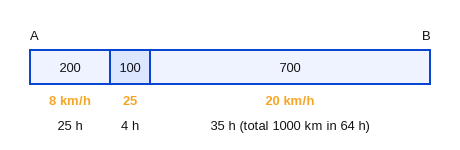
A car covers one-fifth of the distance from A to B at the speed of 8 km/h, one-tenth of the distance at 25 km/h and the remaining at the speed of 20 km/h. Find the average speed of the whole journey.
एक कार A से B तक की दूरी का एक-पाँचवाँ भाग 8 km/h की चाल से, दूरी का एक-दसवाँ भाग 25 km/h की चाल से और शेष दूरी 20 km/h की चाल से तय करती है। पूरी यात्रा की औसत चाल ज्ञात कीजिए।
  1. A14.225 km/h
  2. B12.625 km/h
  3. C15.625 km/h
  4. D17.225 km/h
Show answer

Concept: Average speed =total distancetotal time; assume a convenient total distance.

  1. Let the distance be 1000 km (LCM-friendly): parts 200 km, 100 km, 700 km.
  2. Times: 2008=25 h, 10025=4 h, 70020=35 h; total =64 h.
  3. Average speed =100064=15.625km/h.

Trick: Never average the speeds; pick a distance divisible by 5, 10, 8, 25, 20 (1000 works) and add times.

Answer: (C) 15.625 km/h

अवधारणा: औसत चाल =कुल दूरीकुल समय; सुविधाजनक कुल दूरी मान लें।

  1. दूरी 1000 km मानें: भाग 200 km, 100 km, 700 km।
  2. समय: 2008=25 h, 10025=4 h, 70020=35 h; कुल =64 h।
  3. औसत चाल =100064=15.625km/h।

ट्रिक: चालों का औसत कभी न लें; 5, 10, 8, 25, 20 से विभाज्य दूरी (1000) लेकर समय जोड़ें।

उत्तर: (C) 15.625 km/h

RRB NTPC Graduate CBT 1MathematicsAverage SpeedRRB NTPC Graduate CBT 1 2025 · 25 Mar Shift 1 →
Q15192.
In what duration (in years) will ₹8,400 fetch a simple interest of ₹840 at 5% per annum rate of interest?
5% वार्षिक ब्याज दर पर ₹8,400 कितनी अवधि (वर्षों में) में ₹840 का साधारण ब्याज अर्जित करेगा?
  1. A2
  2. B1
  3. C3
  4. D4
Show answer

Concept: SI=P×R×T100.

  1. 840=8400×5×T100=420T.
  2. T=840420=2 years.

Trick: SI is 10% of the principal and the rate is 5% per year → 10÷5=2 years.

Answer: (A) 2

अवधारणा: SI=P×R×T100।

  1. 840=8400×5×T100=420T।
  2. T=840420=2 वर्ष।

ट्रिक: ब्याज मूलधन का 10% है और दर 5% वार्षिक → 10÷5=2 वर्ष।

उत्तर: (A) 2

RRB NTPC Graduate CBT 1MathematicsSimple InterestRRB NTPC Graduate CBT 1 2025 · 25 Mar Shift 1 →
Q15193.
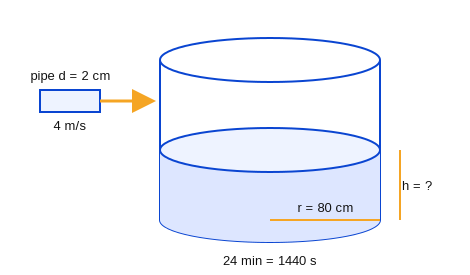
Water flows out through a circular pipe, whose internal diameter is 2 cm, at the rate of 4 metres per second into a cylindrical tank, the radius of whose base is 80 cm. By how much will the level of water rise in 24 minutes?
एक वृत्ताकार पाइप, जिसका आंतरिक व्यास 2 cm है, से 4 मीटर प्रति सेकंड की दर से पानी एक बेलनाकार टंकी में बहता है, जिसके आधार की त्रिज्या 80 cm है। 24 मिनट में पानी का स्तर कितना बढ़ जाएगा?
  1. A100 cm
  2. B90 cm
  3. C96 cm
  4. D91 cm
Show answer

Concept: Volume of water delivered by a pipe = (cross-section area) × (speed) × (time); equate it to the volume of the cylindrical layer formed in the tank.

  1. Pipe radius =1 cm, speed =4 m/s =400 cm/s, time =24×60=1440 s.
  2. Water delivered =π×12×400×1440 cm³.
  3. Rise h: π×802×h=π×400×1440⇒h=5760006400=90 cm.

Trick: h=rpipe2×speed×timeRtank2 – π cancels, just keep all units in cm and s.

Answer: (B) 90 cm

अवधारणा: पाइप से आया पानी = (अनुप्रस्थ काट क्षेत्रफल) × (चाल) × (समय); इसे टंकी में बनी बेलनाकार परत के आयतन के बराबर रखें।

  1. पाइप की त्रिज्या =1 cm, चाल =4 m/s =400 cm/s, समय =24×60=1440 s।
  2. आया पानी =π×12×400×1440 cm³।
  3. वृद्धि h: π×802×h=π×400×1440⇒h=5760006400=90 cm।

ट्रिक: h=rpipe2×चाल×समयRtank2 – π कट जाता है, सभी इकाइयाँ cm और s में रखें।

उत्तर: (B) 90 cm

RRB NTPC Graduate CBT 1MathematicsMensuration – CylinderRRB NTPC Graduate CBT 1 2025 · 25 Mar Shift 1 →
Q15194.
A and B complete a work in 22 days. If A alone can do it in 44 days, then B alone can do three-fourth of the same work in ______________days.
A और B एक काम को 22 दिनों में पूरा करते हैं। यदि A अकेला इसे 44 दिनों में कर सकता है, तो B अकेला उसी काम का तीन-चौथाई भाग ______________ दिनों में कर सकता है।
  1. A66
  2. B132
  3. C99
  4. D33
Show answer

Concept: One-day work of B = one-day work of (A+B) − one-day work of A.

  1. Total work =44 units (LCM of 22, 44). A+B do 2 units/day, A does 1 unit/day.
  2. B does 2−1=1 unit/day → whole work in 44 days.
  3. Three-fourth of the work: 34×44=33 days.

Trick: A alone takes exactly double the pair's time, so B is as fast as A → B also needs 44 days; then take ¾.

Answer: (D) 33

अवधारणा: B का एक दिन का कार्य = (A+B) का एक दिन का कार्य − A का एक दिन का कार्य।

  1. कुल कार्य =44 इकाई (22, 44 का LCM)। A+B प्रतिदिन 2 इकाई, A प्रतिदिन 1 इकाई।
  2. B प्रतिदिन 2−1=1 इकाई → पूरा कार्य 44 दिन में।
  3. तीन-चौथाई कार्य: 34×44=33 दिन।

ट्रिक: A अकेला जोड़ी से ठीक दोगुना समय लेता है, यानी B भी A जितना तेज़ → B को भी 44 दिन; फिर ¾ लें।

उत्तर: (D) 33

RRB NTPC Graduate CBT 1MathematicsTime and WorkRRB NTPC Graduate CBT 1 2025 · 25 Mar Shift 1 →
Q15195.
Find the solution of the following system of linear equations:
2x + y + z = 25
x − 3y + 2z = 0
y − z = 6
रैखिक समीकरणों के निम्नलिखित निकाय का हल ज्ञात कीजिए:
2x + y + z = 25
x − 3y + 2z = 0
y − z = 6
  1. Ax=554, y=−174, z=74
  2. Bx=−174, y=554, z=74
  3. Cx=74, y=554, z=−174
  4. Dx=554, y=74, z=−174
Show answer

Concept: Use the simplest equation to express one variable, substitute into the others and reduce to one unknown.

  1. From y−z=6: y=z+6.
  2. Second equation: x−3(z+6)+2z=0⇒x=z+18.
  3. First equation: 2(z+18)+(z+6)+z=25⇒4z+42=25⇒z=−174.
  4. x=−174+18=554,y=−174+6=74.

Trick: All options share the same three fractions – just check y−z=74+174=6 to pick the option where y=74, z=−174.

Answer: (D) x=554, y=74, z=−174

अवधारणा: सबसे सरल समीकरण से एक चर निकालें, बाकी में रखें और एक अज्ञात तक लाएँ।

  1. y−z=6 से: y=z+6।
  2. दूसरा समीकरण: x−3(z+6)+2z=0⇒x=z+18।
  3. पहला समीकरण: 2(z+18)+(z+6)+z=25⇒4z+42=25⇒z=−174।
  4. x=−174+18=554,y=−174+6=74।

ट्रिक: सभी विकल्पों में वही तीन भिन्न हैं – बस y−z=74+174=6 जाँचकर वह विकल्प चुनें जहाँ y=74, z=−174।

उत्तर: (D) x=554, y=74, z=−174

RRB NTPC Graduate CBT 1MathematicsLinear Equations in Three VariablesRRB NTPC Graduate CBT 1 2025 · 25 Mar Shift 1 →
Q15196.
What number will be in the place of x?
2.8 : 3.8 : : x : 5.7
x के स्थान पर कौन-सी संख्या आएगी?
2.8 : 3.8 : : x : 5.7
  1. A4.8
  2. B3.6
  3. C5.1
  4. D4.2
Show answer

Concept: In a:b::c:d, product of extremes = product of means, i.e. ab=cd.

  1. 2.83.8=x5.7.
  2. 5.7=3.8×1.5, so x=2.8×1.5=4.2.

Trick: Spot the multiplier between the two denominators (3.8 → 5.7 is ×1.5) and apply it to the numerator.

Answer: (D) 4.2

अवधारणा: a:b::c:d में बाह्य पदों का गुणनफल = मध्य पदों का गुणनफल, यानी ab=cd।

  1. 2.83.8=x5.7।
  2. 5.7=3.8×1.5, अतः x=2.8×1.5=4.2।

ट्रिक: दोनों हरों के बीच गुणक पहचानें (3.8 → 5.7 है ×1.5) और उसे अंश पर लगाएँ।

उत्तर: (D) 4.2

RRB NTPC Graduate CBT 1MathematicsProportionRRB NTPC Graduate CBT 1 2025 · 25 Mar Shift 1 →
Q15197.
A typist takes 40 minutes to type 10 pages. How many pages will he type in 88 minutes?
एक टाइपिस्ट 10 पृष्ठ टाइप करने में 40 मिनट लेता है। वह 88 मिनट में कितने पृष्ठ टाइप करेगा?
  1. A23
  2. B22
  3. C21
  4. D24
Show answer

Concept: Pages typed are directly proportional to time.

  1. Pages per minute =1040=14.
  2. In 88 minutes: 88×14=22 pages.

Trick: 4 minutes per page → 88÷4=22.

Answer: (B) 22

अवधारणा: टाइप किए पृष्ठ समय के समानुपाती होते हैं।

  1. प्रति मिनट पृष्ठ =1040=14।
  2. 88 मिनट में: 88×14=22 पृष्ठ।

ट्रिक: प्रति पृष्ठ 4 मिनट → 88÷4=22।

उत्तर: (B) 22

RRB NTPC Graduate CBT 1MathematicsUnitary MethodRRB NTPC Graduate CBT 1 2025 · 25 Mar Shift 1 →
Q15198.
Below are given two sets of numbers. In each set of numbers, a certain mathematical operation on the first number results in the second number. Similarly, a certain mathematical operation on the second number results in the third number, and so on. Which of the given options follows the same set of operations as in the question? (NOTE: A two-/three-digit number cannot be broken into individual digits for operations, e.g. if 37 is followed by 10, the operation cannot be 3 + 7, as a two-digit number cannot be broken into individual digits.)
50 – 10 – 5 – 15 ; 200 – 40 – 20 – 30
नीचे संख्याओं के दो समुच्चय दिए गए हैं। संख्याओं के प्रत्येक समुच्चय में, पहली संख्या पर एक निश्चित गणितीय संक्रिया करने से दूसरी संख्या प्राप्त होती है। इसी प्रकार, दूसरी संख्या पर एक निश्चित गणितीय संक्रिया करने से तीसरी संख्या प्राप्त होती है, और इसी तरह आगे। दिए गए विकल्पों में से कौन-सा प्रश्न में दी गई संक्रियाओं के समान समुच्चय का अनुसरण करता है? (नोट: संक्रियाओं के लिए किसी दो-/तीन-अंकीय संख्या को उसके अलग-अलग अंकों में विभाजित नहीं किया जा सकता, उदाहरण के लिए यदि 37 के बाद 10 आता है, तो संक्रिया 3 + 7 नहीं हो सकती, क्योंकि किसी दो-अंकीय संख्या को अलग-अलग अंकों में विभाजित नहीं किया जा सकता।)
50 – 10 – 5 – 15 ; 200 – 40 – 20 – 30
  1. A160 – 40 – 20 – 30
  2. B120 – 60 – 30 – 40
  3. C100 – 20 – 40 – 60
  4. D400 – 80 – 40 – 50
Show answer

Concept: Find one fixed chain of operations that takes the 1st number to the 2nd, the 2nd to the 3rd and the 3rd to the 4th in both given sets.

  1. 50÷5=10, 10÷2=5, 5+10=15.
  2. Check: 200÷5=40, 40÷2=20, 20+10=30 ✓. So the chain is ÷5, ÷2, +10.
  3. Option (D): 400÷5=80, 80÷2=40, 40+10=50 ✓. Others fail at the first step (160÷5=32, 120÷5=24, 100÷5=20 but 20÷2≠40).

Trick: The last step is +10, not ×3 – test it on the second set (20→30) before trusting the first set.

Answer: (D) 400 – 80 – 40 – 50

अवधारणा: संक्रियाओं की एक ऐसी स्थिर शृंखला खोजें जो दोनों सेटों में पहली संख्या से दूसरी, दूसरी से तीसरी और तीसरी से चौथी तक ले जाए।

  1. 50÷5=10, 10÷2=5, 5+10=15।
  2. जाँच: 200÷5=40, 40÷2=20, 20+10=30 ✓। अतः शृंखला है ÷5, ÷2, +10।
  3. विकल्प (D): 400÷5=80, 80÷2=40, 40+10=50 ✓। बाकी पहले ही चरण में असफल (160÷5=32, 120÷5=24, 100÷5=20 पर 20÷2≠40)।

ट्रिक: अंतिम चरण +10 है, ×3 नहीं – पहले सेट पर भरोसा करने से पहले दूसरे सेट (20→30) पर परखें।

उत्तर: (D) 400 – 80 – 40 – 50

RRB NTPC Graduate CBT 1General Intelligence and ReasoningNumber series (operations)RRB NTPC Graduate CBT 1 2025 · 25 Mar Shift 1 →
Q15199.
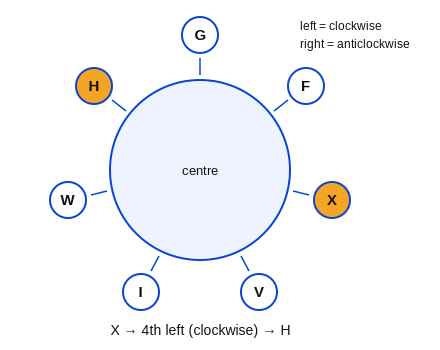
Seven people F, G, H, I, V, W, and X are sitting around a circular table facing the centre of the table. I sits third to the right of G. Only two people sit between I and F. Only three people sit between G and V. H sits to the immediate left of W. Who sits fourth to the left of X?
सात व्यक्ति F, G, H, I, V, W और X एक वृत्ताकार मेज़ के चारों ओर मेज़ के केंद्र की ओर मुख करके बैठे हैं। I, G के दाएँ तीसरे स्थान पर बैठा है। I और F के बीच केवल दो व्यक्ति बैठे हैं। G और V के बीच केवल तीन व्यक्ति बैठे हैं। H, W के ठीक बाएँ बैठा है। X के बाएँ चौथे स्थान पर कौन बैठा है?
  1. AH
  2. BI
  3. CW
  4. DF
Show answer

Concept: When everyone faces the centre, "right" means anticlockwise and "left" means clockwise.

  1. Fix G. I is 3rd to the right of G (3 places anticlockwise).
  2. Two people between I and F: one candidate seat is G itself, so F takes the other – the seat immediately clockwise of G.
  3. Three between G and V: V sits opposite-ish, the slot not occupied by I. H is immediately left of W, so H–W take the two adjacent free seats; X gets the last seat (between F and V).
  4. Final clockwise order: G, F, X, V, I, W, H. Fourth to the left of X (4 clockwise) = H.

Trick: Draw 7 dots, place the fixed person first, and count "right" as anticlockwise – most errors come from mixing the direction.

Answer: (A) H

अवधारणा: जब सब केंद्र की ओर मुख किए हों, तो "दाएँ" = वामावर्त (anticlockwise) और "बाएँ" = दक्षिणावर्त (clockwise)।

  1. G को स्थिर करें। I, G के दाएँ तीसरा (3 स्थान वामावर्त)।
  2. I और F के बीच दो लोग: दूसरी तरफ़ का स्थान स्वयं G है, अतः F, G के बगल में (दक्षिणावर्त ओर) बैठता है।
  3. G और V के बीच तीन लोग: V वह स्थान लेता है जो I ने नहीं लिया। H, W के तुरंत बाएँ है, अतः H–W दो सटी हुई खाली सीटें लेते हैं; X को अंतिम सीट (F और V के बीच) मिलती है।
  4. अंतिम दक्षिणावर्त क्रम: G, F, X, V, I, W, H। X के बाएँ चौथा (4 स्थान दक्षिणावर्त) = H।

ट्रिक: 7 बिंदु बनाएँ, पहले स्थिर व्यक्ति रखें और "दाएँ" को वामावर्त गिनें – अधिकतर गलतियाँ दिशा उलझाने से होती हैं।

उत्तर: (A) H

RRB NTPC Graduate CBT 1General Intelligence and ReasoningCircular seating arrangementRRB NTPC Graduate CBT 1 2025 · 25 Mar Shift 1 →
Q15200.
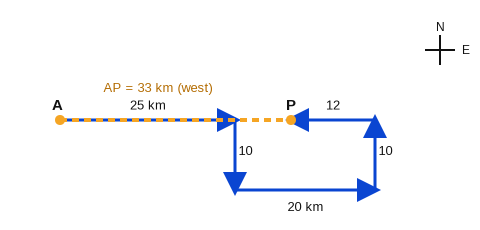
Arvind starts from Point A and drives 25 km towards east. He then takes a right turn, drives 10 km, turns left and drives 20 km. He then takes a left turn and drives 10 km. He takes a final left turn, drives 12 km and stops at Point P. How far (shortest distance) and towards which direction should he drive in order to reach Point A again? (All turns are 90-degree turns only, unless specified.)
अरविंद बिंदु A से शुरू करता है और पूर्व की ओर 25 km गाड़ी चलाता है। फिर वह दाएँ मुड़ता है, 10 km गाड़ी चलाता है, बाएँ मुड़ता है और 20 km गाड़ी चलाता है। फिर वह बाएँ मुड़ता है और 10 km गाड़ी चलाता है। वह अंतिम बार बाएँ मुड़ता है, 12 km गाड़ी चलाता है और बिंदु P पर रुक जाता है। बिंदु A पर पुनः पहुँचने के लिए उसे कितनी दूर (न्यूनतम दूरी) और किस दिशा में गाड़ी चलानी चाहिए? (जब तक अन्यथा निर्दिष्ट न हो, सभी मोड़ केवल 90 डिग्री के मोड़ हैं।)
  1. A20 km towards northउत्तर की ओर 20 km
  2. B33 km towards westपश्चिम की ओर 33 km
  3. C25 km towards eastपूर्व की ओर 25 km
  4. D10 km towards southदक्षिण की ओर 10 km
Show answer

Concept: Plot each leg on an East–North grid; the final position relative to the start gives the shortest distance and direction.

  1. A → 25 km east: (25,0). Right turn (south) 10 km: (25,−10). Left (east) 20 km: (45,−10).
  2. Left (north) 10 km: (45,0). Left (west) 12 km: P =(33,0).
  3. P is on the same east–west line as A, 33 km east of it, so he must drive 33 km west.

Trick: The two 10 km legs (south, then north) cancel – only the east–west moves matter: 25+20−12=33.

Answer: (B) 33 km towards west

अवधारणा: हर चरण को पूर्व–उत्तर ग्रिड पर आँकें; प्रारंभ के सापेक्ष अंतिम स्थिति से न्यूनतम दूरी और दिशा मिलती है।

  1. A → 25 km पूर्व: (25,0)। दाएँ (दक्षिण) 10 km: (25,−10)। बाएँ (पूर्व) 20 km: (45,−10)।
  2. बाएँ (उत्तर) 10 km: (45,0)। बाएँ (पश्चिम) 12 km: P =(33,0)।
  3. P, A की ही पूर्व–पश्चिम रेखा पर उससे 33 km पूर्व में है, अतः उसे 33 km पश्चिम चलना होगा।

ट्रिक: 10 km के दोनों चरण (दक्षिण, फिर उत्तर) कट जाते हैं – केवल पूर्व–पश्चिम चालें गिनें: 25+20−12=33।

उत्तर: (B) 33 km पश्चिम की ओर

RRB NTPC Graduate CBT 1General Intelligence and ReasoningDirection and distanceRRB NTPC Graduate CBT 1 2025 · 25 Mar Shift 1 →