Question bank

Q&A: practice questions with answers

Search questions on any topic. Filter by exam category, exam, subject and topic, try the question, then open the answer and explanation.

Courses – airGurukul

20,719 questions found.

Q15281.
Calculate the median (rounded to two decimal places) from the following data:
Marks0 – 1010 – 3030 – 6060 – 8080 – 90
Number of students91934126
Total frequency N = 80
निम्नलिखित आँकड़ों से माध्यिका (दो दशमलव स्थानों तक पूर्णांकित) की गणना कीजिए:
अंक0 – 1010 – 3030 – 6060 – 8080 – 90
विद्यार्थियों की संख्या91934126
कुल बारंबारता N = 80
  1. A40.59
  2. B37.06
  3. C33.14
  4. D36.27
Show answer

Concept: Median=l+N2−cff×h, where l = lower limit of the median class, cf = cumulative frequency before it, f = its frequency, h = class width.

  1. Cumulative frequencies: 9, 28, 62, 74, 80. N2=40 lies in 30–60 (cf jumps from 28 to 62).
  2. l=30, cf=28, f=34, h=30.
  3. Median=30+40−2834×30=30+36034=30+10.59=40.59.

Trick: Classes are unequal here – always use the actual width of the median class (h=30), not a common width.

Answer: (A) 40.59

अवधारणा: माध्यिका=l+N2−cff×h, जहाँ l = माध्यिका वर्ग की निचली सीमा, cf = उससे पहले की संचयी बारंबारता, f = उसकी बारंबारता, h = वर्ग-चौड़ाई।

  1. संचयी बारंबारता: 9, 28, 62, 74, 80। N2=40 वर्ग 30–60 में है (cf 28 से 62 हो जाता है)।
  2. l=30, cf=28, f=34, h=30।
  3. माध्यिका=30+40−2834×30=30+36034=30+10.59=40.59।

ट्रिक: यहाँ वर्ग असमान हैं – हमेशा माध्यिका वर्ग की वास्तविक चौड़ाई (h=30) लें, कोई साझा चौड़ाई नहीं।

उत्तर: (A) 40.59
RRB NTPC Graduate CBT 1MathematicsStatistics – median of grouped dataRRB NTPC Graduate CBT 1 2025 · 24 Mar Shift 3 →
Q15282.
A man can row 8 km/hr in still water while speed of current is 3 km/hr. How much time (in hours) will he take to row 11 km downstream and 15 km upstream?
एक व्यक्ति शांत जल में 8 km/hr की गति से नाव चला सकता है, जबकि धारा की गति 3 km/hr है। उसे धारा के अनुकूल 11 km और धारा के प्रतिकूल 15 km नाव चलाने में कितना समय (घंटों में) लगेगा?
  1. A4
  2. B6
  3. C3
  4. D5
Show answer

Concept: Downstream speed =u+v, upstream speed =u−v; time =distancespeed.

  1. Downstream: 8+3=11km/h; time =1111=1 h.
  2. Upstream: 8−3=5km/h; time =155=3 h.
  3. Total =1+3=4 hours.

Trick: Numbers are chosen to divide exactly: 11÷11 and 15÷5.

Answer: (A) 4

अवधारणा: धारा के अनुकूल चाल =u+v, प्रतिकूल चाल =u−v; समय =दूरीचाल।

  1. अनुकूल: 8+3=11km/h; समय =1111=1 घंटा।
  2. प्रतिकूल: 8−3=5km/h; समय =155=3 घंटे।
  3. कुल =1+3=4 घंटे।

ट्रिक: संख्याएँ पूरी-पूरी विभाजित होती हैं: 11÷11 और 15÷5।

उत्तर: (A) 4

RRB NTPC Graduate CBT 1MathematicsBoats and streamsRRB NTPC Graduate CBT 1 2025 · 24 Mar Shift 3 →
Q15283.
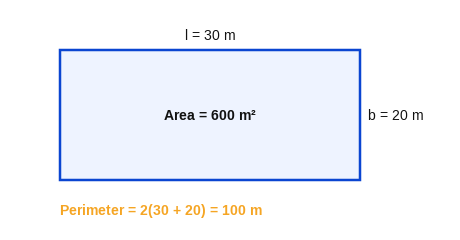
The breadth of a rectangular field is 23 of its length. Its area is 600 m2. Find the cost of fencing it all around at the cost of ₹200/m.
एक आयताकार खेत की चौड़ाई उसकी लंबाई की 23 है। इसका क्षेत्रफल 600 m2 है। ₹200/m की दर से इसके चारों ओर बाड़ लगाने की लागत ज्ञात कीजिए।
  1. A₹30,000
  2. B₹20,000
  3. C₹32,000
  4. D₹26,000
Show answer

Concept: Area =l×b, fencing cost depends on the perimeter 2(l+b).

  1. b=23l⇒l×23l=600⇒l2=900⇒l=30 m, b=20 m.
  2. Perimeter =2(30+20)=100 m.
  3. Cost =100×200= ₹20,000.

Trick: Ratio 3:2 with area 600 ⇒ 6x2=600, x=10 ⇒ sides 30 and 20.

Answer: (B) ₹20,000

अवधारणा: क्षेत्रफल =l×b, बाड़ लगाने की लागत परिमाप 2(l+b) पर निर्भर करती है।

  1. b=23l⇒l×23l=600⇒l2=900⇒l=30 m, b=20 m।
  2. परिमाप =2(30+20)=100 m।
  3. लागत =100×200= ₹20,000।

ट्रिक: अनुपात 3:2 और क्षेत्रफल 600 ⇒ 6x2=600, x=10 ⇒ भुजाएँ 30 और 20।

उत्तर: (B) ₹20,000

RRB NTPC Graduate CBT 1MathematicsMensuration – rectangleRRB NTPC Graduate CBT 1 2025 · 24 Mar Shift 3 →
Q15284.
Find the area of the rectangle with length 10 cm and width 5 cm. (Round off the answer to 2 decimal places.)
10 cm लंबाई और 5 cm चौड़ाई वाले आयत का क्षेत्रफल ज्ञात कीजिए। (उत्तर को 2 दशमलव स्थानों तक पूर्णांकित कीजिए।)
  1. A17.58 sq. cm.17.58 वर्ग cm
  2. B18.52 sq. cm.18.52 वर्ग cm
  3. C15.98 sq. cm.15.98 वर्ग cm
  4. D22.36 sq. cm.22.36 वर्ग cm
Show answer

Concept: Area of a rectangle =length×width.

  1. Area =10×5 sq. cm.
  2. 5≈2.236, so area =10×2.236=22.36 sq. cm.

Yaad rakhein: 2≈1.414, 3≈1.732, 5≈2.236 – multiplying by 10 only shifts the decimal point.

Answer: (D) 22.36 sq. cm.

अवधारणा: आयत का क्षेत्रफल =लंबाई×चौड़ाई।

  1. क्षेत्रफल =10×5 वर्ग सेमी।
  2. 5≈2.236, अतः क्षेत्रफल =10×2.236=22.36 वर्ग सेमी।

याद रखें: 2≈1.414, 3≈1.732, 5≈2.236 – 10 से गुणा करने पर केवल दशमलव खिसकता है।

उत्तर: (D) 22.36 sq. cm.

RRB NTPC Graduate CBT 1MathematicsArea of rectangleRRB NTPC Graduate CBT 1 2025 · 24 Mar Shift 3 →
Q15285.
A car runs for 10 hours and Its speed during the ith hour is i3 km per hour, where i=1,2,3...,10. The average speed of the car for the journey is _____ km per hour.
एक कार 10 घंटे चलती है और iवें घंटे के दौरान इसकी गति i3 km प्रति घंटा है, जहाँ i=1,2,3...,10 है। यात्रा के लिए कार की औसत गति _____ km प्रति घंटा है।
  1. A350.2
  2. B305.2
  3. C302.5
  4. D320.5
Show answer

Concept: When each hour is of equal duration, average speed =total distancetotal time=sum of hourly speedsnumber of hours.

  1. Distance in the ith hour =i3 km, so total distance =13+23+…+103.
  2. ∑i3=[n(n+1)2]2=(10×112)2=552=3025 km.
  3. Average speed =302510=302.5km/h.

Trick: Sum of first n cubes = (sum of first n numbers)2; for n=10 that is 552=3025.

Answer: (C) 302.5

अवधारणा: जब हर घंटा बराबर अवधि का हो, औसत चाल =कुल दूरीकुल समय=घंटेवार चालों का योगघंटों की संख्या।

  1. iवें घंटे में दूरी =i3 km, अतः कुल दूरी =13+23+…+103।
  2. ∑i3=[n(n+1)2]2=(10×112)2=552=3025 km।
  3. औसत चाल =302510=302.5km/h।

ट्रिक: पहले n घनों का योग = (पहली n संख्याओं का योग)2; n=10 के लिए 552=3025।

उत्तर: (C) 302.5

RRB NTPC Graduate CBT 1MathematicsAverage speedRRB NTPC Graduate CBT 1 2025 · 24 Mar Shift 3 →
Q15286.
The average marks of 17 students in a class is 40. If the marks of each student are doubled, find the new average.
एक कक्षा के 17 विद्यार्थियों के औसत अंक 40 हैं। यदि प्रत्येक विद्यार्थी के अंक दुगुने कर दिए जाएँ, तो नया औसत ज्ञात कीजिए।
  1. A80
  2. B17
  3. C40
  4. D34
Show answer

Concept: If every observation is multiplied by k, the average is also multiplied by k.

  1. Original average =40, each mark doubled → k=2.
  2. New average =2×40=80 (the number of students, 17, does not matter).

Trick: Add/subtract a constant → average shifts by it; multiply/divide → average scales by it.

Answer: (A) 80

अवधारणा: यदि हर प्रेक्षण को k से गुणा करें तो औसत भी k गुना हो जाता है।

  1. मूल औसत =40, हर अंक दोगुना → k=2।
  2. नया औसत =2×40=80 (छात्रों की संख्या 17 का कोई असर नहीं)।

ट्रिक: स्थिरांक जोड़ें/घटाएँ → औसत उतना खिसकता है; गुणा/भाग करें → औसत उतने गुना बदलता है।

उत्तर: (A) 80

RRB NTPC Graduate CBT 1MathematicsAverage – scalingRRB NTPC Graduate CBT 1 2025 · 24 Mar Shift 3 →
Q15287.
A typist takes 40 minutes to type 2 pages. How long (in minutes) will he take to type 95 pages?
एक टाइपिस्ट 2 पृष्ठ टाइप करने में 40 मिनट लेता है। 95 पृष्ठ टाइप करने में उसे कितना समय (मिनटों में) लगेगा?
  1. A1905
  2. B1890
  3. C1910
  4. D1900
Show answer

Concept: Time is directly proportional to the number of pages at a constant typing rate.

  1. Time per page =402=20 minutes.
  2. Time for 95 pages =95×20=1900 minutes.

Trick: 95×20=(100−5)×20=2000−100=1900.

Answer: (D) 1900

अवधारणा: टाइपिंग की दर स्थिर हो तो समय पृष्ठों की संख्या के समानुपाती होता है।

  1. प्रति पृष्ठ समय =402=20 मिनट।
  2. 95 पृष्ठों का समय =95×20=1900 मिनट।

ट्रिक: 95×20=(100−5)×20=2000−100=1900।

उत्तर: (D) 1900

RRB NTPC Graduate CBT 1MathematicsUnitary methodRRB NTPC Graduate CBT 1 2025 · 24 Mar Shift 3 →
Q15288.
If the ratio of the ages of A and B is 3 : 5, the ratio of the ages of B and C is 2 : 3, and the ratio of the ages of C and D is 3 : 4, what is the ratio of the ages of A and D?
यदि A और B की आयु का अनुपात 3 : 5, B और C की आयु का अनुपात 2 : 3 तथा C और D की आयु का अनुपात 3 : 4 है, तो A और D की आयु का अनुपात क्या है?
  1. A5 : 11
  2. B3 : 13
  3. C7 : 10
  4. D3 : 10
Show answer

Concept: To combine ratios, make the common term equal in both.

  1. A:B=3:5 and B:C=2:3 → make B =10: A:B:C=6:10:15.
  2. C:D=3:4 → make C =15: C:D=15:20, so A:B:C:D=6:10:15:20.
  3. A:D=6:20=3:10.

Trick: AD=AB×BC×CD=35×23×34=310.

Answer: (D) 3 : 10

अवधारणा: अनुपात जोड़ने के लिए उभयनिष्ठ पद को दोनों में बराबर करें।

  1. A:B=3:5 और B:C=2:3 → B =10 करें: A:B:C=6:10:15।
  2. C:D=3:4 → C =15 करें: C:D=15:20, अतः A:B:C:D=6:10:15:20।
  3. A:D=6:20=3:10।

ट्रिक: AD=AB×BC×CD=35×23×34=310।

उत्तर: (D) 3 : 10

RRB NTPC Graduate CBT 1MathematicsChain ratioRRB NTPC Graduate CBT 1 2025 · 24 Mar Shift 3 →
Q15289.
Find the mode of the following distribution.
Class interval10–1515–2020–2525–3030–3535–40
Frequency304872362418
निम्नलिखित बंटन का बहुलक ज्ञात कीजिए।
वर्ग अंतराल10–1515–2020–2525–3030–3535–40
बारंबारता304872362418
  1. A24.25
  2. B22
  3. C22.5
  4. D25
Show answer

Concept: Mode =l+f1−f02f1−f0−f2×h, where l = lower limit of the modal class, f1 its frequency, f0 and f2 the frequencies of the classes before and after, h = class width.

  1. Highest frequency 72 → modal class 20–25: l=20, f1=72, f0=48, f2=36, h=5.
  2. Mode =20+72−48144−48−36×5=20+2460×5.
  3. =20+2=22.

Trick: The mode always lies inside the modal class (here 20–25) – options 24.25, 25 are out at once; a quick check between 22 and 22.5 decides.

Answer: (B) 22

अवधारणा: बहुलक (mode) =l+f1−f02f1−f0−f2×h, जहाँ l = बहुलक वर्ग की निचली सीमा, f1 उसकी बारंबारता, f0, f2 पहले व बाद के वर्गों की बारंबारताएँ, h = वर्ग-चौड़ाई।

  1. सबसे अधिक बारंबारता 72 → बहुलक वर्ग 20–25: l=20, f1=72, f0=48, f2=36, h=5।
  2. बहुलक =20+72−48144−48−36×5=20+2460×5।
  3. =20+2=22।

ट्रिक: बहुलक हमेशा बहुलक वर्ग (यहाँ 20–25) के अंदर होता है – 24.25 और 25 तुरंत बाहर; 22 व 22.5 में गणना से निर्णय।

उत्तर: (B) 22

RRB NTPC Graduate CBT 1MathematicsMode of grouped dataRRB NTPC Graduate CBT 1 2025 · 24 Mar Shift 3 →
Q15290.
If 2cosecA=3secA, then find the value of (1−cosA)(1+cosA)(1−sinA)(1+sinA).
यदि 2cosecA=3secA है, तो (1−cosA)(1+cosA)(1−sinA)(1+sinA) का मान ज्ञात कीजिए।
  1. A413
  2. B49
  3. C139
  4. D23
Show answer

Concept: (1−cosA)(1+cosA)=1−cos2A=sin2A and (1−sinA)(1+sinA)=cos2A.

  1. 2cosecA=3secA⇒2sinA=3cosA⇒tanA=23.
  2. Required expression =sin2Acos2A=tan2A.
  3. =(23)2=49.

Trick: acosecA=bsecA⇒tanA=ab; products like (1−x)(1+x) always collapse to 1−x2.

Answer: (B) 49

अवधारणा: (1−cosA)(1+cosA)=1−cos2A=sin2A तथा (1−sinA)(1+sinA)=cos2A।

  1. 2cosecA=3secA⇒2sinA=3cosA⇒tanA=23।
  2. अभीष्ट व्यंजक =sin2Acos2A=tan2A।
  3. =(23)2=49।

ट्रिक: acosecA=bsecA⇒tanA=ab; (1−x)(1+x) जैसे गुणनफल हमेशा 1−x2 बन जाते हैं।

उत्तर: (B) 49

RRB NTPC Graduate CBT 1MathematicsTrigonometric identitiesRRB NTPC Graduate CBT 1 2025 · 24 Mar Shift 3 →
Q15291.
Priyanshi wants to solve the expression:
3.6+54×2.4−12
What is the value of the expression?
प्रियांशी निम्नलिखित व्यंजक को हल करना चाहती है:
3.6+54×2.4−12
व्यंजक का मान क्या है?
  1. A6.1
  2. B6.5
  3. C7.5
  4. D7.1
Show answer

Concept: BODMAS – do multiplication before addition and subtraction.

  1. 54×2.4=1.25×2.4=3.
  2. 3.6+3−12=6.6−0.5=6.1.

Trick: 54×2.4=5×2.44=124=3 – cancel before multiplying.

Answer: (A) 6.1

अवधारणा: BODMAS – जोड़-घटाव से पहले गुणा करें।

  1. 54×2.4=1.25×2.4=3।
  2. 3.6+3−12=6.6−0.5=6.1।

ट्रिक: 54×2.4=5×2.44=124=3 – गुणा से पहले काटें।

उत्तर: (A) 6.1

RRB NTPC Graduate CBT 1MathematicsBODMASRRB NTPC Graduate CBT 1 2025 · 24 Mar Shift 3 →
Q15292.
There are 45 members in group A, 31 members in group B and 48 members in group C. All the members of these groups went to a restaurant. The average amounts spent on each member of groups A, B and C are ₹295, ₹311 and ₹233, respectively. The overall average amount (in ₹) spent per member is:
समूह A में 45 सदस्य, समूह B में 31 सदस्य और समूह C में 48 सदस्य हैं। इन समूहों के सभी सदस्य एक रेस्तरां में गए। समूह A, B और C के प्रत्येक सदस्य पर खर्च की गई औसत राशि क्रमशः ₹295, ₹311 और ₹233 है। प्रति सदस्य खर्च की गई कुल औसत राशि (₹ में) है:
  1. A276
  2. B273
  3. C275
  4. D272
Show answer

Concept: Overall average =total amounttotal members.

  1. Totals: 45×295=13275, 31×311=9641, 48×233=11184.
  2. Sum =13275+9641+11184=34100; members =45+31+48=124.
  3. Average =34100124=275.

Trick: Take 275 as base: deviations 45×20=900, 31×36=1116, 48×(−42)=−2016 → total 0, so the average is exactly 275.

Answer: (C) 275

अवधारणा: कुल औसत =कुल राशिकुल सदस्य।

  1. कुल: 45×295=13275, 31×311=9641, 48×233=11184।
  2. योग =13275+9641+11184=34100; सदस्य =45+31+48=124।
  3. औसत =34100124=275।

ट्रिक: 275 को आधार मानें: विचलन 45×20=900, 31×36=1116, 48×(−42)=−2016 → योग 0, अतः औसत ठीक 275।

उत्तर: (C) 275

RRB NTPC Graduate CBT 1MathematicsWeighted averageRRB NTPC Graduate CBT 1 2025 · 24 Mar Shift 3 →
Q15293.
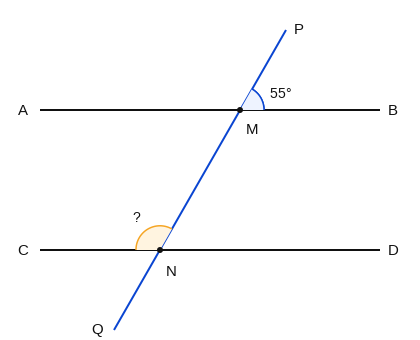
Two parallel lines AB ∥ CD are cut by a transversal line PQ, as shown in the figure. If the angle ∠PMB=55° then find the angle ∠CNM.
दो समांतर रेखाएँ AB ∥ CD एक तिर्यक रेखा PQ द्वारा काटी जाती हैं, जैसा कि चित्र में दिखाया गया है। यदि कोण ∠PMB=55° है, तो कोण ∠CNM ज्ञात कीजिए।
  1. A75°
  2. B125°
  3. C60°
  4. D55°
Show answer

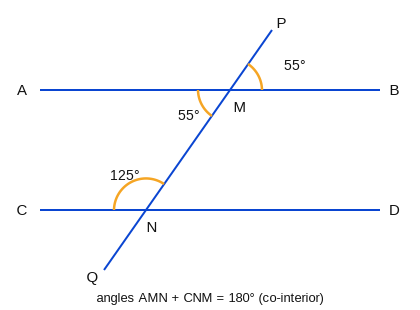
Concept: When a transversal cuts parallel lines, co-interior (same-side interior) angles add up to 180∘; vertically opposite angles are equal.

  1. ∠AMN is vertically opposite to ∠PMB, so ∠AMN=55∘.
  2. ∠AMN and ∠CNM lie between AB and CD on the same side of PQ → co-interior.
  3. ∠CNM=180∘−55∘=125∘.

Trick: With parallel lines every angle at the two crossings is either x or 180∘−x; ∠CNM is the obtuse one, so 125∘.

Answer: (B) 125°

अवधारणा: तिर्यक रेखा समांतर रेखाओं को काटे तो सह-अंतःकोण (co-interior) का योग 180∘ होता है; शीर्षाभिमुख कोण बराबर होते हैं।

  1. ∠AMN, ∠PMB का शीर्षाभिमुख कोण है, अतः ∠AMN=55∘।
  2. ∠AMN और ∠CNM AB व CD के बीच, PQ के एक ही ओर हैं → सह-अंतःकोण।
  3. ∠CNM=180∘−55∘=125∘।

ट्रिक: समांतर रेखाओं में दोनों कटान बिंदुओं पर हर कोण या तो x या 180∘−x होता है; ∠CNM अधिक कोण है, अतः 125∘।

उत्तर: (B) 125°

RRB NTPC Graduate CBT 1MathematicsParallel lines – anglesRRB NTPC Graduate CBT 1 2025 · 24 Mar Shift 3 →
Q15294.
Ashish has ₹1404 with him. He divides this amount between his two sons, Arun and Mahesh, and asks them to invest their respective shares at a compound interest rate of 8% per annum, compounded annually. It is observed that Arun’s investment amounts to the same value after 17 years as Mahesh’s investment does after 18 years. How much (in ₹) did Ashish give to Mahesh?
आशीष के पास ₹1404 हैं। वह इस राशि को अपने दो पुत्रों, अरुण और महेश, के बीच बाँटता है और उन्हें अपने-अपने हिस्से को 8% वार्षिक चक्रवृद्धि ब्याज की दर पर, वार्षिक रूप से संयोजित, निवेश करने को कहता है। यह देखा गया कि अरुण का निवेश 17 वर्षों बाद उतनी ही राशि हो जाता है जितनी महेश का निवेश 18 वर्षों बाद होता है। आशीष ने महेश को कितनी राशि (₹ में) दी?
  1. A675
  2. B525
  3. C729
  4. D829
Show answer

Concept: If amounts become equal after different periods, the ratio of principals is the inverse ratio of the growth factors.

  1. A(1.08)17=M(1.08)18⇒AM=1.08=2725.
  2. Total parts =27+25=52; 140452=27.
  3. Mahesh's share =25×27=675.

Trick: Periods differing by 1 year → shares are in the ratio (100+r):100; for 8% that is 27:25.

Answer: (A) 675

अवधारणा: यदि मिश्रधन अलग-अलग अवधि के बाद बराबर हों तो मूलधनों का अनुपात वृद्धि-गुणकों का व्युत्क्रम अनुपात होता है।

  1. A(1.08)17=M(1.08)18⇒AM=1.08=2725।
  2. कुल भाग =27+25=52; 140452=27।
  3. महेश का हिस्सा =25×27=675।

ट्रिक: अवधि में 1 वर्ष का अंतर → हिस्से (100+r):100 में; 8% पर 27:25।

उत्तर: (A) 675

RRB NTPC Graduate CBT 1MathematicsCompound interest – divisionRRB NTPC Graduate CBT 1 2025 · 24 Mar Shift 3 →
Q15295.
Piyush bought an article for ₹331 and sold it to Payal at a loss of 5%. With this amount, Piyush bought another article and sold it at a gain of 60%. What is Piyush's overall gain percentage?
पीयूष ने ₹331 में एक वस्तु खरीदी और उसे 5% की हानि पर पायल को बेच दिया। इस राशि से पीयूष ने एक अन्य वस्तु खरीदी और उसे 60% के लाभ पर बेच दिया। पीयूष का कुल लाभ प्रतिशत क्या है?
  1. A50%
  2. B52%
  3. C47%
  4. D48%
Show answer

Concept: Successive changes multiply: overall factor =(1−5100)(1+60100).

  1. After 5% loss: 331×0.95=314.45; this is reinvested.
  2. After 60% gain: 314.45×1.6=503.12.
  3. Overall gain =503.12−331331×100=172.12331×100=52%.

Trick: 0.95×1.6=1.52 → 52% gain directly; the ₹331 is irrelevant.

Answer: (B) 52%

अवधारणा: क्रमिक परिवर्तन गुणा होते हैं: कुल गुणक =(1−5100)(1+60100)।

  1. 5% हानि के बाद: 331×0.95=314.45; यही फिर लगाया।
  2. 60% लाभ के बाद: 314.45×1.6=503.12।
  3. कुल लाभ =503.12−331331×100=172.12331×100=52%।

ट्रिक: 0.95×1.6=1.52 → सीधे 52% लाभ; ₹331 की ज़रूरत ही नहीं।

उत्तर: (B) 52%

RRB NTPC Graduate CBT 1MathematicsSuccessive profit/lossRRB NTPC Graduate CBT 1 2025 · 24 Mar Shift 3 →
Q15296.
Refer to the following letter, symbol series and answer the question. Counting to be done from left to right only
(Left) B R © # # # W & S @ Z @ @ A & L @ @ I © O © (Right)
How many such letters are there each of which is immediately preceded by a letter and also immediately followed by a symbol?
निम्नलिखित अक्षर, प्रतीक श्रृंखला को देखिए और प्रश्न का उत्तर दीजिए। गिनती केवल बाएँ से दाएँ की ओर की जानी है
(बाएँ) B R © # # # W & S @ Z @ @ A & L @ @ I © O © (दाएँ)
ऐसे कितने अक्षर हैं जिनमें से प्रत्येक के ठीक पहले एक अक्षर है और ठीक बाद एक प्रतीक है?
  1. A2
  2. B1
  3. C0
  4. D3
Show answer

Concept: We need the pattern letter – LETTER – symbol: the middle letter must have a letter on its left and a symbol on its right.

  1. Series: B R © # # # W & S @ Z @ @ A & L @ @ I © O ©
  2. Scan each letter: R has B before and © after ✓.
  3. W, S, Z, A, L, I, O all have a symbol just before them ✗.

Trick: Only look at letters that come in pairs (two letters side by side); here only 'B R' qualifies, then check the right side.

Answer: (B) 1

अवधारणा: हमें पैटर्न अक्षर – अक्षर – प्रतीक चाहिए: बीच वाले अक्षर के बाएँ अक्षर और दाएँ प्रतीक हो।

  1. श्रृंखला: B R © # # # W & S @ Z @ @ A & L @ @ I © O ©
  2. हर अक्षर जाँचें: R के पहले B और बाद में © है ✓।
  3. W, S, Z, A, L, I, O सबके ठीक पहले प्रतीक है ✗।

ट्रिक: केवल वहीं देखें जहाँ दो अक्षर साथ-साथ हों; यहाँ सिर्फ 'B R' है, फिर दाईं ओर जाँचें।

उत्तर: (B) 1

RRB NTPC Graduate CBT 1General Intelligence and ReasoningLetter–symbol seriesRRB NTPC Graduate CBT 1 2025 · 24 Mar Shift 3 →
Q15297.
In the following number-pairs, the second number is obtained by applying certain mathematical operations to the first number. Select the set in which the numbers are related in the same way as are the numbers of the following sets.
(NOTE : Operations should be performed on the whole numbers, without breaking down the numbers into its constituent digits. E.g. 13 – Operations on 13 such as adding / subtracting /multiplying etc. to 13 can be performed. Breaking down 13 into 1 and 3 and then performing mathematical operations on 1 and 3 is not allowed)
17, 67
22, 87
निम्नलिखित संख्या-युग्मों में, दूसरी संख्या पहली संख्या पर कुछ गणितीय संक्रियाएँ करके प्राप्त की गई है। उस समुच्चय का चयन कीजिए जिसमें संख्याएँ उसी प्रकार संबंधित हैं जैसे निम्नलिखित समुच्चयों की संख्याएँ संबंधित हैं।
(नोट: संक्रियाएँ पूर्ण संख्याओं पर की जानी चाहिए, संख्याओं को उनके घटक अंकों में तोड़े बिना। उदाहरण के लिए 13 – 13 पर संक्रियाएँ जैसे 13 में जोड़ना/घटाना/गुणा करना आदि की जा सकती हैं। 13 को 1 और 3 में तोड़कर फिर 1 और 3 पर गणितीय संक्रियाएँ करने की अनुमति नहीं है)
17, 67
22, 87
  1. A24, 98
  2. B25, 99
  3. C24, 99
  4. D25, 98
Show answer

Concept: Find one operation on the whole first number that gives the second.

  1. 17×4−1=67 ✓; 22×4−1=87 ✓. Rule: second =4× first −1.
  2. Check options: 24×4−1=95 (not 98 or 99); 25×4−1=99 ✓.

Trick: Second number is always odd and just under a multiple of 4 (68, 88, 100) → 25, 99.

Answer: (B) 25, 99

अवधारणा: पहली पूरी संख्या पर ऐसी एक संक्रिया खोजें जिससे दूसरी मिले।

  1. 17×4−1=67 ✓; 22×4−1=87 ✓। नियम: दूसरी =4× पहली −1।
  2. विकल्प जाँचें: 24×4−1=95 (98 या 99 नहीं); 25×4−1=99 ✓।

ट्रिक: दूसरी संख्या हमेशा विषम और 4 के गुणज (68, 88, 100) से 1 कम → 25, 99।

उत्तर: (B) 25, 99

RRB NTPC Graduate CBT 1General Intelligence and ReasoningNumber analogyRRB NTPC Graduate CBT 1 2025 · 24 Mar Shift 3 →
Q15298.
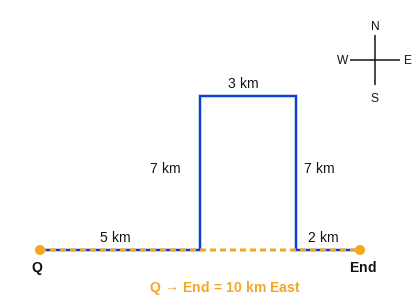
Sneha starts from Point Q, walks 5 km East, turns left and walks 7 km, turns right and walks 3 km, turns right and walks 7 km, then turns left and walks 2 km. How far and in which direction is she from Point Q? (All turns are 90-degree turns only unless specified.)
स्नेहा बिंदु Q से चलना शुरू करती है, 5 km पूर्व की ओर चलती है, बाएँ मुड़कर 7 km चलती है, दाएँ मुड़कर 3 km चलती है, दाएँ मुड़कर 7 km चलती है, फिर बाएँ मुड़कर 2 km चलती है। वह बिंदु Q से कितनी दूर और किस दिशा में है? (जब तक अन्यथा न कहा जाए, सभी मोड़ केवल 90 डिग्री के मोड़ हैं।)
  1. A5 km towards South5 km दक्षिण की ओर
  2. B10 km towards East10 km पूर्व की ओर
  3. C2 km towards West2 km पश्चिम की ओर
  4. D7 km towards North7 km उत्तर की ओर
Show answer

Concept: Track the position on a grid: East = +x, North = +y. Start Q = (0, 0).

  1. 5 km East → (5, 0); turn left (North) 7 km → (5, 7).
  2. Turn right (East) 3 km → (8, 7); turn right (South) 7 km → (8, 0).
  3. Turn left (East) 2 km → (10, 0).
  4. Final point is 10 km due East of Q.

Trick: The 7 km North and 7 km South cancel; East distances add: 5+3+2=10 km.

Answer: (B) 10 km towards East

अवधारणा: ग्रिड पर स्थिति ट्रैक करें: पूर्व = +x, उत्तर = +y। प्रारंभ Q = (0, 0)।

  1. 5 km पूर्व → (5, 0); बाएँ (उत्तर) 7 km → (5, 7)।
  2. दाएँ (पूर्व) 3 km → (8, 7); दाएँ (दक्षिण) 7 km → (8, 0)।
  3. बाएँ (पूर्व) 2 km → (10, 0)।
  4. अंतिम बिंदु Q से ठीक 10 km पूर्व में है।

ट्रिक: 7 km उत्तर और 7 km दक्षिण कट जाते हैं; पूर्व की दूरियाँ जुड़ती हैं: 5+3+2=10 km।

उत्तर: (B) 10 km towards East

RRB NTPC Graduate CBT 1General Intelligence and ReasoningDirection and distanceRRB NTPC Graduate CBT 1 2025 · 24 Mar Shift 3 →
Q15299.
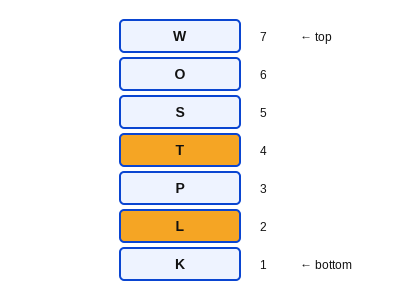
Seven boxes, K, L, O, P, S, T and W are kept one over the other but not necessarily in the same order. Only three boxes are kept below T. Only one box is kept between O and T. Only two boxes are kept between T and W. Only W is kept above O. S is kept immediately below O. L is kept at one of the places above K and at one of the places below P. How many boxes are kept between T and L?
सात बक्से, K, L, O, P, S, T और W एक के ऊपर एक रखे गए हैं, लेकिन आवश्यक नहीं कि इसी क्रम में हों। T के नीचे केवल तीन बक्से रखे हैं। O और T के बीच केवल एक बक्सा रखा है। T और W के बीच केवल दो बक्से रखे हैं। O के ऊपर केवल W रखा है। S, O के ठीक नीचे रखा है। L, K के ऊपर किसी एक स्थान पर और P के नीचे किसी एक स्थान पर रखा है। T और L के बीच कितने बक्से रखे हैं?
  1. AThreeतीन
  2. BTwoदो
  3. CFourचार
  4. DOneएक
Show answer

Concept: Number positions 1 (bottom) to 7 (top) and place the fixed boxes first.

  1. Three boxes below T ⇒ T = 4. One box between O and T ⇒ O = 2 or 6; only W above O ⇒ O = 6, W = 7 (and W is two places from T ✓).
  2. S immediately below O ⇒ S = 5.
  3. Remaining 1, 2, 3 for K, L, P with P above L above K ⇒ K = 1, L = 2, P = 3.
  4. Between T (4) and L (2) is only P.

Trick: "Only W is above O" fixes the top two boxes at once – start from such definite clues.

Answer: (D) One

अवधारणा: स्थान 1 (नीचे) से 7 (ऊपर) तक गिनें और पहले निश्चित बॉक्स रखें।

  1. T के नीचे तीन बॉक्स ⇒ T = 4। O और T के बीच एक ⇒ O = 2 या 6; O के ऊपर केवल W ⇒ O = 6, W = 7 (W, T से दो स्थान दूर ✓)।
  2. S, O के ठीक नीचे ⇒ S = 5।
  3. बचे 1, 2, 3 में K, L, P; P ऊपर, फिर L, फिर K ⇒ K = 1, L = 2, P = 3।
  4. T (4) और L (2) के बीच केवल P।

ट्रिक: "O के ऊपर केवल W" से ऊपर के दो बॉक्स तुरंत तय हो जाते हैं – ऐसे निश्चित सुरागों से शुरू करें।

उत्तर: (D) One

RRB NTPC Graduate CBT 1General Intelligence and ReasoningBox arrangement (stacking)RRB NTPC Graduate CBT 1 2025 · 24 Mar Shift 3 →
Q15300.
WXPL is related to VZMP in a certain way based on the English alphabetical order. In the same way, ZUQH is related to YWNL. To which of the following is TRKF related, following the same logic?
अंग्रेज़ी वर्णमाला क्रम के आधार पर WXPL एक निश्चित तरीके से VZMP से संबंधित है। इसी प्रकार, ZUQH, YWNL से संबंधित है। उसी तर्क का अनुसरण करते हुए, TRKF निम्नलिखित में से किससे संबंधित है?
  1. ARTFL
  2. BSTHJ
  3. CUPNB
  4. DSUGK
Show answer

Concept: Compare each letter position-wise and find the shift pattern.

  1. WXPL → VZMP: W−1=V, X+2=Z, P−3=M, L+4=P. Pattern: −1,+2,−3,+4.
  2. ZUQH → YWNL: Z−1=Y, U+2=W, Q−3=N, H+4=L ✓.
  3. TRKF: T−1=S, R+2=T, K−3=H, F+4=J → STHJ.

Trick: Alternating signs with growing size: −1,+2,−3,+4.

Answer: (B) STHJ

अवधारणा: हर अक्षर की स्थिति मिलाकर शिफ्ट पैटर्न खोजें।

  1. WXPL → VZMP: W−1=V, X+2=Z, P−3=M, L+4=P। पैटर्न: −1,+2,−3,+4।
  2. ZUQH → YWNL: Z−1=Y, U+2=W, Q−3=N, H+4=L ✓।
  3. TRKF: T−1=S, R+2=T, K−3=H, F+4=J → STHJ।

ट्रिक: बारी-बारी चिह्न और बढ़ता आकार: −1,+2,−3,+4।

उत्तर: (B) STHJ

RRB NTPC Graduate CBT 1General Intelligence and ReasoningLetter-cluster analogyRRB NTPC Graduate CBT 1 2025 · 24 Mar Shift 3 →