Question bank

Q&A: practice questions with answers

Search questions on any topic. Filter by exam category, exam, subject and topic, try the question, then open the answer and explanation.

Courses – airGurukul

20,719 questions found.

Q15361.
A computer performs millions of calculations in a fraction of a second. Which characteristic is primarily demonstrated here?
एक कंप्यूटर एक सेकंड के अंश में लाखों गणनाएँ करता है। यहाँ मुख्य रूप से कौन-सी विशेषता प्रदर्शित होती है?
  1. AVersatilityबहुमुखी प्रतिभा (Versatility)
  2. BAccuracyशुद्धता (Accuracy)
  3. CStorageभंडारण (Storage)
  4. DSpeedगति (Speed)
Show answer

Concept: Speed is the characteristic that describes how fast a computer processes instructions, measured in microseconds, nanoseconds or even picoseconds.

  1. Performing millions of calculations in a fraction of a second is a direct example of speed.
  2. Accuracy refers to error-free results, storage to holding data, and versatility to doing varied tasks; none describes "how fast".

Yaad rakhein: "Millions per second" → Speed; "no mistakes" → Accuracy; "many kinds of work" → Versatility.

Answer: (D) Speed

अवधारणा: गति (speed) वह विशेषता है जो बताती है कि कंप्यूटर निर्देशों को कितनी तेज़ी से संसाधित करता है, जिसे माइक्रोसेकंड, नैनोसेकंड या पिकोसेकंड में मापा जाता है।

  1. एक सेकंड के अंश में लाखों गणनाएँ करना गति का सीधा उदाहरण है।
  2. Accuracy त्रुटिरहित परिणाम, storage डेटा रखना और versatility विविध कार्य करना है; कोई भी "कितना तेज़" नहीं बताता।

याद रखें: "लाखों प्रति सेकंड" → Speed; "कोई गलती नहीं" → Accuracy; "कई तरह के काम" → Versatility।

उत्तर: (D) Speed
RRB NTPC Graduate CBT 1General AwarenessComputer Fundamentals – CharacteristicsRRB NTPC Graduate CBT 1 2025 · 24 Mar Shift 2 →
Q15362.
Who among the following composed the work Rajashekharacharitra, which is a Prabandha dealing with the wars and loves of Rajashekhara, King of Avanti?
निम्नलिखित में से किसने 'राजशेखरचरित्र' की रचना की, जो अवंति के राजा राजशेखर के युद्धों और प्रेम-प्रसंगों से संबंधित एक प्रबंध है?
  1. AAllasani Peddanaअल्लसानि पेद्दन
  2. BMadayagari Mallanaमादयगारि मल्लन
  3. CKrishnadevarayaकृष्णदेवराय
  4. DNachana Somanathaनाचन सोमनाथ
Show answer

Concept: The Ashtadiggajas were the eight great Telugu poets in the court of Krishnadevaraya of Vijayanagara.

  1. Madayagari Mallana, one of the Ashtadiggajas, wrote Rajashekharacharitra, a Prabandha on the wars and loves of Rajashekhara, king of Avanti.
  2. Allasani Peddana wrote Manucharitra; Krishnadevaraya himself wrote Amuktamalyada; Nachana Somanatha (earlier period) wrote Uttara Harivamsam.

Yaad rakhein: Mallana – Rajashekharacharitra; Peddana – Manucharitra; Raya – Amuktamalyada.

Answer: (B) Madayagari Mallana

अवधारणा: अष्टदिग्गज विजयनगर के कृष्णदेवराय के दरबार के आठ महान तेलुगु कवि थे।

  1. अष्टदिग्गजों में से एक मदयगरि मल्लन ने राजशेखरचरित्र लिखा, जो अवंति के राजा राजशेखर के युद्धों और प्रेम पर आधारित प्रबंध काव्य है।
  2. अल्लसानि पेद्दन ने मनुचरित्र, स्वयं कृष्णदेवराय ने अमुक्तमाल्यद, और नाचन सोमनाथ (पूर्ववर्ती काल) ने उत्तर हरिवंशम लिखा।

याद रखें: मल्लन – राजशेखरचरित्र; पेद्दन – मनुचरित्र; राय – अमुक्तमाल्यद।

उत्तर: (B) Madayagari Mallana

RRB NTPC Graduate CBT 1General AwarenessMedieval History – Vijayanagara LiteratureRRB NTPC Graduate CBT 1 2025 · 24 Mar Shift 2 →
Q15363.
The number of significant figures present in 0.00200 is ________.
0.00200 में उपस्थित सार्थक अंकों (significant figures) की संख्या ________ है।
  1. A5
  2. B4
  3. C3
  4. D6
Show answer

Concept: Leading zeros are never significant; trailing zeros after a decimal point are significant.

  1. In 0.00200 the zeros before 2 only fix the decimal place → not counted.
  2. The digits 2, 0, 0 after it are significant → 3 significant figures.
  3. In scientific notation 0.00200=2.00×10⁻³, which shows the 3 figures clearly.

Trick: Write the number in scientific notation; the digits in the mantissa are the significant figures.

Answer: (C) 3

अवधारणा: आगे के शून्य कभी सार्थक नहीं होते; दशमलव के बाद अंत के शून्य सार्थक होते हैं।

  1. 0.00200 में 2 से पहले के शून्य केवल दशमलव स्थान तय करते हैं → नहीं गिने जाते।
  2. उसके बाद के अंक 2, 0, 0 सार्थक हैं → 3 सार्थक अंक।
  3. वैज्ञानिक संकेतन में 0.00200=2.00×10⁻³, जिसमें 3 अंक स्पष्ट दिखते हैं।

ट्रिक: संख्या को वैज्ञानिक संकेतन में लिखें; मैंटिसा के अंक ही सार्थक अंक हैं।

उत्तर: (C) 3

RRB NTPC Graduate CBT 1General AwarenessPhysics – Significant FiguresRRB NTPC Graduate CBT 1 2025 · 24 Mar Shift 2 →
Q15364.
Which of the following rulers of the Gurjara-Pratihara dynasty is credited with resisting Arab invasions effectively?
गुर्जर-प्रतिहार वंश के निम्नलिखित में से किस शासक को अरब आक्रमणों का प्रभावी ढंग से प्रतिरोध करने का श्रेय दिया जाता है?
  1. ARamabhadraरामभद्र
  2. BNagabhata Iनागभट्ट प्रथम
  3. CMihira Bhojaमिहिर भोज
  4. DYasovarman Iयशोवर्मन प्रथम
Show answer

Concept: The Gurjara-Pratihara dynasty (8th–11th century) acted as a barrier against Arab expansion from Sindh into India.

  1. Nagabhata I (c. 730–760 CE), the founder, defeated the Arab forces of the Sindh governor Junaid and is praised in the Gwalior inscription as the destroyer of the mleccha army.
  2. Mihira Bhoja was the greatest ruler of the dynasty but later (836–885); Ramabhadra was a weak ruler; Yasovarman was a Kannauj king, not a Pratihara.

Yaad rakhein: Nagabhata I = Arab resistance; Mihira Bhoja = Adivaraha, Kannauj glory.

Answer: (B) Nagabhata I

अवधारणा: गुर्जर-प्रतिहार वंश (8वीं–11वीं शताब्दी) सिंध से भारत में अरब विस्तार के विरुद्ध दीवार बना।

  1. संस्थापक नागभट्ट प्रथम (लगभग 730–760 ई.) ने सिंध के गवर्नर जुनैद की अरब सेना को हराया; ग्वालियर अभिलेख में उन्हें म्लेच्छ सेना का विनाशक कहा गया है।
  2. मिहिर भोज वंश के सबसे महान शासक थे पर बाद में (836–885); रामभद्र कमज़ोर शासक थे; यशोवर्मन कन्नौज के राजा थे, प्रतिहार नहीं।

याद रखें: नागभट्ट प्रथम = अरब प्रतिरोध; मिहिर भोज = आदिवराह, कन्नौज का वैभव।

उत्तर: (B) Nagabhata I

RRB NTPC Graduate CBT 1General AwarenessEarly Medieval History – Gurjara-PratiharasRRB NTPC Graduate CBT 1 2025 · 24 Mar Shift 2 →
Q15365.
What is the purpose of Pressing ALT + F4 in Windows operating system?
Windows ऑपरेटिंग सिस्टम में ALT + F4 दबाने का उद्देश्य क्या है?
  1. ADelete selected textचयनित टेक्स्ट को हटाना
  2. BSwitch tabsटैब बदलना
  3. CClose the current window or applicationवर्तमान विंडो या एप्लिकेशन को बंद करना
  4. DOpen the Find dialogFind डायलॉग खोलना
Show answer

Concept: Alt + F4 is the Windows shortcut to close the active window or application; on the desktop it opens the Shut Down dialog.

  1. Switching tabs is Ctrl + Tab, the Find dialog is Ctrl + F, and deleting selected text is the Delete key.
  2. Ctrl + F4 closes only the current document/tab inside an application, while Alt + F4 closes the whole program.

Yaad rakhein: Alt + F4 = Application band (close); Ctrl + F4 = tab/document band.

Answer: (C) Close the current window or application

अवधारणा: Alt + F4 Windows में सक्रिय विंडो या एप्लिकेशन बंद करने का शॉर्टकट है; डेस्कटॉप पर यह Shut Down डायलॉग खोलता है।

  1. टैब बदलना Ctrl + Tab, Find डायलॉग Ctrl + F, और चयनित टेक्स्ट हटाना Delete कुंजी है।
  2. Ctrl + F4 केवल एप्लिकेशन के अंदर वर्तमान दस्तावेज़/टैब बंद करता है, जबकि Alt + F4 पूरा प्रोग्राम बंद करता है।

याद रखें: Alt + F4 = Application बंद; Ctrl + F4 = टैब/दस्तावेज़ बंद।

उत्तर: (C) Close the current window or application

RRB NTPC Graduate CBT 1General AwarenessComputer – Keyboard ShortcutsRRB NTPC Graduate CBT 1 2025 · 24 Mar Shift 2 →
Q15366.
A typist takes 40 minutes to type 2 pages. How long (in minutes) will he take to type 84 pages?
एक टाइपिस्ट 2 पृष्ठ टाइप करने में 40 मिनट लेता है। 84 पृष्ठ टाइप करने में वह कितना समय (मिनट में) लेगा?
  1. A1690
  2. B1670
  3. C1680
  4. D1685
Show answer

Concept: Time is directly proportional to the number of pages when the speed is constant.

  1. Time for 1 page =402=20 minutes.
  2. Time for 84 pages =84×20=1680 minutes.

Trick: Find the rate per unit first (20 min/page), then multiply – no need for cross-multiplication.

Answer: (C) 1680

अवधारणा: गति स्थिर हो तो समय पृष्ठों की संख्या के समानुपाती होता है।

  1. 1 पृष्ठ का समय =402=20 मिनट।
  2. 84 पृष्ठों का समय =84×20=1680 मिनट।

ट्रिक: पहले प्रति इकाई दर (20 मिनट/पृष्ठ) निकालें, फिर गुणा करें – वज्र-गुणन की ज़रूरत नहीं।

उत्तर: (C) 1680

RRB NTPC Graduate CBT 1MathematicsUnitary MethodRRB NTPC Graduate CBT 1 2025 · 24 Mar Shift 2 →
Q15367.
A quadratic polynomial f(x) gives a remainder of 5 when divided by (x - 2), and of -3 when divided by (x - 4). If f(x) is of the form ax2+ bx + c and the leading coefficient is 1, then which of the following is the correct quadratic equation f(x)=0?
एक द्विघात बहुपद f(x) को (x - 2) से विभाजित करने पर शेषफल 5 और (x - 4) से विभाजित करने पर शेषफल -3 प्राप्त होता है। यदि f(x), ax2+ bx + c के रूप का है और अग्रणी गुणांक (leading coefficient) 1 है, तो निम्नलिखित में से कौन-सा सही द्विघात समीकरण f(x)=0 है?
  1. Ax2−10x+21=0
  2. Bx2−6x+11=0
  3. Cx2−9x+20=0
  4. Dx2−8x+13=0
Show answer

Concept: By the remainder theorem, the remainder on dividing f(x) by (x−k) is f(k).

  1. Let f(x)=x2+bx+c (leading coefficient 1). Given f(2)=5 and f(4)=−3.
  2. 4+2b+c=5⇒2b+c=1; 16+4b+c=−3⇒4b+c=−19.
  3. Subtracting: 2b=−20⇒b=−10, so c=21.
  4. f(x)=x2−10x+21, i.e. x2−10x+21=0.

Trick: Faster: test the options – only option (A) gives f(2)=4−20+21=5 and f(4)=16−40+21=−3.

Answer: (A) x2−10x+21=0

अवधारणा: शेषफल प्रमेय से, f(x) को (x−k) से भाग देने पर शेषफल f(k) होता है।

  1. माना f(x)=x2+bx+c (अग्र गुणांक 1)। दिया है f(2)=5 और f(4)=−3।
  2. 4+2b+c=5⇒2b+c=1; 16+4b+c=−3⇒4b+c=−19।
  3. घटाने पर: 2b=−20⇒b=−10, अतः c=21।
  4. f(x)=x2−10x+21, अर्थात x2−10x+21=0।

ट्रिक: तेज़ तरीका: विकल्प जाँचें – केवल (A) में f(2)=4−20+21=5 और f(4)=16−40+21=−3 आता है।

उत्तर: (A) x2−10x+21=0

RRB NTPC Graduate CBT 1MathematicsRemainder TheoremRRB NTPC Graduate CBT 1 2025 · 24 Mar Shift 2 →
Q15368.
In an election between two candidates, 80% of the registered voters cast their votes and 3% of the votes polled were found invalid. Winning candidate got 52% of the valid votes and won the election by a margin of 291 votes. How many voters were registered?
दो उम्मीदवारों के बीच एक चुनाव में, पंजीकृत मतदाताओं में से 80% ने अपना मत डाला और डाले गए मतों में से 3% अवैध पाए गए। विजेता उम्मीदवार को वैध मतों का 52% प्राप्त हुआ और वह 291 मतों के अंतर से चुनाव जीता। कितने मतदाता पंजीकृत थे?
  1. A9373
  2. B9370
  3. C9378
  4. D9375
Show answer

Concept: Margin of victory = (winner% − loser%) of the valid votes.

  1. Let registered voters =N. Votes polled =80% of N=0.8N.
  2. Valid votes =97% of 0.8N=0.776N.
  3. Winner 52%, loser 48% → margin =4% of valid votes =0.04×0.776N=0.03104N.
  4. 0.03104N=291⇒N=2910.03104=9375.

Trick: Chain the percentages: N×80100×97100×4100=291; 291=3×97 cancels neatly with 97.

Answer: (D) 9375

अवधारणा: जीत का अंतर = वैध मतों का (विजेता% − पराजित%)।

  1. माना पंजीकृत मतदाता =N। डाले गए मत =N का 80%=0.8N।
  2. वैध मत =0.8N का 97%=0.776N।
  3. विजेता 52%, पराजित 48% → अंतर = वैध मतों का 4%=0.04×0.776N=0.03104N।
  4. 0.03104N=291⇒N=2910.03104=9375।

ट्रिक: प्रतिशतों को शृंखला में लिखें: N×80100×97100×4100=291; 291=3×97 से 97 सीधे कट जाता है।

उत्तर: (D) 9375

RRB NTPC Graduate CBT 1MathematicsPercentage – ElectionsRRB NTPC Graduate CBT 1 2025 · 24 Mar Shift 2 →
Q15369.
Evaluate: 16 + 20 ÷ 4 - 2 × 4
मान ज्ञात कीजिए: 16 + 20 ÷ 4 - 2 × 4
  1. A13
  2. B16
  3. C15
  4. D12
Show answer

Concept: Follow BODMAS: division and multiplication first (left to right), then addition and subtraction.

  1. 20÷4=5 and 2×4=8.
  2. 16+5−8=13.

Trick: Never add first – '16 + 20' before dividing gives a wrong answer.

Answer: (A) 13

अवधारणा: BODMAS का पालन करें: पहले भाग और गुणा (बाएँ से दाएँ), फिर जोड़ और घटाव।

  1. 20÷4=5 और 2×4=8।
  2. 16+5−8=13।

ट्रिक: पहले कभी न जोड़ें – भाग से पहले '16 + 20' करने पर गलत उत्तर आता है।

उत्तर: (A) 13

RRB NTPC Graduate CBT 1MathematicsBODMASRRB NTPC Graduate CBT 1 2025 · 24 Mar Shift 2 →
Q15370.
Which of the given ratios is the greatest?
3 : 17, 13 : 67, 10 : 37 and 5 : 9
दिए गए अनुपातों में से कौन-सा सबसे बड़ा है?
3 : 17, 13 : 67, 10 : 37 और 5 : 9
  1. A13 : 67
  2. B5 : 9
  3. C10 : 37
  4. D3 : 17
Show answer

Concept: Convert each ratio to a decimal (or compare with a benchmark such as 12).

  1. 3:17=317≈0.176; 13:67=1367≈0.194.
  2. 10:37=1037≈0.270; 5:9=59≈0.556.
  3. Greatest is 5:9.

Trick: Only 59 is more than 12 (numerator more than half the denominator) – spot it without any division.

Answer: (B) 5 : 9

अवधारणा: हर अनुपात को दशमलव में बदलें (या 12 जैसे मानक से तुलना करें)।

  1. 3:17=317≈0.176; 13:67=1367≈0.194।
  2. 10:37=1037≈0.270; 5:9=59≈0.556।
  3. सबसे बड़ा 5:9 है।

ट्रिक: केवल 59 ही 12 से बड़ा है (अंश, हर के आधे से अधिक) – बिना भाग किए पहचानें।

उत्तर: (B) 5 : 9

RRB NTPC Graduate CBT 1MathematicsComparison of RatiosRRB NTPC Graduate CBT 1 2025 · 24 Mar Shift 2 →
Q15371.
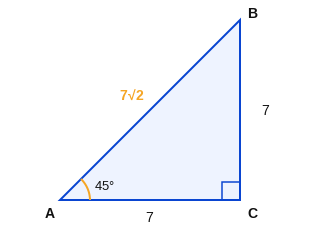
In a right-angled triangle ABC, ∠C=90°, ∠A=45°, and the length of the adjacent side to ∠A (side AC) is 7 units.
Determine the length of the side AB (the hypotenuse).
एक समकोण त्रिभुज ABC में, ∠C=90°, ∠A=45°, और ∠A की आसन्न भुजा (भुजा AC) की लंबाई 7 इकाई है।
भुजा AB (कर्ण) की लंबाई ज्ञात कीजिए।
  1. A14 units14 इकाई
  2. B7 units7 इकाई
  3. C72 units72 इकाई
  4. D142 units142 इकाई
Show answer

Concept: In a right triangle with one acute angle 45∘, the other is also 45∘, so the two legs are equal and hypotenuse =leg×2.

  1. ∠C=90∘, ∠A=45∘⇒∠B=45∘, so BC=AC=7.
  2. AB=72+72=98=72 units.
  3. Check with trigonometry: cos45∘=ACAB⇒AB=71/2=72.

Trick: 45-45-90 triangle sides are in the ratio 1:1:2; 30-60-90 are 1:3:2.

Answer: (C) 72 units

अवधारणा: समकोण त्रिभुज में एक न्यून कोण 45∘ हो तो दूसरा भी 45∘ होता है, अतः दोनों भुजाएँ बराबर और कर्ण =भुजा×2।

  1. ∠C=90∘, ∠A=45∘⇒∠B=45∘, अतः BC=AC=7।
  2. AB=72+72=98=72 इकाई।
  3. त्रिकोणमिति से जाँच: cos45∘=ACAB⇒AB=71/2=72।

ट्रिक: 45-45-90 त्रिभुज की भुजाएँ 1:1:2 में; 30-60-90 की 1:3:2 में।

उत्तर: (C) 72 इकाई

RRB NTPC Graduate CBT 1MathematicsRight Triangle – 45°-45°-90°RRB NTPC Graduate CBT 1 2025 · 24 Mar Shift 2 →
Q15372.
Three positive integers, a, b, c, satisfy: gcd (a, b) = 8, gcd (b, c) = 12, gcd (c, a) = 4 and LCM (a, b, c) = 240. Then, the minimum value of a + b + c is:
तीन धनात्मक पूर्णांक a, b, c निम्न को संतुष्ट करते हैं: gcd (a, b) = 8, gcd (b, c) = 12, gcd (c, a) = 4 और LCM (a, b, c) = 240। तब a + b + c का न्यूनतम मान है:
  1. A100
  2. B84
  3. C96
  4. D80
Show answer

Concept: Work with prime powers: 240=24×3×5. Each HCF fixes the minimum power common to two numbers.

  1. gcd(a,b)=8 and gcd(b,c)=12 → b is a multiple of 24; gcd(c,a)=4 → c=22×3×… and a has no factor 3.
  2. LCM needs 24 (in a or b) and a factor 5 (in any one). Smallest bases: a=8,b=24,c=12.
  3. Options: a=16,b=24,c=60 → 100; a=40,b=48,c=12 → 100; a=8,b=48,c=60 → 116; a=80,b=24,c=12 → 116.
  4. Check (16,24,60): gcds 8,12,4 and LCM 240 ✓. Minimum sum =100.

Trick: Put the 'expensive' extra factors (24 and 5) on different numbers and compare – 16+24+60 and 40+48+12 both give 100.

Answer: (A) 100

अवधारणा: अभाज्य घातों से काम करें: 240=24×3×5। हर HCF दो संख्याओं में न्यूनतम उभयनिष्ठ घात तय करता है।

  1. gcd(a,b)=8 और gcd(b,c)=12 → b, 24 का गुणज; gcd(c,a)=4 → c=22×3×… और a में गुणनखंड 3 नहीं।
  2. LCM के लिए 24 (a या b में) और गुणनखंड 5 (किसी एक में) चाहिए। सबसे छोटे आधार: a=8,b=24,c=12।
  3. विकल्प: a=16,b=24,c=60 → 100; a=40,b=48,c=12 → 100; a=8,b=48,c=60 → 116; a=80,b=24,c=12 → 116।
  4. जाँच (16,24,60): gcd 8,12,4 और LCM 240 ✓। न्यूनतम योग =100।

ट्रिक: 'महँगे' अतिरिक्त गुणनखंड (24 और 5) अलग-अलग संख्याओं पर रखकर तुलना करें – 16+24+60 और 40+48+12 दोनों 100 देते हैं।

उत्तर: (A) 100

RRB NTPC Graduate CBT 1MathematicsHCF and LCMRRB NTPC Graduate CBT 1 2025 · 24 Mar Shift 2 →
Q15373.
Solve the given equations for (x, y, z):
x + y + z = 2
6x − 4y + 5z = 31
5x + 2y + 2z = 13
दिए गए समीकरणों को (x, y, z) के लिए हल कीजिए:
x + y + z = 2
6x − 4y + 5z = 31
5x + 2y + 2z = 13
  1. A(3, −2, −1)
  2. B(−3, −2, 1)
  3. C(3, −2, 1)
  4. D(3, 2, 1)
Show answer

Concept: With options given, substitute the triple that satisfies all three equations; otherwise eliminate one variable at a time.

  1. Try (3,−2,1): 3−2+1=2 ✓.
  2. 6(3)−4(−2)+5(1)=18+8+5=31 ✓.
  3. 5(3)+2(−2)+2(1)=15−4+2=13 ✓ – all three satisfied.
  4. Option (A) fails the first equation (3−2−1=0), (D) fails (3+2+1=6), (B) fails (−3−2+1=−4).

Trick: The first equation x+y+z=2 alone rejects A, B and D – check the simplest equation first.

Answer: (C) (3, −2, 1)

अवधारणा: विकल्प दिए हों तो वह त्रिक रखें जो तीनों समीकरण संतुष्ट करे; अन्यथा एक-एक चर हटाएँ।

  1. (3,−2,1) रखें: 3−2+1=2 ✓।
  2. 6(3)−4(−2)+5(1)=18+8+5=31 ✓।
  3. 5(3)+2(−2)+2(1)=15−4+2=13 ✓ – तीनों संतुष्ट।
  4. विकल्प (A) पहले समीकरण में विफल (3−2−1=0), (D) विफल (3+2+1=6), (B) विफल (−3−2+1=−4)।

ट्रिक: अकेला पहला समीकरण x+y+z=2 ही A, B और D को खारिज कर देता है – सबसे सरल समीकरण पहले जाँचें।

उत्तर: (C) (3, −2, 1)

RRB NTPC Graduate CBT 1MathematicsLinear Equations in Three VariablesRRB NTPC Graduate CBT 1 2025 · 24 Mar Shift 2 →
Q15374.
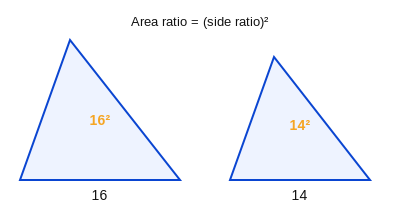
The ratio of the lengths of two corresponding sides of two similar triangles is 16 : 14. The ratio of the areas of these two triangles, in the order mentioned, is:
दो समरूप त्रिभुजों की दो संगत भुजाओं की लंबाइयों का अनुपात 16 : 14 है। इन दो त्रिभुजों के क्षेत्रफलों का अनुपात, उल्लिखित क्रम में, है:
  1. A256 : 196
  2. B1616:14
  3. C257 : 197
  4. D16 : 14
Show answer

Concept: For similar triangles, ratio of areas = square of the ratio of corresponding sides.

  1. Side ratio =16:14.
  2. Area ratio =162:142=256:196 (which simplifies to 64:49).

Trick: Sides → square for area, cube for volume; never take the same ratio for area.

Answer: (A) 256 : 196

अवधारणा: समरूप त्रिभुजों में क्षेत्रफलों का अनुपात = संगत भुजाओं के अनुपात का वर्ग।

  1. भुजा अनुपात =16:14।
  2. क्षेत्रफल अनुपात =162:142=256:196 (सरल रूप 64:49)।

ट्रिक: भुजा → क्षेत्रफल के लिए वर्ग, आयतन के लिए घन; क्षेत्रफल के लिए वही अनुपात कभी न लें।

उत्तर: (A) 256 : 196

RRB NTPC Graduate CBT 1MathematicsSimilar Triangles – Area RatioRRB NTPC Graduate CBT 1 2025 · 24 Mar Shift 2 →
Q15375.
There are 12 members in group A, 55 members in group B and 89 members in group C. All the members of these groups went to a restaurant. The average amounts spent on each member of groups A, B and C are ₹160, ₹109 and ₹181, respectively. The overall average amount (in ₹) spent per member is:
समूह A में 12 सदस्य, समूह B में 55 सदस्य और समूह C में 89 सदस्य हैं। इन समूहों के सभी सदस्य एक रेस्तरां में गए। समूह A, B और C के प्रत्येक सदस्य पर खर्च की गई औसत राशि क्रमशः ₹160, ₹109 और ₹181 है। प्रति सदस्य खर्च की गई कुल औसत राशि (₹ में) है:
  1. A157
  2. B153
  3. C151
  4. D154
Show answer

Concept: Overall average =total amounttotal members – weight each group average by its size.

  1. Totals: 12×160=1920, 55×109=5995, 89×181=16109.
  2. Sum =1920+5995+16109=24024; members =12+55+89=156.
  3. Average =24024156=154.

Trick: Never average the averages (160+109+1813=150) – group sizes differ.

Answer: (D) 154

अवधारणा: कुल औसत =कुल राशिकुल सदस्य – हर समूह के औसत को उसके आकार से भारित करें।

  1. कुल: 12×160=1920, 55×109=5995, 89×181=16109।
  2. योग =1920+5995+16109=24024; सदस्य =12+55+89=156।
  3. औसत =24024156=154।

ट्रिक: औसतों का औसत (160+109+1813=150) कभी न लें – समूहों के आकार अलग हैं।

उत्तर: (D) 154

RRB NTPC Graduate CBT 1MathematicsWeighted AverageRRB NTPC Graduate CBT 1 2025 · 24 Mar Shift 2 →
Q15376.
The selling price of 48 pieces of an item is same as the cost price of its x pieces. If the profit is 25%, then find the value of x.
किसी वस्तु के 48 नगों का विक्रय मूल्य उसके x नगों के क्रय मूल्य के समान है। यदि लाभ 25% है, तो x का मान ज्ञात कीजिए।
  1. A60
  2. B40
  3. C50
  4. D70
Show answer

Concept: If SP of m articles = CP of n articles, then Profit%=n−mm×100.

  1. Let CP of each piece = ₹1. Then SP of 48 pieces = ₹x (the CP of x pieces).
  2. Profit 25% → SP of 48 pieces =48×125100=60.
  3. So x=60.

Trick: x−4848=14⇒x−48=12⇒x=60; with profit, x>48 – reject 40 instantly.

Answer: (A) 60

अवधारणा: यदि m वस्तुओं का SP = n वस्तुओं का CP, तो लाभ%=n−mm×100।

  1. माना प्रत्येक का CP = ₹1। तब 48 वस्तुओं का SP = ₹x (x वस्तुओं का CP)।
  2. लाभ 25% → 48 वस्तुओं का SP =48×125100=60।
  3. अतः x=60।

ट्रिक: x−4848=14⇒x−48=12⇒x=60; लाभ में x>48 – 40 तुरंत खारिज।

उत्तर: (A) 60

RRB NTPC Graduate CBT 1MathematicsProfit and LossRRB NTPC Graduate CBT 1 2025 · 24 Mar Shift 2 →
Q15377.
If (x+y):(y+z):(z+x)=6:7:8 and x+y+z=14, then find the value of z.
यदि (x+y):(y+z):(z+x)=6:7:8 और x+y+z=14 है, तो z का मान ज्ञात कीजिए।
  1. A8
  2. B6
  3. C5
  4. D7
Show answer

Concept: Adding the three pair-sums gives twice the total x+y+z.

  1. Let x+y=6k,y+z=7k,z+x=8k.
  2. Adding: 2(x+y+z)=21k⇒28=21k⇒k=43.
  3. z=(x+y+z)−(x+y)=14−6k=14−8=6.

Trick: Simpler: the pair-sum that leaves out z is x+y=621×28=8, so z=14−8=6.

Answer: (B) 6

अवधारणा: तीनों युग्म-योगों को जोड़ने पर कुल x+y+z का दोगुना मिलता है।

  1. माना x+y=6k,y+z=7k,z+x=8k।
  2. जोड़ने पर: 2(x+y+z)=21k⇒28=21k⇒k=43।
  3. z=(x+y+z)−(x+y)=14−6k=14−8=6।

ट्रिक: सरल तरीका: जिस भाग में z नहीं है वह x+y=621×28=8, अतः z=14−8=6।

उत्तर: (B) 6

RRB NTPC Graduate CBT 1MathematicsRatio and ProportionRRB NTPC Graduate CBT 1 2025 · 24 Mar Shift 2 →
Q15378.
How many coins, each 5.5 cm in circumference and 2 mm thick, must be melted to form a cuboid of dimensions 14 cm × 11 cm × 8 cm? (Use π = 22/7)
5.5 cm परिधि और 2 mm मोटाई वाले कितने सिक्कों को पिघलाकर 14 cm × 11 cm × 8 cm विमाओं वाला एक घनाभ बनाया जा सकता है? (π = 22/7 का प्रयोग कीजिए)
  1. A2560
  2. B2370
  3. C2480
  4. D2240
Show answer

Concept: Number of coins =Volume of cuboidVolume of one coin (volume is conserved on melting).

  1. Circumference 2πr=5.5⇒r=5.5×72×22=78 cm; thickness h=2 mm =15 cm.
  2. Coin volume =πr2h=227×4964×15=77160 cm³.
  3. Cuboid volume =14×11×8=1232 cm³.
  4. Coins =1232÷77160=1232×16077=16×160=2560.

Trick: Convert mm to cm before anything else; 123277=16 because 77×16=1232.

Answer: (A) 2560

अवधारणा: सिक्कों की संख्या =घनाभ का आयतनएक सिक्के का आयतन (पिघलाने पर आयतन संरक्षित)।

  1. परिधि 2πr=5.5⇒r=5.5×72×22=78 cm; मोटाई h=2 mm =15 cm।
  2. सिक्के का आयतन =πr2h=227×4964×15=77160 cm³।
  3. घनाभ का आयतन =14×11×8=1232 cm³।
  4. सिक्के =1232÷77160=1232×16077=16×160=2560।

ट्रिक: सबसे पहले mm को cm में बदलें; 123277=16 क्योंकि 77×16=1232।

उत्तर: (A) 2560

RRB NTPC Graduate CBT 1MathematicsMensuration – Cylinder to CuboidRRB NTPC Graduate CBT 1 2025 · 24 Mar Shift 2 →
Q15379.
The sum of the cubes of the numbers 55, –30 and –25 is equal to:
संख्याओं 55, –30 और –25 के घनों का योग किसके बराबर है?
  1. A132570
  2. B132750
  3. C123570
  4. D123750
Show answer

Concept: If a+b+c=0, then a3+b3+c3=3abc.

  1. 55+(−30)+(−25)=0, so the identity applies.
  2. 3abc=3×55×(−30)×(−25)=3×55×750=123750.
  3. Direct check: 166375−27000−15625=123750.

Trick: Whenever three numbers add to zero, skip the cubes – just compute 3abc.

Answer: (D) 123750

अवधारणा: यदि a+b+c=0, तो a3+b3+c3=3abc।

  1. 55+(−30)+(−25)=0, अतः सर्वसमिका लागू।
  2. 3abc=3×55×(−30)×(−25)=3×55×750=123750।
  3. सीधी जाँच: 166375−27000−15625=123750।

ट्रिक: जब तीन संख्याओं का योग शून्य हो, घन निकालना छोड़ें – सीधे 3abc निकालें।

उत्तर: (D) 123750

RRB NTPC Graduate CBT 1MathematicsAlgebraic Identities – Sum of CubesRRB NTPC Graduate CBT 1 2025 · 24 Mar Shift 2 →
Q15380.
Govind gets double the amount in 7 years when invested at compound
interest,compounded annually. In how many years will the amount become eight times itself?
गोविंद को वार्षिक रूप से संयोजित चक्रवृद्धि ब्याज पर निवेश करने पर 7 वर्षों में
दोगुनी राशि प्राप्त होती है। कितने वर्षों में राशि स्वयं की आठ गुनी हो जाएगी?
  1. A28
  2. B14
  3. C21
  4. D56
Show answer

Concept: Under compound interest, if money doubles in n years, it becomes 2k times in k×n years.

  1. Doubles in 7 years: (1+r)7=2.
  2. Eight times =23=[(1+r)7]3=(1+r)21.
  3. So the time is 21 years.

Trick: CI: double in n → 4× in 2n, 8× in 3n. (In SI it would be 7×7=49 years – a different rule.)

Answer: (C) 21

अवधारणा: चक्रवृद्धि ब्याज में धन n वर्षों में दोगुना हो तो k×n वर्षों में 2k गुना होता है।

  1. 7 वर्ष में दोगुना: (1+r)7=2।
  2. आठ गुना =23=[(1+r)7]3=(1+r)21।
  3. अतः समय =21 वर्ष।

ट्रिक: CI: n में दोगुना → 2n में 4 गुना, 3n में 8 गुना। (SI में 7×7=49 वर्ष होता – नियम अलग है।)

उत्तर: (C) 21

RRB NTPC Graduate CBT 1MathematicsCompound Interest – DoublingRRB NTPC Graduate CBT 1 2025 · 24 Mar Shift 2 →