Question bank

Q&A: practice questions with answers

Search questions on any topic. Filter by exam category, exam, subject and topic, try the question, then open the answer and explanation.

Courses – airGurukul

20,719 questions found.

Q15381.
At what rate per annum will a sum of money become four times itself in 25 years under simple interest?
साधारण ब्याज पर कोई धनराशि 25 वर्षों में स्वयं की चार गुनी किस वार्षिक दर पर हो जाएगी?
  1. A10%
  2. B14%
  3. C12%
  4. D24%
Show answer

Concept: Under simple interest, if a sum becomes n times itself, the interest earned is (n−1) times the principal, so R=(n−1)×100T.

  1. Sum becomes 4 times, so SI=3P.
  2. SI=P×R×T100⇒3P=P×R×25100.
  3. R=30025=12% per annum.

Trick: "n times in T years" ⇒R=100(n−1)T. Here 100×325=12.

Answer: (C) 12%

अवधारणा: साधारण ब्याज में यदि धन n गुना हो जाए तो ब्याज मूलधन का (n−1) गुना होता है, अतः R=(n−1)×100T।

  1. धन 4 गुना हुआ, अतः SI=3P।
  2. SI=P×R×T100⇒3P=P×R×25100।
  3. R=30025=12% वार्षिक।

ट्रिक: "T वर्ष में n गुना" ⇒R=100(n−1)T। यहाँ 100×325=12।

उत्तर: (C) 12%

RRB NTPC Graduate CBT 1MathematicsSimple InterestRRB NTPC Graduate CBT 1 2025 · 24 Mar Shift 2 →
Q15382.
Three friends X, Y and Z started a business by investing a sum of money in the ratio of 9 : 4 : 8. After 6 months, X withdraws half of his capital. If the sum invested by Z is ₹23,000, then out of a total annual profit of ₹33,000, what is the difference between X's and Y's profit?
तीन मित्रों X, Y और Z ने 9 : 4 : 8 के अनुपात में धनराशि निवेश करके एक व्यापार शुरू किया। 6 महीने बाद, X अपनी पूँजी का आधा भाग निकाल लेता है। यदि Z द्वारा निवेश की गई राशि ₹23,000 है, तो ₹33,000 के कुल वार्षिक लाभ में से X और Y के लाभ के बीच का अंतर क्या है?
  1. A₹5845
  2. B₹3880
  3. C₹4840
  4. D₹4660
Show answer

Concept: Profit is shared in the ratio of (capital × time). When capital changes mid-year, add the products for each period.

  1. X: 9×6+92×6=54+27=81; Y: 4×12=48; Z: 8×12=96. Ratio 81:48:96, total 225 parts.
  2. Difference of X and Y =81−48=33 parts.
  3. 33×33000225=33×146.67= ₹4840.

Trick: Z's ₹23,000 is only a distractor; the profit split needs only the ratio. 33000225=14623, times 33 gives 4840.

Answer: (C) ₹4840

अवधारणा: लाभ (पूँजी × समय) के अनुपात में बँटता है। बीच में पूँजी बदले तो हर अवधि के गुणनफल जोड़ें।

  1. X: 9×6+92×6=54+27=81; Y: 4×12=48; Z: 8×12=96। अनुपात 81:48:96, कुल 225 भाग।
  2. X और Y का अंतर =81−48=33 भाग।
  3. 33×33000225=33×146.67= ₹4840।

ट्रिक: Z के ₹23,000 केवल भटकाने के लिए हैं; लाभ बाँटने में सिर्फ अनुपात चाहिए। 33000225=14623, इसे 33 से गुणा करने पर 4840।

उत्तर: (C) ₹4840

RRB NTPC Graduate CBT 1MathematicsPartnershipRRB NTPC Graduate CBT 1 2025 · 24 Mar Shift 2 →
Q15383.
The sum of the interior angles of a regular polygon is 1620°. What is the difference (in degrees) between the measures of an interior angle and an exterior angle of the polygon?
एक सम बहुभुज के अंतः कोणों का योग 1620° है। बहुभुज के एक अंतः कोण और एक बहिष्कोण के मापों के बीच का अंतर (डिग्री में) क्या है?
  1. A114611
  2. B182511
  3. C213211
  4. D151311
Show answer

Concept: Sum of interior angles =(n−2)×180∘; each exterior angle of a regular polygon =360∘n; interior + exterior =180∘.

  1. (n−2)×180=1620⇒n−2=9⇒n=11.
  2. Interior angle =162011, exterior angle =36011.
  3. Difference =1620−36011=126011=114611 degrees.

Trick: Difference =180∘−2×exterior=180−72011=126011.

Answer: (A) 114611

अवधारणा: अंतः कोणों का योग =(n−2)×180∘; सम बहुभुज का प्रत्येक बाह्य कोण =360∘n; अंतः + बाह्य =180∘।

  1. (n−2)×180=1620⇒n−2=9⇒n=11।
  2. अंतः कोण =162011, बाह्य कोण =36011।
  3. अंतर =1620−36011=126011=114611 डिग्री।

ट्रिक: अंतर =180∘−2×बाह्य कोण=180−72011=126011।

उत्तर: (A) 114611

RRB NTPC Graduate CBT 1MathematicsPolygons – Interior & Exterior AnglesRRB NTPC Graduate CBT 1 2025 · 24 Mar Shift 2 →
Q15384.
By selling an article at 311 of its marked price, Hitesh incurs a loss of 15%. If he sells it at 54% of its marked price, then the profit percentage is
किसी वस्तु को उसके अंकित मूल्य के 311 पर बेचने से हितेश को 15% की हानि होती है। यदि वह इसे इसके अंकित मूल्य के 54% पर बेचता है, तो लाभ प्रतिशत है
  1. A67.4%
  2. B68.3%
  3. C67.2%
  4. D69.5%
Show answer

Concept: Express MP in terms of CP from the loss condition, then compute the new SP.

  1. 311MP=0.85CP⇒MP=0.85×113CP=9.353CP.
  2. New SP =0.54×MP=0.54×9.353CP=1.683CP.
  3. Profit =68.3%.

Trick: Let MP =1100. Then 311×1100=300=0.85CP⇒CP=352.94; SP =594; profit =594−352.94352.94×100≈68.3%.

Answer: (B) 68.3%

अवधारणा: हानि की शर्त से MP को CP के रूप में लिखें, फिर नया SP निकालें।

  1. 311MP=0.85CP⇒MP=0.85×113CP=9.353CP।
  2. नया SP =0.54×MP=0.54×9.353CP=1.683CP।
  3. लाभ =68.3%।

ट्रिक: MP =1100 मानें। 311×1100=300=0.85CP⇒CP=352.94; SP =594; लाभ =594−352.94352.94×100≈68.3%।

उत्तर: (B) 68.3%

RRB NTPC Graduate CBT 1MathematicsProfit, Loss & Marked PriceRRB NTPC Graduate CBT 1 2025 · 24 Mar Shift 2 →
Q15385.
What is the mode of the data given below? [Give your answer correct to 2 decimal places.]
Age in years20-3030-4040-5050-6060-7070-8080-90
No. of patients31293328391018
नीचे दिए गए आँकड़ों का बहुलक (mode) क्या है? [अपना उत्तर 2 दशमलव स्थानों तक सही दीजिए।]
आयु (वर्षों में)20-3030-4040-5050-6060-7070-8080-90
रोगियों की संख्या31293328391018
  1. A61.75
  2. B62.75
  3. C64.75
  4. D65.75
Show answer

Concept: Mode =l+f1−f02f1−f0−f2×h, where l = lower limit of the modal class, f1 its frequency, f0, f2 the frequencies before and after, h class width.

  1. Highest frequency 39 → modal class 60–70; l=60, h=10, f1=39, f0=28, f2=10.
  2. Mode =60+39−2878−28−10×10=60+1140×10.
  3. =60+2.75=62.75.

Trick: The mode always lies inside the modal class (60–70); only options A and B qualify, and 11040=2.75 settles it.

Answer: (B) 62.75

अवधारणा: बहुलक =l+f1−f02f1−f0−f2×h, जहाँ l = बहुलक वर्ग की निचली सीमा, f1 उसकी बारंबारता, f0, f2 पहले और बाद वाले वर्गों की बारंबारता, h वर्ग-अंतराल।

  1. अधिकतम बारंबारता 39 → बहुलक वर्ग 60–70; l=60, h=10, f1=39, f0=28, f2=10।
  2. बहुलक =60+39−2878−28−10×10=60+1140×10।
  3. =60+2.75=62.75।

ट्रिक: बहुलक हमेशा बहुलक वर्ग (60–70) के अंदर होता है; केवल A और B बचते हैं, और 11040=2.75 से उत्तर तय।

उत्तर: (B) 62.75

RRB NTPC Graduate CBT 1MathematicsStatistics – Mode of Grouped DataRRB NTPC Graduate CBT 1 2025 · 24 Mar Shift 2 →
Q15386.
If x=723−7−23, then the value of x3+3x is:
यदि x=723−7−23 है, तो x3+3x का मान है:
  1. A790343
  2. B240049
  3. C250042
  4. D80049
Show answer

Concept: If x=a−b with ab=1, then x3=a3−b3−3ab(a−b)=a3−b3−3x, so x3+3x=a3−b3.

  1. Here a=72/3, b=7−2/3, and ab=70=1.
  2. a3=72=49, b3=7−2=149.
  3. x3+3x=49−149=2401−149=240049.

Trick: Whenever x=t−1t, remember x3+3x=t3−1t3 (and for x=t+1t, x3−3x=t3+1t3).

Answer: (B) 240049

अवधारणा: यदि x=a−b और ab=1, तो x3=a3−b3−3ab(a−b)=a3−b3−3x, अतः x3+3x=a3−b3।

  1. यहाँ a=72/3, b=7−2/3, और ab=70=1।
  2. a3=72=49, b3=7−2=149।
  3. x3+3x=49−149=2401−149=240049।

ट्रिक: जब x=t−1t हो, याद रखें x3+3x=t3−1t3 (और x=t+1t के लिए x3−3x=t3+1t3)।

उत्तर: (B) 240049

RRB NTPC Graduate CBT 1MathematicsAlgebra – Cubic IdentitiesRRB NTPC Graduate CBT 1 2025 · 24 Mar Shift 2 →
Q15387.
What is the maximum value that must be assigned to A so that the 8-digit number 230A7807 is divisible by 3?
A को अधिकतम कौन-सा मान दिया जाना चाहिए ताकि 8-अंकीय संख्या 230A7807, 3 से विभाज्य हो?
  1. A5
  2. B4
  3. C9
  4. D7
Show answer

Concept: A number is divisible by 3 when the sum of its digits is divisible by 3.

  1. Digit sum of 230A7807 =2+3+0+A+7+8+0+7=27+A.
  2. 27 is already a multiple of 3, so A must be a multiple of 3: A=0,3,6,9.
  3. Maximum single digit value =9.

Trick: Drop digits that already sum to a multiple of 3 (2+7, 3, 8+7) → only A remains, so A∈{0,3,6,9}.

Answer: (C) 9

अवधारणा: कोई संख्या 3 से विभाज्य होती है जब उसके अंकों का योग 3 से विभाज्य हो।

  1. 230A7807 का अंक-योग =2+3+0+A+7+8+0+7=27+A।
  2. 27 पहले से 3 का गुणज है, अतः A भी 3 का गुणज होना चाहिए: A=0,3,6,9।
  3. अधिकतम एक-अंकीय मान =9।

ट्रिक: जिन अंकों का योग पहले से 3 का गुणज है (2+7, 3, 8+7) उन्हें हटा दें → केवल A बचता है, अतः A∈{0,3,6,9}।

उत्तर: (C) 9

RRB NTPC Graduate CBT 1MathematicsDivisibility RulesRRB NTPC Graduate CBT 1 2025 · 24 Mar Shift 2 →
Q15388.
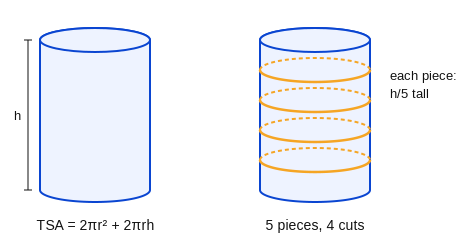
A solid cylinder is cut into 5 identical pieces by making cuts parallel to its flat surfaces. The curved surface area of all pieces is equal to the flat surface area of all pieces. If the total surface area of a piece is S square units, then the total surface area of the cylinder was ____ square units initially.
एक ठोस बेलन को उसके सपाट पृष्ठों के समांतर कटाव करके 5 समरूप टुकड़ों में काटा जाता है। सभी टुकड़ों का वक्र पृष्ठीय क्षेत्रफल, सभी टुकड़ों के सपाट पृष्ठीय क्षेत्रफल के बराबर है। यदि एक टुकड़े का कुल पृष्ठीय क्षेत्रफल S वर्ग इकाई है, तो बेलन का कुल पृष्ठीय क्षेत्रफल प्रारंभ में ____ वर्ग इकाई था।
  1. A5S
  2. B2S
  3. C4S
  4. D3S
Show answer

Concept: Cutting a cylinder parallel to its bases does not change the curved surface; it only adds new circular faces. TSA of cylinder =2πr2+2πrh.

  1. 5 pieces have 10 flat faces of area πr2 each, total 10πr2; their total curved surface is still 2πrh.
  2. Given 2πrh=10πr2, so the original TSA =2πr2+10πr2=12πr2.
  3. One piece: S=2πr2+2πrh5=2πr2+2πr2=4πr2. Hence TSA =12πr24πr2S=3S.

Trick: Per piece, flat = curved = 2πr2, so S=4πr2; original TSA =2πr2 (ends) +10πr2 (curved) =12πr2=3S.

Answer: (D) 3S

अवधारणा: बेलन को आधारों के समांतर काटने से वक्र पृष्ठ नहीं बदलता; केवल नए वृत्ताकार फलक जुड़ते हैं। बेलन का TSA =2πr2+2πrh।

  1. 5 टुकड़ों में πr2 क्षेत्रफल वाले 10 समतल फलक हैं, कुल 10πr2; कुल वक्र पृष्ठ अब भी 2πrh।
  2. दिया है 2πrh=10πr2, अतः मूल TSA =2πr2+10πr2=12πr2।
  3. एक टुकड़ा: S=2πr2+2πrh5=2πr2+2πr2=4πr2। अतः TSA =12πr24πr2S=3S।

ट्रिक: प्रति टुकड़ा समतल = वक्र = 2πr2, अतः S=4πr2; मूल TSA =2πr2 (सिरे) +10πr2 (वक्र) =12πr2=3S।

उत्तर: (D) 3S

RRB NTPC Graduate CBT 1MathematicsMensuration – CylinderRRB NTPC Graduate CBT 1 2025 · 24 Mar Shift 2 →
Q15389.
A shopkeeper fixes the marked price of an item 136% above its cost price. What percentage of discount on marked price should be allowed to gain 18%?
एक दुकानदार किसी वस्तु का अंकित मूल्य उसके क्रय मूल्य से 136% अधिक निर्धारित करता है। 18% लाभ प्राप्त करने के लिए अंकित मूल्य पर कितने प्रतिशत छूट दी जानी चाहिए?
  1. A47%
  2. B51%
  3. C48%
  4. D50%
Show answer

Concept: Take CP =100; then MP and the required SP are easy to compare.

  1. CP =100, MP =100+136=236.
  2. Required SP for 18% gain =118.
  3. Discount =236−118=118; discount% =118236×100=50%.

Trick: 236=2×118, so the SP is exactly half of MP → 50% discount.

Answer: (D) 50%

अवधारणा: CP =100 मानें; फिर MP और वांछित SP की तुलना आसान है।

  1. CP =100, MP =100+136=236।
  2. 18% लाभ के लिए SP =118।
  3. छूट =236−118=118; छूट% =118236×100=50%।

ट्रिक: 236=2×118, अतः SP ठीक MP का आधा है → 50% छूट।

उत्तर: (D) 50%

RRB NTPC Graduate CBT 1MathematicsDiscount & Marked PriceRRB NTPC Graduate CBT 1 2025 · 24 Mar Shift 2 →
Q15390.
What should come in place of ‘?’ in the given series?
73 71 68 63 56 ?
दी गई श्रेणी में '?' के स्थान पर क्या आना चाहिए?
73 71 68 63 56 ?
  1. A45
  2. B44
  3. C46
  4. D43
Show answer

Concept: Look at the differences between consecutive terms.

  1. 73−71=2, 71−68=3, 68−63=5, 63−56=7: the differences are consecutive primes.
  2. Next prime is 11, so ?=56−11=45.

Trick: Differences 2, 3, 5, 7, 11, 13 … (primes) is a very common NTPC pattern.

Answer: (A) 45

अवधारणा: क्रमागत पदों के अंतर देखें।

  1. 73−71=2, 71−68=3, 68−63=5, 63−56=7: अंतर क्रमागत अभाज्य संख्याएँ हैं।
  2. अगली अभाज्य 11, अतः ?=56−11=45।

ट्रिक: अंतर 2, 3, 5, 7, 11, 13 … (अभाज्य) NTPC का बहुत आम पैटर्न है।

उत्तर: (A) 45

RRB NTPC Graduate CBT 1MathematicsNumber SeriesRRB NTPC Graduate CBT 1 2025 · 24 Mar Shift 2 →
Q15391.
What should come in place of ‘?’ in the given series?
122 120 117 112 105 ?
दी गई श्रेणी में '?' के स्थान पर क्या आना चाहिए?
122 120 117 112 105 ?
  1. A93
  2. B94
  3. C95
  4. D92
Show answer

Concept: Find the pattern in the differences.

  1. 122−120=2, 120−117=3, 117−112=5, 112−105=7: consecutive primes.
  2. Next difference =11, so ?=105−11=94.

Trick: Same prime-difference pattern as the series 73, 71, 68, 63, 56 → 45.

Answer: (B) 94

अवधारणा: अंतरों में पैटर्न खोजें।

  1. 122−120=2, 120−117=3, 117−112=5, 112−105=7: क्रमागत अभाज्य।
  2. अगला अंतर =11, अतः ?=105−11=94।

ट्रिक: वही अभाज्य-अंतर पैटर्न जैसा 73, 71, 68, 63, 56 → 45 में था।

उत्तर: (B) 94

RRB NTPC Graduate CBT 1MathematicsNumber SeriesRRB NTPC Graduate CBT 1 2025 · 24 Mar Shift 2 →
Q15392.
The ratio of the angles of a triangle is 2:3:4. What percentage of the total angle measure is the largest angle? (Round to the nearest integer)
एक त्रिभुज के कोणों का अनुपात 2:3:4 है। सबसे बड़ा कोण कुल कोण माप का कितना प्रतिशत है? (निकटतम पूर्णांक तक पूर्णांकित कीजिए)
  1. A44%
  2. B40%
  3. C42%
  4. D46%
Show answer

Concept: The angles of a triangle add to 180∘; a ratio share as a percentage of the total is partsum of parts×100.

  1. Ratio 2:3:4, sum of parts =9; largest angle =49×180=80∘.
  2. Percentage =80180×100=49×100=44.44%≈44%.

Trick: You don't even need 180∘: the largest share is 49 of the total =44.4%.

Answer: (A) 44%

अवधारणा: त्रिभुज के कोणों का योग 180∘ होता है; कुल का प्रतिशत =भागभागों का योग×100।

  1. अनुपात 2:3:4, भागों का योग =9; सबसे बड़ा कोण =49×180=80∘।
  2. प्रतिशत =80180×100=49×100=44.44%≈44%।

ट्रिक: 180∘ की ज़रूरत ही नहीं: सबसे बड़ा हिस्सा कुल का 49=44.4% है।

उत्तर: (A) 44%

RRB NTPC Graduate CBT 1MathematicsTriangles – Angle Sum & PercentageRRB NTPC Graduate CBT 1 2025 · 24 Mar Shift 2 →
Q15393.
Two taps can fill a cistern in 4 hours and 30 hours respectively. A third tap can empty it in 30 hours. How long (in hours) will it take to fill one-fourth of the empty cistern, if all of them are opened together?
दो नल एक टंकी को क्रमशः 4 घंटे और 30 घंटे में भर सकते हैं। एक तीसरा नल इसे 30 घंटे में खाली कर सकता है। यदि सभी को एक साथ खोल दिया जाए, तो खाली टंकी का एक-चौथाई भाग भरने में कितना समय (घंटों में) लगेगा?
  1. A3
  2. B1
  3. C2
  4. D4
Show answer

Concept: Add the per-hour work of filling taps and subtract that of the emptying tap.

  1. Net part filled per hour =14+130−130=14.
  2. Full cistern takes 4 hours, so one-fourth takes 4×14=1 hour.

Trick: The 30-hour filler and 30-hour emptier cancel exactly; only the 4-hour tap matters.

Answer: (B) 1

अवधारणा: भरने वाले नलों का प्रति घंटा कार्य जोड़ें और खाली करने वाले का घटाएँ।

  1. प्रति घंटा शुद्ध भराव =14+130−130=14।
  2. पूरी टंकी 4 घंटे में, अतः एक-चौथाई 4×14=1 घंटे में।

ट्रिक: 30 घंटे वाला भरने वाला और 30 घंटे वाला खाली करने वाला नल एक-दूसरे को काट देते हैं; केवल 4 घंटे वाला नल मायने रखता है।

उत्तर: (B) 1

RRB NTPC Graduate CBT 1MathematicsPipes & CisternsRRB NTPC Graduate CBT 1 2025 · 24 Mar Shift 2 →
Q15394.
The marks obtained by a student in five subjects are: 72, 68, 74, 70, and 76. What is the average marks of the student per subject?
एक छात्र द्वारा पाँच विषयों में प्राप्त अंक हैं: 72, 68, 74, 70 और 76। छात्र के प्रति विषय औसत अंक क्या हैं?
  1. A74
  2. B70
  3. C75
  4. D72
Show answer

Concept: Average =sum of observationsnumber of observations.

  1. Sum =72+68+74+70+76=360.
  2. Average =3605=72.

Trick: Take 72 as base: deviations 0,−4,+2,−2,+4 add to 0, so the average is exactly 72.

Answer: (D) 72

अवधारणा: औसत =प्रेक्षणों का योगप्रेक्षणों की संख्या।

  1. योग =72+68+74+70+76=360।
  2. औसत =3605=72।

ट्रिक: 72 को आधार मानें: विचलन 0,−4,+2,−2,+4 का योग 0 है, अतः औसत ठीक 72।

उत्तर: (D) 72

RRB NTPC Graduate CBT 1MathematicsAverageRRB NTPC Graduate CBT 1 2025 · 24 Mar Shift 2 →
Q15395.
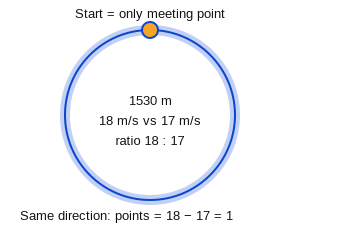
In a circular race of length 1530 m, Shahrukh and Amir start simultaneously from the same point and run in the same direction. Shahrukh completes one round in 85 seconds, while Amir completes one round in 90 seconds. How many different meeting points are there on the circumference of the track?
1530 m लंबाई की एक वृत्ताकार दौड़ में, शाहरुख और आमिर एक ही बिंदु से एक साथ शुरू करते हैं और एक ही दिशा में दौड़ते हैं। शाहरुख एक चक्कर 85 सेकंड में पूरा करता है, जबकि आमिर एक चक्कर 90 सेकंड में पूरा करता है। ट्रैक की परिधि पर कितने भिन्न मिलन बिंदु हैं?
  1. A1
  2. B35
  3. C11
  4. D2
Show answer

Concept: If two runners run in the same direction with speeds in the simplest ratio a:b, the number of distinct meeting points on the track is |a−b| (for opposite directions it is a+b).

  1. Speeds: Shahrukh =153085=18m/s, Amir =153090=17m/s.
  2. Ratio 18:17 is already in lowest terms.
  3. Same direction → meeting points =18−17=1 (only at the starting point).

Trick: Ratio of speeds = inverse ratio of lap times =90:85=18:17; difference 1 → one meeting point.

Answer: (A) 1

अवधारणा: यदि दो धावक एक ही दिशा में दौड़ें और उनकी चालों का सरलतम अनुपात a:b हो, तो ट्रैक पर अलग-अलग मिलन बिंदुओं की संख्या |a−b| होती है (विपरीत दिशा में a+b)।

  1. चाल: Shahrukh =153085=18m/s, Amir =153090=17m/s।
  2. अनुपात 18:17 पहले से सरलतम रूप में है।
  3. एक ही दिशा → मिलन बिंदु =18−17=1 (केवल प्रारंभ बिंदु पर)।

ट्रिक: चालों का अनुपात = चक्कर-समय का व्युत्क्रम अनुपात =90:85=18:17; अंतर 1 → एक मिलन बिंदु।

उत्तर: (A) 1

RRB NTPC Graduate CBT 1MathematicsCircular Races – Meeting PointsRRB NTPC Graduate CBT 1 2025 · 24 Mar Shift 2 →
Q15396.
The following table shows the heights of plants (in cm) and the corresponding number of plants. Find the mode of the data.
Height (in cm)142723211917
Number of Plants1361275
निम्न तालिका पौधों की ऊँचाई (cm में) और पौधों की संगत संख्या दर्शाती है। आँकड़ों का बहुलक (mode) ज्ञात कीजिए।
ऊँचाई (cm में)142723211917
पौधों की संख्या1361275
  1. A21 cm
  2. B27 cm
  3. C24 cm
  4. D23 cm
Show answer

Concept: For ungrouped frequency data, the mode is the observation with the highest frequency.

  1. Number of plants: 14 cm → 1, 27 cm → 3, 23 cm → 6, 21 cm → 12, 19 cm → 7, 17 cm → 5.
  2. Highest frequency is 12, for height 21 cm.

Trick: Mode = "most repeated"; do not average or pick the largest height (27 cm is a distractor).

Answer: (A) 21 cm

अवधारणा: अवर्गीकृत बारंबारता आँकड़ों में बहुलक वह प्रेक्षण है जिसकी बारंबारता सबसे अधिक हो।

  1. पौधों की संख्या: 14 cm → 1, 27 cm → 3, 23 cm → 6, 21 cm → 12, 19 cm → 7, 17 cm → 5।
  2. सबसे अधिक बारंबारता 12 है, ऊँचाई 21 cm के लिए।

ट्रिक: बहुलक = "सबसे अधिक बार"; औसत न निकालें और न ही सबसे बड़ी ऊँचाई चुनें (27 cm भटकाने के लिए है)।

उत्तर: (A) 21 cm

RRB NTPC Graduate CBT 1MathematicsStatistics – ModeRRB NTPC Graduate CBT 1 2025 · 24 Mar Shift 2 →
Q15397.
Ansh walks to his school at a certain speed from his home in the morning and returns in the afternoon at a speed, which is 2 km/h slower than his speed in the morning. If the average speed of Ansh of going to and coming back from the school is 4.8 km/h, find the sum of the speeds (in km/h) of Ansh in the morning and afternoon.
अंश सुबह अपने घर से एक निश्चित चाल से अपने विद्यालय जाता है और दोपहर में ऐसी चाल से वापस आता है, जो उसकी सुबह की चाल से 2 km/h कम है। यदि विद्यालय जाने और वापस आने में अंश की औसत चाल 4.8 km/h है, तो सुबह और दोपहर में अंश की चालों का योग (km/h में) ज्ञात कीजिए।
  1. A9
  2. B10
  3. C8
  4. D11
Show answer

Concept: For equal distances at speeds a and b, average speed =2aba+b.

  1. Let morning speed =v, afternoon =v−2. Then 2v(v−2)2v−2=4.8⇒v(v−2)v−1=4.8.
  2. v2−2v=4.8v−4.8⇒v2−6.8v+4.8=0⇒(v−6)(v−0.8)=0.
  3. v=6 (since v>2); speeds 6 and 4 km/h, sum =10 km/h.

Trick: Test options: sum 10 → speeds 6 and 4 → 2×6×410=4.8 ✓ in one line.

Answer: (B) 10

अवधारणा: समान दूरी के लिए चाल a और b हों तो औसत चाल =2aba+b।

  1. सुबह की चाल =v, दोपहर =v−2। तो 2v(v−2)2v−2=4.8⇒v(v−2)v−1=4.8।
  2. v2−2v=4.8v−4.8⇒v2−6.8v+4.8=0⇒(v−6)(v−0.8)=0।
  3. v=6 (क्योंकि v>2); चालें 6 और 4 km/h, योग =10 km/h।

ट्रिक: विकल्प जाँचें: योग 10 → चालें 6 और 4 → 2×6×410=4.8 ✓ एक पंक्ति में।

उत्तर: (B) 10

RRB NTPC Graduate CBT 1MathematicsAverage SpeedRRB NTPC Graduate CBT 1 2025 · 24 Mar Shift 2 →
Q15398.
In a certain code language, ‘COOK’ is coded as ‘8245’ and ‘HOOK’ is coded as ‘5429’. What is the code for ‘H’ in that language?
एक निश्चित कूट भाषा में, 'COOK' को '8245' के रूप में कूटबद्ध किया जाता है और 'HOOK' को '5429' के रूप में कूटबद्ध किया जाता है। उस भाषा में 'H' का कूट क्या है?
  1. A8
  2. B9
  3. C4
  4. D5
Show answer

Concept: Compare two coded words: common letters get the common digits; the leftover letter gets the leftover digit.

  1. COOK → 8245 and HOOK → 5429 share the letters O, O, K.
  2. Common digits of 8245 and 5429 are 2, 4, 5 → these belong to O, O, K.
  3. Leftover: C → 8 (from COOK) and H → 9 (from HOOK).

Trick: In such codes the digits are usually jumbled, so match by elimination, not by position.

Answer: (B) 9

अवधारणा: दो कूट शब्दों की तुलना करें: समान अक्षरों को समान अंक मिलते हैं; बचे अक्षर को बचा अंक।

  1. COOK → 8245 और HOOK → 5429 में O, O, K अक्षर समान हैं।
  2. 8245 और 5429 में समान अंक 2, 4, 5 हैं → ये O, O, K के हैं।
  3. शेष: C → 8 (COOK से) और H → 9 (HOOK से)।

ट्रिक: ऐसे कूट में अंक प्रायः उलट-पुलट होते हैं, इसलिए स्थिति से नहीं, निराकरण (elimination) से मिलान करें।

उत्तर: (B) 9

RRB NTPC Graduate CBT 1General Intelligence and ReasoningCoding-DecodingRRB NTPC Graduate CBT 1 2025 · 24 Mar Shift 2 →
Q15399.
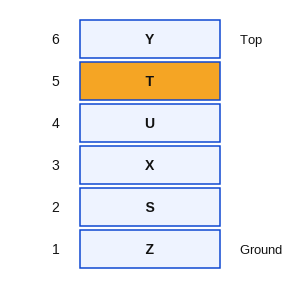
X, Y, Z, S, T and U live on six different floors of the same building. The lowermost floor in the building is numbered 1, the floor above it is numbered 2, and so on till the topmost floor is numbered 6. U lives on floor number 4. Only two people live between U and Z. Only T lives between U and Y. X lives immediately below U. Who lives on floor number 5?
X, Y, Z, S, T और U एक ही भवन की छह अलग-अलग मंज़िलों पर रहते हैं। भवन की सबसे निचली मंज़िल की संख्या 1 है, उसके ऊपर की मंज़िल की संख्या 2 है, और इसी प्रकार सबसे ऊपरी मंज़िल तक, जिसकी संख्या 6 है। U मंज़िल संख्या 4 पर रहता है। U और Z के बीच केवल दो व्यक्ति रहते हैं। U और Y के बीच केवल T रहता है। X, U के ठीक नीचे रहता है। मंज़िल संख्या 5 पर कौन रहता है?
  1. AS
  2. BY
  3. CX
  4. DT
Show answer

Concept: Fix the given floor first, then place people using the 'between' and 'immediately' clues.

  1. U = floor 4. Two people between U and Z → Z = 1 (floor 7 does not exist).
  2. X lives immediately below U → X = 3.
  3. Only T between U and Y → T = 5, Y = 6 (T = 3 is taken by X). Remaining S = 2.
  4. Floor 5 is occupied by T.

Trick: Always begin with the definite clue (U = 4); 'immediately below' kills the other branch at once.

Answer: (D) T

अवधारणा: पहले दी गई मंज़िल तय करें, फिर 'बीच में' और 'ठीक नीचे' वाले संकेतों से लोगों को रखें।

  1. U = मंज़िल 4। U और Z के बीच दो लोग → Z = 1 (मंज़िल 7 नहीं है)।
  2. X, U के ठीक नीचे रहता है → X = 3।
  3. U और Y के बीच केवल T → T = 5, Y = 6 (T = 3 पर X है)। शेष S = 2।
  4. मंज़िल 5 पर T रहता है।

ट्रिक: हमेशा निश्चित संकेत (U = 4) से शुरू करें; 'ठीक नीचे' दूसरी शाखा को तुरंत खत्म कर देता है।

उत्तर: (D) T

RRB NTPC Graduate CBT 1General Intelligence and ReasoningFloor PuzzleRRB NTPC Graduate CBT 1 2025 · 24 Mar Shift 2 →
Q15400.
Based on the English alphabetical order, three of the following four letter-cluster pairs are alike in a certain way and thus form a group. Which letter-cluster pair DOES NOT belong to that group?
(Note: The odd one out is not based on the number of consonants/vowels or their position in the letter-cluster.)
अंग्रेज़ी वर्णमाला क्रम के आधार पर, निम्नलिखित चार अक्षर-समूह युग्मों में से तीन एक निश्चित प्रकार से समान हैं और इस प्रकार एक समूह बनाते हैं। कौन-सा अक्षर-समूह युग्म उस समूह से संबंधित नहीं है?
(नोट: विषम वाला व्यंजनों/स्वरों की संख्या या अक्षर-समूह में उनकी स्थिति पर आधारित नहीं है।)
  1. ARQ−PO
  2. BZY−XW
  3. CYX−WV
  4. DLK−IK
Show answer

Concept: Write the alphabet positions and look at the pattern inside each pair.

  1. RQ−PO: R(18) Q(17) P(16) O(15) – four consecutive letters in reverse order.
  2. ZY−XW: 26, 25, 24, 23 and YX−WV: 25, 24, 23, 22 – also four consecutive letters backwards.
  3. LK−IK: L(12) K(11) I(9) K(11) – the chain breaks (gap of 2, then K repeats).

Trick: Three options following 'consecutive descending' leave the odd one out immediately – look for the repeated letter.

Answer: (D) LK−IK

अवधारणा: अक्षरों के स्थान लिखें और हर जोड़े के भीतर पैटर्न देखें।

  1. RQ−PO: R(18) Q(17) P(16) O(15) – उल्टे क्रम में चार क्रमागत अक्षर।
  2. ZY−XW: 26, 25, 24, 23 और YX−WV: 25, 24, 23, 22 – ये भी उल्टे क्रम में चार क्रमागत अक्षर।
  3. LK−IK: L(12) K(11) I(9) K(11) – शृंखला टूटती है (2 का अंतर, फिर K दोहराया)।

ट्रिक: तीन विकल्प 'क्रमागत अवरोही' हैं, इससे विषम तुरंत दिखता है – दोहराया हुआ अक्षर पहचानें।

उत्तर: (D) LK−IK

RRB NTPC Graduate CBT 1General Intelligence and ReasoningLetter Cluster ClassificationRRB NTPC Graduate CBT 1 2025 · 24 Mar Shift 2 →