Question bank

Q&A: practice questions with answers

Search questions on any topic. Filter by exam category, exam, subject and topic, try the question, then open the answer and explanation.

Courses – airGurukul

20,719 questions found.

Q15521.
In a certain code language,
A + B means ‘A is the wife of B’
A - B means ‘A is the mother of B’
A × B means ‘A is the father of B’
A ÷ B means ‘A is the husband of B’
Based on the above, how is Y related to S if ‘Y + N × K ÷ T - S’?
एक निश्चित कूट भाषा में,
A + B का अर्थ है ‘A, B की पत्नी है’
A - B का अर्थ है ‘A, B की माता है’
A × B का अर्थ है ‘A, B का पिता है’
A ÷ B का अर्थ है ‘A, B का पति है’
उपर्युक्त के आधार पर, यदि ‘Y + N × K ÷ T - S’ है, तो Y, S से किस प्रकार संबंधित है?
  1. AFather’s sisterपिता की बहन
  2. BMotherमाता
  3. CFather’s motherपिता की माता
  4. DSisterबहन
Show answer

Concept: Decode the chain symbol by symbol and draw a family tree, marking gender from the relation words (wife/mother = female, father/husband = male).
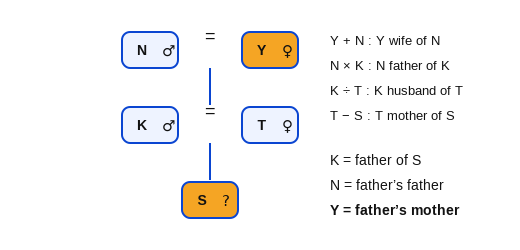
  1. Y + N: Y is the wife of N. N × K: N is the father of K.
  2. K ÷ T: K is the husband of T. T − S: T is the mother of S → K is the father of S.
  3. N is the father of S's father; Y, N's wife, is the mother of S's father.
  4. So Y is S's father's mother (paternal grandmother).

Trick: Start from the person asked about (S) and climb up: S → father K → father's father N → his wife Y.

Answer: (C) Father's mother

अवधारणा: श्रृंखला को प्रतीक-दर-प्रतीक डिकोड करके वंश-वृक्ष बनाइए; संबंध शब्दों से लिंग चिह्नित कीजिए (wife/mother = स्त्री, father/husband = पुरुष)।

  1. Y + N: Y, N की पत्नी। N × K: N, K का पिता।
  2. K ÷ T: K, T का पति। T − S: T, S की माँ → K, S का पिता।
  3. N, S के पिता का पिता; N की पत्नी Y, S के पिता की माँ।
  4. अतः Y, S के पिता की माँ (दादी) है।

ट्रिक: जिसके बारे में पूछा है (S) उससे ऊपर चढ़ें: S → पिता K → पिता का पिता N → उसकी पत्नी Y।

उत्तर: (C) Father's mother
RRB NTPC Graduate CBT 1General Intelligence and ReasoningBlood relations (coded)RRB NTPC Graduate CBT 1 2025 · 24 Mar Shift 1 →
Q15522.
HM 14 is related to EJ 16 in a certain way. In the same way, RW 22 is related to OT 24. To which of the following is SX 27 related, following the same logic?
HM 14, EJ 16 से एक निश्चित प्रकार से संबंधित है। उसी प्रकार, RW 22, OT 24 से संबंधित है। उसी तर्क के आधार पर, SX 27 निम्नलिखित में से किससे संबंधित है?
  1. APU 29
  2. BQU 28
  3. CPV 29
  4. DQV 29
Show answer

Concept: Treat the letters and the number separately: find the shift applied to each letter and the change in the number.

  1. HM 14 → EJ 16: H −3= E, M −3= J, 14+2=16.
  2. RW 22 → OT 24: R −3= O, W −3= T, 22+2=24 ✓ same rule.
  3. SX 27 → S −3= P, X −3= U, 27+2=29 → PU 29.

Trick: Use letter positions: S =19→16= P, X =24→21= U. Write A–Z with numbers at the top of your rough sheet.

Answer: (A) PU 29

अवधारणा: अक्षरों और संख्या को अलग-अलग देखिए: हर अक्षर पर लगा शिफ्ट और संख्या में परिवर्तन खोजिए।

  1. HM 14 → EJ 16: H −3= E, M −3= J, 14+2=16।
  2. RW 22 → OT 24: R −3= O, W −3= T, 22+2=24 ✓ वही नियम।
  3. SX 27 → S −3= P, X −3= U, 27+2=29 → PU 29।

ट्रिक: अक्षर स्थान प्रयोग करें: S =19→16= P, X =24→21= U। रफ शीट के ऊपर A–Z संख्याओं सहित लिख लें।

उत्तर: (A) PU 29

RRB NTPC Graduate CBT 1General Intelligence and ReasoningLetter–number analogyRRB NTPC Graduate CBT 1 2025 · 24 Mar Shift 1 →
Q15523.
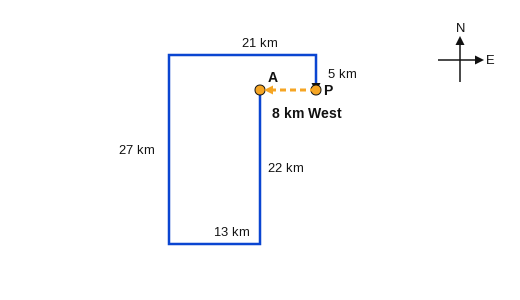
Lagan starts from Point A and drives 22 km towards South. He then takes a right turn, drives 13 km, turns right and drives 27 km. He then takes a right turn and drives 21 km. He takes a final right turn, drives 5 km and stops at Point P. How far (shortest distance) and towards which direction should he drive in order to reach Point A again? (All turns are 90 degrees turns only unless specified)
लगन बिंदु A से चलना प्रारंभ करता है और दक्षिण की ओर 22 km गाड़ी चलाता है। फिर वह दाएँ मुड़ता है, 13 km गाड़ी चलाता है, दाएँ मुड़ता है और 27 km गाड़ी चलाता है। फिर वह दाएँ मुड़ता है और 21 km गाड़ी चलाता है। वह अंतिम बार दाएँ मुड़ता है, 5 km गाड़ी चलाता है और बिंदु P पर रुक जाता है। बिंदु A पर पुनः पहुँचने के लिए उसे कितनी दूर (न्यूनतम दूरी) और किस दिशा में गाड़ी चलानी चाहिए? (जब तक अन्यथा निर्दिष्ट न हो, सभी मोड़ केवल 90 डिग्री के मोड़ हैं)
  1. A8 km to the east8 km पूर्व की ओर
  2. B8 km to the west8 km पश्चिम की ओर
  3. C7 km to the west7 km पश्चिम की ओर
  4. D7 km to the east7 km पूर्व की ओर
Show answer

Concept: Track the heading after each right turn (S → W → N → E → S) and add up the net north–south and east–west displacements.

  1. 22 km South; right turn → 13 km West; right → 27 km North; right → 21 km East; right → 5 km South.
  2. North–south: 22−27+5=0 → P is level with A.
  3. East–west: 21−13=8 km East → P is 8 km east of A.
  4. To return to A he must drive 8 km towards the West.

Trick: Facing South, "right" is West. Write the compass once and rotate it mentally with each turn.

Answer: (B) 8 km to the west

अवधारणा: हर दाएँ मोड़ के बाद दिशा (S → W → N → E → S) ट्रैक कीजिए और उत्तर–दक्षिण व पूर्व–पश्चिम के शुद्ध विस्थापन जोड़िए।

  1. 22 km दक्षिण; दाएँ → 13 km पश्चिम; दाएँ → 27 km उत्तर; दाएँ → 21 km पूर्व; दाएँ → 5 km दक्षिण।
  2. उत्तर–दक्षिण: 22−27+5=0 → P, A की सीध में।
  3. पूर्व–पश्चिम: 21−13=8 km पूर्व → P, A से 8 km पूर्व में।
  4. A पर लौटने के लिए उसे 8 km पश्चिम की ओर चलना होगा।

ट्रिक: दक्षिण की ओर मुख हो तो "दाएँ" = पश्चिम। कम्पास एक बार बनाकर हर मोड़ पर मन में घुमाइए।

उत्तर: (B) 8 km to the west

RRB NTPC Graduate CBT 1General Intelligence and ReasoningDirection and distanceRRB NTPC Graduate CBT 1 2025 · 24 Mar Shift 1 →
Q15524.
23 is related to 139 following a certain logic. Following the same logic, 28 is related to 169. To which of the following is 25 related, following the same logic?
(NOTE: Operations should be performed on the whole numbers, without breaking down the numbers into its constituent digits. E.g., 13 – Operations on 13 such as
adding/subtracting/multiplying etc. to 13 can be performed. Breaking down 13 into 1 and 3 and then performing mathematical operations on 1 and 3 is not allowed.)
एक निश्चित तर्क के आधार पर 23, 139 से संबंधित है। उसी तर्क के आधार पर, 28, 169 से संबंधित है। उसी तर्क के आधार पर, 25 निम्नलिखित में से किससे संबंधित है?
(नोट: संक्रियाएँ पूर्ण संख्याओं पर की जानी चाहिए, संख्याओं को उनके घटक अंकों में तोड़े बिना। उदाहरण के लिए, 13 – 13 पर संक्रियाएँ, जैसे
13 में जोड़ना/घटाना/गुणा करना आदि, की जा सकती हैं। 13 को 1 और 3 में तोड़कर फिर 1 और 3 पर गणितीय संक्रियाएँ करना अनुमत नहीं है।)
  1. A151
  2. B146
  3. C155
  4. D141
Show answer

Concept: Find a "multiply then add" rule that fits both pairs; verify before applying.

  1. 23→139: 23×6=138, 138+1=139 ✓.
  2. 28→169: 28×6=168, 168+1=169 ✓.
  3. 25→25×6+1=151.

Trick: Output difference 169−139=30 for input difference 5 → multiplier 6. The constant is then 139−138=1.

Answer: (A) 151

अवधारणा: "गुणा फिर जोड़" वाला नियम खोजिए जो दोनों युग्मों पर खरा उतरे; लगाने से पहले जाँचिए।

  1. 23→139: 23×6=138, 138+1=139 ✓।
  2. 28→169: 28×6=168, 168+1=169 ✓।
  3. 25→25×6+1=151।

ट्रिक: आउटपुट अंतर 169−139=30, इनपुट अंतर 5 → गुणक 6। स्थिरांक 139−138=1।

उत्तर: (A) 151

RRB NTPC Graduate CBT 1General Intelligence and ReasoningNumber analogyRRB NTPC Graduate CBT 1 2025 · 24 Mar Shift 1 →
Q15525.
In this question, a question is followed by two statements numbered (I) and (II). You have to decide whether the data provided in the statements are sufficient to answer the question. Read both the statements and decide the appropriate answer.
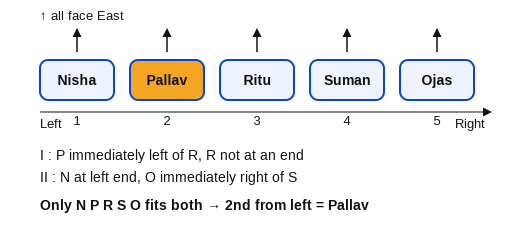
Q. Five people – Nisha, Ojas, Pallav, Ritu, and Suman – are standing in a straight line facing east.
Who is standing second from the left end?
(I) Pallav is standing immediately to the left of Ritu, and Ritu is not standing at either ends.
(II) Nisha is standing at the extreme left end, and Ojas is standing immediately to the right of Suman.
इस प्रश्न में, एक प्रश्न के बाद (I) और (II) संख्या वाले दो कथन दिए गए हैं। आपको यह निर्धारित करना है कि कथनों में दिए गए डेटा प्रश्न का उत्तर देने के लिए पर्याप्त हैं या नहीं। दोनों कथनों को पढ़िए और उपयुक्त उत्तर का निर्धारण कीजिए।
प्रश्न. पाँच व्यक्ति – निशा, ओजस, पल्लव, रितु और सुमन – पूर्व की ओर मुख करके एक सीधी पंक्ति में खड़े हैं।
बाएँ छोर से दूसरे स्थान पर कौन खड़ा है?
(I) पल्लव, रितु के ठीक बाईं ओर खड़ा है, और रितु किसी भी छोर पर खड़ी नहीं है।
(II) निशा सबसे बाएँ छोर पर खड़ी है, और ओजस, सुमन के ठीक दाईं ओर खड़ा है।
  1. ABoth statements I and II together are NOT sufficient to answer the questionकथन I और II दोनों मिलकर भी प्रश्न का उत्तर देने के लिए पर्याप्त नहीं हैं
  2. BData in Statement II alone is sufficient to answer the question while data in Statement I is notकथन II के डेटा अकेले प्रश्न का उत्तर देने के लिए पर्याप्त हैं, जबकि कथन I के डेटा पर्याप्त नहीं हैं
  3. CBoth statements I and II together (and not statement I alone or statement II alone) are sufficient to answer the questionकथन I और II दोनों मिलकर (न कि अकेले कथन I या अकेले कथन II) प्रश्न का उत्तर देने के लिए पर्याप्त हैं
  4. DData in Statement I alone is sufficient to answer the question while data in Statement II is notकथन I के डेटा अकेले प्रश्न का उत्तर देने के लिए पर्याप्त हैं, जबकि कथन II के डेटा पर्याप्त नहीं हैं
Show answer

Concept: Test each statement alone; if neither fixes the answer, combine them and see whether exactly one arrangement survives.

  1. Statement I alone: Pallav–Ritu adjacent with Ritu at position 2, 3 or 4 → second place could be Pallav, Ritu or someone else. Not sufficient.
  2. Statement II alone: Nisha at 1, Suman–Ojas adjacent → second place could be Suman, Pallav or Ritu. Not sufficient.
  3. Together: positions 2–5 hold the blocks PR and SO. Order SO PR puts Ritu at the end (not allowed), so only N P R S O works → second from left is Pallav.

Trick: In data-sufficiency you never need the actual name – stop as soon as you know the answer is unique (or not).

Answer: (C) Both statements I and II together (and not statement I alone or statement II alone) are sufficient to answer the question

अवधारणा: हर कथन अकेले जाँचिए; यदि कोई भी उत्तर तय न करे, तो दोनों मिलाकर देखिए कि ठीक एक व्यवस्था बचती है या नहीं।

  1. कथन I अकेले: पल्लव–ऋतु साथ, ऋतु स्थान 2, 3 या 4 पर → दूसरे स्थान पर पल्लव, ऋतु या कोई और हो सकता है। अपर्याप्त।
  2. कथन II अकेले: निशा 1 पर, सुमन–ओजस साथ → दूसरे स्थान पर सुमन, पल्लव या ऋतु संभव। अपर्याप्त।
  3. दोनों मिलाकर: स्थान 2–5 में ब्लॉक PR और SO। क्रम SO PR में ऋतु अंतिम छोर पर (अनुमत नहीं), अतः केवल N P R S O संभव → बाएँ से दूसरा पल्लव।

ट्रिक: आँकड़ा पर्याप्तता में वास्तविक नाम की ज़रूरत नहीं – जैसे ही पता चले कि उत्तर अद्वितीय है (या नहीं), रुक जाइए।

उत्तर: (C) Both statements I and II together (and not statement I alone or statement II alone) are sufficient to answer the question

RRB NTPC Graduate CBT 1General Intelligence and ReasoningData sufficiency – linear arrangementRRB NTPC Graduate CBT 1 2025 · 24 Mar Shift 1 →
Q15526.
In accordance with Article 84 of the Constitution of India, which of the following is the minimum age a person must meet to qualify for membership of the House of the People?
भारत के संविधान के अनुच्छेद 84 के अनुसार, लोक सभा की सदस्यता के लिए अर्हता प्राप्त करने हेतु किसी व्यक्ति की न्यूनतम आयु निम्नलिखित में से कौन-सी होनी चाहिए?
  1. ATwenty-one yearsइक्कीस वर्ष
  2. BTwenty-five yearsपच्चीस वर्ष
  3. CThirty yearsतीस वर्ष
  4. DEighteen yearsअठारह वर्ष
Show answer

Concept: Article 84 lays down the qualifications for membership of Parliament.

  1. Art. 84(b): minimum age 25 years for the Lok Sabha (House of the People) and 30 years for the Rajya Sabha.
  2. Also required: Indian citizenship and an oath under the Third Schedule.
  3. Thirty years is the Rajya Sabha limit; 18 years is only the voting age.

Yaad rakhein: Lok Sabha / Vidhan Sabha – 25; Rajya Sabha / Vidhan Parishad – 30; President – 35.

Answer: (B) Twenty-five years

अवधारणा: अनुच्छेद 84 संसद की सदस्यता की योग्यताएँ बताता है।

  1. अनु. 84(b): लोकसभा के लिए न्यूनतम आयु 25 वर्ष, राज्यसभा के लिए 30 वर्ष।
  2. साथ ही भारत की नागरिकता और तीसरी अनुसूची के अनुसार शपथ आवश्यक।
  3. 30 वर्ष राज्यसभा की सीमा है; 18 वर्ष केवल मतदान की आयु है।

याद रखें: लोकसभा / विधानसभा – 25; राज्यसभा / विधान परिषद – 30; राष्ट्रपति – 35।

उत्तर: (B) पच्चीस वर्ष

RRB NTPC Graduate CBT 1General AwarenessParliament – QualificationsRRB NTPC Graduate CBT 1 2025 · 22 Mar Shift 3 →
Q15527.
Which facility, inaugurated in 2025 by the ISRO Chairman, became India’s first private- sector navigation innovation hub aimed at strengthening self-reliance in advanced navigation systems?
2025 में ISRO अध्यक्ष द्वारा उद्घाटित कौन-सी सुविधा भारत का पहला निजी क्षेत्र का नौवहन (navigation) नवाचार केंद्र बनी, जिसका उद्देश्य उन्नत नौवहन प्रणालियों में आत्मनिर्भरता को मज़बूत करना है?
  1. AIndian Navigation Research and Innovation Centre
  2. BNational Hub for Advanced Satellite Navigation
  3. CAnanth Centre of Excellence for Navigation
  4. DCentre for Indigenous Navigation Technologies
Show answer

Concept: India is pushing self-reliance in satellite navigation (NavIC) through private-sector participation.

  1. In 2025 ISRO Chairman V. Narayanan inaugurated the Ananth Centre of Excellence for Navigation at Ananth Technologies, Hyderabad.
  2. It is described as India's first private-sector navigation innovation hub, meant to develop indigenous navigation receivers and systems.
  3. The other names are not real facilities.

Yaad rakhein: Ananth Technologies (Hyderabad) – private space firm; “Ananth Centre of Excellence for Navigation” – first private navigation hub.

Answer: (C) Ananth Centre of Excellence for Navigation

अवधारणा: भारत निजी क्षेत्र की भागीदारी से उपग्रह नेविगेशन (NavIC) में आत्मनिर्भरता बढ़ा रहा है।

  1. 2025 में ISRO अध्यक्ष वी. नारायणन ने हैदराबाद में Ananth Technologies के Ananth Centre of Excellence for Navigation का उद्घाटन किया।
  2. यह भारत का पहला निजी क्षेत्र का नेविगेशन इनोवेशन हब है, जो स्वदेशी नेविगेशन रिसीवर व प्रणालियाँ विकसित करेगा।
  3. बाकी नाम वास्तविक संस्थान नहीं हैं।

याद रखें: Ananth Technologies (हैदराबाद) – निजी अंतरिक्ष कंपनी; “Ananth Centre of Excellence for Navigation” – पहला निजी नेविगेशन हब।

उत्तर: (C) Ananth Centre of Excellence for Navigation

RRB NTPC Graduate CBT 1General AwarenessCurrent Affairs – SpaceRRB NTPC Graduate CBT 1 2025 · 22 Mar Shift 3 →
Q15528.
Which of the following pairs of leaders were closely associated with the signing of the Lucknow Pact of 1916?
निम्नलिखित में से नेताओं की कौन-सी जोड़ी 1916 के लखनऊ समझौते (Lucknow Pact) पर हस्ताक्षर से निकटता से जुड़ी थी?
  1. ADadabhai Naoroji and Surendranath Banerjeeदादाभाई नौरोजी और सुरेंद्रनाथ बनर्जी
  2. BLala Lajpat Rai and Bipin Chandra Palलाला लाजपत राय और बिपिन चंद्र पाल
  3. CGopal Krishna Gokhale and Annie Besantगोपाल कृष्ण गोखले और एनी बेसेंट
  4. DBal Gangadhar Tilak and Muhammad Ali Jinnahबाल गंगाधर तिलक और मुहम्मद अली जिन्ना
Show answer

Concept: The Lucknow Pact (December 1916) was an agreement between the Congress and the Muslim League for joint constitutional demands.

  1. Bal Gangadhar Tilak led the Congress side and Muhammad Ali Jinnah the League side; Jinnah was hailed as the “ambassador of Hindu–Muslim unity”.
  2. The same session also reunited the Moderates and Extremists in the Congress.
  3. Congress accepted separate electorates for Muslims in this pact.

Yaad rakhein: 1916 Lucknow = Tilak + Jinnah; 1916 also = Home Rule Leagues of Tilak and Annie Besant.

Answer: (D) Bal Gangadhar Tilak and Muhammad Ali Jinnah

अवधारणा: लखनऊ समझौता (दिसंबर 1916) कांग्रेस और मुस्लिम लीग के बीच संयुक्त संवैधानिक माँगों का समझौता था।

  1. कांग्रेस की ओर से बाल गंगाधर तिलक और लीग की ओर से मुहम्मद अली जिन्ना मुख्य भूमिका में थे; जिन्ना को “हिंदू-मुस्लिम एकता का दूत” कहा गया।
  2. इसी अधिवेशन में कांग्रेस के नरम और गरम दल भी फिर एक हुए।
  3. इसमें कांग्रेस ने मुसलमानों के लिए पृथक निर्वाचन मंडल स्वीकार किया।

याद रखें: 1916 लखनऊ = तिलक + जिन्ना; 1916 = तिलक और एनी बेसेंट की होम रूल लीग भी।

उत्तर: (D) बाल गंगाधर तिलक और मुहम्मद अली जिन्ना

RRB NTPC Graduate CBT 1General AwarenessModern History – Lucknow PactRRB NTPC Graduate CBT 1 2025 · 22 Mar Shift 3 →
Q15529.
Which of the following is an example of Application Software?
निम्नलिखित में से कौन-सा अनुप्रयोग सॉफ़्टवेयर (Application Software) का उदाहरण है?
  1. AMS Excel
  2. BBIOS
  3. CLinux
  4. DWindows
Show answer

Concept: Application software performs user tasks; system software (OS, firmware) runs and manages the hardware.

  1. MS Excel is a spreadsheet program used directly by the user – application software.
  2. Windows and Linux are operating systems; BIOS is firmware – all system software.

Trick: If you open it to “do work” (type, calculate, browse) it is an application; if the computer needs it just to start and run, it is system software.

Answer: (A) MS Excel

अवधारणा: एप्लिकेशन सॉफ्टवेयर उपयोगकर्ता के काम करता है; सिस्टम सॉफ्टवेयर (OS, फर्मवेयर) हार्डवेयर को चलाता और नियंत्रित करता है।

  1. MS Excel एक स्प्रेडशीट प्रोग्राम है जिसे उपयोगकर्ता सीधे काम के लिए खोलता है – एप्लिकेशन सॉफ्टवेयर।
  2. Windows और Linux ऑपरेटिंग सिस्टम हैं; BIOS फर्मवेयर है – सभी सिस्टम सॉफ्टवेयर।

ट्रिक: जिसे “काम करने” के लिए खोलते हैं (टाइप, गणना, ब्राउज़) वह एप्लिकेशन; जिसके बिना कंप्यूटर चालू ही न हो वह सिस्टम सॉफ्टवेयर।

उत्तर: (A) MS Excel

RRB NTPC Graduate CBT 1General AwarenessComputer – Software TypesRRB NTPC Graduate CBT 1 2025 · 22 Mar Shift 3 →
Q15530.
While cooking, if the exterior of the cooking vessel becomes blackened, what does it indicate?
खाना पकाते समय, यदि खाना पकाने के बर्तन का बाहरी भाग काला पड़ जाए, तो यह क्या दर्शाता है?
  1. AThe food inside is undercooked.अंदर का भोजन कम पका है।
  2. BThe fuel is fully burned.ईंधन पूरी तरह जल गया है।
  3. CThe combustion of the fuel is incomplete.ईंधन का दहन अपूर्ण है।
  4. DThe fuel contains moisture.ईंधन में नमी है।
Show answer

Concept: Complete combustion gives a clean blue flame and CO2; incomplete combustion (less oxygen) gives a yellow sooty flame with unburnt carbon.

  1. The black deposit on the vessel is soot – fine carbon particles from fuel that did not burn fully.
  2. So the fuel is undergoing incomplete combustion, often because the burner holes are blocked or air supply is poor.
  3. Fully burnt fuel (option B) would leave no soot.

Yaad rakhein: Blue flame = complete, hottest; yellow sooty flame = incomplete, blackens vessels.

Answer: (C) The combustion of the fuel is incomplete.

अवधारणा: पूर्ण दहन से नीली साफ लौ और CO2 बनती है; अपूर्ण दहन (कम ऑक्सीजन) से पीली कालिख वाली लौ और बिना जला कार्बन निकलता है।

  1. बर्तन पर काली परत कालिख (soot) है – ईंधन के पूरी तरह न जलने से बने कार्बन कण।
  2. अतः ईंधन का दहन अपूर्ण हो रहा है, प्रायः बर्नर के छेद बंद होने या हवा कम मिलने से।
  3. पूरी तरह जला ईंधन (विकल्प B) कालिख नहीं छोड़ता।

याद रखें: नीली लौ = पूर्ण दहन, सबसे गर्म; पीली कालिख वाली लौ = अपूर्ण दहन, बर्तन काला।

उत्तर: (C) ईंधन का दहन अपूर्ण है।

RRB NTPC Graduate CBT 1General AwarenessChemistry – CombustionRRB NTPC Graduate CBT 1 2025 · 22 Mar Shift 3 →
Q15531.
The interference of two identical waves moving in opposite directions produces:
विपरीत दिशाओं में गति करती दो समरूप तरंगों का व्यतिकरण (interference) उत्पन्न करता है:
  1. AIncident Wavesआपतित तरंगें (Incident Waves)
  2. BStanding Wavesअप्रगामी तरंगें (Standing Waves)
  3. CLongitudinal Wavesअनुदैर्ध्य तरंगें (Longitudinal Waves)
  4. DTransversal wavesअनुप्रस्थ तरंगें (Transverse Waves)
Show answer

Concept: When two identical waves (same frequency and amplitude) travel in opposite directions and superpose, the resulting pattern does not travel – it is a stationary or standing wave.

  1. Fixed points of zero displacement are called nodes; points of maximum displacement are antinodes.
  2. Examples: vibrating strings of a sitar, air columns in flutes and organ pipes.
  3. Longitudinal/transverse describe the direction of vibration, not the result of interference.

Yaad rakhein: Opposite directions + identical waves = standing wave (nodes and antinodes).

Answer: (B) Standing Waves

अवधारणा: जब दो समान तरंगें (समान आवृत्ति व आयाम) विपरीत दिशा में चलकर अध्यारोपित होती हैं, तो बना पैटर्न आगे नहीं बढ़ता – इसे अप्रगामी या स्थिर तरंग (standing wave) कहते हैं।

  1. शून्य विस्थापन के स्थिर बिंदु निस्पंद (node) और अधिकतम विस्थापन के बिंदु प्रस्पंद (antinode) कहलाते हैं।
  2. उदाहरण: सितार के तार, बाँसुरी और ऑर्गन पाइप का वायु-स्तंभ।
  3. अनुदैर्ध्य/अनुप्रस्थ कंपन की दिशा बताते हैं, व्यतिकरण का परिणाम नहीं।

याद रखें: विपरीत दिशा + समान तरंगें = अप्रगामी तरंग (node–antinode)।

उत्तर: (B) Standing Waves (अप्रगामी तरंगें)

RRB NTPC Graduate CBT 1General AwarenessPhysics – WavesRRB NTPC Graduate CBT 1 2025 · 22 Mar Shift 3 →
Q15532.
In MS-Excel, if cells A1, A2 and A3 contain the values 2, 3 and 2 respectively, what is the result of the formula =A1*A2 + A2/A3?
MS-Excel में, यदि सेल A1, A2 और A3 में क्रमशः 2, 3 और 2 मान हैं, तो सूत्र =A1*A2 + A2/A3 का परिणाम क्या होगा?
  1. A6
  2. B9
  3. C7.5
  4. D8
Show answer

Concept: Excel follows the usual operator precedence: * and / before + and −.

  1. A1×A2=2×3=6.
  2. A2÷A3=3÷2=1.5.
  3. Sum =6+1.5=7.5.

Yaad rakhein: Excel precedence: brackets, then percent, then exponent, then × and ÷, then + and −.

Answer: (C) 7.5

अवधारणा: Excel सामान्य संक्रिया क्रम मानता है: * और / पहले, + और − बाद में।

  1. A1×A2=2×3=6।
  2. A2÷A3=3÷2=1.5।
  3. योग =6+1.5=7.5।

याद रखें: Excel क्रम: कोष्ठक, फिर प्रतिशत, फिर घात, फिर × व ÷, फिर + व −।

उत्तर: (C) 7.5

RRB NTPC Graduate CBT 1General AwarenessMS Excel – FormulasRRB NTPC Graduate CBT 1 2025 · 22 Mar Shift 3 →
Q15533.
Which of the following is a correct definition of the word 'tributary'?
निम्नलिखित में से कौन-सी 'सहायक नदी (tributary)' शब्द की सही परिभाषा है?
  1. AA river flowing into a larger riverएक नदी जो किसी बड़ी नदी में मिलती है
  2. BA body of salty water mixing with river waterखारे पानी का एक जलाशय जो नदी के पानी के साथ मिलता है
  3. CA lake at the rivers mouthनदी के मुहाने पर स्थित एक झील
  4. DA river branching away from anotherएक नदी जो दूसरी नदी से अलग होकर निकलती है
Show answer

Concept: A tributary is a smaller river or stream that joins (flows into) a larger river.

  1. Example: Yamuna is a tributary of the Ganga; Chambal is a tributary of the Yamuna.
  2. A river branching away from the main river is a distributary (e.g. Hooghly from the Ganga); salty water mixing with river water describes an estuary.

Yaad rakhein: Tributary joins in (contributes); distributary goes out (distributes).

Answer: (A) A river flowing into a larger river

अवधारणा: सहायक नदी (tributary) वह छोटी नदी/धारा है जो किसी बड़ी नदी में मिलती है।

  1. उदाहरण: यमुना गंगा की सहायक नदी; चंबल यमुना की सहायक नदी।
  2. मुख्य नदी से अलग होकर निकलने वाली धारा वितरिका (distributary) है, जैसे गंगा से हुगली; खारे पानी का नदी-जल से मिलना ज्वारनदमुख (estuary) है।

याद रखें: Tributary अंदर मिलती है (contribute); distributary बाहर निकलती है (distribute)।

उत्तर: (A) बड़ी नदी में मिलने वाली नदी

RRB NTPC Graduate CBT 1General AwarenessGeography – River TermsRRB NTPC Graduate CBT 1 2025 · 22 Mar Shift 3 →
Q15534.
Which Bill, assented to by the President of India in 2025, consolidates civil nuclear laws and allows private sector participation?
2025 में भारत के राष्ट्रपति द्वारा अनुमोदित कौन-सा विधेयक असैन्य परमाणु कानूनों को समेकित करता है और निजी क्षेत्र की भागीदारी की अनुमति देता है?
  1. ANational Policy for Nuclear Energy Expansion with Private Participation Bill
  2. BCivil Nuclear Governance and Private Sector Participation Framework Bill
  3. CAtomic Energy Reform and Private Participation in Nuclear Power Bill
  4. DSustainable Harnessing and Advancement of Nuclear Energy for Transforming India (SHANTI) Bill
Show answer

Concept: In 2025 Parliament replaced the Atomic Energy Act, 1962 and the Civil Liability for Nuclear Damage Act, 2010 with a single consolidated law.

  1. The Sustainable Harnessing and Advancement of Nuclear Energy for Transforming India (SHANTI) Bill, 2025 was passed in the Winter Session and received the President's assent in December 2025.
  2. It opens nuclear power generation to private companies under licence and reworks supplier liability, supporting the 100 GW nuclear target by 2047.
  3. The other three names are not actual Bills.

Yaad rakhein: SHANTI Bill 2025 = nuclear sector opened to private players; Budget 2025 announced the Nuclear Energy Mission (100 GW by 2047).

Answer: (D) Sustainable Harnessing and Advancement of Nuclear Energy for Transforming India (SHANTI) Bill

अवधारणा: 2025 में संसद ने परमाणु ऊर्जा अधिनियम 1962 और नाभिकीय क्षति के लिए सिविल दायित्व अधिनियम 2010 की जगह एक समेकित कानून बनाया।

  1. Sustainable Harnessing and Advancement of Nuclear Energy for Transforming India (SHANTI) Bill, 2025 शीतकालीन सत्र में पारित हुआ और दिसंबर 2025 में राष्ट्रपति की स्वीकृति मिली।
  2. यह लाइसेंस के तहत निजी कंपनियों को परमाणु बिजली उत्पादन की अनुमति देता है और आपूर्तिकर्ता दायित्व को बदलता है – 2047 तक 100 GW लक्ष्य के लिए।
  3. बाकी तीन नाम वास्तविक विधेयक नहीं हैं।

याद रखें: SHANTI Bill 2025 = परमाणु क्षेत्र निजी कंपनियों के लिए खुला; बजट 2025 में Nuclear Energy Mission (2047 तक 100 GW)।

उत्तर: (D) SHANTI Bill

RRB NTPC Graduate CBT 1General AwarenessCurrent Affairs – Nuclear LawRRB NTPC Graduate CBT 1 2025 · 22 Mar Shift 3 →
Q15535.
Which international agreement did India reaffirm its commitment to during the 2025 climate summit?
2025 के जलवायु शिखर सम्मेलन के दौरान भारत ने किस अंतर्राष्ट्रीय समझौते के प्रति अपनी प्रतिबद्धता की पुनः पुष्टि की?
  1. AParis Agreementपेरिस समझौता (Paris Agreement)
  2. BKyoto Protocolक्योटो प्रोटोकॉल
  3. CBasel Conventionबेसल अभिसमय (Basel Convention)
  4. DMontreal Protocolमॉन्ट्रियल प्रोटोकॉल
Show answer

Concept: The Paris Agreement (2015, under UNFCCC) is the global pact to keep warming well below 2°C; India's climate pledges (NDCs, net zero by 2070) are made under it.

  1. At the 2025 UN climate summit (COP30, Belém, Brazil, November 2025) India reaffirmed its commitment to the Paris Agreement and its NDC targets.
  2. Kyoto Protocol (1997) is the older emissions treaty; Montreal Protocol concerns ozone-depleting substances; Basel Convention deals with hazardous waste.

Yaad rakhein: Climate pledges today = Paris Agreement; ozone = Montreal; hazardous waste = Basel.

Answer: (A) Paris Agreement

अवधारणा: पेरिस समझौता (2015, UNFCCC के अंतर्गत) तापवृद्धि को 2°C से काफी नीचे रखने का वैश्विक समझौता है; भारत के जलवायु वचन (NDC, 2070 तक नेट ज़ीरो) इसी के तहत हैं।

  1. 2025 के UN जलवायु सम्मेलन (COP30, बेलेम, ब्राज़ील, नवंबर 2025) में भारत ने पेरिस समझौते और अपने NDC लक्ष्यों के प्रति प्रतिबद्धता दोहराई।
  2. क्योटो प्रोटोकॉल (1997) पुरानी उत्सर्जन संधि है; मॉन्ट्रियल प्रोटोकॉल ओज़ोन-क्षयकारी पदार्थों पर; बेसल कन्वेंशन खतरनाक कचरे पर।

याद रखें: आज के जलवायु वचन = पेरिस समझौता; ओज़ोन = मॉन्ट्रियल; खतरनाक कचरा = बेसल।

उत्तर: (A) पेरिस समझौता

RRB NTPC Graduate CBT 1General AwarenessCurrent Affairs – ClimateRRB NTPC Graduate CBT 1 2025 · 22 Mar Shift 3 →
Q15536.
Which wildlife sanctuary in Madhya Pradesh was announced in October 2025 to be developed as the third cheetah habitat in the state?
अक्टूबर 2025 में मध्य प्रदेश के किस वन्यजीव अभयारण्य को राज्य में तीसरे चीता आवास के रूप में विकसित करने की घोषणा की गई?
  1. AKuno National Parkकुनो राष्ट्रीय उद्यान
  2. BGandhi Sagar Wildlife Sanctuaryगांधी सागर वन्यजीव अभयारण्य
  3. CNauradehi Wildlife Sanctuaryनौरादेही वन्यजीव अभयारण्य
  4. DMadhav National Parkमाधव राष्ट्रीय उद्यान
Show answer

Concept: Project Cheetah (2022) reintroduced African cheetahs in Madhya Pradesh – first at Kuno National Park, then Gandhi Sagar Wildlife Sanctuary (April 2025).

  1. In October 2025 the state announced that Nauradehi Wildlife Sanctuary (part of Veerangana Durgavati Tiger Reserve, Sagar–Damoh–Narsinghpur) would be developed as the third cheetah habitat.
  2. Kuno and Gandhi Sagar are already the first and second sites, so they cannot be the “third”.

Yaad rakhein: Cheetah sites in MP: 1 Kuno → 2 Gandhi Sagar → 3 Nauradehi.

Answer: (C) Nauradehi Wildlife Sanctuary

अवधारणा: प्रोजेक्ट चीता (2022) के तहत अफ्रीकी चीते मध्य प्रदेश में लाए गए – पहले कूनो राष्ट्रीय उद्यान, फिर गांधी सागर वन्यजीव अभयारण्य (अप्रैल 2025)।

  1. अक्टूबर 2025 में राज्य ने घोषणा की कि नौरादेही वन्यजीव अभयारण्य (वीरांगना दुर्गावती टाइगर रिज़र्व का भाग, सागर–दमोह–नरसिंहपुर) को तीसरे चीता आवास के रूप में विकसित किया जाएगा।
  2. कूनो और गांधी सागर पहले व दूसरे स्थल हैं, अतः “तीसरा” नहीं हो सकते।

याद रखें: MP में चीता स्थल: 1 कूनो → 2 गांधी सागर → 3 नौरादेही।

उत्तर: (C) नौरादेही वन्यजीव अभयारण्य

RRB NTPC Graduate CBT 1General AwarenessCurrent Affairs – Project CheetahRRB NTPC Graduate CBT 1 2025 · 22 Mar Shift 3 →
Q15537.
When was the Pradhan Mantri Gram Sadak Yojna launched?
प्रधानमंत्री ग्राम सड़क योजना कब शुरू की गई थी?
  1. A1991
  2. B2008
  3. C2014
  4. D2000
Show answer

Concept: Pradhan Mantri Gram Sadak Yojana (PMGSY) provides all-weather road connectivity to unconnected villages.

  1. Launched on 25 December 2000 by the Atal Bihari Vajpayee government as a centrally sponsored scheme.
  2. Administered by the Ministry of Rural Development; PMGSY-IV was approved in 2024.
  3. 1991 = economic reforms; 2008 = NREGA extended nationwide; 2014 = Swachh Bharat / PMJDY.

Yaad rakhein: PMGSY – 25 Dec 2000 (Vajpayee's birthday, Good Governance Day).

Answer: (D) 2000

अवधारणा: प्रधानमंत्री ग्राम सड़क योजना (PMGSY) असंबद्ध गाँवों को हर मौसम में चलने योग्य सड़क से जोड़ती है।

  1. 25 दिसंबर 2000 को अटल बिहारी वाजपेयी सरकार ने केंद्र प्रायोजित योजना के रूप में शुरू की।
  2. ग्रामीण विकास मंत्रालय संचालित करता है; PMGSY-IV को 2024 में मंज़ूरी मिली।
  3. 1991 = आर्थिक सुधार; 2008 = NREGA पूरे देश में; 2014 = स्वच्छ भारत / PMJDY।

याद रखें: PMGSY – 25 दिसंबर 2000 (वाजपेयी जयंती, सुशासन दिवस)।

उत्तर: (D) 2000

RRB NTPC Graduate CBT 1General AwarenessGovernment Schemes – PMGSYRRB NTPC Graduate CBT 1 2025 · 22 Mar Shift 3 →
Q15538.
Which of the following is a legislative reform aimed at modernizing India’s aviation sector by re-enacting the Aircraft Act, 1934, in alignment with contemporary needs and global standards?
निम्नलिखित में से कौन-सा एक विधायी सुधार है जिसका उद्देश्य समकालीन आवश्यकताओं और वैश्विक मानकों के अनुरूप वायुयान अधिनियम, 1934 (Aircraft Act, 1934) को पुनः अधिनियमित करके भारत के विमानन क्षेत्र का आधुनिकीकरण करना है?
  1. AThe Carriage by Air (Amendment) Act, 2022
  2. BBharatiya Vayuyan Adhiniyam, 2024भारतीय वायुयान अधिनियम, 2024
  3. CAircraft (Security) Rules, 2020 & Amendments (2022)
  4. DProtection of Interests in Aircraft Objects Act, 2023
Show answer

Concept: The Bharatiya Vayuyan Adhiniyam, 2024 replaced the colonial-era Aircraft Act, 1934 to regulate design, manufacture, maintenance and operation of aircraft.

  1. Passed by Parliament in December 2024; it came into force from 1 January 2025.
  2. It keeps DGCA, BCAS and AAIB as regulators, adds provisions for the Radio Telephone Operator licence and aligns with ICAO standards.
  3. The Protection of Interests in Aircraft Objects Act, 2023 implements the Cape Town Convention – a different purpose.

Yaad rakhein: Aircraft Act 1934 → Bharatiya Vayuyan Adhiniyam 2024 (in force 1 Jan 2025).

Answer: (B) Bharatiya Vayuyan Adhiniyam, 2024

अवधारणा: भारतीय वायुयान अधिनियम, 2024 ने औपनिवेशिक काल के Aircraft Act, 1934 की जगह ली – विमानों के डिज़ाइन, निर्माण, रखरखाव व संचालन के नियमन के लिए।

  1. दिसंबर 2024 में संसद से पारित; 1 जनवरी 2025 से लागू।
  2. DGCA, BCAS और AAIB नियामक बने रहे; रेडियो टेलीफोन ऑपरेटर लाइसेंस का प्रावधान जोड़ा और ICAO मानकों से तालमेल बिठाया।
  3. Protection of Interests in Aircraft Objects Act, 2023 केप टाउन कन्वेंशन लागू करता है – अलग उद्देश्य।

याद रखें: Aircraft Act 1934 → भारतीय वायुयान अधिनियम 2024 (लागू 1 जनवरी 2025)।

उत्तर: (B) भारतीय वायुयान अधिनियम, 2024

RRB NTPC Graduate CBT 1General AwarenessAviation LawRRB NTPC Graduate CBT 1 2025 · 22 Mar Shift 3 →
Q15539.
In 2025, India was re-elected to the Council of which organization for the 2026–27 term under Category B?
2025 में, भारत श्रेणी B के अंतर्गत 2026–27 की अवधि के लिए किस संगठन की परिषद में पुनः निर्वाचित हुआ?
  1. AInternational Civil Aviation Organizationअंतर्राष्ट्रीय नागर विमानन संगठन (International Civil Aviation Organization)
  2. BWorld Trade Organizationविश्व व्यापार संगठन (World Trade Organization)
  3. CInternational Seabed Authorityअंतर्राष्ट्रीय समुद्रतल प्राधिकरण (International Seabed Authority)
  4. DInternational Maritime Organization (IMO)अंतर्राष्ट्रीय समुद्री संगठन (International Maritime Organization – IMO)
Show answer

Concept: The International Maritime Organization (IMO) Council has three categories: A (largest shipping nations), B (largest seaborne trade interest) and C (regional representation).

  1. At the IMO Assembly in London (November–December 2025) India was re-elected to the Council under Category B for the 2026–27 biennium.
  2. India has been continuously on the IMO Council since 1959 and is pushing its maritime vision (Sagarmala, Maritime India Vision 2030).
  3. ICAO and ISA councils have different structures; WTO has no elected “Council” in categories.

Yaad rakhein: IMO (London, 1948) – India in Category B; ICAO (Montreal) – India in Part II.

Answer: (D) International Maritime Organization (IMO)

अवधारणा: अंतरराष्ट्रीय समुद्री संगठन (IMO) की परिषद की तीन श्रेणियाँ हैं: A (सबसे बड़े शिपिंग देश), B (समुद्री व्यापार में सबसे बड़ी रुचि) और C (क्षेत्रीय प्रतिनिधित्व)।

  1. लंदन में IMO सभा (नवंबर–दिसंबर 2025) में भारत 2026–27 के लिए श्रेणी B के तहत परिषद में पुनः निर्वाचित हुआ।
  2. भारत 1959 से लगातार IMO परिषद में है और सागरमाला, Maritime India Vision 2030 के साथ समुद्री दृष्टि आगे बढ़ा रहा है।
  3. ICAO और ISA परिषदों की संरचना अलग है; WTO में श्रेणियों वाली निर्वाचित परिषद नहीं है।

याद रखें: IMO (लंदन, 1948) – भारत श्रेणी B में; ICAO (मॉन्ट्रियल) – भारत Part II में।

उत्तर: (D) अंतरराष्ट्रीय समुद्री संगठन (IMO)

RRB NTPC Graduate CBT 1General AwarenessCurrent Affairs – International OrganisationsRRB NTPC Graduate CBT 1 2025 · 22 Mar Shift 3 →
Q15540.
A person born in India between 26 January 1950 and 1 July 1987 is automatically considered a citizen of India by:
26 जनवरी 1950 और 1 जुलाई 1987 के बीच भारत में जन्मा व्यक्ति स्वतः ही भारत का नागरिक माना जाता है:
  1. Adescentवंश (descent) के आधार पर
  2. Bnaturalisationदेशीयकरण (naturalisation) के आधार पर
  3. Cregistrationपंजीकरण (registration) के आधार पर
  4. Dbirthजन्म (birth) के आधार पर
Show answer

Concept: Section 3 of the Citizenship Act, 1955 gives citizenship by birth in three time-bands depending on the parents' status.

  1. Born in India on/after 26 January 1950 but before 1 July 1987 → citizen by birth irrespective of the parents' nationality.
  2. Born 1 July 1987 to 2 December 2004 → at least one parent must be an Indian citizen; after 3 December 2004 → both parents citizens, or one citizen and the other not an illegal migrant.
  3. Descent applies to those born outside India; registration and naturalisation are acquired later by application.

Yaad rakhein: 1950–1987: birth alone is enough; 1987 (Citizenship Amendment Act 1986) tightened it.

Answer: (D) birth

अवधारणा: नागरिकता अधिनियम 1955 की धारा 3 जन्म से नागरिकता को माता-पिता की स्थिति के अनुसार तीन कालखंडों में बाँटती है।

  1. 26 जनवरी 1950 से 1 जुलाई 1987 से पहले भारत में जन्मा → माता-पिता की राष्ट्रीयता चाहे जो हो, जन्म से नागरिक।
  2. 1 जुलाई 1987 से 2 दिसंबर 2004 → कम से कम एक अभिभावक भारतीय नागरिक; 3 दिसंबर 2004 के बाद → दोनों नागरिक, या एक नागरिक और दूसरा अवैध प्रवासी न हो।
  3. वंश (descent) भारत के बाहर जन्मे लोगों पर लागू; पंजीकरण और देशीयकरण आवेदन से बाद में मिलते हैं।

याद रखें: 1950–1987: केवल जन्म पर्याप्त; 1987 (नागरिकता संशोधन अधिनियम 1986) से शर्तें कड़ी हुईं।

उत्तर: (D) जन्म से

RRB NTPC Graduate CBT 1General AwarenessCitizenship Act, 1955RRB NTPC Graduate CBT 1 2025 · 22 Mar Shift 3 →