Question bank

Q&A: practice questions with answers

Search questions on any topic. Filter by exam category, exam, subject and topic, try the question, then open the answer and explanation.

Courses – airGurukul

20,719 questions found.

Q15581.
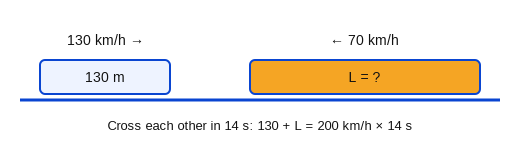
Two trains are moving in opposite directions at speeds of 130 km/hr and 70 km/hr. The length of one train is 130 m. The time taken by them to cross each other is 14 seconds. The length (in m) of the other train (rounded off to 2 decimal places) is:
दो रेलगाड़ियाँ 130 km/hr और 70 km/hr की चाल से विपरीत दिशाओं में चल रही हैं। एक रेलगाड़ी की लंबाई 130 m है। उन्हें एक-दूसरे को पार करने में 14 सेकंड लगते हैं। दूसरी रेलगाड़ी की लंबाई (m में) (2 दशमलव स्थानों तक पूर्णांकित) है:
  1. A647.78
  2. B650.67
  3. C646.47
  4. D649.6
Show answer

Concept: Trains in opposite directions: relative speed = sum of speeds; distance covered while crossing = sum of lengths.

  1. Relative speed =130+70=200 km/h =200×518=5009 m/s.
  2. Sum of lengths =5009×14=70009=777.78 m.
  3. Other train =777.78−130=647.78 m.

Trick: km/h → m/s: multiply by 518. 200×518×14=1400018=777.7―.

Answer: (A) 647.78

अवधारणा: विपरीत दिशा में रेलगाड़ियाँ: सापेक्ष चाल = चालों का योग; पार करने में तय दूरी = लंबाइयों का योग।

  1. सापेक्ष चाल =130+70=200 km/h =200×518=5009 m/s।
  2. लंबाइयों का योग =5009×14=70009=777.78 m।
  3. दूसरी रेलगाड़ी =777.78−130=647.78 m।

ट्रिक: km/h → m/s: 518 से गुणा। 200×518×14=1400018=777.7―।

उत्तर: (A) 647.78

RRB NTPC Graduate CBT 1MathematicsTrains – Opposite DirectionsRRB NTPC Graduate CBT 1 2025 · 22 Mar Shift 3 →
Q15582.
P sells an item to Q at 40% profit. Q sells the same item to R at 50% loss. If R paid ₹ 6895 for the item, then at what price (in ₹) is the item purchased by P?
P एक वस्तु Q को 40% लाभ पर बेचता है। Q वही वस्तु R को 50% हानि पर बेचता है। यदि R ने उस वस्तु के लिए ₹ 6895 का भुगतान किया, तो P ने वह वस्तु किस कीमत (₹ में) पर खरीदी?
  1. A9849
  2. B9852
  3. C9850
  4. D9848
Show answer

Concept: Successive profit/loss multiply: Final price=CP×140100×50100.

  1. Let P's cost price be x. Q pays 1.4x; R pays 1.4x×0.5=0.7x.
  2. 0.7x=6895⇒x=68950.7=9850.

Trick: +40% then −50% = net −30% (multiplier 0.7); 6895÷7=985, so ×10=9850.

Answer: (C) 9850

अवधारणा: क्रमिक लाभ/हानि गुणा होते हैं: अंतिम मूल्य=CP×140100×50100।

  1. P का क्रय मूल्य x मानें। Q देता है 1.4x; R देता है 1.4x×0.5=0.7x।
  2. 0.7x=6895⇒x=68950.7=9850।

ट्रिक: +40% फिर −50% = कुल −30% (गुणक 0.7); 6895÷7=985, अतः ×10=9850।

उत्तर: (C) 9850

RRB NTPC Graduate CBT 1MathematicsProfit and Loss – SuccessiveRRB NTPC Graduate CBT 1 2025 · 22 Mar Shift 3 →
Q15583.
If the mean of the following data is 47, find the value of X.
Class30–4040–5050–6060–7070–80
Frequency49332421X
यदि निम्नलिखित आँकड़ों का माध्य 47 है, तो X का मान ज्ञात कीजिए।
वर्ग30–4040–5050–6060–7070–80
बारंबारता49332421X
  1. A3
  2. B27
  3. C23
  4. D8
Show answer

Concept: x¯=∑fixi∑fi with class marks xi = 35, 45, 55, 65, 75.

  1. ∑fixi=49×35+33×45+24×55+21×65+75X=1715+1485+1320+1365+75X=5885+75X.
  2. ∑fi=127+X.
  3. 47(127+X)=5885+75X⇒5969+47X=5885+75X⇒28X=84⇒X=3.

Trick: Use deviations from assumed mean 45: ∑fidi=49(−10)+0+24(10)+21(20)+30X=170+30X; mean =45+170+30X127+X=47⇒X=3.

Answer: (A) 3

अवधारणा: x¯=∑fixi∑fi, वर्ग-चिह्न xi = 35, 45, 55, 65, 75।

  1. ∑fixi=49×35+33×45+24×55+21×65+75X=5885+75X।
  2. ∑fi=127+X।
  3. 47(127+X)=5885+75X⇒28X=84⇒X=3।

ट्रिक: कल्पित माध्य 45 से विचलन लें: ∑fidi=170+30X; माध्य =45+170+30X127+X=47⇒X=3।

उत्तर: (A) 3

RRB NTPC Graduate CBT 1MathematicsStatistics – Mean of Grouped DataRRB NTPC Graduate CBT 1 2025 · 22 Mar Shift 3 →
Q15584.
Due to a decrease in manpower, production in a factory falls by 52%. By what
percentage should the working hours be increased to restore the original level of production?
जनशक्ति में कमी के कारण, एक कारखाने में उत्पादन 52% गिर जाता है। उत्पादन के मूल स्तर को पुनः प्राप्त करने के लिए कार्य के घंटों में कितने प्रतिशत की वृद्धि की जानी चाहिए?
  1. A10423%
  2. B48%
  3. C10813%
  4. D52%
Show answer

Concept: Production = manpower × hours. If output falls to 48%, hours must be scaled by 10048.

  1. New production = 100−52=48 units (per 100 originally).
  2. Required increase =5248×100%=3253%=10813%.

Trick: Fall of x% needs a rise of x100−x×100% to restore; here 5248=1312.

Answer: (C) 10813%

अवधारणा: उत्पादन = श्रमिक × घंटे। उत्पादन 48% रह जाए तो घंटे 10048 गुना करने होंगे।

  1. नया उत्पादन = 100−52=48 इकाई (मूल 100 पर)।
  2. आवश्यक वृद्धि =5248×100%=3253%=10813%।

ट्रिक: x% की कमी की भरपाई के लिए x100−x×100% की वृद्धि चाहिए; यहाँ 5248=1312।

उत्तर: (C) 10813%

RRB NTPC Graduate CBT 1MathematicsPercentage – CompensationRRB NTPC Graduate CBT 1 2025 · 22 Mar Shift 3 →
Q15585.
By selling an article at 512 of its actual selling price, Akash incurs a loss of 20%. If he sells it at 80% of its actual selling price, then the profit percentage is
एक वस्तु को उसके वास्तविक विक्रय मूल्य के 512 पर बेचने से आकाश को 20% की हानि होती है। यदि वह इसे उसके वास्तविक विक्रय मूल्य के 80% पर बेचता है, तो लाभ प्रतिशत है
  1. A52.9%
  2. B55.3%
  3. C52.3%
  4. D53.6%
Show answer

Concept: Express the actual selling price in terms of CP, then find the new SP.

  1. 512SP=80% of CP=0.8CP⇒SP=0.8×125CP=1.92CP.
  2. New SP =80% of 1.92CP=1.536CP.
  3. Profit =53.6%.

Trick: Take CP = 100: actual SP = 80×125=192; 80% of 192 = 153.6 → profit 53.6%.

Answer: (D) 53.6%

अवधारणा: वास्तविक विक्रय मूल्य को CP में व्यक्त करें, फिर नया SP निकालें।

  1. 512SP=CP का 80%=0.8CP⇒SP=0.8×125CP=1.92CP।
  2. नया SP =1.92CP का 80%=1.536CP।
  3. लाभ =53.6%।

ट्रिक: CP = 100 लें: वास्तविक SP = 80×125=192; 192 का 80% = 153.6 → लाभ 53.6%।

उत्तर: (D) 53.6%

RRB NTPC Graduate CBT 1MathematicsProfit and LossRRB NTPC Graduate CBT 1 2025 · 22 Mar Shift 3 →
Q15586.
If sinA=35, then find the value of 11+3cscA4−5sinA.
यदि sinA=35 है, तो 11+3cscA4−5sinA का मान ज्ञात कीजिए।
  1. A3
  2. B4
  3. C3
  4. D2
Show answer

Concept: cscA=1sinA; substitute the values directly.

  1. sinA=35⇒cscA=53.
  2. Numerator: 11+3×53=11+5=16; denominator: 4−5×35=4−3=1.
  3. 161=4.

Trick: 3cscA and 5sinA are built to cancel the fractions – the answer is a whole number.

Answer: (B) 4

अवधारणा: cscA=1sinA; मान सीधे रखें।

  1. sinA=35⇒cscA=53।
  2. अंश: 11+3×53=16; हर: 4−5×35=1।
  3. 161=4।

ट्रिक: 3cscA और 5sinA भिन्न काटने के लिए ही बने हैं – उत्तर पूर्ण संख्या है।

उत्तर: (B) 4

RRB NTPC Graduate CBT 1MathematicsTrigonometry – RatiosRRB NTPC Graduate CBT 1 2025 · 22 Mar Shift 3 →
Q15587.
What will be the maximum value of the quadratic expression 10(x −1) − 5x2 + 4(2 − x) + 8?
द्विघात व्यंजक 10(x −1) − 5x2 + 4(2 − x) + 8 का अधिकतम मान क्या होगा?
  1. A8.7
  2. B7.8
  3. C6.9
  4. D9.6
Show answer

Concept: For ax2+bx+c with a<0, maximum value =c−b24a.

  1. Simplify: 10x−10−5x2+8−4x+8=−5x2+6x+6.
  2. a=−5, b=6, c=6: max =6−364(−5)=6+1.8=7.8.

Trick: Maximum occurs at x=−b2a=0.6; plug in: −1.8+3.6+6=7.8.

Answer: (B) 7.8

अवधारणा: ax2+bx+c में a<0 हो तो अधिकतम मान =c−b24a।

  1. सरल करें: 10x−10−5x2+8−4x+8=−5x2+6x+6।
  2. a=−5, b=6, c=6: अधिकतम =6−364(−5)=6+1.8=7.8।

ट्रिक: अधिकतम x=−b2a=0.6 पर; रखें: −1.8+3.6+6=7.8।

उत्तर: (B) 7.8

RRB NTPC Graduate CBT 1MathematicsQuadratic – Maximum ValueRRB NTPC Graduate CBT 1 2025 · 22 Mar Shift 3 →
Q15588.
100 men have provisions for 27 days. If 40 men have left, for how many days the same provisions would last for the remaining men?
100 आदमियों के लिए 27 दिनों की खाद्य सामग्री है। यदि 40 आदमी चले जाएँ, तो वही खाद्य सामग्री शेष आदमियों के लिए कितने दिनों तक चलेगी?
  1. A47
  2. B43
  3. C45
  4. D49
Show answer

Concept: Same provisions ⇒ men × days = constant (inverse variation).

  1. Remaining men =100−40=60.
  2. 100×27=60×d⇒d=270060=45 days.

Trick: Men become 35, so days become 53: 27×53=45.

Answer: (C) 45

अवधारणा: समान राशन ⇒ आदमी × दिन = स्थिर (व्युत्क्रम अनुपात)।

  1. शेष आदमी =100−40=60।
  2. 100×27=60×d⇒d=270060=45 दिन।

ट्रिक: आदमी 35 हुए, तो दिन 53 गुना: 27×53=45।

उत्तर: (C) 45

RRB NTPC Graduate CBT 1MathematicsInverse Variation – ProvisionsRRB NTPC Graduate CBT 1 2025 · 22 Mar Shift 3 →
Q15589.
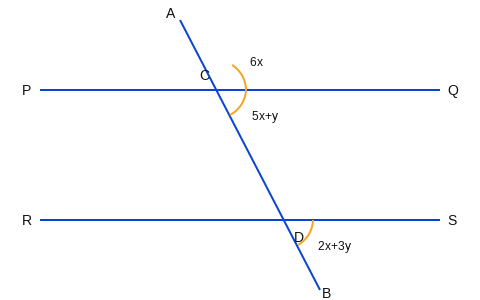
Line PQ is parallel to line RS and a transversal AB intersects PQ at C and RS at D. If ∠ACQ=(6x)∘, ∠QCD=(5x+y)∘ and ∠BDS=(2x+3y)∘, find the measure of ∠QCD.
रेखा PQ रेखा RS के समांतर है और एक तिर्यक रेखा AB, PQ को C पर तथा RS को D पर प्रतिच्छेद करती है। यदि ∠ACQ=(6x)∘, ∠QCD=(5x+y)∘ और ∠BDS=(2x+3y)∘ है, तो ∠QCD का माप ज्ञात कीजिए।
  1. A93.6∘
  2. B84.5∘
  3. C102∘
  4. D110∘
Show answer

Concept: On a straight line, adjacent angles sum to 180∘; with parallel lines, corresponding angles are equal.

  1. ∠ACQ+∠QCD=180∘ (linear pair on AB): 6x+5x+y=180⇒11x+y=180.
  2. ∠QCD=∠BDS (corresponding angles, PQ ∥ RS): 5x+y=2x+3y⇒3x=2y⇒y=1.5x.
  3. 11x+1.5x=180⇒x=14.4, y=21.6.
  4. ∠QCD=5(14.4)+21.6=93.6∘.

Trick: Two equations, two unknowns: linear pair gives one, corresponding angles give the other – solve for x, then add 5x+y.

Answer: (A) 93.6∘

अवधारणा: सरल रेखा पर आसन्न कोणों का योग 180∘; समांतर रेखाओं में संगत कोण (corresponding angles) बराबर।

  1. ∠ACQ+∠QCD=180∘ (AB पर रैखिक युग्म): 6x+5x+y=180⇒11x+y=180।
  2. ∠QCD=∠BDS (संगत कोण, PQ ∥ RS): 5x+y=2x+3y⇒y=1.5x।
  3. 11x+1.5x=180⇒x=14.4, y=21.6।
  4. ∠QCD=5(14.4)+21.6=93.6∘।

ट्रिक: दो समीकरण, दो अज्ञात: रैखिक युग्म से एक, संगत कोण से दूसरा – x निकालें, फिर 5x+y जोड़ें।

उत्तर: (A) 93.6∘

RRB NTPC Graduate CBT 1MathematicsLines and Angles – Parallel LinesRRB NTPC Graduate CBT 1 2025 · 22 Mar Shift 3 →
Q15590.
If a=x+2x and b=x−2x, then find the value of a4+b4−2a2b2.
यदि a=x+2x और b=x−2x है, तो a4+b4−2a2b2 का मान ज्ञात कीजिए।
  1. A36
  2. B64
  3. C16
  4. D49
Show answer

Concept: a4+b4−2a2b2=(a2−b2)2=[(a+b)(a−b)]2.

  1. a+b=2x, a−b=4x.
  2. (a+b)(a−b)=2x×4x=8.
  3. Required value =82=64.

Trick: Whenever you see a4+b4−2a2b2, read it as (a2−b2)2 – the x cancels and no expansion is needed.

Answer: (B) 64

अवधारणा: a4+b4−2a2b2=(a2−b2)2=[(a+b)(a−b)]2।

  1. a+b=2x, a−b=4x।
  2. (a+b)(a−b)=2x×4x=8।
  3. अभीष्ट मान =82=64।

ट्रिक: a4+b4−2a2b2 दिखे तो उसे (a2−b2)2 पढ़ें – x कट जाता है, विस्तार की ज़रूरत नहीं।

उत्तर: (B) 64

RRB NTPC Graduate CBT 1MathematicsAlgebra – IdentitiesRRB NTPC Graduate CBT 1 2025 · 22 Mar Shift 3 →
Q15591.
What is the mean of the following distribution?
Marks1621478099
No. of Students2438263213
निम्नलिखित बंटन का माध्य क्या है?
अंक1621478099
छात्रों की संख्या2438263213
  1. A67
  2. B47
  3. C74
  4. D71
Show answer

Concept: x¯=∑fixi∑fi.

  1. ∑fixi=16×24+21×38+47×26+80×32+99×13=384+798+1222+2560+1287=6251.
  2. ∑fi=24+38+26+32+13=133.
  3. x¯=6251133=47.

Trick: Take assumed mean 47: deviations −31,−26,0,33,52 give ∑fidi=−744−988+0+1056+676=0 → mean is exactly 47.

Answer: (B) 47

अवधारणा: x¯=∑fixi∑fi।

  1. ∑fixi=16×24+21×38+47×26+80×32+99×13=384+798+1222+2560+1287=6251।
  2. ∑fi=24+38+26+32+13=133।
  3. x¯=6251133=47।

ट्रिक: कल्पित माध्य 47 लें: विचलन −31,−26,0,33,52 से ∑fidi=−744−988+0+1056+676=0 → माध्य ठीक 47।

उत्तर: (B) 47

RRB NTPC Graduate CBT 1MathematicsStatistics – MeanRRB NTPC Graduate CBT 1 2025 · 22 Mar Shift 3 →
Q15592.
A and B start a business by investing capitals in the ratio 5:7. After 4 months, C joins the business with a capital equal to half of B’s capital. After 8 months from the start, A withdraws 40% of his capital, while B continues with the same investment. At the end of one year, the total profit is ₹27,675. The share of profit of B (in ₹) is:
A और B 5:7 के अनुपात में पूँजी निवेश करके एक व्यापार शुरू करते हैं। 4 महीने बाद, C, B की पूँजी के आधे के बराबर पूँजी के साथ व्यापार में शामिल होता है। शुरुआत से 8 महीने बाद, A अपनी पूँजी का 40% निकाल लेता है, जबकि B उसी निवेश के साथ बना रहता है। एक वर्ष के अंत में कुल लाभ ₹27,675 है। B के लाभ का हिस्सा (₹ में) है:
  1. A17,175
  2. B14,175
  3. C16,175
  4. D15,175
Show answer

Concept: Profit is shared in the ratio of (capital × time).

  1. Let A = 5, B = 7, C = 3.5 units.
  2. A: 5×8+3×4=52 (after withdrawing 40%, 3 units remain); B: 7×12=84; C: 3.5×8=28.
  3. Ratio 52 : 84 : 28 = 13 : 21 : 7 (total 41).
  4. B's share =2141×27675=21×675=14175.

Trick: 27675÷41=675 exactly – a clean division confirms the ratio is right.

Answer: (B) 14,175

अवधारणा: लाभ (पूँजी × समय) के अनुपात में बँटता है।

  1. A = 5, B = 7, C = 3.5 इकाई मानें।
  2. A: 5×8+3×4=52 (40% निकालने पर 3 इकाई शेष); B: 7×12=84; C: 3.5×8=28।
  3. अनुपात 52 : 84 : 28 = 13 : 21 : 7 (योग 41)।
  4. B का हिस्सा =2141×27675=21×675=14175।

ट्रिक: 27675÷41=675 पूरा-पूरा – साफ़ भाग अनुपात सही होने की पुष्टि है।

उत्तर: (B) 14,175

RRB NTPC Graduate CBT 1MathematicsPartnershipRRB NTPC Graduate CBT 1 2025 · 22 Mar Shift 3 →
Q15593.
Evaluate: (-9) - (-56) ÷ (-14) + (-3) × 7
मान ज्ञात कीजिए: (-9) - (-56) ÷ (-14) + (-3) × 7
  1. A-37
  2. B-36
  3. C-34
  4. D-33
Show answer

Concept: Division and multiplication before addition and subtraction; watch the signs.

  1. (−56)÷(−14)=4; (−3)×7=−21.
  2. (−9)−4+(−21)=−13−21=−34.

Trick: Negative ÷ negative = positive; then "minus a positive" makes the total more negative.

Answer: (C) −34

अवधारणा: जोड़-घटाव से पहले भाग और गुणा; चिह्नों पर ध्यान।

  1. (−56)÷(−14)=4; (−3)×7=−21।
  2. (−9)−4+(−21)=−13−21=−34।

ट्रिक: ऋण ÷ ऋण = धन; फिर "ऋण में धन घटाना" योग को और ऋणात्मक करता है।

उत्तर: (C) −34

RRB NTPC Graduate CBT 1MathematicsSimplification – BODMASRRB NTPC Graduate CBT 1 2025 · 22 Mar Shift 3 →
Q15594.
What should come in place of ‘?’ in the given series?
55 56 60 69 85 ?
दी गई श्रेणी में '?' के स्थान पर क्या आना चाहिए?
55 56 60 69 85 ?
  1. A108
  2. B110
  3. C104
  4. D112
Show answer

Concept: Look at the differences between consecutive terms.

  1. 56 − 55 = 1, 60 − 56 = 4, 69 − 60 = 9, 85 − 69 = 16 → perfect squares 12,22,32,42.
  2. Next difference =52=25 → 85+25=110.

Trick: Differences 1, 4, 9, 16 – squares; next is always 25.

Answer: (B) 110

अवधारणा: क्रमागत पदों के अंतर देखें।

  1. 56 − 55 = 1, 60 − 56 = 4, 69 − 60 = 9, 85 − 69 = 16 → पूर्ण वर्ग 12,22,32,42।
  2. अगला अंतर =52=25 → 85+25=110।

ट्रिक: अंतर 1, 4, 9, 16 – वर्ग; अगला हमेशा 25।

उत्तर: (B) 110

RRB NTPC Graduate CBT 1MathematicsNumber SeriesRRB NTPC Graduate CBT 1 2025 · 22 Mar Shift 3 →
Q15595.
The total surface area of a cube having side 91 cm is:
91 cm भुजा वाले एक घन का कुल पृष्ठीय क्षेत्रफल है:
  1. A49668 cm2
  2. B49716 cm2
  3. C49666 cm2
  4. D49686 cm2
Show answer

Concept: Total surface area of a cube =6a2.

  1. 912=(90+1)2=8100+180+1=8281.
  2. TSA =6×8281=49686 cm2.

Trick: Unit digit 6×1=6 keeps only B and D; then 6×8300=49800 minus 6×19=114 gives 49686.

Answer: (D) 49686 cm2

अवधारणा: घन का कुल पृष्ठीय क्षेत्रफल =6a2।

  1. 912=(90+1)2=8100+180+1=8281।
  2. TSA =6×8281=49686 cm2।

ट्रिक: इकाई अंक 6×1=6 – विकल्प B और D में 6; 6×8300=49800 में से 6×19=114 घटाएँ → 49686।

उत्तर: (D) 49686 cm2

RRB NTPC Graduate CBT 1MathematicsMensuration – CubeRRB NTPC Graduate CBT 1 2025 · 22 Mar Shift 3 →
Q15596.
The HCF and LCM of two numbers are 5 and 180 respectively. If one number is 45, what is the other number?
दो संख्याओं का HCF और LCM क्रमशः 5 और 180 है। यदि एक संख्या 45 है, तो दूसरी संख्या क्या है?
  1. A36
  2. B40
  3. C20
  4. D25
Show answer

Concept: Product of two numbers =HCF×LCM.

  1. 45×n=5×180=900.
  2. n=90045=20.
  3. Check: HCF(45, 20) = 5, LCM = 180 ✓.

Trick: Other number =HCF×LCMgiven number – one line, no factorisation.

Answer: (C) 20

अवधारणा: दो संख्याओं का गुणनफल =HCF×LCM।

  1. 45×n=5×180=900।
  2. n=90045=20।
  3. जाँच: HCF(45, 20) = 5, LCM = 180 ✓।

ट्रिक: दूसरी संख्या =HCF×LCMदी गई संख्या – एक पंक्ति, गुणनखंड की ज़रूरत नहीं।

उत्तर: (C) 20

RRB NTPC Graduate CBT 1MathematicsHCF and LCMRRB NTPC Graduate CBT 1 2025 · 22 Mar Shift 3 →
Q15597.
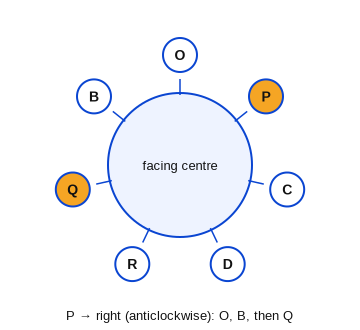
Seven people B, C, D, O, P, Q and R are sitting around a circular table facing the center of the table.
D sits fourth to the right of O. Only two people sit between D and B when counted from the left of D. B sits third to the right of C. Q is an immediate neighbor of B and R. How many people sit between P and Q when counted from the right of P?
सात व्यक्ति B, C, D, O, P, Q और R एक वृत्ताकार मेज़ के चारों ओर मेज़ के केंद्र की ओर मुख करके बैठे हैं।
D, O के दायें चौथे स्थान पर बैठा है। D के बायें से गिनने पर D और B के बीच केवल दो व्यक्ति बैठे हैं। B, C के दायें तीसरे स्थान पर बैठा है। Q, B और R का निकटतम पड़ोसी है। P के दायें से गिनने पर P और Q के बीच कितने व्यक्ति बैठे हैं?
  1. AOneएक
  2. BFourचार
  3. CThreeतीन
  4. DTwoदो
Show answer

Concept: Facing the centre, “right” means anticlockwise and “left” means clockwise. Number the seats 1–7 clockwise and place people step by step.

  1. O at seat 1. D is 4th to the right (anticlockwise) of O → D at seat 4.
  2. Two people between D and B counting from D's left (clockwise): seats 5, 6 in between → B at seat 7.
  3. B is 3rd to the right of C → C is 3 clockwise from B → seat 3. Q is a neighbour of B (seats 6 or 1); seat 1 is O, so Q at 6 and R at 5. P gets seat 2.
  4. From P (seat 2) to the right (anticlockwise): O (1), B (7), then Q (6) → two people between P and Q.

Trick: Facing centre: right = anticlockwise, left = clockwise. Fix the first person at the top and count seats, not names.

Answer: (D) Two

अवधारणा: केंद्र की ओर मुख होने पर “दाएँ” = वामावर्त (anticlockwise) और “बाएँ” = दक्षिणावर्त (clockwise)। सीटों को 1–7 दक्षिणावर्त नंबर दें और क्रम से बैठाएँ।

  1. O सीट 1 पर। D, O के दाएँ (वामावर्त) चौथा → D सीट 4 पर।
  2. D के बाएँ (दक्षिणावर्त) से गिनने पर D और B के बीच दो लोग: सीट 5, 6 बीच में → B सीट 7 पर।
  3. B, C के दाएँ तीसरा → C, B से 3 दक्षिणावर्त → सीट 3। Q, B का पड़ोसी (सीट 6 या 1); सीट 1 पर O है, अतः Q सीट 6 और R सीट 5 पर। P को सीट 2।
  4. P (सीट 2) से दाएँ (वामावर्त): O (1), B (7), फिर Q (6) → P और Q के बीच दो लोग।

ट्रिक: केंद्र की ओर मुख: दाएँ = वामावर्त, बाएँ = दक्षिणावर्त। पहले व्यक्ति को ऊपर रखें और नाम नहीं, सीटें गिनें।

उत्तर: (D) दो

RRB NTPC Graduate CBT 1General Intelligence and ReasoningCircular SeatingRRB NTPC Graduate CBT 1 2025 · 22 Mar Shift 3 →
Q15598.
Select the set in which the numbers are related in the same way as are the numbers of the following sets.
(NOTE: Operations should be performed on the whole numbers, without breaking down the numbers into their constituent digits. E.g. 13 – Operations on 13 such as
adding/subtracting/multiplying to 13 can be performed. Breaking down 13 into 1 and 3 and then performing mathematical operations on 1 and 3 is not allowed.)
(252, 80, 172)
(170, 55, 115)
उस समुच्चय का चयन कीजिए जिसमें संख्याएँ उसी प्रकार संबंधित हैं जिस प्रकार निम्नलिखित समुच्चयों की संख्याएँ संबंधित हैं।
(नोट: संक्रियाएँ पूर्ण संख्याओं पर की जानी चाहिए, संख्याओं को उनके घटक अंकों में तोड़े बिना। उदाहरण के लिए 13 – 13 पर संक्रियाएँ जैसे
13 में जोड़ना/घटाना/गुणा करना की जा सकती हैं। 13 को 1 और 3 में तोड़कर फिर 1 और 3 पर गणितीय संक्रियाएँ करने की अनुमति नहीं है।)
(252, 80, 172)
(170, 55, 115)
  1. A(212, 72, 130)
  2. B(195, 95, 100)
  3. C(180, 53, 137)
  4. D(236, 105, 141)
Show answer

Concept: Find one rule linking the three numbers of each given set and apply it to the options.

  1. (252,80,172): 252−80=172.
  2. (170,55,115): 170−55=115. Rule: first − second = third.
  3. Check: 195−95=100 ✓; 212−72=140≠130; 180−53=127≠137; 236−105=131≠141.

Trick: In three-number sets, test a−b=c and a+b or a×b relations first.

Answer: (B) (195, 95, 100)

अवधारणा: दिए गए समुच्चयों की तीनों संख्याओं को जोड़ने वाला नियम खोजें और विकल्पों पर लगाएँ।

  1. (252,80,172): 252−80=172।
  2. (170,55,115): 170−55=115। नियम: पहली − दूसरी = तीसरी।
  3. जाँच: 195−95=100 ✓; 212−72=140≠130; 180−53=127≠137; 236−105=131≠141।

ट्रिक: तीन संख्याओं के समुच्चय में पहले a−b=c, फिर a+b या a×b संबंध जाँचें।

उत्तर: (B) (195, 95, 100)

RRB NTPC Graduate CBT 1General Intelligence and ReasoningNumber AnalogyRRB NTPC Graduate CBT 1 2025 · 22 Mar Shift 3 →
Q15599.
Read the given statements and conclusions carefully. Assuming that the information given in the statements is true, even if it appears to be at variance with commonly known facts, decide which of the given conclusion(s) logically follow(s) from the statements.
Statements:
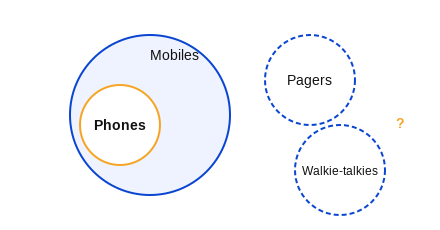
All phones are mobiles. No mobile is a pager. No mobile is a walkie-talkie.
Conclusions:
(I) No phone is a pager.
(II) Some walkie-talkies are pagers.
दिए गए कथनों और निष्कर्षों को ध्यानपूर्वक पढ़िए। यह मानते हुए कि कथनों में दी गई जानकारी सत्य है, भले ही वह सामान्यतः ज्ञात तथ्यों से भिन्न प्रतीत होती हो, निर्णय कीजिए कि दिए गए निष्कर्षों में से कौन-सा/से निष्कर्ष कथनों का तार्किक रूप से अनुसरण करता/करते है/हैं।
कथन:
सभी फ़ोन मोबाइल हैं। कोई मोबाइल पेजर नहीं है। कोई मोबाइल वॉकी-टॉकी नहीं है।
निष्कर्ष:
(I) कोई फ़ोन पेजर नहीं है।
(II) कुछ वॉकी-टॉकी पेजर हैं।
  1. AOnly conclusion (II) follows.केवल निष्कर्ष (II) अनुसरण करता है।
  2. BNeither conclusion (I) nor (II) follows.न तो निष्कर्ष (I) और न ही (II) अनुसरण करता है।
  3. COnly conclusion (I) follows.केवल निष्कर्ष (I) अनुसरण करता है।
  4. DBoth conclusions (I) and (II) follow.निष्कर्ष (I) और (II) दोनों अनुसरण करते हैं।
Show answer

Concept: Draw the Venn diagram. “All A are B” + “No B is C” ⇒ “No A is C” is a definite conclusion; two “No” statements about different classes tell nothing about each other.

  1. Phones lie wholly inside Mobiles; Mobiles and Pagers are disjoint → no phone can be a pager. Conclusion I follows.
  2. Pagers and Walkie-talkies are each separated from Mobiles only; their mutual relation is unknown → “Some walkie-talkies are pagers” is not definite. Conclusion II does not follow.

Trick: All + No (shared middle term) = No. Two negative premises never give a positive conclusion.

Answer: (C) Only conclusion (I) follows.

अवधारणा: वेन आरेख बनाएँ। “सभी A, B हैं” + “कोई B, C नहीं” ⇒ “कोई A, C नहीं” निश्चित निष्कर्ष है; अलग-अलग वर्गों के दो “कोई नहीं” कथन आपस में कुछ नहीं बताते।

  1. Phones पूरी तरह Mobiles के अंदर; Mobiles और Pagers अलग → कोई phone, pager नहीं हो सकता। निष्कर्ष I अनुसरण करता है।
  2. Pagers और Walkie-talkies केवल Mobiles से अलग हैं; आपसी संबंध अज्ञात → “कुछ walkie-talkies, pagers हैं” निश्चित नहीं। निष्कर्ष II अनुसरण नहीं करता।

ट्रिक: सभी + कोई नहीं (साझा मध्य पद) = कोई नहीं। दो नकारात्मक कथन कभी सकारात्मक निष्कर्ष नहीं देते।

उत्तर: (C) केवल निष्कर्ष (I) अनुसरण करता है।

RRB NTPC Graduate CBT 1General Intelligence and ReasoningSyllogismRRB NTPC Graduate CBT 1 2025 · 22 Mar Shift 3 →
Q15600.
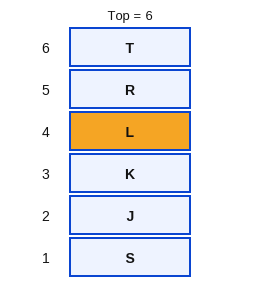
J, K, L, R, S and T live on six different floors of the same building. The lowermost floor in the building is numbered 1, the floor above it is numbered 2 and so on till the topmost floor is numbered 6. Only two people live between R and J. Only two people live between T and K. No one lives above T. J lives below K but above S. How many people live below L?
J, K, L, R, S और T एक ही भवन की छह अलग-अलग मंज़िलों पर रहते हैं। भवन की सबसे निचली मंज़िल की संख्या 1 है, उसके ऊपर की मंज़िल की संख्या 2 है और इसी प्रकार सबसे ऊपरी मंज़िल की संख्या 6 है। R और J के बीच केवल दो व्यक्ति रहते हैं। T और K के बीच केवल दो व्यक्ति रहते हैं। T के ऊपर कोई नहीं रहता। J, K के नीचे लेकिन S के ऊपर रहता है। L के नीचे कितने व्यक्ति रहते हैं?
  1. AOneएक
  2. BThreeतीन
  3. CTwoदो
  4. DFourचार
Show answer

Concept: Start with the definite clue (“no one above T”) and fill the floors one by one.

  1. No one above T → T on floor 6. Two people between T and K → K on floor 3.
  2. J below K but above S → J on 2 and S on 1 (only floors left below 3).
  3. Two people between R and J (floor 2) → R on floor 5. L takes the remaining floor 4.
  4. Below L (floor 4): K, J, S → three people.

Trick: Always lock the top/bottom floor first; “only two between X and Y” means a gap of 3 floors.

Answer: (B) Three

अवधारणा: निश्चित सुराग (“T के ऊपर कोई नहीं”) से शुरू करके मंज़िलें एक-एक कर भरें।

  1. T के ऊपर कोई नहीं → T मंज़िल 6 पर। T और K के बीच दो लोग → K मंज़िल 3 पर।
  2. J, K से नीचे पर S से ऊपर → J मंज़िल 2, S मंज़िल 1 पर।
  3. R और J (मंज़िल 2) के बीच दो लोग → R मंज़िल 5 पर। बची मंज़िल 4 पर L।
  4. L (मंज़िल 4) के नीचे: K, J, S → तीन लोग।

ट्रिक: सबसे ऊपर/नीचे की मंज़िल पहले तय करें; “X और Y के बीच केवल दो” = 3 मंज़िल का अंतर।

उत्तर: (B) तीन

RRB NTPC Graduate CBT 1General Intelligence and ReasoningFloor PuzzleRRB NTPC Graduate CBT 1 2025 · 22 Mar Shift 3 →