Question bank

Q&A: practice questions with answers

Search questions on any topic. Filter by exam category, exam, subject and topic, try the question, then open the answer and explanation.

Courses – airGurukul

20,719 questions found.

Q15661.
According to the Second Five Year Plan (1956), which sectors of the economy did the Indian government decide to develop and manage directly?
द्वितीय पंचवर्षीय योजना (1956) के अनुसार, भारत सरकार ने अर्थव्यवस्था के किन क्षेत्रों को सीधे विकसित और प्रबंधित करने का निर्णय लिया?
  1. AHeavy industriesभारी उद्योग
  2. BAgricultural sectorकृषि क्षेत्र
  3. CService sectorसेवा क्षेत्र
  4. DSmall businessesलघु व्यवसाय
Show answer

Concept: The Second Plan (1956–61), based on the Mahalanobis model, aimed at rapid industrialisation with emphasis on heavy and basic industries.

  1. The Industrial Policy Resolution 1956 reserved core/heavy industries (steel, heavy machinery, mining, defence) for the public sector – the state would develop and manage them directly.
  2. Steel plants at Bhilai, Rourkela and Durgapur were set up in this plan.
  3. Agriculture was the priority of the First Plan; small industries were left to the private/cooperative sector.

Trick: 1st Plan = Agriculture (Harrod-Domar); 2nd Plan = Heavy industry (Mahalanobis); 3rd = self-reliant economy.

Answer: (A) Heavy industries

अवधारणा: द्वितीय योजना (1956–61), महालनोबिस मॉडल पर आधारित, भारी व आधारभूत उद्योगों पर ज़ोर देकर तीव्र औद्योगीकरण का लक्ष्य रखती थी।

  1. औद्योगिक नीति प्रस्ताव 1956 ने मूल/भारी उद्योग (इस्पात, भारी मशीनरी, खनन, रक्षा) सार्वजनिक क्षेत्र के लिए आरक्षित किए – राज्य इन्हें सीधे विकसित व प्रबंधित करेगा।
  2. भिलाई, राउरकेला और दुर्गापुर इस्पात संयंत्र इसी योजना में लगे।
  3. कृषि प्रथम योजना की प्राथमिकता थी; लघु उद्योग निजी/सहकारी क्षेत्र पर छोड़े गए।

ट्रिक: 1ली योजना = कृषि (हैरोड-डोमर); 2री योजना = भारी उद्योग (महालनोबिस); 3री = आत्मनिर्भर अर्थव्यवस्था।

उत्तर: (A) Heavy industries
RRB NTPC Graduate CBT 1General AwarenessEconomy – Second Five Year PlanRRB NTPC Graduate CBT 1 2025 · 22 Mar Shift 2 →
Q15662.
The Indian men’s hockey team clinched the Asia Cup 2025 title by overcoming which of the following teams 4 - 1 in the final held at the Rajgir Sports Complex in Bihar?
भारतीय पुरुष हॉकी टीम ने बिहार के राजगीर खेल परिसर में हुए फ़ाइनल में निम्नलिखित में से किस टीम को 4 - 1 से हराकर एशिया कप 2025 का खिताब जीता?
  1. APakistanपाकिस्तान
  2. BRepublic of Koreaकोरिया गणराज्य
  3. CMalaysiaमलेशिया
  4. DJapanजापान
Show answer

Concept: The Men's Hockey Asia Cup 2025 was held at Rajgir Hockey Stadium, Bihar (29 Aug–7 Sep 2025).

  1. India beat the Republic of Korea 4–1 in the final on 7 September 2025 to win its fourth Asia Cup title (after 2003, 2007, 2017).
  2. The win also earned India direct qualification for the FIH Men's World Cup 2026 (Belgium–Netherlands); Pakistan did not participate.

Trick: Asia Cup 2025 = Rajgir (Bihar), India 4–1 Korea; Dilpreet Singh scored twice in the final.

Answer: (B) Republic of Korea

अवधारणा: पुरुष हॉकी एशिया कप 2025 राजगीर हॉकी स्टेडियम, बिहार में (29 अगस्त–7 सितंबर 2025) खेला गया।

  1. भारत ने 7 सितंबर 2025 के फ़ाइनल में कोरिया गणराज्य को 4–1 से हराकर चौथा एशिया कप खिताब जीता (पहले 2003, 2007, 2017)।
  2. इस जीत से भारत को FIH पुरुष विश्व कप 2026 (बेल्जियम–नीदरलैंड) में सीधा प्रवेश मिला; पाकिस्तान ने भाग नहीं लिया।

ट्रिक: एशिया कप 2025 = राजगीर (बिहार), भारत 4–1 कोरिया; फ़ाइनल में दिलप्रीत सिंह ने दो गोल किए।

उत्तर: (B) Republic of Korea

RRB NTPC Graduate CBT 1General AwarenessSports – Hockey Asia Cup 2025RRB NTPC Graduate CBT 1 2025 · 22 Mar Shift 2 →
Q15663.
Which of the following pairs of author and their work is correctly matched?
निम्नलिखित में से लेखक और उनकी कृति का कौन-सा युग्म सही सुमेलित है?
  1. ABankim Chandra Chatterjee – Kamayaniबंकिम चंद्र चटर्जी – कामायनी
  2. BMunshi Premchand – Madhushalaमुंशी प्रेमचंद – मधुशाला
  3. CRabindranath Tagore – Anandamathरबींद्रनाथ टैगोर – आनंदमठ
  4. DSharat Chandra Chatterjee – Devdasशरत चंद्र चटर्जी – देवदास
Show answer

Concept: Match famous Indian literary works with their authors.

  1. Devdas (1917) is a Bengali novel by Sharat Chandra Chattopadhyay – correctly matched.
  2. Kamayani is by Jaishankar Prasad (not Bankim); Madhushala is by Harivansh Rai Bachchan (not Premchand); Anandamath is by Bankim Chandra Chatterjee (not Tagore).

Trick: Bankim = Anandamath (Vande Mataram); Prasad = Kamayani; Bachchan = Madhushala; Sharat = Devdas, Parineeta, Srikanta.

Answer: (D) Sharat Chandra Chatterjee – Devdas

अवधारणा: प्रसिद्ध भारतीय साहित्यिक रचनाओं को उनके लेखकों से मिलाएँ।

  1. देवदास (1917) शरतचंद्र चट्टोपाध्याय का बांग्ला उपन्यास है – सही मिलान।
  2. कामायनी जयशंकर प्रसाद की है (बंकिम की नहीं); मधुशाला हरिवंशराय बच्चन की (प्रेमचंद की नहीं); आनंदमठ बंकिमचंद्र चटर्जी की (टैगोर की नहीं)।

ट्रिक: बंकिम = आनंदमठ (वंदे मातरम्); प्रसाद = कामायनी; बच्चन = मधुशाला; शरत = देवदास, परिणीता, श्रीकांत।

उत्तर: (D) Sharat Chandra Chatterjee – Devdas

RRB NTPC Graduate CBT 1General AwarenessLiterature – Authors & WorksRRB NTPC Graduate CBT 1 2025 · 22 Mar Shift 2 →
Q15664.
What causes the flow of water to lose its smoothness when a tap is opened wider?
नल (tap) को अधिक खोलने पर जल के प्रवाह की सुचारुता (smoothness) समाप्त होने का कारण क्या है?
  1. AThe water pressure decreases.जल का दाब कम हो जाता है।
  2. BThe outflow speed increases, causing turbulence.बहिर्प्रवाह की गति बढ़ जाती है, जिससे विक्षुब्धता (turbulence) उत्पन्न होती है।
  3. CThe water temperature changes.जल का तापमान बदल जाता है।
  4. DThe density of water changes.जल का घनत्व बदल जाता है।
Show answer

Concept: Fluid flow is streamline (laminar) at low speeds and becomes turbulent above a critical speed, as described by the Reynolds number.

  1. Opening the tap wider increases the outflow speed; beyond the critical velocity the smooth streamlines break into eddies – turbulence.
  2. Reynolds number Re=ρvdη grows with speed v; Re>2000 marks turbulent flow.
  3. Pressure, temperature and density of the water do not change appreciably when the tap is opened.

Trick: Thin trickle = laminar (glassy); gushing tap = turbulent (noisy, frothy). Speed is the deciding factor.

Answer: (B) The outflow speed increases, causing turbulence.

अवधारणा: कम गति पर तरल प्रवाह धारारेखीय (laminar) होता है और एक क्रांतिक गति से ऊपर विक्षुब्ध (turbulent) हो जाता है, जिसे रेनॉल्ड्स संख्या बताती है।

  1. नल अधिक खोलने से बहाव की गति बढ़ती है; क्रांतिक वेग से ऊपर चिकनी धारारेखाएँ भँवरों में टूट जाती हैं – विक्षोभ (turbulence)।
  2. रेनॉल्ड्स संख्या Re=ρvdη गति v के साथ बढ़ती है; Re>2000 विक्षुब्ध प्रवाह दर्शाता है।
  3. नल खोलने पर पानी का दाब, तापमान या घनत्व उल्लेखनीय रूप से नहीं बदलता।

ट्रिक: पतली धार = धारारेखीय (काँच जैसी); तेज़ धार = विक्षुब्ध (शोर, झाग)। गति ही निर्णायक है।

उत्तर: (B) The outflow speed increases, causing turbulence.

RRB NTPC Graduate CBT 1General AwarenessPhysics – Fluid FlowRRB NTPC Graduate CBT 1 2025 · 22 Mar Shift 2 →
Q15665.
As per Article 80 of the Constitution of India, which of the following indicates the number of members appointed by the President to the Council of States?
भारत के संविधान के अनुच्छेद 80 के अनुसार, निम्नलिखित में से कौन-सा राज्य सभा (Council of States) में राष्ट्रपति द्वारा नियुक्त सदस्यों की संख्या को दर्शाता है?
  1. ATwentyबीस
  2. BTenदस
  3. CTwelveबारह
  4. DFourteenचौदह
Show answer

Concept: Article 80 fixes the composition of the Council of States (Rajya Sabha): maximum 250 members – up to 238 elected and 12 nominated.

  1. The President nominates 12 members having special knowledge or practical experience in literature, science, art and social service [Art. 80(3)].
  2. Elected members are chosen by State Legislative Assemblies by proportional representation (single transferable vote).
  3. Present strength: 245 (233 elected + 12 nominated).

Trick: Rajya Sabha: 250 max = 238 + 12 (Art. 80); Lok Sabha nomination of 2 Anglo-Indians (Art. 331) was abolished by the 104th Amendment, 2019.

Answer: (C) Twelve

अवधारणा: अनुच्छेद 80 राज्यसभा (Council of States) की संरचना तय करता है: अधिकतम 250 सदस्य – 238 तक निर्वाचित और 12 मनोनीत।

  1. राष्ट्रपति साहित्य, विज्ञान, कला और समाज सेवा में विशेष ज्ञान या व्यावहारिक अनुभव वाले 12 सदस्य मनोनीत करते हैं [अनु. 80(3)]।
  2. निर्वाचित सदस्य राज्य विधानसभाओं द्वारा आनुपातिक प्रतिनिधित्व (एकल संक्रमणीय मत) से चुने जाते हैं।
  3. वर्तमान संख्या: 245 (233 निर्वाचित + 12 मनोनीत)।

ट्रिक: राज्यसभा: अधिकतम 250 = 238 + 12 (अनु. 80); लोकसभा में 2 एंग्लो-इंडियन मनोनयन (अनु. 331) 104वें संशोधन, 2019 से समाप्त।

उत्तर: (C) Twelve

RRB NTPC Graduate CBT 1General AwarenessPolity – Rajya Sabha CompositionRRB NTPC Graduate CBT 1 2025 · 22 Mar Shift 2 →
Q15666.
By selling an article at 310 of its marked price, Aman incurs a loss of 25%. If he sells it at 69% of its actual marked price, then the profit percentage is
एक वस्तु को उसके अंकित मूल्य के 310 पर बेचने से अमन को 25% की हानि होती है। यदि वह इसे इसके वास्तविक अंकित मूल्य के 69% पर बेचता है, तो लाभ प्रतिशत है
  1. A75.1%
  2. B74.1%
  3. C73.5%
  4. D72.5%
Show answer

Concept: Take MP =100; find CP from the loss, then the profit at the new SP.

  1. SP =310×100=30 gives 25% loss → CP =300.75=40.
  2. New SP =69% of 100 =69.
  3. Profit =69−40=29; profit%=2940×100=72.5%.

Trick: CP =SP1−loss%; with MP =100 all numbers stay small.

Answer: (D) 72.5%

अवधारणा: MP =100 लें; हानि से CP निकालें, फिर नए SP पर लाभ।

  1. SP =310×100=30 पर 25% हानि → CP =300.75=40।
  2. नया SP =100 का 69%=69।
  3. लाभ =69−40=29; लाभ%=2940×100=72.5%।

ट्रिक: CP =SP1−हानि%; MP =100 लेने से संख्याएँ छोटी रहती हैं।

उत्तर: (D) 72.5%

RRB NTPC Graduate CBT 1MathematicsProfit & Loss – Marked PriceRRB NTPC Graduate CBT 1 2025 · 22 Mar Shift 2 →
Q15667.
Three friends X, Y and Z started a business by investing a sum of money in the ratio of 9 : 5 : 2. After 6 months, X withdraws half of his capital. If the sum invested by Z is ₹83,000, then out of a total annual profit of ₹88,000, what is the difference between X's and Y's profit?
तीन मित्रों X, Y और Z ने 9 : 5 : 2 के अनुपात में धनराशि निवेश करके एक व्यापार शुरू किया। 6 महीने बाद, X अपनी पूँजी का आधा भाग निकाल लेता है। यदि Z द्वारा निवेश की गई राशि ₹83,000 है, तो ₹88,000 के कुल वार्षिक लाभ में से X और Y के लाभ का अंतर क्या है?
  1. A₹11,200
  2. B₹10,550
  3. C₹10,945
  4. D₹12,710
Show answer

Concept: Profit is shared in the ratio of (capital × time).

  1. X: 9×6+4.5×6=81; Y: 5×12=60; Z: 2×12=24. Ratio 81:60:24, total 165 parts.
  2. One part =88000165=16003.
  3. Difference X − Y =21 parts =21×16003=11200.

Trick: Z's ₹83,000 is a distraction – the ratio alone fixes the profit shares.

Answer: (A) ₹11,200

अवधारणा: लाभ (पूँजी × समय) के अनुपात में बँटता है।

  1. X: 9×6+4.5×6=81; Y: 5×12=60; Z: 2×12=24। अनुपात 81:60:24, कुल 165 भाग।
  2. एक भाग =88000165=16003।
  3. अंतर X − Y =21 भाग =21×16003=11200।

ट्रिक: Z के ₹83,000 केवल भटकाने के लिए हैं – अनुपात ही लाभ तय करता है।

उत्तर: (A) ₹11,200

RRB NTPC Graduate CBT 1MathematicsPartnershipRRB NTPC Graduate CBT 1 2025 · 22 Mar Shift 2 →
Q15668.
If (5x−1)3+(x+3)3+8(3x−4)3=6(5x−1)(x+3)(3x−4), then the value of x is:
यदि (5x−1)3+(x+3)3+8(3x−4)3=6(5x−1)(x+3)(3x−4) है, तो x का मान है:
  1. A35
  2. B34
  3. C14
  4. D12
Show answer

Concept: If a3+b3+c3=3abc and a,b,c are not all equal, then a+b+c=0.

  1. Let a=5x−1, b=x+3, c=2(3x−4)=6x−8. Then c3=8(3x−4)3.
  2. RHS: 3abc=3(5x−1)(x+3)(6x−8)=6(5x−1)(x+3)(3x−4) – exactly the given form.
  3. So a+b+c=0: 5x−1+x+3+6x−8=12x−6=0 → x=12.

Trick: Whenever you see cubes equal to "3 × product", just add the three brackets and equate to zero.

Answer: (D) 12

अवधारणा: यदि a3+b3+c3=3abc और a,b,c सब बराबर नहीं, तो a+b+c=0।

  1. a=5x−1, b=x+3, c=2(3x−4)=6x−8 लें। तब c3=8(3x−4)3।
  2. RHS: 3abc=3(5x−1)(x+3)(6x−8)=6(5x−1)(x+3)(3x−4) – ठीक प्रश्न जैसा।
  3. अतः a+b+c=0: 5x−1+x+3+6x−8=12x−6=0 → x=12।

ट्रिक: घन = "3 × गुणनफल" दिखे तो तीनों कोष्ठक जोड़कर शून्य के बराबर रख दें।

उत्तर: (D) 12

RRB NTPC Graduate CBT 1MathematicsAlgebra – a³+b³+c³ IdentityRRB NTPC Graduate CBT 1 2025 · 22 Mar Shift 2 →
Q15669.
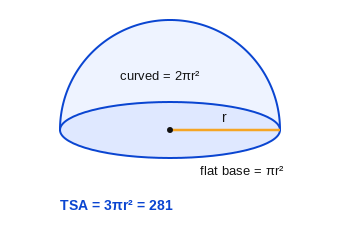
The total surface area of a solid hemisphere is 281 cm2. What is its radius (in cm)? (Take π=227)
एक ठोस अर्धगोले का कुल पृष्ठीय क्षेत्रफल 281 cm2 है। इसकी त्रिज्या (cm में) क्या है? (π=227 लीजिए)
  1. A196666
  2. B196766
  3. C196566
  4. D1957132
Show answer

Concept: TSA of a solid hemisphere =2πr2+πr2=3πr2.

  1. 3×227×r2=281.
  2. r2=281×766=196766.
  3. r=196766cm.

Trick: Solid hemisphere → 3πr2 (with base); hollow bowl surface → 2πr2. Here numerator must be 281×7=1967.

Answer: (B) 196766

अवधारणा: ठोस अर्धगोले का TSA =2πr2+πr2=3πr2।

  1. 3×227×r2=281।
  2. r2=281×766=196766।
  3. r=196766cm।

ट्रिक: ठोस अर्धगोला → 3πr2 (आधार सहित); खोखला कटोरा → 2πr2। यहाँ अंश 281×7=1967 होना चाहिए।

उत्तर: (B) 196766

RRB NTPC Graduate CBT 1MathematicsMensuration – HemisphereRRB NTPC Graduate CBT 1 2025 · 22 Mar Shift 2 →
Q15670.
Pipe P can fill 59 part of a tank in 15 hours and pipe Q can fill 79 part of the same tank in 21 hours. Both P and Q were kept open for 3 hours, then both were closed. Pipe R alone was then opened and it emptied the water in the tank in 4 hours. Pipes P, Q and R together can fill the empty tank in:
पाइप P एक टंकी के 59 भाग को 15 घंटे में भर सकता है और पाइप Q उसी टंकी के 79 भाग को 21 घंटे में भर सकता है। P और Q दोनों को 3 घंटे तक खुला रखा गया, फिर दोनों को बंद कर दिया गया। इसके बाद केवल पाइप R को खोला गया और उसने टंकी के पानी को 4 घंटे में खाली कर दिया। पाइप P, Q और R मिलकर खाली टंकी को कितने समय में भर सकते हैं:
  1. A57 hours57 घंटे
  2. B58 hours58 घंटे
  3. C42 hours42 घंटे
  4. D54 hours54 घंटे
Show answer

Concept: Convert each pipe to "full tank per hour", then add fillers and subtract the emptier.

  1. P fills 59 in 15 h → full tank in 15×95=27 h. Q fills 79 in 21 h → 21×97=27 h.
  2. P + Q in 3 h =3×227=29 of tank. R empties 29 in 4 h → R empties full tank in 18 h.
  3. Together: 127+127−118=4−354=154 → 54 hours.

Trick: Take LCM 54 units: P =2, Q =2, R =−3 per hour → net 1 unit/h → 54 h.

Answer: (D) 54 hours

अवधारणा: हर पाइप को "पूरी टंकी प्रति घंटा" में बदलें, भरने वाले जोड़ें और खाली करने वाला घटाएँ।

  1. P, 15 घंटे में 59 भरता है → पूरी टंकी 15×95=27 घंटे। Q, 21 घंटे में 79 → 21×97=27 घंटे।
  2. P + Q 3 घंटे में =3×227=29 टंकी। R इसे 4 घंटे में खाली करता है → पूरी टंकी 18 घंटे में।
  3. तीनों साथ: 127+127−118=4−354=154 → 54 घंटे।

ट्रिक: LCM 54 इकाई लें: P =2, Q =2, R =−3 प्रति घंटा → शुद्ध 1 इकाई/घंटा → 54 घंटे।

उत्तर: (D) 54 घंटे

RRB NTPC Graduate CBT 1MathematicsPipes & CisternsRRB NTPC Graduate CBT 1 2025 · 22 Mar Shift 2 →
Q15671.
A and B complete a work in 20 days. If A alone can do it in 45 days, then B alone can do three-fourth of the same work in ______________days.
A और B एक कार्य को 20 दिनों में पूरा करते हैं। यदि A अकेले इसे 45 दिनों में कर सकता है, तो B अकेले उसी कार्य का तीन-चौथाई भाग ______________ दिनों में कर सकता है।
  1. A81
  2. B54
  3. C108
  4. D27
Show answer

Concept: B's one-day work = (A+B)'s − A's.

  1. 120−145=9−4180=5180=136 → B alone takes 36 days.
  2. Three-fourth of the work: 34×36=27 days.

Trick: LCM 180 units: A+B =9/day, A =4/day, B =5/day → 1355=27 days.

Answer: (D) 27

अवधारणा: B का एक दिन का कार्य = (A+B) का − A का।

  1. 120−145=9−4180=5180=136 → B अकेला 36 दिन।
  2. तीन-चौथाई कार्य: 34×36=27 दिन।

ट्रिक: LCM 180 इकाई: A+B =9/दिन, A =4/दिन, B =5/दिन → 1355=27 दिन।

उत्तर: (D) 27

RRB NTPC Graduate CBT 1MathematicsTime & WorkRRB NTPC Graduate CBT 1 2025 · 22 Mar Shift 2 →
Q15672.
The population of a village was 2,90,000. It increased by 15% in the first year and increased by 20% in the second year. Its population after two years is _______.
एक गाँव की जनसंख्या 2,90,000 थी। पहले वर्ष में इसमें 15% की वृद्धि हुई और दूसरे वर्ष में 20% की वृद्धि हुई। दो वर्ष बाद इसकी जनसंख्या _______ है।
  1. A3,33,500
  2. B4,00,200
  3. C3,48,000
  4. D3,91,500
Show answer

Concept: Successive increases multiply: P×(1+r1)(1+r2).

  1. Net factor =1.15×1.20=1.38 (same as 15+20+15×20100=38%).
  2. Population =2,90,000×1.38=4,00,200.

Trick: a+b+ab100 for two successive changes – here 38% of 2,90,000=1,10,200; add it.

Answer: (B) 4,00,200

अवधारणा: क्रमिक वृद्धियाँ गुणा होती हैं: P×(1+r1)(1+r2)।

  1. कुल गुणक =1.15×1.20=1.38 (यानी 15+20+15×20100=38%)।
  2. जनसंख्या =2,90,000×1.38=4,00,200।

ट्रिक: दो क्रमिक परिवर्तनों के लिए a+b+ab100 – यहाँ 2,90,000 का 38%=1,10,200 जोड़ें।

उत्तर: (B) 4,00,200

RRB NTPC Graduate CBT 1MathematicsSuccessive Percentage ChangeRRB NTPC Graduate CBT 1 2025 · 22 Mar Shift 2 →
Q15673.
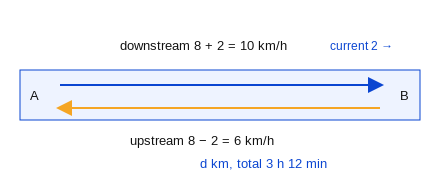
A man can row at 8 km/hr in still water. When the river flows at 2 km/hr, he takes 3 hours 12 minutes to row to a destination and back. Find the distance to the destination.
एक व्यक्ति शांत जल में 8 km/hr की चाल से नाव चला सकता है। जब नदी 2 km/hr की चाल से बहती है, तो उसे एक गंतव्य तक जाकर वापस आने में 3 घंटे 12 मिनट लगते हैं। गंतव्य की दूरी ज्ञात कीजिए।
  1. A10 km
  2. B8 km
  3. C15 km
  4. D12 km
Show answer

Concept: Downstream speed =u+v, upstream speed =u−v; total time =du+v+du−v.

  1. Downstream =8+2=10km/h, upstream =8−2=6km/h; time =3h12min=165 h.
  2. d10+d6=165 → 8d30=165.
  3. d=165×308=12 km.

Trick: d=T(u2−v2)2u=3.2×6016=12.

Answer: (D) 12 km

अवधारणा: अनुप्रवाह चाल =u+v, प्रतिप्रवाह =u−v; कुल समय =du+v+du−v।

  1. अनुप्रवाह =8+2=10km/h, प्रतिप्रवाह =8−2=6km/h; समय =3h12min=165 घंटे।
  2. d10+d6=165 → 8d30=165।
  3. d=165×308=12 km।

ट्रिक: d=T(u2−v2)2u=3.2×6016=12।

उत्तर: (D) 12 km

RRB NTPC Graduate CBT 1MathematicsBoats & StreamsRRB NTPC Graduate CBT 1 2025 · 22 Mar Shift 2 →
Q15674.
Simplify: cosθ1+sinθ+1+sinθcosθ.
सरल कीजिए: cosθ1+sinθ+1+sinθcosθ।
  1. A2cosecθ
  2. B2sinθ
  3. C2secθ
  4. D2cosθ
Show answer

Concept: Take LCM and use sin2θ+cos2θ=1.

  1. cosθ1+sinθ+1+sinθcosθ=cos2θ+(1+sinθ)2(1+sinθ)cosθ.
  2. Numerator =cos2θ+1+2sinθ+sin2θ=2+2sinθ=2(1+sinθ).
  3. Cancel (1+sinθ): result =2cosθ=2secθ.

Trick: Put θ=0∘: 11+11=2; only 2sec0∘=2 matches.

Answer: (C) 2secθ

अवधारणा: LCM लें और sin2θ+cos2θ=1 लगाएँ।

  1. cosθ1+sinθ+1+sinθcosθ=cos2θ+(1+sinθ)2(1+sinθ)cosθ।
  2. अंश =cos2θ+1+2sinθ+sin2θ=2+2sinθ=2(1+sinθ)।
  3. (1+sinθ) काटने पर =2cosθ=2secθ।

ट्रिक: θ=0∘ रखें: 11+11=2; केवल 2sec0∘=2 मिलता है।

उत्तर: (C) 2secθ

RRB NTPC Graduate CBT 1MathematicsTrigonometric IdentitiesRRB NTPC Graduate CBT 1 2025 · 22 Mar Shift 2 →
Q15675.
At what rate (in percentage) per year will a sum of money double itself in 20 years on simple interest?
साधारण ब्याज पर प्रति वर्ष कितनी दर (प्रतिशत में) से कोई धनराशि 20 वर्षों में स्वयं की दोगुनी हो जाएगी?
  1. A10
  2. B5
  3. C7
  4. D3
Show answer

Concept: To double, SI must equal the principal: P×R×T100=P → R×T=100.

  1. T=20 years → R=10020=5% per annum.

Trick: Double → RT=100; triple → RT=200; n times → RT=100(n−1).

Answer: (B) 5

अवधारणा: दोगुना होने के लिए SI = मूलधन: P×R×T100=P → R×T=100।

  1. T=20 वर्ष → R=10020=5% वार्षिक।

ट्रिक: दोगुना → RT=100; तिगुना → RT=200; n गुना → RT=100(n−1)।

उत्तर: (B) 5

RRB NTPC Graduate CBT 1MathematicsSimple InterestRRB NTPC Graduate CBT 1 2025 · 22 Mar Shift 2 →
Q15676.
If 2820 is divided into two parts such that one-fifth of the first part and one-eighth of the second part are in the ratio 3 : 4, what is the ratio of the first part to the second part?
यदि 2820 को दो भागों में इस प्रकार विभाजित किया जाता है कि पहले भाग का पाँचवाँ भाग और दूसरे भाग का आठवाँ भाग 3 : 4 के अनुपात में हैं, तो पहले भाग का दूसरे भाग से अनुपात क्या है?
  1. A18 : 19
  2. B15 : 32
  3. C15 : 37
  4. D17 : 36
Show answer

Concept: Set up the ratio of the fractional parts and simplify.

  1. a/5b/8=34 → 8a5b=34 → 32a=15b.
  2. a:b=15:32.

Trick: a:b=(3×5):(4×8)=15:32 – multiply each ratio term by its own denominator. The total 2820 is not needed.

Answer: (B) 15 : 32

अवधारणा: भिन्नात्मक भागों का अनुपात लिखकर सरल करें।

  1. a/5b/8=34 → 8a5b=34 → 32a=15b।
  2. a:b=15:32।

ट्रिक: a:b=(3×5):(4×8)=15:32 – हर अनुपात-पद को उसके हर से गुणा करें। कुल 2820 की ज़रूरत नहीं।

उत्तर: (B) 15 : 32

RRB NTPC Graduate CBT 1MathematicsRatio & ProportionRRB NTPC Graduate CBT 1 2025 · 22 Mar Shift 2 →
Q15677.
In a 150-meter race, R beats S by 6 meters. In a 250-meter race, R beats S by 2 seconds. As per this, in a race, if R runs for 30 seconds, then he beats S by ___ meters.
150 मीटर की दौड़ में, R, S को 6 मीटर से हराता है। 250 मीटर की दौड़ में, R, S को 2 सेकंड से हराता है। इसके अनुसार, एक दौड़ में यदि R 30 सेकंड तक दौड़ता है, तो वह S को ___ मीटर से हराता है।
  1. A5.75
  2. B7.25
  3. C6.75
  4. D6.25
Show answer

Concept: Find the speed ratio from the first race and S's actual speed from the second.

  1. 150 m race: R runs 150 while S runs 144 → speeds R : S =25:24.
  2. 250 m race: when R finishes 250, S has run 240 and needs 2 s for the last 10 m → S's speed =5m/s; R's speed =5×2524=12524m/s.
  3. In 30 s: R =156.25 m, S =150 m → R beats S by 6.25 m.

Trick: Lead in 30 s =30×(R−S speed)=30×524=6.25.

Answer: (D) 6.25

अवधारणा: पहली दौड़ से चाल का अनुपात और दूसरी से S की वास्तविक चाल निकालें।

  1. 150 m दौड़: R 150 दौड़ता है तो S 144 → चाल R : S =25:24।
  2. 250 m दौड़: R के 250 पूरे करने पर S 240 पर; बचे 10 m में 2 s → S की चाल =5m/s; R की चाल =5×2524=12524m/s।
  3. 30 s में: R =156.25 m, S =150 m → R, S को 6.25 m से हराता है।

ट्रिक: 30 s की बढ़त =30×(R−S चाल)=30×524=6.25।

उत्तर: (D) 6.25

RRB NTPC Graduate CBT 1MathematicsRacesRRB NTPC Graduate CBT 1 2025 · 22 Mar Shift 2 →
Q15678.
What will be the positive difference in the population of a town 3 years ago and 2 years ago, if its current population is 450000 and the population has been increasing at a rate of 25% every year?
किसी नगर की 3 वर्ष पहले और 2 वर्ष पहले की जनसंख्या में धनात्मक अंतर क्या होगा, यदि इसकी वर्तमान जनसंख्या 450000 है और जनसंख्या प्रति वर्ष 25% की दर से बढ़ रही है?
  1. A57050
  2. B56850
  3. C57950
  4. D57600
Show answer

Concept: Past population =present(1+r)n; 25% growth means factor 54 per year.

  1. 2 years ago: 450000×45×45=288000.
  2. 3 years ago: 288000×45=230400.
  3. Difference =288000−230400=57600.

Trick: Difference = (population 3 yrs ago) ×25% =230400×14=57600.

Answer: (D) 57600

अवधारणा: पिछली जनसंख्या =वर्तमान(1+r)n; 25% वृद्धि = प्रति वर्ष गुणक 54।

  1. 2 वर्ष पहले: 450000×45×45=288000।
  2. 3 वर्ष पहले: 288000×45=230400।
  3. अंतर =288000−230400=57600।

ट्रिक: अंतर = (3 वर्ष पहले की जनसंख्या) ×25% =230400×14=57600।

उत्तर: (D) 57600

RRB NTPC Graduate CBT 1MathematicsCompound Growth – PopulationRRB NTPC Graduate CBT 1 2025 · 22 Mar Shift 2 →
Q15679.
Girish scored 768 marks in an examination and was 60 marks short of 92% of maximum marks. In the same examination, his friend scored 738 marks. What is the percentage of marks scored by his friend?
गिरीश ने एक परीक्षा में 768 अंक प्राप्त किए और वह अधिकतम अंकों के 92% से 60 अंक कम रहा। उसी परीक्षा में उसके मित्र ने 738 अंक प्राप्त किए। उसके मित्र द्वारा प्राप्त अंकों का प्रतिशत क्या है?
  1. A82%
  2. B80%
  3. C79%
  4. D81%
Show answer

Concept: First find the maximum marks from Girish's score.

  1. 92% of max =768+60=828 → max =828×10092=900.
  2. Friend's percentage =738900×100=82%.

Trick: 828=92×9 → max =900; then 738÷9=82.

Answer: (A) 82%

अवधारणा: पहले गिरीश के अंकों से अधिकतम अंक निकालें।

  1. अधिकतम का 92%=768+60=828 → अधिकतम =828×10092=900।
  2. मित्र का प्रतिशत =738900×100=82%।

ट्रिक: 828=92×9 → अधिकतम =900; फिर 738÷9=82।

उत्तर: (A) 82%

RRB NTPC Graduate CBT 1MathematicsPercentage – MarksRRB NTPC Graduate CBT 1 2025 · 22 Mar Shift 2 →
Q15680.
What is the nature of the roots of the following quadratic equation?
x−1x=17
निम्नलिखित द्विघात समीकरण के मूलों की प्रकृति क्या है?
x−1x=17
  1. AReal and equalवास्तविक और समान
  2. BNo real rootsकोई वास्तविक मूल नहीं
  3. CReal and distinct (irrational)वास्तविक और भिन्न (अपरिमेय)
  4. DReal and distinct (rational)वास्तविक और भिन्न (परिमेय)
Show answer

Concept: For ax2+bx+c=0, the discriminant D=b2−4ac decides the roots: D>0 real and distinct (rational if D is a perfect square, else irrational), D=0 equal, D<0 no real roots.

  1. Multiply x−1x=17 by x: x2−17x−1=0.
  2. D=(−17)2−4(1)(−1)=289+4=293>0.
  3. 293 is not a perfect square (172=289, 182=324), so the roots are real, distinct and irrational.

Trick: Whenever c is negative with a positive, D=b2−4ac is surely positive – roots are always real and distinct; just check perfect square for rational/irrational.

Answer: (C) Real and distinct (irrational)

अवधारणा: ax2+bx+c=0 के लिए विविक्तकर (discriminant) D=b2−4ac मूलों की प्रकृति बताता है: D>0 वास्तविक व भिन्न (यदि D पूर्ण वर्ग हो तो परिमेय, अन्यथा अपरिमेय), D=0 समान, D<0 कोई वास्तविक मूल नहीं।

  1. x−1x=17 को x से गुणा करें: x2−17x−1=0।
  2. D=(−17)2−4(1)(−1)=289+4=293>0।
  3. 293 पूर्ण वर्ग नहीं है (172=289, 182=324), अतः मूल वास्तविक, भिन्न और अपरिमेय (irrational) हैं।

ट्रिक: जब a धनात्मक और c ऋणात्मक हो, तो D निश्चित ही धनात्मक होता है – मूल हमेशा वास्तविक व भिन्न; बस पूर्ण वर्ग जाँचकर परिमेय/अपरिमेय तय करें।

उत्तर: (C) Real and distinct (irrational)

RRB NTPC Graduate CBT 1MathematicsQuadratic Equations – Nature of RootsRRB NTPC Graduate CBT 1 2025 · 22 Mar Shift 2 →