Question bank

Q&A: practice questions with answers

Search questions on any topic. Filter by exam category, exam, subject and topic, try the question, then open the answer and explanation.

Courses – airGurukul

20,719 questions found.

Q15681.
The larger of two supplementary angles is 32° more than the smaller. The smaller angle (in degree) is:
दो संपूरक कोणों में से बड़ा कोण छोटे कोण से 32° अधिक है। छोटा कोण (डिग्री में) है:
  1. A75
  2. B81
  3. C74
  4. D76
Show answer

Concept: Two angles are supplementary when their sum is 180∘.

  1. Let the smaller angle be x; the larger is x+32.
  2. x+(x+32)=180⇒2x=148⇒x=74.
  3. Check: 74∘+106∘=180∘ ✓

Trick: Smaller =180−difference2=180−322=74; larger =180+322=106.

Answer: (C) 74

अवधारणा: दो कोण संपूरक (supplementary) होते हैं जब उनका योग 180∘ हो।

  1. छोटा कोण x मानें; बड़ा x+32।
  2. x+(x+32)=180⇒2x=148⇒x=74।
  3. जाँच: 74∘+106∘=180∘ ✓

ट्रिक: छोटा =180−अंतर2=180−322=74; बड़ा =180+322=106।

उत्तर: (C) 74

RRB NTPC Graduate CBT 1MathematicsSupplementary AnglesRRB NTPC Graduate CBT 1 2025 · 22 Mar Shift 2 →
Q15682.
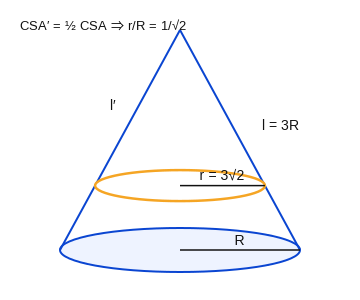
A right circular cone has a slant height that is 3 times its radius. A plane cuts the cone parallel to the base at a height such that the smaller, upper cone has half the curved surface area of the original cone. If the diameter of the smaller cone is 62 cm, then what is the radius (in cm) of the original cone?
एक लंब वृत्तीय शंकु की तिर्यक ऊँचाई उसकी त्रिज्या की 3 गुनी है। एक समतल शंकु को आधार के समांतर इतनी ऊँचाई पर काटता है कि छोटे, ऊपरी शंकु का वक्र पृष्ठीय क्षेत्रफल मूल शंकु के वक्र पृष्ठीय क्षेत्रफल का आधा है। यदि छोटे शंकु का व्यास 62 cm है, तो मूल शंकु की त्रिज्या (cm में) क्या है?
  1. A3
  2. B6
  3. C9
  4. D12
Show answer

Concept: A plane parallel to the base cuts off a smaller cone similar to the original. If the linear ratio is k, areas scale by k2 and volumes by k3.

  1. CSA of the small cone =12 CSA of the original ⇒k2=12⇒k=12.
  2. Radius of the small cone =622=32cm.
  3. Original radius R=32k=32×2=6cm.
  4. Check with l=3R: CSA =πR·3R=3πR2; small cone 3π(32)2=54π, original 3π·36=108π – exactly half ✓

Trick: For similar solids: length ratio k, area ratio k2, volume ratio k3. The "slant height = 3 × radius" data is only a distraction here.

Answer: (B) 6

अवधारणा: आधार के समांतर काटने से बना छोटा शंकु मूल शंकु के समरूप होता है। यदि रैखिक अनुपात k हो तो क्षेत्रफल k2 और आयतन k3 के अनुपात में होते हैं।

  1. छोटे शंकु का वक्र पृष्ठ =12 मूल का ⇒k2=12⇒k=12।
  2. छोटे शंकु की त्रिज्या =622=32cm।
  3. मूल त्रिज्या R=32k=32×2=6cm।
  4. l=3R से जाँच: CSA =πR·3R=3πR2; छोटा 3π(32)2=54π, मूल 3π·36=108π – ठीक आधा ✓

ट्रिक: समरूप ठोसों में: लंबाई अनुपात k, क्षेत्रफल k2, आयतन k3। "तिर्यक ऊँचाई = 3 × त्रिज्या" यहाँ केवल ध्यान भटकाने के लिए है।

उत्तर: (B) 6

RRB NTPC Graduate CBT 1MathematicsMensuration – Frustum/Similar ConesRRB NTPC Graduate CBT 1 2025 · 22 Mar Shift 2 →
Q15683.
A trader gives 5% discount on the marked price of an article and gives 2 articles free for buying 14 articles and gains 33% in the entire transaction. Assuming a customer pays for 14 articles, the marked price of an article is what percent more than its cost price?
एक व्यापारी एक वस्तु के अंकित मूल्य पर 5% की छूट देता है और 14 वस्तुएँ खरीदने पर 2 वस्तुएँ मुफ़्त देता है तथा पूरे लेन-देन में 33% का लाभ प्राप्त करता है। यह मानते हुए कि ग्राहक 14 वस्तुओं का भुगतान करता है, एक वस्तु का अंकित मूल्य उसके क्रय मूल्य से कितने प्रतिशत अधिक है?
  1. A52%
  2. B60%
  3. C68%
  4. D58%
Show answer

Concept: Take CP of one article as ₹100. The customer pays for 14 articles but the trader gives away 16, so the cost is on 16 articles while the sale is on 14 at the discounted price.

  1. CP of 16 articles =16×100=1600. Gain 33% ⇒ SP =1600×1.33=2128.
  2. SP per paid article =212814=152.
  3. SP =95% of MP ⇒ MP =1520.95=160.
  4. MP is 160−100=60% above CP.

Trick: Chain formula: MP=CP×1614×133100×10095=100×16×13314×95=160.

Answer: (B) 60%

अवधारणा: एक वस्तु का CP ₹100 मानें। ग्राहक 14 का भुगतान करता है पर 16 पाता है, अतः लागत 16 वस्तुओं की और बिक्री 14 वस्तुओं की छूट-सहित कीमत पर।

  1. 16 वस्तुओं का CP =16×100=1600। 33% लाभ ⇒ SP =1600×1.33=2128।
  2. प्रति भुगतान-वस्तु SP =212814=152।
  3. SP = MP का 95% ⇒ MP =1520.95=160।
  4. MP, CP से 160−100=60% अधिक।

ट्रिक: श्रृंखला सूत्र: MP=CP×1614×133100×10095=100×16×13314×95=160।

उत्तर: (B) 60%

RRB NTPC Graduate CBT 1MathematicsProfit & Loss – Discount with Free ArticlesRRB NTPC Graduate CBT 1 2025 · 22 Mar Shift 2 →
Q15684.
A shopkeeper purchased 32 dozens of articles at the rate of ₹102 per dozen. He sold each one of them at the rate of ₹68. What percentage profit did he make?
एक दुकानदार ने ₹102 प्रति दर्जन की दर से 32 दर्जन वस्तुएँ खरीदीं। उसने उनमें से प्रत्येक को ₹68 की दर से बेच दिया। उसे कितने प्रतिशत लाभ हुआ?
  1. A697%
  2. B702%
  3. C700%
  4. D701%
Show answer

Concept: Profit% is calculated on the cost price of the same unit: Profit%=SP−CPCP×100.

  1. CP of one article =10212=8.5 rupees.
  2. SP of one article =68 rupees. Profit =68−8.5=59.5.
  3. Profit% =59.58.5×100=7×100=700%.

Trick: Note 68=8×8.5, i.e. SP is 8 times CP → profit is 7 times CP → 700%. The "32 dozens" is irrelevant.

Answer: (C) 700%

अवधारणा: लाभ% समान इकाई के क्रय मूल्य पर निकाला जाता है: लाभ%=SP−CPCP×100।

  1. एक वस्तु का CP =10212=8.5 रुपये।
  2. एक वस्तु का SP =68 रुपये। लाभ =68−8.5=59.5।
  3. लाभ% =59.58.5×100=7×100=700%।

ट्रिक: ध्यान दें 68=8×8.5, यानी SP, CP का 8 गुना → लाभ CP का 7 गुना → 700%। "32 दर्जन" अनावश्यक है।

उत्तर: (C) 700%

RRB NTPC Graduate CBT 1MathematicsProfit PercentageRRB NTPC Graduate CBT 1 2025 · 22 Mar Shift 2 →
Q15685.
The marks obtained by 11 students in a mathematics test are as follows: 45, 62, 58, 71, 66, 54, 60, 49, 68, 57, 63.What is the median marks?
गणित की एक परीक्षा में 11 विद्यार्थियों द्वारा प्राप्त अंक निम्नलिखित हैं: 45, 62, 58, 71, 66, 54, 60, 49, 68, 57, 63। माध्यिका अंक क्या है?
  1. A60
  2. B66
  3. C58
  4. D54
Show answer

Concept: For n observations arranged in order, the median is the (n+12)th value when n is odd.

  1. Arrange: 45, 49, 54, 57, 58, 60, 62, 63, 66, 68, 71.
  2. n=11⇒ median =11+12=6th value =60.

Trick: Odd count → middle value directly; even count → average of the two middle values. Always sort first!

Answer: (A) 60

अवधारणा: n प्रेक्षणों को क्रम में रखने पर, n विषम हो तो माध्यिका (n+12)वाँ मान होती है।

  1. क्रम में: 45, 49, 54, 57, 58, 60, 62, 63, 66, 68, 71।
  2. n=11⇒ माध्यिका =11+12=6वाँ मान =60।

ट्रिक: विषम संख्या → सीधे बीच वाला मान; सम संख्या → बीच के दो मानों का औसत। पहले क्रम में लगाना न भूलें!

उत्तर: (A) 60

RRB NTPC Graduate CBT 1MathematicsStatistics – MedianRRB NTPC Graduate CBT 1 2025 · 22 Mar Shift 2 →
Q15686.
The least common multiple and the highest common factor of x2.5y0.5×xy and y1.5x×xy are ____ and ______, respectively, where x and y are co-prime integers greater than 1.
x2.5y0.5×xy और y1.5x×xy का लघुत्तम समापवर्त्य और महत्तम समापवर्तक क्रमशः ____ और ______ हैं, जहाँ x और y 1 से बड़े सह-अभाज्य पूर्णांक हैं।
  1. Ax(xy)2, x
  2. By(xy)2, 1
  3. Cy(xy)2, y
  4. Dx(xy)2, 1
Show answer

Concept: First simplify each expression using the laws of indices (am·an=am+n, a=a0.5), then find LCM and HCF.

  1. First: x2.5y0.5×xy=x2.5y−0.5·x0.5y0.5=x3.
  2. Second: y1.5x×xy=y1.5x−0.5·x0.5y0.5=y2.
  3. x and y are co-prime, so x3 and y2 share no factor: HCF =1, LCM =x3y2=x(xy)2.

Trick: For co-prime bases the HCF of pure powers is always 1 and the LCM is just their product.

Answer: (D) x(xy)2, 1

अवधारणा: पहले घातांक नियमों (am·an=am+n, a=a0.5) से हर व्यंजक सरल करें, फिर LCM और HCF निकालें।

  1. पहला: x2.5y0.5×xy=x2.5y−0.5·x0.5y0.5=x3।
  2. दूसरा: y1.5x×xy=y1.5x−0.5·x0.5y0.5=y2।
  3. x और y सह-अभाज्य हैं, अतः x3 और y2 में कोई उभयनिष्ठ गुणनखंड नहीं: HCF =1, LCM =x3y2=x(xy)2।

ट्रिक: सह-अभाज्य आधारों की शुद्ध घातों का HCF हमेशा 1 और LCM उनका गुणनफल होता है।

उत्तर: (D) x(xy)2, 1

RRB NTPC Graduate CBT 1MathematicsIndices – LCM & HCF of ExpressionsRRB NTPC Graduate CBT 1 2025 · 22 Mar Shift 2 →
Q15687.
Solve the following system of linear equations:
u+v+w=2
6u+4v+5w=31
5u+2v+2w=13
रैखिक समीकरणों के निम्नलिखित निकाय को हल कीजिए:
u+v+w=2
6u+4v+5w=31
5u+2v+2w=13
  1. Au = 1, v = 15, w = −14
  2. Bu = 3, v = −15, w = 14
  3. Cu = 1, v = 18, w = −17
  4. Du = 3, v = −18, w = 17
Show answer

Concept: Eliminate one variable using the simplest equation, reduce to two equations in two unknowns, then back-substitute. Options can also be verified directly.

  1. From (1): w=2−u−v. Put in (2): 6u+4v+5(2−u−v)=31⇒u−v=21.
  2. Put in (3): 5u+2v+2(2−u−v)=13⇒3u=9⇒u=3.
  3. Then v=u−21=−18 and w=2−3+18=17.
  4. Check (2): 18−72+85=31 ✓

Trick: Equation (3) collapses fast because 2v+2w=2(v+w)=2(2−u). Look for such shortcuts before heavy elimination – or simply test options in equation (1) first (only B and D give 2).

Answer: (D) u = 3, v = −18, w = 17

अवधारणा: सबसे सरल समीकरण से एक चर हटाएँ, दो चरों के दो समीकरण बनाएँ, फिर पीछे प्रतिस्थापन करें। विकल्प सीधे जाँचे भी जा सकते हैं।

  1. (1) से: w=2−u−v। (2) में रखें: 6u+4v+5(2−u−v)=31⇒u−v=21।
  2. (3) में रखें: 5u+2v+2(2−u−v)=13⇒3u=9⇒u=3।
  3. तब v=u−21=−18 और w=2−3+18=17।
  4. जाँच (2): 18−72+85=31 ✓

ट्रिक: समीकरण (3) जल्दी सुलझता है क्योंकि 2v+2w=2(v+w)=2(2−u)। भारी विलोपन से पहले ऐसे शॉर्टकट देखें – या पहले विकल्पों को समीकरण (1) में जाँचें (केवल B और D से 2 आता है)।

उत्तर: (D) u = 3, v = −18, w = 17

RRB NTPC Graduate CBT 1MathematicsLinear Equations in Three VariablesRRB NTPC Graduate CBT 1 2025 · 22 Mar Shift 2 →
Q15688.
There are 16 members in group A, 86 members in group B and 21 members in group C. All the members of these groups went to a restaurant. The average amounts spent on each member of groups A, B and C are ₹447, ₹396 and ₹158, respectively. The overall average amount (in ₹) spent per member is:
समूह A में 16 सदस्य, समूह B में 86 सदस्य और समूह C में 21 सदस्य हैं। इन समूहों के सभी सदस्य एक रेस्तरां में गए। समूह A, B और C के प्रत्येक सदस्य पर खर्च की गई औसत राशि क्रमशः ₹447, ₹396 और ₹158 है। प्रति सदस्य खर्च की गई समग्र औसत राशि (₹ में) है:
  1. A362
  2. B366
  3. C367
  4. D360
Show answer

Concept: Overall average =total amounttotal members=∑nix¯i∑ni.

  1. Totals: 16×447=7152, 86×396=34056, 21×158=3318.
  2. Sum =7152+34056+3318=44526; members =16+86+21=123.
  3. Average =44526123=362.

Trick: Use deviations from 400: 16(+47)+86(−4)+21(−242)=752−344−5082=−4674; −4674123=−38 → 400−38=362.

Answer: (A) 362

अवधारणा: समग्र औसत =कुल राशिकुल सदस्य=∑nix¯i∑ni।

  1. योग: 16×447=7152, 86×396=34056, 21×158=3318।
  2. कुल =7152+34056+3318=44526; सदस्य =16+86+21=123।
  3. औसत =44526123=362।

ट्रिक: 400 से विचलन लें: 16(+47)+86(−4)+21(−242)=752−344−5082=−4674; −4674123=−38 → 400−38=362।

उत्तर: (A) 362

RRB NTPC Graduate CBT 1MathematicsWeighted AverageRRB NTPC Graduate CBT 1 2025 · 22 Mar Shift 2 →
Q15689.
Evaluate: (-9) - (-56) ÷ (-14) + (-2) × 6
मान ज्ञात कीजिए: (-9) - (-56) ÷ (-14) + (-2) × 6
  1. A-24
  2. B-27
  3. C-25
  4. D-28
Show answer

Concept: Apply BODMAS: division and multiplication first (left to right), then addition and subtraction. Keep the sign rules for negatives.

  1. (−56)÷(−14)=4 and (−2)×6=−12.
  2. Expression =(−9)−4+(−12)=−9−4−12=−25.

Trick: Negative ÷ negative = positive; negative × positive = negative. Write the simplified terms before adding to avoid sign slips.

Answer: (C) -25

अवधारणा: BODMAS लगाएँ: पहले भाग व गुणा (बाएँ से दाएँ), फिर जोड़ व घटाव। ऋणात्मक संख्याओं के चिह्न नियम याद रखें।

  1. (−56)÷(−14)=4 और (−2)×6=−12।
  2. व्यंजक =(−9)−4+(−12)=−9−4−12=−25।

ट्रिक: ऋण ÷ ऋण = धन; ऋण × धन = ऋण। चिह्न की गलती से बचने के लिए सरल पद पहले लिख लें।

उत्तर: (C) -25

RRB NTPC Graduate CBT 1MathematicsSimplification – BODMASRRB NTPC Graduate CBT 1 2025 · 22 Mar Shift 2 →
Q15690.
If the mode of a data exceeds its mean by 33.6, then the mode exceeds the median by _____. (Use empirical formula to find the answer.)
यदि किसी आँकड़े का बहुलक उसके माध्य से 33.6 अधिक है, तो बहुलक माध्यिका से _____ अधिक है। (उत्तर ज्ञात करने के लिए आनुभविक सूत्र का प्रयोग कीजिए।)
  1. A22.4
  2. B23.8
  3. C20.6
  4. D19.5
Show answer

Concept: Empirical relation: Mode=3Median−2Mean, which rearranges to Mode−Median=23(Mode−Mean).

  1. Given Mode−Mean=33.6.
  2. Mode−Median=23×33.6=22.4.
  3. Check: then Mean−Median would be −11.2, i.e. Median exceeds Mean by 11.2, and 33.6=3×11.2 ✓

Trick: Mean – Median – Mode are in the ratio of gaps 1:2: Mode−Median is twice Median−Mean, so Mode−Mean splits as 23 and 13.

Answer: (A) 22.4

अवधारणा: आनुभविक संबंध: Mode=3Median−2Mean, जिससे Mode−Median=23(Mode−Mean)।

  1. दिया है Mode−Mean=33.6।
  2. Mode−Median=23×33.6=22.4।
  3. जाँच: तब माध्यिका माध्य से 11.2 अधिक होगी और 33.6=3×11.2 ✓

ट्रिक: माध्य – माध्यिका – बहुलक के अंतराल 1:2 के अनुपात में हैं: Mode−Median, Median−Mean का दोगुना है, अतः Mode−Mean का 23 और 13 में बँटता है।

उत्तर: (A) 22.4

RRB NTPC Graduate CBT 1MathematicsStatistics – Empirical RelationRRB NTPC Graduate CBT 1 2025 · 22 Mar Shift 2 →
Q15691.
Find the value of y, satisfying 18×7×560÷3136=y+703
y का वह मान ज्ञात कीजिए, जो 18×7×560÷3136=y+703 को संतुष्ट करता है
  1. A557
  2. B556
  3. C559
  4. D567
Show answer

Concept: Evaluate the root first, then follow BODMAS: division before multiplication/addition in left-to-right order.

  1. 3136=56 (since 562=3136).
  2. 560÷56=10, so LHS =18×7×10=1260.
  3. 1260=y+703⇒y=557.

Trick: Recognise squares ending in 6: 562=3136 (and 442=1936, 542=2916). Note 560=10×56 for an instant division.

Answer: (A) 557

अवधारणा: पहले मूल निकालें, फिर BODMAS: बाएँ से दाएँ क्रम में गुणा/जोड़ से पहले भाग।

  1. 3136=56 (क्योंकि 562=3136)।
  2. 560÷56=10, अतः LHS =18×7×10=1260।
  3. 1260=y+703⇒y=557।

ट्रिक: 6 पर खत्म होने वाले वर्ग पहचानें: 562=3136 (और 442=1936, 542=2916)। 560=10×56 से भाग तुरंत हो जाता है।

उत्तर: (A) 557

RRB NTPC Graduate CBT 1MathematicsSimplification – Square RootsRRB NTPC Graduate CBT 1 2025 · 22 Mar Shift 2 →
Q15692.
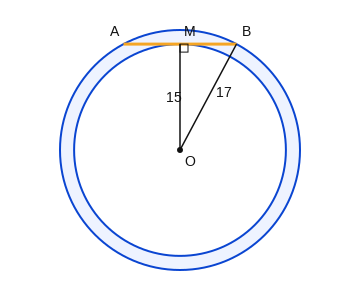
Two concentric circles have radii of 15 cm and 17 cm. Find out the length of the chord of the larger circle that is tangent to the smaller circle.
दो संकेंद्रीय वृत्तों की त्रिज्याएँ 15 cm और 17 cm हैं। बड़े वृत्त की उस जीवा की लंबाई ज्ञात कीजिए जो छोटे वृत्त की स्पर्श रेखा है।
  1. A24 cm
  2. B8 cm
  3. C30 cm
  4. D16 cm
Show answer

Concept: A chord of the outer circle that touches the inner circle is perpendicular to the radius of the inner circle at the point of contact, and that radius bisects the chord.

  1. Let O be the common centre, AB the chord touching the smaller circle at M. Then OM=15, OB=17, OM⟂AB.
  2. In right △OMB: MB=172−152=289−225=64=8cm.
  3. Chord AB=2×MB=16cm.

Trick: Chord length =2R2−r2. Spot the Pythagorean triple 8-15-17 and double the 8.

Answer: (D) 16 cm

अवधारणा: बाहरी वृत्त की वह जीवा जो आंतरिक वृत्त को स्पर्श करे, स्पर्श बिंदु पर आंतरिक त्रिज्या के लंबवत होती है और वह त्रिज्या जीवा को समद्विभाजित करती है।

  1. O उभयनिष्ठ केंद्र, AB जीवा जो छोटे वृत्त को M पर छूती है। तब OM=15, OB=17, OM⟂AB।
  2. समकोण △OMB में: MB=172−152=289−225=64=8cm।
  3. जीवा AB=2×MB=16cm।

ट्रिक: जीवा की लंबाई =2R2−r2। पाइथागोरस त्रिक 8-15-17 पहचानें और 8 को दोगुना करें।

उत्तर: (D) 16 cm

RRB NTPC Graduate CBT 1MathematicsCircles – Chord Tangent to Inner CircleRRB NTPC Graduate CBT 1 2025 · 22 Mar Shift 2 →
Q15693.
The average of three numbers is 20. If two numbers are 13 and 22, the third number is:
तीन संख्याओं का औसत 20 है। यदि दो संख्याएँ 13 और 22 हैं, तो तीसरी संख्या है:
  1. A26
  2. B27
  3. C25
  4. D24
Show answer

Concept: Sum of observations =average×count.

  1. Sum of the three numbers =20×3=60.
  2. Third number =60−(13+22)=60−35=25.

Trick: Deviation method: 13 is 7 below 20, 22 is 2 above → net −5, so the third must be 5 above: 25.

Answer: (C) 25

अवधारणा: प्रेक्षणों का योग =औसत×संख्या।

  1. तीनों संख्याओं का योग =20×3=60।
  2. तीसरी संख्या =60−(13+22)=60−35=25।

ट्रिक: विचलन विधि: 13, 20 से 7 कम; 22, 2 अधिक → शुद्ध −5, अतः तीसरी 5 अधिक होनी चाहिए: 25।

उत्तर: (C) 25

RRB NTPC Graduate CBT 1MathematicsAverageRRB NTPC Graduate CBT 1 2025 · 22 Mar Shift 2 →
Q15694.
The number 22.121212… in the form pq where p and q are integers and q≠0 is:
संख्या 22.121212… को pq के रूप में, जहाँ p और q पूर्णांक हैं और q≠0 है, लिखने पर प्राप्त होता है:
  1. A71033
  2. B74033
  3. C73033
  4. D72033
Show answer

Concept: A pure recurring part of n digits equals that block divided by n nines: 0.12―=1299.

  1. 22.121212…=22+0.12―=22+1299=22+433.
  2. =22×33+433=726+433=73033.
  3. Check: 73033=22.1212… ✓

Trick: Direct formula: 2212−2299=219099=73033 (whole number with repeating block minus whole number, over 99).

Answer: (C) 73033

अवधारणा: n अंकों का शुद्ध आवर्ती भाग उस खंड को n नौ से भाग देने के बराबर है: 0.12―=1299।

  1. 22.121212…=22+0.12―=22+1299=22+433।
  2. =22×33+433=726+433=73033।
  3. जाँच: 73033=22.1212… ✓

ट्रिक: सीधा सूत्र: 2212−2299=219099=73033 (आवर्ती खंड सहित संख्या में से पूर्णांक घटाकर 99 से भाग)।

उत्तर: (C) 73033

RRB NTPC Graduate CBT 1MathematicsRecurring Decimals to FractionsRRB NTPC Graduate CBT 1 2025 · 22 Mar Shift 2 →
Q15695.
If 8, x and 18 are in continued proportion, find the value of x.
यदि 8, x और 18 वितत अनुपात (continued proportion) में हैं, तो x का मान ज्ञात कीजिए।
  1. A18
  2. B14
  3. C12
  4. D8
Show answer

Concept: If a, b, c are in continued proportion then ab=bc, i.e. b2=ac (b is the mean proportional).

  1. x2=8×18=144.
  2. x=144=12 (taking the positive value).
  3. Check: 8:12=12:18=2:3 ✓

Trick: Mean proportional =ac. Here 8×18=144, a perfect square – answer is 12 at sight.

Answer: (C) 12

अवधारणा: यदि a, b, c वितत अनुपात में हों तो ab=bc, अर्थात b2=ac (b मध्यानुपाती है)।

  1. x2=8×18=144।
  2. x=144=12 (धनात्मक मान)।
  3. जाँच: 8:12=12:18=2:3 ✓

ट्रिक: मध्यानुपाती =ac। यहाँ 8×18=144, पूर्ण वर्ग – उत्तर 12 तुरंत।

उत्तर: (C) 12

RRB NTPC Graduate CBT 1MathematicsContinued ProportionRRB NTPC Graduate CBT 1 2025 · 22 Mar Shift 2 →
Q15696.
If 1 is added to each odd digit and 2 is added to each even digit in the number 6134527, what will be the sum of the last and first digits of the new number thus formed?
यदि संख्या 6134527 के प्रत्येक विषम अंक में 1 जोड़ा जाए और प्रत्येक सम अंक में 2 जोड़ा जाए, तो इस प्रकार बनी नई संख्या के अंतिम और पहले अंकों का योग क्या होगा?
  1. A14
  2. B18
  3. C12
  4. D16
Show answer

Concept: Change every digit by the rule, then read the new number.

  1. Number 6134527: odd digits +1, even digits +2.
  2. 6→8, 1→2, 3→4, 4→6, 5→6, 2→4, 7→8 → new number 8246648.
  3. First digit 8, last digit 8 → sum =8+8=16.

Trick: Only the first and last digits are asked – just convert those two: 6→8 and 7→8.

Answer: (D) 16

अवधारणा: नियम से हर अंक बदलें, फिर नई संख्या पढ़ें।

  1. संख्या 6134527: विषम अंक +1, सम अंक +2।
  2. 6→8, 1→2, 3→4, 4→6, 5→6, 2→4, 7→8 → नई संख्या 8246648।
  3. पहला अंक 8, अंतिम अंक 8 → योग =8+8=16।

ट्रिक: केवल पहला और अंतिम अंक पूछा है – बस वही दो बदलें: 6→8, 7→8।

उत्तर: (D) 16

RRB NTPC Graduate CBT 1General Intelligence and ReasoningNumber OperationsRRB NTPC Graduate CBT 1 2025 · 22 Mar Shift 2 →
Q15697.
Based on the English alphabetical order, three of the following four are alike in a certain way and thus form a group. Which is the one that does not belong to that group? (Note: The odd man out is not based on the number of consonants/vowels or their position in the letter cluster)
अंग्रेज़ी वर्णमाला क्रम के आधार पर, निम्नलिखित चार में से तीन एक निश्चित प्रकार से समान हैं और इस प्रकार एक समूह बनाते हैं। वह कौन-सा है जो उस समूह से संबंधित नहीं है? (नोट: असंगत का निर्धारण व्यंजनों/स्वरों की संख्या या अक्षर-समूह में उनकी स्थिति के आधार पर नहीं किया गया है)
  1. ATYS
  2. BYCX
  3. CGKF
  4. DNRM
Show answer

Concept: Write the alphabet positions and compare the gaps.

  1. YCX: 25→3 is +4 (wrapping past Z), 3→24 is −5.
  2. GKF: 7→11 (+4), 11→6 (−5); NRM: 14→18 (+4), 18→13 (−5).
  3. TYS: 20→25 (+5), 25→19 (−6) – different pattern, so TYS is the odd one.

Trick: Three clusters follow +4,−5; the third letter is one place before the first letter (F before G, M before N, X before Y) – but S is not just before T.

Answer: (A) TYS

अवधारणा: अक्षरों के स्थान लिखकर अंतर मिलाएँ।

  1. YCX: 25→3 यानी +4 (Z के बाद घूमकर), 3→24 यानी −5।
  2. GKF: 7→11 (+4), 11→6 (−5); NRM: 14→18 (+4), 18→13 (−5)।
  3. TYS: 20→25 (+5), 25→19 (−6) – अलग पैटर्न, अतः TYS विषम है।

ट्रिक: तीन समूहों में +4,−5; तीसरा अक्षर पहले अक्षर से ठीक एक पहले है (F–G, M–N, X–Y) – पर S, T से ठीक पहले नहीं।

उत्तर: (A) TYS

RRB NTPC Graduate CBT 1General Intelligence and ReasoningLetter Cluster Odd One OutRRB NTPC Graduate CBT 1 2025 · 22 Mar Shift 2 →
Q15698.
In a certain code language, ‘ROAD’ is coded as ‘8657’ and ‘DEAR’ is coded as ‘4567’. What is the code for ‘E’ in the given code language?
एक निश्चित कूट भाषा में, ‘ROAD’ को ‘8657’ के रूप में कूटबद्ध किया जाता है और ‘DEAR’ को ‘4567’ के रूप में कूटबद्ध किया जाता है। दी गई कूट भाषा में ‘E’ का कूट क्या है?
  1. A5
  2. B6
  3. C7
  4. D4
Show answer

Concept: Common letters in two words get common codes; the leftover letter takes the leftover code.

  1. ROAD → 8657, DEAR → 4567. Common letters R, A, D ↔ common codes 5, 6, 7.
  2. In ROAD the extra letter O gets the extra code 8.
  3. In DEAR the extra letter E gets the extra code 4.

Trick: Don't match letter positions – just cancel the common letters and common digits.

Answer: (D) 4

अवधारणा: दो शब्दों के समान अक्षरों के कोड समान होते हैं; बचा अक्षर बचा कोड लेता है।

  1. ROAD → 8657, DEAR → 4567. समान अक्षर R, A, D ↔ समान कोड 5, 6, 7।
  2. ROAD में अतिरिक्त अक्षर O का कोड 8।
  3. DEAR में अतिरिक्त अक्षर E का कोड 4।

ट्रिक: अक्षरों की स्थिति न मिलाएँ – समान अक्षर और समान अंक काट दें।

उत्तर: (D) 4

RRB NTPC Graduate CBT 1General Intelligence and ReasoningCoding-DecodingRRB NTPC Graduate CBT 1 2025 · 22 Mar Shift 2 →
Q15699.
In a certain code language, ‘REST’ is coded as ‘5729’ and ‘SEAT’ is coded as ‘7625’. What is the code for ‘A’ in that language?
एक निश्चित कूट भाषा में, ‘REST’ को ‘5729’ के रूप में कूटबद्ध किया जाता है और ‘SEAT’ को ‘7625’ के रूप में कूटबद्ध किया जाता है। उस भाषा में ‘A’ का कूट क्या है?
  1. A2
  2. B5
  3. C7
  4. D6
Show answer

Concept: Cancel the common letters and common digits of the two words.

  1. REST → 5729, SEAT → 7625. Common letters S, E, T ↔ common codes 5, 7, 2.
  2. REST's extra letter R → extra code 9.
  3. SEAT's extra letter A → extra code 6.

Trick: Whatever digit appears in only one word belongs to the letter that appears in only that word.

Answer: (D) 6

अवधारणा: दोनों शब्दों के समान अक्षर और समान अंक काट दें।

  1. REST → 5729, SEAT → 7625. समान अक्षर S, E, T ↔ समान कोड 5, 7, 2।
  2. REST का अतिरिक्त अक्षर R → अतिरिक्त कोड 9।
  3. SEAT का अतिरिक्त अक्षर A → अतिरिक्त कोड 6।

ट्रिक: जो अंक केवल एक शब्द में है, वह उसी शब्द के अकेले अक्षर का कोड है।

उत्तर: (D) 6

RRB NTPC Graduate CBT 1General Intelligence and ReasoningCoding-DecodingRRB NTPC Graduate CBT 1 2025 · 22 Mar Shift 2 →
Q15700.
In this question, a question is followed by two statements numbered (I) and (II). You have to decide whether the data provided in the statements are sufficient to answer the question. Read both the statements and decide the appropriate answer.
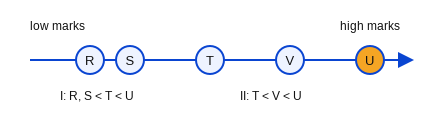
Q. Ritu, Seema, Tanya, Usha, and Varsha scored different marks. Who scored the highest marks?
(I) Tanya scored more than Ritu and Seema but less than Usha.
(II) Varsha scored more than Tanya but less than Usha.
इस प्रश्न में, एक प्रश्न के बाद (I) और (II) क्रमांकित दो कथन दिए गए हैं। आपको यह निर्णय लेना है कि कथनों में दिए गए आँकड़े प्रश्न का उत्तर देने के लिए पर्याप्त हैं या नहीं। दोनों कथनों को पढ़िए और उपयुक्त उत्तर का चयन कीजिए।
प्रश्न. रितु, सीमा, तान्या, उषा और वर्षा ने अलग-अलग अंक प्राप्त किए। सबसे अधिक अंक किसने प्राप्त किए?
(I) तान्या ने रितु और सीमा से अधिक लेकिन उषा से कम अंक प्राप्त किए।
(II) वर्षा ने तान्या से अधिक लेकिन उषा से कम अंक प्राप्त किए।
  1. ABoth statements I and II together (and not statement I alone or statement II alone) are sufficient to answer the questionकथन I और II दोनों मिलकर (और न कि केवल कथन I या केवल कथन II) प्रश्न का उत्तर देने के लिए पर्याप्त हैं
  2. BBoth statements I and II together are NOT sufficient to answer the questionकथन I और II दोनों मिलकर भी प्रश्न का उत्तर देने के लिए पर्याप्त नहीं हैं
  3. CData in Statement II alone is sufficient to answer the question while data in Statement I is notकेवल कथन II के आँकड़े प्रश्न का उत्तर देने के लिए पर्याप्त हैं, जबकि कथन I के आँकड़े पर्याप्त नहीं हैं
  4. DData in Statement I alone is sufficient to answer the question while data in Statement II is notकेवल कथन I के आँकड़े प्रश्न का उत्तर देने के लिए पर्याप्त हैं, जबकि कथन II के आँकड़े पर्याप्त नहीं हैं
Show answer

Concept: Check each statement alone, then together.

  1. Statement I: Ritu, Seema < Tanya < Usha. Varsha is unknown – she could be above Usha. Not sufficient.
  2. Statement II: Tanya < Varsha < Usha. Ritu and Seema unknown. Not sufficient.
  3. Together: Usha is above Tanya, Varsha, Ritu and Seema → Usha scored the highest. Both needed.

Trick: For "who is highest", every person must be placed below someone – any unplaced name kills sufficiency.

Answer: (A) Both statements together are sufficient

अवधारणा: पहले हर कथन अकेले जाँचें, फिर दोनों साथ।

  1. कथन I: रितु, सीमा < तान्या < उषा। वर्षा अज्ञात – वह उषा से ऊपर हो सकती है। अपर्याप्त।
  2. कथन II: तान्या < वर्षा < उषा। रितु, सीमा अज्ञात। अपर्याप्त।
  3. दोनों साथ: उषा, तान्या-वर्षा-रितु-सीमा सबसे ऊपर → उषा सर्वाधिक। दोनों आवश्यक।

ट्रिक: "सबसे ऊपर कौन" के लिए हर व्यक्ति किसी से नीचे रखा होना चाहिए – एक भी अज्ञात नाम पर्याप्तता खत्म कर देता है।

उत्तर: (A) दोनों कथन मिलकर पर्याप्त

RRB NTPC Graduate CBT 1General Intelligence and ReasoningData Sufficiency – RankingRRB NTPC Graduate CBT 1 2025 · 22 Mar Shift 2 →