Question bank

Q&A: practice questions with answers

Search questions on any topic. Filter by exam category, exam, subject and topic, try the question, then open the answer and explanation.

Courses – airGurukul

20,719 questions found.

Q15761.
In Windows 11, which built-in tool opens immediately when a user presses the keyboard shortcut Ctrl + Shift + Esc?
Windows 11 में, जब उपयोगकर्ता कीबोर्ड शॉर्टकट Ctrl + Shift + Esc दबाता है, तो कौन-सा अंतर्निर्मित (built-in) टूल तुरंत खुलता है?
  1. AFile Explorer
  2. BTask Manager
  3. CControl Panel
  4. DSettings
Show answer

Concept: Ctrl + Shift + Esc opens Task Manager directly in Windows (10 and 11).

  1. Ctrl + Alt + Del shows a security screen from which Task Manager is one option; Ctrl + Shift + Esc skips that screen.
  2. Windows + E opens File Explorer; Windows + I opens Settings.

Yaad rakhein: Win+E = Explorer, Win+I = Settings, Ctrl+Shift+Esc = Task Manager.

Answer: (B) Task Manager

अवधारणा: Windows (10 व 11) में Ctrl + Shift + Esc सीधे Task Manager खोलता है।

  1. Ctrl + Alt + Del एक सुरक्षा स्क्रीन दिखाता है जिसमें Task Manager एक विकल्प है; Ctrl + Shift + Esc वह स्क्रीन छोड़ देता है।
  2. Windows + E से File Explorer; Windows + I से Settings खुलता है।

याद रखें: Win+E = Explorer, Win+I = Settings, Ctrl+Shift+Esc = Task Manager.

उत्तर: (B) Task Manager
RRB NTPC Graduate CBT 1General AwarenessComputer awareness – shortcutsRRB NTPC Graduate CBT 1 2025 · 22 Mar Shift 1 →
Q15762.
Which Supreme Court case, decided in April 2025, led to the 16th Presidential Reference under Article 143 concerning timelines for assent to State Bills?
अप्रैल 2025 में निर्णीत किस सर्वोच्च न्यायालय मामले के कारण राज्य विधेयकों पर स्वीकृति की समय-सीमा से संबंधित अनुच्छेद 143 के अंतर्गत 16वाँ राष्ट्रपति संदर्भ (Presidential Reference) किया गया?
  1. AState of Tamil Nadu vs Governor of Tamil Naduतमिलनाडु राज्य बनाम तमिलनाडु के राज्यपाल
  2. BNabam Rebia vs Deputy Speaker, Arunachal Pradeshनबाम रेबिया बनाम उपाध्यक्ष, अरुणाचल प्रदेश
  3. CS.R. Bommai vs Union of Indiaएस.आर. बोम्मई बनाम भारत संघ
  4. DKaiser-I-Hind Pvt. Ltd. vs National Textile Corporationकैसर-ए-हिंद प्रा. लि. बनाम नेशनल टेक्सटाइल कॉरपोरेशन
Show answer

Concept: In State of Tamil Nadu vs Governor of Tamil Nadu (8 April 2025) the Supreme Court held the Governor’s withholding of 10 Bills illegal and laid down timelines for Governors and the President to act on State Bills.

  1. President Droupadi Murmu then sought the Court’s opinion under Article 143 (May 2025) on whether such timelines can be imposed – the 16th Presidential Reference.
  2. Nabam Rebia (2016) and S.R. Bommai (1994) are earlier Governor-related cases, not the trigger here.

Yaad rakhein: TN Governor case (Apr 2025) → Article 143 reference → SC advisory opinion (Nov 2025): no fixed timelines can be imposed.

Answer: (A) State of Tamil Nadu vs Governor of Tamil Nadu

अवधारणा: State of Tamil Nadu vs Governor of Tamil Nadu (8 अप्रैल 2025) में सर्वोच्च न्यायालय ने राज्यपाल द्वारा 10 विधेयकों को रोकना अवैध ठहराया और राज्यपाल व राष्ट्रपति के लिए राज्य विधेयकों पर निर्णय की समय-सीमाएँ तय कीं।

  1. इसके बाद राष्ट्रपति द्रौपदी मुर्मु ने अनुच्छेद 143 के तहत (मई 2025) राय माँगी कि क्या ऐसी समय-सीमाएँ थोपी जा सकती हैं – यह 16वाँ राष्ट्रपति संदर्भ था।
  2. Nabam Rebia (2016) और S.R. Bommai (1994) राज्यपाल से जुड़े पुराने मामले हैं, इस संदर्भ का कारण नहीं।

याद रखें: TN राज्यपाल मामला (अप्रैल 2025) → अनुच्छेद 143 संदर्भ → SC की परामर्शी राय (नवंबर 2025): निश्चित समय-सीमा नहीं थोपी जा सकती।

उत्तर: (A) State of Tamil Nadu vs Governor of Tamil Nadu

RRB NTPC Graduate CBT 1General AwarenessCurrent affairs – Presidential Reference 2025RRB NTPC Graduate CBT 1 2025 · 22 Mar Shift 1 →
Q15763.
According to the Gandhian principles incorporated in the Directive Principles of State Policy, the State shall endeavor to promote:
राज्य के नीति निदेशक तत्वों में सम्मिलित गांधीवादी सिद्धांतों के अनुसार, राज्य निम्नलिखित को बढ़ावा देने का प्रयास करेगा:
  1. ALarge-scale corporate farmingबड़े पैमाने पर कॉरपोरेट खेती
  2. BIndustrialization in urban areasशहरी क्षेत्रों में औद्योगीकरण
  3. CCottage industries on an individual or cooperative basis in rural areasग्रामीण क्षेत्रों में व्यक्तिगत या सहकारी आधार पर कुटीर उद्योग
  4. DForeign trade agreementsविदेशी व्यापार समझौते
Show answer

Concept: Article 43 (a Gandhian principle) directs the State to promote cottage industries on an individual or co-operative basis in rural areas.

  1. Other Gandhian DPSPs: Art. 40 village panchayats, Art. 46 SC/ST/weaker sections, Art. 47 prohibition of intoxicants, Art. 48 cow protection.
  2. Corporate farming, urban industrialisation and foreign trade are not Gandhian ideals.

Yaad rakhein: Gandhian DPSP = 40, 43, 43B, 46, 47, 48.

Answer: (C) Cottage industries on an individual or cooperative basis in rural areas

अवधारणा: अनुच्छेद 43 (गांधीवादी सिद्धांत) राज्य को ग्रामीण क्षेत्रों में व्यक्तिगत या सहकारी आधार पर कुटीर उद्योगों को बढ़ावा देने का निर्देश देता है।

  1. अन्य गांधीवादी DPSP: अनु. 40 ग्राम पंचायत, अनु. 46 SC/ST/कमज़ोर वर्ग, अनु. 47 मादक पदार्थों का निषेध, अनु. 48 गो-संरक्षण।
  2. कॉर्पोरेट खेती, शहरी औद्योगीकरण और विदेशी व्यापार गांधीवादी आदर्श नहीं हैं।

याद रखें: गांधीवादी DPSP = 40, 43, 43B, 46, 47, 48.

उत्तर: (C) Cottage industries on an individual or cooperative basis in rural areas

RRB NTPC Graduate CBT 1General AwarenessPolity – Gandhian DPSPsRRB NTPC Graduate CBT 1 2025 · 22 Mar Shift 1 →
Q15764.
Momentum of an object is defined as the product of its mass and velocity, hence what are its SI units?
किसी वस्तु का संवेग (momentum) उसके द्रव्यमान और वेग के गुणनफल के रूप में परिभाषित किया जाता है, अतः इसकी SI इकाई क्या है?
  1. Akg m s–1
  2. Bkg m s–2
  3. Ckg m s
  4. Dg m s–1
Show answer

Concept: Momentum p=mv; unit = unit of mass × unit of velocity.

  1. SI unit of mass = kg, SI unit of velocity = m s−1.
  2. So momentum has the unit kg m s−1 (equivalently N s).
  3. kg m s−2 is the unit of force (newton), so B is wrong.

Yaad rakhein: Momentum = kg m s−1 = N s; Force = kg m s−2 = N; Impulse = N s.

Answer: (A) kg m s−1

अवधारणा: संवेग p=mv; मात्रक = द्रव्यमान का मात्रक × वेग का मात्रक।

  1. द्रव्यमान का SI मात्रक kg, वेग का m s−1.
  2. अतः संवेग का मात्रक kg m s−1 (= N s)।
  3. kg m s−2 बल (न्यूटन) का मात्रक है, अतः B गलत।

याद रखें: संवेग = kg m s−1 = N s; बल = kg m s−2 = N; आवेग = N s.

उत्तर: (A) kg m s−1

RRB NTPC Graduate CBT 1General AwarenessPhysics – unitsRRB NTPC Graduate CBT 1 2025 · 22 Mar Shift 1 →
Q15765.
Under the Greenhouse Gases Emission Intensity Target Rules, 2025, if an obligated entity fails to meet targets, then environmental compensation is linked to carbon credit prices. The compensation for shortfall is:
ग्रीनहाउस गैस उत्सर्जन तीव्रता लक्ष्य नियम, 2025 के अंतर्गत, यदि कोई बाध्य इकाई (obligated entity) लक्ष्यों को पूरा करने में विफल रहती है, तो पर्यावरणीय क्षतिपूर्ति कार्बन क्रेडिट की कीमतों से जुड़ी होती है। कमी के लिए क्षतिपूर्ति है:
  1. AA fixed penalty per tonne decided by SPCBsSPCB द्वारा निर्धारित प्रति टन एक निश्चित दंड
  2. BThree times the average traded price of carbon credit certificatesकार्बन क्रेडिट प्रमाणपत्रों के औसत कारोबारी मूल्य का तीन गुना
  3. CTwice the average traded price of carbon credit certificatesकार्बन क्रेडिट प्रमाणपत्रों के औसत कारोबारी मूल्य का दो गुना
  4. DEqual to the average traded price of carbon credit certificatesकार्बन क्रेडिट प्रमाणपत्रों के औसत कारोबारी मूल्य के बराबर
Show answer

Concept: The Greenhouse Gases Emission Intensity (GEI) Target Rules, 2025, notified under the Environment (Protection) Act, operationalise the Carbon Credit Trading Scheme.

  1. An obligated entity that fails to meet its GEI target must pay environmental compensation equal to twice the average trading price of carbon credit certificates in that compliance cycle, for the shortfall.
  2. The compensation is collected by CPCB, not fixed by SPCBs.

Yaad rakhein: GEI Rules 2025 – shortfall penalty = 2 × average carbon-credit price.

Answer: (C) Twice the average traded price of carbon credit certificates

अवधारणा: ग्रीनहाउस गैस उत्सर्जन तीव्रता (GEI) लक्ष्य नियम, 2025, पर्यावरण (संरक्षण) अधिनियम के तहत अधिसूचित, कार्बन क्रेडिट ट्रेडिंग स्कीम को लागू करते हैं।

  1. लक्ष्य पूरा न करने वाली बाध्य इकाई को कमी (shortfall) पर उस अनुपालन-चक्र में कार्बन क्रेडिट प्रमाणपत्रों के औसत व्यापार मूल्य का दोगुना पर्यावरणीय मुआवज़ा देना होता है।
  2. यह मुआवज़ा CPCB वसूलता है, SPCB तय नहीं करते।

याद रखें: GEI नियम 2025 – कमी पर दंड = 2 × औसत कार्बन-क्रेडिट मूल्य।

उत्तर: (C) Twice the average traded price of carbon credit certificates

RRB NTPC Graduate CBT 1General AwarenessCurrent affairs – GEI Target Rules 2025RRB NTPC Graduate CBT 1 2025 · 22 Mar Shift 1 →
Q15766.
A shopkeeper fixes the marked price of an item 100% above its cost price. What percentage of discount on marked price should be allowed to gain 88%?
एक दुकानदार किसी वस्तु का अंकित मूल्य उसके क्रय मूल्य से 100% अधिक निर्धारित करता है। 88% लाभ प्राप्त करने के लिए अंकित मूल्य पर कितने प्रतिशत छूट दी जानी चाहिए?
  1. A4%
  2. B6%
  3. C5%
  4. D3%
Show answer

Concept: Take CP = 100. Marked price is 100% above CP, and the required SP comes from the desired gain; discount is the gap between MP and SP as a % of MP.

  1. CP =100⇒ MP =200.
  2. Required SP for 88% gain =188.
  3. Discount =200−188=12; Discount% =12200×100=6%.

Trick: (100+markup)(100−discount)=100(100+gain) → 200(100−d)=18800⇒d=6.

Answer: (B) 6%

अवधारणा: CP = 100 मानें। अंकित मूल्य (MP) CP से 100% अधिक है, और इच्छित लाभ से SP निकलता है; छूट = MP और SP का अंतर, MP के % में।

  1. CP =100⇒ MP =200।
  2. 88% लाभ के लिए SP =188।
  3. छूट =200−188=12; छूट% =12200×100=6%।

ट्रिक: (100+markup)(100−discount)=100(100+gain) → 200(100−d)=18800⇒d=6।

उत्तर: (B) 6%

RRB NTPC Graduate CBT 1MathematicsProfit, Loss and DiscountRRB NTPC Graduate CBT 1 2025 · 22 Mar Shift 1 →
Q15767.
The standard deviation of 7 consecutive integers with mean 0 is _______.
माध्य 0 वाले 7 क्रमागत पूर्णांकों का मानक विचलन (standard deviation) _______ है।
  1. A1
  2. B3
  3. C0
  4. D2
Show answer

Concept: 7 consecutive integers with mean 0 are symmetric about 0: −3,−2,−1,0,1,2,3. SD =∑(x−x¯)2n.

  1. Squared deviations: 9+4+1+0+1+4+9=28.
  2. Variance =287=4.
  3. SD =4=2.

Trick: For n consecutive integers, variance =n2−112; here 49−112=4⇒ SD =2.

Answer: (D) 2

अवधारणा: माध्य 0 वाले 7 क्रमागत पूर्णांक 0 के सममित होंगे: −3,−2,−1,0,1,2,3। मानक विचलन (SD) =∑(x−x¯)2n।

  1. विचलनों के वर्ग: 9+4+1+0+1+4+9=28।
  2. प्रसरण (variance) =287=4।
  3. SD =4=2।

ट्रिक: n क्रमागत पूर्णांकों का प्रसरण =n2−112; यहाँ 49−112=4⇒ SD =2।

उत्तर: (D) 2

RRB NTPC Graduate CBT 1MathematicsStatistics – Standard DeviationRRB NTPC Graduate CBT 1 2025 · 22 Mar Shift 1 →
Q15768.
Convert the recurring decimal 0.26― into a vulgar fraction.
आवर्ती दशमलव 0.26― को साधारण भिन्न (vulgar fraction) में परिवर्तित कीजिए।
  1. A115
  2. B415
  3. C715
  4. D215
Show answer

Concept: For a mixed recurring decimal, fraction =(all digits)−(non-recurring digits)9 for each recurring digit, then 0 for each non-recurring digit.

  1. 0.26―: all digits = 26, non-recurring part = 2.
  2. 0.26―=26−290=2490.
  3. Simplify: 2490=415. Check: 4÷15=0.2666…

Trick: Algebra check: x=0.26―⇒10x=2.6―, 100x=26.6―, subtract: 90x=24.

Answer: (B) 415

अवधारणा: मिश्रित आवर्ती दशमलव के लिए भिन्न =(सभी अंक)−(अनावर्ती अंक)हर आवर्ती अंक के लिए 9, फिर हर अनावर्ती अंक के लिए 0।

  1. 0.26―: सभी अंक = 26, अनावर्ती भाग = 2।
  2. 0.26―=26−290=2490।
  3. सरल करें: 2490=415। जाँच: 4÷15=0.2666…

ट्रिक: बीजगणित से जाँच: x=0.26―⇒10x=2.6―, 100x=26.6―, घटाने पर 90x=24।

उत्तर: (B) 415

RRB NTPC Graduate CBT 1MathematicsRecurring DecimalsRRB NTPC Graduate CBT 1 2025 · 22 Mar Shift 1 →
Q15769.
20% of a number is more than 20% of 620 by 200. The number is:
किसी संख्या का 20%, 620 के 20% से 200 अधिक है। वह संख्या है:
  1. A1470
  2. B1670
  3. C1620
  4. D1720
Show answer

Concept: Translate the statement into an equation: 20% of N = 20% of 620 + 200.

  1. 20% of 620 =124.
  2. 0.2N=124+200=324.
  3. N=3240.2=1620.

Trick: 20% of (N − 620) = 200 ⇒ N−620=1000⇒N=1620.

Answer: (C) 1620

अवधारणा: कथन को समीकरण में बदलें: N का 20% = 620 का 20% + 200।

  1. 620 का 20% =124।
  2. 0.2N=124+200=324।
  3. N=3240.2=1620।

ट्रिक: (N − 620) का 20% = 200 ⇒ N−620=1000⇒N=1620।

उत्तर: (C) 1620

RRB NTPC Graduate CBT 1MathematicsPercentageRRB NTPC Graduate CBT 1 2025 · 22 Mar Shift 1 →
Q15770.
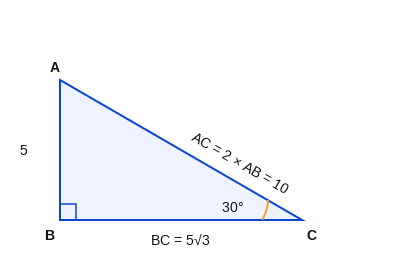
Let ABC be a right-angled triangle such that ∠B = 90°, ∠ACB = 30° and AB = 5 cm. Find the value (in cm) of AC + BC.
मान लीजिए ABC एक समकोण त्रिभुज है जिसमें ∠B = 90°, ∠ACB = 30° और AB = 5 cm है। AC + BC का मान (cm में) ज्ञात कीजिए।
  1. A10+23
  2. B53
  3. C10+53
  4. D123
Show answer

Concept: In a right triangle with a 30° angle, the side opposite 30° is half the hypotenuse and the other leg is 3 times it.

  1. ∠B = 90°, ∠C = 30° → AB is opposite 30°: AB=5.
  2. Hypotenuse AC=2×AB=10; BC=AB3=53 (or tan30∘=ABBC).
  3. AC+BC=10+53.

Trick: 30-60-90 sides are in ratio 1:3:2 (opposite 30°, 60°, 90°). Multiply by 5.

Answer: (C) 10+53

अवधारणा: 30° कोण वाले समकोण त्रिभुज में 30° के सामने की भुजा कर्ण की आधी और दूसरी भुजा उसकी 3 गुनी होती है।

  1. ∠B = 90°, ∠C = 30° → AB, 30° के सामने है: AB=5।
  2. कर्ण AC=2×AB=10; BC=AB3=53 (या tan30∘=ABBC)।
  3. AC+BC=10+53।

ट्रिक: 30-60-90 की भुजाएँ 1:3:2 (30°, 60°, 90° के सामने) के अनुपात में; 5 से गुणा करें।

उत्तर: (C) 10+53

RRB NTPC Graduate CBT 1MathematicsTrigonometry – 30-60-90 TriangleRRB NTPC Graduate CBT 1 2025 · 22 Mar Shift 1 →
Q15771.
A tourist covers his 120 km journey in three stages. In the first stage, he travels at a speed of x km/hr. In the second stage, he increases his speed by 50%. In the third stage, he reduces his second-stage speed by 20%. He spends equal time on all the 3 stages, and his average speed for the entire journey is 48 km/hr. Find the value of x correct to one decimal place.
एक पर्यटक अपनी 120 km की यात्रा तीन चरणों में पूरी करता है। पहले चरण में वह x km/hr की चाल से यात्रा करता है। दूसरे चरण में वह अपनी चाल 50% बढ़ा देता है। तीसरे चरण में वह अपनी दूसरे चरण की चाल को 20% कम कर देता है। वह तीनों चरणों में समान समय व्यतीत करता है, और पूरी यात्रा के लिए उसकी औसत चाल 48 km/hr है। x का मान एक दशमलव स्थान तक सही ज्ञात कीजिए।
  1. A38.9
  2. B38.3
  3. C39.3
  4. D40.3
Show answer

Concept: When equal time is spent at different speeds, average speed = simple average of the speeds.

  1. Speeds: stage 1 =x, stage 2 =1.5x, stage 3 =0.8×1.5x=1.2x.
  2. Average =x+1.5x+1.2x3=3.7x3=48.
  3. x=1443.7≈38.92≈38.9.

Trick: Equal time → arithmetic mean of speeds; equal distance → harmonic mean. The 120 km is not needed here.

Answer: (A) 38.9

अवधारणा: जब अलग-अलग चालों पर बराबर समय लगे, औसत चाल = चालों का साधारण औसत।

  1. चालें: चरण 1 =x, चरण 2 =1.5x, चरण 3 =0.8×1.5x=1.2x।
  2. औसत =x+1.5x+1.2x3=3.7x3=48।
  3. x=1443.7≈38.92≈38.9।

ट्रिक: बराबर समय → चालों का समांतर माध्य; बराबर दूरी → हरात्मक माध्य। यहाँ 120 km की ज़रूरत ही नहीं।

उत्तर: (A) 38.9

RRB NTPC Graduate CBT 1MathematicsAverage SpeedRRB NTPC Graduate CBT 1 2025 · 22 Mar Shift 1 →
Q15772.
If A's salary is 130% more than that of B, then by how much percent is B's salary less than that of A (correct to 2 decimal places)?
यदि A का वेतन B के वेतन से 130% अधिक है, तो B का वेतन A के वेतन से कितने प्रतिशत कम है (2 दशमलव स्थानों तक सही)?
  1. A58.42%
  2. B56.52%
  3. C55.88%
  4. D54.62%
Show answer

Concept: If A is p% more than B, B is less than A by p100+p×100%.

  1. Let B =100; then A =230.
  2. B is less than A by 230−100=130, on base A.
  3. 130230×100=56.52%.

Trick: 130230=1323; 13÷23=0.5652. Always use the larger value as the base when asking "less than".

Answer: (B) 56.52%

अवधारणा: यदि A, B से p% अधिक है तो B, A से p100+p×100% कम है।

  1. B =100 लें; तब A =230।
  2. B, A से 230−100=130 कम है, आधार A।
  3. 130230×100=56.52%।

ट्रिक: 130230=1323; 13÷23=0.5652। "कम" पूछने पर बड़े मान को आधार बनाएँ।

उत्तर: (B) 56.52%

RRB NTPC Graduate CBT 1MathematicsPercentage ComparisonRRB NTPC Graduate CBT 1 2025 · 22 Mar Shift 1 →
Q15773.
Find the solution of the following system of linear equations:
x + 4y + 2z = 12
2x − y + z = 3
x + y − z = 0
निम्नलिखित रैखिक समीकरण निकाय का हल ज्ञात कीजिए:
x + 4y + 2z = 12
2x − y + z = 3
x + y − z = 0
  1. Ax=52, y=1, z=32
  2. Bx=1, y=52, z=32
  3. Cx=1, y=32, z=52
  4. Dx=32, y=1, z=52
Show answer

Concept: Use the simplest equation to substitute one variable and reduce to two equations.

  1. From x+y−z=0: z=x+y.
  2. Eq. 1: x+4y+2(x+y)=12⇒3x+6y=12⇒x+2y=4.
  3. Eq. 2: 2x−y+(x+y)=3⇒3x=3⇒x=1.
  4. y=4−12=32, z=1+32=52.

Trick: Options can be tested: only x=1,y=32,z=52 satisfies x+y−z=0 and 2x−y+z=3 together.

Answer: (C) x=1, y=32, z=52

अवधारणा: सबसे सरल समीकरण से एक चर प्रतिस्थापित कर दो समीकरणों तक लाएँ।

  1. x+y−z=0 से: z=x+y।
  2. समीकरण 1: x+4y+2(x+y)=12⇒3x+6y=12⇒x+2y=4।
  3. समीकरण 2: 2x−y+(x+y)=3⇒3x=3⇒x=1।
  4. y=4−12=32, z=1+32=52।

ट्रिक: विकल्प जाँचें: केवल x=1,y=32,z=52 ही x+y−z=0 और 2x−y+z=3 दोनों को संतुष्ट करता है।

उत्तर: (C) x=1, y=32, z=52

RRB NTPC Graduate CBT 1MathematicsLinear Equations in Three VariablesRRB NTPC Graduate CBT 1 2025 · 22 Mar Shift 1 →
Q15774.
The mode of the following data is 36. Find the missing frequency in it.
Class Interval0-1010-2020-3030-4040-50
Frequency46--95
निम्नलिखित आँकड़ों का बहुलक (mode) 36 है। इसमें लुप्त बारंबारता ज्ञात कीजिए।
वर्ग अंतराल0-1010-2020-3030-4040-50
बारंबारता46--95
  1. A3
  2. B5
  3. C4
  4. D6
Show answer

Concept: Mode =l+f1−f02f1−f0−f2×h, where f1 = modal-class frequency, f0, f2 = frequencies of the classes before and after.

  1. Mode 36 lies in 30–40 → l=30, h=10, f1=9, f2=5, f0=x (20–30).
  2. 36=30+9−x18−x−5×10⇒9−x13−x=0.6.
  3. 9−x=7.8−0.6x⇒0.4x=1.2⇒x=3.

Trick: Check: 9−313−3=610=0.6 → 30+6=36 ✓.

Answer: (A) 3

अवधारणा: बहुलक =l+f1−f02f1−f0−f2×h, जहाँ f1 = बहुलक वर्ग की बारंबारता, f0, f2 = पहले और बाद के वर्गों की बारंबारताएँ।

  1. बहुलक 36, वर्ग 30–40 में → l=30, h=10, f1=9, f2=5, f0=x (20–30)।
  2. 36=30+9−x18−x−5×10⇒9−x13−x=0.6।
  3. 9−x=7.8−0.6x⇒0.4x=1.2⇒x=3।

ट्रिक: जाँच: 9−313−3=610=0.6 → 30+6=36 ✓।

उत्तर: (A) 3

RRB NTPC Graduate CBT 1MathematicsStatistics – Mode of Grouped DataRRB NTPC Graduate CBT 1 2025 · 22 Mar Shift 1 →
Q15775.
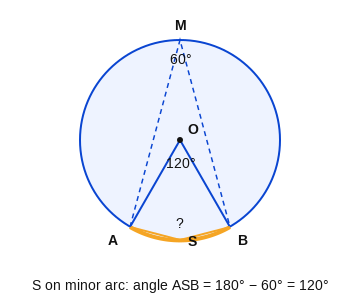
Let C be a circle with centre O and AB be a minor arc on C. Let S be a point on the minor arc AB. If AB subtends an angle 120° at O, then find the measure of ∠ASB.
मान लीजिए C केंद्र O वाला एक वृत्त है और AB, C पर एक लघु चाप है। मान लीजिए S लघु चाप AB पर एक बिंदु है। यदि AB, O पर 120° का कोण अंतरित करता है, तो ∠ASB की माप ज्ञात कीजिए।
  1. A120°
  2. B110°
  3. C100°
  4. D60°
Show answer

Concept: Angle at the centre = 2 × angle at any point of the remaining (major) arc; angles in opposite segments are supplementary.

  1. ∠AOB = 120° → for a point M on the major arc, ∠AMB =120∘2=60∘.
  2. S lies on the minor arc, so ASBM is a cyclic quadrilateral: ∠ASB =180∘−60∘=120∘.

Trick: Point on the minor arc sees the chord at 180∘−central angle2; here 180∘−60∘=120∘. 60° (option D) is the trap for a point on the major arc.

Answer: (A) 120°

अवधारणा: केंद्र पर कोण = शेष (दीर्घ) चाप के किसी बिंदु पर कोण का 2 गुना; विपरीत वृत्तखंडों के कोण संपूरक होते हैं।

  1. ∠AOB = 120° → दीर्घ चाप के बिंदु M पर ∠AMB =120∘2=60∘।
  2. S लघु चाप पर है, अतः ASBM चक्रीय चतुर्भुज है: ∠ASB =180∘−60∘=120∘।

ट्रिक: लघु चाप का बिंदु जीवा को 180∘−केंद्रीय कोण2 पर देखता है; यहाँ 180∘−60∘=120∘। 60° (विकल्प D) दीर्घ चाप के बिंदु का जाल है।

उत्तर: (A) 120°

RRB NTPC Graduate CBT 1MathematicsCircle – Angles in SegmentsRRB NTPC Graduate CBT 1 2025 · 22 Mar Shift 1 →
Q15776.
Two pipes can fill a cistern in 24 minutes and 36 minutes, respectively. A third pipe can empty it in 18 minutes. If all three are opened together, how long will it take to fill the tank?
दो पाइप एक टंकी को क्रमशः 24 मिनट और 36 मिनट में भर सकते हैं। एक तीसरा पाइप इसे 18 मिनट में खाली कर सकता है। यदि तीनों पाइप एक साथ खोल दिए जाएँ, तो टंकी को भरने में कितना समय लगेगा?
  1. A144 minutes144 मिनट
  2. B60 minutes60 मिनट
  3. C108 minutes108 मिनट
  4. D72 minutes72 मिनट
Show answer

Concept: Take total capacity = LCM of the times; add filling rates, subtract the emptying rate.

  1. Capacity =LCM(24,36,18)=72 units.
  2. Rates: 7224=3, 7236=2, outlet 7218=−4 units/min.
  3. Net =3+2−4=1 unit/min → time =72 minutes.

Trick: With LCM units the net rate is often 1 or 2 – here net 1 unit/min means time = capacity = 72 min.

Answer: (D) 72 minutes

अवधारणा: कुल क्षमता = समयों का LCM लें; भरने की दरें जोड़ें, खाली करने की दर घटाएँ।

  1. क्षमता =LCM(24,36,18)=72 इकाई।
  2. दरें: 7224=3, 7236=2, निकास 7218=−4 इकाई/मिनट।
  3. शुद्ध =3+2−4=1 इकाई/मिनट → समय =72 मिनट।

ट्रिक: LCM इकाइयों में शुद्ध दर प्रायः 1 या 2 आती है – यहाँ 1 इकाई/मिनट, अतः समय = क्षमता = 72 मिनट।

उत्तर: (D) 72 minutes

RRB NTPC Graduate CBT 1MathematicsPipes and CisternsRRB NTPC Graduate CBT 1 2025 · 22 Mar Shift 1 →
Q15777.
100 men have provisions for 26 days. If 48 men have left, for how many days the same provisions would last for the remaining men?
100 आदमियों के पास 26 दिनों की खाद्य सामग्री है। यदि 48 आदमी चले जाएँ, तो वही खाद्य सामग्री शेष आदमियों के लिए कितने दिनों तक चलेगी?
  1. A54
  2. B48
  3. C50
  4. D52
Show answer

Concept: Total provision (man-days) is constant: M1D1=M2D2.

  1. Man-days =100×26=2600.
  2. Remaining men =100−48=52.
  3. D2=260052=50 days.

Trick: Fewer men → more days (inverse). 10052×26=260052=50.

Answer: (C) 50

अवधारणा: कुल राशन (व्यक्ति-दिन) स्थिर रहता है: M1D1=M2D2।

  1. व्यक्ति-दिन =100×26=2600।
  2. शेष व्यक्ति =100−48=52।
  3. D2=260052=50 दिन।

ट्रिक: कम व्यक्ति → अधिक दिन (व्युत्क्रम)। 10052×26=260052=50।

उत्तर: (C) 50

RRB NTPC Graduate CBT 1MathematicsInverse Proportion – Men and ProvisionsRRB NTPC Graduate CBT 1 2025 · 22 Mar Shift 1 →
Q15778.
The ratio of the ages of two persons, P and Q, is 3 : 4. After 6 years, the ratio of their ages will become 4 : 5. What is the present age of P?
दो व्यक्तियों P और Q की आयु का अनुपात 3 : 4 है। 6 वर्ष बाद उनकी आयु का अनुपात 4 : 5 हो जाएगा। P की वर्तमान आयु क्या है?
  1. A18 years18 वर्ष
  2. B30 years30 वर्ष
  3. C20 years20 वर्ष
  4. D13 years13 वर्ष
Show answer

Concept: Write present ages as multiples of the ratio and form an equation for the future ratio.

  1. Let P =3x, Q =4x.
  2. After 6 years: 3x+64x+6=45⇒15x+30=16x+24⇒x=6.
  3. P =3×6=18 years.

Trick: Difference of ages is constant: x (present) = 1 unit (future) and the units differ by 6 years → x=6.

Answer: (A) 18 years

अवधारणा: वर्तमान आयु को अनुपात के गुणज में लिखें और भविष्य के अनुपात का समीकरण बनाएँ।

  1. P =3x, Q =4x लें।
  2. 6 वर्ष बाद: 3x+64x+6=45⇒15x+30=16x+24⇒x=6।
  3. P =3×6=18 वर्ष।

ट्रिक: आयु का अंतर स्थिर: वर्तमान में x = भविष्य में 1 इकाई, और इकाइयों में 6 वर्ष का अंतर → x=6।

उत्तर: (A) 18 years

RRB NTPC Graduate CBT 1MathematicsRatio – AgesRRB NTPC Graduate CBT 1 2025 · 22 Mar Shift 1 →
Q15779.
Find the number of possible values for a natural number N such that the LCM of 120 and N is 360, and the HCF of 900 and N is 90.
एक प्राकृत संख्या N के संभव मानों की संख्या ज्ञात कीजिए, जिसके लिए 120 और N का LCM 360 है, तथा 900 और N का HCF 90 है।
  1. A4
  2. B3
  3. C1
  4. D2
Show answer

Concept: Compare powers of each prime. LCM takes the maximum power, HCF the minimum.

  1. 120=23·3·5, 360=23·32·5, 900=22·32·52, 90=2·32·5. Let N=2a3b5c (no other primes, since N | 360).
  2. Prime 2: min(2,a)=1⇒a=1. Prime 3: max(1,b)=2 and min(2,b)=2⇒b=2. Prime 5: min(2,c)=1⇒c=1.
  3. N=2·9·5=90 only. Check: LCM(120, 90) = 360 ✓, HCF(900, 90) = 90 ✓.

Trick: N must be a multiple of HCF 90 and a divisor of LCM 360: candidates 90, 180, 360; only 90 keeps HCF(900, N) = 90.

Answer: (C) 1

अवधारणा: हर अभाज्य की घातें मिलाएँ। LCM में अधिकतम घात, HCF में न्यूनतम घात आती है।

  1. 120=23·3·5, 360=23·32·5, 900=22·32·52, 90=2·32·5। N=2a3b5c लें (अन्य अभाज्य नहीं, क्योंकि N, 360 को विभाजित करता है)।
  2. अभाज्य 2: min(2,a)=1⇒a=1। अभाज्य 3: max(1,b)=2 और min(2,b)=2⇒b=2। अभाज्य 5: min(2,c)=1⇒c=1।
  3. केवल N=2·9·5=90। जाँच: LCM(120, 90) = 360 ✓, HCF(900, 90) = 90 ✓।

ट्रिक: N, HCF 90 का गुणज और LCM 360 का भाजक होना चाहिए: 90, 180, 360; केवल 90 पर HCF(900, N) = 90 रहता है।

उत्तर: (C) 1

RRB NTPC Graduate CBT 1MathematicsLCM and HCF – Prime FactorisationRRB NTPC Graduate CBT 1 2025 · 22 Mar Shift 1 →
Q15780.
At what rate per annum will a sum of money become five times itself in 10 years under simple interest?
साधारण ब्याज पर वार्षिक कितनी दर से एक धनराशि 10 वर्षों में स्वयं की पाँच गुनी हो जाएगी?
  1. A80%
  2. B38%
  3. C40%
  4. D42%
Show answer

Concept: If a sum becomes n times under SI, the interest is (n−1) times the principal: R=(n−1)×100T.

  1. Five times → SI =4P.
  2. 4P=P×R×10100⇒R=40%.

Trick: R=(5−1)×10010=40% per annum.

Answer: (C) 40%

अवधारणा: यदि साधारण ब्याज पर राशि n गुनी हो जाए तो ब्याज मूलधन का (n−1) गुना होता है: R=(n−1)×100T।

  1. पाँच गुना → SI =4P।
  2. 4P=P×R×10100⇒R=40%।

ट्रिक: R=(5−1)×10010=40% वार्षिक।

उत्तर: (C) 40%

RRB NTPC Graduate CBT 1MathematicsSimple InterestRRB NTPC Graduate CBT 1 2025 · 22 Mar Shift 1 →