Question bank

Q&A: practice questions with answers

Search questions on any topic. Filter by exam category, exam, subject and topic, try the question, then open the answer and explanation.

Courses – airGurukul

20,719 questions found.

Q15861.
Which of these Union Territories has a legislative assembly and council of ministers?
इनमें से किस केंद्र शासित प्रदेश में विधान सभा और मंत्रिपरिषद है?
  1. ADaman and Diuदमन और दीव
  2. BAndaman and Nicobar Islandsअंडमान और निकोबार द्वीप समूह
  3. CPuducherryपुडुचेरी
  4. DDadra and Nagar Haveliदादरा और नगर हवेली
Show answer

Concept: Only Delhi, Puducherry and Jammu & Kashmir are UTs with a legislative assembly and council of ministers (Articles 239A/239AA).

  1. Puducherry got its assembly under the Government of Union Territories Act, 1963.
  2. Andaman & Nicobar and Dadra & Nagar Haveli and Daman & Diu are administered directly through an Administrator.

Yaad rakhein: UTs with assembly = D-P-J (Delhi, Puducherry, J&K).

Answer: (C) Puducherry

अवधारणा: केवल दिल्ली, पुडुचेरी और जम्मू-कश्मीर ऐसे UT हैं जिनमें विधानसभा और मंत्रिपरिषद है (अनुच्छेद 239A/239AA)।

  1. पुडुचेरी को विधानसभा Government of Union Territories Act, 1963 से मिली।
  2. अंडमान-निकोबार तथा दादरा-नगर हवेली और दमन-दीव सीधे प्रशासक द्वारा शासित हैं।

याद रखें: विधानसभा वाले UT = D-P-J (दिल्ली, पुडुचेरी, J&K)।

उत्तर: (C) Puducherry (पुडुचेरी)
RRB NTPC Graduate CBT 1General AwarenessUnion Territories with legislatureRRB NTPC Graduate CBT 1 2025 · 19 Mar Shift 3 →
Q15862.
Which Article of the Indian Constitution was given practical effect through the 73rd Constitutional Amendment Act, 1992, leading to the establishment of the Panchayati Raj System in India?
भारतीय संविधान के किस अनुच्छेद को 73वें संविधान संशोधन अधिनियम, 1992 के माध्यम से व्यावहारिक रूप दिया गया, जिससे भारत में पंचायती राज प्रणाली की स्थापना हुई?
  1. AArticle 38अनुच्छेद 38
  2. BArticle 40अनुच्छेद 40
  3. CArticle 56अनुच्छेद 56
  4. DArticle 48अनुच्छेद 48
Show answer

Concept: Article 40 (a Directive Principle) directs the State to organise village panchayats; the 73rd Amendment Act, 1992 gave it constitutional force by adding Part IX (Articles 243–243O) and the 11th Schedule.

  1. Article 38 – social order for welfare; Article 48 – agriculture and animal husbandry; Article 56 – President's term.

Yaad rakhein: Art. 40 → 73rd Amendment (Panchayats, 1992); 74th Amendment → Municipalities.

Answer: (B) Article 40

अवधारणा: अनुच्छेद 40 (नीति-निदेशक तत्व) राज्य को ग्राम पंचायतें संगठित करने का निर्देश देता है; 73वें संशोधन अधिनियम, 1992 ने भाग IX (अनुच्छेद 243–243O) और 11वीं अनुसूची जोड़कर इसे संवैधानिक बल दिया।

  1. अनुच्छेद 38 – कल्याणकारी सामाजिक व्यवस्था; 48 – कृषि व पशुपालन; 56 – राष्ट्रपति का कार्यकाल।

याद रखें: अनु. 40 → 73वाँ संशोधन (पंचायत, 1992); 74वाँ संशोधन → नगरपालिका।

उत्तर: (B) Article 40 (अनुच्छेद 40)

RRB NTPC Graduate CBT 1General AwarenessArticle 40 – PanchayatsRRB NTPC Graduate CBT 1 2025 · 19 Mar Shift 3 →
Q15863.
Which of the following devices functions as both an input and an output device?
निम्नलिखित में से कौन-सा उपकरण इनपुट और आउटपुट दोनों उपकरण के रूप में कार्य करता है?
  1. APrinterप्रिंटर
  2. BSpeakerस्पीकर
  3. CTouchscreenटचस्क्रीन
  4. DKeyboardकीबोर्ड
Show answer

Concept: A touchscreen displays output and accepts touch input, so it is both an input and output device.

  1. Keyboard = input only; printer and speaker = output only.
  2. Other dual devices: modem, network card, headset with mic, multifunction printer.

Yaad rakhein: Touchscreen = screen (output) + touch (input).

Answer: (C) Touchscreen

अवधारणा: टचस्क्रीन आउटपुट दिखाती है और स्पर्श से इनपुट भी लेती है, अतः यह इनपुट और आउटपुट दोनों डिवाइस है।

  1. कीबोर्ड = केवल इनपुट; प्रिंटर और स्पीकर = केवल आउटपुट।
  2. अन्य दोहरे डिवाइस: मॉडेम, नेटवर्क कार्ड, माइक वाला हेडसेट, मल्टीफ़ंक्शन प्रिंटर।

याद रखें: टचस्क्रीन = स्क्रीन (आउटपुट) + टच (इनपुट)।

उत्तर: (C) Touchscreen (टचस्क्रीन)

RRB NTPC Graduate CBT 1General AwarenessComputer – I/O devicesRRB NTPC Graduate CBT 1 2025 · 19 Mar Shift 3 →
Q15864.
Which of the following is correct with respect to the theme of Yamuna Paryatam, the first novel in Marathi?
मराठी के प्रथम उपन्यास 'यमुना पर्यटन' की विषयवस्तु के संबंध में निम्नलिखित में से कौन-सा कथन सही है?
  1. APraised Hindu customsहिंदू रीति-रिवाजों की प्रशंसा की
  2. BFocused on Political life of Yamuna regionयमुना क्षेत्र के राजनीतिक जीवन पर केंद्रित
  3. CCriticized Hindu practices regarding widowsविधवाओं के संबंध में हिंदू प्रथाओं की आलोचना की
  4. DFocused on adventure storiesसाहसिक कहानियों पर केंद्रित
Show answer

Concept: "Yamuna Paryatan" (1857) by Baba Padmanji is regarded as the first Marathi novel; it depicts the miserable condition of Hindu widows.

  1. Through the heroine Yamuna's travels, the novel criticises customs like enforced widowhood and supports widow remarriage.
  2. It is a social-reform novel, not a political or adventure story.

Yaad rakhein: Yamuna Paryatan (Marathi, 1857) – widows; Indulekha (Malayalam, 1889); Rajmohan's Wife (English, 1864).

Answer: (C) Criticized Hindu practices regarding widows

अवधारणा: बाबा पद्मनजी का "यमुना पर्यटन" (1857) पहला मराठी उपन्यास माना जाता है; इसमें हिंदू विधवाओं की दयनीय दशा दिखाई गई है।

  1. नायिका यमुना की यात्राओं के माध्यम से उपन्यास जबरन वैधव्य जैसी प्रथाओं की आलोचना करता है और विधवा पुनर्विवाह का समर्थन करता है।
  2. यह समाज-सुधार उपन्यास है, राजनीतिक या साहसिक कथा नहीं।

याद रखें: यमुना पर्यटन (मराठी, 1857) – विधवाएँ; इंदुलेखा (मलयालम, 1889); राजमोहन'स वाइफ़ (अंग्रेज़ी, 1864)।

उत्तर: (C) विधवाओं से जुड़ी हिंदू प्रथाओं की आलोचना की

RRB NTPC Graduate CBT 1General AwarenessFirst Marathi novelRRB NTPC Graduate CBT 1 2025 · 19 Mar Shift 3 →
Q15865.
Which of the following statements is INCORRECT in the context of the Indian National Congress (INC)?
भारतीय राष्ट्रीय कांग्रेस (INC) के संदर्भ में निम्नलिखित में से कौन-सा कथन गलत है?
  1. AWomesh Chandra Bonnerjee was the first Hindu President of the INCव्योमेश चंद्र बनर्जी INC के पहले हिंदू अध्यक्ष थे
  2. BBadruddin Tyabji was the first Jainist President of the INCबदरुद्दीन तैयबजी INC के पहले जैन अध्यक्ष थे
  3. CGeorge Yule was the first non-Indian President of the INCजॉर्ज यूल INC के पहले गैर-भारतीय अध्यक्ष थे
  4. DDadabhai Naoroji was the first Parsi President of the INCदादाभाई नौरोजी INC के पहले पारसी अध्यक्ष थे
Show answer

Concept: Badruddin Tyabji (Madras session, 1887) was the first Muslim President of the INC — not "Jainist", so statement (B) is incorrect.

  1. W. C. Bonnerjee (1885) – first President (Hindu); Dadabhai Naoroji (1886) – first Parsi; George Yule (1888) – first non-Indian/British President.

Yaad rakhein: 1885 Bonnerjee → 1886 Naoroji → 1887 Tyabji → 1888 Yule.

Answer: (B) Badruddin Tyabji was the first Jainist President of the INC

अवधारणा: बदरुद्दीन तैयबजी (मद्रास अधिवेशन, 1887) कांग्रेस के पहले मुस्लिम अध्यक्ष थे — "जैन" नहीं, अतः कथन (B) गलत है।

  1. डब्ल्यू. सी. बनर्जी (1885) – पहले अध्यक्ष (हिंदू); दादाभाई नौरोजी (1886) – पहले पारसी; जॉर्ज यूल (1888) – पहले गैर-भारतीय/ब्रिटिश अध्यक्ष।

याद रखें: 1885 बनर्जी → 1886 नौरोजी → 1887 तैयबजी → 1888 यूल।

उत्तर: (B) बदरुद्दीन तैयबजी INC के पहले जैन अध्यक्ष थे (गलत कथन)

RRB NTPC Graduate CBT 1General AwarenessINC – first presidentsRRB NTPC Graduate CBT 1 2025 · 19 Mar Shift 3 →
Q15866.
The population of a village was 2,90,000. It increased by 5% in the first year and increased by 30% in the second year. Its population after two years is _______.
एक गाँव की जनसंख्या 2,90,000 थी। पहले वर्ष में इसमें 5% की वृद्धि हुई और दूसरे वर्ष में 30% की वृद्धि हुई। दो वर्ष बाद इसकी जनसंख्या _______ है।
  1. A3,95,850
  2. B3,91,500
  3. C3,04,500
  4. D3,77,000
Show answer

Concept: Successive increases multiply: final =P×(1+a100)(1+b100).

  1. After year 1: 2,90,000×105100=3,04,500.
  2. After year 2: 3,04,500×130100=3,95,850.

Trick: Net single change =a+b+ab100=5+30+1.5=36.5%; 2,90,000×1.365=3,95,850.

Answer: (A) 3,95,850

अवधारणा: क्रमिक वृद्धियाँ गुणा होती हैं: अंतिम =P×(1+a100)(1+b100)।

  1. पहले वर्ष बाद: 2,90,000×105100=3,04,500।
  2. दूसरे वर्ष बाद: 3,04,500×130100=3,95,850।

ट्रिक: कुल एक-बार परिवर्तन =a+b+ab100=5+30+1.5=36.5%; 2,90,000×1.365=3,95,850।

उत्तर: (A) 3,95,850

RRB NTPC Graduate CBT 1MathematicsSuccessive Percentage ChangeRRB NTPC Graduate CBT 1 2025 · 19 Mar Shift 3 →
Q15867.
Calculate the mode for the following frequency distribution of marks obtained by students in an exam. (Rounded off to two decimal places)
Marks0-1010-2020-3030-4040-50
Number of Students816363416
एक परीक्षा में छात्रों द्वारा प्राप्त अंकों के निम्नलिखित बारंबारता बंटन के लिए बहुलक (mode) की गणना कीजिए। (दो दशमलव स्थानों तक पूर्णांकित)
अंक: 0-10, 10-20, 20-30, 30-40, 40-50
छात्रों की संख्या: 8, 16, 36, 34, 16
  1. A28.45
  2. B30.15
  3. C31.25
  4. D29.09
Show answer

Concept: Mode =l+f1−f02f1−f0−f2×h, where l = lower limit of the modal class (highest frequency), f1 its frequency, f0, f2 the frequencies before and after, h = class width.

  1. Highest frequency 36 → modal class 20–30: l=20, f1=36, f0=16, f2=34, h=10.
  2. Mode =20+36−1672−16−34×10=20+2022×10.
  3. =20+9.09=29.09.

Trick: The mode always lies inside the modal class (20–30) – options 30.15 and 31.25 are out at once.

Answer: (D) 29.09

अवधारणा: बहुलक =l+f1−f02f1−f0−f2×h, जहाँ l = बहुलक वर्ग (सर्वाधिक बारंबारता) की निचली सीमा, f1 उसकी बारंबारता, f0, f2 पहले-बाद की बारंबारताएँ, h = वर्ग-चौड़ाई।

  1. सर्वाधिक बारंबारता 36 → बहुलक वर्ग 20–30: l=20, f1=36, f0=16, f2=34, h=10।
  2. बहुलक =20+36−1672−16−34×10=20+2022×10।
  3. =20+9.09=29.09।

ट्रिक: बहुलक सदैव बहुलक वर्ग (20–30) के भीतर होता है – 30.15 और 31.25 तुरंत कटते हैं।

उत्तर: (D) 29.09

RRB NTPC Graduate CBT 1MathematicsMode of Grouped DataRRB NTPC Graduate CBT 1 2025 · 19 Mar Shift 3 →
Q15868.
A boat travels 120 km downstream in 6 hours and 120 km upstream in 10 hours. The speed of the current is 4 km/hr. What is the speed of the boat in still water?
एक नाव धारा के अनुकूल 120 km की दूरी 6 घंटे में और धारा के प्रतिकूल 120 km की दूरी 10 घंटे में तय करती है। धारा की चाल 4 km/hr है। शांत जल में नाव की चाल क्या है?
  1. A14 km/hr
  2. B8 km/hr
  3. C16 km/hr
  4. D10 km/hr
Show answer

Concept: Speed of boat in still water =downstream speed+upstream speed2.

  1. Downstream speed =1206=20km/h; upstream speed =12010=12km/h.
  2. Boat speed =20+122=16km/h (current =20−122=4km/h, matching the data).

Trick: Boat = average of the two speeds; current = half their difference.

Answer: (C) 16 km/hr

अवधारणा: शांत जल में नाव की चाल =अनुप्रवाह चाल+प्रतिप्रवाह चाल2।

  1. अनुप्रवाह चाल =1206=20km/h; प्रतिप्रवाह चाल =12010=12km/h।
  2. नाव की चाल =20+122=16km/h (धारा =20−122=4km/h, दिए आँकड़े से मेल)।

ट्रिक: नाव = दोनों चालों का औसत; धारा = अंतर का आधा।

उत्तर: (C) 16 km/hr

RRB NTPC Graduate CBT 1MathematicsBoats and StreamsRRB NTPC Graduate CBT 1 2025 · 19 Mar Shift 3 →
Q15869.
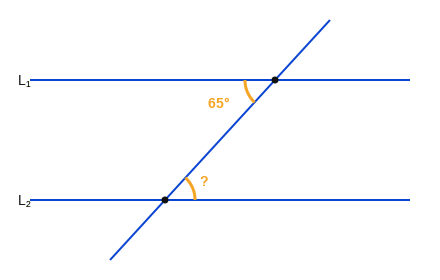
Two parallel lines L1 and L2​ are cut by a transversal. If one of the alternate interior angles is 65°, what is the measure of the corresponding alternate interior angle?
दो समांतर रेखाएँ L1 और L2 एक तिर्यक रेखा (transversal) द्वारा काटी जाती हैं। यदि एकांतर अंतः कोणों में से एक 65° है, तो संगत एकांतर अंतः कोण का माप क्या है?
  1. A180°
  2. B65°
  3. C110°
  4. D90°
Show answer

Concept: When a transversal cuts two parallel lines, each pair of alternate interior angles is equal.

  1. The two alternate interior angles lie on opposite sides of the transversal, between the parallel lines, forming a "Z".
  2. Given one of them =65∘, the other alternate interior angle is also 65∘.
  3. 110∘ would be the co-interior (same-side) angle (180∘−65∘), not the alternate one.

Trick: Z-angles (alternate) equal, F-angles (corresponding) equal, C-angles (co-interior) add to 180∘.

Answer: (B) 65°

अवधारणा: जब एक तिर्यक रेखा दो समांतर रेखाओं को काटती है, तो एकांतर अंतःकोणों का प्रत्येक युग्म बराबर होता है।

  1. दोनों एकांतर अंतःकोण तिर्यक रेखा के विपरीत ओर, समांतर रेखाओं के बीच "Z" बनाते हैं।
  2. एक कोण =65∘ दिया है, अतः दूसरा एकांतर अंतःकोण भी 65∘।
  3. 110∘ तो सह-अंतःकोण (180∘−65∘) होता, एकांतर नहीं।

ट्रिक: Z-कोण (एकांतर) बराबर, F-कोण (संगत) बराबर, C-कोण (सह-अंतः) का योग 180∘।

उत्तर: (B) 65°

RRB NTPC Graduate CBT 1MathematicsParallel Lines and TransversalRRB NTPC Graduate CBT 1 2025 · 19 Mar Shift 3 →
Q15870.
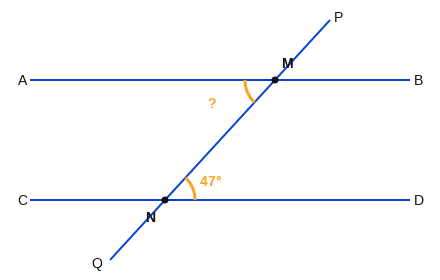
Two lines AB and CD are parallel. Let PQ be the transversal intersecting AB at M and CD at N. If ∠MND=47∘, find ∠AMN.
दो रेखाएँ AB और CD समांतर हैं। मान लीजिए PQ एक तिर्यक रेखा है जो AB को M पर और CD को N पर काटती है। यदि ∠MND=47∘ है, तो ∠AMN ज्ञात कीजिए।
  1. A73∘
  2. B133∘
  3. C47∘
  4. D107∘
Show answer

Concept: Alternate interior angles made by a transversal with two parallel lines are equal.

  1. Transversal PQ meets AB at M and CD at N. ∠AMN (at M, towards A) and ∠MND (at N, towards D) lie between the parallels on opposite sides of MN – alternate interior angles.
  2. Hence ∠AMN=∠MND=47∘.
  3. 133∘ is the adjacent angle (∠BMN or ∠MNC), not the one asked.

Trick: A and D are on opposite sides of the transversal → the "Z" pair → equal.

Answer: (C) 47°

अवधारणा: दो समांतर रेखाओं के साथ तिर्यक रेखा से बने एकांतर अंतःकोण बराबर होते हैं।

  1. तिर्यक PQ, AB को M पर और CD को N पर काटती है। ∠AMN (M पर, A की ओर) और ∠MND (N पर, D की ओर) समांतर रेखाओं के बीच MN के विपरीत ओर हैं – एकांतर अंतःकोण।
  2. अतः ∠AMN=∠MND=47∘।
  3. 133∘ संलग्न कोण (∠BMN या ∠MNC) है, पूछा गया कोण नहीं।

ट्रिक: A और D तिर्यक रेखा के विपरीत ओर → "Z" युग्म → बराबर।

उत्तर: (C) 47°

RRB NTPC Graduate CBT 1MathematicsParallel Lines and TransversalRRB NTPC Graduate CBT 1 2025 · 19 Mar Shift 3 →
Q15871.
Ankur jogs on a circular track X at 123 m/s and Mahima jogs on track Y at 2112 m/s. The total length of Tracks X and Y is 0.325 km. Ankur makes 9 rounds of track X in the same time Mahima makes 5 rounds of track Y. The time taken (in seconds) by Mahima to complete one round of track X is:
अंकुर एक वृत्ताकार ट्रैक X पर 123 m/s की चाल से और महिमा ट्रैक Y पर 2112 m/s की चाल से जॉगिंग करती है। ट्रैक X और Y की कुल लंबाई 0.325 km है। अंकुर ट्रैक X के 9 चक्कर उतने ही समय में लगाता है जितने समय में महिमा ट्रैक Y के 5 चक्कर लगाती है। महिमा द्वारा ट्रैक X का एक चक्कर पूरा करने में लिया गया समय (सेकंड में) है:
  1. A35
  2. B48
  3. C42
  4. D39
Show answer

Concept: Equal time ⇒ distance1speed1=distance2speed2. Use it to find each track length.

  1. Speeds: Ankur =53 m/s, Mahima =2512 m/s. Let track X =x m, track Y =y m, x+y=325.
  2. Same time: 9x5/3=5y25/12⇒27x5=12y5⇒27x=12y⇒y=9x4.
  3. x+9x4=325⇒13x4=325⇒x=100 m (so y=225 m).
  4. Mahima on track X: time =10025/12=100×1225=48 s.

Trick: Convert 0.325 km to 325 m at once and keep speeds as fractions – the numbers cancel neatly.

Answer: (B) 48

अवधारणा: समान समय ⇒ दूरी1चाल1=दूरी2चाल2। इससे प्रत्येक ट्रैक की लंबाई निकालें।

  1. चालें: अंकुर =53 m/s, महिमा =2512 m/s। माना ट्रैक X =x m, ट्रैक Y =y m, x+y=325।
  2. समान समय: 9x5/3=5y25/12⇒27x5=12y5⇒27x=12y⇒y=9x4।
  3. x+9x4=325⇒13x4=325⇒x=100 m (अतः y=225 m)।
  4. महिमा ट्रैक X पर: समय =10025/12=100×1225=48 s।

ट्रिक: 0.325 km को तुरंत 325 m करें और चालें भिन्न में रखें – संख्याएँ साफ़ कटती हैं।

उत्तर: (B) 48

RRB NTPC Graduate CBT 1MathematicsSpeed, Time and Distance – Circular TracksRRB NTPC Graduate CBT 1 2025 · 19 Mar Shift 3 →
Q15872.
What is the mode of the data given below? [Give your answer correct to 2 decimal places.]
Age in years15-2525-3535-4545-5555-6565-7575-85
No. of patients18101514304034
नीचे दिए गए आँकड़ों का बहुलक (mode) क्या है? [अपना उत्तर 2 दशमलव स्थानों तक सही दीजिए।]
आयु (वर्षों में): 15-25, 25-35, 35-45, 45-55, 55-65, 65-75, 75-85
रोगियों की संख्या: 18, 10, 15, 14, 30, 40, 34
  1. A70.25
  2. B72.25
  3. C71.25
  4. D69.25
Show answer

Concept: Mode =l+f1−f02f1−f0−f2×h with l = lower limit of the modal class, f1 its frequency, f0 and f2 the neighbouring frequencies, h = class width.

  1. Highest frequency 40 → modal class 65–75: l=65, f1=40, f0=30, f2=34, h=10.
  2. Mode =65+40−3080−30−34×10=65+1016×10.
  3. =65+6.25=71.25.

Trick: 1016=0.625; the decimal part ".25" of the answer comes straight from 6.25.

Answer: (C) 71.25

अवधारणा: बहुलक =l+f1−f02f1−f0−f2×h, जहाँ l = बहुलक वर्ग की निचली सीमा, f1 उसकी बारंबारता, f0 व f2 पड़ोसी बारंबारताएँ, h = वर्ग-चौड़ाई।

  1. सर्वाधिक बारंबारता 40 → बहुलक वर्ग 65–75: l=65, f1=40, f0=30, f2=34, h=10।
  2. बहुलक =65+40−3080−30−34×10=65+1016×10।
  3. =65+6.25=71.25।

ट्रिक: 1016=0.625; उत्तर का दशमलव भाग ".25" सीधे 6.25 से आता है।

उत्तर: (C) 71.25

RRB NTPC Graduate CBT 1MathematicsMode of Grouped DataRRB NTPC Graduate CBT 1 2025 · 19 Mar Shift 3 →
Q15873.
There are ₹5, ₹2, and ₹1 coins amounting to a total of ₹212. The total number of coins is 112. The number of ₹2 coins is 50 more than the number of ₹5 coins. Find the number of ₹1 coins.
₹5, ₹2 और ₹1 के सिक्के हैं जिनकी कुल राशि ₹212 है। सिक्कों की कुल संख्या 112 है। ₹2 के सिक्कों की संख्या ₹5 के सिक्कों की संख्या से 50 अधिक है। ₹1 के सिक्कों की संख्या ज्ञात कीजिए।
  1. A42
  2. B50
  3. C10
  4. D25
Show answer

Concept: Form equations from the count of coins and their total value.

  1. Let ₹5 coins =x, ₹2 coins =x+50, ₹1 coins =z. Count: x+(x+50)+z=112⇒2x+z=62.
  2. Value: 5x+2(x+50)+z=212⇒7x+z=112.
  3. Subtracting: 5x=50⇒x=10, so z=62−20=42.
  4. Check: 10+60+42=112 coins; 50+120+42=212 ₹ ✓.

Trick: Subtract the count equation from the value equation – the ₹1 coins vanish, leaving only x.

Answer: (A) 42

अवधारणा: सिक्कों की संख्या और कुल मूल्य से समीकरण बनाएँ।

  1. माना ₹5 के सिक्के =x, ₹2 के =x+50, ₹1 के =z। संख्या: x+(x+50)+z=112⇒2x+z=62।
  2. मूल्य: 5x+2(x+50)+z=212⇒7x+z=112।
  3. घटाने पर: 5x=50⇒x=10, अतः z=62−20=42।
  4. जाँच: 10+60+42=112 सिक्के; 50+120+42=212 ₹ ✓।

ट्रिक: मूल्य समीकरण से संख्या समीकरण घटाएँ – ₹1 के सिक्के कट जाते हैं, केवल x बचता है।

उत्तर: (A) 42

RRB NTPC Graduate CBT 1MathematicsLinear Equations – CoinsRRB NTPC Graduate CBT 1 2025 · 19 Mar Shift 3 →
Q15874.
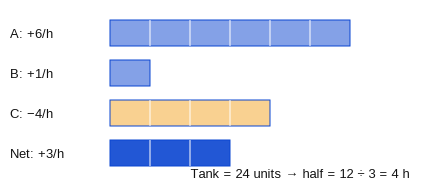
Two pipes can fill a tank in 4 hours and 24 hours, respectively. A third pipe can empty the tank in 6 hours. If all three pipes are opened together, how long (in hours) will it take to fill half of the empty tank?
दो पाइप एक टंकी को क्रमशः 4 घंटे और 24 घंटे में भर सकते हैं। एक तीसरा पाइप टंकी को 6 घंटे में खाली कर सकता है। यदि तीनों पाइप एक साथ खोल दिए जाएँ, तो खाली टंकी का आधा भाग भरने में कितना समय (घंटों में) लगेगा?
  1. A2 hours2 घंटे
  2. B6 hours6 घंटे
  3. C3 hours3 घंटे
  4. D4 hours4 घंटे
Show answer

Concept: Take the tank capacity as the LCM of the times; each pipe's work per hour is then a whole number of units.

  1. LCM(4, 24, 6) =24 units. Pipe A fills 244=6/h, pipe B fills 2424=1/h, pipe C empties 246=4/h.
  2. Net per hour =6+1−4=3 units.
  3. Half tank =12 units → time =123=4 hours.

Trick: Fraction method: 14+124−16=324=18 → full in 8 h, half in 4 h.

Answer: (D) 4 hours

अवधारणा: टंकी की क्षमता समयों का LCM लें; तब हर पाइप का प्रति घंटा काम पूर्ण इकाइयों में आता है।

  1. LCM(4, 24, 6) =24 इकाई। पाइप A भरता है 244=6/h, पाइप B 2424=1/h, पाइप C खाली करता है 246=4/h।
  2. प्रति घंटा शुद्ध =6+1−4=3 इकाई।
  3. आधी टंकी =12 इकाई → समय =123=4 घंटे।

ट्रिक: भिन्न विधि: 14+124−16=324=18 → पूरी 8 h में, आधी 4 h में।

उत्तर: (D) 4 घंटे (4 hours)

RRB NTPC Graduate CBT 1MathematicsPipes and CisternsRRB NTPC Graduate CBT 1 2025 · 19 Mar Shift 3 →
Q15875.
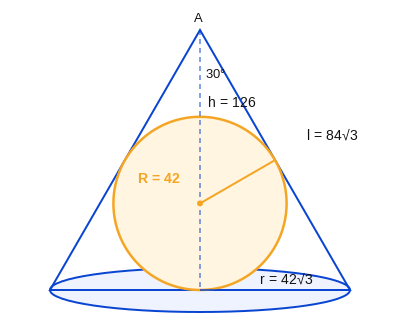
Find the volume of largest possible sphere that can be inscribed in a cone whose base radius is 423 cm and slant height equal to the diameter of the base. (Use π=227)
उस सबसे बड़े संभव गोले का आयतन ज्ञात कीजिए जो एक ऐसे शंकु के अंतर्गत बनाया जा सकता है जिसके आधार की त्रिज्या 423 cm है और तिर्यक ऊँचाई आधार के व्यास के बराबर है। (π=227 का प्रयोग कीजिए)
  1. A314046 cm3
  2. B301644 cm3
  3. C314064 cm3
  4. D310464 cm3
Show answer

Concept: For a cone with base radius r, height h and slant height l, the radius of the largest inscribed sphere is R=rhl+r.

  1. r=423, l=2r=843 ⇒ h=l2−r2=3r2=r3=126 cm.
  2. R=423×126843+423=423×1261263=42 cm.
  3. Volume =43×227×423=8821×74088=310464cm3.

Trick: Slant height = diameter means the cone is equilateral (semi-vertical angle 30∘); then the inscribed sphere has R=h3 directly.

Answer: (D) 310464cm3

अवधारणा: आधार त्रिज्या r, ऊँचाई h और तिर्यक ऊँचाई l वाले शंकु में सबसे बड़े अंतर्वृत्त गोले की त्रिज्या R=rhl+r होती है।

  1. r=423, l=2r=843 ⇒ h=l2−r2=r3=126 cm।
  2. R=423×1261263=42 cm।
  3. आयतन =43×227×423=8821×74088=310464cm3।

ट्रिक: तिर्यक ऊँचाई = व्यास का मतलब समबाहु शंकु (अर्ध-शीर्ष कोण 30∘); तब अंतर्वृत्त गोले की त्रिज्या सीधे R=h3 होती है।

उत्तर: (D) 310464cm3

RRB NTPC Graduate CBT 1MathematicsMensuration – sphere in coneRRB NTPC Graduate CBT 1 2025 · 19 Mar Shift 3 →
Q15876.
What is the average of all the natural numbers from 1 to 60?
1 से 60 तक की सभी प्राकृत संख्याओं का औसत क्या है?
  1. A31
  2. B31.5
  3. C30
  4. D30.5
Show answer

Concept: Numbers 1 to n form an AP, so their average is first+last2=n+12.

  1. Average of 1 to 60 =1+602=30.5.
  2. Check: sum =60×612=1830, 183060=30.5.

Yaad rakhein: Average of first n natural numbers =n+12 — no need to add anything.

Answer: (D) 30.5

अवधारणा: 1 से n तक की संख्याएँ समांतर श्रेढ़ी (AP) हैं, इसलिए औसत =पहली+अंतिम2=n+12।

  1. 1 से 60 का औसत =1+602=30.5।
  2. जाँच: योग =60×612=1830, 183060=30.5।

याद रखें: पहली n प्राकृत संख्याओं का औसत =n+12 — जोड़ने की ज़रूरत नहीं।

उत्तर: (D) 30.5

RRB NTPC Graduate CBT 1MathematicsAverage of natural numbersRRB NTPC Graduate CBT 1 2025 · 19 Mar Shift 3 →
Q15877.
There are 39 members in group A, 33 members in group B and 52 members in group C. All the members of these groups went to a restaurant. The average amounts spent on each member of groups A, B and C are ₹377, ₹401 and ₹233, respectively. The overall average amount (in ₹) spent per member is:
समूह A में 39 सदस्य, समूह B में 33 सदस्य और समूह C में 52 सदस्य हैं। इन समूहों के सभी सदस्य एक रेस्तरां में गए। समूह A, B और C के प्रत्येक सदस्य पर खर्च की गई औसत राशि क्रमशः ₹377, ₹401 और ₹233 है। प्रति सदस्य खर्च की गई कुल औसत राशि (₹ में) है:
  1. A324
  2. B328
  3. C323
  4. D325
Show answer

Concept: Overall average =total amounttotal members (weighted mean).

  1. Totals: 39×377=14703, 33×401=13233, 52×233=12116.
  2. Sum =14703+13233+12116=40052; members =39+33+52=124.
  3. Average =40052124=323.

Trick: Take 323 as base: deviations 39×54=2106, 33×78=2574, 52×(−90)=−4680; they sum to 0, so the average is exactly 323.

Answer: (C) 323

अवधारणा: कुल औसत =कुल राशिकुल सदस्य (भारित औसत)।

  1. कुल: 39×377=14703, 33×401=13233, 52×233=12116।
  2. योग =40052; सदस्य =124।
  3. औसत =40052124=323।

ट्रिक: 323 को आधार मानें: विचलन 39×54=2106, 33×78=2574, 52×(−90)=−4680 — योग 0, अतः औसत ठीक 323।

उत्तर: (C) 323

RRB NTPC Graduate CBT 1MathematicsWeighted averageRRB NTPC Graduate CBT 1 2025 · 19 Mar Shift 3 →
Q15878.
If (125)1.3×(25)1.8÷(5)2.5=5x, then find the value of 18x−5.
यदि (125)1.3×(25)1.8÷(5)2.5=5x है, तो 18x−5 का मान ज्ञात कीजिए।
  1. A85
  2. B95
  3. C80
  4. D90
Show answer

Concept: Write every base as a power of the same prime, then add/subtract exponents: am×an=am+n, am÷an=am−n.

  1. 1251.3=53×1.3=53.9, 251.8=52×1.8=53.6.
  2. 53.9+3.6−2.5=55 ⇒ x=5.
  3. 18x−5=90−5=85.

Trick: 125=53, 25=52 — just multiply the decimal exponents by 3 and 2 mentally.

Answer: (A) 85

अवधारणा: हर आधार को एक ही अभाज्य की घात में लिखें, फिर घातांक जोड़ें/घटाएँ: am×an=am+n, am÷an=am−n।

  1. 1251.3=53.9, 251.8=53.6।
  2. 53.9+3.6−2.5=55 ⇒ x=5।
  3. 18x−5=90−5=85।

ट्रिक: 125=53, 25=52 — दशमलव घातांकों को मन में 3 और 2 से गुणा कर लें।

उत्तर: (A) 85

RRB NTPC Graduate CBT 1MathematicsIndicesRRB NTPC Graduate CBT 1 2025 · 19 Mar Shift 3 →
Q15879.
If a : b = 1 : 3, b : c = 5 : 7 and c : d = 9 : 5, then the value of a : b : c : d is:
यदि a : b = 1 : 3, b : c = 5 : 7 और c : d = 9 : 5 है, तो a : b : c : d का मान है:
  1. A15 : 75 : 105 : 35
  2. B5 : 75 : 105 : 35
  3. C15 : 45 : 63 : 35
  4. D25 : 75 : 105 : 45
Show answer

Concept: To join ratios, make the common term equal by cross-multiplying step by step.

  1. a:b=1:3, b:c=5:7 ⇒ a:b:c=5:15:21.
  2. c:d=9:5 with c=21: multiply first by 9 and second by 21 ⇒ a:b:c:d=45:135:189:105.
  3. Divide by 3: 15:45:63:35.

Trick: a:b:c:d=(1·5·9):(3·5·9):(3·7·9):(3·7·5)=45:135:189:105 — one line.

Answer: (C) 15 : 45 : 63 : 35

अवधारणा: अनुपात जोड़ने के लिए उभयनिष्ठ पद को क्रॉस-गुणा से बराबर करें।

  1. a:b=1:3, b:c=5:7 ⇒ a:b:c=5:15:21।
  2. c:d=9:5, c=21: पहले को 9 से, दूसरे को 21 से गुणा ⇒ 45:135:189:105।
  3. 3 से भाग: 15:45:63:35।

ट्रिक: a:b:c:d=(1·5·9):(3·5·9):(3·7·9):(3·7·5)=45:135:189:105 — एक लाइन में।

उत्तर: (C) 15 : 45 : 63 : 35

RRB NTPC Graduate CBT 1MathematicsCompound ratioRRB NTPC Graduate CBT 1 2025 · 19 Mar Shift 3 →
Q15880.
Find the volume (in cm3) of a sphere having a diameter of 37.8 cm, giving your answer correct to two places of decimal. (take π=227)
37.8 cm व्यास वाले एक गोले का आयतन (cm3 में) ज्ञात कीजिए, अपना उत्तर दो दशमलव स्थानों तक सही दीजिए। (π=227 लीजिए)
  1. A28281.03
  2. B28291.03
  3. C28311.03
  4. D28301.03
Show answer

Concept: V=43πr3 with r=diameter2.

  1. r=37.82=18.9 cm; 18.93=6751.269.
  2. V=43×227×6751.269=88×6751.26921=594111.67221.
  3. V≈28291.03cm3.

Trick: 18.9=18910=7×2710, so the 7 cancels with π=227: V=88×49×2733×1000=88×49×65611000≈28291.03.

Answer: (B) 28291.03

अवधारणा: V=43πr3, जहाँ r=व्यास2।

  1. r=18.9 cm; 18.93=6751.269।
  2. V=43×227×6751.269=594111.67221।
  3. V≈28291.03cm3।

ट्रिक: 18.9=7×2710, अतः 7, π=227 से कट जाता है: V=88×49×65611000≈28291.03।

उत्तर: (B) 28291.03

RRB NTPC Graduate CBT 1MathematicsVolume of sphereRRB NTPC Graduate CBT 1 2025 · 19 Mar Shift 3 →