Question bank

Q&A: practice questions with answers

Search questions on any topic. Filter by exam category, exam, subject and topic, try the question, then open the answer and explanation.

Courses – airGurukul

20,719 questions found.

Q15961.
Chilika Lake spans across which three districts of Odisha?
चिल्का झील ओडिशा के किन तीन ज़िलों में फैली हुई है?
  1. APuri, Jagatsinghpur and Khurdaपुरी, जगतसिंहपुर और खुर्दा
  2. BCuttack, Puri and Kendraparaकटक, पुरी और केंद्रपाड़ा
  3. CPuri, Khurda and Ganjamपुरी, खुर्दा और गंजाम
  4. DKhurda, Balasore and Ganjamखुर्दा, बालासोर और गंजाम
Show answer

Concept: Chilika, Asia's largest brackish-water lagoon, lies on Odisha's coast spread over three districts.

  1. It covers parts of Puri, Khurda and Ganjam districts; its mouth opens into the Bay of Bengal near Satapada.
  2. Cuttack, Kendrapara and Balasore are further north (Kendrapara has Bhitarkanika, not Chilika).

Yaad rakhein: Chilika = P-K-G (Puri, Khurda, Ganjam); Ramsar site since 1981; Irrawaddy dolphins.

Answer: (C) Puri, Khurda and Ganjam

अवधारणा: चिल्का, एशिया का सबसे बड़ा खारे पानी का लैगून, ओडिशा के तट पर तीन ज़िलों में फैला है।

  1. यह पुरी, खुर्दा और गंजाम ज़िलों के हिस्सों में है; इसका मुहाना सतपड़ा के पास बंगाल की खाड़ी में खुलता है।
  2. कटक, केंद्रपाड़ा और बालासोर और उत्तर में हैं (केंद्रपाड़ा में भितरकनिका है, चिल्का नहीं)।

याद रखें: चिल्का = पु-खु-गं (पुरी, खुर्दा, गंजाम); 1981 से रामसर स्थल; इरावदी डॉल्फ़िन।

उत्तर: (C) Puri, Khurda and Ganjam
RRB NTPC Graduate CBT 1General AwarenessGeography – LakesRRB NTPC Graduate CBT 1 2025 · 19 Mar Shift 2 →
Q15962.
The modified petiole of Acacia species that resembles a leaf blade is termed as __________________.
बबूल (Acacia) प्रजातियों का रूपांतरित पर्णवृंत (petiole), जो पत्ती के फलक जैसा दिखता है, __________________ कहलाता है।
  1. Aspineकाँटा (spine)
  2. Bphyllodeपर्णाभवृंत (phyllode)
  3. Ctendrilप्रतान (tendril)
  4. Dbractsसहपत्र (bracts)
Show answer

Concept: A phyllode is a petiole (leaf stalk) flattened into a leaf-like blade that performs photosynthesis.

  1. In Australian Acacia species the true leaflets fall off early and the flattened petiole – the phyllode – takes over the leaf's work, reducing water loss.
  2. Spines (Opuntia) and tendrils (pea) are other leaf modifications; bracts are leaves that bear flowers.

Yaad rakhein: Phyllode = "phyll" (leaf) + petiole – Acacia (Australian babool).

Answer: (B) phyllode

अवधारणा: पर्णाभवृंत (phyllode) चपटा होकर पत्ती जैसा बना पर्णवृंत (petiole) है, जो प्रकाश-संश्लेषण करता है।

  1. ऑस्ट्रेलियाई Acacia में असली पर्णक जल्दी झड़ जाते हैं और चपटा पर्णवृंत – phyllode – पत्ती का काम करता है, जिससे जल-हानि घटती है।
  2. काँटे (Opuntia) और प्रतान (मटर) पत्ती के अन्य रूपांतरण हैं; सहपत्र (bracts) वे पत्तियाँ हैं जिनके कक्ष में फूल लगते हैं।

याद रखें: Phyllode = "phyll" (पत्ती) + petiole – Acacia (ऑस्ट्रेलियाई बबूल)।

उत्तर: (B) phyllode

RRB NTPC Graduate CBT 1General AwarenessBiology – Plant MorphologyRRB NTPC Graduate CBT 1 2025 · 19 Mar Shift 2 →
Q15963.
The conceptual framework of Human Development was pioneered by:
मानव विकास की संकल्पनात्मक रूपरेखा का प्रतिपादन किसने किया था?
  1. ADr. Abdus Salamडॉ. अब्दुस सलाम
  2. BEllen C. Sempleएलेन सी. सेम्पल
  3. CDr. Mahbub-ul-Haqडॉ. महबूब-उल-हक
  4. DProf. Amartya Senप्रो. अमर्त्य सेन
Show answer

Concept: The Human Development approach and the first Human Development Report (UNDP, 1990) were pioneered by Pakistani economist Dr. Mahbub-ul-Haq.

  1. He designed the Human Development Index (HDI) combining health, education and income.
  2. Amartya Sen's "capability approach" provided the philosophical base and he collaborated, but the framework and HDR were Haq's initiative; Semple was a geographer, Salam a physicist.

Yaad rakhein: HDI = Haq (architect) + Sen (capability idea); first HDR 1990.

Answer: (C) Dr. Mahbub-ul-Haq

अवधारणा: मानव विकास की अवधारणा और पहली मानव विकास रिपोर्ट (UNDP, 1990) पाकिस्तानी अर्थशास्त्री डॉ. महबूब-उल-हक ने प्रारंभ की।

  1. उन्होंने स्वास्थ्य, शिक्षा और आय को मिलाकर मानव विकास सूचकांक (HDI) बनाया।
  2. अमर्त्य सेन के "क्षमता दृष्टिकोण" ने दार्शनिक आधार दिया और वे सहयोगी रहे, पर ढाँचा और HDR हक की पहल थी; सेंपल भूगोलवेत्ता और सलाम भौतिकविद थे।

याद रखें: HDI = हक (निर्माता) + सेन (क्षमता विचार); पहली HDR 1990।

उत्तर: (C) Dr. Mahbub-ul-Haq

RRB NTPC Graduate CBT 1General AwarenessEconomics – Human DevelopmentRRB NTPC Graduate CBT 1 2025 · 19 Mar Shift 2 →
Q15964.
Which shortcut saves the current file?
कौन-सा शॉर्टकट वर्तमान फ़ाइल को सेव (save) करता है?
  1. ACtrl+L
  2. BCtrl+R
  3. CCtrl+P
  4. DCtrl+S
Show answer

Concept: In almost every application, Ctrl+S saves the current file (S = Save).

  1. Ctrl+P prints, Ctrl+R refreshes a page (or right-aligns text in Word), Ctrl+L focuses the address bar in browsers (left-align in Word).
  2. Ctrl+Shift+S or F12 opens "Save As" in MS Office.

Yaad rakhein: S–Save, P–Print, O–Open, N–New, Z–Undo.

Answer: (D) Ctrl+S

अवधारणा: लगभग हर एप्लिकेशन में Ctrl+S वर्तमान फ़ाइल को सेव करता है (S = Save)।

  1. Ctrl+P प्रिंट, Ctrl+R पेज रिफ्रेश (Word में दाएँ संरेखण), Ctrl+L ब्राउज़र में एड्रेस बार (Word में बाएँ संरेखण)।
  2. MS Office में Ctrl+Shift+S या F12 से "Save As" खुलता है।

याद रखें: S–Save, P–Print, O–Open, N–New, Z–Undo।

उत्तर: (D) Ctrl+S

RRB NTPC Graduate CBT 1General AwarenessComputer – Keyboard ShortcutsRRB NTPC Graduate CBT 1 2025 · 19 Mar Shift 2 →
Q15965.
In November 2025, which of the following organizations collaborated with UNICEF to secure a new deal for affordable malaria vaccines?
नवंबर 2025 में निम्नलिखित में से किस संगठन ने किफ़ायती मलेरिया टीकों के लिए एक नया समझौता सुनिश्चित करने हेतु UNICEF के साथ सहयोग किया?
  1. AGaviगावी (Gavi)
  2. BOxfamऑक्सफ़ैम
  3. CRed Crossरेड क्रॉस
  4. DDoctors Without Bordersडॉक्टर्स विदाउट बॉर्डर्स
Show answer

Concept: Gavi, the Vaccine Alliance, finances vaccines for low-income countries and works with UNICEF, which procures them.

  1. In November 2025, Gavi and UNICEF announced new agreements with manufacturers that cut the price of malaria vaccines by more than half, to about US$3 per dose, so more African children can be protected.
  2. Oxfam, Red Cross and Doctors Without Borders are humanitarian bodies, not vaccine-financing alliances.

Yaad rakhein: Vaccine price deals = Gavi + UNICEF; malaria vaccines = RTS,S and R21.

Answer: (A) Gavi

अवधारणा: Gavi (वैक्सीन एलायंस) निम्न-आय देशों के लिए टीकों का वित्तपोषण करता है और UNICEF के साथ काम करता है, जो खरीद करता है।

  1. नवंबर 2025 में Gavi और UNICEF ने निर्माताओं के साथ नए समझौतों की घोषणा की, जिनसे मलेरिया टीकों की कीमत आधी से भी कम होकर लगभग 3 अमेरिकी डॉलर प्रति खुराक रह गई, ताकि अधिक अफ्रीकी बच्चों को सुरक्षा मिल सके।
  2. Oxfam, Red Cross और Doctors Without Borders मानवीय संस्थाएँ हैं, टीका-वित्तपोषण गठबंधन नहीं।

याद रखें: टीकों की कीमत के समझौते = Gavi + UNICEF; मलेरिया टीके = RTS,S और R21।

उत्तर: (A) Gavi

RRB NTPC Graduate CBT 1General AwarenessCurrent Affairs – HealthRRB NTPC Graduate CBT 1 2025 · 19 Mar Shift 2 →
Q15966.
At what rate (in percentage, rounded off to two decimal place) per year will a sum of money 5 times itself in 18 years on simple interest?
साधारण ब्याज पर कोई धनराशि 18 वर्षों में स्वयं की 5 गुनी हो जाती है। प्रति वर्ष ब्याज की दर (प्रतिशत में, दो दशमलव स्थानों तक पूर्णांकित) क्या होगी?
  1. A44.44
  2. B20.22
  3. C22.22
  4. D24.22
Show answer

Concept: If a sum becomes n times itself on simple interest, the interest earned is (n−1) times the principal, so R=(n−1)×100T.

  1. Amount =5P, so SI=5P−P=4P.
  2. R=SI×100P×T=4P×100P×18=40018.
  3. R=22.22% (to two decimal places).

Trick: "n times in T years" on SI ⇒R×T=(n−1)×100. Here R×18=400.

Answer: (C) 22.22

अवधारणा: साधारण ब्याज पर यदि धन n गुना हो जाए तो ब्याज मूलधन का (n−1) गुना होता है, अतः R=(n−1)×100T।

  1. मिश्रधन =5P, इसलिए SI=5P−P=4P।
  2. R=SI×100P×T=4P×100P×18=40018।
  3. R=22.22% (दो दशमलव तक)।

ट्रिक: SI में "T वर्ष में n गुना" ⇒R×T=(n−1)×100। यहाँ R×18=400।

उत्तर: (C) 22.22

RRB NTPC Graduate CBT 1MathematicsSimple InterestRRB NTPC Graduate CBT 1 2025 · 19 Mar Shift 2 →
Q15967.
Three friends X, Y and Z started a business by investing a sum of money in the ratio of 6 : 3 : 5. After 6 months, X withdraws half of his capital. If the sum invested by Z is ₹12,000, then out of a total annual profit of ₹69,000, what is the difference between X's and Y's profit?
तीन मित्रों X, Y और Z ने 6 : 3 : 5 के अनुपात में धनराशि निवेश करके एक व्यवसाय शुरू किया। 6 महीने बाद X अपनी पूँजी का आधा भाग निकाल लेता है। यदि Z द्वारा निवेश की गई राशि ₹12,000 है, तो ₹69,000 के कुल वार्षिक लाभ में से X और Y के लाभ का अंतर कितना है?
  1. A₹8120
  2. B₹9910
  3. C₹7290
  4. D₹8280
Show answer

Concept: Profit is shared in the ratio of (capital × time). When capital changes mid-year, add the products for each period.

  1. Ratio 6:3:5 and Z = ₹12,000 ⇒ 1 unit = ₹2,400. So X = ₹14,400, Y = ₹7,200 (we only need the ratio units).
  2. X: 6×6+3×6=54; Y: 3×12=36; Z: 5×12=60. Total =150 units.
  3. 1 unit of profit =69000150= ₹460.
  4. X − Y =(54−36)×460=18×460= ₹8,280.

Trick: Z's actual amount is a distraction – only the ratio units matter. Difference =18 units straight away.

Answer: (D) ₹8280

अवधारणा: लाभ (पूँजी × समय) के अनुपात में बँटता है। बीच में पूँजी बदलने पर हर अवधि के गुणनफल जोड़ें।

  1. अनुपात 6:3:5 और Z = ₹12,000 ⇒ 1 इकाई = ₹2,400। (केवल अनुपात की इकाइयाँ चाहिए।)
  2. X: 6×6+3×6=54; Y: 3×12=36; Z: 5×12=60। कुल =150 इकाई।
  3. लाभ की 1 इकाई =69000150= ₹460।
  4. X − Y =(54−36)×460=18×460= ₹8,280।

ट्रिक: Z की वास्तविक राशि केवल भटकाने के लिए है – अनुपात की इकाइयों से ही काम चल जाता है; अंतर सीधे 18 इकाई।

उत्तर: (D) ₹8280

RRB NTPC Graduate CBT 1MathematicsPartnershipRRB NTPC Graduate CBT 1 2025 · 19 Mar Shift 2 →
Q15968.
What is the average of all the natural numbers from 1 to 64?
1 से 64 तक की सभी प्राकृत संख्याओं का औसत क्या है?
  1. A33
  2. B33.5
  3. C32
  4. D32.5
Show answer

Concept: Natural numbers 1 to n form an AP, and the average of an AP is first+last2.

  1. Average =1+642=652=32.5.
  2. Check: sum =64×652=2080; 208064=32.5.

Trick: Average of 1 to n =n+12 – no need to add anything.

Answer: (D) 32.5

अवधारणा: 1 से n तक की प्राकृत संख्याएँ एक AP हैं और AP का औसत =पहला+अंतिम2।

  1. औसत =1+642=652=32.5।
  2. जाँच: योग =64×652=2080; 208064=32.5।

ट्रिक: 1 से n का औसत =n+12 – कुछ जोड़ने की ज़रूरत नहीं।

उत्तर: (D) 32.5

RRB NTPC Graduate CBT 1MathematicsAverageRRB NTPC Graduate CBT 1 2025 · 19 Mar Shift 2 →
Q15969.
Find the mean proportional between 9 and 25.
9 और 25 के बीच मध्यानुपाती ज्ञात कीजिए।
  1. A18
  2. B21
  3. C12
  4. D15
Show answer

Concept: The mean proportional between a and b is ab (since a:x::x:b⇒x2=ab).

  1. x=9×25=225=15.
  2. Check: 9:15=15:25 (both =3:5).

Trick: 9×25=3×5=15 – multiply the square roots directly.

Answer: (D) 15

अवधारणा: a और b का मध्यानुपाती =ab (क्योंकि a:x::x:b⇒x2=ab)।

  1. x=9×25=225=15।
  2. जाँच: 9:15=15:25 (दोनों =3:5)।

ट्रिक: 9×25=3×5=15 – वर्गमूलों को सीधे गुणा करें।

उत्तर: (D) 15

RRB NTPC Graduate CBT 1MathematicsRatio & ProportionRRB NTPC Graduate CBT 1 2025 · 19 Mar Shift 2 →
Q15970.
The following table shows the distribution of marks obtained by 100 students in a test.
Marks0-1010-2020-3030-4040-5050-60
Number of Students5914223020
The median marks is:
निम्नलिखित तालिका एक परीक्षा में 100 विद्यार्थियों द्वारा प्राप्त अंकों का बंटन दर्शाती है।
अंक: 0-10, 10-20, 20-30, 30-40, 40-50, 50-60
विद्यार्थियों की संख्या: 5, 9, 14, 22, 30, 20
माध्यिका अंक है:
  1. A42.2
  2. B39.2
  3. C38.8
  4. D40.0
Show answer

Concept: For grouped data, Median =l+N2−cff×h, where the median class is the first class whose cumulative frequency reaches N2.

  1. Cumulative frequencies: 5, 14, 28, 50, 80, 100. N=100, N2=50.
  2. The cf first reaches 50 in class 30–40, so l=30, cf=28 (previous), f=22, h=10.
  3. Median =30+50−2822×10=30+10=40.

Trick: When N2 equals a cumulative frequency exactly, the median is the upper limit of that class – here 40 at once.

Answer: (D) 40.0

अवधारणा: वर्गीकृत आँकड़ों में माध्यिका =l+N2−cff×h; माध्यिका वर्ग वह पहला वर्ग है जिसकी संचयी बारंबारता N2 तक पहुँचे।

  1. संचयी बारंबारता: 5, 14, 28, 50, 80, 100। N=100, N2=50।
  2. cf पहली बार 50 वर्ग 30–40 में पहुँचती है, अतः l=30, cf=28 (पिछला), f=22, h=10।
  3. माध्यिका =30+50−2822×10=30+10=40।

ट्रिक: जब N2 किसी संचयी बारंबारता के ठीक बराबर हो, तो माध्यिका उस वर्ग की ऊपरी सीमा होती है – यहाँ सीधे 40।

उत्तर: (D) 40.0

RRB NTPC Graduate CBT 1MathematicsStatistics – MedianRRB NTPC Graduate CBT 1 2025 · 19 Mar Shift 2 →
Q15971.
There are 32 members in group A, 52 members in group B and 73 members in group C. All the members of these groups went to a restaurant. The average amounts spent on each member of groups A, B and C are ₹266, ₹470 and ₹168, respectively. The overall average amount (in ₹) spent per member is:
समूह A में 32 सदस्य, समूह B में 52 सदस्य और समूह C में 73 सदस्य हैं। इन समूहों के सभी सदस्य एक रेस्तराँ में गए। समूह A, B और C के प्रत्येक सदस्य पर खर्च की गई औसत राशि क्रमशः ₹266, ₹470 और ₹168 है। प्रति सदस्य खर्च की गई कुल औसत राशि (₹ में) है:
  1. A288
  2. B292
  3. C291
  4. D286
Show answer

Concept: Overall average =total amounttotal members – a weighted mean, not the mean of the three averages.

  1. Total =32×266+52×470+73×168=8512+24440+12264=45216.
  2. Members =32+52+73=157.
  3. Average =45216157=288 (since 157×288=45216).

Trick: Take 288 as a guess: deviations −22×32, +182×52, −120×73 =−704+9464−8760=0 ✓.

Answer: (A) 288

अवधारणा: कुल औसत =कुल राशिकुल सदस्य – यह भारित माध्य है, तीन औसतों का औसत नहीं।

  1. कुल =32×266+52×470+73×168=8512+24440+12264=45216।
  2. सदस्य =32+52+73=157।
  3. औसत =45216157=288 (क्योंकि 157×288=45216)।

ट्रिक: 288 मानकर विचलन देखें: −22×32, +182×52, −120×73 =−704+9464−8760=0 ✓।

उत्तर: (A) 288

RRB NTPC Graduate CBT 1MathematicsWeighted AverageRRB NTPC Graduate CBT 1 2025 · 19 Mar Shift 2 →
Q15972.
If the mean of the following data is 40, find the value of X.
Class10-2020-3030-4040-5050-60
Frequency42192326X
यदि निम्नलिखित आँकड़ों का माध्य 40 है, तो X का मान ज्ञात कीजिए।
वर्ग: 10-20, 20-30, 30-40, 40-50, 50-60
बारंबारता: 42, 19, 23, 26, X
  1. A40
  2. B88
  3. C79
  4. D38
Show answer

Concept: Mean =∑fixi∑fi with xi the class marks.

  1. Class marks: 15, 25, 35, 45, 55.
  2. ∑fixi=42×15+19×25+23×35+26×45+55X=630+475+805+1170+55X=3080+55X.
  3. ∑fi=110+X. Mean =40⇒3080+55X=40(110+X)=4400+40X.
  4. 15X=1320⇒X=88.

Trick: Deviation method with A=40: 42(−25)+19(−15)+23(−5)+26(5)+X(15)=0⇒−1050−285−115+130+15X=0⇒X=88.

Answer: (B) 88

अवधारणा: माध्य =∑fixi∑fi, जहाँ xi वर्ग-चिह्न हैं।

  1. वर्ग-चिह्न: 15, 25, 35, 45, 55।
  2. ∑fixi=42×15+19×25+23×35+26×45+55X=3080+55X।
  3. ∑fi=110+X। माध्य =40⇒3080+55X=4400+40X।
  4. 15X=1320⇒X=88।

ट्रिक: A=40 लेकर विचलन विधि: 42(−25)+19(−15)+23(−5)+26(5)+15X=0⇒X=88।

उत्तर: (B) 88

RRB NTPC Graduate CBT 1MathematicsStatistics – Mean of Grouped DataRRB NTPC Graduate CBT 1 2025 · 19 Mar Shift 2 →
Q15973.
Simplify: cotθ−cosθcotθ+cosθ.
सरल कीजिए: cotθ−cosθcotθ+cosθ।
  1. Asecθ−1secθ+1
  2. Bcosecθ−1cosecθ+1
  3. Csecθ+1secθ−1
  4. Dcosecθ+1cosecθ−1
Show answer

Concept: Write cotθ=cosθsinθ and factor out cosθ.

  1. cotθ−cosθ=cosθ(1sinθ−1)=cosθ(cosecθ−1).
  2. cotθ+cosθ=cosθ(cosecθ+1).
  3. Ratio =cosecθ−1cosecθ+1.

Trick: Put θ=30∘: 3−323+32=13; option B gives 2−12+1=13 ✓ (A gives 2/3−12/3+1≠13).

Answer: (B) cosecθ−1cosecθ+1

अवधारणा: cotθ=cosθsinθ लिखकर cosθ उभयनिष्ठ निकालें।

  1. cotθ−cosθ=cosθ(1sinθ−1)=cosθ(cosecθ−1)।
  2. cotθ+cosθ=cosθ(cosecθ+1)।
  3. अनुपात =cosecθ−1cosecθ+1।

ट्रिक: θ=30∘ रखें: मान =13; विकल्प B से 2−12+1=13 ✓।

उत्तर: (B) cosecθ−1cosecθ+1

RRB NTPC Graduate CBT 1MathematicsTrigonometric IdentitiesRRB NTPC Graduate CBT 1 2025 · 19 Mar Shift 2 →
Q15974.
20% of a number is more than 20% of 620 by 190. The number is:
एक संख्या का 20%, 620 के 20% से 190 अधिक है। वह संख्या है:
  1. A1570
  2. B1670
  3. C1420
  4. D1620
Show answer

Concept: Translate the sentence into an equation: 20% of N =20% of 620+190.

  1. 20% of 620=124.
  2. 0.2N=124+190=314.
  3. N=3140.2=1570.

Trick: 20% of the difference is 190, so N−620=190×5=950⇒N=1570.

Answer: (A) 1570

अवधारणा: वाक्य को समीकरण बनाएँ: N का 20% =620 का 20%+190।

  1. 620 का 20%=124।
  2. 0.2N=124+190=314।
  3. N=3140.2=1570।

ट्रिक: अंतर का 20% 190 है, अतः N−620=190×5=950⇒N=1570।

उत्तर: (A) 1570

RRB NTPC Graduate CBT 1MathematicsPercentageRRB NTPC Graduate CBT 1 2025 · 19 Mar Shift 2 →
Q15975.
Evaluate: (-9) - (-56) ÷ (-14) + (-3) × 6
मान ज्ञात कीजिए: (-9) - (-56) ÷ (-14) + (-3) × 6
  1. A-30
  2. B-31
  3. C-33
  4. D-34
Show answer

Concept: Do division and multiplication before addition and subtraction, keeping track of signs.

  1. (−56)÷(−14)=+4 and (−3)×6=−18.
  2. Expression =(−9)−4+(−18)=−9−4−18.
  3. =−31.

Trick: Negative ÷ negative = positive; then "−(+4)" is a subtraction – the common slip is writing +4.

Answer: (B) −31

अवधारणा: जोड़-घटाव से पहले भाग और गुणा करें, चिह्नों का ध्यान रखें।

  1. (−56)÷(−14)=+4 और (−3)×6=−18।
  2. व्यंजक =(−9)−4+(−18)=−9−4−18।
  3. =−31।

ट्रिक: ऋण ÷ ऋण = धन; फिर "−(+4)" घटाव है – आम गलती इसे +4 लिखना है।

उत्तर: (B) −31

RRB NTPC Graduate CBT 1MathematicsSimplification (BODMAS)RRB NTPC Graduate CBT 1 2025 · 19 Mar Shift 2 →
Q15976.
A woman travelled at a speed of 20 m/min for 90 min, and at a speed of 70 m/min for 60 min. Her average speed (in m/min) for the entire journey is:
एक महिला ने 90 मिनट तक 20 m/min की चाल से और 60 मिनट तक 70 m/min की चाल से यात्रा की। पूरी यात्रा के लिए उसकी औसत चाल (m/min में) है:
  1. A44
  2. B46
  3. C40
  4. D33
Show answer

Concept: Average speed =total distancetotal time, never the plain average of speeds.

  1. Distance =20×90+70×60=1800+4200=6000m.
  2. Time =90+60=150min.
  3. Average speed =6000150=40m/min.

Trick: Time-weighted mean: 20×3+70×23+2=2005=40 (times in ratio 3:2).

Answer: (C) 40

अवधारणा: औसत चाल =कुल दूरीकुल समय, चालों का साधारण औसत नहीं।

  1. दूरी =20×90+70×60=1800+4200=6000m।
  2. समय =90+60=150min।
  3. औसत चाल =6000150=40m/min।

ट्रिक: समय-भारित माध्य: 20×3+70×23+2=2005=40 (समय का अनुपात 3:2)।

उत्तर: (C) 40

RRB NTPC Graduate CBT 1MathematicsAverage SpeedRRB NTPC Graduate CBT 1 2025 · 19 Mar Shift 2 →
Q15977.
A shopkeeper purchased 21 dozens of articles at the rate of ₹150 per dozen. He sold each one of them at the rate of ₹78. What percentage profit did he make?
एक दुकानदार ने ₹150 प्रति दर्जन की दर से 21 दर्जन वस्तुएँ खरीदीं। उसने उनमें से प्रत्येक को ₹78 की दर से बेच दिया। उसे कितने प्रतिशत लाभ हुआ?
  1. A526%
  2. B524%
  3. C523%
  4. D525%
Show answer

Concept: Compare cost and selling price per article; Profit%=SP−CPCP×100.

  1. CP per article =15012= ₹12.50; SP per article = ₹78.
  2. Profit per article =78−12.5= ₹65.50.
  3. Profit%=65.512.5×100=524%.

Trick: Per dozen: CP 150, SP 78×12=936; 936−150150=786150=5.24⇒524%. The "21 dozens" is never needed.

Answer: (B) 524%

अवधारणा: प्रति वस्तु क्रय व विक्रय मूल्य तुलना करें; लाभ%=SP−CPCP×100।

  1. प्रति वस्तु CP =15012= ₹12.50; SP = ₹78।
  2. प्रति वस्तु लाभ =78−12.5= ₹65.50।
  3. लाभ%=65.512.5×100=524%।

ट्रिक: प्रति दर्जन: CP 150, SP 78×12=936; 936−150150=5.24⇒524%। "21 दर्जन" की ज़रूरत ही नहीं।

उत्तर: (B) 524%

RRB NTPC Graduate CBT 1MathematicsProfit & LossRRB NTPC Graduate CBT 1 2025 · 19 Mar Shift 2 →
Q15978.
At present, Vanraj is three times as old as his son, and his daughter is 3 years younger than the son. If the sum of the ages of these three people 3 years ago was 93 years, then Vanraj's present age (in years) is:
वर्तमान में वनराज की आयु अपने पुत्र की आयु की तीन गुनी है, और उसकी पुत्री पुत्र से 3 वर्ष छोटी है। यदि 3 वर्ष पहले इन तीनों की आयु का योग 93 वर्ष था, तो वनराज की वर्तमान आयु (वर्षों में) है:
  1. A49
  2. B39
  3. C63
  4. D44
Show answer

Concept: Express all ages in one variable; subtract 3 years per person for "3 years ago".

  1. Son =s, daughter =s−3, Vanraj =3s. Present sum =5s−3.
  2. 3 years ago each is 3 less: 5s−3−9=5s−12=93⇒5s=105⇒s=21.
  3. Vanraj =3×21=63 years.

Trick: Present sum =93+3×3=102; then 5s−3=102. Only option C (63) is a multiple of 3 with a sensible son's age.

Answer: (C) 63

अवधारणा: सभी आयु एक चर में लिखें; "3 वर्ष पहले" के लिए हर व्यक्ति से 3 घटाएँ।

  1. पुत्र =s, पुत्री =s−3, वनराज =3s। वर्तमान योग =5s−3।
  2. 3 वर्ष पहले: 5s−3−9=5s−12=93⇒5s=105⇒s=21।
  3. वनराज =3×21=63 वर्ष।

ट्रिक: वर्तमान योग =93+3×3=102; फिर 5s−3=102। विकल्पों में केवल 63 ही 3 का गुणज है।

उत्तर: (C) 63

RRB NTPC Graduate CBT 1MathematicsAgesRRB NTPC Graduate CBT 1 2025 · 19 Mar Shift 2 →
Q15979.
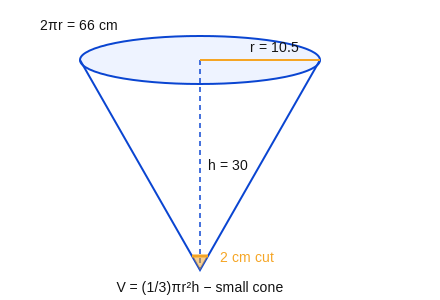
A conical open packet is made from a rectangular sheet of paper of length 66 cm and breadth 30 cm. The height of the packet is as large as possible and the length of the rectangle forms the circumference of the base of the conical packet. The conical packet is stapled at a height of 2 cm from the vertex of the cone, to avoid spilling of items inside it. Find the volume (in cm3) of the packet, rounded off to the nearest whole number.
(Use π=227)
66 cm लंबाई और 30 cm चौड़ाई वाली एक आयताकार कागज़ की शीट से एक खुला शंक्वाकार पैकेट बनाया जाता है। पैकेट की ऊँचाई यथासंभव अधिक है और आयत की लंबाई शंक्वाकार पैकेट के आधार की परिधि बनाती है। अंदर रखी वस्तुओं को गिरने से बचाने के लिए शंक्वाकार पैकेट को शंकु के शीर्ष से 2 cm की ऊँचाई पर स्टेपल किया जाता है। पैकेट का आयतन (cm3 में), निकटतम पूर्ण संख्या तक पूर्णांकित, ज्ञात कीजिए।
(π=227 का प्रयोग कीजिए)
  1. A3638
  2. B3582
  3. C3464
  4. D3296
Show answer

Concept: Volume of a cone =13πr2h. The length 66 cm becomes the base circumference and the breadth 30 cm is taken as the height (largest possible).

  1. 2πr=66⇒r=66×744=10.5cm, h=30cm.
  2. Full cone: V=13×227×10.52×30=13×227×110.25×30=3465cm3.
  3. Stapled 2 cm from the vertex: the tiny cone removed is similar to the big one, r′=10.5×230=0.7, volume =13×227×0.49×2≈1.03cm3.
  4. Usable volume ≈3465−1.03≈3464cm3.

Trick: A cone cut parallel to the base at 1k of its height has volume 1k3 of the whole – here 3465153≈1.

Answer: (C) 3464

अवधारणा: शंकु का आयतन =13πr2h। लंबाई 66 cm आधार की परिधि बनती है और चौड़ाई 30 cm को ऊँचाई (अधिकतम संभव) लिया गया है।

  1. 2πr=66⇒r=66×744=10.5cm, h=30cm।
  2. पूरा शंकु: V=13×227×110.25×30=3465cm3।
  3. शीर्ष से 2 cm ऊपर स्टेपल: हटाया गया छोटा शंकु बड़े के समरूप है, r′=10.5×230=0.7, आयतन =13×227×0.49×2≈1.03cm3।
  4. उपयोगी आयतन ≈3465−1.03≈3464cm3।

ट्रिक: आधार के समांतर ऊँचाई के 1k भाग पर कटा शंकु पूरे का 1k3 होता है – यहाँ 3465153≈1।

उत्तर: (C) 3464

RRB NTPC Graduate CBT 1MathematicsMensuration – ConeRRB NTPC Graduate CBT 1 2025 · 19 Mar Shift 2 →
Q15980.
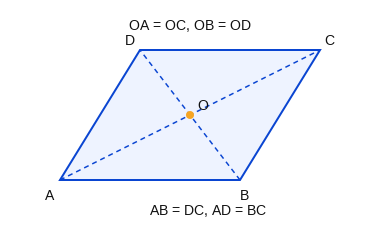
Let ABCD be a quadrilateral which satisfies any of the following conditions.
( i ) opposite sides are equal
( ii ) each diagonal of ABCD divides it into congruent triangles
( iii ) each pair of opposite angles are equal
( iv ) diagonals of ABCD bisect each other
Then ABCD has to be a _____________.
मान लीजिए ABCD एक चतुर्भुज है जो निम्नलिखित में से कोई भी शर्त पूरी करता है।
( i ) सम्मुख भुजाएँ बराबर हैं
( ii ) ABCD का प्रत्येक विकर्ण इसे सर्वांगसम त्रिभुजों में विभाजित करता है
( iii ) सम्मुख कोणों का प्रत्येक युग्म बराबर है
( iv ) ABCD के विकर्ण एक-दूसरे को समद्विभाजित करते हैं
तब ABCD अवश्य ही एक _____________ होगा।
  1. Akiteपतंग (kite)
  2. Btrapeziumसमलंब (trapezium)
  3. Cparallelogramसमांतर चतुर्भुज
  4. Drectangleआयत
Show answer

Concept: Each of the four properties is a standard test for a parallelogram.

  1. Opposite sides equal ⇒ parallelogram; each diagonal dividing it into congruent triangles ⇒ parallelogram.
  2. Opposite angles equal ⇒ parallelogram; diagonals bisecting each other ⇒ parallelogram.
  3. A rectangle also satisfies these but is a special case – nothing here forces a right angle, so the figure "has to be" only a parallelogram.

Yaad rakhein: Rectangle needs one right angle (or equal diagonals); kite/trapezium fail "opposite sides equal".

Answer: (C) parallelogram

अवधारणा: दिए गए चारों गुण समांतर चतुर्भुज (parallelogram) की मानक पहचान हैं।

  1. सम्मुख भुजाएँ बराबर ⇒ समांतर चतुर्भुज; प्रत्येक विकर्ण सर्वांगसम त्रिभुज बनाए ⇒ समांतर चतुर्भुज।
  2. सम्मुख कोण बराबर ⇒ समांतर चतुर्भुज; विकर्ण एक-दूसरे को समद्विभाजित करें ⇒ समांतर चतुर्भुज।
  3. आयत भी इन्हें संतुष्ट करता है पर वह विशेष स्थिति है – यहाँ समकोण अनिवार्य नहीं, इसलिए आकृति "अवश्य" केवल समांतर चतुर्भुज है।

याद रखें: आयत के लिए एक समकोण (या बराबर विकर्ण) चाहिए; पतंग/समलंब में सम्मुख भुजाएँ बराबर नहीं होतीं।

उत्तर: (C) parallelogram

RRB NTPC Graduate CBT 1MathematicsGeometry – QuadrilateralsRRB NTPC Graduate CBT 1 2025 · 19 Mar Shift 2 →