Question bank

Q&A: practice questions with answers

Search questions on any topic. Filter by exam category, exam, subject and topic, try the question, then open the answer and explanation.

Courses – airGurukul

20,719 questions found.

Q15981.
If a 7-digit number 56339A8 is completely divisible by 6, what is the minimum value of A?
यदि 7 अंकों की एक संख्या 56339A8, 6 से पूर्णतः विभाज्य है, तो A का न्यूनतम मान क्या है?
  1. A1
  2. B3
  3. C2
  4. D5
Show answer

Concept: Divisible by 6 ⇔ divisible by both 2 and 3.

  1. The number 56339A8 ends in 8, so it is even for every A.
  2. Digit sum =5+6+3+3+9+A+8=34+A must be a multiple of 3.
  3. 34+2=36 → smallest A=2 (next would be 5 or 8).

Trick: For "minimum A", find the first multiple of 3 at or above the fixed digit sum.

Answer: (C) 2

अवधारणा: 6 से विभाज्य ⇔ 2 और 3 दोनों से विभाज्य।

  1. संख्या 56339A8 का अंतिम अंक 8 है, अतः हर A के लिए सम।
  2. अंकों का योग =5+6+3+3+9+A+8=34+A, 3 का गुणज होना चाहिए।
  3. 34+2=36 → न्यूनतम A=2 (अगले मान 5 या 8)।

ट्रिक: "न्यूनतम A" के लिए अंक-योग के बराबर या उससे ऊपर का पहला 3 का गुणज लें।

उत्तर: (C) 2
RRB NTPC Graduate CBT 1MathematicsDivisibilityRRB NTPC Graduate CBT 1 2025 · 19 Mar Shift 2 →
Q15982.
Which of the following is equivalent to a quadratic equation?
निम्नलिखित में से कौन-सा एक द्विघात समीकरण के तुल्य है?
  1. Ax3−3x2+3x−1=(x−1)3
  2. Bxx−1+2xx−1=3
  3. C(x2+1)2−x4=2x+1
  4. Dx2−1x+1=x−2
Show answer

Concept: Simplify each equation; it is quadratic only if, after simplification, the highest power of x is exactly 2.

  1. (A) x3−3x2+3x−1=(x−1)3 is an identity (true for all x) – not an equation to solve.
  2. (B) 3xx−1=3⇒3x=3x−3 – linear, no solution. (D) (x−1)(x+1)x+1=x−2⇒x−1=x−2 – linear.
  3. (C) (x2+1)2−x4=2x+1⇒2x2+1=2x+1⇒2x2−2x=0 – a quadratic.

Trick: Expand and cancel first; the degree you see before simplifying can be misleading.

Answer: (C) (x2+1)2−x4=2x+1

अवधारणा: हर समीकरण को सरल करें; सरल करने के बाद x की उच्चतम घात ठीक 2 हो तभी द्विघात है।

  1. (A) x3−3x2+3x−1=(x−1)3 एक सर्वसमिका है (हर x के लिए सत्य) – हल करने वाला समीकरण नहीं।
  2. (B) 3xx−1=3⇒3x=3x−3 – रैखिक, कोई हल नहीं। (D) (x−1)(x+1)x+1=x−2⇒x−1=x−2 – रैखिक।
  3. (C) (x2+1)2−x4=2x+1⇒2x2+1=2x+1⇒2x2−2x=0 – द्विघात।

ट्रिक: पहले विस्तार करके काटें; बिना सरल किए दिखने वाली घात भ्रामक हो सकती है।

उत्तर: (C) (x2+1)2−x4=2x+1

RRB NTPC Graduate CBT 1MathematicsQuadratic EquationsRRB NTPC Graduate CBT 1 2025 · 19 Mar Shift 2 →
Q15983.
A shopkeeper professes to sell his goods at a 60% loss but uses a false balance and gains 70%. The actual weight (rounded off to one decimal place) that he uses instead of 1 kg is:
एक दुकानदार अपना माल 60% हानि पर बेचने का दावा करता है, परंतु वह गलत तराज़ू का उपयोग करता है और 70% लाभ कमाता है। 1 kg के स्थान पर वह जिस वास्तविक भार का उपयोग करता है (एक दशमलव स्थान तक पूर्णांकित), वह है:
  1. A235.3 gm235.3 ग्राम
  2. B230.9 gm230.9 ग्राम
  3. C241.3 gm241.3 ग्राम
  4. D239.8 gm239.8 ग्राम
Show answer

Concept: With a false weight, actual gain =claimed SPcost of goods actually given. Let the true weight used be w g per "1 kg".

  1. Selling "1 kg" at 60% loss: he receives 0.4C, where C = cost of 1000 g.
  2. He actually gives w g costing w1000C. Gain 70% ⇒ 0.4Cw1000C=1.7.
  3. w=4001.7=235.29≈235.3 g.

Trick: w=1000×100−loss%100+gain%=1000×40170.

Answer: (A) 235.3 gm

अवधारणा: गलत बाट में वास्तविक लाभ =बताया गया SPवास्तव में दिए माल की लागत। मान लें "1 kg" के बदले वास्तविक भार w g है।

  1. "1 kg" 60% हानि पर बेचा: उसे 0.4C मिलता है, जहाँ C = 1000 g की लागत।
  2. वह वास्तव में w g देता है जिसकी लागत w1000C। 70% लाभ ⇒ 0.4Cw1000C=1.7।
  3. w=4001.7=235.29≈235.3 g।

ट्रिक: w=1000×100−हानि%100+लाभ%=1000×40170।

उत्तर: (A) 235.3 gm

RRB NTPC Graduate CBT 1MathematicsProfit & Loss – False WeightRRB NTPC Graduate CBT 1 2025 · 19 Mar Shift 2 →
Q15984.
A typist takes 40 minutes to type 2 pages. How long (in minutes) will he take to type 87 pages?
एक टाइपिस्ट 2 पृष्ठ टाइप करने में 40 मिनट लेता है। 87 पृष्ठ टाइप करने में उसे कितना समय (मिनट में) लगेगा?
  1. A1745
  2. B1730
  3. C1740
  4. D1750
Show answer

Concept: Time is directly proportional to the number of pages.

  1. 2 pages → 40 min, so 1 page → 20 min.
  2. 87 pages → 87×20=1740 min.

Trick: 402×87 – reduce to one unit first, then multiply.

Answer: (C) 1740

अवधारणा: समय, पृष्ठों की संख्या के सीधे अनुपात में है।

  1. 2 पृष्ठ → 40 मिनट, अतः 1 पृष्ठ → 20 मिनट।
  2. 87 पृष्ठ → 87×20=1740 मिनट।

ट्रिक: 402×87 – पहले एक इकाई का मान निकालें, फिर गुणा करें।

उत्तर: (C) 1740

RRB NTPC Graduate CBT 1MathematicsUnitary MethodRRB NTPC Graduate CBT 1 2025 · 19 Mar Shift 2 →
Q15985.
In an election between two candidates, 80% of the registered voters cast their vote and 15% of the votes polled were found invalid. Winning candidate got 75% of the valid votes and won the election by a margin of 289 votes. How many voters were registered?
दो उम्मीदवारों के बीच एक चुनाव में, पंजीकृत मतदाताओं में से 80% ने मतदान किया और डाले गए मतों में से 15% अवैध पाए गए। विजयी उम्मीदवार को वैध मतों के 75% मत मिले और उसने 289 मतों के अंतर से चुनाव जीता। कितने मतदाता पंजीकृत थे?
  1. A852
  2. B848
  3. C850
  4. D851
Show answer

Concept: Margin = (winner's % − loser's %) of valid votes. Let registered voters =N.

  1. Votes polled =0.8N; valid =85% of polled =0.68N.
  2. Winner 75%, loser 25% ⇒ margin =50% of valid =0.34N.
  3. 0.34N=289⇒N=850.

Trick: N=2890.8×0.85×0.5=2890.34=850.

Answer: (C) 850

अवधारणा: जीत का अंतर = वैध मतों का (विजेता % − पराजित %)। पंजीकृत मतदाता =N मानें।

  1. डाले गए मत =0.8N; वैध = डाले गए का 85%=0.68N।
  2. विजेता 75%, पराजित 25% ⇒ अंतर = वैध का 50%=0.34N।
  3. 0.34N=289⇒N=850।

ट्रिक: N=2890.8×0.85×0.5=2890.34=850।

उत्तर: (C) 850

RRB NTPC Graduate CBT 1MathematicsPercentage – ElectionsRRB NTPC Graduate CBT 1 2025 · 19 Mar Shift 2 →
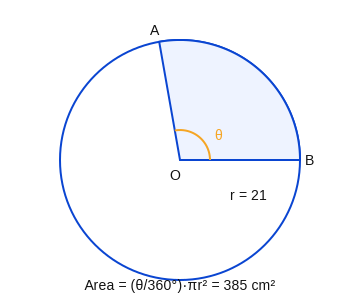
Q15986.
Let C be a circle with centre O and radius 21 cm. Let OAB be a sector of C. If the area of the sector is 385 cm2, then find the angle made by the sector at O.
(Use π = 22/7.)
मान लीजिए C एक वृत्त है जिसका केंद्र O और त्रिज्या 21 cm है। मान लीजिए OAB, C का एक त्रिज्यखंड है। यदि त्रिज्यखंड का क्षेत्रफल 385 cm2 है, तो त्रिज्यखंड द्वारा O पर बनाया गया कोण ज्ञात कीजिए।
(π = 22/7 का प्रयोग कीजिए।)
  1. A120°
  2. B80°
  3. C60°
  4. D100°
Show answer

Concept: Area of a sector =θ360∘×πr2.

  1. πr2=227×21×21=1386cm2.
  2. θ360∘×1386=385⇒θ360∘=3851386=518.
  3. θ=518×360∘=100∘.

Trick: Sector area ÷ circle area = angle ÷ 360∘; 3851386 cancels by 77 to 518.

Answer: (D) 100∘

अवधारणा: त्रिज्यखंड का क्षेत्रफल =θ360∘×πr2।

  1. πr2=227×21×21=1386cm2।
  2. θ360∘×1386=385⇒θ360∘=3851386=518।
  3. θ=518×360∘=100∘।

ट्रिक: त्रिज्यखंड क्षेत्रफल ÷ वृत्त क्षेत्रफल = कोण ÷ 360∘; 3851386 को 77 से काटें → 518।

उत्तर: (D) 100∘

RRB NTPC Graduate CBT 1MathematicsMensuration – Sector of CircleRRB NTPC Graduate CBT 1 2025 · 19 Mar Shift 2 →
Q15987.
Ajay gets double the amount in 7 years when invested at compound interest,
compounded annually. In how many years will the amount become sixteen times itself?
अजय को वार्षिक रूप से संयोजित चक्रवृद्धि ब्याज पर निवेश करने पर 7 वर्षों में दोगुनी राशि प्राप्त होती है।
कितने वर्षों में राशि स्वयं की सोलह गुनी हो जाएगी?
  1. A112
  2. B28
  3. C56
  4. D14
Show answer

Concept: Under compound interest, if money doubles in n years it becomes 2k times in kn years.

  1. Doubles in 7 years ⇒ ×2 every 7 years.
  2. 16=24, so four doublings are needed.
  3. Time =4×7=28 years.

Trick: CI multiplies, it does not add – 2 → 4 → 8 → 16 takes 7 years each step.

Answer: (B) 28

अवधारणा: चक्रवृद्धि ब्याज में यदि धन n वर्ष में दोगुना हो, तो kn वर्ष में 2k गुना होता है।

  1. 7 वर्ष में दोगुना ⇒ हर 7 वर्ष में ×2।
  2. 16=24, अतः चार बार दोगुना होना है।
  3. समय =4×7=28 वर्ष।

ट्रिक: CI गुणा करता है, जोड़ता नहीं – 2 → 4 → 8 → 16 में हर कदम 7 वर्ष।

उत्तर: (B) 28

RRB NTPC Graduate CBT 1MathematicsCompound Interest – DoublingRRB NTPC Graduate CBT 1 2025 · 19 Mar Shift 2 →
Q15988.
If x = ∛(31 + 14√3) and y = ∛(31 - 14√3), then the value of x³ + y³ + 3x³y³ is
यदि x = ∛(31 + 14√3) और y = ∛(31 - 14√3) है, तो x³ + y³ + 3x³y³ का मान है
  1. A1181
  2. B1143
  3. C1198
  4. D1157
Show answer

Concept: Cube both expressions directly: x3=31+143, y3=31−143.

  1. x3+y3=62.
  2. x3y3=(31+143)(31−143)=961−588=373.
  3. x3+y3+3x3y3=62+3×373=62+1119=1181.

Trick: Conjugate surds multiply to a2−b2c – no need to simplify the cube roots.

Answer: (A) 1181

अवधारणा: दोनों का सीधे घन लें: x3=31+143, y3=31−143।

  1. x3+y3=62।
  2. x3y3=(31+143)(31−143)=961−588=373।
  3. x3+y3+3x3y3=62+3×373=62+1119=1181।

ट्रिक: संयुग्मी करणियों का गुणनफल a2−b2c – घनमूल सरल करने की ज़रूरत नहीं।

उत्तर: (A) 1181

RRB NTPC Graduate CBT 1MathematicsAlgebra – CubesRRB NTPC Graduate CBT 1 2025 · 19 Mar Shift 2 →
Q15989.
If x is inversely proportional to y, and y = 30 when x = 28, find the value of x, when y = 20.
यदि x, y के व्युत्क्रमानुपाती है, और x = 28 होने पर y = 30 है, तो y = 20 होने पर x का मान ज्ञात कीजिए।
  1. A33
  2. B42
  3. C52
  4. D38
Show answer

Concept: Inverse proportion ⇒ xy= constant.

  1. k=xy=28×30=840.
  2. When y=20: x=84020=42.

Trick: y falls from 30 to 20 (ratio 3:2), so x rises in ratio 2:3: 28×32=42.

Answer: (B) 42

अवधारणा: व्युत्क्रम अनुपात ⇒ xy= नियतांक।

  1. k=xy=28×30=840।
  2. y=20 पर: x=84020=42।

ट्रिक: y 30 से 20 (अनुपात 3:2) घटा, तो x अनुपात 2:3 में बढ़ेगा: 28×32=42।

उत्तर: (B) 42

RRB NTPC Graduate CBT 1MathematicsInverse VariationRRB NTPC Graduate CBT 1 2025 · 19 Mar Shift 2 →
Q15990.
If 8x3−27y3=(Ax+By)(Cx2−Dy2+Exy), then the value of (A+B+C+D+E) is:
यदि 8x3−27y3=(Ax+By)(Cx2−Dy2+Exy) है, तो (A+B+C+D+E) का मान है:
  1. A−3
  2. B−1
  3. C0
  4. D2
Show answer

Concept: a3−b3=(a−b)(a2+ab+b2) with a=2x, b=3y.

  1. 8x3−27y3=(2x−3y)(4x2+6xy+9y2).
  2. Match with (Ax+By)(Cx2−Dy2+Exy): A=2, B=−3, C=4, −D=9⇒D=−9, E=6.
  3. A+B+C+D+E=2−3+4−9+6=0.

Trick: Watch the sign in front of D – the identity has +9y2, so D=−9, not 9.

Answer: (C) 0

अवधारणा: a3−b3=(a−b)(a2+ab+b2), यहाँ a=2x, b=3y।

  1. 8x3−27y3=(2x−3y)(4x2+6xy+9y2)।
  2. (Ax+By)(Cx2−Dy2+Exy) से मिलाएँ: A=2, B=−3, C=4, −D=9⇒D=−9, E=6।
  3. A+B+C+D+E=2−3+4−9+6=0।

ट्रिक: D के आगे का चिह्न देखें – सर्वसमिका में +9y2 है, अतः D=−9, 9 नहीं।

उत्तर: (C) 0

RRB NTPC Graduate CBT 1MathematicsAlgebra – FactorisationRRB NTPC Graduate CBT 1 2025 · 19 Mar Shift 2 →
Q15991.
A dealer buys two articles X and Y for ₹1,000 each. He marks each of them at the same price. He sells X by giving two successive discounts of 15% and 30% and still earns ₹337 as profit. If he sells Y at a single discount of 49%, then what is the profit
percentage on Y?
एक व्यापारी दो वस्तुएँ X और Y, प्रत्येक ₹1,000 में खरीदता है। वह दोनों पर समान अंकित मूल्य लगाता है। वह X को 15% और 30% की दो क्रमिक छूटें देकर बेचता है और फिर भी ₹337 का लाभ कमाता है। यदि वह Y को 49% की एकल छूट पर बेचता है, तो Y पर लाभ
प्रतिशत कितना है?
  1. A14.6%
  2. B13.6%
  3. C13%
  4. D14%
Show answer

Concept: Same marked price M for both; use X to find M, then apply the single discount to Y.

  1. X: SP =M×0.85×0.70=0.595M=1000+337=1337⇒M=13370.595≈2247.06.
  2. Y: SP =0.51M=0.51×2247.06≈1146.
  3. Profit on Y =1146−1000=146⇒14.6%.

Trick: SPY=1337×0.510.595=1337×67=1146 – skip finding M.

Answer: (A) 14.6%

अवधारणा: दोनों का अंकित मूल्य M समान; X से M निकालें, फिर Y पर एकल छूट लगाएँ।

  1. X: SP =M×0.85×0.70=0.595M=1000+337=1337⇒M=13370.595≈2247.06।
  2. Y: SP =0.51M=0.51×2247.06≈1146।
  3. Y पर लाभ =1146−1000=146⇒14.6%।

ट्रिक: SPY=1337×0.510.595=1337×67=1146 – M निकालने की ज़रूरत नहीं।

उत्तर: (A) 14.6%

RRB NTPC Graduate CBT 1MathematicsProfit & Loss – DiscountsRRB NTPC Graduate CBT 1 2025 · 19 Mar Shift 2 →
Q15992.
The sum of two numbers a and b, where a < b, is 129. The HCF and LCM of a and b are 3 and 1350, respectively. Find the value of 1a−1b.
दो संख्याओं a और b, जहाँ a < b है, का योग 129 है। a और b का HCF और LCM क्रमशः 3 और 1350 हैं। 1a−1b का मान ज्ञात कीजिए।
  1. A71350
  2. B−34550
  3. C−211550
  4. D441450
Show answer

Concept: a×b=HCF×LCM and 1a−1b=b−aab.

  1. ab=3×1350=4050. Let a=3p, b=3q (co-prime): pq=450, p+q=43⇒p=18,q=25.
  2. So a=54, b=75 (54+75=129 ✓), b−a=21.
  3. 1a−1b=214050=71350.

Trick: (b−a)2=(a+b)2−4ab=16641−16200=441⇒b−a=21 – no need to find a,b separately.

Answer: (A) 71350

अवधारणा: a×b=HCF×LCM और 1a−1b=b−aab।

  1. ab=3×1350=4050। a=3p, b=3q (सह-अभाज्य) लें: pq=450, p+q=43⇒p=18,q=25।
  2. अतः a=54, b=75 (54+75=129 ✓), b−a=21।
  3. 1a−1b=214050=71350।

ट्रिक: (b−a)2=(a+b)2−4ab=16641−16200=441⇒b−a=21 – a,b अलग-अलग निकालने की ज़रूरत नहीं।

उत्तर: (A) 71350

RRB NTPC Graduate CBT 1MathematicsHCF and LCMRRB NTPC Graduate CBT 1 2025 · 19 Mar Shift 2 →
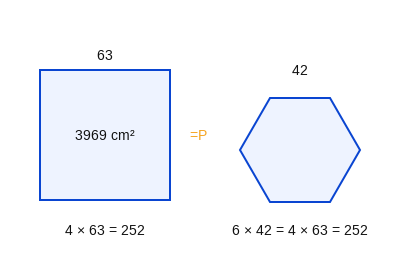
Q15993.
The area of a square is 3969 cm2. Its perimeter is equal to the perimeter of a regular hexagon. What is the area (in cm2) of the hexagon?
एक वर्ग का क्षेत्रफल 3969 cm2 है। इसका परिमाप एक समषट्भुज के परिमाप के बराबर है। षट्भुज का क्षेत्रफल (cm2 में) क्या है?
  1. A2600
  2. B2608
  3. C26623
  4. D26463
Show answer

Concept: Area of a regular hexagon =332a2; equal perimeters link the square and hexagon.

  1. Square side =3969=63 cm, perimeter =4×63=252 cm.
  2. Hexagon side a=2526=42 cm.
  3. Area =332×422=332×1764=26463cm2.

Trick: 632=3969 (since 63=9×7); hexagon side =23 of square side when perimeters are equal.

Answer: (D) 26463

अवधारणा: सम षट्भुज का क्षेत्रफल =332a2; बराबर परिमाप से वर्ग और षट्भुज जुड़ते हैं।

  1. वर्ग की भुजा =3969=63 cm, परिमाप =4×63=252 cm।
  2. षट्भुज की भुजा a=2526=42 cm।
  3. क्षेत्रफल =332×422=332×1764=26463cm2।

ट्रिक: 632=3969 (63=9×7); परिमाप बराबर हों तो षट्भुज की भुजा = वर्ग की भुजा का 23।

उत्तर: (D) 26463

RRB NTPC Graduate CBT 1MathematicsMensuration – Regular HexagonRRB NTPC Graduate CBT 1 2025 · 19 Mar Shift 2 →
Q15994.
If 4 lines of a print, in a column of a book, contain 36 words, how many words will a column of 93 lines contain?
यदि किसी पुस्तक के एक कॉलम में छपी 4 पंक्तियों में 36 शब्द हैं, तो 93 पंक्तियों वाले कॉलम में कितने शब्द होंगे?
  1. A833
  2. B841
  3. C837
  4. D847
Show answer

Concept: Words are directly proportional to the number of lines.

  1. 4 lines → 36 words ⇒ 1 line → 9 words.
  2. 93 lines → 93×9=837 words.

Trick: 93×9=93×10−93=930−93=837.

Answer: (C) 837

अवधारणा: शब्द, पंक्तियों की संख्या के सीधे अनुपात में हैं।

  1. 4 पंक्तियाँ → 36 शब्द ⇒ 1 पंक्ति → 9 शब्द।
  2. 93 पंक्तियाँ → 93×9=837 शब्द।

ट्रिक: 93×9=93×10−93=930−93=837।

उत्तर: (C) 837

RRB NTPC Graduate CBT 1MathematicsUnitary MethodRRB NTPC Graduate CBT 1 2025 · 19 Mar Shift 2 →
Q15995.
P and Q are two stations. A train travels from P to Q at a speed of 144 km/h and returns to P at a slower speed. If the average speed for the entire journey is 126 km/h, find the speed at which the train returns.
P और Q दो स्टेशन हैं। एक रेलगाड़ी P से Q तक 144 km/h की चाल से जाती है और धीमी चाल से P लौटती है। यदि पूरी यात्रा की औसत चाल 126 km/h है, तो रेलगाड़ी की लौटते समय की चाल ज्ञात कीजिए।
  1. A124 km/h
  2. B128 km/h
  3. C121 km/h
  4. D112 km/h
Show answer

Concept: For equal distances, average speed =2uvu+v.

  1. 2×144×v144+v=126.
  2. 288v=126×144+126v⇒162v=18144.
  3. v=112km/h.

Trick: 1v=2126−1144=163−1144=144−639072=819072=1112.

Answer: (D) 112 km/h

अवधारणा: समान दूरी के लिए औसत चाल =2uvu+v।

  1. 2×144×v144+v=126।
  2. 288v=126×144+126v⇒162v=18144।
  3. v=112km/h।

ट्रिक: 1v=2126−1144=163−1144=819072=1112।

उत्तर: (D) 112 km/h

RRB NTPC Graduate CBT 1MathematicsAverage SpeedRRB NTPC Graduate CBT 1 2025 · 19 Mar Shift 2 →
Q15996.
In a certain code language,
A + B means ‘A is the son of B’
A – B means ‘A is the brother of B’
A x B means ‘A is the wife of B’
A ÷ B means ‘A is the father of B’
Based on the above, how is W related to G if ‘W – O x R + K ÷ G’?
एक निश्चित कूट भाषा में,
A + B का अर्थ है ‘A, B का पुत्र है’
A – B का अर्थ है ‘A, B का भाई है’
A x B का अर्थ है ‘A, B की पत्नी है’
A ÷ B का अर्थ है ‘A, B का पिता है’
उपर्युक्त के आधार पर, यदि ‘W – O x R + K ÷ G’ है, तो W का G से क्या संबंध है?
  1. ABrother's wife's brotherभाई की पत्नी का भाई
  2. BBrother's wife's fatherभाई की पत्नी का पिता
  3. CWife's fatherपत्नी का पिता
  4. DWife's brotherपत्नी का भाई
Show answer

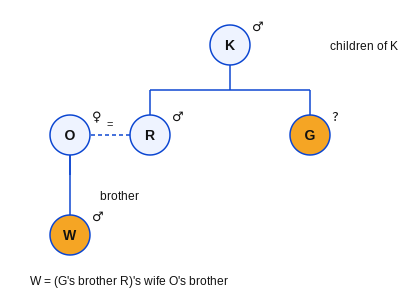
Concept: Decode the expression pair by pair and build the family tree.

  1. W – O: W is the brother of O. O x R: O is the wife of R. R + K: R is the son of K. K ÷ G: K is the father of G.
  2. So R and G are children of K, i.e. R is G's brother.
  3. O is R's wife = G's brother's wife; W is O's brother.
  4. Hence W is G's brother's wife's brother.

Trick: Always start from the person asked about at the end (G) and walk back along the chain.

Answer: (A) Brother's wife's brother

अवधारणा: व्यंजक को जोड़ी-जोड़ी में decode करके वंश-वृक्ष बनाइए।

  1. W – O: W, O का भाई। O x R: O, R की पत्नी। R + K: R, K का पुत्र। K ÷ G: K, G का पिता।
  2. अतः R और G दोनों K की संतान हैं, यानी R, G का भाई है।
  3. O, R की पत्नी = G के भाई की पत्नी; W, O का भाई।
  4. इसलिए W, G के भाई की पत्नी का भाई है।

ट्रिक: जिसके बारे में पूछा गया है (G) उससे शुरू करके श्रृंखला में पीछे चलें।

उत्तर: (A) Brother's wife's brother (भाई की पत्नी का भाई)

RRB NTPC Graduate CBT 1General Intelligence and ReasoningBlood RelationsRRB NTPC Graduate CBT 1 2025 · 19 Mar Shift 2 →
Q15997.
10 is related to 120 following a certain logic. Following the same logic, 12 is related to 168. To which of the following is 18 related, following the same logic?
​
(NOTE: Operations should be performed on the whole numbers, without breaking down the numbers into their constituent digits. E.g. 13 – Operations on 13 such as
adding/subtracting/multiplying etc. to 13, can be performed. Breaking down 13 into 1 and 3 and then performing mathematical operations on 1 and 3 is not allowed.)
10 एक निश्चित तर्क के अनुसार 120 से संबंधित है। उसी तर्क के अनुसार 12, 168 से संबंधित है। उसी तर्क के अनुसार 18 निम्नलिखित में से किससे संबंधित है?
​
(नोट: संक्रियाएँ पूर्ण संख्याओं पर की जानी चाहिए, संख्याओं को उनके घटक अंकों में तोड़े बिना। उदाहरण के लिए 13 – 13 पर संक्रियाएँ जैसे 13 में जोड़ना/घटाना/गुणा करना आदि की जा सकती हैं। 13 को 1 और 3 में तोड़कर फिर 1 और 3 पर गणितीय संक्रियाएँ करने की अनुमति नहीं है।)
  1. A324
  2. B256
  3. C360
  4. D400
Show answer

Concept: Find one rule that links both given pairs and apply it to the new number.

  1. 10→120: 10×12=10×(10+2)=120.
  2. 12→168: 12×14=12×(12+2)=168. Rule: n×(n+2).
  3. 18→18×20=360.

Trick: Equivalent form: n2+2n. Check: 100+20=120 ✓, 144+24=168 ✓, 324+36=360.

Answer: (C) 360

अवधारणा: दोनों दी गई जोड़ियों पर लागू होने वाला एक नियम खोजें और नई संख्या पर लगाएँ।

  1. 10→120: 10×12=10×(10+2)=120।
  2. 12→168: 12×14=12×(12+2)=168। नियम: n×(n+2)।
  3. 18→18×20=360।

ट्रिक: दूसरा रूप: n2+2n। जाँच: 100+20=120 ✓, 144+24=168 ✓, 324+36=360।

उत्तर: (C) 360

RRB NTPC Graduate CBT 1General Intelligence and ReasoningNumber AnalogyRRB NTPC Graduate CBT 1 2025 · 19 Mar Shift 2 →
Q15998.
X, Y, Z, S, T and U live on six different floors of the same building. The lowermost floor in the building is numbered 1, the floor above it is numbered 2, and so on till the topmost floor is numbered 6. X lives on an even numbered floor but not on floor number 4. Only two people live between X and T. S lives on an odd numbered floor but not on the lowermost floor. Only two people live between S and Y. Z lives immediately below S. How many people live between U and Z?
X, Y, Z, S, T और U एक ही इमारत की छह अलग-अलग मंज़िलों पर रहते हैं। इमारत की सबसे निचली मंज़िल की संख्या 1 है, उसके ऊपर की मंज़िल की संख्या 2 है, और इसी प्रकार सबसे ऊपरी मंज़िल की संख्या 6 है। X एक सम संख्या वाली मंज़िल पर रहता है, परंतु मंज़िल संख्या 4 पर नहीं। X और T के बीच केवल दो व्यक्ति रहते हैं। S एक विषम संख्या वाली मंज़िल पर रहता है, परंतु सबसे निचली मंज़िल पर नहीं। S और Y के बीच केवल दो व्यक्ति रहते हैं। Z, S के ठीक नीचे रहता है। U और Z के बीच कितने व्यक्ति रहते हैं?
  1. ATwoदो
  2. BThreeतीन
  3. CFourचार
  4. DOneएक
Show answer

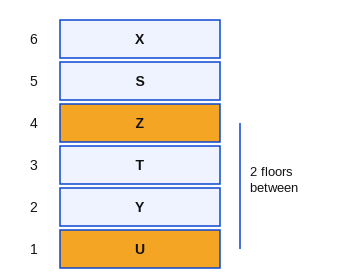
Concept: Fix the most restricted person first (X), test each case and discard contradictions.

  1. X is on an even floor other than 4 ⇒ X =2 or 6. Two people between X and T ⇒ (X, T) =(2,5) or (6,3).
  2. S is odd but not 1 ⇒ S =3 or 5; two between S and Y ⇒ (S, Y) =(3,6) or (5,2); Z is just below S.
  3. If X =2, T =5: S =3 makes Z =2 (clash with X) and S =5 clashes with T. Rejected.
  4. So X =6, T =3, S =5, Y =2, Z =4 and U gets floor 1. Between U (1) and Z (4): floors 2 and 3 – two people.

Trick: "Immediately below" clues are the fastest contradiction-finders – test them first in each case.

Answer: (A) Two

अवधारणा: सबसे अधिक प्रतिबंधित व्यक्ति (X) को पहले रखें, हर स्थिति जाँचें और विरोधाभास हटाएँ।

  1. X सम मंज़िल पर है पर 4 पर नहीं ⇒ X =2 या 6। X और T के बीच दो लोग ⇒ (X, T) =(2,5) या (6,3)।
  2. S विषम पर 1 नहीं ⇒ S =3 या 5; S और Y के बीच दो ⇒ (S, Y) =(3,6) या (5,2); Z ठीक S के नीचे।
  3. X =2, T =5 लें: S =3 से Z =2 (X से टकराव), S =5 T से टकराता है। अस्वीकार।
  4. अतः X =6, T =3, S =5, Y =2, Z =4, U मंज़िल 1 पर। U (1) और Z (4) के बीच मंज़िल 2 और 3 – दो लोग।

ट्रिक: "ठीक नीचे/ऊपर" वाले सुराग सबसे जल्दी विरोधाभास पकड़ते हैं – हर case में इन्हें पहले जाँचें।

उत्तर: (A) Two (दो)

RRB NTPC Graduate CBT 1General Intelligence and ReasoningFloor PuzzleRRB NTPC Graduate CBT 1 2025 · 19 Mar Shift 2 →
Q15999.
In a certain code language, ‘WINS’ is coded as ‘8246’ and ‘NORM’ is coded as ‘3851’. What is the code for 'N’ in the given code language?
एक निश्चित कूट भाषा में, ‘WINS’ को ‘8246’ के रूप में कूटबद्ध किया जाता है और ‘NORM’ को ‘3851’ के रूप में कूटबद्ध किया जाता है। उस कूट भाषा में 'N' का कूट क्या है?
  1. A4
  2. B3
  3. C8
  4. D1
Show answer

Concept: In number-coding of words, a letter common to two words gets the digit common to both codes.

  1. WINS → 8 2 4 6 and NORM → 3 8 5 1.
  2. Only letter common to both words: N. Only digit common to both codes: 8.
  3. So N =8.

Trick: Compare letters and digits side by side – the single overlap gives the answer in one look.

Answer: (C) 8

अवधारणा: शब्दों की संख्या-कोडिंग में दोनों शब्दों का साझा अक्षर, दोनों कोड के साझा अंक से कोड होता है।

  1. WINS → 8 2 4 6 और NORM → 3 8 5 1।
  2. दोनों शब्दों में साझा अक्षर केवल N; दोनों कोड में साझा अंक केवल 8।
  3. अतः N =8।

ट्रिक: अक्षरों और अंकों को आमने-सामने रखें – एक ही overlap से उत्तर मिल जाता है।

उत्तर: (C) 8

RRB NTPC Graduate CBT 1General Intelligence and ReasoningCoding–DecodingRRB NTPC Graduate CBT 1 2025 · 19 Mar Shift 2 →
Q16000.
If 1 is added to each odd digit and 2 is subtracted from each even digit in the number 8371456, what will be the sum of the digits that are second from the left and second from the right in the new number thus formed?
यदि संख्या 8371456 में प्रत्येक विषम अंक में 1 जोड़ा जाए और प्रत्येक सम अंक में से 2 घटाया जाए, तो इस प्रकार बनी नई संख्या में बाएँ से दूसरे और दाएँ से दूसरे अंकों का योग क्या होगा?
  1. A9
  2. B8
  3. C11
  4. D10
Show answer

Concept: Apply the rule digit by digit, then read the required positions in the new number.

  1. 8 3 7 1 4 5 6: odd digits +1, even digits −2.
  2. 8→6, 3→4, 7→8, 1→2, 4→2, 5→6, 6→4 ⇒ new number 6 4 8 2 2 6 4.
  3. Second from left =4, second from right =6; sum =10.

Trick: Write the new digits directly below the old ones – positions never get mixed up.

Answer: (D) 10

अवधारणा: नियम हर अंक पर लगाएँ, फिर नई संख्या में माँगे गए स्थान पढ़ें।

  1. 8 3 7 1 4 5 6: विषम अंक +1, सम अंक −2।
  2. 8→6, 3→4, 7→8, 1→2, 4→2, 5→6, 6→4 ⇒ नई संख्या 6 4 8 2 2 6 4।
  3. बाएँ से दूसरा =4, दाएँ से दूसरा =6; योग =10।

ट्रिक: नए अंक पुराने अंकों के ठीक नीचे लिखें – स्थान कभी नहीं गड़बड़ाते।

उत्तर: (D) 10

RRB NTPC Graduate CBT 1General Intelligence and ReasoningNumber OperationsRRB NTPC Graduate CBT 1 2025 · 19 Mar Shift 2 →