Question bank

Q&A: practice questions with answers

Search questions on any topic. Filter by exam category, exam, subject and topic, try the question, then open the answer and explanation.

Courses – airGurukul

20,719 questions found.

Q16001.
Which of the given letter-number clusters will replace the question mark (?) in the following series to make it logically complete?
YQM 2 SKG 6 MEA 12 GYU 20 ?
निम्नलिखित श्रृंखला को तार्किक रूप से पूर्ण करने के लिए दिए गए अक्षर-संख्या समूहों में से कौन-सा प्रश्नचिह्न (?) के स्थान पर आएगा?
YQM 2 SKG 6 MEA 12 GYU 20 ?
  1. ABTP 32
  2. BASO 30
  3. CDZP 30
  4. DLWY 30
Show answer

Concept: Treat the letters and the numbers as two separate series.

  1. Letters: Y→S→M→G (each −6), so G−6= A. Q→K→E→Y (also −6), so Y−6= S. M→G→A→U, so U−6= O. Cluster: ASO.
  2. Numbers: 2, 6, 12, 20 – differences 4, 6, 8, so next difference 10 ⇒30.

Trick: 2, 6, 12, 20, 30 is n(n+1): 1×2, 2×3, 3×4, 4×5, 5×6.

Answer: (B) ASO 30

अवधारणा: अक्षरों और संख्याओं को दो अलग श्रृंखलाओं की तरह देखें।

  1. अक्षर: Y→S→M→G (हर बार −6), अतः G−6= A। Q→K→E→Y (−6), अतः S। M→G→A→U, अतः O। समूह: ASO।
  2. संख्याएँ: 2, 6, 12, 20 – अंतर 4, 6, 8, अगला अंतर 10 ⇒30।

ट्रिक: 2, 6, 12, 20, 30 =n(n+1): 1×2, 2×3, 3×4, 4×5, 5×6।

उत्तर: (B) ASO 30

RRB NTPC Graduate CBT 1General Intelligence and ReasoningLetter–Number SeriesRRB NTPC Graduate CBT 1 2025 · 19 Mar Shift 2 →
Q16002.
Based on the English alphabetical order, three of the following four are alike in a certain way and thus form a group. Which is the one that does not belong to that group? (Note: The odd man out is not based on the number of consonants/vowels or their position in the letter cluster)
अंग्रेज़ी वर्णमाला क्रम के आधार पर, निम्नलिखित चार में से तीन एक निश्चित प्रकार से समान हैं और इस प्रकार एक समूह बनाते हैं। वह कौन-सा है जो उस समूह से संबंधित नहीं है? (नोट: असंगत का चयन व्यंजनों/स्वरों की संख्या या अक्षर समूह में उनकी स्थिति के आधार पर नहीं किया गया है)
  1. AEHJ
  2. BNQS
  3. CBEG
  4. DDGH
Show answer

Concept: Check the gaps between consecutive letters in each cluster.

  1. EHJ: E+3​H+2​J. NQS: +3,+2. BEG: +3,+2.
  2. DGH: D+3​G+1​H – the second gap is +1, not +2.

Trick: Convert to positions (E5 H8 J10, D4 G7 H8) – the differing gap jumps out.

Answer: (D) DGH

अवधारणा: हर समूह में क्रमागत अक्षरों के बीच का अंतर देखें।

  1. EHJ: E+3​H+2​J। NQS: +3,+2। BEG: +3,+2।
  2. DGH: D+3​G+1​H – दूसरा अंतर +1 है, +2 नहीं।

ट्रिक: स्थान-संख्या लिखें (E5 H8 J10, D4 G7 H8) – अलग अंतर तुरंत दिखता है।

उत्तर: (D) DGH

RRB NTPC Graduate CBT 1General Intelligence and ReasoningLetter Cluster – Odd One OutRRB NTPC Graduate CBT 1 2025 · 19 Mar Shift 2 →
Q16003.
Which of the following letter-clusters should replace # and % so that the pattern and relationship followed between the letter-cluster pair on the left side of :: is the same as that on the right side of :: ?
# : LHN :: PLR : %
निम्नलिखित में से कौन-से अक्षर-समूह # और % के स्थान पर आने चाहिए ताकि :: के बाईं ओर के अक्षर-समूह युग्म के बीच पालन किया गया पैटर्न और संबंध, :: के दाईं ओर के युग्म के समान हो?
# : LHN :: PLR : %
  1. A# = MIP , % = OKQ
  2. B# = MIO , % = OKQ
  3. C# = MIO , % = OLQ
  4. D# = MIO , % = OKR
Show answer

Concept: The same letter-shift must turn # into LHN and PLR into %. Test the pattern suggested by the options.

  1. Options give # = MIO (mostly). MIO → LHN: M−1=L, I−1=H, O−1=N – each letter −1.
  2. Apply the same to PLR: P−1=O, L−1=K, R−1=Q ⇒ % = OKQ.
  3. Only option B has both # = MIO and % = OKQ.

Trick: When the left term is unknown, work backwards from the second pair and eliminate options with a single mismatched letter.

Answer: (B) # = MIO , % = OKQ

अवधारणा: एक ही अक्षर-परिवर्तन से # → LHN और PLR → % बनना चाहिए। विकल्पों से पैटर्न जाँचें।

  1. विकल्पों में # = MIO (अधिकतर)। MIO → LHN: M−1=L, I−1=H, O−1=N – हर अक्षर −1।
  2. PLR पर वही: P−1=O, L−1=K, R−1=Q ⇒ % = OKQ।
  3. केवल विकल्प B में # = MIO और % = OKQ दोनों हैं।

ट्रिक: बायाँ पद अज्ञात हो तो दूसरी जोड़ी से उल्टा चलें और एक अक्षर के अंतर वाले विकल्प हटाएँ।

उत्तर: (B) # = MIO , % = OKQ

RRB NTPC Graduate CBT 1General Intelligence and ReasoningLetter AnalogyRRB NTPC Graduate CBT 1 2025 · 19 Mar Shift 2 →
Q16004.
In a certain code language, ‘MINT’ is coded as ‘6134’ and ‘TIME’ is coded as ‘4365’. What is the code for ‘E’ in the given code language?
एक निश्चित कूट भाषा में, ‘MINT’ को ‘6134’ के रूप में कूटबद्ध किया जाता है और ‘TIME’ को ‘4365’ के रूप में कूटबद्ध किया जाता है। उस कूट भाषा में ‘E’ का कूट क्या है?
  1. A4
  2. B5
  3. C3
  4. D6
Show answer

Concept: Letters common to both words take the digits common to both codes; the leftover letter takes the leftover digit.

  1. MINT → 6 1 3 4; TIME → 4 3 6 5.
  2. Common letters M, I, T ↔ common digits 6, 3, 4.
  3. The extra letter in TIME is E and the extra digit is 5, so E =5.

Trick: Cross out the common letters and common digits – whatever is left is the pair you need.

Answer: (B) 5

अवधारणा: दोनों शब्दों के साझा अक्षर, साझा अंक लेते हैं; बचा हुआ अक्षर बचे हुए अंक का कोड है।

  1. MINT → 6 1 3 4; TIME → 4 3 6 5।
  2. साझा अक्षर M, I, T ↔ साझा अंक 6, 3, 4।
  3. TIME में अतिरिक्त अक्षर E और अतिरिक्त अंक 5, अतः E =5।

ट्रिक: साझा अक्षर और साझा अंक काट दें – जो बचे वही जोड़ी उत्तर है।

उत्तर: (B) 5

RRB NTPC Graduate CBT 1General Intelligence and ReasoningCoding–DecodingRRB NTPC Graduate CBT 1 2025 · 19 Mar Shift 2 →
Q16005.
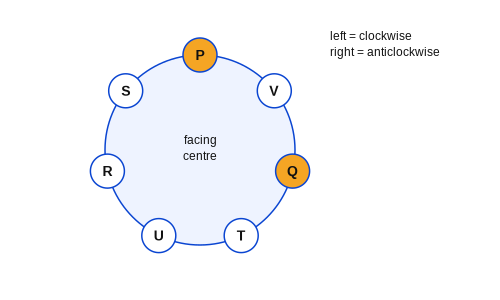
P, Q, R, S, T, U and V sit around a circular table facing the centre. Only two people sit between P and U when counted from the right of P. Only two people sit between U and V. Only three people sit between P and T. S sits to the immediate left of R. How many people sit between P and Q when counted from the right of Q?
P, Q, R, S, T, U और V एक वृत्ताकार मेज़ के चारों ओर केंद्र की ओर मुख करके बैठे हैं। P के दाईं ओर से गिनने पर P और U के बीच केवल दो व्यक्ति बैठे हैं। U और V के बीच केवल दो व्यक्ति बैठे हैं। P और T के बीच केवल तीन व्यक्ति बैठे हैं। S, R के ठीक बाईं ओर बैठा है। Q के दाईं ओर से गिनने पर P और Q के बीच कितने व्यक्ति बैठे हैं?
  1. A1
  2. B3
  3. C4
  4. D2
Show answer

Concept: Facing the centre, "left" means clockwise and "right" means anticlockwise. Place P first and count carefully.

  1. From P's right (anticlockwise) two people, then U. Two between U and V and three between P and T fix V next to P (clockwise) and T between V-side and U, as in the figure.
  2. Remaining seats: one between V and T, and two between U and P. S is to the immediate left (clockwise) of R, so R and S take the two adjacent seats; Q takes the single seat between V and T.
  3. From the right (anticlockwise) of Q: V, then P. Only one person (V) sits between P and Q.

Trick: Draw 7 dots, mark "right = anticlockwise" once at the top, and never re-think direction mid-question.

Answer: (A) 1

अवधारणा: केंद्र की ओर मुख होने पर "बायाँ" = दक्षिणावर्त (clockwise) और "दायाँ" = वामावर्त (anticlockwise)। P को पहले रखें।

  1. P के दाएँ (anticlockwise) दो लोग, फिर U। U–V के बीच दो और P–T के बीच तीन लोग होने से V, P के बगल (clockwise) और T चित्र जैसा स्थिर हो जाता है।
  2. बची सीटें: V और T के बीच एक, U और P के बीच दो। S, R के ठीक बाएँ (clockwise) है, अतः R, S पास-पास वाली दो सीटों पर; Q, V और T के बीच की अकेली सीट पर।
  3. Q के दाएँ (anticlockwise) से: V, फिर P। P और Q के बीच केवल एक व्यक्ति (V)।

ट्रिक: 7 बिंदु बनाएँ, ऊपर एक बार "दायाँ = anticlockwise" लिख लें और बीच में दिशा दोबारा न सोचें।

उत्तर: (A) 1

RRB NTPC Graduate CBT 1General Intelligence and ReasoningCircular SeatingRRB NTPC Graduate CBT 1 2025 · 19 Mar Shift 2 →
Q16006.
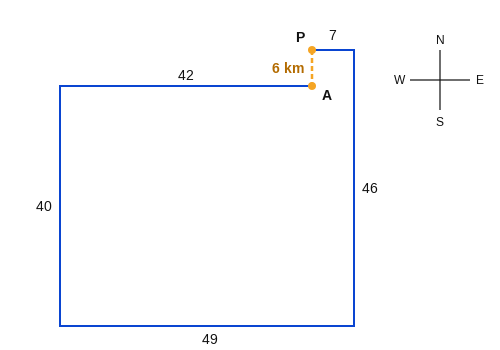
Fardin starts from Point A and drives 42 km towards the West. He then takes a left turn, drives 40 km, turns left and drives 49 km. He then takes a left turn and drives 46 km. He takes a final left turn, drives 7 km and stops at Point P. How far (shortest distance) and towards which direction should he drive in order to reach Point A again? (All turns are 90-degree turns only unless specified.)
फ़रदीन बिंदु A से चलना शुरू करता है और पश्चिम की ओर 42 km गाड़ी चलाता है। फिर वह बाएँ मुड़ता है, 40 km चलता है, बाएँ मुड़ता है और 49 km चलता है। फिर वह बाएँ मुड़ता है और 46 km चलता है। वह अंतिम बार बाएँ मुड़ता है, 7 km चलता है और बिंदु P पर रुक जाता है। बिंदु A पर पुनः पहुँचने के लिए उसे कितनी दूर (न्यूनतम दूरी) और किस दिशा में गाड़ी चलानी चाहिए? (जब तक अन्यथा न कहा जाए, सभी मोड़ केवल 90 डिग्री के हैं।)
  1. A7 km to the South7 km दक्षिण की ओर
  2. B8 km to the South8 km दक्षिण की ओर
  3. C5 km to the South5 km दक्षिण की ओर
  4. D6 km to the South6 km दक्षिण की ओर
Show answer

Concept: Plot the path on axes (East =+x, North =+y); a left turn rotates the heading anticlockwise: W → S → E → N → W.

  1. A(0,0) W42​ (−42,0) S40​ (−42,−40) E49​ (7,−40).
  2. N46​ (7,6) W7​ P(0,6).
  3. P is directly 6 km north of A, so he must drive 6 km South to reach A.

Trick: Net E–W: −42+49−7=0; net N–S: −40+46=+6 (north). Just net the opposite legs.

Answer: (D) 6 km to the South

अवधारणा: पथ को अक्षों पर रखें (पूर्व =+x, उत्तर =+y); बायाँ मोड़ दिशा को वामावर्त घुमाता है: W → S → E → N → W।

  1. A(0,0) W42​ (−42,0) S40​ (−42,−40) E49​ (7,−40)।
  2. N46​ (7,6) W7​ P(0,6)।
  3. P, A से ठीक 6 km उत्तर में है, अतः A पहुँचने के लिए 6 km दक्षिण चलना होगा।

ट्रिक: शुद्ध पूर्व–पश्चिम: −42+49−7=0; शुद्ध उत्तर–दक्षिण: −40+46=+6 (उत्तर)। विपरीत भुजाओं का net निकालें।

उत्तर: (D) 6 km to the South (6 km दक्षिण)

RRB NTPC Graduate CBT 1General Intelligence and ReasoningDirection & DistanceRRB NTPC Graduate CBT 1 2025 · 19 Mar Shift 2 →
Q16007.
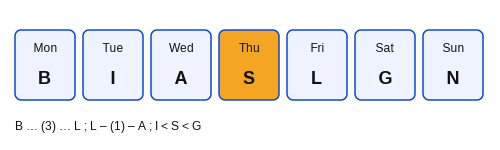
Each of A, B, L, I, N, G and S has exam on a different day of a week starting from Monday and ending on Sunday of the same week. B has exam on first day of the week. Only three people have exam between B and L. Only one person has exam between L and A. N has exam on Sunday. S has exam on one of the days after I but on one of the days before G. Who has exam on Thursday?
A, B, L, I, N, G और S में से प्रत्येक की परीक्षा एक ही सप्ताह में सोमवार से शुरू होकर रविवार को समाप्त होने वाले सप्ताह के अलग-अलग दिन है। B की परीक्षा सप्ताह के पहले दिन है। B और L के बीच केवल तीन व्यक्तियों की परीक्षा है। L और A के बीच केवल एक व्यक्ति की परीक्षा है। N की परीक्षा रविवार को है। S की परीक्षा I के बाद के किसी एक दिन परंतु G से पहले के किसी एक दिन है। गुरुवार को किसकी परीक्षा है?
  1. AG
  2. BI
  3. CA
  4. DS
Show answer

Concept: Pin the fixed days first (B on Monday, N on Sunday), then use the "between" clues.

  1. B = Monday. Three people between B and L ⇒ L = Friday.
  2. One person between L and A ⇒ A = Wednesday or Sunday; Sunday is N, so A = Wednesday.
  3. Remaining days Tue, Thu, Sat for I, S, G with I before S before G ⇒ I = Tue, S = Thu, G = Sat.
  4. Thursday: S.

Trick: "Only three between" from Monday always lands on Friday (Mon +4).

Answer: (D) S

अवधारणा: पहले निश्चित दिन रखें (B सोमवार, N रविवार), फिर "बीच में" वाले सुराग लगाएँ।

  1. B = सोमवार। B और L के बीच तीन लोग ⇒ L = शुक्रवार।
  2. L और A के बीच एक ⇒ A = बुधवार या रविवार; रविवार N का है, अतः A = बुधवार।
  3. बचे दिन मंगल, गुरु, शनि – I, S, G के लिए, क्रम I, फिर S, फिर G ⇒ I = मंगल, S = गुरु, G = शनि।
  4. गुरुवार: S।

ट्रिक: सोमवार से "केवल तीन बीच में" हमेशा शुक्रवार (Mon +4) देता है।

उत्तर: (D) S

RRB NTPC Graduate CBT 1General Intelligence and ReasoningScheduling Puzzle (Days)RRB NTPC Graduate CBT 1 2025 · 19 Mar Shift 2 →
Q16008.
In this question, a question is followed by two statements numbered (I) and (II). You have to decide whether the data provided in the statements are sufficient to answer the question. Read both the statements and decide the appropriate answer.
Question:
Among 5 trees, L, M, N, T and V each having a different height, which tree is the shortest?
Statements:
(I) N is shorter than only three trees.
(II) N is taller than M but shorter than T.
इस प्रश्न में, एक प्रश्न के बाद (I) और (II) क्रमांकित दो कथन दिए गए हैं। आपको यह तय करना है कि कथनों में दिए गए आँकड़े प्रश्न का उत्तर देने के लिए पर्याप्त हैं या नहीं। दोनों कथनों को पढ़िए और उपयुक्त उत्तर चुनिए।
प्रश्न:
5 पेड़ों L, M, N, T और V में, जिनमें से प्रत्येक की ऊँचाई अलग-अलग है, कौन-सा पेड़ सबसे छोटा है?
कथन:
(I) N केवल तीन पेड़ों से छोटा है।
(II) N, M से लंबा परंतु T से छोटा है।
  1. ABoth statements I and II together are NOT sufficient to answer the questionकथन I और II दोनों मिलकर भी प्रश्न का उत्तर देने के लिए पर्याप्त नहीं हैं
  2. BData in Statement II alone is sufficient to answer the question while data in statement I is notकेवल कथन II के आँकड़े प्रश्न का उत्तर देने के लिए पर्याप्त हैं, जबकि कथन I के आँकड़े पर्याप्त नहीं हैं
  3. CData in Statement I alone is sufficient to answer the question while data in statement II is notकेवल कथन I के आँकड़े प्रश्न का उत्तर देने के लिए पर्याप्त हैं, जबकि कथन II के आँकड़े पर्याप्त नहीं हैं
  4. DBoth statements I and II together (and not statement 1 alone or statement II alone) are sufficient to answer the questionकथन I और II दोनों मिलकर (न कि अकेले कथन I या अकेले कथन II) प्रश्न का उत्तर देने के लिए पर्याप्त हैं
Show answer

Concept: Test each statement alone, then both together; stop as soon as the shortest tree is uniquely fixed.

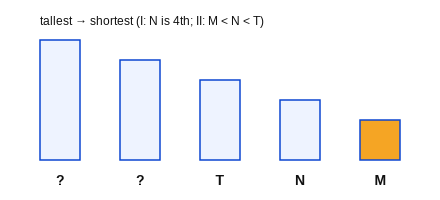
  1. (I) alone: N is shorter than only three ⇒ N is 4th tallest, i.e. exactly one tree is shorter than N – but we don't know which. Not sufficient.
  2. (II) alone: M < N < T. L and V are unplaced, so the shortest could be M, L or V. Not sufficient.
  3. Together: only one tree is below N, and (II) says M is below N ⇒ M is the shortest. Sufficient.

Trick: "Shorter than only three" = 4th position in a group of 5 – convert such phrases to ranks immediately.

Answer: (D) Both statements I and II together (and not statement I alone or statement II alone) are sufficient

अवधारणा: पहले हर कथन अकेले, फिर दोनों साथ जाँचें; जैसे ही सबसे छोटा पेड़ अद्वितीय रूप से तय हो, रुक जाएँ।

  1. (I) अकेले: N केवल तीन से छोटा ⇒ N चौथे स्थान पर, यानी N से छोटा ठीक एक पेड़ है – पर कौन, पता नहीं। अपर्याप्त।
  2. (II) अकेले: M < N < T। L और V का स्थान नहीं, सबसे छोटा M, L या V हो सकता है। अपर्याप्त।
  3. दोनों साथ: N से नीचे केवल एक पेड़, और (II) कहता है M, N से छोटा ⇒ M सबसे छोटा। पर्याप्त।

ट्रिक: "केवल तीन से छोटा" = 5 में चौथा स्थान – ऐसे वाक्यों को तुरंत रैंक में बदलें।

उत्तर: (D) दोनों कथन I और II मिलकर पर्याप्त हैं

RRB NTPC Graduate CBT 1General Intelligence and ReasoningData SufficiencyRRB NTPC Graduate CBT 1 2025 · 19 Mar Shift 2 →
Q16009.
This question is based on the five, three-digit numbers given below.
(Left) 419 975 573 389 937 (Right)
(Example- 697 – First digit = 6, second digit = 9 and third digit = 7)
NOTE - All operations to be done from left to right.
What will be the resultant if the second digit of the highest number is added to the third digit of the lowest number?
यह प्रश्न नीचे दी गई पाँच तीन-अंकीय संख्याओं पर आधारित है।
(बाएँ) 419 975 573 389 937 (दाएँ)
(उदाहरण- 697 – पहला अंक = 6, दूसरा अंक = 9 और तीसरा अंक = 7)
नोट - सभी संक्रियाएँ बाएँ से दाएँ की जानी हैं।
यदि सबसे बड़ी संख्या के दूसरे अंक को सबसे छोटी संख्या के तीसरे अंक में जोड़ा जाए, तो परिणाम क्या होगा?
  1. A16
  2. B19
  3. C18
  4. D17
Show answer

Concept: Identify the required numbers, pick the asked digits, then operate.

  1. Numbers: 419, 975, 573, 389, 937. Highest =975, lowest =389.
  2. Second digit of 975 =7; third digit of 389 =9.
  3. 7+9=16.

Trick: Highest/lowest are decided by the first digit (9 vs 3); 975 > 937 by the second digit.

Answer: (A) 16

अवधारणा: माँगी गई संख्याएँ पहचानें, फिर अंक चुनकर संक्रिया करें।

  1. संख्याएँ: 419, 975, 573, 389, 937। सबसे बड़ी =975, सबसे छोटी =389।
  2. 975 का दूसरा अंक =7; 389 का तीसरा अंक =9।
  3. 7+9=16।

ट्रिक: सबसे बड़ी/छोटी पहले अंक से तय (9 बनाम 3); 975 > 937 दूसरे अंक से।

उत्तर: (A) 16

RRB NTPC Graduate CBT 1General Intelligence and ReasoningNumber ArrangementRRB NTPC Graduate CBT 1 2025 · 19 Mar Shift 2 →
Q16010.
Read the given statements and conclusions carefully. Assuming that the information given in the statement(s) is true, even if it appears to be at variance with commonly known facts, decide which of the given conclusions logically follow(s) from the statement(s).
Statements:
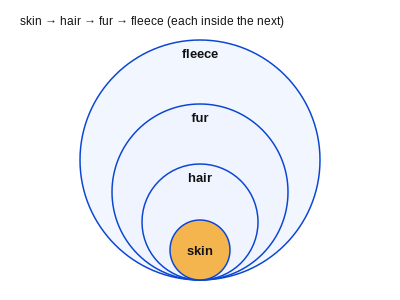
All skin is hair. All hair is fur. All fur is fleece.
Conclusions:
(I) All skin is fleece.
(II) Some fleeces are hair.
दिए गए कथनों और निष्कर्षों को ध्यानपूर्वक पढ़िए। यह मानते हुए कि कथन(नों) में दी गई जानकारी सत्य है, भले ही वह सामान्यतः ज्ञात तथ्यों से भिन्न प्रतीत होती हो, तय कीजिए कि दिए गए निष्कर्षों में से कौन-सा/से निष्कर्ष कथन(नों) का तार्किक रूप से अनुसरण करता/करते है/हैं।
कथन:
सभी त्वचा, बाल हैं। सभी बाल, फर हैं। सभी फर, ऊन हैं।
निष्कर्ष:
(I) सभी त्वचा, ऊन हैं।
(II) कुछ ऊन, बाल हैं।
  1. AOnly conclusion (I) follows.केवल निष्कर्ष (I) अनुसरण करता है।
  2. BBoth conclusions (I) and (II) follow.निष्कर्ष (I) और (II) दोनों अनुसरण करते हैं।
  3. CNeither conclusion (I) nor (II) follows.न तो निष्कर्ष (I) और न ही (II) अनुसरण करता है।
  4. DOnly conclusion (II) follows.केवल निष्कर्ष (II) अनुसरण करता है।
Show answer

Concept: "All A is B" statements chain together; draw nested circles.

  1. skin ⊆ hair ⊆ fur ⊆ fleece, so every skin is fleece – conclusion (I) follows.
  2. "All hair is fur, all fur is fleece" gives all hair is fleece; its converse "some fleeces are hair" is always true – conclusion (II) follows.

Trick: All A is B ⇒ Some B is A (valid conversion). Chains of "All" never break.

Answer: (B) Both conclusions (I) and (II) follow.

अवधारणा: "सभी A, B हैं" कथन श्रृंखला बनाते हैं; एक-दूसरे के अंदर वृत्त बनाएँ।

  1. skin ⊆ hair ⊆ fur ⊆ fleece, अतः हर skin, fleece है – निष्कर्ष (I) सही।
  2. "सभी hair, fur; सभी fur, fleece" से सभी hair, fleece; इसका विलोम "कुछ fleece, hair हैं" सदैव सत्य – निष्कर्ष (II) सही।

ट्रिक: सभी A, B ⇒ कुछ B, A (मान्य परिवर्तन)। "सभी" की श्रृंखला कभी नहीं टूटती।

उत्तर: (B) दोनों निष्कर्ष (I) और (II) सही हैं।

RRB NTPC Graduate CBT 1General Intelligence and ReasoningSyllogismRRB NTPC Graduate CBT 1 2025 · 19 Mar Shift 2 →
Q16011.
Refer to the following letter, symbol series and answer the question. Counting to be done from left to right only.
(Left) C P # A G = % B H * + D F ? E ! L M $ I O (Right)
How many such letters are there, each of which is immediately preceded by a symbol and also immediately followed by another letter?
निम्नलिखित अक्षर, प्रतीक श्रृंखला को देखिए और प्रश्न का उत्तर दीजिए। गिनती केवल बाएँ से दाएँ की जानी है।
(बाएँ) C P # A G = % B H * + D F ? E ! L M $ I O (दाएँ)
ऐसे कितने अक्षर हैं, जिनमें से प्रत्येक के ठीक पहले एक प्रतीक है और ठीक बाद में एक अन्य अक्षर है?
  1. AONEएक
  2. BFIVEपाँच
  3. CTWOदो
  4. DFOURचार
Show answer

Concept: Scan for the pattern [symbol][letter][letter] – the middle letter is counted.

  1. Series: C P # A G = % B H * + D F ? E ! L M $ I O.
  2. Letters with a symbol just before them: A (#), B (%), D (+), E (?), L (!), I ($).
  3. Followed by a letter? A→G ✓, B→H ✓, D→F ✓, E→! ✗, L→M ✓, I→O ✓.
  4. Count =5.

Trick: First list every symbol, then check only the letter right after it – fewer places to inspect.

Answer: (B) FIVE

अवधारणा: [प्रतीक][अक्षर][अक्षर] का पैटर्न खोजें – बीच वाला अक्षर गिना जाता है।

  1. श्रृंखला: C P # A G = % B H * + D F ? E ! L M $ I O।
  2. जिनके ठीक पहले प्रतीक है: A (#), B (%), D (+), E (?), L (!), I ($)।
  3. बाद में अक्षर? A→G ✓, B→H ✓, D→F ✓, E→! ✗, L→M ✓, I→O ✓।
  4. गिनती =5।

ट्रिक: पहले सभी प्रतीक चिह्नित करें, फिर केवल उनके बाद का अक्षर जाँचें – कम जगह देखनी पड़ती है।

उत्तर: (B) FIVE (पाँच)

RRB NTPC Graduate CBT 1General Intelligence and ReasoningLetter–Symbol SeriesRRB NTPC Graduate CBT 1 2025 · 19 Mar Shift 2 →
Q16012.
Which of the following letter-number clusters will replace the question mark “?” in the given series to make it logically complete?
KUO 5, PZT 12, UEY 19, ZJD 26, ?
दी गई श्रृंखला को तार्किक रूप से पूर्ण करने के लिए निम्नलिखित में से कौन-सा अक्षर-संख्या समूह प्रश्नचिह्न “?” के स्थान पर आएगा?
KUO 5, PZT 12, UEY 19, ZJD 26, ?
  1. AENG 33
  2. BEPK 35
  3. CEOI 33
  4. DDNH 32
Show answer

Concept: Check the letter shift and the number difference separately.

  1. Letters: K→P→U→Z (+5 each), U→Z→E→J (+5), O→T→Y→D (+5).
  2. Next: Z+5= E, J+5= O, D+5= I ⇒ EOI.
  3. Numbers: 5, 12, 19, 26 (+7) ⇒33.

Trick: Wrap around after Z (Z+5: A B C D E). Letters +5, numbers +7 – both constant.

Answer: (C) EOI 33

अवधारणा: अक्षर-परिवर्तन और संख्या-अंतर अलग-अलग जाँचें।

  1. अक्षर: K→P→U→Z (हर बार +5), U→Z→E→J (+5), O→T→Y→D (+5)।
  2. अगला: Z+5= E, J+5= O, D+5= I ⇒ EOI।
  3. संख्याएँ: 5, 12, 19, 26 (+7) ⇒33।

ट्रिक: Z के बाद A से फिर गिनें (Z+5: A B C D E)। अक्षर +5, संख्या +7 – दोनों स्थिर।

उत्तर: (C) EOI 33

RRB NTPC Graduate CBT 1General Intelligence and ReasoningLetter–Number SeriesRRB NTPC Graduate CBT 1 2025 · 19 Mar Shift 2 →
Q16013.
What should come in place of ‘?’ in the given series?
52 50 47 42 35 ?
दी गई श्रृंखला में ‘?’ के स्थान पर क्या आना चाहिए?
52 50 47 42 35 ?
  1. A24
  2. B23
  3. C25
  4. D26
Show answer

Concept: Look at the successive differences.

  1. 52→50→47→42→35: differences 2,3,5,7 – consecutive prime numbers.
  2. Next prime =11, so 35−11=24.

Trick: Differences 2, 3, 5, 7, 11, 13 … are a favourite exam pattern – check primes whenever differences look irregular.

Answer: (A) 24

अवधारणा: क्रमागत अंतर देखें।

  1. 52→50→47→42→35: अंतर 2,3,5,7 – क्रमागत अभाज्य संख्याएँ।
  2. अगली अभाज्य =11, अतः 35−11=24।

ट्रिक: अंतर 2, 3, 5, 7, 11, 13 … परीक्षा का प्रिय पैटर्न है – अंतर अनियमित लगें तो अभाज्य जाँचें।

उत्तर: (A) 24

RRB NTPC Graduate CBT 1General Intelligence and ReasoningNumber SeriesRRB NTPC Graduate CBT 1 2025 · 19 Mar Shift 2 →
Q16014.
What should come in place of ‘?’ in the given series?
77 78 82 91 107 ?
दी गई श्रृंखला में ‘?’ के स्थान पर क्या आना चाहिए?
77 78 82 91 107 ?
  1. A134
  2. B133
  3. C132
  4. D131
Show answer

Concept: Look at the differences between consecutive terms – here they are perfect squares.

  1. 78−77=1, 82−78=4, 91−82=9, 107−91=16.
  2. Differences 12,22,32,42 → next difference 52=25.
  3. 107+25=132.

Trick: When differences grow quickly but not by a fixed amount, test squares 1,4,9,16,25.

Answer: (C) 132

अवधारणा: लगातार पदों के अंतर देखें – यहाँ वे पूर्ण वर्ग हैं।

  1. 78−77=1, 82−78=4, 91−82=9, 107−91=16।
  2. अंतर 12,22,32,42 → अगला अंतर 52=25।
  3. 107+25=132।

ट्रिक: अंतर तेज़ी से बढ़ें पर समान न हों, तो वर्ग 1,4,9,16,25 जाँचें।

उत्तर: (C) 132

RRB NTPC Graduate CBT 1General Intelligence and ReasoningNumber SeriesRRB NTPC Graduate CBT 1 2025 · 19 Mar Shift 2 →
Q16015.
Read the given statements and conclusions carefully. Assuming that the information given in the statements is true, even if it appears to be at variance with commonly known facts, decide which of the given conclusion(s) logically follow(s) from the statements.
Statements:
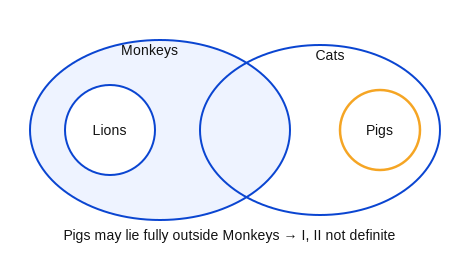
All lions are monkeys. Some monkeys are cats. All pigs are cats.
Conclusions:
(I) Some pigs are lions.
(II) Some pigs are monkeys.
दिए गए कथनों और निष्कर्षों को ध्यानपूर्वक पढ़िए। यह मानते हुए कि कथनों में दी गई जानकारी सत्य है, भले ही वह सामान्यतः ज्ञात तथ्यों से भिन्न प्रतीत होती हो, तय कीजिए कि दिए गए निष्कर्षों में से कौन-सा/से निष्कर्ष कथनों का तार्किक रूप से अनुसरण करता/करते है/हैं।
कथन:
सभी शेर, बंदर हैं। कुछ बंदर, बिल्लियाँ हैं। सभी सूअर, बिल्लियाँ हैं।
निष्कर्ष:
(I) कुछ सूअर, शेर हैं।
(II) कुछ सूअर, बंदर हैं।
  1. AOnly conclusion (I) follows.केवल निष्कर्ष (I) अनुसरण करता है।
  2. BNeither conclusion (I) nor (II) follows.न तो निष्कर्ष (I) और न ही (II) अनुसरण करता है।
  3. CBoth conclusions (I) and (II) follow.निष्कर्ष (I) और (II) दोनों अनुसरण करते हैं।
  4. DOnly conclusion (II) follows.केवल निष्कर्ष (II) अनुसरण करता है।
Show answer

Concept: Draw the least-committed Venn diagram; a conclusion follows only if it is true in every possible diagram.

  1. Lions lie inside Monkeys; Cats only partly overlap Monkeys; Pigs lie inside Cats.
  2. Pigs can sit in the part of Cats that is outside Monkeys – then no pig is a monkey and no pig is a lion.
  3. So neither "some pigs are lions" nor "some pigs are monkeys" is definite.

Trick: Two "some" links (Monkeys–Cats) in the chain never give a definite conclusion between the end terms.

Answer: (B) Neither conclusion (I) nor (II) follows.

अवधारणा: सबसे कम मान्यता वाला वेन आरेख बनाएँ; निष्कर्ष तभी निकलता है जब वह हर संभव आरेख में सही हो।

  1. Lions, Monkeys के अंदर; Cats का Monkeys से केवल आंशिक ओवरलैप; Pigs, Cats के अंदर।
  2. Pigs, Cats के उस हिस्से में हो सकते हैं जो Monkeys के बाहर है – तब कोई pig न monkey है न lion।
  3. अतः "कुछ pigs lions हैं" और "कुछ pigs monkeys हैं" दोनों निश्चित नहीं।

ट्रिक: शृंखला में बीच की कड़ी "some" (Monkeys–Cats) हो, तो सिरों के बीच कोई निश्चित निष्कर्ष नहीं बनता।

उत्तर: (B) Neither conclusion (I) nor (II) follows.

RRB NTPC Graduate CBT 1General Intelligence and ReasoningSyllogismRRB NTPC Graduate CBT 1 2025 · 19 Mar Shift 2 →
Q16016.
What will come in the place of ‘?’ in the following equation, if ‘+’ and ‘-‘ are interchanged and ‘×’ and ‘÷’ are interchanged?
216 ÷ 3 + 1313 × 13 - 112 = ?
यदि ‘+’ और ‘-’ को आपस में बदल दिया जाए तथा ‘×’ और ‘÷’ को आपस में बदल दिया जाए, तो निम्नलिखित समीकरण में ‘?’ के स्थान पर क्या आएगा?
216 ÷ 3 + 1313 × 13 - 112 = ?
  1. A586
  2. B722
  3. C523
  4. D659
Show answer

Concept: Swap the signs as told, then apply BODMAS.

  1. Interchanging: 216÷3+1313×13−112 becomes 216×3−1313÷13+112.
  2. 216×3=648, 1313÷13=101.
  3. 648−101+112=659.

Trick: 1313=13×101 – spotting this saves the division.

Answer: (D) 659

अवधारणा: बताए अनुसार चिह्न बदलें, फिर BODMAS लगाएँ।

  1. बदलने पर: 216÷3+1313×13−112 → 216×3−1313÷13+112।
  2. 216×3=648, 1313÷13=101।
  3. 648−101+112=659।

ट्रिक: 1313=13×101 – यह देख लेने से भाग करना नहीं पड़ता।

उत्तर: (D) 659

RRB NTPC Graduate CBT 1General Intelligence and ReasoningMathematical OperationsRRB NTPC Graduate CBT 1 2025 · 19 Mar Shift 2 →
Q16017.
Refer to the following number and symbol series and answer the question that follows. Counting to be done from left to right only. All numbers are single-digit numbers only. (Left) \ ? % 4 ? 3 / 3 / 9 4 6 4 1 ? * + ^ > 2 * (Right)
How many such symbols are there, each of which is immediately preceded by another symbol and also immediately followed by a number?
निम्नलिखित संख्या और प्रतीक श्रृंखला को देखिए और उसके बाद दिए गए प्रश्न का उत्तर दीजिए। गिनती केवल बाएँ से दाएँ की जानी है। सभी संख्याएँ केवल एक-अंकीय संख्याएँ हैं। (बाएँ) \ ? % 4 ? 3 / 3 / 9 4 6 4 1 ? * + ^ > 2 * (दाएँ)
ऐसे कितने प्रतीक हैं, जिनमें से प्रत्येक के ठीक पहले एक अन्य प्रतीक है और ठीक बाद में एक संख्या है?
  1. AThreeतीन
  2. BFourचार
  3. COneएक
  4. DTwoदो
Show answer

Concept: Check every symbol: is its left neighbour a symbol AND its right neighbour a number?

  1. Series: \ · ? · % · 4 · ? · 3 · / · 3 · / · 9 · 4 · 6 · 4 · 1 · ? · * · + · ^ · > · 2 · *
  2. % : left ? (symbol), right 4 (number) ✓. > : left ^ (symbol), right 2 (number) ✓.
  3. Other symbols fail – e.g. * (16th) is followed by +, and the ? at 15th is preceded by 1.

Trick: Only look at "symbol-symbol-number" triplets; scan once from left to right.

Answer: (D) Two

अवधारणा: हर प्रतीक जाँचें: क्या बाईं ओर प्रतीक है और दाईं ओर संख्या?

  1. श्रृंखला: \ · ? · % · 4 · ? · 3 · / · 3 · / · 9 · 4 · 6 · 4 · 1 · ? · * · + · ^ · > · 2 · *
  2. % : बाएँ ? (प्रतीक), दाएँ 4 (संख्या) ✓। > : बाएँ ^ (प्रतीक), दाएँ 2 (संख्या) ✓।
  3. बाकी प्रतीक शर्त पूरी नहीं करते – जैसे 16वाँ * के बाद + है, 15वें ? से पहले 1 है।

ट्रिक: केवल "प्रतीक-प्रतीक-संख्या" के त्रिक देखें; बाएँ से दाएँ एक बार स्कैन करें।

उत्तर: (D) Two

RRB NTPC Graduate CBT 1General Intelligence and ReasoningSymbol SeriesRRB NTPC Graduate CBT 1 2025 · 19 Mar Shift 2 →
Q16018.
​In a certain code language,
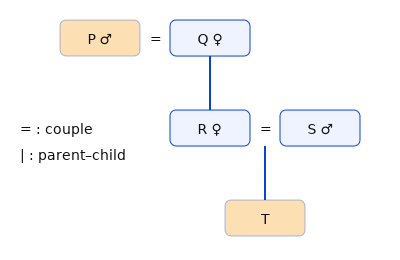
X + Y means ‘X is the husband of Y’,
X – Y means ‘X is the mother of Y’,
X × Y means ‘X is the wife of Y’ and
X ÷ Y means ‘X is the father of Y’.
Based on the above, how is P related to T if ‘P + Q – R × S ÷ T’?
​एक निश्चित कूट भाषा में,
X + Y का अर्थ है ‘X, Y का पति है’,
X – Y का अर्थ है ‘X, Y की माता है’,
X × Y का अर्थ है ‘X, Y की पत्नी है’ और
X ÷ Y का अर्थ है ‘X, Y का पिता है’।
उपर्युक्त के आधार पर, यदि ‘P + Q – R × S ÷ T’ है, तो P का T से क्या संबंध है?
  1. AFather's fatherपिता का पिता
  2. BFather's brotherपिता का भाई
  3. CMother's fatherमाता का पिता
  4. DMother's brotherमाता का भाई
Show answer

Concept: Decode each symbol step by step and build the family tree.

  1. P + Q: P is husband of Q. Q – R: Q is mother of R. R × S: R is wife of S. S ÷ T: S is father of T.
  2. So R is T's mother, Q (R's mother) is T's maternal grandmother.
  3. P, Q's husband, is T's maternal grandfather = mother's father.

Trick: Start from the person asked about (T) and climb upward – father S → mother R → her parents Q, P.

Answer: (C) Mother's father

अवधारणा: हर प्रतीक को क्रम से डिकोड करें और वंश-वृक्ष बनाएँ।

  1. P + Q: P, Q का पति। Q – R: Q, R की माँ। R × S: R, S की पत्नी। S ÷ T: S, T का पिता।
  2. अतः R, T की माँ है; Q (R की माँ) T की नानी है।
  3. P, Q का पति, T का नाना = माँ का पिता (Mother's father)।

ट्रिक: जिसके बारे में पूछा है (T) उससे ऊपर चढ़ें – पिता S → माँ R → उसके माता-पिता Q, P।

उत्तर: (C) Mother's father

RRB NTPC Graduate CBT 1General Intelligence and ReasoningBlood Relations – CodedRRB NTPC Graduate CBT 1 2025 · 19 Mar Shift 2 →
Q16019.
Select the set in which the numbers are related in the same way as are the numbers of the following sets.
5-7-9
11-13-15
(NOTE: Operations should be performed on the whole numbers, without breaking down the numbers into its constituent digits. E.g. 13 – Operations on 13 such as adding / subtracting /multiplying etc. to 13 can be performed. Breaking down 13 into 1 and 3 and then performing mathematical operations on 1 and 3 is not allowed)
उस समुच्चय का चयन कीजिए जिसमें संख्याएँ उसी प्रकार संबंधित हैं जिस प्रकार निम्नलिखित समुच्चयों की संख्याएँ संबंधित हैं।
5-7-9
11-13-15
(नोट: संक्रियाएँ पूर्ण संख्याओं पर की जानी चाहिए, संख्याओं को उनके घटक अंकों में तोड़े बिना। उदाहरण के लिए 13 – 13 पर संक्रियाएँ जैसे 13 में जोड़ना / घटाना / गुणा करना आदि की जा सकती हैं। 13 को 1 और 3 में तोड़कर फिर 1 और 3 पर गणितीय संक्रियाएँ करने की अनुमति नहीं है)
  1. A4-39-61
  2. B21-23-25
  3. C18-15-12
  4. D4-30-84
Show answer

Concept: Find the rule linking the three numbers of each given set.

  1. 5-7-9 and 11-13-15: each number is the previous one +2 (three consecutive odd numbers).
  2. 21-23-25: 21+2=23, 23+2=25 ✓.
  3. 4-39-61, 18-15-12 (decreasing by 3), 4-30-84 do not follow +2,+2.

Trick: Check the gaps first – equal gaps of 2 settle it immediately.

Answer: (B) 21-23-25

अवधारणा: हर समूह की तीनों संख्याओं को जोड़ने वाला नियम खोजें।

  1. 5-7-9 और 11-13-15: हर संख्या पिछली से +2 (तीन क्रमागत विषम संख्याएँ)।
  2. 21-23-25: 21+2=23, 23+2=25 ✓।
  3. 4-39-61, 18-15-12 (3 घटते हुए), 4-30-84 में +2,+2 नहीं है।

ट्रिक: पहले अंतर देखें – 2 के बराबर अंतर से तुरंत उत्तर मिल जाता है।

उत्तर: (B) 21-23-25

RRB NTPC Graduate CBT 1General Intelligence and ReasoningNumber AnalogyRRB NTPC Graduate CBT 1 2025 · 19 Mar Shift 2 →
Q16020.
Select the set in which the numbers are related in the same way as are the numbers of the following sets.
(NOTE : Operations should be performed on the whole numbers, without breaking down the numbers into their constituent digits. E.g. 13 – Operations on 13 such as adding / subtracting / multiplying etc. to 13 can be performed. Breaking down 13 into 1 and 3 and then performing mathematical operations on 1 and 3 is not allowed.)
(24, 578, 3)
(23, 536, 8)
उस समुच्चय का चयन कीजिए जिसमें संख्याएँ उसी प्रकार संबंधित हैं जिस प्रकार निम्नलिखित समुच्चयों की संख्याएँ संबंधित हैं।
(नोट : संक्रियाएँ पूर्ण संख्याओं पर की जानी चाहिए, संख्याओं को उनके घटक अंकों में तोड़े बिना। उदाहरण के लिए 13 – 13 पर संक्रियाएँ जैसे 13 में जोड़ना / घटाना / गुणा करना आदि की जा सकती हैं। 13 को 1 और 3 में तोड़कर फिर 1 और 3 पर गणितीय संक्रियाएँ करने की अनुमति नहीं है।)
(24, 578, 3)
(23, 536, 8)
  1. A(10, 106, 7)
  2. B(47, 2230, 17)
  3. C(16, 285, 25)
  4. D(9, 109, 24)
Show answer

Concept: Relate the middle number to the first and third numbers of each triplet.

  1. (24, 578, 3): 242+3−1=576+2=578 ✓.
  2. (23, 536, 8): 232+8−1=529+7=536 ✓. Rule: middle=a2+c−1.
  3. (10, 106, 7): 102+7−1=106 ✓. Others fail: 472+17−1=2225≠2230, 162+25−1=280≠285, 92+24−1=104≠109.

Trick: When the middle number is close to the square of the first, test a2± (something with c).

Answer: (A) (10, 106, 7)

अवधारणा: बीच की संख्या को पहली और तीसरी संख्या से जोड़ें।

  1. (24, 578, 3): 242+3−1=576+2=578 ✓।
  2. (23, 536, 8): 232+8−1=529+7=536 ✓। नियम: मध्य=a2+c−1।
  3. (10, 106, 7): 102+7−1=106 ✓। बाकी असफल: 472+17−1=2225≠2230, 162+25−1=280≠285, 92+24−1=104≠109।

ट्रिक: बीच की संख्या पहली के वर्ग के पास हो, तो a2± (c से जुड़ा कुछ) जाँचें।

उत्तर: (A) (10, 106, 7)

RRB NTPC Graduate CBT 1General Intelligence and ReasoningNumber AnalogyRRB NTPC Graduate CBT 1 2025 · 19 Mar Shift 2 →