Question bank

Q&A: practice questions with answers

Search questions on any topic. Filter by exam category, exam, subject and topic, try the question, then open the answer and explanation.

Courses – airGurukul

20,719 questions found.

Q16061.
Which stitched sailing vessel of the Indian Navy, which was scheduled for its maiden overseas voyage in December 2025 from Porbandar to Muscat, aims to revive India’s ancient maritime legacy?
भारतीय नौसेना का कौन-सा सिला हुआ (stitched) पालदार जलयान, जिसकी पहली विदेशी यात्रा दिसंबर 2025 में पोरबंदर से मस्कट तक निर्धारित थी, भारत की प्राचीन समुद्री विरासत को पुनर्जीवित करने का लक्ष्य रखता है?
  1. AINSV Mhadei
  2. BINSV Kaundinya
  3. CINSV Shardul
  4. DINSV Tarangini
Show answer

Concept: INSV Kaundinya is the Indian Navy's stitched (sewn-plank) sailing ship, built in the ancient style without nails, inducted at Karwar in May 2025.

  1. Its design is based on a 5th-century ship painting in the Ajanta caves; it is named after the mariner Kaundinya who sailed to South-East Asia.
  2. Its maiden overseas voyage was planned from Porbandar to Muscat (Oman) in December 2025 along the ancient trade route. Mhadei and Tarangini are modern sail-training vessels.

Yaad rakhein: Kaundinya = stitched ship = Ajanta design = Gujarat–Oman voyage.

Answer: (B) INSV Kaundinya

अवधारणा: INSV कौंडिन्य भारतीय नौसेना का सिला हुआ (stitched, बिना कील) प्राचीन शैली का पाल-पोत है, जिसे मई 2025 में कारवार में शामिल किया गया।

  1. इसका डिज़ाइन अजंता गुफाओं के 5वीं सदी के जहाज़-चित्र पर आधारित है; नाम दक्षिण-पूर्व एशिया तक गए नाविक कौंडिन्य पर है।
  2. इसकी पहली विदेशी यात्रा दिसंबर 2025 में पोरबंदर से मस्कट (ओमान) तक प्राचीन व्यापार मार्ग पर नियोजित थी। म्हादेई और तरंगिणी आधुनिक पाल-प्रशिक्षण पोत हैं।

याद रखें: कौंडिन्य = सिला जहाज़ = अजंता डिज़ाइन = गुजरात–ओमान यात्रा।

उत्तर: (B) INSV कौंडिन्य
RRB NTPC Graduate CBT 1General AwarenessDefence – current affairsRRB NTPC Graduate CBT 1 2025 · 19 Mar Shift 1 →
Q16062.
Which defensive strategy assigns each defender to guard a specific offensive player based on size and ability in a basketball game?
बास्केटबॉल खेल में कौन-सी रक्षात्मक रणनीति आकार और क्षमता के आधार पर प्रत्येक रक्षक (defender) को एक विशिष्ट आक्रामक खिलाड़ी की रक्षा (guard) करने का कार्य सौंपती है?
  1. ACombined defenceसंयुक्त रक्षा (Combined defence)
  2. BZone defenceज़ोन रक्षा (Zone defence)
  3. CFull court pressफुल कोर्ट प्रेस (Full court press)
  4. DMan to man defenceमैन टू मैन रक्षा (Man to man defence)
Show answer

Concept: In man-to-man defence each defender is assigned one particular opponent, usually matched by height, speed and skill.

  1. Zone defence guards an area of the court, not a player; full-court press is pressure applied over the whole court; combined defence mixes zone and man-to-man.

Yaad rakhein: 'Man to man' = one defender, one attacker; 'zone' = one defender, one area.

Answer: (D) Man to man defence

अवधारणा: मैन-टू-मैन डिफेंस में हर रक्षक को एक विशेष विरोधी खिलाड़ी सौंपा जाता है, आमतौर पर कद, गति और कौशल के मेल से।

  1. ज़ोन डिफेंस कोर्ट के क्षेत्र की रक्षा करता है, खिलाड़ी की नहीं; फुल-कोर्ट प्रेस पूरे कोर्ट में दबाव है; कंबाइंड डिफेंस ज़ोन और मैन-टू-मैन का मिश्रण है।

याद रखें: 'मैन टू मैन' = एक रक्षक, एक आक्रामक; 'ज़ोन' = एक रक्षक, एक क्षेत्र।

उत्तर: (D) मैन टू मैन डिफेंस

RRB NTPC Graduate CBT 1General AwarenessSports – basketballRRB NTPC Graduate CBT 1 2025 · 19 Mar Shift 1 →
Q16063.
Which of the following is a direct consequence of increased particulate matter (PM2.5) in urban air?
निम्नलिखित में से कौन-सा शहरी वायु में कणिकीय पदार्थ (PM2.5) की वृद्धि का प्रत्यक्ष परिणाम है?
  1. ARespiratory health issuesश्वसन संबंधी स्वास्थ्य समस्याएँ
  2. BIncreased soil fertilityमृदा उर्वरता में वृद्धि
  3. CStratospheric ozone depletionसमतापमंडलीय ओज़ोन क्षरण
  4. DOcean acidificationमहासागरीय अम्लीकरण
Show answer

Concept: PM2.5 are particles smaller than 2.5 micrometres; they penetrate deep into the lungs and even the bloodstream.

  1. Direct effects: asthma, bronchitis, reduced lung function, heart disease – hence respiratory health issues.
  2. Ozone depletion is caused by CFCs, ocean acidification by CO2, and particulates do not raise soil fertility.

Yaad rakhein: PM2.5 is about one-thirtieth the width of a human hair – small enough to reach the alveoli.

Answer: (A) Respiratory health issues

अवधारणा: PM2.5 = 2.5 माइक्रोमीटर से छोटे कण; ये फेफड़ों की गहराई और रक्त तक पहुँच जाते हैं।

  1. प्रत्यक्ष प्रभाव: दमा, ब्रोंकाइटिस, फेफड़ों की क्षमता में कमी, हृदय रोग – अतः श्वसन संबंधी समस्याएँ।
  2. ओज़ोन क्षरण CFC से, महासागर अम्लीकरण CO2 से होता है, और कण मिट्टी की उर्वरता नहीं बढ़ाते।

याद रखें: PM2.5 मानव बाल की मोटाई का लगभग तीसवाँ हिस्सा है – इतना छोटा कि वायुकोष्ठिका (alveoli) तक पहुँच जाए।

उत्तर: (A) श्वसन संबंधी स्वास्थ्य समस्याएँ

RRB NTPC Graduate CBT 1General AwarenessEnvironment – air pollutionRRB NTPC Graduate CBT 1 2025 · 19 Mar Shift 1 →
Q16064.
Pandit Jawaharlal Nehru described which of the following as the “temple(s) of modern India”?
पंडित जवाहरलाल नेहरू ने निम्नलिखित में से किसे “आधुनिक भारत के मंदिर” कहा था?
  1. ADamsबाँध
  2. BHospitalsअस्पताल
  3. CParliamentसंसद
  4. DSchoolsविद्यालय
Show answer

Concept: Jawaharlal Nehru called big dams and heavy industrial projects the 'temples of modern India'.

  1. He used the phrase in July 1954 while dedicating the Bhakra-Nangal canal system, and similarly for Hirakud and other multipurpose projects of the First Five-Year Plan.
  2. Later (1958) he also cautioned against the 'disease of gigantism', but the famous phrase stays with dams.

Yaad rakhein: Nehru – Bhakra Nangal – 'temples of modern India' = dams.

Answer: (A) Dams

अवधारणा: जवाहरलाल नेहरू ने बड़े बाँधों और भारी उद्योग परियोजनाओं को 'आधुनिक भारत के मंदिर' कहा था।

  1. उन्होंने यह वाक्य जुलाई 1954 में भाखड़ा-नांगल नहर प्रणाली राष्ट्र को समर्पित करते हुए कहा, और हीराकुंड जैसी प्रथम पंचवर्षीय योजना की बहुउद्देशीय परियोजनाओं के लिए भी।
  2. बाद में (1958) उन्होंने 'विशालता के रोग' से सावधान भी किया, पर प्रसिद्ध वाक्य बाँधों से ही जुड़ा है।

याद रखें: नेहरू – भाखड़ा नांगल – 'आधुनिक भारत के मंदिर' = बाँध।

उत्तर: (A) बाँध

RRB NTPC Graduate CBT 1General AwarenessModern India – Nehru eraRRB NTPC Graduate CBT 1 2025 · 19 Mar Shift 1 →
Q16065.
Which of the following are Plantation crops respectively in Assam and Karnataka?
निम्नलिखित में से कौन-सी क्रमशः असम और कर्नाटक की बागानी (Plantation) फसलें हैं?
  1. ABarley and ragiजौ और रागी
  2. BTea and coffeeचाय और कॉफी
  3. CRice and wheatचावल और गेहूँ
  4. DSugarcane and mustardगन्ना और सरसों
Show answer

Concept: Plantation crops are grown on large estates for commercial sale – tea, coffee, rubber, coconut, spices.

  1. Assam is India's largest tea producer (Brahmaputra valley, Upper Assam).
  2. Karnataka produces about 70% of India's coffee (Kodagu, Chikkamagaluru, Hassan).
  3. Barley, ragi, rice, wheat, sugarcane and mustard are food or cash crops, not plantation crops.

Yaad rakhein: Tea = Assam, Coffee = Karnataka, Rubber = Kerala.

Answer: (B) Tea and coffee

अवधारणा: बागानी फसलें बड़े एस्टेट्स पर व्यावसायिक बिक्री के लिए उगाई जाती हैं – चाय, कॉफ़ी, रबर, नारियल, मसाले।

  1. असम भारत का सबसे बड़ा चाय उत्पादक है (ब्रह्मपुत्र घाटी, ऊपरी असम)।
  2. कर्नाटक भारत की लगभग 70% कॉफ़ी पैदा करता है (कोडागु, चिक्कमगलूरु, हासन)।
  3. जौ, रागी, चावल, गेहूँ, गन्ना और सरसों खाद्य या नकदी फसलें हैं, बागानी नहीं।

याद रखें: चाय = असम, कॉफ़ी = कर्नाटक, रबर = केरल।

उत्तर: (B) चाय और कॉफ़ी

RRB NTPC Graduate CBT 1General AwarenessAgriculture – plantation cropsRRB NTPC Graduate CBT 1 2025 · 19 Mar Shift 1 →
Q16066.
A and B complete a work in 21 days. If A alone can do it in 28 days, then B alone can do three-fourth of the same work in ______________days.
A और B एक काम को 21 दिनों में पूरा करते हैं। यदि A अकेला इसे 28 दिनों में कर सकता है, तो B अकेला उसी काम का तीन-चौथाई ______________ दिनों में कर सकता है।
  1. A35
  2. B56
  3. C63
  4. D49
Show answer

Concept: Take total work = LCM of the days; work per day = total ÷ days.

  1. Total work = LCM(21, 28) = 84 units.
  2. (A+B) per day = 8421=4, A per day = 8428=3, so B per day = 4−3=1 unit.
  3. B alone finishes the whole work in 84 days; three-fourth of it in 34×84=63 days.

Trick: B alone = 21×2828−21=84 days; then take 34 of it.

Answer: (C) 63

अवधारणा: कुल कार्य = दिनों का LCM; प्रतिदिन कार्य = कुल कार्य ÷ दिन।

  1. कुल कार्य = LCM(21, 28) = 84 इकाई।
  2. (A+B) प्रतिदिन = 8421=4, A प्रतिदिन = 8428=3, अतः B प्रतिदिन = 4−3=1 इकाई।
  3. B अकेला पूरा कार्य 84 दिन में करेगा; तीन-चौथाई कार्य 34×84=63 दिन में।

ट्रिक: B अकेला = 21×2828−21=84 दिन; फिर इसका 34 लें।

उत्तर: (C) 63

RRB NTPC Graduate CBT 1MathematicsTime and WorkRRB NTPC Graduate CBT 1 2025 · 19 Mar Shift 1 →
Q16067.
Girish scored 441 marks in an examination and was 75 marks short of 30% of maximum marks. In the same examination, his friend scored 688 marks. What is the percentage of marks scored by his friend?
गिरीश ने एक परीक्षा में 441 अंक प्राप्त किए और वह अधिकतम अंकों के 30% से 75 अंक कम रहा। उसी परीक्षा में उसके मित्र ने 688 अंक प्राप्त किए। उसके मित्र द्वारा प्राप्त अंकों का प्रतिशत क्या है?
  1. A38%
  2. B42%
  3. C44%
  4. D40%
Show answer

Concept: First find the maximum marks from the given percentage condition.

  1. 30% of maximum = 441+75=516.
  2. Maximum marks = 516×10030=1720.
  3. Friend's percentage = 6881720×100=40%.

Trick: 1720×25=688, so 40% directly.

Answer: (D) 40%

अवधारणा: पहले दी गई प्रतिशत शर्त से अधिकतम अंक निकालें।

  1. अधिकतम अंकों का 30% = 441+75=516।
  2. अधिकतम अंक = 516×10030=1720।
  3. मित्र का प्रतिशत = 6881720×100=40%।

ट्रिक: 1720×25=688, अतः सीधे 40%।

उत्तर: (D) 40%

RRB NTPC Graduate CBT 1MathematicsPercentageRRB NTPC Graduate CBT 1 2025 · 19 Mar Shift 1 →
Q16068.
The common root of the equations x2 − 21x + 110 = 0 and 110 + x − x2 = 0, is:
समीकरणों x2 − 21x + 110 = 0 और 110 + x − x2 = 0 का उभयनिष्ठ मूल (common root) है:
  1. A11
  2. B10
  3. C–11
  4. D–10
Show answer

Concept: Factorise both equations and pick the common root.

  1. x2−21x+110=0⇒(x−10)(x−11)=0⇒x=10,11.
  2. 110+x−x2=0⇒x2−x−110=0⇒(x−11)(x+10)=0⇒x=11,−10.
  3. Common root = 11.

Trick: Subtracting the two equations: −22x+242=0⇒x=11 at once.

Answer: (A) 11

अवधारणा: दोनों समीकरणों के गुणनखंड करके उभयनिष्ठ (common) मूल चुनें।

  1. x2−21x+110=0⇒(x−10)(x−11)=0⇒x=10,11।
  2. 110+x−x2=0⇒x2−x−110=0⇒(x−11)(x+10)=0⇒x=11,−10।
  3. उभयनिष्ठ मूल = 11।

ट्रिक: दोनों समीकरण घटाने पर −22x+242=0⇒x=11 तुरंत।

उत्तर: (A) 11

RRB NTPC Graduate CBT 1MathematicsQuadratic EquationsRRB NTPC Graduate CBT 1 2025 · 19 Mar Shift 1 →
Q16069.
The distance between two points on a map is 4 cm. The scale of the map is 1 : 829483. The actual distance between the two points (in km) is:
(Round off your answer to two decimal places.)
एक मानचित्र पर दो बिंदुओं के बीच की दूरी 4 cm है। मानचित्र का पैमाना 1 : 829483 है। दोनों बिंदुओं के बीच की वास्तविक दूरी (km में) है:
(अपने उत्तर को दो दशमलव स्थानों तक पूर्णांकित करें।)
  1. A38.85
  2. B33.63
  3. C30.25
  4. D33.18
Show answer

Concept: Scale 1 : 829483 means 1 cm on the map = 829483 cm on the ground.

  1. Actual distance = 4×829483=3,317,932 cm.
  2. Convert: 1 km = 100000 cm, so 3317932100000=33.17932 km.
  3. Rounded to two decimals: 33.18 km.

Trick: 829483 cm≈8.29 km; 4×8.295≈33.18.

Answer: (D) 33.18

अवधारणा: पैमाना 1 : 829483 का अर्थ – मानचित्र का 1 cm = ज़मीन पर 829483 cm।

  1. वास्तविक दूरी = 4×829483=3,317,932 cm।
  2. 1 km = 100000 cm, अतः 3317932100000=33.17932 km।
  3. दो दशमलव तक: 33.18 km।

ट्रिक: 829483 cm≈8.29 km; 4×8.295≈33.18।

उत्तर: (D) 33.18

RRB NTPC Graduate CBT 1MathematicsRatio – Map ScaleRRB NTPC Graduate CBT 1 2025 · 19 Mar Shift 1 →
Q16070.
Solve the following system of linear equations:
−p+2q−3r=−9
p−3q+r=6
2p−5q+5r=17
रैखिक समीकरणों के निम्नलिखित निकाय को हल करें:
−p+2q−3r=−9
p−3q+r=6
2p−5q+5r=17
  1. Ap = −1, q = 3, r = 2
  2. Bp = 1, q = −1, r = 2
  3. Cp = 1, q = 1, r = −2
  4. Dp = −1, q = −1, r = 3
Show answer

Concept: Add equations to eliminate one variable, or simply verify the options.

  1. Adding (1) and (2): −q−2r=−3⇒q+2r=3.
  2. (2)×2 − (3): 2p−6q+2r−2p+5q−5r=12−17⇒−q−3r=−5⇒q+3r=5.
  3. Subtracting: r=2, q=3−4=−1; from (2): p=6+3q−r=6−3−2=1.
  4. Check (1): −1−2−6=−9 ✓.

Trick: Put each option in the easiest equation p−3q+r=6: only (B) gives 1+3+2=6.

Answer: (B) p=1, q=−1, r=2

अवधारणा: समीकरण जोड़कर एक चर हटाएँ, या विकल्पों की जाँच करें।

  1. (1)+(2): −q−2r=−3⇒q+2r=3।
  2. (2)×2 − (3): −q−3r=−5⇒q+3r=5।
  3. घटाने पर r=2, q=3−4=−1; (2) से p=6+3q−r=6−3−2=1।
  4. जाँच (1): −1−2−6=−9 ✓।

ट्रिक: हर विकल्प को सबसे सरल समीकरण p−3q+r=6 में रखें: केवल (B) से 1+3+2=6।

उत्तर: (B) p=1, q=−1, r=2

RRB NTPC Graduate CBT 1MathematicsLinear Equations in Three VariablesRRB NTPC Graduate CBT 1 2025 · 19 Mar Shift 1 →
Q16071.
Evaluate: (-9) - (-56) ÷ (-14) + (-4) × 8
मान ज्ञात करें: (-9) - (-56) ÷ (-14) + (-4) × 8
  1. A-48
  2. B-47
  3. C-44
  4. D-45
Show answer

Concept: Division and multiplication first, then addition/subtraction from left to right.

  1. (−56)÷(−14)=4 and (−4)×8=−32.
  2. Expression = −9−4+(−32)=−13−32=−45.

Trick: Negative ÷ negative = positive; watch the minus sign before the division result.

Answer: (D) −45

अवधारणा: पहले भाग और गुणा, फिर बाएँ से दाएँ जोड़/घटाव।

  1. (−56)÷(−14)=4 तथा (−4)×8=−32।
  2. व्यंजक = −9−4+(−32)=−13−32=−45।

ट्रिक: ऋण ÷ ऋण = धन; भाग के परिणाम से पहले लगे ऋण चिह्न का ध्यान रखें।

उत्तर: (D) −45

RRB NTPC Graduate CBT 1MathematicsSimplification – BODMASRRB NTPC Graduate CBT 1 2025 · 19 Mar Shift 1 →
Q16072.
What is the median if the mode of distribution is 48 and the mean is 72?
यदि किसी बंटन का बहुलक (mode) 48 और माध्य (mean) 72 है, तो माध्यिका (median) क्या है?
  1. A62
  2. B64
  3. C54
  4. D60
Show answer

Concept: For a moderately skewed distribution, Mode=3Median−2Mean.

  1. 48=3Median−2×72=3Median−144.
  2. 3Median=192⇒Median=64.

Trick: Median always lies between mode and mean, one-third of the way from the mean: 72−72−483=64.

Answer: (B) 64

अवधारणा: मध्यम विषम बंटन के लिए Mode=3Median−2Mean।

  1. 48=3Median−2×72=3Median−144।
  2. 3Median=192⇒Median=64।

ट्रिक: माध्यिका (median) सदैव बहुलक और माध्य के बीच, माध्य से एक-तिहाई दूरी पर: 72−72−483=64।

उत्तर: (B) 64

RRB NTPC Graduate CBT 1MathematicsStatistics – Empirical RelationRRB NTPC Graduate CBT 1 2025 · 19 Mar Shift 1 →
Q16073.
A, B and C together can complete a certain work in 36 days. B and C together can complete the same work in 48 days. B is 75% more efficient than A. A, B and C work together for 15 days. B alone will complete the remaining work in:
A, B और C मिलकर एक निश्चित काम को 36 दिनों में पूरा कर सकते हैं। B और C मिलकर उसी काम को 48 दिनों में पूरा कर सकते हैं। B, A से 75% अधिक कार्यकुशल है। A, B और C 15 दिनों तक मिलकर काम करते हैं। B अकेला शेष काम को कितने समय में पूरा करेगा:
  1. A48 days48 दिन
  2. B51 days51 दिन
  3. C53 days53 दिन
  4. D44 days44 दिन
Show answer

Concept: Take total work = LCM; efficiency ratio converts to units per day.

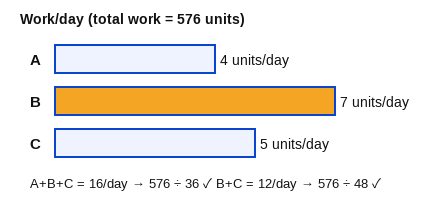
  1. Total work = LCM(36, 48) = 144 units. (A+B+C) = 4/day, (B+C) = 3/day → A = 1/day.
  2. B is 75% more efficient than A → B = 1.75/day; C = 3−1.75=1.25/day. To avoid decimals multiply by 4: work = 576, A = 4, B = 7, C = 5, total 16/day.
  3. Work done in 15 days = 15×16=240; remaining = 576−240=336.
  4. B alone: 3367=48 days.

Trick: 15 of 36 days done → 2136=712 of work left; B does 7576 per day → 712×5767=48.

Answer: (A) 48 days

अवधारणा: कुल कार्य = LCM; दक्षता-अनुपात को प्रतिदिन इकाइयों में बदलें।

  1. कुल कार्य = LCM(36, 48) = 144 इकाई। (A+B+C) = 4/दिन, (B+C) = 3/दिन → A = 1/दिन।
  2. B, A से 75% अधिक दक्ष → B = 1.75/दिन; C = 3−1.75=1.25/दिन। दशमलव हटाने के लिए 4 से गुणा: कार्य = 576, A = 4, B = 7, C = 5, कुल 16/दिन।
  3. 15 दिन में कार्य = 15×16=240; शेष = 576−240=336।
  4. B अकेला: 3367=48 दिन।

ट्रिक: 36 में से 15 दिन हो गए → 712 कार्य शेष; B प्रतिदिन 7576 करता है → 712×5767=48।

उत्तर: (A) 48 days

RRB NTPC Graduate CBT 1MathematicsTime and Work – EfficiencyRRB NTPC Graduate CBT 1 2025 · 19 Mar Shift 1 →
Q16074.
The number of ordered pair of positive integral solutions (a, b) such that the HCF of a and b is 28 and a + b = 868 is
धनात्मक पूर्णांक हलों के क्रमित युग्मों (ordered pairs) (a, b) की संख्या, जिनके लिए a और b का HCF 28 है तथा a + b = 868 है, है
  1. A20
  2. B25
  3. C15
  4. D30
Show answer

Concept: If HCF(a, b) = 28, write a=28x, b=28y with HCF(x, y) = 1.

  1. 28x+28y=868⇒x+y=86828=31.
  2. 31 is prime, so any pair with x+y=31 is automatically co-prime (a common factor of x and y would divide 31).
  3. x can be 1, 2, …, 30 → 30 ordered pairs (a, b).

Trick: Number of co-prime ordered pairs with sum n = ϕ(n); for prime 31 it is 30.

Answer: (D) 30

अवधारणा: HCF(a, b) = 28 हो तो a=28x, b=28y जहाँ HCF(x, y) = 1।

  1. 28x+28y=868⇒x+y=86828=31।
  2. 31 अभाज्य है, अतः x+y=31 वाला हर युग्म स्वतः सह-अभाज्य है (x, y का उभयनिष्ठ गुणनखंड 31 को विभाजित करता)।
  3. x = 1, 2, …, 30 → 30 क्रमित युग्म (a, b)।

ट्रिक: योग n वाले सह-अभाज्य क्रमित युग्मों की संख्या = ϕ(n); अभाज्य 31 के लिए 30।

उत्तर: (D) 30

RRB NTPC Graduate CBT 1MathematicsHCF – Co-prime PairsRRB NTPC Graduate CBT 1 2025 · 19 Mar Shift 1 →
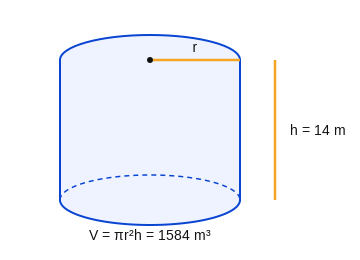
Q16075.
The volume of a cylindrical tank is 1584 cubic meters. If the height of the tank is 14 m, then find the diameter of the tank. (Use π=227)
एक बेलनाकार टंकी का आयतन 1584 घन मीटर है। यदि टंकी की ऊँचाई 14 m है, तो टंकी का व्यास ज्ञात करें। (Use π=227)
  1. A6 m
  2. B12 m
  3. C18 m
  4. D9 m
Show answer

Concept: Volume of a cylinder V=πr2h.

  1. 227×r2×14=1584⇒44r2=1584.
  2. r2=36⇒r=6 m.
  3. Diameter =2r=12 m.

Trick: πh=227×14=44; so r2=158444=36.

Answer: (B) 12 m

अवधारणा: बेलन का आयतन V=πr2h।

  1. 227×r2×14=1584⇒44r2=1584।
  2. r2=36⇒r=6 m।
  3. व्यास =2r=12 m।

ट्रिक: πh=227×14=44; अतः r2=158444=36।

उत्तर: (B) 12 m

RRB NTPC Graduate CBT 1MathematicsMensuration – CylinderRRB NTPC Graduate CBT 1 2025 · 19 Mar Shift 1 →
Q16076.
There are 46 members in group A, 15 members in group B and 11 members in group C. All the members of these groups went to a restaurant. The average amounts spent on each member of groups A, B and C are ₹496, ₹106 and ₹406, respectively. The overall average amount (in ₹) spent per member is:
समूह A में 46 सदस्य, समूह B में 15 सदस्य और समूह C में 11 सदस्य हैं। इन समूहों के सभी सदस्य एक रेस्तरां में गए। समूह A, B और C के प्रत्येक सदस्य पर खर्च की गई औसत राशि क्रमशः ₹496, ₹106 और ₹406 है। प्रति सदस्य खर्च की गई समग्र औसत राशि (₹ में) है:
  1. A403
  2. B396
  3. C399
  4. D401
Show answer

Concept: Overall average = total amount ÷ total members.

  1. Total = 46×496+15×106+11×406=22816+1590+4466=28872.
  2. Members = 46+15+11=72.
  3. Average = 2887272=401.

Trick: Deviations from 400: 46×96−15×294+11×6=4416−4410+66=72; 7272=1 → 401.

Answer: (D) 401

अवधारणा: कुल औसत = कुल राशि ÷ कुल सदस्य।

  1. कुल = 46×496+15×106+11×406=22816+1590+4466=28872।
  2. सदस्य = 46+15+11=72।
  3. औसत = 2887272=401।

ट्रिक: 400 से विचलन: 46×96−15×294+11×6=4416−4410+66=72; 7272=1 → 401।

उत्तर: (D) 401

RRB NTPC Graduate CBT 1MathematicsWeighted AverageRRB NTPC Graduate CBT 1 2025 · 19 Mar Shift 1 →
Q16077.
If x+y+z=10, x2+y2+z2=38, 5xyz=150 and (xy+yz+zx)=31, then what is the value of 2(x3+y3+z3)?
यदि x+y+z=10, x2+y2+z2=38, 5xyz=150 और (xy+yz+zx)=31 है, तो 2(x3+y3+z3) का मान क्या है?
  1. A520
  2. B320
  3. C260
  4. D160
Show answer

Concept: x3+y3+z3−3xyz=(x+y+z)(x2+y2+z2−xy−yz−zx).

  1. 5xyz=150⇒xyz=30.
  2. x3+y3+z3=10×(38−31)+3×30=70+90=160.
  3. 2(x3+y3+z3)=320.

Trick: Check consistency: (x+y+z)2=38+2×31=100 ✓, so the data fits.

Answer: (B) 320

अवधारणा: x3+y3+z3−3xyz=(x+y+z)(x2+y2+z2−xy−yz−zx)।

  1. 5xyz=150⇒xyz=30।
  2. x3+y3+z3=10×(38−31)+3×30=70+90=160।
  3. 2(x3+y3+z3)=320।

ट्रिक: जाँच: (x+y+z)2=38+2×31=100 ✓, अतः आँकड़े सही हैं।

उत्तर: (B) 320

RRB NTPC Graduate CBT 1MathematicsAlgebraic IdentitiesRRB NTPC Graduate CBT 1 2025 · 19 Mar Shift 1 →
Q16078.
During a sale 35% of the goods are sold at 22% profit, 40% of the remaining goods are sold at 37% profit and the still remaining goods are sold at a loss of 38%. If there is an overall profit of x%, then what is the value of x?
एक सेल (sale) के दौरान 35% वस्तुएँ 22% लाभ पर बेची जाती हैं, शेष वस्तुओं का 40% भाग 37% लाभ पर बेचा जाता है और फिर भी बची हुई वस्तुएँ 38% की हानि पर बेची जाती हैं। यदि कुल मिलाकर x% का लाभ होता है, तो x का मान क्या है?
  1. A10.8
  2. B5.4
  3. C2.5
  4. D6.8
Show answer

Concept: Take total cost = 100; overall profit % = weighted sum of profits of each part.

  1. Part 1: 35% at 22% profit → 35×0.22=7.7.
  2. Remaining 65%; 40% of it = 26% at 37% profit → 26×0.37=9.62.
  3. Rest = 65−26=39% at 38% loss → 39×0.38=14.82 loss.
  4. Net = 7.7+9.62−14.82=2.5, so x=2.5.

Trick: Split goods as 35 : 26 : 39 and multiply by +22, +37, −38 respectively.

Answer: (C) 2.5

अवधारणा: कुल लागत = 100 मानें; कुल लाभ % = हर भाग के लाभ का भारित योग।

  1. भाग 1: 35% पर 22% लाभ → 35×0.22=7.7।
  2. शेष 65%; इसका 40% = 26% पर 37% लाभ → 26×0.37=9.62।
  3. बाकी = 65−26=39% पर 38% हानि → 39×0.38=14.82 हानि।
  4. शुद्ध = 7.7+9.62−14.82=2.5, अतः x=2.5।

ट्रिक: माल को 35 : 26 : 39 में बाँटें और क्रमशः +22, +37, −38 से गुणा करें।

उत्तर: (C) 2.5

RRB NTPC Graduate CBT 1MathematicsProfit and Loss – Mixed SaleRRB NTPC Graduate CBT 1 2025 · 19 Mar Shift 1 →
Q16079.
Subrata gets double the amount in 8 years when invested at compound interest, compounded annually. In how many years will the amount become eight times itself?
वार्षिक रूप से संयोजित चक्रवृद्धि ब्याज पर निवेश करने पर सुब्रत को 8 वर्षों में दोगुनी राशि प्राप्त होती है। कितने वर्षों में यह राशि अपने आप की आठ गुनी हो जाएगी?
  1. A24
  2. B64
  3. C32
  4. D16
Show answer

Concept: Under compound interest, if money becomes k times in n years, it becomes km times in mn years.

  1. Doubles in 8 years: (1+r)8=2.
  2. Eight times =23 → (1+r)24=23=8.
  3. Time = 3×8=24 years.

Trick: 2× in 8 yrs → 4× in 16 yrs → 8× in 24 yrs (keep multiplying by 2 every 8 years).

Answer: (A) 24

अवधारणा: चक्रवृद्धि ब्याज में यदि धन n वर्ष में k गुना हो, तो mn वर्ष में km गुना होता है।

  1. 8 वर्ष में दोगुना: (1+r)8=2।
  2. आठ गुना =23 → (1+r)24=23=8।
  3. समय = 3×8=24 वर्ष।

ट्रिक: 8 वर्ष में 2× → 16 वर्ष में 4× → 24 वर्ष में 8× (हर 8 वर्ष में 2 से गुणा)।

उत्तर: (A) 24

RRB NTPC Graduate CBT 1MathematicsCompound Interest – DoublingRRB NTPC Graduate CBT 1 2025 · 19 Mar Shift 1 →
Q16080.
In what duration (in years) will ₹8,400 fetch a simple interest of ₹840 at 4% per annum rate of interest?
4% वार्षिक ब्याज दर पर ₹8,400 कितनी अवधि (वर्षों में) में ₹840 का साधारण ब्याज अर्जित करेगा?
  1. A1.5
  2. B2.5
  3. C3.5
  4. D5
Show answer

Concept: SI=P×R×T100.

  1. 840=8400×4×T100=336T.
  2. T=840336=2.5 years.

Trick: SI is 10% of principal; at 4% per year that needs 104=2.5 years.

Answer: (B) 2.5

अवधारणा: SI=P×R×T100।

  1. 840=8400×4×T100=336T।
  2. T=840336=2.5 वर्ष।

ट्रिक: ब्याज मूलधन का 10% है; 4% वार्षिक दर पर 104=2.5 वर्ष लगेंगे।

उत्तर: (B) 2.5

RRB NTPC Graduate CBT 1MathematicsSimple InterestRRB NTPC Graduate CBT 1 2025 · 19 Mar Shift 1 →