Question bank

Q&A: practice questions with answers

Search questions on any topic. Filter by exam category, exam, subject and topic, try the question, then open the answer and explanation.

Courses – airGurukul

20,719 questions found.

Q16161.
Which of the following demonstrates the use of computers in scientific research?
निम्नलिखित में से कौन-सा वैज्ञानिक अनुसंधान में कंप्यूटर के उपयोग को दर्शाता है?
  1. AOnline shoppingऑनलाइन शॉपिंग
  2. BTicket reservationटिकट आरक्षण
  3. CSimulation of experimentsप्रयोगों का सिमुलेशन (simulation)
  4. DWord processingवर्ड प्रोसेसिंग
Show answer

Concept: In scientific research, computers are used for modelling, simulation and analysis of large data.

  1. Simulation of experiments – e.g. weather models, molecular dynamics, nuclear or crash simulations – lets scientists test hypotheses that are costly or impossible to perform physically.
  2. Online shopping (e-commerce), ticket reservation (transport) and word processing (office) are general/business applications, not research-specific.

Yaad rakhein: Research → simulation, CAD, data analysis; Business → e-commerce, reservation, banking; Office → word processing.

Answer: (C) Simulation of experiments

अवधारणा: वैज्ञानिक अनुसंधान में कंप्यूटर का उपयोग मॉडलिंग, सिमुलेशन और बड़े डेटा के विश्लेषण में होता है।

  1. प्रयोगों का सिमुलेशन – जैसे मौसम मॉडल, आणविक गतिकी, परमाणु या क्रैश सिमुलेशन – वैज्ञानिकों को ऐसी परिकल्पनाएँ जाँचने देता है जो भौतिक रूप से महँगी या असंभव हों।
  2. ऑनलाइन शॉपिंग (ई-कॉमर्स), टिकट आरक्षण (परिवहन) और वर्ड प्रोसेसिंग (कार्यालय) सामान्य/व्यावसायिक अनुप्रयोग हैं, अनुसंधान-विशिष्ट नहीं।

याद रखें: अनुसंधान → सिमुलेशन, CAD, डेटा विश्लेषण; व्यवसाय → ई-कॉमर्स, आरक्षण, बैंकिंग; कार्यालय → वर्ड प्रोसेसिंग।

उत्तर: (C) प्रयोगों का सिमुलेशन
RRB NTPC Graduate CBT 1General AwarenessComputer ApplicationsRRB NTPC Graduate CBT 1 2025 · 18 Mar Shift 3 →
Q16162.
In 2025, with the theme “My Great Story: Cultures and Development”, International Migrants Day was observed on which of the following dates?
2025 में, “My Great Story: Cultures and Development” विषय के साथ अंतर्राष्ट्रीय प्रवासी दिवस निम्नलिखित में से किस तिथि को मनाया गया?
  1. ADecember 1818 दिसंबर
  2. BDecember 1919 दिसंबर
  3. CDecember 2121 दिसंबर
  4. DDecember 2020 दिसंबर
Show answer

Concept: International Migrants Day is observed every year on 18 December, proclaimed by the UN General Assembly in 2000.

  1. The date marks the adoption (18 Dec 1990) of the International Convention on the Protection of the Rights of All Migrant Workers and Members of Their Families; the 2025 theme was "My Great Story: Cultures and Development".
  2. 20 December is International Human Solidarity Day – a common confusion.

Yaad rakhein: December: 18 Migrants Day, 20 Human Solidarity Day, 10 Human Rights Day, 11 Mountain Day.

Answer: (A) December 18

अवधारणा: अंतरराष्ट्रीय प्रवासी दिवस प्रतिवर्ष 18 दिसंबर को मनाया जाता है, जिसे संयुक्त राष्ट्र महासभा ने 2000 में घोषित किया।

  1. यह तिथि सभी प्रवासी कामगारों और उनके परिवारों के अधिकारों की सुरक्षा पर अंतरराष्ट्रीय अभिसमय के अंगीकरण (18 दिसंबर 1990) की याद में है; 2025 की थीम "My Great Story: Cultures and Development" थी।
  2. 20 दिसंबर अंतरराष्ट्रीय मानव एकजुटता दिवस है – सामान्य भ्रम।

याद रखें: दिसंबर: 18 प्रवासी दिवस, 20 मानव एकजुटता दिवस, 10 मानवाधिकार दिवस, 11 पर्वत दिवस।

उत्तर: (A) 18 दिसंबर

RRB NTPC Graduate CBT 1General AwarenessImportant DaysRRB NTPC Graduate CBT 1 2025 · 18 Mar Shift 3 →
Q16163.
In climatology, what most accurately explains how seasonal conditions are experienced at a particular location?
जलवायु विज्ञान में, किसी विशेष स्थान पर मौसमी परिस्थितियों का अनुभव किस प्रकार होता है, इसकी सबसे सटीक व्याख्या क्या है?
  1. AShort-term fluctuations in atmospheric elementsवायुमंडलीय तत्वों में अल्पकालिक उतार-चढ़ाव
  2. BPermanent climatic classification of the areaक्षेत्र का स्थायी जलवायु वर्गीकरण
  3. CLong-term average atmospheric patterns of the regionक्षेत्र के दीर्घकालिक औसत वायुमंडलीय प्रतिरूप
  4. DLatitudinal position of the placeस्थान की अक्षांशीय स्थिति
Show answer

Concept: Seasons are recurring periods of the year defined by the long-term average atmospheric conditions of a region.

  1. Weather is the short-term (daily) state; climate is the long-term average (usually 30 years). Seasonal conditions – e.g. India's hot, monsoon, winter seasons – are described by these averaged patterns of temperature, rainfall and wind.
  2. Latitude is only one controlling factor (altitude, distance from sea, winds also matter), and a "permanent classification" (Köppen type) labels the climate, it does not describe how seasons are experienced.

Yaad rakhein: Weather = today; Season = recurring part of the year; Climate = long-term average that defines the seasons.

Answer: (C) Long-term average atmospheric patterns of the region

अवधारणा: ऋतुएँ वर्ष की आवर्ती अवधियाँ हैं जो किसी क्षेत्र की दीर्घकालिक औसत वायुमंडलीय दशाओं से परिभाषित होती हैं।

  1. मौसम (weather) अल्पकालिक (दैनिक) स्थिति है; जलवायु दीर्घकालिक औसत (प्रायः 30 वर्ष) है। ऋतु-दशाएँ – जैसे भारत की ग्रीष्म, वर्षा, शीत ऋतु – तापमान, वर्षा व पवन के इन्हीं औसत पैटर्नों से बताई जाती हैं।
  2. अक्षांश केवल एक नियंत्रक कारक है (ऊँचाई, समुद्र से दूरी, पवनें भी प्रभावी), और "स्थायी वर्गीकरण" (कोपेन प्रकार) केवल जलवायु का नाम देता है, ऋतुओं के अनुभव को नहीं बताता।

याद रखें: मौसम = आज; ऋतु = वर्ष का आवर्ती भाग; जलवायु = दीर्घकालिक औसत जो ऋतुओं को परिभाषित करता है।

उत्तर: (C) क्षेत्र के दीर्घकालिक औसत वायुमंडलीय पैटर्न

RRB NTPC Graduate CBT 1General AwarenessWeather, Season and ClimateRRB NTPC Graduate CBT 1 2025 · 18 Mar Shift 3 →
Q16164.
______________ is the sophisticated technology used by high-speed scanners (like those in commercial settings or advanced libraries) to capture a very accurate and detailed digital image from a physical document, often used for archival purposes.
______________ वह परिष्कृत तकनीक है जिसका उपयोग उच्च गति वाले स्कैनर (जैसे व्यावसायिक परिवेशों या उन्नत पुस्तकालयों में प्रयुक्त) किसी भौतिक दस्तावेज़ से अत्यंत सटीक और विस्तृत डिजिटल छवि प्राप्त करने के लिए करते हैं, जिसका प्रयोग प्रायः अभिलेखीय (archival) उद्देश्यों के लिए किया जाता है।
  1. AOptical Character Recognition (OCR)ऑप्टिकल कैरेक्टर रिकग्निशन (OCR)
  2. BMagnetic Ink Character Recognition (MICR)मैग्नेटिक इंक कैरेक्टर रिकग्निशन (MICR)
  3. CElectrostatic Plottingइलेक्ट्रोस्टैटिक प्लॉटिंग
  4. DThermal Printingथर्मल प्रिंटिंग
Show answer

Concept: High-speed document scanners capture a digital image of the page and typically run OCR to make the text searchable.

  1. Optical Character Recognition (OCR) converts scanned images of printed or typed text into machine-readable, editable text – the technology used in libraries and archives for digitisation.
  2. MICR reads magnetic ink on cheques; electrostatic plotting and thermal printing are output (printing) technologies, not capture.

Yaad rakhein: OCR – documents/books; OMR – answer sheets (bubbles); MICR – bank cheques; BCR – barcodes.

Answer: (A) Optical Character Recognition (OCR)

अवधारणा: हाई-स्पीड डॉक्यूमेंट स्कैनर पृष्ठ की डिजिटल छवि लेते हैं और प्रायः OCR चलाकर टेक्स्ट को खोजने योग्य बनाते हैं।

  1. ऑप्टिकल कैरेक्टर रिकग्निशन (OCR) मुद्रित या टाइप किए टेक्स्ट की स्कैन छवि को मशीन-पठनीय, संपादन योग्य टेक्स्ट में बदलता है – पुस्तकालयों और अभिलेखागारों के डिजिटलीकरण में प्रयुक्त तकनीक।
  2. MICR चेक पर चुंबकीय स्याही पढ़ता है; इलेक्ट्रोस्टैटिक प्लॉटिंग और थर्मल प्रिंटिंग आउटपुट (मुद्रण) तकनीकें हैं, कैप्चर नहीं।

याद रखें: OCR – दस्तावेज़/पुस्तकें; OMR – उत्तर पत्रक (बबल); MICR – बैंक चेक; BCR – बारकोड।

उत्तर: (A) ऑप्टिकल कैरेक्टर रिकग्निशन (OCR)

RRB NTPC Graduate CBT 1General AwarenessComputer – Input DevicesRRB NTPC Graduate CBT 1 2025 · 18 Mar Shift 3 →
Q16165.
What is one direct way in which economic infrastructure contributes to development?
आर्थिक अवसंरचना विकास में किस एक प्रत्यक्ष तरीके से योगदान देती है?
  1. AIt limits the expansion and growth of physical capital in various sectorsयह विभिन्न क्षेत्रों में भौतिक पूँजी के विस्तार और वृद्धि को सीमित करती है
  2. BIt restricts the improvements in human capital affecting labor qualityयह श्रम की गुणवत्ता को प्रभावित करने वाले मानव पूँजी के सुधारों को प्रतिबंधित करती है
  3. CIt decreases the overall productivity of all inputs across different sectorsयह विभिन्न क्षेत्रों में सभी निवेशों (inputs) की समग्र उत्पादकता को घटाती है
  4. DThe output or the final products of different segments of infrastructureअवसंरचना के विभिन्न खंडों का उत्पादन या अंतिम उत्पाद
Show answer

Concept: Economic infrastructure (power, transport, communication, banking, irrigation) supports production directly and indirectly.

  1. Its direct contribution is the output of the infrastructure sectors themselves – electricity generated, freight carried, calls connected – which counts in GDP and is used as input by other sectors.
  2. Indirectly it raises productivity of all inputs and builds physical and human capital; options (A), (B), (C) state the opposite (limits, restricts, decreases) and are wrong.

Yaad rakhein: Economic infrastructure → direct output + higher productivity; Social infrastructure (health, education) → human capital.

Answer: (D) The output or the final products of different segments of infrastructure

अवधारणा: आर्थिक अवसंरचना (बिजली, परिवहन, संचार, बैंकिंग, सिंचाई) उत्पादन को प्रत्यक्ष और अप्रत्यक्ष रूप से सहारा देती है।

  1. इसका प्रत्यक्ष योगदान है अवसंरचना क्षेत्रों का अपना उत्पादन – उत्पन्न बिजली, ढोया गया माल, जुड़ी कॉलें – जो GDP में गिना जाता है और अन्य क्षेत्रों में इनपुट बनता है।
  2. अप्रत्यक्ष रूप से यह सभी इनपुट की उत्पादकता बढ़ाती है और भौतिक व मानव पूँजी बनाती है; विकल्प (A), (B), (C) इसके विपरीत (सीमित, प्रतिबंधित, घटाना) कहते हैं, अतः गलत हैं।

याद रखें: आर्थिक अवसंरचना → प्रत्यक्ष उत्पादन + उच्च उत्पादकता; सामाजिक अवसंरचना (स्वास्थ्य, शिक्षा) → मानव पूँजी।

उत्तर: (D) अवसंरचना के विभिन्न खंडों का उत्पादन या अंतिम उत्पाद

RRB NTPC Graduate CBT 1General AwarenessInfrastructure and DevelopmentRRB NTPC Graduate CBT 1 2025 · 18 Mar Shift 3 →
Q16166.
By selling an article at 310 of its actual selling price, Aman incurs a loss of 25%. If he sells it at 77% of its actual selling price, then the profit percentage is:
किसी वस्तु को उसके वास्तविक विक्रय मूल्य के 310 पर बेचने से अमन को 25% की हानि होती है। यदि वह इसे इसके वास्तविक विक्रय मूल्य के 77% पर बेचता है, तो लाभ प्रतिशत है:
  1. A90.6%
  2. B91.4%
  3. C92.5%
  4. D92.6%
Show answer

Concept: Express the cost price in terms of the actual selling price, then compare.

  1. Let the actual selling price be S. Selling at 310S gives 25% loss: 310S=34CP⇒CP=310S×43=25S=0.4S.
  2. New selling price =0.77S. Profit =0.77S−0.40S=0.37S.
  3. Profit%=0.37S0.40S×100=92.5%.

Trick: Take S=100: CP =30÷0.75=40; selling at 77 → profit 37 on 40 =92.5%.

Answer: (C) 92.5%

अवधारणा: लागत मूल्य को वास्तविक विक्रय मूल्य के रूप में लिखें, फिर तुलना करें।

  1. वास्तविक विक्रय मूल्य S मानें। 310S पर बेचने से 25% हानि: 310S=34CP⇒CP=25S=0.4S।
  2. नया विक्रय मूल्य =0.77S। लाभ =0.77S−0.40S=0.37S।
  3. लाभ%=0.37S0.40S×100=92.5%।

ट्रिक: S=100 लें: CP =30÷0.75=40; 77 पर बेचा → 40 पर 37 लाभ =92.5%।

उत्तर: (C) 92.5%

RRB NTPC Graduate CBT 1MathematicsProfit and LossRRB NTPC Graduate CBT 1 2025 · 18 Mar Shift 3 →
Q16167.
What is the average of five consecutive even integers if the smallest integer is 28?
पाँच क्रमागत सम पूर्णांकों का औसत क्या है, यदि सबसे छोटा पूर्णांक 28 है?
  1. A33
  2. B32
  3. C31
  4. D30
Show answer

Concept: The average of consecutive (evenly spaced) numbers is the middle term.

  1. Five consecutive even integers from 28: 28, 30, 32, 34, 36.
  2. Average =28+30+32+34+365=1605=32 – the middle (third) term.

Trick: For an odd count of equally spaced numbers, average = middle number; here the 3rd of 5 = 28+2×2=32.

Answer: (B) 32

अवधारणा: क्रमागत (समान अंतर वाली) संख्याओं का औसत बीच वाला पद होता है।

  1. 28 से पाँच क्रमागत सम पूर्णांक: 28, 30, 32, 34, 36।
  2. औसत =28+30+32+34+365=1605=32 – बीच का (तीसरा) पद।

ट्रिक: विषम संख्या में समान अंतर वाले पदों का औसत = बीच वाला पद; यहाँ 5 में से तीसरा =28+2×2=32।

उत्तर: (B) 32

RRB NTPC Graduate CBT 1MathematicsAverage of Consecutive NumbersRRB NTPC Graduate CBT 1 2025 · 18 Mar Shift 3 →
Q16168.
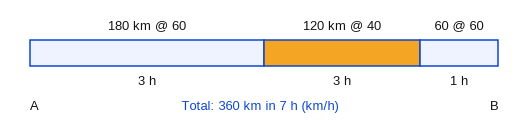
A car travels from City A to City B, a distance of 360 km. For the first half of the distance, it travels at a speed of 60 km/h. Due to traffic, it travels the next 120 km at 40 km/h. For the remaining distance, it travels at the same speed as it did for the first half. What is the average speed (in km/h) of the car for the entire trip, correct to two places after decimal?
एक कार शहर A से शहर B तक 360 km की दूरी तय करती है। दूरी के पहले आधे भाग में यह 60 km/h की चाल से चलती है। यातायात के कारण, अगले 120 km यह 40 km/h की चाल से चलती है। शेष दूरी में यह उसी चाल से चलती है जिस चाल से पहले आधे भाग में चली थी। पूरी यात्रा के लिए कार की औसत चाल (km/h में), दशमलव के दो स्थानों तक सही, क्या है?
  1. A52.43 km/h
  2. B49.43 km/h
  3. C51.43 km/h
  4. D50.43 km/h
Show answer

Concept: Average speed =total distancetotal time – never the average of the speeds.

  1. First half: 180km at 60km/h → 3h.
  2. Next 120km at 40km/h → 3h. Remaining 360−180−120=60km at 60km/h → 1h.
  3. Total time =3+3+1=7h. Average speed =3607=51.43km/h.

Trick: Find the time of each leg separately; 360 km in 7 h – 3607 is the only option near 51.4.

Answer: (C) 51.43 km/h

अवधारणा: औसत चाल =कुल दूरीकुल समय – चालों का औसत कभी नहीं।

  1. पहला आधा: 180km, 60km/h पर → 3h।
  2. अगले 120km, 40km/h पर → 3h। शेष 360−180−120=60km, 60km/h पर → 1h।
  3. कुल समय =3+3+1=7h। औसत चाल =3607=51.43km/h।

ट्रिक: हर भाग का समय अलग निकालें; 360 km, 7 h में – 3607 ही 51.4 के पास वाला विकल्प है।

उत्तर: (C) 51.43 km/h

RRB NTPC Graduate CBT 1MathematicsAverage SpeedRRB NTPC Graduate CBT 1 2025 · 18 Mar Shift 3 →
Q16169.
Which of the values of a, b, c given in the options satisfy the following equations?
3a−4b+2c=−9
−4a+4b+10c=32
−a+2b−7c=−7
विकल्पों में दिए गए a, b, c के कौन-से मान निम्नलिखित समीकरणों को संतुष्ट करते हैं?
3a−4b+2c=−9
−4a+4b+10c=32
−a+2b−7c=−7
  1. A(1, 4, 2)
  2. B(2, 1, 4)
  3. C(5, 1, 1)
  4. D(3, 2, 2)
Show answer

Concept: When the options give the values, substitute each option into all three equations – the one satisfying all is the answer.

  1. Try (a,b,c)=(1,4,2): 3(1)−4(4)+2(2)=3−16+4=−9 ✓
  2. −4(1)+4(4)+10(2)=−4+16+20=32 ✓
  3. −(1)+2(4)−7(2)=−1+8−14=−7 ✓ – all three hold, so (1,4,2) is the solution.

Trick: Check the shortest equation first (−a+2b−7c=−7): (3,2,2) gives −13, (2,1,4) gives −28, (5,1,1) gives −10 – only (1,4,2) survives; then confirm with another equation.

Answer: (A) (1, 4, 2)

अवधारणा: जब विकल्पों में मान दिए हों, तो हर विकल्प तीनों समीकरणों में रखें – जो सबमें सही बैठे वही उत्तर।

  1. (a,b,c)=(1,4,2) रखें: 3(1)−4(4)+2(2)=3−16+4=−9 ✓
  2. −4(1)+4(4)+10(2)=−4+16+20=32 ✓
  3. −(1)+2(4)−7(2)=−1+8−14=−7 ✓ – तीनों सही, अतः (1,4,2) हल है।

ट्रिक: सबसे छोटा समीकरण (−a+2b−7c=−7) पहले जाँचें: (3,2,2) से −3+4−14=−13, (2,1,4) से −28, (5,1,1) से −10 – केवल (1,4,2) बचता है; फिर दूसरे समीकरण से पुष्टि करें।

उत्तर: (A) (1, 4, 2)

RRB NTPC Graduate CBT 1MathematicsLinear Equations (Verification)RRB NTPC Graduate CBT 1 2025 · 18 Mar Shift 3 →
Q16170.
What is the maximum value that must be assigned to A so that the 8-digit number 713A8845 is divisible by 3?
A को अधिकतम कौन-सा मान दिया जाना चाहिए ताकि 8 अंकों की संख्या 713A8845, 3 से विभाज्य हो?
  1. A9
  2. B8
  3. C6
  4. D7
Show answer

Concept: A number is divisible by 3 when the sum of its digits is divisible by 3.

  1. Digit sum of 713A8845 =7+1+3+A+8+8+4+5=36+A.
  2. 36 is already a multiple of 3, so A must be a multiple of 3: A=0,3,6 or 9.
  3. The maximum single digit is A=9 (sum =45, divisible by 3).

Trick: If the known digits already sum to a multiple of 3, the missing digit can be 0, 3, 6 or 9 – take 9 for 'maximum'.

Answer: (A) 9

अवधारणा: कोई संख्या 3 से विभाज्य होती है जब उसके अंकों का योग 3 से विभाज्य हो।

  1. 713A8845 का अंक-योग =7+1+3+A+8+8+4+5=36+A।
  2. 36 पहले से 3 का गुणज है, अतः A भी 3 का गुणज: A=0,3,6 या 9।
  3. अधिकतम एक-अंकीय मान A=9 (योग =45, 3 से विभाज्य)।

ट्रिक: ज्ञात अंकों का योग पहले से 3 का गुणज हो तो लुप्त अंक 0, 3, 6 या 9 – 'अधिकतम' के लिए 9 लें।

उत्तर: (A) 9

RRB NTPC Graduate CBT 1MathematicsDivisibility Rule of 3RRB NTPC Graduate CBT 1 2025 · 18 Mar Shift 3 →
Q16171.
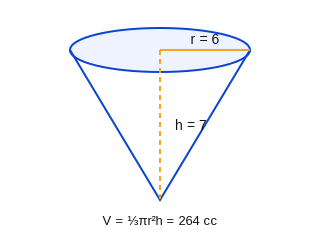
A cone has a base radius of 6 cm and a height of 7 cm. It is to be filled with water, and for every 180 cc of water poured into the cone, an additional 20 cc of water is spilled while pouring. If the spillage is proportional as described, how much water (in cc) will be required to fill the cone to its brim? (Use π = 22/7 and give your answer correct to two decimal places.)
एक शंकु के आधार की त्रिज्या 6 cm और ऊँचाई 7 cm है। इसे पानी से भरा जाना है, और शंकु में डाले गए प्रत्येक 180 cc पानी पर डालते समय अतिरिक्त 20 cc पानी छलक जाता है। यदि छलकाव वर्णित अनुसार समानुपाती है, तो शंकु को उसके किनारे तक भरने के लिए कितने पानी (cc में) की आवश्यकता होगी? (π = 22/7 का प्रयोग कीजिए और अपना उत्तर दशमलव के दो स्थानों तक सही दीजिए।)
  1. A295.67
  2. B296.67
  3. C283.33
  4. D293.33
Show answer

Concept: Volume of a cone =13πr2h; then account for the spillage ratio.

  1. V=13×227×62×7=13×22×36=264cc.
  2. For every 180cc that goes in, 20cc spills, so 200cc must be poured to retain 180cc.
  3. Water required =264×200180=264×109=293.33cc.

Trick: Spillage of 20 per 180 means pour 109 of the volume: 264×109=293.33.

Answer: (D) 293.33

अवधारणा: शंकु का आयतन =13πr2h; फिर छलकने का अनुपात लगाएँ।

  1. V=13×227×62×7=13×22×36=264cc।
  2. हर 180cc अंदर जाने पर 20cc छलकता है, यानी 180cc रखने के लिए 200cc डालना पड़ता है।
  3. आवश्यक पानी =264×200180=264×109=293.33cc।

ट्रिक: 180 पर 20 छलकना = आयतन का 109 डालना: 264×109=293.33।

उत्तर: (D) 293.33

RRB NTPC Graduate CBT 1MathematicsMensuration – Volume of ConeRRB NTPC Graduate CBT 1 2025 · 18 Mar Shift 3 →
Q16172.
Find the value of m, satisfying equation:
(1310)4×(1013)16×(1310)17=(1013)3m+18
समीकरण को संतुष्ट करने वाले m का मान ज्ञात कीजिए:
(1310)4×(1013)16×(1310)17=(1013)3m+18
  1. A−293
  2. B−333
  3. C−243
  4. D−233
Show answer

Concept: Write every base as the same fraction: (1013)n=(1310)−n, then equate the powers.

  1. LHS =(1310)4×(1310)−16×(1310)17=(1310)4−16+17=(1310)5.
  2. RHS =(1013)3m+18=(1310)−(3m+18).
  3. So −(3m+18)=5⇒3m=−23⇒m=−233.

Trick: Flipping a fraction changes the sign of the power; collect all powers on one base before equating.

Answer: (D) −233

अवधारणा: हर आधार को एक ही भिन्न में लिखें: (1013)n=(1310)−n, फिर घातें बराबर करें।

  1. LHS =(1310)4×(1310)−16×(1310)17=(1310)5।
  2. RHS =(1013)3m+18=(1310)−(3m+18)।
  3. अतः −(3m+18)=5⇒3m=−23⇒m=−233।

ट्रिक: भिन्न पलटने से घात का चिह्न बदलता है; बराबर करने से पहले सारी घातें एक आधार पर लाएँ।

उत्तर: (D) −233

RRB NTPC Graduate CBT 1MathematicsLaws of IndicesRRB NTPC Graduate CBT 1 2025 · 18 Mar Shift 3 →
Q16173.
If cosecA=53, then find the value of 9(1+cot2A)80(1−secA)(1+secA).
यदि cosecA=53 है, तो 9(1+cot2A)80(1−secA)(1+secA) का मान ज्ञात कीजिए।
  1. A57
  2. B−79
  3. C37
  4. D−59
Show answer

Concept: Use 1+cot2A=csc2A and (1−secA)(1+secA)=1−sec2A=−tan2A.

  1. cscA=53⇒sinA=35, cosA=45, tanA=34.
  2. Numerator =9csc2A=9×259=25.
  3. Denominator =80×(1−sec2A)=80×(−tan2A)=80×(−916)=−45.
  4. Value =25−45=−59.

Trick: The 3-4-5 triangle does it all: csc=53 means opposite 3, hypotenuse 5, adjacent 4. 1−sec2 is always negative, so look for a negative option.

Answer: (D) −59

अवधारणा: 1+cot2A=csc2A और (1−secA)(1+secA)=1−sec2A=−tan2A का प्रयोग करें।

  1. cscA=53⇒sinA=35, cosA=45, tanA=34।
  2. अंश =9csc2A=9×259=25।
  3. हर =80×(1−sec2A)=80×(−tan2A)=80×(−916)=−45।
  4. मान =25−45=−59।

ट्रिक: 3-4-5 त्रिभुज से सब मिल जाता है: csc=53 यानी लंब 3, कर्ण 5, आधार 4। 1−sec2 हमेशा ऋणात्मक – ऋणात्मक विकल्प देखें।

उत्तर: (D) −59

RRB NTPC Graduate CBT 1MathematicsTrigonometric IdentitiesRRB NTPC Graduate CBT 1 2025 · 18 Mar Shift 3 →
Q16174.
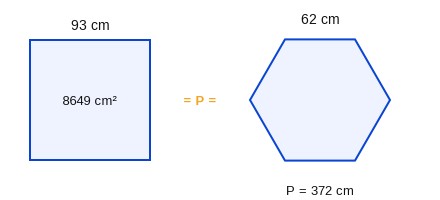
The area of a square is 8649 cm2. Its perimeter is equal to the perimeter of a regular hexagon. What is the area (in cm2) of the hexagon?
एक वर्ग का क्षेत्रफल 8649 cm2 है। इसका परिमाप एक सम षट्भुज के परिमाप के बराबर है। षट्भुज का क्षेत्रफल (cm2 में) क्या है?
  1. A5758
  2. B5716
  3. C57623
  4. D57663
Show answer

Concept: Equal perimeters give the hexagon's side; area of a regular hexagon =332a2.

  1. Side of square =8649=93cm; perimeter =4×93=372cm.
  2. Hexagon side a=3726=62cm.
  3. Area =332×622=332×3844=57663cm2.

Trick: Hexagon side =46=23 of the square's side; a regular hexagon is 6 equilateral triangles, so area =6×34a2.

Answer: (D) 57663

अवधारणा: बराबर परिमाप से षट्भुज की भुजा मिलती है; सम षट्भुज का क्षेत्रफल =332a2।

  1. वर्ग की भुजा =8649=93cm; परिमाप =4×93=372cm।
  2. षट्भुज की भुजा a=3726=62cm।
  3. क्षेत्रफल =332×622=332×3844=57663cm2।

ट्रिक: षट्भुज की भुजा = वर्ग की भुजा का 23; सम षट्भुज = 6 समबाहु त्रिभुज, अतः क्षेत्रफल =6×34a2।

उत्तर: (D) 57663

RRB NTPC Graduate CBT 1MathematicsMensuration – Square and Regular HexagonRRB NTPC Graduate CBT 1 2025 · 18 Mar Shift 3 →
Q16175.
The monthly incomes of two friends Mohan and David, are in the ratio 6 : 7 respectively and each of them saves ₹69,000 every month. If the ratio of their monthly expenditure is 2 : 3, find the monthly income of Mohan (in ₹).
दो मित्रों मोहन और डेविड की मासिक आय का अनुपात क्रमशः 6 : 7 है और उनमें से प्रत्येक प्रति माह ₹69,000 की बचत करता है। यदि उनके मासिक व्यय का अनुपात 2 : 3 है, तो मोहन की मासिक आय (₹ में) ज्ञात कीजिए।
  1. A1,03,500
  2. B1,04,500
  3. C1,44,900
  4. D1,02,500
Show answer

Concept: Income − Savings = Expenditure; equate the expenditure ratio.

  1. Let incomes be 6x and 7x. Expenditures: 6x−69000 and 7x−69000.
  2. 6x−690007x−69000=23⇒18x−207000=14x−138000⇒4x=69000⇒x=17250.
  3. Mohan's income =6x=6×17250= ₹1,03,500.

Trick: Equal savings → income1−income2=exp1−exp2: x=(one part of expenditure); here 7x−6x=3k−2k gives x=k, so 6k−69000=2k⇒k=17250.

Answer: (A) 1,03,500

अवधारणा: आय − बचत = व्यय; व्यय का अनुपात बराबर रखें।

  1. आय 6x और 7x मानें। व्यय: 6x−69000 और 7x−69000।
  2. 6x−690007x−69000=23⇒18x−207000=14x−138000⇒4x=69000⇒x=17250।
  3. मोहन की आय =6x=6×17250= ₹1,03,500।

ट्रिक: बचत बराबर → आय का अंतर = व्यय का अंतर: 7x−6x=3k−2k⇒x=k; तब 6k−69000=2k⇒k=17250।

उत्तर: (A) 1,03,500

RRB NTPC Graduate CBT 1MathematicsRatio – Income, Expenditure and SavingsRRB NTPC Graduate CBT 1 2025 · 18 Mar Shift 3 →
Q16176.
If the mean proportional of two numbers is 14 and their third proportional is 112, then the numbers are:
यदि दो संख्याओं का मध्यानुपाती 14 है और उनका तृतीयानुपाती 112 है, तो संख्याएँ हैं:
  1. A14, 14
  2. B7, 28
  3. C4, 44
  4. D4, 49
Show answer

Concept: For numbers a and b: mean proportional =ab, third proportional =b2a.

  1. ab=14⇒ab=196.
  2. b2a=112⇒b2=112a. Multiply by b: b3=112ab=112×196=21952=283⇒b=28.
  3. a=19628=7. Numbers: 7 and 28.

Trick: Test options: product must be 196 → only (14,14) and (7,28); third proportional of 7, 28 =2827=112 ✓.

Answer: (B) 7, 28

अवधारणा: संख्याओं a, b के लिए: मध्यानुपाती =ab, तृतीयानुपाती =b2a।

  1. ab=14⇒ab=196।
  2. b2a=112⇒b2=112a। b से गुणा: b3=112ab=112×196=21952=283⇒b=28।
  3. a=19628=7। संख्याएँ: 7 और 28।

ट्रिक: विकल्प जाँचें: गुणनफल 196 चाहिए → केवल (14,14) और (7,28); 7, 28 का तृतीयानुपाती =2827=112 ✓।

उत्तर: (B) 7, 28

RRB NTPC Graduate CBT 1MathematicsMean and Third ProportionalRRB NTPC Graduate CBT 1 2025 · 18 Mar Shift 3 →
Q16177.
If the diameter of a circle is 14 cm, then what is the circumference of the circle? (Use π=227)
यदि एक वृत्त का व्यास 14 cm है, तो वृत्त की परिधि क्या है? (π=227 का प्रयोग कीजिए)
  1. A36 cm
  2. B44 cm
  3. C22 cm
  4. D24 cm
Show answer

Concept: Circumference =πd=2πr.

  1. d=14cm, so circumference =227×14.
  2. =22×2=44cm.

Trick: With π=227, a diameter that is a multiple of 7 cancels neatly: 14→44, 7→22, 21→66.

Answer: (B) 44 cm

अवधारणा: परिधि =πd=2πr।

  1. d=14cm, अतः परिधि =227×14।
  2. =22×2=44cm।

ट्रिक: π=227 के साथ 7 के गुणज वाला व्यास सीधा कटता है: 14→44, 7→22, 21→66।

उत्तर: (B) 44 cm

RRB NTPC Graduate CBT 1MathematicsCircumference of a CircleRRB NTPC Graduate CBT 1 2025 · 18 Mar Shift 3 →
Q16178.
Evaluate: (−9) − (−56) ÷ (−14) + (−2) × 9
मान ज्ञात कीजिए: (−9) − (−56) ÷ (−14) + (−2) × 9
  1. A−33
  2. B−31
  3. C−30
  4. D−34
Show answer

Concept: Do division and multiplication before addition and subtraction; mind the signs.

  1. (−56)÷(−14)=4 and (−2)×9=−18.
  2. Expression =(−9)−4+(−18)=−9−4−18=−31.

Trick: Negative ÷ negative = positive; then '− (positive)' subtracts. Keep a running total: −9→−13→−31.

Answer: (B) −31

अवधारणा: जोड़-घटाव से पहले भाग और गुणा करें; चिह्नों का ध्यान रखें।

  1. (−56)÷(−14)=4 और (−2)×9=−18।
  2. व्यंजक =(−9)−4+(−18)=−9−4−18=−31।

ट्रिक: ऋण ÷ ऋण = धन; फिर '− (धन)' घटता है। चलता योग रखें: −9→−13→−31।

उत्तर: (B) −31

RRB NTPC Graduate CBT 1MathematicsBODMAS with IntegersRRB NTPC Graduate CBT 1 2025 · 18 Mar Shift 3 →
Q16179.
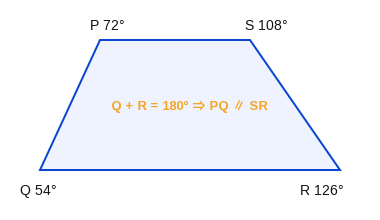
If ∠P, ∠Q, ∠R and ∠S of a quadrilateral PQRS, taken in order, are in the ratio 4 : 3 : 7 : 6, then quadrilateral PQRS will be of which type?
यदि एक चतुर्भुज PQRS के ∠P, ∠Q, ∠R और ∠S, क्रम से लेने पर, 4 : 3 : 7 : 6 के अनुपात में हैं, तो चतुर्भुज PQRS किस प्रकार का होगा?
  1. AKiteपतंग (Kite)
  2. BParallelogramसमांतर चतुर्भुज
  3. CRhombusसमचतुर्भुज
  4. DTrapeziumसमलंब
Show answer

Concept: Angle sum of a quadrilateral =360∘; if a pair of co-interior (adjacent) angles adds to 180∘, the sides containing them are parallel.

  1. 4x+3x+7x+6x=20x=360∘⇒x=18∘. Angles: P=72∘, Q=54∘, R=126∘, S=108∘.
  2. Q+R=54∘+126∘=180∘ (and P+S=180∘) → PQ∥SR. But P+Q=126∘≠180∘, so PS is not parallel to QR.
  3. Exactly one pair of opposite sides parallel, and opposite angles are unequal → a trapezium (not a parallelogram, rhombus or kite).

Trick: Opposite angles equal → parallelogram/rhombus; only one pair of adjacent angles supplementary → trapezium. Here 4 : 3 : 7 : 6 has unequal opposite terms.

Answer: (D) Trapezium

अवधारणा: चतुर्भुज का कोण-योग =360∘; यदि संलग्न (co-interior) कोणों का योग 180∘ हो, तो उन्हें मिलाने वाली भुजाएँ समांतर होती हैं।

  1. 4x+3x+7x+6x=20x=360∘⇒x=18∘। कोण: P=72∘, Q=54∘, R=126∘, S=108∘।
  2. Q+R=54∘+126∘=180∘ (और P+S=180∘) → PQ∥SR। पर P+Q=126∘≠180∘, अतः PS, QR के समांतर नहीं।
  3. सम्मुख भुजाओं का ठीक एक युग्म समांतर और सम्मुख कोण असमान → समलंब (trapezium), न कि समांतर चतुर्भुज, समचतुर्भुज या पतंग।

ट्रिक: सम्मुख कोण बराबर → समांतर चतुर्भुज/समचतुर्भुज; केवल एक युग्म संलग्न कोण संपूरक → समलंब। यहाँ 4 : 3 : 7 : 6 में सम्मुख पद असमान हैं।

उत्तर: (D) समलंब (Trapezium)

RRB NTPC Graduate CBT 1MathematicsQuadrilaterals – Angle PropertiesRRB NTPC Graduate CBT 1 2025 · 18 Mar Shift 3 →
Q16180.
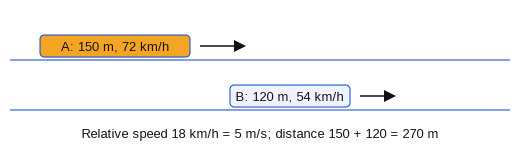
Two trains, Train A and Train B, are running on parallel tracks in the same direction. Train A, which is 150 metres long, is moving at 72 km/hr, while Train B, which is 120 metres long, is moving at 54 km/hr. How long will it take for Train A to completely overtake Train B?
दो रेलगाड़ियाँ, रेलगाड़ी A और रेलगाड़ी B, समांतर पटरियों पर एक ही दिशा में चल रही हैं। रेलगाड़ी A, जो 150 मीटर लंबी है, 72 km/hr की चाल से चल रही है, जबकि रेलगाड़ी B, जो 120 मीटर लंबी है, 54 km/hr की चाल से चल रही है। रेलगाड़ी A को रेलगाड़ी B को पूरी तरह पार करने में कितना समय लगेगा?
  1. A58 seconds58 सेकंड
  2. B50 seconds50 सेकंड
  3. C54 seconds54 सेकंड
  4. D52 seconds52 सेकंड
Show answer

Concept: Same direction → relative speed = difference of speeds; distance to overtake = sum of lengths.

  1. Relative speed =72−54=18km/h=18×518=5m/s.
  2. Distance =150+120=270m.
  3. Time =2705=54s.

Trick: km/h → m/s: multiply by 518; 18 km/h is exactly 5 m/s – a value worth memorising.

Answer: (C) 54 seconds

अवधारणा: समान दिशा → सापेक्ष चाल = चालों का अंतर; पार करने की दूरी = लंबाइयों का योग।

  1. सापेक्ष चाल =72−54=18km/h=18×518=5m/s।
  2. दूरी =150+120=270m।
  3. समय =2705=54s।

ट्रिक: km/h → m/s: 518 से गुणा; 18 km/h ठीक 5 m/s – याद रखने लायक मान।

उत्तर: (C) 54 सेकंड

RRB NTPC Graduate CBT 1MathematicsTrains – Same DirectionRRB NTPC Graduate CBT 1 2025 · 18 Mar Shift 3 →