Question bank

Q&A: practice questions with answers

Search questions on any topic. Filter by exam category, exam, subject and topic, try the question, then open the answer and explanation.

Courses – airGurukul

20,719 questions found.

Q16481.
The arithmetic mean of 10 observations is 6 and the sum of nine of the observations is 49. Find the tenth observation.
10 प्रेक्षणों का समांतर माध्य 6 है और उनमें से नौ प्रेक्षणों का योग 49 है। दसवाँ प्रेक्षण ज्ञात कीजिए।
  1. A9
  2. B10
  3. C13
  4. D11
Show answer

Concept: Sum of observations=Mean×Number of observations.

  1. Total of 10 observations =6×10=60.
  2. Sum of nine of them =49.
  3. Tenth observation =60−49=11.

Trick: Mean questions almost always start with 'total = mean × n'.

Answer: (D) 11

अवधारणा: प्रेक्षणों का योग=माध्य×प्रेक्षणों की संख्या।

  1. 10 प्रेक्षणों का योग =6×10=60।
  2. नौ प्रेक्षणों का योग =49।
  3. दसवाँ प्रेक्षण =60−49=11।

ट्रिक: माध्य के प्रश्न लगभग हमेशा 'योग = माध्य × n' से शुरू होते हैं।

उत्तर: (D) 11
RRB NTPC Graduate CBT 1MathematicsStatistics – arithmetic meanRRB NTPC Graduate CBT 1 2025 · 17 Mar Shift 3 →
Q16482.
A, B and C together can complete a certain work in 40 days. B and C together can complete the same work in 72 days. B is 50% more efficient than A. A, B and C work together for 16 days. B alone will complete the remaining work in:
A, B और C मिलकर एक निश्चित कार्य को 40 दिनों में पूरा कर सकते हैं। B और C मिलकर उसी कार्य को 72 दिनों में पूरा कर सकते हैं। B, A से 50% अधिक कार्यकुशल है। A, B और C 16 दिनों तक एक साथ कार्य करते हैं। B अकेला शेष कार्य को पूरा करेगा:
  1. A36 days36 दिनों में
  2. B34 days34 दिनों में
  3. C38 days38 दिनों में
  4. D35 days35 दिनों में
Show answer

Concept: Work per day is additive: A=(A+B+C)−(B+C). Efficiency ratio gives individual rates.

  1. A's one-day work =140−172=9−5360=190.
  2. B is 50% more efficient: B's one-day work =190×32=160, so B alone takes 60 days.
  3. In 16 days all three do 1640=25; remaining =35.
  4. B needs 35×60=36 days.

Trick: Take total work =360 units (LCM of 40, 72): all three 9/day, B+C 5/day, A 4/day, B 6/day; left 360−144=216; 216÷6=36.

Answer: (A) 36 days

अवधारणा: प्रतिदिन कार्य जोड़े-घटाए जा सकते हैं: A=(A+B+C)−(B+C)। दक्षता अनुपात से व्यक्तिगत दर मिलती है।

  1. A का एक दिन का कार्य =140−172=9−5360=190।
  2. B 50% अधिक दक्ष: B का एक दिन का कार्य =190×32=160, अतः B अकेले 60 दिन लेगा।
  3. 16 दिनों में तीनों ने 1640=25 किया; शेष =35।
  4. B को 35×60=36 दिन लगेंगे।

ट्रिक: कुल कार्य =360 इकाई (40, 72 का LCM) लें: तीनों 9/दिन, B+C 5/दिन, A 4/दिन, B 6/दिन; शेष 360−144=216; 216÷6=36।

उत्तर: (A) 36 days

RRB NTPC Graduate CBT 1MathematicsTime and work – efficiencyRRB NTPC Graduate CBT 1 2025 · 17 Mar Shift 3 →
Q16483.
Simplify: (4+4cot2A)tanA(3+3tan2A)cosecA
सरल कीजिए: (4+4cot2A)tanA(3+3tan2A)cosecA
  1. A4sinA3
  2. B4cosA3
  3. CsinA3
  4. DcosA3
Show answer

Concept: 1+cot2A=csc2A and 1+tan2A=sec2A.

  1. Numerator =4(1+cot2A)tanA=4csc2AtanA; denominator =3(1+tan2A)cscA=3sec2AcscA.
  2. Ratio =4csc2AtanA3sec2AcscA=43·cscAtanAsec2A.
  3. cscAtanA=1sinA·sinAcosA=secA, so the ratio =43·secAsec2A=4cosA3.

Trick: Put A=45∘: numerator =4·2·1=8, denominator =3·2·2; ratio =432=4cos45∘3 ✓.

Answer: (B) 4cosA3

अवधारणा: 1+cot2A=csc2A तथा 1+tan2A=sec2A।

  1. अंश =4(1+cot2A)tanA=4csc2AtanA; हर =3(1+tan2A)cscA=3sec2AcscA।
  2. अनुपात =4csc2AtanA3sec2AcscA=43·cscAtanAsec2A।
  3. cscAtanA=1sinA·sinAcosA=secA, अतः अनुपात =43·secAsec2A=4cosA3।

ट्रिक: A=45∘ रखें: अंश =4·2·1=8, हर =3·2·2; अनुपात =432=4cos45∘3 ✓।

उत्तर: (B) 4cosA3

RRB NTPC Graduate CBT 1MathematicsTrigonometry – identitiesRRB NTPC Graduate CBT 1 2025 · 17 Mar Shift 3 →
Q16484.
The speeds of two vehicles are 20 km/h and 45 km/h. Find the mean proportional between the two speeds.
दो वाहनों की चाल 20 km/h और 45 km/h है। दोनों चालों के बीच का मध्यानुपाती (mean proportional) ज्ञात कीजिए।
  1. A30 km/h
  2. B25 km/h
  3. C32 km/h
  4. D35 km/h
Show answer

Concept: Mean proportional between a and b is ab (since a:x=x:b).

  1. x=20×45=900.
  2. x=30 km/h.

Trick: 20×45=900=302 – spot perfect squares quickly.

Answer: (A) 30 km/h

अवधारणा: a और b के बीच मध्यानुपाती =ab (क्योंकि a:x=x:b)।

  1. x=20×45=900।
  2. x=30 km/h।

ट्रिक: 20×45=900=302 – पूर्ण वर्ग तुरंत पहचानें।

उत्तर: (A) 30 km/h

RRB NTPC Graduate CBT 1MathematicsRatio – mean proportionalRRB NTPC Graduate CBT 1 2025 · 17 Mar Shift 3 →
Q16485.
Girish scored 831 marks in an examination and was 72 marks short of 35% of maximum marks. In the same examination, his friend scored 774 marks. What is the percentage of marks scored by his friend?
गिरीश ने एक परीक्षा में 831 अंक प्राप्त किए और वह अधिकतम अंकों के 35% से 72 अंक कम रहा। उसी परीक्षा में उसके मित्र ने 774 अंक प्राप्त किए। उसके मित्र द्वारा प्राप्त अंकों का प्रतिशत क्या है?
  1. A28%
  2. B34%
  3. C30%
  4. D32%
Show answer

Concept: First find the maximum marks from the given shortfall, then compute the friend's percentage.

  1. 35% of maximum =831+72=903, so maximum =903×10035=2580.
  2. Friend's percentage =7742580×100=30%.

Trick: 2580×0.3=774 – check options by multiplying rather than dividing.

Answer: (C) 30%

अवधारणा: दी गई कमी से पहले अधिकतम अंक निकालें, फिर मित्र का प्रतिशत।

  1. अधिकतम का 35% =831+72=903, अतः अधिकतम =903×10035=2580।
  2. मित्र का प्रतिशत =7742580×100=30%।

ट्रिक: 2580×0.3=774 – भाग देने के बजाय विकल्पों को गुणा करके जाँचें।

उत्तर: (C) 30%

RRB NTPC Graduate CBT 1MathematicsPercentageRRB NTPC Graduate CBT 1 2025 · 17 Mar Shift 3 →
Q16486.
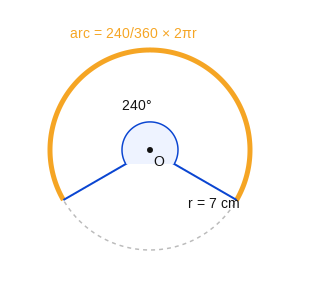
A circle has a radius of 7 cm. Calculate the length of an arc that subtends a central angle of 240°. (Give your answer in cm, rounded up to two decimal places; Use π = 22/7)
एक वृत्त की त्रिज्या 7 cm है। उस चाप की लंबाई की गणना कीजिए जो 240° का केंद्रीय कोण अंतरित करता है। (अपना उत्तर cm में, दो दशमलव स्थानों तक पूर्णांकित करके दीजिए; π = 22/7 का उपयोग कीजिए)
  1. A27.33 cm
  2. B28.67 cm
  3. C29.33 cm
  4. D31.33 cm
Show answer

Concept: Arc length =θ360∘×2πr.

  1. 240360=23.
  2. Circumference =2×227×7=44 cm.
  3. Arc =23×44=29.33 cm.

Trick: 240∘ is two-thirds of a full turn, so take two-thirds of the circumference.

Answer: (C) 29.33 cm

अवधारणा: चाप की लंबाई =θ360∘×2πr।

  1. 240360=23।
  2. परिधि =2×227×7=44 cm।
  3. चाप =23×44=29.33 cm।

ट्रिक: 240∘ पूरे चक्कर का दो-तिहाई है, इसलिए परिधि का दो-तिहाई लें।

उत्तर: (C) 29.33 cm

RRB NTPC Graduate CBT 1MathematicsCircle – arc lengthRRB NTPC Graduate CBT 1 2025 · 17 Mar Shift 3 →
Q16487.
What should come in place of ‘?’ in the given series?
81 79 76 71 64 ?
दी गई श्रेणी में ‘?’ के स्थान पर क्या आना चाहिए?
81 79 76 71 64 ?
  1. A54
  2. B53
  3. C55
  4. D51
Show answer

Concept: Look at the differences between consecutive terms.

  1. 81−79=2, 79−76=3, 76−71=5, 71−64=7 – differences are prime numbers.
  2. Next prime is 11, so ?=64−11=53.

Trick: Differences 2, 3, 5, 7, 11, 13… (primes) is a favourite pattern.

Answer: (B) 53

अवधारणा: क्रमागत पदों के अंतर देखें।

  1. 81−79=2, 79−76=3, 76−71=5, 71−64=7 – अंतर अभाज्य संख्याएँ हैं।
  2. अगली अभाज्य 11, अतः ?=64−11=53।

ट्रिक: अंतर 2, 3, 5, 7, 11, 13… (अभाज्य) एक पसंदीदा पैटर्न है।

उत्तर: (B) 53

RRB NTPC Graduate CBT 1MathematicsNumber seriesRRB NTPC Graduate CBT 1 2025 · 17 Mar Shift 3 →
Q16488.
At what rate (in percentage, rounded off to two decimal place) per year will a sum of money 5 times itself in 24 years on simple interest?
साधारण ब्याज पर प्रति वर्ष किस दर (प्रतिशत में, दो दशमलव स्थानों तक पूर्णांकित) से कोई धनराशि 24 वर्षों में स्वयं की 5 गुनी हो जाएगी?
  1. A16.67
  2. B14.67
  3. C33.34
  4. D18.67
Show answer

Concept: If a sum becomes n times at SI, interest =(n−1)P and R=(n−1)×100T.

  1. Amount =5P, so SI =4P in 24 years.
  2. R=4P×100P×24=40024=16.67%.

Trick: 'n times in T years' → R=100(n−1)T; here 40024.

Answer: (A) 16.67

अवधारणा: यदि राशि SI पर n गुनी हो, तो ब्याज =(n−1)P और R=(n−1)×100T।

  1. मिश्रधन =5P, अतः SI =4P (24 वर्ष में)।
  2. R=4P×100P×24=40024=16.67%।

ट्रिक: 'T वर्ष में n गुना' → R=100(n−1)T; यहाँ 40024।

उत्तर: (A) 16.67

RRB NTPC Graduate CBT 1MathematicsSimple interestRRB NTPC Graduate CBT 1 2025 · 17 Mar Shift 3 →
Q16489.
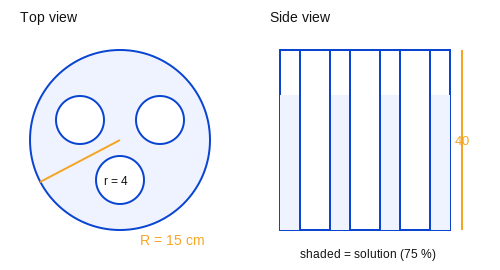
A chemical engineer designs a cylindrical reaction vessel with inner radius 15 cm and height 40 cm. Inside this vessel, three identical cylindrical cooling tubes (each with radius 4 cm and same height as the vessel) are installed vertically. If the remaining space is filled to 75% capacity with reactive solution, what volume of solution (in liters) does the vessel contain? (Use π = 3.14) (Round your answer off to two decimal places.)
एक रासायनिक इंजीनियर 15 cm आंतरिक त्रिज्या और 40 cm ऊँचाई वाला एक बेलनाकार अभिक्रिया पात्र डिज़ाइन करता है। इस पात्र के अंदर तीन समरूप बेलनाकार शीतलन नलिकाएँ (प्रत्येक की त्रिज्या 4 cm और ऊँचाई पात्र के समान) ऊर्ध्वाधर रूप से लगाई गई हैं। यदि शेष स्थान को अभिक्रियाशील विलयन से 75% क्षमता तक भरा जाता है, तो पात्र में विलयन का आयतन (लीटर में) कितना है? (π = 3.14 का उपयोग कीजिए) (अपने उत्तर को दो दशमलव स्थानों तक पूर्णांकित कीजिए।)
  1. A16.67 liters16.67 लीटर
  2. B18.15 liters18.15 लीटर
  3. C19.33 liters19.33 लीटर
  4. D17.42 liters17.42 लीटर
Show answer

Concept: Volume of cylinder =πr2h; free space = vessel volume − volume of tubes; 1 litre =1000 cm³.

  1. Vessel: π×152×40=9000π cm³.
  2. Three tubes: 3×π×42×40=1920π cm³.
  3. Free space =7080π=7080×3.14=22231.2 cm³.
  4. Solution =75% of it =16673.4 cm³ ≈16.67 litres.

Trick: Keep π till the end: 0.75×7080π=5310π, then multiply by 3.14 once.

Answer: (A) 16.67 liters

अवधारणा: बेलन का आयतन =πr2h; खाली स्थान = बर्तन का आयतन − नलियों का आयतन; 1 लीटर =1000 cm³।

  1. बर्तन: π×152×40=9000π cm³।
  2. तीन नलियाँ: 3×π×42×40=1920π cm³।
  3. खाली स्थान =7080π=7080×3.14=22231.2 cm³।
  4. घोल = इसका 75%=16673.4 cm³ ≈16.67 लीटर।

ट्रिक: π अंत तक रखें: 0.75×7080π=5310π, फिर एक बार 3.14 से गुणा करें।

उत्तर: (A) 16.67 liters

RRB NTPC Graduate CBT 1MathematicsMensuration – cylinderRRB NTPC Graduate CBT 1 2025 · 17 Mar Shift 3 →
Q16490.
A shopkeeper fixes the marked price of an item 180% above its cost price. What percentage of discount on marked price should be allowed to gain 152%?
एक दुकानदार किसी वस्तु का अंकित मूल्य उसके क्रय मूल्य से 180% अधिक निर्धारित करता है। 152% लाभ प्राप्त करने के लिए अंकित मूल्य पर कितने प्रतिशत छूट दी जानी चाहिए?
  1. A8%
  2. B9%
  3. C7%
  4. D10%
Show answer

Concept: Take CP =100; MP=CP(1+markup), SP=CP(1+gain), discount is on MP.

  1. MP =100+180=280; required SP =100+152=252.
  2. Discount =280−252=28.
  3. Discount% =28280×100=10%.

Trick: (1+markup)(1−d)=(1+gain): 2.8(1−d)=2.52⇒1−d=0.9.

Answer: (D) 10%

अवधारणा: CP =100 लें; MP=CP(1+वृद्धि), SP=CP(1+लाभ), छूट MP पर होती है।

  1. MP =100+180=280; अभीष्ट SP =100+152=252।
  2. छूट =280−252=28।
  3. छूट% =28280×100=10%।

ट्रिक: (1+वृद्धि)(1−d)=(1+लाभ): 2.8(1−d)=2.52⇒1−d=0.9।

उत्तर: (D) 10%

RRB NTPC Graduate CBT 1MathematicsProfit and loss – discountRRB NTPC Graduate CBT 1 2025 · 17 Mar Shift 3 →
Q16491.
Amit invested the same sum at simple and compound interest (compounded annually) for 2 years at 4% per annum. The difference between the compound interest and the simple interest is ₹47. Find the sum (in ₹) invested in each case.
अमित ने समान धनराशि 2 वर्षों के लिए 4% वार्षिक दर से साधारण ब्याज और चक्रवृद्धि ब्याज (वार्षिक रूप से संयोजित) पर निवेश की। चक्रवृद्धि ब्याज और साधारण ब्याज के बीच का अंतर ₹47 है। प्रत्येक स्थिति में निवेश की गई धनराशि (₹ में) ज्ञात कीजिए।
  1. A29,725
  2. B29,375
  3. C28,625
  4. D28,475
Show answer

Concept: For 2 years, CI−SI=P(R100)2.

  1. P×(4100)2=47.
  2. P×1610000=47⇒P=47×1000016=29375.

Trick: 2-year difference =PR210000; 3-year difference =PR2(300+R)106.

Answer: (B) 29,375

अवधारणा: 2 वर्ष के लिए, CI−SI=P(R100)2।

  1. P×(4100)2=47।
  2. P×1610000=47⇒P=47×1000016=29375।

ट्रिक: 2 वर्ष का अंतर =PR210000; 3 वर्ष का अंतर =PR2(300+R)106।

उत्तर: (B) 29,375

RRB NTPC Graduate CBT 1MathematicsCI – SI differenceRRB NTPC Graduate CBT 1 2025 · 17 Mar Shift 3 →
Q16492.
Walking at 47 of his normal speed from his home, Lakshya is 15 minutes late in reaching his office. The usual time taken by him to cover the distance between his home and his office is
अपने घर से अपनी सामान्य चाल के 47 से चलते हुए, लक्ष्य अपने कार्यालय पहुँचने में 15 मिनट देर हो जाता है। अपने घर और कार्यालय के बीच की दूरी तय करने में उसे सामान्यतः लगने वाला समय है
  1. A20 minutes20 मिनट
  2. B29 minutes29 मिनट
  3. C23 minutes23 मिनट
  4. D16 minutes16 मिनट
Show answer

Concept: For a fixed distance, time is inversely proportional to speed.

  1. Speed becomes 47 of usual ⇒ time becomes 74 of usual time t.
  2. Extra time =74t−t=34t=15 minutes.
  3. t=15×43=20 minutes.

Trick: Speed ratio 4:7 ⇒ time ratio 7:4; the difference of 3 parts =15 min ⇒ 1 part =5, usual =4×5=20.

Answer: (A) 20 minutes

अवधारणा: निश्चित दूरी के लिए समय, चाल के व्युत्क्रमानुपाती होता है।

  1. चाल सामान्य की 47 ⇒ समय सामान्य समय t का 74।
  2. अतिरिक्त समय =74t−t=34t=15 मिनट।
  3. t=15×43=20 मिनट।

ट्रिक: चाल अनुपात 4:7 ⇒ समय अनुपात 7:4; 3 भागों का अंतर =15 मिनट ⇒ 1 भाग =5, सामान्य =4×5=20।

उत्तर: (A) 20 minutes

RRB NTPC Graduate CBT 1MathematicsSpeed and time – late/earlyRRB NTPC Graduate CBT 1 2025 · 17 Mar Shift 3 →
Q16493.
Evaluate: 16 + 18 ÷ 6 - 2 × 4
मान ज्ञात कीजिए: 16 + 18 ÷ 6 - 2 × 4
  1. A13
  2. B11
  3. C14
  4. D10
Show answer

Concept: Do division and multiplication before addition and subtraction (BODMAS).

  1. 18÷6=3 and 2×4=8.
  2. 16+3−8=11.

Trick: Underline all ÷ and × first, solve them, then run left to right.

Answer: (B) 11

अवधारणा: जोड़-घटाव से पहले भाग और गुणा करें (BODMAS)।

  1. 18÷6=3 और 2×4=8।
  2. 16+3−8=11।

ट्रिक: पहले सभी ÷ और × रेखांकित करके हल करें, फिर बाएँ से दाएँ चलें।

उत्तर: (B) 11

RRB NTPC Graduate CBT 1MathematicsSimplification – BODMASRRB NTPC Graduate CBT 1 2025 · 17 Mar Shift 3 →
Q16494.
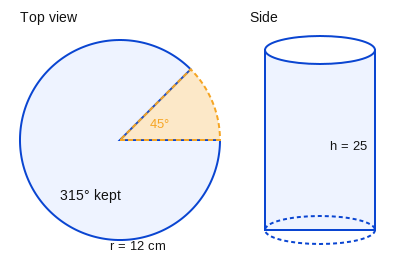
The radius of a solid cylinder is 12 cm, and its height is 25 cm. A three- dimensional sector with a sector angle of 45o is removed from it, all along the height of the cylinder. What is the volume (in cm3) of the larger piece of the cylinder?
एक ठोस बेलन की त्रिज्या 12 cm है और इसकी ऊँचाई 25 cm है। इससे 45o त्रिज्यखंड कोण वाला एक त्रि-विमीय त्रिज्यखंड बेलन की पूरी ऊँचाई के अनुदिश निकाल दिया जाता है। बेलन के बड़े टुकड़े का आयतन (cm3 में) क्या है?
  1. A3150π
  2. B3200π
  3. C3000π
  4. D3250π
Show answer

Concept: A sector of angle θ cut along the height takes θ360∘ of the cylinder's volume πr2h.

  1. Full volume =π×122×25=3600π cm³.
  2. Removed piece =45360=18 of it; larger piece =78.
  3. Larger piece =78×3600π=3150π cm³.

Trick: 45∘ is one-eighth of a turn – keep 78, remove 18.

Answer: (A) 3150π

अवधारणा: ऊँचाई के साथ काटा गया θ कोण का त्रिज्यखंड बेलन के आयतन πr2h का θ360∘ भाग लेता है।

  1. पूरा आयतन =π×122×25=3600π cm³।
  2. हटाया भाग =45360=18; बड़ा टुकड़ा =78।
  3. बड़ा टुकड़ा =78×3600π=3150π cm³।

ट्रिक: 45∘ पूरे चक्कर का आठवाँ भाग – 78 रखें, 18 हटाएँ।

उत्तर: (A) 3150π

RRB NTPC Graduate CBT 1MathematicsMensuration – cylinder sectorRRB NTPC Graduate CBT 1 2025 · 17 Mar Shift 3 →
Q16495.
At present, Vanraj is three times as old as his son, and his daughter is 3 years younger than the son. If the sum of the ages of these three people 3 years ago was 58 years, then Vanraj's present age (in years) is:
वर्तमान में, वनराज की आयु अपने पुत्र की आयु की तीन गुनी है, और उसकी पुत्री पुत्र से 3 वर्ष छोटी है। यदि 3 वर्ष पहले इन तीनों की आयु का योग 58 वर्ष था, तो वनराज की वर्तमान आयु (वर्षों में) है:
  1. A42
  2. B36
  3. C33
  4. D45
Show answer

Concept: Let the son's present age be x; express every age in x and shift all three back by 3 years.

  1. Son =x, daughter =x−3, Vanraj =3x; present sum =5x−3.
  2. Three years ago the sum is 9 less: 5x−3−9=58⇒5x=70⇒x=14.
  3. Vanraj =3×14=42 years.

Trick: For n people 'k years ago', subtract nk from the present total – here 3×3=9.

Answer: (A) 42

अवधारणा: पुत्र की वर्तमान आयु x लें; हर आयु x में लिखें और तीनों को 3 वर्ष पीछे ले जाएँ।

  1. पुत्र =x, पुत्री =x−3, वनराज =3x; वर्तमान योग =5x−3।
  2. तीन वर्ष पहले योग 9 कम: 5x−3−9=58⇒5x=70⇒x=14।
  3. वनराज =3×14=42 वर्ष।

ट्रिक: n लोगों के लिए 'k वर्ष पहले', वर्तमान योग से nk घटाएँ – यहाँ 3×3=9।

उत्तर: (A) 42

RRB NTPC Graduate CBT 1MathematicsAgesRRB NTPC Graduate CBT 1 2025 · 17 Mar Shift 3 →
Q16496.
If x+118x=3, then the value of 18x3+1324x3 is:
यदि x+118x=3 है, तो 18x3+1324x3 का मान है:
  1. A491
  2. B431
  3. C465
  4. D477
Show answer

Concept: If a+b=k then a3+b3=k3−3ab·k.

  1. Take a=x, b=118x; then ab=118 and a+b=3.
  2. x3+15832x3=a3+b3=27−3×118×3=27−12=532.
  3. 18x3+1324x3=18(x3+15832x3)=18×532=477.

Trick: Note 324=182 and 5832=183 – the expression is just 18(a3+b3).

Answer: (D) 477

अवधारणा: यदि a+b=k तो a3+b3=k3−3ab·k।

  1. a=x, b=118x लें; तब ab=118 और a+b=3।
  2. x3+15832x3=a3+b3=27−3×118×3=27−12=532।
  3. 18x3+1324x3=18(x3+15832x3)=18×532=477।

ट्रिक: ध्यान दें 324=182 और 5832=183 – व्यंजक बस 18(a3+b3) है।

उत्तर: (D) 477

RRB NTPC Graduate CBT 1MathematicsAlgebra – cubes identityRRB NTPC Graduate CBT 1 2025 · 17 Mar Shift 3 →
Q16497.
FKEP is related to EIBL in a certain way based on the English alphabetical order. In the same way, JMHT is related to IKEP. To which of the following is PQNW related, following the same logic?
अंग्रेज़ी वर्णमाला क्रम के आधार पर FKEP, EIBL से एक निश्चित प्रकार से संबंधित है। उसी प्रकार, JMHT, IKEP से संबंधित है। उसी तर्क का अनुसरण करते हुए, PQNW निम्नलिखित में से किससे संबंधित है?
  1. AOOLS
  2. BOQKT
  3. COPJS
  4. DOOKS
Show answer

Concept: Compare each letter of the first cluster with the matching letter of the second and note the shift.

  1. FKEP → EIBL: F−1=E, K−2=I, E−3=B, P−4=L. Pattern −1,−2,−3,−4.
  2. Check: JMHT → J−1=I, M−2=K, H−3=E, T−4=P = IKEP ✓.
  3. Apply to PQNW: P−1=O, Q−2=O, N−3=K, W−4=S → OOKS.

Trick: Write the shifts under the letters; a sequence like −1,−2,−3,−4 is the commonest NTPC pattern.

Answer: (D) OOKS

अवधारणा: पहले समूह के हर अक्षर की तुलना दूसरे समूह के उसी स्थान के अक्षर से करें और shift देखें।

  1. FKEP → EIBL: F−1=E, K−2=I, E−3=B, P−4=L। पैटर्न −1,−2,−3,−4।
  2. जाँच: JMHT → I, K, E, P = IKEP ✓।
  3. PQNW: P−1=O, Q−2=O, N−3=K, W−4=S → OOKS।

ट्रिक: अक्षरों के नीचे shift लिखें; −1,−2,−3,−4 जैसा क्रम NTPC में सबसे आम पैटर्न है।

उत्तर: (D) OOKS

RRB NTPC Graduate CBT 1General Intelligence and ReasoningLetter Cluster AnalogyRRB NTPC Graduate CBT 1 2025 · 17 Mar Shift 3 →
Q16498.
In a certain code language, ‘LIME’ is coded as ‘4839’ and ‘TIME’ is coded as ‘9324’. What is the code for ‘T’ in the given code language?
एक निश्चित कूट भाषा में, ‘LIME’ को ‘4839’ के रूप में कूटबद्ध किया जाता है और ‘TIME’ को ‘9324’ के रूप में कूटबद्ध किया जाता है। दी गई कूट भाषा में ‘T’ का कूट क्या है?
  1. A4
  2. B9
  3. C3
  4. D2
Show answer

Concept: Letters common to both words get the common digits; the letter that is left over gets the digit that is left over.

  1. LIME → 4839 and TIME → 9324 share I, M, E.
  2. Common digits of the two codes: {4,8,3,9}∩{9,3,2,4}={4,3,9} → these belong to I, M, E.
  3. So L = 8 (the digit only in LIME) and T = 2 (the digit only in TIME).

Trick: Don’t try to match letter positions – just find the digit that appears in only one code.

Answer: (D) 2

अवधारणा: दोनों शब्दों में समान अक्षरों को समान अंक मिलते हैं; जो अक्षर बचता है उसे बचा हुआ अंक।

  1. LIME → 4839 और TIME → 9324 में I, M, E समान हैं।
  2. दोनों कोड के समान अंक: {4,8,3,9}∩{9,3,2,4}={4,3,9} → ये I, M, E के हैं।
  3. अतः L = 8 और T = 2 (जो अंक सिर्फ़ TIME के कोड में है)।

ट्रिक: अक्षरों की स्थिति मिलाने की कोशिश न करें – बस वह अंक ढूँढें जो केवल एक कोड में है।

उत्तर: (D) 2

RRB NTPC Graduate CBT 1General Intelligence and ReasoningCoding–Decoding (Common Letters)RRB NTPC Graduate CBT 1 2025 · 17 Mar Shift 3 →
Q16499.
What should come in place of ‘?’ in the given series?
7 11 19 31 47 ?
दी गई श्रेणी में ‘?’ के स्थान पर क्या आना चाहिए?
7 11 19 31 47 ?
  1. A67
  2. B69
  3. C63
  4. D65
Show answer

Concept: Find the differences between consecutive terms; they often form a simple pattern.

  1. Differences: 11−7=4, 19−11=8, 31−19=12, 47−31=16.
  2. Differences increase by 4 each time → next difference =20.
  3. 47+20=67.

Trick: Differences 4,8,12,16,20 are multiples of 4 – the series is n2+n+5 type, but differences are faster.

Answer: (A) 67

अवधारणा: क्रमागत पदों के अंतर निकालें; वे प्रायः सरल पैटर्न बनाते हैं।

  1. अंतर: 11−7=4, 19−11=8, 31−19=12, 47−31=16।
  2. अंतर हर बार 4 बढ़ रहा है → अगला अंतर =20।
  3. 47+20=67।

ट्रिक: अंतर 4,8,12,16,20 – 4 के गुणज; अंतर निकालना सबसे तेज़ तरीका है।

उत्तर: (A) 67

RRB NTPC Graduate CBT 1General Intelligence and ReasoningNumber SeriesRRB NTPC Graduate CBT 1 2025 · 17 Mar Shift 3 →
Q16500.
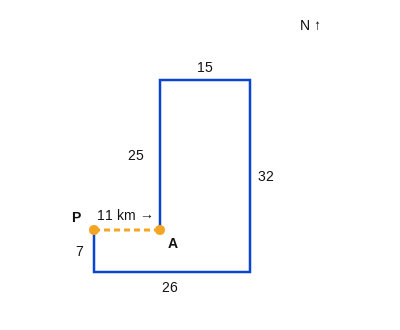
Pawan starts from Point A and drives 25 km towards North. He then takes a right turn, drives 15 km, turns right and drives 32 km. He then takes a right turn and drives 26 km. He takes a final right turn, drives 7 km and stops at Point P. How far (shortest distance) and towards which direction should he drive in order to reach Point A again? (All turns are 90 degrees turns only unless specified)
पवन बिंदु A से शुरू करके उत्तर की ओर 25 km गाड़ी चलाता है। फिर वह दाएँ मुड़ता है, 15 km चलता है, दाएँ मुड़ता है और 32 km चलता है। फिर वह दाएँ मुड़कर 26 km चलता है। वह अंतिम बार दाएँ मुड़ता है, 7 km चलता है और बिंदु P पर रुक जाता है। बिंदु A पर पुनः पहुँचने के लिए उसे कितनी दूर (न्यूनतम दूरी) और किस दिशा में गाड़ी चलानी चाहिए? (जब तक अन्यथा निर्दिष्ट न हो, सभी मोड़ केवल 90 डिग्री के मोड़ हैं)
  1. A10 km to the eastपूर्व की ओर 10 km
  2. B11 km to the westपश्चिम की ओर 11 km
  3. C11 km to the eastपूर्व की ओर 11 km
  4. D10 km to the westपश्चिम की ओर 10 km
Show answer

Concept: Take A as origin; North = +y, East = +x. Every right turn rotates clockwise: N → E → S → W → N.

  1. A(0,0) → 25 km North → (0,25) → right (East) 15 km → (15,25).
  2. Right (South) 32 km → (15,−7) → right (West) 26 km → (−11,−7) → right (North) 7 km → P(−11,0).
  3. P is 11 km west of A on the same horizontal line, so he must drive 11 km towards the East.

Trick: Net North–South: 25−32+7=0; net East–West: 15−26=−11 → 11 km west of A, so go East.

Answer: (C) 11 km to the east

अवधारणा: A को मूल बिंदु मानें; उत्तर = +y, पूर्व = +x। हर दायाँ मोड़ दक्षिणावर्त घूमता है: N → E → S → W → N।

  1. A(0,0) → 25 km उत्तर → (0,25) → दाएँ (पूर्व) 15 km → (15,25)।
  2. दाएँ (दक्षिण) 32 km → (15,−7) → दाएँ (पश्चिम) 26 km → (−11,−7) → दाएँ (उत्तर) 7 km → P(−11,0)।
  3. P, A से 11 km पश्चिम में उसी रेखा पर है, अतः A पहुँचने के लिए 11 km पूर्व की ओर चलना होगा।

ट्रिक: शुद्ध उत्तर–दक्षिण: 25−32+7=0; शुद्ध पूर्व–पश्चिम: 15−26=−11 → A से 11 km पश्चिम, इसलिए पूर्व चलें।

उत्तर: (C) 11 km to the east

RRB NTPC Graduate CBT 1General Intelligence and ReasoningDirection and DistanceRRB NTPC Graduate CBT 1 2025 · 17 Mar Shift 3 →