Question bank

Q&A: practice questions with answers

Search questions on any topic. Filter by exam category, exam, subject and topic, try the question, then open the answer and explanation.

Courses – airGurukul

20,719 questions found.

Q16521.
Read the given statements and conclusions carefully. Assuming that the information given in the statements is true, even if it appears to be at variance with commonly known facts, decide which of the given conclusion(s) logically follow(s) from the statements.
Statements:
All rabbits are yaks. All yaks are whales. No whale is a shark.
Conclusions:
(I) No rabbit is a shark.
(II) Some whales are rabbits.
दिए गए कथनों और निष्कर्षों को ध्यानपूर्वक पढ़िए। यह मानते हुए कि कथनों में दी गई जानकारी सत्य है, भले ही वह सामान्यतः ज्ञात तथ्यों से भिन्न प्रतीत होती हो, निर्णय लीजिए कि दिए गए निष्कर्षों में से कौन-सा/कौन-से कथनों का तार्किक रूप से अनुसरण करता है/करते हैं।
कथन:
सभी खरगोश याक हैं। सभी याक व्हेल हैं। कोई व्हेल शार्क नहीं है।
निष्कर्ष:
(I) कोई खरगोश शार्क नहीं है।
(II) कुछ व्हेल खरगोश हैं।
  1. AOnly conclusion (II) follows.केवल निष्कर्ष (II) अनुसरण करता है।
  2. BBoth conclusions (I) and (II) follow.निष्कर्ष (I) और (II) दोनों अनुसरण करते हैं।
  3. CNeither conclusion (I) nor (II) follows.न तो निष्कर्ष (I) और न ही (II) अनुसरण करता है।
  4. DOnly conclusion (I) follows.केवल निष्कर्ष (I) अनुसरण करता है।
Show answer

Concept: Chain the 'All' statements into nested sets; a 'No' statement makes the sets completely separate.
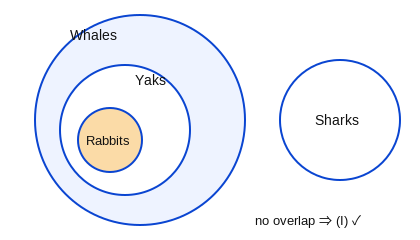
  1. All rabbits are yaks, all yaks are whales ⇒ rabbits sit inside whales. No whale is a shark ⇒ rabbits can't be sharks ⇒ (I) follows.
  2. Since every rabbit is a whale, at least those whales are rabbits ⇒ 'Some whales are rabbits' (II) follows (conversion of 'All A are B' to 'Some B are A').

Trick: 'All A are B' always gives 'Some B are A'; 'All A are B + No B is C' always gives 'No A is C'.

Answer: (B) Both conclusions (I) and (II) follow.

अवधारणा: 'All' कथनों को एक के अंदर एक समुच्चय बनाएँ; 'No' कथन समुच्चयों को पूरी तरह अलग कर देता है।

  1. सभी rabbits, yaks हैं; सभी yaks, whales हैं ⇒ rabbits, whales के अंदर। कोई whale, shark नहीं ⇒ rabbit, shark नहीं हो सकता ⇒ (I) निकलता है।
  2. हर rabbit एक whale है, अतः कम से कम वे whales, rabbits हैं ⇒ 'Some whales are rabbits' (II) भी निकलता है ('All A are B' का रूपांतरण 'Some B are A')।

ट्रिक: 'All A are B' से हमेशा 'Some B are A'; 'All A are B + No B is C' से हमेशा 'No A is C'।

उत्तर: (B) Both conclusions (I) and (II) follow.
RRB NTPC Graduate CBT 1General Intelligence and ReasoningSyllogismRRB NTPC Graduate CBT 1 2025 · 17 Mar Shift 3 →
Q16522.
Based on the English alphabetical order, three of the following four are alike in a certain way and thus form a group. Which is the one
that does not belong to that group?
(Note: The odd one out is not based on the number of consonants/vowels or their position in the letter cluster.)
अंग्रेज़ी वर्णमाला क्रम के आधार पर, निम्नलिखित चार में से तीन एक निश्चित प्रकार से समान हैं और इस प्रकार एक समूह बनाते हैं। वह कौन-सा है
जो उस समूह से संबंधित नहीं है?
(नोट: विषम अक्षर-समूह व्यंजनों/स्वरों की संख्या या अक्षर-समूह में उनकी स्थिति पर आधारित नहीं है।)
  1. AKFN
  2. BWUZ
  3. CMKP
  4. DECH
Show answer

Concept: Convert letters to positions and compare the gaps inside each cluster.

  1. WUZ: 23, 21, 26 ⇒ −2, +5. MKP: 13, 11, 16 ⇒ −2, +5. ECH: 5, 3, 8 ⇒ −2, +5.
  2. KFN: 11, 6, 14 ⇒ −5, +8 – different pattern, so KFN is the odd one.

Trick: Compute gaps for all four; three identical gap-pairs will show the rule, the fourth is the answer.

Answer: (A) KFN

अवधारणा: अक्षरों को स्थान-संख्या में बदलें और हर समूह के अंतर तुलना करें।

  1. WUZ: 23, 21, 26 ⇒ −2, +5। MKP: 13, 11, 16 ⇒ −2, +5। ECH: 5, 3, 8 ⇒ −2, +5।
  2. KFN: 11, 6, 14 ⇒ −5, +8 – अलग पैटर्न, अतः KFN विषम है।

ट्रिक: चारों के अंतर निकालें; तीन समान अंतर-युग्म नियम दिखा देंगे, चौथा उत्तर है।

उत्तर: (A) KFN

RRB NTPC Graduate CBT 1General Intelligence and ReasoningLetter classificationRRB NTPC Graduate CBT 1 2025 · 17 Mar Shift 3 →
Q16523.
Select the set in which the numbers are related in the same way as are the numbers of the following sets.
(NOTE: Operations should be performed on the whole numbers, without breaking down the numbers into its constituent digits. E.g. 13 – Operations on 13 such as
adding/subtracting/multiplying etc. to 13 can be performed. Breaking down 13 into 1 and 3 and then performing mathematical operations on 1 and 3 is not allowed.) (8, 128, 2)
(9, 243, 3)
उस समुच्चय का चयन कीजिए जिसमें संख्याएँ उसी प्रकार संबंधित हैं जिस प्रकार निम्नलिखित समुच्चयों की संख्याएँ संबंधित हैं।
(नोट: संक्रियाएँ पूर्ण संख्याओं पर की जानी चाहिए, संख्याओं को उनके घटक अंकों में तोड़े बिना। उदाहरण के लिए 13 – 13 पर संक्रियाएँ जैसे 13 में
जोड़ना/घटाना/गुणा करना आदि की जा सकती हैं। 13 को 1 और 3 में तोड़कर फिर 1 और 3 पर गणितीय संक्रियाएँ करने की अनुमति नहीं है।) (8, 128, 2)
(9, 243, 3)
  1. A(7, 343, 7)
  2. B(10, 500, 4)
  3. C(6, 216, 3)
  4. D(11, 331, 5)
Show answer

Concept: Find one rule linking the three numbers of each given set and test it on the options.

  1. (8, 128, 2): 82×2=64×2=128 ✓. (9, 243, 3): 92×3=81×3=243 ✓. Rule: 1st2×3rd=2nd.
  2. (7, 343, 7): 72×7=343 ✓.
  3. Others: 102×4=400≠500; 62×3=108≠216; 112×5=605≠331.

Trick: When the middle number is largest, try a2×c or a×c2 first.

Answer: (A) (7, 343, 7)

अवधारणा: हर दिए गए समुच्चय की तीनों संख्याओं को जोड़ने वाला एक नियम खोजें और विकल्पों पर जाँचें।

  1. (8, 128, 2): 82×2=64×2=128 ✓। (9, 243, 3): 92×3=81×3=243 ✓। नियम: पहली2×तीसरी=दूसरी।
  2. (7, 343, 7): 72×7=343 ✓।
  3. अन्य: 102×4=400≠500; 62×3=108≠216; 112×5=605≠331।

ट्रिक: जब बीच की संख्या सबसे बड़ी हो, पहले a2×c या a×c2 आज़माएँ।

उत्तर: (A) (7, 343, 7)

RRB NTPC Graduate CBT 1General Intelligence and ReasoningNumber set relationRRB NTPC Graduate CBT 1 2025 · 17 Mar Shift 3 →
Q16524.
Which of the given letter-number clusters will replace the question mark (?) in the following series to make it logically complete?
DRJ 50 WKC 45 PDV 40 IWO 35 ?
निम्नलिखित श्रेणी को तार्किक रूप से पूर्ण करने के लिए दिए गए अक्षर-संख्या समूहों में से कौन-सा प्रश्नचिह्न (?) के स्थान पर आएगा?
DRJ 50 WKC 45 PDV 40 IWO 35 ?
  1. ALEF 30
  2. BCJE 35
  3. CBPH 30
  4. DAJD 32
Show answer

Concept: Check each letter position for a constant shift (wrapping from A back to Z) and the numbers separately.

  1. 1st letters D(4), W(23), P(16), I(9): −7 each ⇒ I−7 = B(2).
  2. 2nd letters R(18), K(11), D(4), W(23): −7 ⇒ W−7 = P(16).
  3. 3rd letters J(10), C(3), V(22), O(15): −7 ⇒ O−7 = H(8).
  4. Numbers 50, 45, 40, 35: −5 ⇒ 30. Answer BPH 30.

Trick: Numbers give 30 instantly – only options A and C remain; then check just the first letter (I−7 = B).

Answer: (C) BPH 30

अवधारणा: हर अक्षर-स्थिति में स्थिर शिफ्ट (A से पीछे Z पर घूमते हुए) और संख्याएँ अलग से जाँचें।

  1. पहले अक्षर D(4), W(23), P(16), I(9): हर बार −7 ⇒ I−7 = B(2)।
  2. दूसरे अक्षर R(18), K(11), D(4), W(23): −7 ⇒ W−7 = P(16)।
  3. तीसरे अक्षर J(10), C(3), V(22), O(15): −7 ⇒ O−7 = H(8)।
  4. संख्याएँ 50, 45, 40, 35: −5 ⇒ 30। उत्तर BPH 30।

ट्रिक: संख्याओं से तुरंत 30 – केवल A और C बचते हैं; फिर सिर्फ पहला अक्षर जाँचें (I−7 = B)।

उत्तर: (C) BPH 30

RRB NTPC Graduate CBT 1General Intelligence and ReasoningLetter-number seriesRRB NTPC Graduate CBT 1 2025 · 17 Mar Shift 3 →
Q16525.
In a certain code language,
X + Y means ‘X is the husband of Y’,
X – Y means ‘X is the mother of Y’,
X × Y means ‘X is the brother of Y’ and
X ÷ Y means ‘X is the father of Y’.
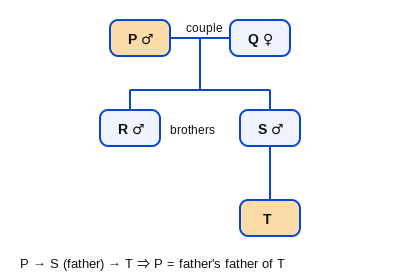
Based on the above information, how is P related to T if ‘P + Q – R × S ÷ T’?
एक निश्चित कूट भाषा में,
X + Y का अर्थ है ‘X, Y का पति है’,
X – Y का अर्थ है ‘X, Y की माता है’,
X × Y का अर्थ है ‘X, Y का भाई है’ और
X ÷ Y का अर्थ है ‘X, Y का पिता है’।
उपर्युक्त जानकारी के आधार पर, यदि ‘P + Q – R × S ÷ T’ है, तो P, T से किस प्रकार संबंधित है?
  1. AFather's brotherपिता का भाई
  2. BFather's fatherपिता का पिता
  3. CMother's brotherमाता का भाई
  4. DMother's fatherमाता का पिता
Show answer

Concept: Decode the symbols one by one and build the family tree.

  1. P + Q: P is husband of Q. Q – R: Q is mother of R ⇒ P is father of R.
  2. R × S: R is brother of S ⇒ S is also P's child (P is father of S).
  3. S ÷ T: S is father of T.
  4. So P is the father of T's father ⇒ father's father (paternal grandfather).

Trick: Husband of the mother = father; father of the father = father's father.

Answer: (B) Father's father

अवधारणा: प्रतीकों को एक-एक करके डिकोड करें और वंश-वृक्ष बनाएँ।

  1. P + Q: P, Q का पति। Q – R: Q, R की माता ⇒ P, R का पिता।
  2. R × S: R, S का भाई ⇒ S भी P की संतान (P, S का पिता)।
  3. S ÷ T: S, T का पिता।
  4. अतः P, T के पिता का पिता ⇒ Father's father (दादा)।

ट्रिक: माता का पति = पिता; पिता का पिता = दादा।

उत्तर: (B) Father's father

RRB NTPC Graduate CBT 1General Intelligence and ReasoningBlood relations – codedRRB NTPC Graduate CBT 1 2025 · 17 Mar Shift 3 →
Q16526.
Wheat is mainly a crop of which season in India?
भारत में गेहूँ मुख्य रूप से किस ऋतु की फसल है?
  1. AZaidज़ायद
  2. BKharifखरीफ
  3. CRabiरबी
  4. DPre-monsoonमानसून-पूर्व
Show answer

Concept: India has three cropping seasons – Kharif (monsoon), Rabi (winter) and Zaid (summer).

  1. Wheat is sown in October–December and harvested in March–April, so it is the chief Rabi crop.
  2. Rice, maize, cotton and jute are Kharif crops; watermelon and cucumber are Zaid crops.
  3. Punjab, Haryana, UP and MP are the main wheat producers.

Yaad rakhein: Rabi = winter sowing (wheat, gram, mustard, barley); Kharif = rain sowing (rice, cotton, jute).

Answer: (C) Rabi

अवधारणा: भारत में तीन फसल ऋतुएँ हैं – खरीफ (मानसून), रबी (शीत) और ज़ायद (ग्रीष्म)।

  1. गेहूँ अक्टूबर–दिसंबर में बोया और मार्च–अप्रैल में काटा जाता है, इसलिए यह प्रमुख रबी फसल है।
  2. चावल, मक्का, कपास, जूट खरीफ फसलें हैं; तरबूज, खीरा ज़ायद फसलें हैं।
  3. पंजाब, हरियाणा, UP और MP मुख्य गेहूँ उत्पादक हैं।

याद रखें: रबी = सर्दी की बुवाई (गेहूँ, चना, सरसों, जौ); खरीफ = बारिश की बुवाई (चावल, कपास, जूट)।

उत्तर: (C) रबी

RRB NTPC Graduate CBT 1General AwarenessIndian Agriculture – Cropping SeasonsRRB NTPC Graduate CBT 1 2025 · 17 Mar Shift 2 →
Q16527.
Raising an object from the ground results in the storage of which type of energy?
किसी वस्तु को ज़मीन से ऊपर उठाने पर किस प्रकार की ऊर्जा संचित होती है?
  1. AElectrical energyविद्युत ऊर्जा
  2. BHeat energyऊष्मा ऊर्जा
  3. CPotential energyस्थितिज ऊर्जा
  4. DKinetic energyगतिज ऊर्जा
Show answer

Concept: Energy stored in a body because of its position or height is gravitational potential energy, PE=mgh.

  1. Lifting an object does work against gravity; this work is stored as potential energy.
  2. Kinetic energy (12mv2) belongs to a moving body, not a raised body at rest.

Yaad rakhein: Height → Potential; Motion → Kinetic.

Answer: (C) Potential energy

अवधारणा: स्थिति या ऊँचाई के कारण वस्तु में संचित ऊर्जा गुरुत्वीय स्थितिज ऊर्जा (potential energy) है, PE=mgh।

  1. वस्तु उठाने में गुरुत्व के विरुद्ध कार्य होता है; यही कार्य स्थितिज ऊर्जा के रूप में संचित रहता है।
  2. गतिज ऊर्जा (12mv2) गतिशील वस्तु की होती है, स्थिर उठी हुई वस्तु की नहीं।

याद रखें: ऊँचाई → स्थितिज; गति → गतिज।

उत्तर: (C) स्थितिज ऊर्जा

RRB NTPC Graduate CBT 1General AwarenessPhysics – Forms of EnergyRRB NTPC Graduate CBT 1 2025 · 17 Mar Shift 2 →
Q16528.
Which cell organelle is responsible for maintaining cell shape and providing structural support?
कौन-सा कोशिकांग कोशिका के आकार को बनाए रखने और संरचनात्मक सहारा देने के लिए उत्तरदायी है?
  1. APeroxisomeपरॉक्सिसोम (Peroxisome)
  2. BCytoskeletonकोशिका कंकाल (Cytoskeleton)
  3. CNucleusकेंद्रक (Nucleus)
  4. DGolgi apparatusगॉल्जी उपकरण (Golgi apparatus)
Show answer

Concept: The cytoskeleton is a network of protein filaments (microtubules, microfilaments, intermediate filaments) in the cytoplasm.

  1. It maintains cell shape, gives mechanical support and helps in cell movement and transport of organelles.
  2. Nucleus controls the cell, Golgi packages proteins, peroxisomes break down fatty acids and H2O2.

Yaad rakhein: Cyto-skeleton = "skeleton of the cell" → shape and support.

Answer: (B) Cytoskeleton

अवधारणा: साइटोस्केलेटन (cytoskeleton) कोशिकाद्रव्य में प्रोटीन तंतुओं (microtubules, microfilaments, intermediate filaments) का जाल है।

  1. यह कोशिका का आकार बनाए रखता है, यांत्रिक सहारा देता है और कोशिका की गति व कोशिकांगों के परिवहन में मदद करता है।
  2. केंद्रक कोशिका को नियंत्रित करता है, Golgi प्रोटीन पैक करता है, peroxisome वसा अम्ल व H2O2 तोड़ता है।

याद रखें: साइटो-स्केलेटन = "कोशिका का कंकाल" → आकार और सहारा।

उत्तर: (B) साइटोस्केलेटन

RRB NTPC Graduate CBT 1General AwarenessBiology – Cell OrganellesRRB NTPC Graduate CBT 1 2025 · 17 Mar Shift 2 →
Q16529.
In which of the following Articles of the Constitution of India is it stated that Union Territories are to be administered by the President, who may appoint an administrator to oversee them?
भारत के संविधान के निम्नलिखित में से किस अनुच्छेद में कहा गया है कि केंद्र शासित प्रदेशों का प्रशासन राष्ट्रपति द्वारा किया जाएगा, जो उनकी देखरेख के लिए एक प्रशासक की नियुक्ति कर सकते हैं?
  1. AArticle 241अनुच्छेद 241
  2. BArticle 239अनुच्छेद 239
  3. CArticle 242अनुच्छेद 242
  4. DArticle 240अनुच्छेद 240
Show answer

Concept: Part VIII (Articles 239–242) of the Constitution deals with Union Territories.

  1. Article 239: every UT is administered by the President through an Administrator appointed by him.
  2. Article 239A – legislature for Puducherry; 239AA – Delhi; 240 – President's power to make regulations; 241 – High Courts for UTs.

Yaad rakhein: UT chapter starts at 239 → "239 = President's administrator".

Answer: (B) Article 239

अवधारणा: संविधान का भाग VIII (अनुच्छेद 239–242) केंद्र शासित प्रदेशों से संबंधित है।

  1. अनुच्छेद 239: हर UT का प्रशासन राष्ट्रपति द्वारा नियुक्त प्रशासक (Administrator) के माध्यम से होता है।
  2. 239A – पुडुचेरी की विधायिका; 239AA – दिल्ली; 240 – राष्ट्रपति की विनियम बनाने की शक्ति; 241 – UT के लिए उच्च न्यायालय।

याद रखें: UT अध्याय 239 से शुरू → "239 = राष्ट्रपति का प्रशासक"।

उत्तर: (B) अनुच्छेद 239

RRB NTPC Graduate CBT 1General AwarenessPolity – Union TerritoriesRRB NTPC Graduate CBT 1 2025 · 17 Mar Shift 2 →
Q16530.
Which of the following is NOT correctly matched with respect to the Directive Principles of State Policy?
राज्य के नीति निदेशक तत्वों के संबंध में निम्नलिखित में से कौन-सा सही सुमेलित नहीं है?
  1. AArticle 40 - Organisation of village panchayatsअनुच्छेद 40 - ग्राम पंचायतों का संगठन
  2. BArticle 39A - Equal justice and free legal aidअनुच्छेद 39A - समान न्याय और निःशुल्क विधिक सहायता
  3. CArticle 43A - Participation of workers in management of industriesअनुच्छेद 43A - उद्योगों के प्रबंधन में कर्मकारों की भागीदारी
  4. DArticle 41 - Provision for just and humane conditions of work and maternity reliefअनुच्छेद 41 - काम की न्यायसंगत और मानवोचित दशाओं तथा प्रसूति सहायता का प्रावधान
Show answer

Concept: DPSPs are in Part IV, Articles 36–51.

  1. Article 41 – right to work, education and public assistance in old age, sickness and unemployment.
  2. Just and humane conditions of work and maternity relief are under Article 42 – so option D is wrongly matched.
  3. Art 40 – village panchayats, 39A – free legal aid, 43A – workers' participation in management are all correct.

Yaad rakhein: 41 = work & assistance, 42 = maternity relief, 43 = living wage, 44 = Uniform Civil Code.

Answer: (D) Article 41 – Provision for just and humane conditions of work and maternity relief

अवधारणा: नीति निदेशक तत्व भाग IV, अनुच्छेद 36–51 में हैं।

  1. अनुच्छेद 41 – काम, शिक्षा और वृद्धावस्था, बीमारी, बेरोज़गारी में सार्वजनिक सहायता का अधिकार।
  2. काम की न्यायसंगत व मानवीय दशाएँ और प्रसूति सहायता अनुच्छेद 42 में हैं – इसलिए विकल्प D गलत सुमेलित है।
  3. अनु. 40 – ग्राम पंचायत, 39A – निःशुल्क विधिक सहायता, 43A – प्रबंधन में श्रमिकों की भागीदारी – सभी सही हैं।

याद रखें: 41 = काम व सहायता, 42 = प्रसूति सहायता, 43 = निर्वाह मज़दूरी, 44 = समान नागरिक संहिता।

उत्तर: (D) अनुच्छेद 41 – काम की न्यायसंगत व मानवीय दशाएँ और प्रसूति सहायता

RRB NTPC Graduate CBT 1General AwarenessPolity – Directive PrinciplesRRB NTPC Graduate CBT 1 2025 · 17 Mar Shift 2 →
Q16531.
Article 25 of the Indian Constitution primarily guarantees which of the following rights?
भारतीय संविधान का अनुच्छेद 25 मुख्य रूप से निम्नलिखित में से किस अधिकार की गारंटी देता है?
  1. ARight to equality before lawविधि के समक्ष समता का अधिकार
  2. BCultural and educational rightsसांस्कृतिक और शैक्षिक अधिकार
  3. CFreedom of religionधर्म की स्वतंत्रता
  4. DRight to constitutional remediesसंवैधानिक उपचारों का अधिकार
Show answer

Concept: Articles 25–28 constitute the Right to Freedom of Religion.

  1. Article 25 – freedom of conscience and free profession, practice and propagation of religion.
  2. Equality before law is Article 14, cultural & educational rights are Articles 29–30, constitutional remedies is Article 32.

Yaad rakhein: 14–18 Equality, 19–22 Freedom, 23–24 Against exploitation, 25–28 Religion, 29–30 Culture, 32 Remedies.

Answer: (C) Freedom of religion

अवधारणा: अनुच्छेद 25–28 धार्मिक स्वतंत्रता का अधिकार बनाते हैं।

  1. अनुच्छेद 25 – अंतःकरण की स्वतंत्रता तथा धर्म को मानने, आचरण करने और प्रचार करने की स्वतंत्रता।
  2. विधि के समक्ष समता अनु. 14, सांस्कृतिक व शैक्षिक अधिकार अनु. 29–30, संवैधानिक उपचार अनु. 32 है।

याद रखें: 14–18 समता, 19–22 स्वतंत्रता, 23–24 शोषण के विरुद्ध, 25–28 धर्म, 29–30 संस्कृति, 32 उपचार।

उत्तर: (C) धार्मिक स्वतंत्रता

RRB NTPC Graduate CBT 1General AwarenessPolity – Fundamental RightsRRB NTPC Graduate CBT 1 2025 · 17 Mar Shift 2 →
Q16532.
Which of the following individuals was awarded the Nobel Peace Prize 2025 for persistent efforts in promoting democratic rights in Venezuela and striving for a just and peaceful transition from dictatorship to democracy?
निम्नलिखित में से किस व्यक्ति को वेनेज़ुएला में लोकतांत्रिक अधिकारों को बढ़ावा देने के निरंतर प्रयासों और तानाशाही से लोकतंत्र की ओर न्यायपूर्ण तथा शांतिपूर्ण परिवर्तन के लिए संघर्ष करने हेतु 2025 का नोबेल शांति पुरस्कार प्रदान किया गया?
  1. ADelcy Rodríguez
  2. BMaria Corina Machado
  3. CJuan Guaidó
  4. DMary E. Brunkow
Show answer

Concept: The Nobel Peace Prize 2025 was awarded to María Corina Machado, Venezuelan opposition leader.

  1. The Norwegian Nobel Committee cited her tireless work promoting democratic rights for the people of Venezuela and her struggle for a peaceful transition from dictatorship to democracy.
  2. Mary E. Brunkow shared the 2025 Nobel Prize in Physiology or Medicine (regulatory T cells); Delcy Rodríguez is a Venezuelan government leader.

Yaad rakhein: Peace 2025 → Machado (Venezuela); Peace 2024 → Nihon Hidankyo (Japan).

Answer: (B) Maria Corina Machado

अवधारणा: नोबेल शांति पुरस्कार 2025 वेनेज़ुएला की विपक्षी नेता मारिया कोरिना मचाडो को मिला।

  1. नॉर्वेजियन नोबेल समिति ने वेनेज़ुएला के लोगों के लोकतांत्रिक अधिकारों के लिए उनके अथक प्रयासों और तानाशाही से लोकतंत्र में शांतिपूर्ण परिवर्तन के संघर्ष का उल्लेख किया।
  2. Mary E. Brunkow को 2025 का चिकित्सा नोबेल (regulatory T cells) मिला; Delcy Rodríguez वेनेज़ुएला सरकार की नेता हैं।

याद रखें: शांति 2025 → मचाडो (वेनेज़ुएला); शांति 2024 → निहोन हिदान्क्यो (जापान)।

उत्तर: (B) मारिया कोरिना मचाडो

RRB NTPC Graduate CBT 1General AwarenessCurrent Affairs – Nobel Prize 2025RRB NTPC Graduate CBT 1 2025 · 17 Mar Shift 2 →
Q16533.
Which of the following industrial financing institutions in India was formed in 1990?
भारत में निम्नलिखित में से कौन-सी औद्योगिक वित्तीय संस्था 1990 में स्थापित की गई थी?
  1. ASmall Industries Development Bank of India (SIDBI)भारतीय लघु उद्योग विकास बैंक (SIDBI)
  2. BIndustrial Finance Corporation of India (IFCI)भारतीय औद्योगिक वित्त निगम (IFCI)
  3. CIndustrial Development Bank of India (IDBI)भारतीय औद्योगिक विकास बैंक (IDBI)
  4. DIndustrial Credit and Investment Corporation of India (ICICI)भारतीय औद्योगिक ऋण और निवेश निगम (ICICI)
Show answer

Concept: SIDBI was set up on 2 April 1990 under an Act of Parliament as the principal institution for MSME financing; headquarters Lucknow.

  1. IFCI – 1948 (first development financial institution), ICICI – 1955, IDBI – 1964.
  2. SIDBI began as a subsidiary of IDBI and was delinked in 1998.

Yaad rakhein: Order of birth: IFCI (48) → ICICI (55) → IDBI (64) → NABARD (82) → SIDBI (90).

Answer: (A) Small Industries Development Bank of India (SIDBI)

अवधारणा: SIDBI की स्थापना 2 अप्रैल 1990 को संसद के अधिनियम से MSME वित्तपोषण की प्रमुख संस्था के रूप में हुई; मुख्यालय लखनऊ।

  1. IFCI – 1948 (पहला विकास वित्तीय संस्थान), ICICI – 1955, IDBI – 1964।
  2. SIDBI पहले IDBI की सहायक थी, 1998 में अलग हुई।

याद रखें: स्थापना क्रम: IFCI (48) → ICICI (55) → IDBI (64) → NABARD (82) → SIDBI (90)।

उत्तर: (A) भारतीय लघु उद्योग विकास बैंक (SIDBI)

RRB NTPC Graduate CBT 1General AwarenessEconomy – Financial InstitutionsRRB NTPC Graduate CBT 1 2025 · 17 Mar Shift 2 →
Q16534.
Which states suffered 30-70% below-normal rainfall in August 2025, contributing to crop stress and water shortages?
अगस्त 2025 में किन राज्यों में सामान्य से 30-70% कम वर्षा हुई, जिससे फसलों पर दबाव और जल की कमी की स्थिति बनी?
  1. ARajasthan, Haryana, Sikkim, Assam, Manipur, and Tripuraराजस्थान, हरियाणा, सिक्किम, असम, मणिपुर और त्रिपुरा
  2. BOdisha, Madhya Pradesh, Chhattisgarh, Telangana, and Andhra Pradeshओडिशा, मध्य प्रदेश, छत्तीसगढ़, तेलंगाना और आंध्र प्रदेश
  3. CLadakh, Arunachal Pradesh, Bihar, UP, Punjab, and the Northeastलद्दाख, अरुणाचल प्रदेश, बिहार, उत्तर प्रदेश, पंजाब और पूर्वोत्तर
  4. DKerala, Tamil Nadu, Karnataka, Maharashtra, Goa, and Gujaratकेरल, तमिलनाडु, कर्नाटक, महाराष्ट्र, गोवा और गुजरात
Show answer

Concept: Monsoon 2025 was uneven: north-west India received excess rain (floods in Punjab, Himachal, J&K) while parts of the east, north-east and Ladakh stayed deficient.

  1. In August 2025 IMD data showed 30–70% below-normal rainfall over Ladakh, Arunachal Pradesh, Bihar, eastern Uttar Pradesh, parts of Punjab and several north-eastern states, hurting paddy and causing water stress.
  2. Rajasthan, Haryana, Gujarat, Maharashtra and the peninsular states (options A, B, D) recorded normal to excess rain in that month.

Yaad rakhein: Monsoon 2025 pattern – west and north-west wet, east and north-east dry.

Answer: (C) Ladakh, Arunachal Pradesh, Bihar, UP, Punjab, and the Northeast

अवधारणा: मानसून 2025 असमान रहा: उत्तर-पश्चिम भारत में अधिक वर्षा (पंजाब, हिमाचल, J&K में बाढ़) जबकि पूर्व, पूर्वोत्तर और लद्दाख के हिस्से कमी में रहे।

  1. अगस्त 2025 के IMD आँकड़ों में लद्दाख, अरुणाचल प्रदेश, बिहार, पूर्वी उत्तर प्रदेश, पंजाब के हिस्सों और कई पूर्वोत्तर राज्यों में 30–70% कम वर्षा दर्ज हुई, जिससे धान को नुकसान और जल संकट हुआ।
  2. राजस्थान, हरियाणा, गुजरात, महाराष्ट्र और प्रायद्वीपीय राज्यों (विकल्प A, B, D) में उस महीने सामान्य से अधिक वर्षा हुई।

याद रखें: मानसून 2025 का पैटर्न – पश्चिम व उत्तर-पश्चिम गीला, पूर्व व पूर्वोत्तर सूखा।

उत्तर: (C) लद्दाख, अरुणाचल प्रदेश, बिहार, UP, पंजाब और पूर्वोत्तर

RRB NTPC Graduate CBT 1General AwarenessCurrent Affairs – Monsoon 2025RRB NTPC Graduate CBT 1 2025 · 17 Mar Shift 2 →
Q16535.
The concept of sustainable development became popular after which report (1987)?
सतत विकास (sustainable development) की अवधारणा किस रिपोर्ट (1987) के बाद लोकप्रिय हुई?
  1. ARio Reportरियो रिपोर्ट
  2. BEarth Reportअर्थ रिपोर्ट
  3. CBrundtland Reportब्रंटलैंड रिपोर्ट
  4. DKyoto Reportक्योटो रिपोर्ट
Show answer

Concept: The 1987 report 'Our Common Future' of the World Commission on Environment and Development, chaired by Gro Harlem Brundtland, popularised 'sustainable development'.

  1. It defined sustainable development as meeting present needs without compromising the ability of future generations to meet their own needs.
  2. Rio (1992) was the Earth Summit and Kyoto (1997) a climate protocol – both came later.

Yaad rakhein: 1987 Brundtland → 1992 Rio Earth Summit → 1997 Kyoto → 2015 Paris.

Answer: (C) Brundtland Report

अवधारणा: ग्रो हार्लेम ब्रंटलैंड की अध्यक्षता वाले विश्व पर्यावरण एवं विकास आयोग की 1987 की रिपोर्ट 'Our Common Future' ने 'सतत विकास' को लोकप्रिय बनाया।

  1. इसने सतत विकास को ऐसा विकास बताया जो भावी पीढ़ियों की ज़रूरतें पूरी करने की क्षमता से समझौता किए बिना वर्तमान ज़रूरतें पूरी करे।
  2. रियो (1992) पृथ्वी सम्मेलन और क्योटो (1997) जलवायु प्रोटोकॉल था – दोनों बाद में आए।

याद रखें: 1987 ब्रंटलैंड → 1992 रियो → 1997 क्योटो → 2015 पेरिस।

उत्तर: (C) ब्रंटलैंड रिपोर्ट

RRB NTPC Graduate CBT 1General AwarenessEnvironment – Sustainable DevelopmentRRB NTPC Graduate CBT 1 2025 · 17 Mar Shift 2 →
Q16536.
Why was the Ghadar Party’s revolutionary attempt during World War I largely
unsuccessful?
प्रथम विश्व युद्ध के दौरान ग़दर पार्टी का क्रांतिकारी प्रयास मुख्यतः क्यों
असफल रहा?
  1. ALack of support from international alliesअंतरराष्ट्रीय सहयोगियों से समर्थन की कमी
  2. BStrong opposition from the Indian National Congressभारतीय राष्ट्रीय कांग्रेस का कड़ा विरोध
  3. CPublic apathy towards armed revolutionसशस्त्र क्रांति के प्रति जनता की उदासीनता
  4. DInterception by British intelligence and internal betrayalब्रिटिश खुफिया तंत्र द्वारा पकड़े जाना और आंतरिक विश्वासघात
Show answer

Concept: The Ghadar Party (1913, San Francisco) planned an armed uprising in India in February 1915 during World War I.

  1. Thousands of Ghadarites returned to Punjab expecting the people and Indian soldiers to rise, but the masses and most peasants stayed indifferent to the call for armed revolution; no popular base existed.
  2. The plan was also leaked by informer Kirpal Singh and crushed by the British – but the deeper cause was lack of mass support and preparation.
  3. The Congress was not an active opponent, so option B is wrong.

Yaad rakhein: Ghadar = Lala Har Dayal, Sohan Singh Bhakna; uprising fixed for 21 Feb 1915; Rash Behari Bose led in Punjab.

Answer: (C) Public apathy towards armed revolution

अवधारणा: ग़दर पार्टी (1913, सैन फ्रांसिस्को) ने प्रथम विश्व युद्ध के दौरान फरवरी 1915 में भारत में सशस्त्र विद्रोह की योजना बनाई।

  1. हज़ारों ग़दरी पंजाब लौटे, आशा थी कि जनता और भारतीय सैनिक उठ खड़े होंगे, पर आम जनता और अधिकांश किसान सशस्त्र क्रांति के आह्वान के प्रति उदासीन रहे; कोई जनाधार नहीं था।
  2. मुखबिर कृपाल सिंह ने योजना लीक भी की और अंग्रेज़ों ने इसे कुचल दिया – पर गहरा कारण जन-समर्थन और तैयारी की कमी थी।
  3. कांग्रेस सक्रिय विरोधी नहीं थी, अतः विकल्प B गलत है।

याद रखें: ग़दर = लाला हरदयाल, सोहन सिंह भकना; विद्रोह की तिथि 21 फरवरी 1915; पंजाब में नेतृत्व रासबिहारी बोस।

उत्तर: (C) सशस्त्र क्रांति के प्रति जनता की उदासीनता

RRB NTPC Graduate CBT 1General AwarenessModern History – Ghadar MovementRRB NTPC Graduate CBT 1 2025 · 17 Mar Shift 2 →
Q16537.
On 27 August 2025, which index reported that global consumer confidence remained unchanged for the second consecutive month, remaining stable at -0.1 points?
27 अगस्त 2025 को किस सूचकांक ने बताया कि वैश्विक उपभोक्ता विश्वास लगातार दूसरे महीने अपरिवर्तित रहा और -0.1 अंक पर स्थिर रहा?
  1. AUNDP Human Development Index ScoreUNDP मानव विकास सूचकांक स्कोर
  2. BJ.P.Morgan Global PMI Composite IndexJ.P.Morgan ग्लोबल PMI कंपोज़िट इंडेक्स
  3. CIpsos Global Consumer Confidence IndexIpsos ग्लोबल कंज़्यूमर कॉन्फिडेंस इंडेक्स
  4. DWorld Bank Global Findex Databaseविश्व बैंक ग्लोबल फिनडेक्स डेटाबेस
Show answer

Concept: The Ipsos Global Consumer Confidence Index tracks consumer sentiment across about 30 countries every month.

  1. Its August 2025 release (27 August) reported the global index flat for a second straight month, with a monthly change of −0.1 points.
  2. J.P. Morgan's index is a PMI (business activity), UNDP's HDI is annual, and the World Bank Findex measures financial inclusion – none is a monthly consumer-confidence measure.

Yaad rakhein: Consumer confidence → Ipsos; business activity → PMI; development → HDI.

Answer: (C) Ipsos Global Consumer Confidence Index

अवधारणा: Ipsos Global Consumer Confidence Index लगभग 30 देशों में हर महीने उपभोक्ता भावना मापता है।

  1. इसके अगस्त 2025 (27 अगस्त) अंक में वैश्विक सूचकांक लगातार दूसरे महीने स्थिर रहा, मासिक बदलाव −0.1 अंक।
  2. J.P. Morgan का सूचकांक PMI (व्यावसायिक गतिविधि) है, UNDP का HDI वार्षिक है और World Bank Findex वित्तीय समावेशन मापता है – कोई भी मासिक उपभोक्ता-विश्वास माप नहीं।

याद रखें: उपभोक्ता विश्वास → Ipsos; व्यावसायिक गतिविधि → PMI; विकास → HDI।

उत्तर: (C) Ipsos Global Consumer Confidence Index

RRB NTPC Graduate CBT 1General AwarenessCurrent Affairs – Economic IndicesRRB NTPC Graduate CBT 1 2025 · 17 Mar Shift 2 →
Q16538.
What is the principal destructive force of tropical cyclones on coastlines?
तटीय क्षेत्रों पर उष्णकटिबंधीय चक्रवातों की प्रमुख विनाशकारी शक्ति क्या है?
  1. AContinuous rainfallनिरंतर वर्षा
  2. BHigh temperatureउच्च तापमान
  3. CStorm surgeतूफ़ानी महोर्मि (storm surge)
  4. DLow atmospheric pressureनिम्न वायुमंडलीय दाब
Show answer

Concept: A storm surge is the abnormal rise of sea level pushed onshore by cyclone winds and low pressure.

  1. It floods low-lying coasts with sea water, causing most cyclone deaths and damage (e.g. 1999 Odisha super cyclone).
  2. Rainfall and low pressure matter, but the surge is the main destructive force on coastlines.

Yaad rakhein: Cyclone's triple threat = wind, rain, surge; the surge is the killer at the coast.

Answer: (C) Storm surge

अवधारणा: तूफ़ानी महोर्मि (storm surge) चक्रवाती हवाओं और निम्न दाब से समुद्र-स्तर का असामान्य उभार है जो तट पर चढ़ आता है।

  1. यह निचले तटों को समुद्री जल से डुबो देता है और चक्रवात से सबसे अधिक मौतें व क्षति इसी से होती हैं (जैसे 1999 ओडिशा सुपर साइक्लोन)।
  2. वर्षा और निम्न दाब भी असर करते हैं, पर तट पर मुख्य विनाशकारी बल महोर्मि है।

याद रखें: चक्रवात का तिहरा खतरा = हवा, वर्षा, महोर्मि; तट पर जानलेवा महोर्मि है।

उत्तर: (C) तूफ़ानी महोर्मि (Storm surge)

RRB NTPC Graduate CBT 1General AwarenessGeography – Tropical CyclonesRRB NTPC Graduate CBT 1 2025 · 17 Mar Shift 2 →
Q16539.
Why do large cities tend to have a higher proportion of tertiary activities in India?
भारत में बड़े शहरों में तृतीयक क्रियाओं का अनुपात अधिक होने की प्रवृत्ति क्यों होती है?
  1. ADue to lack of primary resourcesप्राथमिक संसाधनों की कमी के कारण
  2. BBecause of fertile landउर्वर भूमि के कारण
  3. CDue to agglomeration and services demandसमूहन (agglomeration) और सेवाओं की मांग के कारण
  4. DBecause of mining operationsखनन कार्यों के कारण
Show answer

Concept: Tertiary activities are services – trade, transport, banking, education, health, IT.

  1. Large cities concentrate people, industries and offices (agglomeration), which creates heavy demand for services and skilled workers.
  2. Fertile land and mining relate to primary activities, not to cities' service dominance.

Yaad rakhein: Primary = nature, Secondary = manufacturing, Tertiary = services (cities), Quaternary = knowledge.

Answer: (C) Due to agglomeration and services demand

अवधारणा: तृतीयक गतिविधियाँ सेवाएँ हैं – व्यापार, परिवहन, बैंकिंग, शिक्षा, स्वास्थ्य, IT।

  1. बड़े शहरों में लोग, उद्योग और कार्यालय संकेंद्रित (agglomeration) होते हैं, जिससे सेवाओं और कुशल श्रमिकों की भारी माँग बनती है।
  2. उपजाऊ भूमि और खनन प्राथमिक गतिविधियों से जुड़े हैं, शहरों की सेवा-प्रधानता से नहीं।

याद रखें: प्राथमिक = प्रकृति, द्वितीयक = विनिर्माण, तृतीयक = सेवाएँ (शहर), चतुर्थक = ज्ञान।

उत्तर: (C) संकुलन (agglomeration) और सेवाओं की माँग के कारण

RRB NTPC Graduate CBT 1General AwarenessGeography – Economic ActivitiesRRB NTPC Graduate CBT 1 2025 · 17 Mar Shift 2 →
Q16540.
Which of the following statements with respect to operation twist is/are correct? 1. Operation Twist is a monetary policy of the central banks used to bring down interest rates and control investments in a country.
2. Under this operation, the RBI twisted the yield of government securities to bring liquidity into the markets.
3. This is done by simultaneously buying and selling government securities—both short-term and long-term—through Open Market Operations (OMOs).
Select the correct answer using the codes given below.
ऑपरेशन ट्विस्ट के संबंध में निम्नलिखित में से कौन-सा/से कथन सही है/हैं? 1. ऑपरेशन ट्विस्ट केंद्रीय बैंकों की एक मौद्रिक नीति है जिसका उपयोग किसी देश में ब्याज दरों को कम करने और निवेश को नियंत्रित करने के लिए किया जाता है।
2. इस ऑपरेशन के अंतर्गत RBI ने बाज़ारों में तरलता लाने के लिए सरकारी प्रतिभूतियों के प्रतिफल (yield) को ट्विस्ट किया।
3. यह खुले बाज़ार परिचालनों (OMOs) के माध्यम से सरकारी प्रतिभूतियों—अल्पकालिक और दीर्घकालिक दोनों—को एक साथ खरीदकर और बेचकर किया जाता है।
नीचे दिए गए कूटों का उपयोग करके सही उत्तर चुनिए।
  1. A1, 2 and 31, 2 और 3
  2. B2 and 3 onlyकेवल 2 और 3
  3. C1 and 2 onlyकेवल 1 और 2
  4. D1 and 3 onlyकेवल 1 और 3
Show answer

Concept: Operation Twist is an open-market tool in which the central bank buys long-term and sells short-term government securities simultaneously.

  1. Buying long-term bonds raises their price and lowers long-term yields, cutting borrowing costs for investment – statement 1 is correct.
  2. RBI used it in December 2019 and 2020 to 'twist' the yield curve and ease liquidity – statements 2 and 3 are correct.

Yaad rakhein: Twist = buy long, sell short → flatten the yield curve (first used by US Fed, 1961).

Answer: (A) 1, 2 and 3

अवधारणा: ऑपरेशन ट्विस्ट खुले बाज़ार का उपकरण है जिसमें केंद्रीय बैंक एक साथ दीर्घकालिक सरकारी प्रतिभूतियाँ खरीदता और अल्पकालिक बेचता है।

  1. दीर्घकालिक बॉन्ड खरीदने से उनका मूल्य बढ़ता और दीर्घकालिक प्रतिफल (yield) घटता है, जिससे निवेश के लिए उधार सस्ता होता है – कथन 1 सही।
  2. RBI ने दिसंबर 2019 और 2020 में yield curve को 'ट्विस्ट' कर तरलता देने के लिए इसका प्रयोग किया – कथन 2 और 3 सही।

याद रखें: Twist = लंबा खरीदो, छोटा बेचो → yield curve सपाट (पहली बार US Fed, 1961)।

उत्तर: (A) 1, 2 और 3

RRB NTPC Graduate CBT 1General AwarenessEconomy – Monetary PolicyRRB NTPC Graduate CBT 1 2025 · 17 Mar Shift 2 →