Question bank

Q&A: practice questions with answers

Search questions on any topic. Filter by exam category, exam, subject and topic, try the question, then open the answer and explanation.

Courses – airGurukul

20,719 questions found.

Q16581.
At what rate (in percentage, rounded off to two decimal place) per year will a sum of money double itself in 15 years on simple interest?
साधारण ब्याज पर कोई धनराशि 15 वर्षों में स्वयं की दुगुनी किस वार्षिक दर (प्रतिशत में, दो दशमलव स्थानों तक पूर्णांकित) पर हो जाएगी?
  1. A13.34
  2. B6.67
  3. C4.67
  4. D8.67
Show answer

Concept: A sum doubles on SI when interest = principal, i.e. R×T=100.

  1. R×15=100.
  2. R=10015=6.666…≈6.67%.

Trick: Doubling: RT=100; tripling: RT=200; n times: RT=100(n−1).

Answer: (B) 6.67

अवधारणा: साधारण ब्याज में राशि तब दोगुनी होती है जब ब्याज = मूलधन, अर्थात R×T=100।

  1. R×15=100।
  2. R=10015=6.666…≈6.67%।

ट्रिक: दोगुना: RT=100; तिगुना: RT=200; n गुना: RT=100(n−1)।

उत्तर: (B) 6.67

RRB NTPC Graduate CBT 1MathematicsSimple Interest – doublingRRB NTPC Graduate CBT 1 2025 · 17 Mar Shift 2 →
Q16582.
A motorboat has a speed of 25 km/h in still water. It takes 4 hours to cover a distance of 80 km upstream. Find the total time required by the boat to travel the same distance upstream and then return downstream.
एक मोटरबोट की शांत जल में चाल 25 km/h है। धारा के प्रतिकूल 80 km की दूरी तय करने में इसे 4 घंटे लगते हैं। नाव को धारा के प्रतिकूल उतनी ही दूरी तय करने और फिर धारा के अनुकूल वापस आने में लगने वाला कुल समय ज्ञात कीजिए।
  1. A5 hours 30 minutes5 घंटे 30 मिनट
  2. B6 hours 40 minutes6 घंटे 40 मिनट
  3. C6 hours 20 minutes6 घंटे 20 मिनट
  4. D5 hours 42 minutes5 घंटे 42 मिनट
Show answer

Concept: Upstream speed =u−v, downstream speed =u+v.

  1. Upstream speed =804=20 km/h ⇒ stream speed =25−20=5 km/h.
  2. Downstream speed =25+5=30 km/h; time =8030=223 h = 2 h 40 min.
  3. Total =4 h+2 h 40 min=6 hours 40 minutes.

Trick: Downstream speed =2×still−upstream=50−20=30.

Answer: (B) 6 hours 40 minutes

अवधारणा: धारा के प्रतिकूल चाल =u−v, अनुकूल चाल =u+v।

  1. प्रतिकूल चाल =804=20 km/h ⇒ धारा की चाल =25−20=5 km/h।
  2. अनुकूल चाल =25+5=30 km/h; समय =8030=223 घंटे = 2 घंटे 40 मिनट।
  3. कुल =4 घंटे +2 घंटे 40 मिनट =6 घंटे 40 मिनट।

ट्रिक: अनुकूल चाल =2×स्थिर जल चाल−प्रतिकूल चाल=50−20=30।

उत्तर: (B) 6 घंटे 40 मिनट

RRB NTPC Graduate CBT 1MathematicsBoats and StreamsRRB NTPC Graduate CBT 1 2025 · 17 Mar Shift 2 →
Q16583.
Bell A rings every 18 minutes, bell B rings every 24 minutes and bell C rings every 30 minutes. They all ring together for the first time at 6:30 AM. Find the time at which the bells ring together for the third time.
घंटी A प्रत्येक 18 मिनट में, घंटी B प्रत्येक 24 मिनट में और घंटी C प्रत्येक 30 मिनट में बजती है। वे सभी पहली बार एक साथ 6:30 AM पर बजती हैं। वह समय ज्ञात कीजिए जब घंटियाँ तीसरी बार एक साथ बजेंगी।
  1. A9:30 PM
  2. B3:30 PM
  3. C6:30 PM
  4. D12:30 PM
Show answer

Concept: Bells ring together after every LCM of their intervals.

  1. LCM(18,24,30)=360 minutes =6 hours.
  2. 1st time 6:30 AM, 2nd time 12:30 PM, 3rd time 6:30 AM+12 h= 6:30 PM.

Trick: n-th time together = start +(n−1)×LCM – don't add n×LCM.

Answer: (C) 6:30 PM

अवधारणा: घंटियाँ अंतरालों के LCM के बाद एक साथ बजती हैं।

  1. LCM(18,24,30)=360 मिनट =6 घंटे।
  2. पहली बार 6:30 AM, दूसरी बार 12:30 PM, तीसरी बार 6:30 AM+12 घंटे = 6:30 PM।

ट्रिक: n-वीं बार एक साथ = प्रारंभ +(n−1)×LCM – n×LCM न जोड़ें।

उत्तर: (C) 6:30 PM

RRB NTPC Graduate CBT 1MathematicsLCM – bells ringing togetherRRB NTPC Graduate CBT 1 2025 · 17 Mar Shift 2 →
Q16584.
The sum of the squares of two consecutive odd natural numbers is 5002. The sum of the numbers is:
दो क्रमागत विषम प्राकृत संख्याओं के वर्गों का योग 5002 है। संख्याओं का योग है:
  1. A112
  2. B100
  3. C96
  4. D110
Show answer

Concept: Let the numbers be n and n+2.

  1. n2+(n+2)2=5002⇒2n2+4n+4=5002⇒n2+2n−2499=0.
  2. (n+51)(n−49)=0⇒n=49.
  3. Numbers 49 and 51; sum =100.

Trick: Each square ≈50022=2501≈502, so the numbers are around 50: 492+512=2401+2601=5002 ✓.

Answer: (B) 100

अवधारणा: संख्याएँ n और n+2 मानें।

  1. n2+(n+2)2=5002⇒2n2+4n+4=5002⇒n2+2n−2499=0।
  2. (n+51)(n−49)=0⇒n=49।
  3. संख्याएँ 49 और 51; योग =100।

ट्रिक: प्रत्येक वर्ग ≈50022=2501≈502, अतः संख्याएँ 50 के आसपास: 492+512=2401+2601=5002 ✓।

उत्तर: (B) 100

RRB NTPC Graduate CBT 1MathematicsQuadratic – consecutive odd numbersRRB NTPC Graduate CBT 1 2025 · 17 Mar Shift 2 →
Q16585.
A shopkeeper fixes the marked price of an item 150% above its cost price. What percentage of discount on marked price should be allowed to gain 130%?
एक दुकानदार किसी वस्तु का अंकित मूल्य उसके क्रय मूल्य से 150% अधिक निर्धारित करता है। 130% लाभ प्राप्त करने के लिए अंकित मूल्य पर कितने प्रतिशत छूट दी जानी चाहिए?
  1. A5%
  2. B7%
  3. C10%
  4. D8%
Show answer

Concept: Assume CP =100; find MP and required SP.

  1. MP =100+150=250; required SP for 130% gain =230.
  2. Discount =250−230=20.
  3. Discount% =20250×100=8%.

Trick: Discount%=MP−SPMP×100 with CP =100 – no algebra needed.

Answer: (D) 8%

अवधारणा: CP =100 मानकर MP और आवश्यक SP निकालें।

  1. MP =100+150=250; 130% लाभ के लिए SP =230।
  2. छूट =250−230=20।
  3. छूट% =20250×100=8%।

ट्रिक: छूट%=MP−SPMP×100, CP =100 लेकर – कोई बीजगणित नहीं।

उत्तर: (D) 8%

RRB NTPC Graduate CBT 1MathematicsProfit & Loss – discount on marked priceRRB NTPC Graduate CBT 1 2025 · 17 Mar Shift 2 →
Q16586.
There are 30 members in group A, 72 members in group B and 75 members in group C. All the members of these groups went to a restaurant. The average amounts spent on each member of groups A, B and C are ₹434, ₹324 and ₹280, respectively. The overall average amount (in ₹) spent per member is:
समूह A में 30 सदस्य, समूह B में 72 सदस्य और समूह C में 75 सदस्य हैं। इन समूहों के सभी सदस्य एक रेस्तरां में गए। समूह A, B और C के प्रत्येक सदस्य पर खर्च की गई औसत राशि क्रमशः ₹434, ₹324 और ₹280 है। प्रति सदस्य खर्च की गई समग्र औसत राशि (₹ में) है:
  1. A326
  2. B321
  3. C324
  4. D323
Show answer

Concept: Overall average =total amounttotal members.

  1. Total =30×434+72×324+75×280=13020+23328+21000=57348.
  2. Members =30+72+75=177.
  3. Average =57348177=324.

Trick: Take 324 as base: deviations 30×110=+3300 and 75×(−44)=−3300 cancel exactly, so the average is 324.

Answer: (C) 324

अवधारणा: कुल औसत =कुल राशिकुल सदस्य।

  1. कुल =30×434+72×324+75×280=13020+23328+21000=57348।
  2. सदस्य =30+72+75=177।
  3. औसत =57348177=324।

ट्रिक: 324 को आधार लें: विचलन 30×110=+3300 और 75×(−44)=−3300 ठीक कट जाते हैं, अतः औसत 324।

उत्तर: (C) 324

RRB NTPC Graduate CBT 1MathematicsWeighted AverageRRB NTPC Graduate CBT 1 2025 · 17 Mar Shift 2 →
Q16587.
Solve the following system of equations:
3x−4y=6z−16
−4x+y+z=−5
x=3y+2(z−1)
समीकरणों के निम्नलिखित निकाय को हल कीजिए:
3x−4y=6z−16
−4x+y+z=−5
x=3y+2(z−1)
  1. Ax=3, y=−2, z=5
  2. Bx=3, y=−2, z=2
  3. Cx=2, y=−2, z=5
  4. Dx=2, y=−3, z=5
Show answer

Concept: Rearrange and eliminate; or verify the options directly.

  1. Equations: 3x−4y−6z=−16, −4x+y+z=−5, x−3y−2z=−2.
  2. From (2): y+z=4x−5. Try x=2: y+z=3; with y=−2, z=5.
  3. Check (1): 6+8−30=−16 ✓; (3): 2+6−10=−2 ✓.

Trick: Put each option in the simplest equation −4x+y+z=−5: options A and B give −9, option D gives −6; only option C gives −5.

Answer: (C) x=2, y=−2, z=5

अवधारणा: पुनर्व्यवस्थित कर विलोपन करें; या सीधे विकल्प जाँचें।

  1. समीकरण: 3x−4y−6z=−16, −4x+y+z=−5, x−3y−2z=−2।
  2. (2) से: y+z=4x−5। x=2 लें: y+z=3; y=−2, z=5।
  3. जाँच (1): 6+8−30=−16 ✓; (3): 2+6−10=−2 ✓।

ट्रिक: हर विकल्प को सबसे सरल समीकरण −4x+y+z=−5 में रखें: A और B से −9, D से −6 आता है; केवल C से −5 मिलता है।

उत्तर: (C) x=2, y=−2, z=5

RRB NTPC Graduate CBT 1MathematicsLinear equations in three variablesRRB NTPC Graduate CBT 1 2025 · 17 Mar Shift 2 →
Q16588.
Find the mean deviation from the mean for the following data set.
58, 65, 42, 66, 49, 59, 44, 45, 62, 60
निम्नलिखित आँकड़ों के लिए माध्य से माध्य विचलन ज्ञात कीजिए।
58, 65, 42, 66, 49, 59, 44, 45, 62, 60
  1. A7
  2. B8
  3. C7.4
  4. D7.7
Show answer

Concept: M.D.=∑|xi−x¯|n.

  1. Sum =58+65+42+66+49+59+44+45+62+60=550; mean x¯=55010=55.
  2. |xi−55|: 3,10,13,11,6,4,11,10,7,5; total =80.
  3. M.D. =8010=8.

Trick: Deviations above 55 sum to 3+10+11+4+7+5=40 and below sum to 13+6+11+10=40; they always balance, so just double one side.

Answer: (B) 8

अवधारणा: माध्य विचलन=∑|xi−x¯|n।

  1. योग =58+65+42+66+49+59+44+45+62+60=550; माध्य x¯=55010=55।
  2. |xi−55|: 3,10,13,11,6,4,11,10,7,5; कुल =80।
  3. माध्य विचलन =8010=8।

ट्रिक: माध्य से ऊपर के विचलन 3+10+11+4+7+5=40 और नीचे के 13+6+11+10=40 – ये सदा बराबर होते हैं, अतः एक ओर का योग दोगुना कर लें।

उत्तर: (B) 8

RRB NTPC Graduate CBT 1MathematicsMean DeviationRRB NTPC Graduate CBT 1 2025 · 17 Mar Shift 2 →
Q16589.
If 15 men working 6 hours a day can complete a work in 20 days, how many days will 18 men working 5 hours a day take to complete the same work?
यदि 15 पुरुष प्रतिदिन 6 घंटे कार्य करके एक कार्य को 20 दिनों में पूरा कर सकते हैं, तो 18 पुरुष प्रतिदिन 5 घंटे कार्य करके उसी कार्य को पूरा करने में कितने दिन लेंगे?
  1. A15
  2. B24
  3. C18
  4. D20
Show answer

Concept: M1H1D1=M2H2D2 (same work).

  1. 15×6×20=18×5×D.
  2. 1800=90D⇒D=20 days.

Trick: 15×6=90 and 18×5=90 – man-hours per day are equal, so days stay 20.

Answer: (D) 20

अवधारणा: M1H1D1=M2H2D2 (समान कार्य)।

  1. 15×6×20=18×5×D।
  2. 1800=90D⇒D=20 दिन।

ट्रिक: 15×6=90 और 18×5=90 – प्रतिदिन मानव-घंटे बराबर हैं, अतः दिन 20 ही रहेंगे।

उत्तर: (D) 20

RRB NTPC Graduate CBT 1MathematicsTime and Work – men, hours, daysRRB NTPC Graduate CBT 1 2025 · 17 Mar Shift 2 →
Q16590.
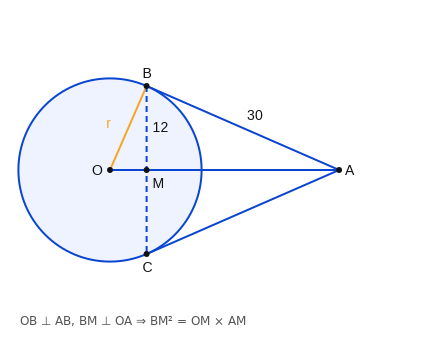
Two tangents AB and AC are drawn from an external point A to a circle with centre O. If AB = 30 cm and BC = 24 cm, then find the radius of the circle (in cm, rounded off to the nearest integer).
केंद्र O वाले एक वृत्त पर बाह्य बिंदु A से दो स्पर्श रेखाएँ AB और AC खींची गई हैं। यदि AB = 30 cm और BC = 24 cm है, तो वृत्त की त्रिज्या (cm में, निकटतम पूर्णांक तक पूर्णांकित) ज्ञात कीजिए।
  1. A11
  2. B10
  3. C13
  4. D12
Show answer

Concept: Tangents from an external point are equal; OA bisects BC perpendicularly at M; ∠OBA=90∘.

  1. AB=AC=30, BM=MC=12 ⇒AM=302−122=756≈27.5.
  2. In right △OBA with altitude BM: BM2=OM×AM⇒OM=14427.5≈5.24.
  3. r=OB=BM2+OM2=144+27.4=171.4≈13.1≈13 cm.

Trick: Direct formula: r=AB·BMAM=30×12756=36027.5≈13.

Answer: (C) 13

अवधारणा: बाह्य बिंदु से स्पर्श रेखाएँ बराबर होती हैं; OA, BC को M पर लंब समद्विभाजित करती है; ∠OBA=90∘।

  1. AB=AC=30, BM=MC=12 ⇒AM=302−122=756≈27.5।
  2. समकोण △OBA में शीर्षलंब BM: BM2=OM×AM⇒OM=14427.5≈5.24।
  3. r=OB=BM2+OM2=144+27.4=171.4≈13.1≈13 cm।

ट्रिक: सीधा सूत्र: r=AB·BMAM=30×12756=36027.5≈13।

उत्तर: (C) 13

RRB NTPC Graduate CBT 1MathematicsCircle – tangents from external pointRRB NTPC Graduate CBT 1 2025 · 17 Mar Shift 2 →
Q16591.
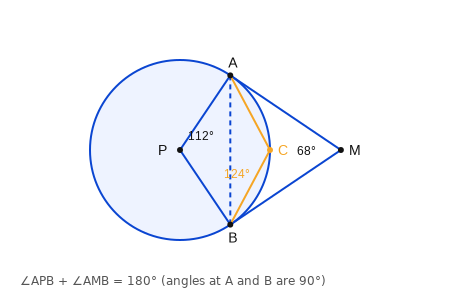
AB is a chord of a circle with its center at P. C is a point between A and B on the minor arc AB. The tangents to the circle at points A and B intersect at an external point M. If ∠ACB=124∘, then find the measure of ∠AMB.
AB एक वृत्त की जीवा है जिसका केंद्र P है। C लघु चाप AB पर A और B के बीच एक बिंदु है। बिंदुओं A और B पर वृत्त की स्पर्श रेखाएँ एक बाह्य बिंदु M पर प्रतिच्छेद करती हैं। यदि ∠ACB=124∘, तो ∠AMB का माप ज्ञात कीजिए।
  1. A72∘
  2. B58∘
  3. C63∘
  4. D68∘
Show answer

Concept: Angle in the minor arc subtends the major arc; central angle =2× inscribed angle; ∠APB+∠AMB=180∘ (tangent–radius angles are 90∘).

  1. C lies on the minor arc, so ∠ACB=124∘ stands on the major arc AB: reflex ∠APB=248∘.
  2. Minor ∠APB=360∘−248∘=112∘.
  3. In quadrilateral PAMB, ∠PAM=∠PBM=90∘ ⇒∠AMB=180∘−112∘=68∘.

Trick: For a point C on the minor arc: ∠AMB=2∠ACB−180∘=248∘−180∘=68∘.

Answer: (D) 68∘

अवधारणा: लघु चाप पर बना कोण दीर्घ चाप को अंतरित करता है; केंद्रीय कोण =2× अंतर्लिखित कोण; ∠APB+∠AMB=180∘ (स्पर्श रेखा–त्रिज्या कोण 90∘)।

  1. C लघु चाप पर है, अतः ∠ACB=124∘ दीर्घ चाप AB पर खड़ा है: प्रतिवर्ती ∠APB=248∘।
  2. लघु ∠APB=360∘−248∘=112∘।
  3. चतुर्भुज PAMB में ∠PAM=∠PBM=90∘ ⇒∠AMB=180∘−112∘=68∘।

ट्रिक: लघु चाप पर बिंदु C के लिए: ∠AMB=2∠ACB−180∘=248∘−180∘=68∘।

उत्तर: (D) 68∘

RRB NTPC Graduate CBT 1MathematicsCircle – angles with tangentsRRB NTPC Graduate CBT 1 2025 · 17 Mar Shift 2 →
Q16592.
A recipe calls for 3 parts of sugar for every 4 parts of flour. If a baker uses 12 cups of sugar, how many cups of flour does he need to use to maintain the same ratio?
एक व्यंजन-विधि में प्रत्येक 4 भाग आटे के लिए 3 भाग चीनी की आवश्यकता होती है। यदि एक बेकर 12 कप चीनी का उपयोग करता है, तो समान अनुपात बनाए रखने के लिए उसे कितने कप आटे का उपयोग करना होगा?
  1. A16
  2. B15
  3. C18
  4. D14
Show answer

Concept: Keep the ratio sugar : flour =3:4.

  1. 34=12x⇒3x=48.
  2. x=16 cups of flour.

Trick: 12 is 4×3, so flour =4×4=16.

Answer: (A) 16

अवधारणा: चीनी : आटा =3:4 बनाए रखें।

  1. 34=12x⇒3x=48।
  2. x=16 कप आटा।

ट्रिक: 12, 3 का 4 गुना है, अतः आटा =4×4=16।

उत्तर: (A) 16

RRB NTPC Graduate CBT 1MathematicsRatio and ProportionRRB NTPC Graduate CBT 1 2025 · 17 Mar Shift 2 →
Q16593.
The average of six consecutive even numbers is 175. What is the smallest of these numbers?
छह क्रमागत सम संख्याओं का औसत 175 है। इन संख्याओं में सबसे छोटी संख्या क्या है?
  1. A170
  2. B172
  3. C166
  4. D168
Show answer

Concept: For consecutive even numbers the average is the middle value.

  1. Let numbers be x,x+2,…,x+10; average =x+5=175⇒x=170.
  2. Numbers: 170, 172, 174, 176, 178, 180 – smallest 170.

Trick: Six even numbers centred on 175: three below (174, 172, 170) and three above.

Answer: (A) 170

अवधारणा: क्रमागत सम संख्याओं का औसत बीच का मान होता है।

  1. संख्याएँ x,x+2,…,x+10; औसत =x+5=175⇒x=170।
  2. संख्याएँ: 170, 172, 174, 176, 178, 180 – सबसे छोटी 170।

ट्रिक: 175 के इर्द-गिर्द छह सम संख्याएँ: तीन नीचे (174, 172, 170) और तीन ऊपर।

उत्तर: (A) 170

RRB NTPC Graduate CBT 1MathematicsAverage of consecutive numbersRRB NTPC Graduate CBT 1 2025 · 17 Mar Shift 2 →
Q16594.
What is the volume (in cm3) of a hemispherical cauldron with diameter 14 cm? (correct up to two decimal places) (Use π=227)
14 cm व्यास वाले एक अर्धगोलाकार कड़ाहे का आयतन (cm3 में) क्या है? (दो दशमलव स्थानों तक सही) (π=227 का प्रयोग कीजिए)
  1. A618.67
  2. B781.33
  3. C718.67
  4. D681.33
Show answer

Concept: Volume of hemisphere =23πr3.

  1. Diameter 14 cm ⇒r=7 cm.
  2. V=23×227×73=23×22×49=21563.
  3. V=718.666…≈718.67 cm3.

Trick: With r=7, πr3=22×49=1078; hemisphere =23×1078.

Answer: (C) 718.67

अवधारणा: अर्धगोले का आयतन =23πr3।

  1. व्यास 14 cm ⇒r=7 cm।
  2. V=23×227×73=23×22×49=21563।
  3. V=718.666…≈718.67 cm3।

ट्रिक: r=7 पर πr3=22×49=1078; अर्धगोला =23×1078।

उत्तर: (C) 718.67

RRB NTPC Graduate CBT 1MathematicsMensuration – hemisphereRRB NTPC Graduate CBT 1 2025 · 17 Mar Shift 2 →
Q16595.
Two taps can fill a cistern in 4 hours and 37 hours respectively. A third tap can empty it in 37 hours. How long (in hours) will it take to fill one-fourth of the empty cistern, if all of them are opened together?
दो नल एक टंकी को क्रमशः 4 घंटे और 37 घंटे में भर सकते हैं। एक तीसरा नल उसे 37 घंटे में खाली कर सकता है। यदि सभी नलों को एक साथ खोल दिया जाए, तो खाली टंकी का एक-चौथाई भाग भरने में कितना समय (घंटों में) लगेगा?
  1. A1
  2. B2
  3. C4
  4. D3
Show answer

Concept: Add filling rates, subtract emptying rates (per hour).

  1. Net rate =14+137−137=14 per hour.
  2. Full tank in 4 hours ⇒ one-fourth in 44=1 hour.

Trick: The 37-hour inlet and 37-hour outlet cancel exactly – only the 4-hour tap matters.

Answer: (A) 1

अवधारणा: भरने की दरें जोड़ें, खाली करने की दर घटाएँ (प्रति घंटा)।

  1. शुद्ध दर =14+137−137=14 प्रति घंटा।
  2. पूरी टंकी 4 घंटे में ⇒ एक-चौथाई 44=1 घंटे में।

ट्रिक: 37-घंटे वाला इनलेट और 37-घंटे वाला आउटलेट एक-दूसरे को काट देते हैं – केवल 4-घंटे वाला नल मायने रखता है।

उत्तर: (A) 1

RRB NTPC Graduate CBT 1MathematicsPipes and CisternsRRB NTPC Graduate CBT 1 2025 · 17 Mar Shift 2 →
Q16596.
What should come in place of ‘?’ in the given series?
55 53 50 45 38 ?
दी गई श्रेणी में ‘?’ के स्थान पर क्या आना चाहिए?
55 53 50 45 38 ?
  1. A31
  2. B29
  3. C27
  4. D33
Show answer

Concept: Check the differences between consecutive terms.

  1. 55−53=2,53−50=3,50−45=5,45−38=7.
  2. The differences 2, 3, 5, 7 are consecutive prime numbers; the next prime is 11.
  3. 38−11=27.

Yaad rakhein: If differences are not constant, test whether they are primes, squares or Fibonacci numbers.

Answer: (C) 27

अवधारणा: क्रमागत पदों के अंतर देखें।

  1. 55−53=2,53−50=3,50−45=5,45−38=7।
  2. अंतर 2, 3, 5, 7 क्रमागत अभाज्य (prime) संख्याएँ हैं; अगली अभाज्य 11 है।
  3. 38−11=27।

याद रखें: अंतर स्थिर न हों तो जाँचें कि वे अभाज्य, वर्ग या Fibonacci संख्याएँ तो नहीं।

उत्तर: (C) 27

RRB NTPC Graduate CBT 1General Intelligence and ReasoningNumber SeriesRRB NTPC Graduate CBT 1 2025 · 17 Mar Shift 2 →
Q16597.
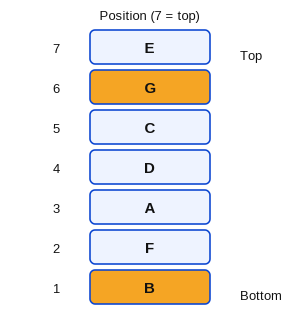
Seven boxes, A, B, C, D, E, F and G, are kept one over the other but not necessarily in the same order. Only two boxes are kept between D and B. Only E is kept above G. No box is kept below B. A is kept at some place below C but at some place above F. How many boxes are kept between B and G?
सात बक्से A, B, C, D, E, F और G एक के ऊपर एक रखे गए हैं, परंतु आवश्यक नहीं कि इसी क्रम में हों। D और B के बीच केवल दो बक्से रखे गए हैं। G के ऊपर केवल E रखा गया है। B के नीचे कोई बक्सा नहीं रखा गया है। A, C के नीचे किसी स्थान पर परंतु F के ऊपर किसी स्थान पर रखा गया है। B और G के बीच कितने बक्से रखे गए हैं?
  1. A2
  2. B1
  3. C3
  4. D4
Show answer

Concept: Number the places 1 (bottom) to 7 (top) and fix the definite clues first.

  1. No box below B → B = 1. Two boxes between D and B → D = 4.
  2. Only E above G → G = 6, E = 7.
  3. Order C > A > F fills 5, 3, 2: C = 5, A = 3, F = 2.
  4. Between B (1) and G (6): F, A, D, C = 4 boxes.

Trick: Clues like "no box below" or "only one above" fix ends of the stack — start there.

Answer: (D) 4

अवधारणा: स्थानों को 1 (नीचे) से 7 (ऊपर) तक नंबर दें और पहले निश्चित सुराग लगाएँ।

  1. B के नीचे कोई बॉक्स नहीं → B = 1। D और B के बीच दो बॉक्स → D = 4।
  2. G के ऊपर केवल E → G = 6, E = 7।
  3. क्रम C > A > F शेष 5, 3, 2 में: C = 5, A = 3, F = 2।
  4. B (1) और G (6) के बीच: F, A, D, C = 4 बॉक्स।

ट्रिक: "नीचे कोई नहीं" या "ऊपर केवल एक" जैसे सुराग ढेर के सिरे तय करते हैं — वहीं से शुरू करें।

उत्तर: (D) 4

RRB NTPC Graduate CBT 1General Intelligence and ReasoningBox ArrangementRRB NTPC Graduate CBT 1 2025 · 17 Mar Shift 2 →
Q16598.
In the following number-pairs, the second number is obtained by applying certain mathematical operations to the first number. Select the set in which the numbers are related in the same way as are the numbers of the following sets.
(NOTE : Operations should be performed on the whole numbers, without breaking down the numbers into its constituent digits. E.g. 13 – Operations on 13 such as adding / subtracting /multiplying etc. to 13 can be performed. Breaking down 13 into 1 and 3 and then performing mathematical operations on 1 and 3 is not allowed)
18, 73
23, 93
निम्नलिखित संख्या-युग्मों में, दूसरी संख्या पहली संख्या पर कुछ निश्चित गणितीय संक्रियाएँ करके प्राप्त की गई है। उस समुच्चय का चयन कीजिए जिसमें संख्याएँ उसी प्रकार संबंधित हैं जैसे निम्नलिखित समुच्चयों की संख्याएँ संबंधित हैं।
(नोट: संक्रियाएँ पूर्ण संख्याओं पर की जानी चाहिए, संख्याओं को उनके घटक अंकों में तोड़े बिना। उदाहरण के लिए 13 – 13 पर संक्रियाएँ जैसे 13 में जोड़ना/घटाना/गुणा करना आदि की जा सकती हैं। 13 को 1 और 3 में तोड़कर फिर 1 और 3 पर गणितीय संक्रियाएँ करने की अनुमति नहीं है)
18, 73
23, 93
  1. A25, 104
  2. B26, 104
  3. C26, 105
  4. D25, 105
Show answer

Concept: Find one operation that works for both given pairs.

  1. 18×4+1=73 and 23×4+1=93 – rule: second =4×first+1.
  2. 26×4+1=105 ✓; 25×4+1=101 ✗.

Trick: When the second number is roughly 4 times the first, test 4n±1 or 4n±2 first.

Answer: (C) 26, 105

अवधारणा: ऐसी एक संक्रिया खोजें जो दोनों दिए गए युग्मों पर लागू हो।

  1. 18×4+1=73 और 23×4+1=93 – नियम: दूसरी =4×पहली+1।
  2. 26×4+1=105 ✓; 25×4+1=101 ✗।

ट्रिक: दूसरी संख्या पहली की लगभग 4 गुनी हो तो पहले 4n±1 या 4n±2 जाँचें।

उत्तर: (C) 26, 105

RRB NTPC Graduate CBT 1General Intelligence and ReasoningNumber AnalogyRRB NTPC Graduate CBT 1 2025 · 17 Mar Shift 2 →
Q16599.
If ‘+’ means ‘−’, ‘−’ means ‘×’, ‘×’ means ‘÷’, ‘÷’ means ‘+’, then what will come in place of the question mark (?) in the following equation?
316 − 2 ÷ 37 + 436 × 4 = ?
यदि ‘+’ का अर्थ ‘−’ है, ‘−’ का अर्थ ‘×’ है, ‘×’ का अर्थ ‘÷’ है, ‘÷’ का अर्थ ‘+’ है, तो निम्नलिखित समीकरण में प्रश्नचिह्न (?) के स्थान पर क्या आएगा?
316 − 2 ÷ 37 + 436 × 4 = ?
  1. A590
  2. B540
  3. C520
  4. D560
Show answer

Concept: Replace the symbols by their real meaning, then apply BODMAS.

  1. 316−2÷37+436×4 becomes 316×2+37−436÷4.
  2. 436÷4=109; 316×2=632.
  3. 632+37−109=560.

Trick: Write the converted equation on paper first; most mistakes happen while converting in the head.

Answer: (D) 560

अवधारणा: चिह्नों को उनके वास्तविक अर्थ से बदलें, फिर BODMAS लगाएँ।

  1. 316−2÷37+436×4 बनता है 316×2+37−436÷4।
  2. 436÷4=109; 316×2=632।
  3. 632+37−109=560।

ट्रिक: बदला हुआ समीकरण पहले कागज़ पर लिखें; अधिकतर गलतियाँ मन में बदलते समय होती हैं।

उत्तर: (D) 560

RRB NTPC Graduate CBT 1General Intelligence and ReasoningMathematical Operations (Symbol Substitution)RRB NTPC Graduate CBT 1 2025 · 17 Mar Shift 2 →
Q16600.
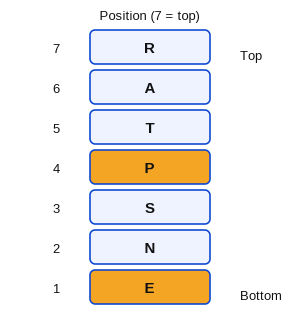
Seven boxes P, A, R, E, N, T and S are kept one over the other but not necessarily in the same order. Only two boxes are kept between A and S. Only E is kept below N. Only R is kept above A. T is not kept immediately above S. How many boxes are kept between P and E?
सात बक्से P, A, R, E, N, T और S एक के ऊपर एक रखे गए हैं, परंतु आवश्यक नहीं कि इसी क्रम में हों। A और S के बीच केवल दो बक्से रखे गए हैं। N के नीचे केवल E रखा गया है। A के ऊपर केवल R रखा गया है। T, S के ठीक ऊपर नहीं रखा गया है। P और E के बीच कितने बक्से रखे गए हैं?
  1. AThreeतीन
  2. BZeroशून्य
  3. CTwoदो
  4. DOneएक
Show answer

Concept: Number places 1 (bottom) to 7 (top); use "only" clues to fix the ends.

  1. Only R above A → R = 7, A = 6. Two boxes between A and S → S = 3.
  2. Only E below N → N = 2, E = 1.
  3. Places 4 and 5 remain for P and T; T is not immediately above S (place 4) → T = 5, P = 4.
  4. Between P (4) and E (1): S and N = two boxes.

Trick: "Only X is above/below Y" fixes two positions at once — always use it first.

Answer: (C) Two

अवधारणा: स्थानों को 1 (नीचे) से 7 (ऊपर) नंबर दें; "केवल" वाले सुराग सिरे तय करते हैं।

  1. A के ऊपर केवल R → R = 7, A = 6। A और S के बीच दो बॉक्स → S = 3।
  2. N के नीचे केवल E → N = 2, E = 1।
  3. स्थान 4 और 5 बचे P, T के लिए; T, S (स्थान 3) के ठीक ऊपर नहीं → T = 5, P = 4।
  4. P (4) और E (1) के बीच: S और N = दो बॉक्स।

ट्रिक: "Y के ऊपर/नीचे केवल X" एक साथ दो स्थान तय करता है — इसे सबसे पहले लगाएँ।

उत्तर: (C) दो

RRB NTPC Graduate CBT 1General Intelligence and ReasoningBox ArrangementRRB NTPC Graduate CBT 1 2025 · 17 Mar Shift 2 →