Question bank

Q&A: practice questions with answers

Search questions on any topic. Filter by exam category, exam, subject and topic, try the question, then open the answer and explanation.

Courses – airGurukul

20,719 questions found.

Q16681.
Evaluate: (-9) - (-56) ÷ (-14) + (-3) × 8
मान ज्ञात कीजिए: (-9) - (-56) ÷ (-14) + (-3) × 8
  1. A-40
  2. B-36
  3. C-39
  4. D-37
Show answer

Concept: Division and multiplication first, then addition/subtraction from left to right.

  1. (−56)÷(−14)=4; (−3)×8=−24.
  2. Expression =−9−4+(−24)=−37.

Trick: Sign rule: (−)÷(−)=+, (−)×(+)=−.

Answer: (D) −37

अवधारणा: पहले भाग और गुणा, फिर बाएँ से दाएँ जोड़/घटाव।

  1. (−56)÷(−14)=4; (−3)×8=−24।
  2. व्यंजक =−9−4+(−24)=−37।

ट्रिक: चिह्न नियम: (−)÷(−)=+, (−)×(+)=−।

उत्तर: (D) −37

RRB NTPC Graduate CBT 1MathematicsBODMASRRB NTPC Graduate CBT 1 2025 · 17 Mar Shift 1 →
Q16682.
There are 12 members in group A, 73 members in group B and 80 members in group C. All the members of these groups went to a restaurant. The average amounts spent on each member of groups A, B and C are ₹184, ₹234 and ₹390, respectively. The overall average amount (in ₹) spent per member is:
समूह A में 12 सदस्य, समूह B में 73 सदस्य और समूह C में 80 सदस्य हैं। इन समूहों के सभी सदस्य एक रेस्तरां में गए। समूह A, B और C के प्रत्येक सदस्य पर खर्च की गई औसत राशि क्रमशः ₹184, ₹234 और ₹390 है। प्रति सदस्य खर्च की गई समग्र औसत राशि (₹ में) है:
  1. A305
  2. B306
  3. C311
  4. D308
Show answer

Concept: Overall average=∑(ni×x¯i)∑ni.

  1. Total spent =12×184+73×234+80×390=2208+17082+31200=50490.
  2. Total members =12+73+80=165.
  3. Average =50490165=306.

Trick: Check the last digit: 50490÷165 must end in 6 since 165×6=990.

Answer: (B) 306

अवधारणा: कुल औसत=∑(ni×x¯i)∑ni।

  1. कुल खर्च =12×184+73×234+80×390=2208+17082+31200=50490।
  2. कुल सदस्य =165।
  3. औसत =50490165=306।

ट्रिक: अंतिम अंक जाँचें: 165×6=990, अतः भागफल 6 पर समाप्त होगा।

उत्तर: (B) 306

RRB NTPC Graduate CBT 1MathematicsWeighted AverageRRB NTPC Graduate CBT 1 2025 · 17 Mar Shift 1 →
Q16683.
If α is a root of the equation 2x(2x+1)=1, then the other root is:
यदि α समीकरण 2x(2x+1)=1 का एक मूल है, तो दूसरा मूल है:
  1. A−α(α+1)
  2. B2α(α−1)
  3. C−14α
  4. D3α(α+1)
Show answer

Concept: For ax2+bx+c=0, product of roots =ca.

  1. 2x(2x+1)=1⇒4x2+2x−1=0.
  2. Product of roots =−14.
  3. If one root is α, the other =−1/4α=−14α.

Trick: When one root is given as α, the other is simply caα.

Answer: (C) −14α

अवधारणा: ax2+bx+c=0 के लिए मूलों का गुणनफल =ca।

  1. 2x(2x+1)=1⇒4x2+2x−1=0।
  2. मूलों का गुणनफल =−14।
  3. एक मूल α हो तो दूसरा =−1/4α=−14α।

ट्रिक: एक मूल α दिया हो तो दूसरा सीधे caα।

उत्तर: (C) −14α

RRB NTPC Graduate CBT 1MathematicsQuadratic Equations – RootsRRB NTPC Graduate CBT 1 2025 · 17 Mar Shift 1 →
Q16684.
In an election between two candidates, 84% of the registered voters cast their votes and 20% of the votes polled were found invalid. Winning candidate got 58% of the valid votes and won the election by a margin of 336 votes. How many voters were
registered?
दो उम्मीदवारों के बीच हुए एक चुनाव में, पंजीकृत मतदाताओं के 84% ने मतदान किया और डाले गए मतों के 20% अवैध पाए गए। विजेता उम्मीदवार को वैध मतों के 58% मत मिले और वह 336 मतों के अंतर से चुनाव जीता। कितने मतदाता
पंजीकृत थे?
  1. A3125
  2. B3123
  3. C3120
  4. D3124
Show answer

Concept: Winning margin = difference of the two candidates' shares of the valid votes.

  1. Let registered voters =N. Votes polled =84% of N=0.84N.
  2. Valid votes =80% of 0.84N=0.672N.
  3. Winner 58%, loser 42% → margin =16% of valid votes =0.16×0.672N=0.10752N.
  4. 0.10752N=336⇒N=3360.10752=3125.

Trick: Margin =(58−42)%=16% of valid votes. Chain the percentages: N×0.84×0.8×0.16=336.

Answer: (A) 3125

अवधारणा: जीत का अंतर = दोनों उम्मीदवारों को मिले वैध मतों का अंतर।

  1. माना पंजीकृत मतदाता =N। डाले गए मत =84% of N=0.84N।
  2. वैध मत =80% of 0.84N=0.672N।
  3. विजेता 58%, हारने वाला 42% → अंतर =16% वैध मतों का =0.16×0.672N=0.10752N।
  4. 0.10752N=336⇒N=3360.10752=3125।

ट्रिक: अंतर =(58−42)%=16% वैध मतों का। प्रतिशत को श्रृंखला में गुणा करें: N×0.84×0.8×0.16=336।

उत्तर: (A) 3125

RRB NTPC Graduate CBT 1MathematicsPercentage – electionsRRB NTPC Graduate CBT 1 2025 · 17 Mar Shift 1 →
Q16685.
The product of two numbers, X and Y, is 6760, and the HCF of X and Y is 13. Find the number of possible pairs (X,Y), given that X>Y.
दो संख्याओं X और Y का गुणनफल 6760 है, और X तथा Y का HCF 13 है। संभव युग्मों (X,Y) की संख्या ज्ञात कीजिए, दिया है कि X>Y।
  1. A1
  2. B2
  3. C4
  4. D3
Show answer

Concept: If HCF of two numbers is h, write them as X=ha, Y=hb with a,b co-prime.

  1. X=13a, Y=13b ⇒ 169ab=6760⇒ab=40.
  2. Co-prime factor pairs of 40: (40,1) and (8,5). Pairs (20,2) and (10,4) are not co-prime.
  3. With X>Y: (520,13) and (104,65) → 2 pairs.

Trick: Number of co-prime pairs of n = 2k−1 where k = number of distinct prime factors. 40=23×5, k=2 → 2 pairs.

Answer: (B) 2

अवधारणा: यदि दो संख्याओं का HCF h है तो उन्हें X=ha, Y=hb लिखें जहाँ a,b सह-अभाज्य (co-prime) हों।

  1. X=13a, Y=13b ⇒ 169ab=6760⇒ab=40।
  2. 40 के सह-अभाज्य गुणनखंड युग्म: (40,1) और (8,5)। (20,2) और (10,4) सह-अभाज्य नहीं हैं।
  3. X>Y के साथ: (520,13) और (104,65) → 2 युग्म।

ट्रिक: n के सह-अभाज्य युग्मों की संख्या =2k−1, जहाँ k = भिन्न अभाज्य गुणनखंडों की संख्या। 40=23×5, k=2 → 2 युग्म।

उत्तर: (B) 2

RRB NTPC Graduate CBT 1MathematicsHCF – number of pairsRRB NTPC Graduate CBT 1 2025 · 17 Mar Shift 1 →
Q16686.
What should come in place of ‘?’ in the given series?
19 20 28 55 119 ?
दी गई श्रेणी में ‘?’ के स्थान पर क्या आना चाहिए?
19 20 28 55 119 ?
  1. A144
  2. B142
  3. C244
  4. D245
Show answer

Concept: Check the differences between consecutive terms; they often form a known pattern (squares, cubes, primes).

  1. 20−19=1=13, 28−20=8=23, 55−28=27=33, 119−55=64=43.
  2. Next difference =53=125.
  3. ?=119+125=244.

Trick: Differences 1, 8, 27, 64 → cubes. Memorise cubes up to 15.

Answer: (C) 244

अवधारणा: क्रमागत पदों के अंतर देखें; वे प्रायः किसी ज्ञात पैटर्न (वर्ग, घन, अभाज्य) में होते हैं।

  1. 20−19=1=13, 28−20=8=23, 55−28=27=33, 119−55=64=43।
  2. अगला अंतर =53=125।
  3. ?=119+125=244।

ट्रिक: अंतर 1, 8, 27, 64 → घन (cubes)। 15 तक के घन याद रखें।

उत्तर: (C) 244

RRB NTPC Graduate CBT 1MathematicsNumber seriesRRB NTPC Graduate CBT 1 2025 · 17 Mar Shift 1 →
Q16687.
₹7770 is divided among A, B, C, and D in such a way that the shares of A and B, B and C, and C and D are in the ratios of 2 : 3, 4 : 5, and 6 : 7, respectively. The share of A (in ₹) is:
₹7770 को A, B, C और D के बीच इस प्रकार बाँटा जाता है कि A और B, B और C, तथा C और D के हिस्से क्रमशः 2 : 3, 4 : 5 और 6 : 7 के अनुपात में हैं। A का हिस्सा (₹ में) है:
  1. A1224
  2. B1184
  3. C1154
  4. D1124
Show answer

Concept: Combine chained ratios by making the common term equal.

  1. A:B=2:3, B:C=4:5, C:D=6:7.
  2. A:B:C:D=(2×4×6):(3×4×6):(3×5×6):(3×5×7)=48:72:90:105.
  3. Sum of parts =315. One part =7770315=2423.
  4. Share of A =48×7770315=7770×16105=74×16=1184.

Trick: For a:b, c:d, e:f → A=ace, B=bce, C=bde, D=bdf.

Answer: (B) ₹1184

अवधारणा: श्रृंखलित अनुपातों को उभयनिष्ठ पद बराबर करके जोड़ें।

  1. A:B=2:3, B:C=4:5, C:D=6:7।
  2. A:B:C:D=(2×4×6):(3×4×6):(3×5×6):(3×5×7)=48:72:90:105।
  3. भागों का योग =315। एक भाग =7770315=2423।
  4. A का हिस्सा =48×7770315=7770×16105=74×16=1184।

ट्रिक: a:b, c:d, e:f के लिए → A=ace, B=bce, C=bde, D=bdf।

उत्तर: (B) ₹1184

RRB NTPC Graduate CBT 1MathematicsRatio – chained ratiosRRB NTPC Graduate CBT 1 2025 · 17 Mar Shift 1 →
Q16688.
A and B start running on a circular track of length 900 m. A runs at 225 m/min and B at 180 m/min. Every time A overtakes B, both reduce their speeds by 5% of their then speeds before continuing. After how many minutes (correct to two decimal places) does A overtake B for the 3rd time?
A और B, 900 m लंबे एक वृत्ताकार ट्रैक पर दौड़ना शुरू करते हैं। A 225 m/min और B 180 m/min की चाल से दौड़ता है। जब भी A, B को पीछे छोड़ता (overtake करता) है, दोनों आगे बढ़ने से पहले अपनी तत्कालीन चाल का 5% कम कर देते हैं। कितने मिनट बाद (दो दशमलव स्थानों तक सही) A, B को 3री बार पीछे छोड़ता है?
  1. A62.11 min62.11 मिनट
  2. B64.41 min64.41 मिनट
  3. C64.21 min64.21 मिनट
  4. D63.21 min63.21 मिनट
Show answer

Concept: On a circular track, A overtakes B each time A gains one full lap: time =track lengthrelative speed.

  1. 1st overtake: relative speed =225−180=45 m/min → t1=90045=20 min.
  2. Speeds drop by 5%, so relative speed also drops by 5%: 45×0.95=42.75 → t2=90042.75≈21.05 min.
  3. Again ×0.95: 40.6125 → t3=90040.6125≈22.16 min.
  4. Total =20+21.05+22.16=63.21 min.

Trick: Each stage's time is the previous one ÷0.95: 20(1+10.95+10.952)≈63.21.

Answer: (D) 63.21 min

अवधारणा: वृत्ताकार ट्रैक पर A, B को तब ओवरटेक करता है जब A एक पूरा चक्कर आगे निकल जाए: समय =ट्रैक की लंबाईसापेक्ष चाल।

  1. पहला ओवरटेक: सापेक्ष चाल =225−180=45 m/min → t1=90045=20 मिनट।
  2. चालें 5% घटती हैं, तो सापेक्ष चाल भी 5% घटती है: 45×0.95=42.75 → t2=90042.75≈21.05 मिनट।
  3. फिर ×0.95: 40.6125 → t3=90040.6125≈22.16 मिनट।
  4. कुल =20+21.05+22.16=63.21 मिनट।

ट्रिक: हर चरण का समय पिछले का ÷0.95: 20(1+10.95+10.952)≈63.21।

उत्तर: (D) 63.21 min

RRB NTPC Graduate CBT 1MathematicsCircular track – overtakingRRB NTPC Graduate CBT 1 2025 · 17 Mar Shift 1 →
Q16689.
What is the average of all the natural numbers from 1 to 63?
1 से 63 तक की सभी प्राकृत संख्याओं का औसत क्या है?
  1. A31.5
  2. B32.5
  3. C32
  4. D33
Show answer

Concept: Average of the first n natural numbers =n+12 (average of an AP = mean of first and last term).

  1. Here n=63.
  2. Average =63+12=642=32.

Trick: For consecutive numbers, average = middle term. The middle of 1…63 is the 32nd term = 32.

Answer: (C) 32

अवधारणा: प्रथम n प्राकृत संख्याओं का औसत =n+12 (AP का औसत = पहले और अंतिम पद का माध्य)।

  1. यहाँ n=63।
  2. औसत =63+12=642=32।

ट्रिक: क्रमागत संख्याओं का औसत = बीच वाला पद। 1…63 का बीच वाला 32वाँ पद = 32।

उत्तर: (C) 32

RRB NTPC Graduate CBT 1MathematicsAverage of natural numbersRRB NTPC Graduate CBT 1 2025 · 17 Mar Shift 1 →
Q16690.
The population of a village was 2,90,000. It increased by 10% in the first year and increased by 20% in the second year. Its population after two years is _______.
एक गाँव की जनसंख्या 2,90,000 थी। पहले वर्ष में इसमें 10% की वृद्धि हुई और दूसरे वर्ष में 20% की वृद्धि हुई। दो वर्षों के बाद इसकी जनसंख्या _______ है।
  1. A3,19,000
  2. B3,48,000
  3. C3,82,800
  4. D3,77,000
Show answer

Concept: Successive increases multiply: final =P(1+a100)(1+b100).

  1. After 1st year: 2,90,000×1.10=3,19,000.
  2. After 2nd year: 3,19,000×1.20=3,82,800.

Trick: Net change =a+b+ab100=10+20+2=32%; 2,90,000×1.32=3,82,800.

Answer: (C) 3,82,800

अवधारणा: क्रमिक वृद्धियाँ गुणा होती हैं: अंतिम =P(1+a100)(1+b100)।

  1. पहले वर्ष बाद: 2,90,000×1.10=3,19,000।
  2. दूसरे वर्ष बाद: 3,19,000×1.20=3,82,800।

ट्रिक: नेट परिवर्तन =a+b+ab100=10+20+2=32%; 2,90,000×1.32=3,82,800।

उत्तर: (C) 3,82,800

RRB NTPC Graduate CBT 1MathematicsSuccessive percentage changeRRB NTPC Graduate CBT 1 2025 · 17 Mar Shift 1 →
Q16691.
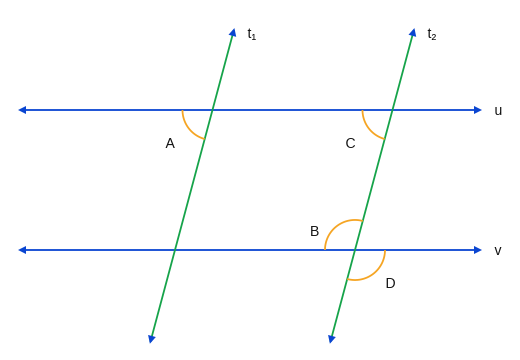
In the given figure, if u∥v, t1∥t2 and ∠A=92∘, find ∠D.
दी गई आकृति में, यदि u∥v, t1∥t2 और ∠A=92∘ है, तो ∠D ज्ञात कीजिए।
  1. A88∘
  2. B82∘
  3. C78∘
  4. D92∘
Show answer

Concept: With parallel lines, corresponding angles are equal, co-interior angles add to 180∘ and vertically opposite angles are equal.

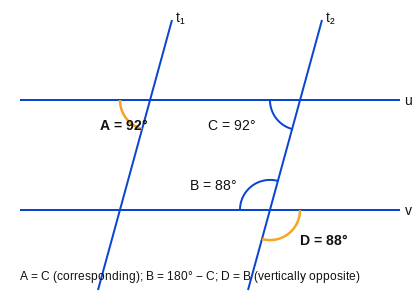
  1. t1∥t2 cut by line u: ∠C is corresponding to ∠A → ∠C=92∘.
  2. u∥v cut by t2: ∠B and ∠C are co-interior → ∠B=180∘−92∘=88∘.
  3. ∠D is vertically opposite to ∠B → ∠D=88∘.

Trick: Two pairs of parallel lines form a parallelogram; ∠A and ∠D are at opposite corners but ∠D is the exterior angle there, so ∠D=180∘−∠A.

Answer: (A) 88∘

अवधारणा: समांतर रेखाओं में संगत कोण बराबर, सह-अंतःकोणों का योग 180∘ और शीर्षाभिमुख कोण बराबर होते हैं।

  1. t1∥t2 को रेखा u काटती है: ∠C, ∠A का संगत कोण → ∠C=92∘।
  2. u∥v को t2 काटती है: ∠B और ∠C सह-अंतःकोण → ∠B=180∘−92∘=88∘।
  3. ∠D, ∠B का शीर्षाभिमुख कोण → ∠D=88∘।

ट्रिक: समांतर रेखाओं के दो युग्म समांतर चतुर्भुज बनाते हैं; ∠D विपरीत कोने पर बाह्य कोण है, अतः ∠D=180∘−∠A।

उत्तर: (A) 88∘

RRB NTPC Graduate CBT 1MathematicsParallel lines – anglesRRB NTPC Graduate CBT 1 2025 · 17 Mar Shift 1 →
Q16692.
A shopkeeper professes to sell his goods at a 25% loss but uses a false balance and gains 70%. The actual weight (rounded off to one decimal place) that he uses instead of 1 kg is:
एक दुकानदार अपना सामान 25% हानि पर बेचने का दावा करता है, परंतु गलत तराजू का उपयोग करता है और 70% लाभ प्राप्त करता है। 1 kg के स्थान पर वह जो वास्तविक भार (एक दशमलव स्थान तक पूर्णांकित) उपयोग करता है, वह है:
  1. A443.3 gm443.3 ग्राम
  2. B441.2 gm441.2 ग्राम
  3. C438.1 gm438.1 ग्राम
  4. D436.4 gm436.4 ग्राम
Show answer

Concept: With a false weight, the dealer charges for 1 kg but hands over only w kg; his real cost is for w kg.

  1. Let cost price = ₹100 per kg. Professed 25% loss → selling price of "1 kg" =75.
  2. Actual goods given =w kg, costing 100w. Gain 70% → 75=1.7×100w.
  3. w=75170=0.4412 kg =441.2 g.

Trick: True weightFalse weight=100+gain%100−loss% → 1000w=17075, w=441.2 g.

Answer: (B) 441.2 gm

अवधारणा: गलत बाट से व्यापारी 1 kg का दाम लेता है पर केवल w kg देता है; उसकी वास्तविक लागत w kg की है।

  1. माना क्रय मूल्य = ₹100 प्रति kg। कथित 25% हानि → "1 kg" का विक्रय मूल्य =75।
  2. वास्तव में दिया माल =w kg, लागत 100w। लाभ 70% → 75=1.7×100w।
  3. w=75170=0.4412 kg =441.2 g।

ट्रिक: सही बाटगलत बाट=100+लाभ%100−हानि% → 1000w=17075, w=441.2 g।

उत्तर: (B) 441.2 gm

RRB NTPC Graduate CBT 1MathematicsDishonest dealer – false weightRRB NTPC Graduate CBT 1 2025 · 17 Mar Shift 1 →
Q16693.
Two taps can fill a cistern in 4 hours and 27 hours respectively. A third tap can empty it in 27 hours. How long (in hours) will it take to fill one-fourth of the empty cistern, if all of them are opened together?
दो नल एक टंकी को क्रमशः 4 घंटे और 27 घंटे में भर सकते हैं। एक तीसरा नल इसे 27 घंटे में खाली कर सकता है। यदि इन सभी को एक साथ खोल दिया जाए, तो खाली टंकी के एक-चौथाई भाग को भरने में कितना समय (घंटों में) लगेगा?
  1. A4
  2. B2
  3. C1
  4. D3
Show answer

Concept: Add the per-hour work of filling taps and subtract that of the emptying tap.

  1. Net work per hour =14+127−127=14.
  2. So the full cistern fills in 4 hours.
  3. One-fourth of the cistern =14×4=1 hour.

Trick: The 27-hour filler and the 27-hour emptier cancel each other – only the 4-hour tap matters.

Answer: (C) 1

अवधारणा: भरने वाले नलों का प्रति घंटा कार्य जोड़ें और खाली करने वाले का घटाएँ।

  1. नेट कार्य प्रति घंटा =14+127−127=14।
  2. अतः पूरी टंकी 4 घंटे में भरती है।
  3. टंकी का एक-चौथाई =14×4=1 घंटा।

ट्रिक: 27 घंटे वाला भरने वाला और 27 घंटे वाला खाली करने वाला नल एक-दूसरे को काट देते हैं – केवल 4 घंटे वाला नल मायने रखता है।

उत्तर: (C) 1

RRB NTPC Graduate CBT 1MathematicsPipes and cisternsRRB NTPC Graduate CBT 1 2025 · 17 Mar Shift 1 →
Q16694.
The median for the following frequency distribution is:
x123456789
f810111620251596
निम्नलिखित बारंबारता बंटन की माध्यिका है:
x: 1, 2, 3, 4, 5, 6, 7, 8, 9
f: 8, 10, 11, 16, 20, 25, 15, 9, 6
  1. A6
  2. B8
  3. C4
  4. D5
Show answer

Concept: For a discrete frequency distribution, median is the value of x whose cumulative frequency first reaches or exceeds N2.

  1. N=8+10+11+16+20+25+15+9+6=120, so N2=60.
  2. Cumulative frequencies: 8, 18, 29, 45, 65, 90, 105, 114, 120.
  3. The first cumulative frequency ≥60 is 65, at x=5 → median =5.

Trick: Both the 60th and 61st observations lie in the x=5 group (46th to 65th), so median = 5 without any averaging.

Answer: (D) 5

अवधारणा: असतत बारंबारता बंटन में माध्यिका वह x है जिसकी संचयी बारंबारता पहली बार N2 के बराबर या अधिक हो।

  1. N=8+10+11+16+20+25+15+9+6=120, अतः N2=60।
  2. संचयी बारंबारता: 8, 18, 29, 45, 65, 90, 105, 114, 120।
  3. पहली संचयी बारंबारता ≥60 है 65, जो x=5 पर है → माध्यिका =5।

ट्रिक: 60वाँ और 61वाँ दोनों प्रेक्षण x=5 समूह (46वें से 65वें) में हैं, अतः बिना औसत निकाले माध्यिका = 5।

उत्तर: (D) 5

RRB NTPC Graduate CBT 1MathematicsStatistics – medianRRB NTPC Graduate CBT 1 2025 · 17 Mar Shift 1 →
Q16695.
A man sold an article for ₹132 by first giving a d% discount on its marked price, and then another discount having the same nominal value (in ₹). If the marked price of the article is ₹880, then what is the value of d?
एक व्यक्ति ने एक वस्तु को उसके अंकित मूल्य पर पहले d% की छूट और फिर उसी सांकेतिक मान (₹ में) की एक और छूट देकर ₹132 में बेचा। यदि वस्तु का अंकित मूल्य ₹880 है, तो d का मान क्या है?
  1. A42.5
  2. B46
  3. C39.5
  4. D37.3
Show answer

Concept: A percentage discount on the marked price is a fixed rupee amount; the second discount here is that same rupee amount again.

  1. First discount =d% of 880 =8.8d rupees.
  2. Second discount = the same amount =8.8d. Total discount =17.6d.
  3. 880−17.6d=132⇒17.6d=748⇒d=42.5.

Trick: Total discount =880−132=748 = two equal discounts → each =374 = 374880×100=42.5%.

Answer: (A) 42.5

अवधारणा: अंकित मूल्य पर प्रतिशत छूट एक निश्चित रुपये की राशि है; यहाँ दूसरी छूट उतनी ही रुपये की राशि है।

  1. पहली छूट =880 का d%=8.8d रुपये।
  2. दूसरी छूट = वही राशि =8.8d। कुल छूट =17.6d।
  3. 880−17.6d=132⇒17.6d=748⇒d=42.5।

ट्रिक: कुल छूट =880−132=748 = दो बराबर छूट → प्रत्येक =374 = 374880×100=42.5%।

उत्तर: (A) 42.5

RRB NTPC Graduate CBT 1MathematicsDiscount – equal rupee discountsRRB NTPC Graduate CBT 1 2025 · 17 Mar Shift 1 →
Q16696.
If a : b : c = 3 : 4 : 5 and 2a - 3b + 4c = 56, then the value of c is:
यदि a : b : c = 3 : 4 : 5 और 2a - 3b + 4c = 56 है, तो c का मान है:
  1. A20
  2. B22
  3. C21
  4. D24
Show answer

Concept: Write the ratio terms with a common multiplier k and substitute in the equation.

  1. Let a=3k, b=4k, c=5k.
  2. 2a−3b+4c=6k−12k+20k=14k=56⇒k=4.
  3. c=5k=20.

Trick: Compute the "ratio value" of the expression first: 2(3)−3(4)+4(5)=14; then k=5614=4.

Answer: (A) 20

अवधारणा: अनुपात के पदों को उभयनिष्ठ गुणक k से लिखें और समीकरण में रखें।

  1. माना a=3k, b=4k, c=5k।
  2. 2a−3b+4c=6k−12k+20k=14k=56⇒k=4।
  3. c=5k=20।

ट्रिक: पहले व्यंजक का "अनुपात मान" निकालें: 2(3)−3(4)+4(5)=14; फिर k=5614=4।

उत्तर: (A) 20

RRB NTPC Graduate CBT 1MathematicsRatio – linear equationRRB NTPC Graduate CBT 1 2025 · 17 Mar Shift 1 →
Q16697.
Refer to the following letter and symbol series and answer the question that follows. Counting to be done from left to right only.
(Left) T O @ $ J $ S € M L I * N G © Y & T P £ Y T (Right)
How many such symbols are there each of which is immediately preceded by a letter and also immediately followed by a symbol?
निम्नलिखित अक्षर और प्रतीक श्रेणी को देखिए और उसके बाद दिए गए प्रश्न का उत्तर दीजिए। गिनती केवल बाएँ से दाएँ की जानी है।
(बाएँ) T O @ $ J $ S € M L I * N G © Y & T P £ Y T (दाएँ)
ऐसे कितने प्रतीक हैं, जिनमें से प्रत्येक के ठीक पहले एक अक्षर है और ठीक बाद भी एक प्रतीक है?
  1. A4
  2. B2
  3. C1
  4. D3
Show answer

Concept: Scan each symbol and check its left neighbour (must be a letter) and right neighbour (must be a symbol).

  1. Series: T O @ $ J $ S € M L I * N G © Y & T P £ Y T.
  2. @ : left O (letter), right $ (symbol) ✓.
  3. Other symbols ($, €, *, ©, &, £) are each followed by a letter, so they fail.

Trick: Look only for the pattern Letter–Symbol–Symbol; the middle one counts.

Answer: (C) 1

अवधारणा: हर प्रतीक के लिए बायाँ पड़ोसी अक्षर और दायाँ पड़ोसी प्रतीक होना चाहिए।

  1. श्रृंखला: T O @ $ J $ S € M L I * N G © Y & T P £ Y T।
  2. @ : बाएँ O (अक्षर), दाएँ $ (प्रतीक) ✓।
  3. बाकी प्रतीकों ($, €, *, ©, &, £) के दाएँ अक्षर है, अतः वे नहीं गिने जाएँगे।

ट्रिक: केवल अक्षर–प्रतीक–प्रतीक पैटर्न खोजिए; बीच वाला गिना जाता है।

उत्तर: (C) 1

RRB NTPC Graduate CBT 1General Intelligence and ReasoningLetter-Symbol SeriesRRB NTPC Graduate CBT 1 2025 · 17 Mar Shift 1 →
Q16698.
Select the set in which the numbers are related in the same way as are the numbers of the following sets.
(NOTE: Operations should be performed on the whole numbers, without breaking down the numbers into their constituent digits. E.g. 13 – Operations on 13 such as adding/ subtracting /multiplying to 13 can be performed. Breaking down 13 into 1 and 3 and then performing mathematical operations on 1 and 3 is not allowed.)
(336, 216, 156)
(379, 259, 199)
उस समुच्चय का चयन कीजिए जिसमें संख्याएँ उसी प्रकार संबंधित हैं जिस प्रकार निम्नलिखित समुच्चयों की संख्याएँ संबंधित हैं।
(नोट: संक्रियाएँ पूर्ण संख्याओं पर की जानी चाहिए, संख्याओं को उनके घटक अंकों में तोड़े बिना। उदाहरण के लिए 13 – 13 पर संक्रियाएँ जैसे 13 में जोड़ना/घटाना/गुणा करना किया जा सकता है। 13 को 1 और 3 में तोड़कर फिर 1 और 3 पर गणितीय संक्रियाएँ करने की अनुमति नहीं है।)
(336, 216, 156)
(379, 259, 199)
  1. A(432, 332, 252)
  2. B(394, 264, 204)
  3. C(412, 292, 232)
  4. D(449, 329, 249)
Show answer

Concept: Find the operation linking the three numbers of each given set.

  1. 336−216=120, 216−156=60; 379−259=120, 259−199=60.
  2. Rule: 1st − 120 = 2nd, 2nd − 60 = 3rd.
  3. Check (C): 412−120=292, 292−60=232 ✓. Others fail (e.g. 432−332=100).

Trick: Check the first difference (120) – only option (C) has it.

Answer: (C) (412, 292, 232)

अवधारणा: हर समुच्चय की तीनों संख्याओं को जोड़ने वाली संक्रिया खोजिए।

  1. 336−216=120, 216−156=60; 379−259=120, 259−199=60।
  2. नियम: पहली − 120 = दूसरी, दूसरी − 60 = तीसरी।
  3. (C): 412−120=292, 292−60=232 ✓। बाकी असफल (जैसे 432−332=100)।

ट्रिक: पहला अंतर (120) जाँचिए – केवल (C) में है।

उत्तर: (C) (412, 292, 232)

RRB NTPC Graduate CBT 1General Intelligence and ReasoningNumber AnalogyRRB NTPC Graduate CBT 1 2025 · 17 Mar Shift 1 →
Q16699.
Below are given two sets of numbers. In each set of numbers, a certain mathematical operation on the first number results in the second number. Similarly, a certain mathematical operation on the second number results in the third number and so on. Which of the given options follows the same set of operations as in the question? (NOTE – A two/three-digit number cannot be broken into individual digits for
operations. E.g. if 37 is followed by 10, the operation cannot be 3+7 as a two-digit number cannot be broken into individual digits.)
157 – 162 – 172 – 86
93 – 98 – 108 – 54
नीचे संख्याओं के दो समुच्चय दिए गए हैं। संख्याओं के प्रत्येक समुच्चय में, पहली संख्या पर एक निश्चित गणितीय संक्रिया करने से दूसरी संख्या प्राप्त होती है। इसी प्रकार, दूसरी संख्या पर एक निश्चित गणितीय संक्रिया करने से तीसरी संख्या प्राप्त होती है, और इसी तरह आगे। दिए गए विकल्पों में से कौन-सा प्रश्न में दी गई संक्रियाओं के उसी समुच्चय का अनुसरण करता है? (नोट – दो/तीन अंकों की संख्या को संक्रियाओं के लिए
अलग-अलग अंकों में नहीं तोड़ा जा सकता। उदाहरण के लिए यदि 37 के बाद 10 है, तो संक्रिया 3+7 नहीं हो सकती, क्योंकि दो अंकों की संख्या को अलग-अलग अंकों में नहीं तोड़ा जा सकता।)
157 – 162 – 172 – 86
93 – 98 – 108 – 54
  1. A98 – 103 – 113 – 133
  2. B112 – 116 – 126 – 63
  3. C185 – 190 – 200 – 100
  4. D65 – 70 – 80 – 160
Show answer

Concept: Find the chain of operations in the given sets and apply it to the options.

  1. 157 +5​ 162 +10​ 172 ÷2​ 86; 93 +5​ 98 +10​ 108 ÷2​ 54.
  2. (C): 185+5=190, 190+10=200, 200÷2=100 ✓.
  3. (A) ends with +20, (B) starts with +4, (D) ends with ×2.

Trick: Check the last step first – only (C) halves the third number.

Answer: (C) 185 – 190 – 200 – 100

अवधारणा: दिए गए समुच्चयों में संक्रियाओं की शृंखला पहचानकर विकल्पों पर लगाइए।

  1. 157 +5​ 162 +10​ 172 ÷2​ 86; 93 +5​ 98 +10​ 108 ÷2​ 54।
  2. (C): 185+5=190, 190+10=200, 200÷2=100 ✓।
  3. (A) का अंत +20, (B) की शुरुआत +4, (D) का अंत ×2 से है।

ट्रिक: पहले अंतिम चरण जाँचिए – केवल (C) में तीसरी संख्या आधी होती है।

उत्तर: (C) 185 – 190 – 200 – 100

RRB NTPC Graduate CBT 1General Intelligence and ReasoningNumber Series OperationsRRB NTPC Graduate CBT 1 2025 · 17 Mar Shift 1 →
Q16700.
A is the wife of B. B is the father of C. D is the brother of C. E is the son of D. How is A related to E?
A, B की पत्नी है। B, C का पिता है। D, C का भाई है। E, D का पुत्र है। A, E से किस प्रकार संबंधित है?
  1. AFather's motherपिता की माता
  2. BMother's motherमाता की माता
  3. CHusband's wifeपति की पत्नी
  4. DMotherमाता
Show answer

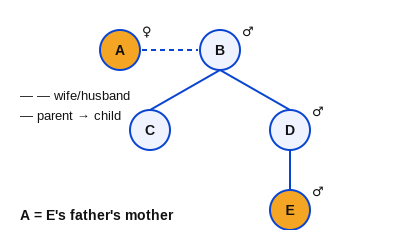
Concept: Draw the family tree generation by generation.

  1. A is B's wife; B is father of C and D (D is C's brother) → A is mother of D.
  2. E is D's son → A is the mother of E's father.

Trick: Trace E upward: E → D (father) → A (D's mother) = paternal grandmother.

Answer: (A) Father's mother

अवधारणा: पीढ़ी-दर-पीढ़ी वंश-वृक्ष बनाइए।

  1. A, B की पत्नी; B, C और D का पिता (D, C का भाई) → A, D की माँ।
  2. E, D का पुत्र → A, E के पिता की माँ (दादी)।

ट्रिक: E से ऊपर जाइए: E → D (पिता) → A (D की माँ) = दादी।

उत्तर: (A) पिता की माँ

RRB NTPC Graduate CBT 1General Intelligence and ReasoningBlood RelationsRRB NTPC Graduate CBT 1 2025 · 17 Mar Shift 1 →