Question bank

Q&A: practice questions with answers

Search questions on any topic. Filter by exam category, exam, subject and topic, try the question, then open the answer and explanation.

Courses – airGurukul

20,719 questions found.

Q16781.
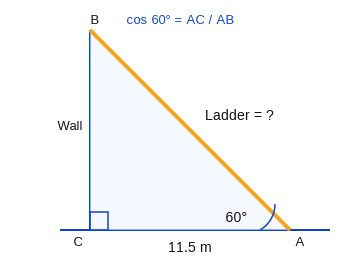
Find the length of the ladder if the angle of elevation of the ladder against a wall is 60° and the foot of the ladder is 11.5 m away from the wall.
यदि दीवार के सहारे रखी एक सीढ़ी का उन्नयन कोण 60° है और सीढ़ी का पाद दीवार से 11.5 m की दूरी पर है, तो सीढ़ी की लंबाई ज्ञात कीजिए।
  1. A23 m
  2. B2332 m
  3. C233 cm
  4. D11.5 m
Show answer

Concept: The ladder, wall and ground form a right triangle. With the angle of elevation θ at the foot, cosθ=distance from wallladder.

  1. Foot of ladder from wall =11.5m, θ=60∘.
  2. cos60∘=12=11.5L
  3. L=2×11.5=23m.

Trick: At 60∘ the hypotenuse is always double the side next to the angle (1:3:2 triangle).

Answer: (A) 23 m

अवधारणा: सीढ़ी, दीवार और ज़मीन एक समकोण त्रिभुज बनाते हैं। पाद पर उन्नयन कोण θ हो तो cosθ=दीवार से दूरीसीढ़ी।

  1. सीढ़ी का पाद दीवार से 11.5m, θ=60∘।
  2. cos60∘=12=11.5L
  3. L=2×11.5=23m।

ट्रिक: 60∘ पर कर्ण हमेशा कोण से लगी भुजा का दोगुना होता है (1:3:2 त्रिभुज)।

उत्तर: (A) 23 m

RRB NTPC Graduate CBT 1MathematicsHeights and DistancesRRB NTPC Graduate CBT 1 2025 · 16 Mar Shift 3 →
Q16782.
If 45% of 20−46×7293×36=y, then the value of y is
यदि 45% का 20−46×7293×36=y, तो y का मान है
  1. A-27
  2. B-35
  3. C-30
  4. D-21
Show answer

Concept: Evaluate roots and percentages first, then multiply, then subtract (BODMAS).

  1. 45% of 20=9; 7293=9; 36=6.
  2. 46×9×6=4×9=36.
  3. y=9−36=−27.

Trick: 46×6 cancels at once to 4 – avoid decimals.

Answer: (A) −27

अवधारणा: पहले मूल और प्रतिशत निकालें, फिर गुणा, फिर घटाव (BODMAS)।

  1. 20 का 45%=9; 7293=9; 36=6।
  2. 46×9×6=4×9=36।
  3. y=9−36=−27।

ट्रिक: 46×6 सीधे 4 हो जाता है – दशमलव से बचें।

उत्तर: (A) −27

RRB NTPC Graduate CBT 1MathematicsSimplification (BODMAS)RRB NTPC Graduate CBT 1 2025 · 16 Mar Shift 3 →
Q16783.
What should come in place of ‘?’ in the given series?
33 40 54 75 103 ?
दी गई श्रेणी में ‘?’ के स्थान पर क्या आना चाहिए?
33 40 54 75 103 ?
  1. A142
  2. B140
  3. C138
  4. D145
Show answer

Concept: Check the differences between consecutive terms.

  1. 40−33=7, 54−40=14, 75−54=21, 103−75=28.
  2. Differences are multiples of 7: 7,14,21,28, so next is 35.
  3. 103+35=138.

Trick: Differences in a table of a number (here 7) is the commonest CBT 1 pattern.

Answer: (C) 138

अवधारणा: क्रमागत पदों के अंतर देखें।

  1. 40−33=7, 54−40=14, 75−54=21, 103−75=28।
  2. अंतर 7 के गुणज हैं: 7,14,21,28, अगला 35।
  3. 103+35=138।

ट्रिक: किसी संख्या के पहाड़े में अंतर (यहाँ 7) CBT 1 का सबसे आम पैटर्न है।

उत्तर: (C) 138

RRB NTPC Graduate CBT 1MathematicsNumber SeriesRRB NTPC Graduate CBT 1 2025 · 16 Mar Shift 3 →
Q16784.
If (a+1a)=4, then what is the value of (a5+1a5)?
यदि (a+1a)=4, तो (a5+1a5) का मान क्या है?
  1. A724
  2. B709
  3. C776
  4. D770
Show answer

Concept: From a+1a build higher powers: a2+1a2=(a+1a)2−2, a3+1a3=(a+1a)3−3(a+1a), and a5+1a5=(a2+1a2)(a3+1a3)−(a+1a).

  1. a2+1a2=16−2=14.
  2. a3+1a3=64−12=52.
  3. a5+1a5=14×52−4=728−4=724.

Trick: Multiply the 2nd and 3rd power sums and subtract the 1st – works for any a+1a.

Answer: (A) 724

अवधारणा: a+1a से ऊँची घातें बनाएँ: a2+1a2=(a+1a)2−2, a3+1a3=(a+1a)3−3(a+1a), और a5+1a5=(a2+1a2)(a3+1a3)−(a+1a)।

  1. a2+1a2=16−2=14।
  2. a3+1a3=64−12=52।
  3. a5+1a5=14×52−4=728−4=724।

ट्रिक: दूसरी और तीसरी घात के योग गुणा करें, पहली घटा दें – हर a+1a पर लागू।

उत्तर: (A) 724

RRB NTPC Graduate CBT 1MathematicsAlgebra – Power IdentitiesRRB NTPC Graduate CBT 1 2025 · 16 Mar Shift 3 →
Q16785.
If 4 : 28 :: 4.1 : x and 4 : 32 :: 3 : y, then what is the ratio of x to y?
यदि 4 : 28 :: 4.1 : x और 4 : 32 :: 3 : y, तो x और y का अनुपात क्या है?
  1. A287 : 240
  2. B285 : 241
  3. C288 : 238
  4. D291 : 250
Show answer

Concept: In a:b::c:d, d=b×ca.

  1. x=28×4.14=7×4.1=28.7.
  2. y=32×34=24.
  3. x:y=28.7:24=287:240.

Trick: 4:28 means ×7 and 4:32 means ×8 – just multiply 4.1×7 and 3×8.

Answer: (A) 287 : 240

अवधारणा: a:b::c:d में d=b×ca।

  1. x=28×4.14=7×4.1=28.7।
  2. y=32×34=24।
  3. x:y=28.7:24=287:240।

ट्रिक: 4:28 यानी ×7 और 4:32 यानी ×8 – बस 4.1×7 और 3×8 करें।

उत्तर: (A) 287 : 240

RRB NTPC Graduate CBT 1MathematicsProportionRRB NTPC Graduate CBT 1 2025 · 16 Mar Shift 3 →
Q16786.
Madhu and Madhuri start a business by investing in the ratio 31 : 34. If total profit is ₹44,850, then what is the difference between the shares of profit (in ₹) of Madhu and Madhuri?
मधु और माधुरी 31 : 34 के अनुपात में निवेश करके एक व्यापार शुरू करते हैं। यदि कुल लाभ ₹44,850 है, तो मधु और माधुरी के लाभ के हिस्सों (₹ में) के बीच अंतर क्या है?
  1. A₹3,570
  2. B₹1,570
  3. C₹570
  4. D₹2,070
Show answer

Concept: With equal time, profit is shared in the ratio of investments.

  1. Ratio 31:34, total parts =65; difference of parts =3.
  2. One part =4485065=690.
  3. Difference =3×690= ₹2,070.

Trick: Directly compute difference of ratiosum of ratio×profit=365×44850.

Answer: (D) ₹2,070

अवधारणा: समान समय पर लाभ निवेश के अनुपात में बँटता है।

  1. अनुपात 31:34, कुल भाग =65; भागों का अंतर =3।
  2. एक भाग =4485065=690।
  3. अंतर =3×690= ₹2,070।

ट्रिक: सीधे अनुपात का अंतरअनुपात का योग×लाभ=365×44850 निकालें।

उत्तर: (D) ₹2,070

RRB NTPC Graduate CBT 1MathematicsPartnershipRRB NTPC Graduate CBT 1 2025 · 16 Mar Shift 3 →
Q16787.
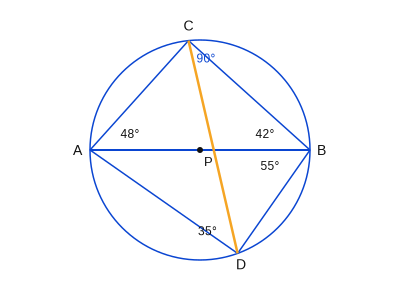
AB is the diameter of a circle with centre P. C and D are two points on the circle on either side of AB, such that ∠CAB=48∘ and ∠ABD=55∘. What is the difference between the measures of ∠CBD and ∠CAD?
AB, केंद्र P वाले एक वृत्त का व्यास है। C और D वृत्त पर AB के दोनों ओर स्थित दो बिंदु इस प्रकार हैं कि ∠CAB=48∘ और ∠ABD=55∘। ∠CBD और ∠CAD के मापों के बीच अंतर क्या है?
  1. A14∘
  2. B11∘
  3. C18∘
  4. D8∘
Show answer

Concept: The angle in a semicircle is 90∘, and the angles of a triangle add to 180∘.

  1. In △ACB: ∠ACB=90∘, ∠CAB=48∘ → ∠CBA=42∘.
  2. In △ADB: ∠ADB=90∘, ∠ABD=55∘ → ∠BAD=35∘.
  3. C and D are on opposite sides of AB, so ∠CBD=42∘+55∘=97∘ and ∠CAD=48∘+35∘=83∘.
  4. Difference =97∘−83∘=14∘.

Trick: ∠CBD+∠CAD=180∘ (opposite angles of cyclic quadrilateral ACBD); difference =(42+55)−(48+35).

Answer: (A) 14∘

अवधारणा: अर्धवृत्त का कोण 90∘ होता है और त्रिभुज के कोणों का योग 180∘।

  1. △ACB में: ∠ACB=90∘, ∠CAB=48∘ → ∠CBA=42∘।
  2. △ADB में: ∠ADB=90∘, ∠ABD=55∘ → ∠BAD=35∘।
  3. C और D, AB के विपरीत ओर हैं, अतः ∠CBD=42∘+55∘=97∘ और ∠CAD=48∘+35∘=83∘।
  4. अंतर =97∘−83∘=14∘।

ट्रिक: ∠CBD+∠CAD=180∘ (चक्रीय चतुर्भुज ACBD के सम्मुख कोण); अंतर =(42+55)−(48+35)।

उत्तर: (A) 14∘

RRB NTPC Graduate CBT 1MathematicsCircle – Angle in a SemicircleRRB NTPC Graduate CBT 1 2025 · 16 Mar Shift 3 →
Q16788.
100 men have provisions for 27 days. If 55 men have left, for how many days the same provisions would last for the remaining men?
100 आदमियों के लिए 27 दिनों की खाद्य-सामग्री है। यदि 55 आदमी चले जाएँ, तो वही खाद्य-सामग्री शेष आदमियों के लिए कितने दिनों तक चलेगी?
  1. A60
  2. B64
  3. C62
  4. D58
Show answer

Concept: Provisions are fixed, so men×days is constant.

  1. Remaining men =100−55=45.
  2. 100×27=45×d.
  3. d=270045=60 days.

Trick: Fewer men → more days; 10045=209, so 27×209=60.

Answer: (A) 60

अवधारणा: राशन निश्चित है, अतः आदमी×दिन स्थिर रहता है।

  1. बचे आदमी =100−55=45।
  2. 100×27=45×d।
  3. d=270045=60 दिन।

ट्रिक: कम आदमी → ज़्यादा दिन; 10045=209, अतः 27×209=60।

उत्तर: (A) 60

RRB NTPC Graduate CBT 1MathematicsInverse Variation (Men & Provisions)RRB NTPC Graduate CBT 1 2025 · 16 Mar Shift 3 →
Q16789.
The price of each article of type P, Q, and R is ₹280, ₹180 and ₹115, respectively. Tejas buys articles of each type in the ratio 4 : 2 : 5 for ₹6,165. How many articles of type Q did he purchase?
P, Q और R प्रकार की प्रत्येक वस्तु का मूल्य क्रमशः ₹280, ₹180 और ₹115 है। तेजस ₹6,165 में प्रत्येक प्रकार की वस्तुएँ 4 : 2 : 5 के अनुपात में खरीदता है। उसने Q प्रकार की कितनी वस्तुएँ खरीदीं?
  1. A14
  2. B6
  3. C3
  4. D12
Show answer

Concept: Let the numbers bought be 4k,2k,5k and equate total cost.

  1. Cost =4k×280+2k×180+5k×115=1120k+360k+575k=2055k.
  2. 2055k=6165⇒k=3.
  3. Articles of type Q =2k=6.

Trick: Cost of one 'set' (4P+2Q+5R) =2055; 6165÷2055=3 sets.

Answer: (B) 6

अवधारणा: खरीदी संख्याएँ 4k,2k,5k मानकर कुल लागत बराबर रखें।

  1. लागत =4k×280+2k×180+5k×115=1120k+360k+575k=2055k।
  2. 2055k=6165⇒k=3।
  3. Q प्रकार की वस्तुएँ =2k=6।

ट्रिक: एक 'सेट' (4P+2Q+5R) की लागत =2055; 6165÷2055=3 सेट।

उत्तर: (B) 6

RRB NTPC Graduate CBT 1MathematicsRatio – Cost of ArticlesRRB NTPC Graduate CBT 1 2025 · 16 Mar Shift 3 →
Q16790.
Find the mode of the following frequency distribution. (Round off the answer to two decimal places.)
Class0-1010-2020-3030-4040-50
Frequency58122010
निम्नलिखित बारंबारता बंटन का बहुलक (mode) ज्ञात कीजिए। (उत्तर को दो दशमलव स्थानों तक पूर्णांकित कीजिए।)
वर्ग: 0-10, 10-20, 20-30, 30-40, 40-50
बारंबारता: 5, 8, 12, 20, 10
  1. A32.25
  2. B31.51
  3. C33.35
  4. D34.44
Show answer

Concept: Mode=l+f1−f02f1−f0−f2×h, where f1 is the highest frequency.

  1. Modal class =30–40 (f1=20), l=30, h=10, f0=12, f2=10.
  2. Mode=30+20−1240−12−10×10=30+8018.
  3. =30+4.44=34.44.

Trick: Mode always lies inside the modal class (30–40) – only option D qualifies.

Answer: (D) 34.44

अवधारणा: बहुलक=l+f1−f02f1−f0−f2×h, जहाँ f1 सबसे अधिक बारंबारता है।

  1. बहुलक वर्ग =30–40 (f1=20), l=30, h=10, f0=12, f2=10।
  2. बहुलक=30+20−1240−12−10×10=30+8018।
  3. =30+4.44=34.44।

ट्रिक: बहुलक हमेशा बहुलक वर्ग (30–40) के भीतर होता है – केवल विकल्प D इसमें है।

उत्तर: (D) 34.44

RRB NTPC Graduate CBT 1MathematicsStatistics – ModeRRB NTPC Graduate CBT 1 2025 · 16 Mar Shift 3 →
Q16791.
What should come in place of ‘?’ in the given series?
45 65 81 93 101 ?
दी गई श्रेणी में ‘?’ के स्थान पर क्या आना चाहिए?
45 65 81 93 101 ?
  1. A105
  2. B103
  3. C106
  4. D104
Show answer

Concept: Look at consecutive differences.

  1. 65−45=20, 81−65=16, 93−81=12, 101−93=8.
  2. Differences fall by 4 each time: 20,16,12,8 → next 4.
  3. 101+4=105.

Trick: Decreasing differences in an arithmetic pattern – just continue the step.

Answer: (A) 105

अवधारणा: क्रमागत अंतर देखें।

  1. 65−45=20, 81−65=16, 93−81=12, 101−93=8।
  2. अंतर हर बार 4 घटता है: 20,16,12,8 → अगला 4।
  3. 101+4=105।

ट्रिक: समांतर रूप से घटते अंतर – बस अगला कदम बढ़ाएँ।

उत्तर: (A) 105

RRB NTPC Graduate CBT 1MathematicsNumber SeriesRRB NTPC Graduate CBT 1 2025 · 16 Mar Shift 3 →
Q16792.
A woman travelled at a speed of 20 m/min for 90 min, and at a speed of 55 m/min for 60 min. Her average speed (in m/min) for the entire journey is:
एक महिला 90 मिनट तक 20 m/min की चाल से और 60 मिनट तक 55 m/min की चाल से यात्रा करती है। संपूर्ण यात्रा के लिए उसकी औसत चाल (m/min में) है:
  1. A27
  2. B40
  3. C38
  4. D34
Show answer

Concept: Average speed=total distancetotal time.

  1. Distance 1 =20×90=1800m; distance 2 =55×60=3300m.
  2. Total distance =5100m, total time =150 min.
  3. Average =5100150=34m/min.

Trick: Time-weighted mean: 20×3+55×25=1705=34.

Answer: (D) 34

अवधारणा: औसत चाल=कुल दूरीकुल समय।

  1. दूरी 1 =20×90=1800m; दूरी 2 =55×60=3300m।
  2. कुल दूरी =5100m, कुल समय =150 मिनट।
  3. औसत =5100150=34m/min।

ट्रिक: समय-भारित माध्य: 20×3+55×25=1705=34।

उत्तर: (D) 34

RRB NTPC Graduate CBT 1MathematicsAverage SpeedRRB NTPC Graduate CBT 1 2025 · 16 Mar Shift 3 →
Q16793.
Three friends travel along three consecutive segments: from P to Q, Q to R, and R to S. Their speeds on these segments are 48 km/h, 72 km/h, and 96 km/h, respectively. The distances of the three segments are in the ratio 2 : 3 : 1, and the total distance from P to S is 480 km. Calculate the average speed for the entire journey.
तीन मित्र तीन क्रमागत खंडों पर यात्रा करते हैं: P से Q, Q से R, और R से S। इन खंडों पर उनकी चाल क्रमशः 48 km/h, 72 km/h और 96 km/h है। तीन खंडों की दूरियाँ 2 : 3 : 1 के अनुपात में हैं, और P से S तक की कुल दूरी 480 km है। संपूर्ण यात्रा के लिए औसत चाल की गणना कीजिए।
  1. A58 km/h
  2. B64 km/h
  3. C65 km/h
  4. D68 km/h
Show answer

Concept: Average speed =total distancetotal time; find each segment's time.

  1. Distances =2:3:1 of 480 → 160,240,80 km.
  2. Times: 16048=103 h, 24072=103 h, 8096=56 h.
  3. Total time =103+103+56=456=7.5 h.
  4. Average speed =4807.5=64km/h.

Trick: Work with 1 km units: 248+372+196=4+4+196=996 h per 6 km → 6×969=64.

Answer: (B) 64 km/h

अवधारणा: औसत चाल =कुल दूरीकुल समय; हर खंड का समय निकालें।

  1. दूरियाँ 480 का 2:3:1 → 160,240,80 km।
  2. समय: 16048=103 h, 24072=103 h, 8096=56 h।
  3. कुल समय =103+103+56=456=7.5 h।
  4. औसत चाल =4807.5=64km/h।

ट्रिक: इकाई दूरी से: 248+372+196=996 h प्रति 6 km → 6×969=64।

उत्तर: (B) 64 km/h

RRB NTPC Graduate CBT 1MathematicsAverage SpeedRRB NTPC Graduate CBT 1 2025 · 16 Mar Shift 3 →
Q16794.
The total surface area of a solid cube each side of which is 84 cm long is:
एक ठोस घन, जिसकी प्रत्येक भुजा 84 cm लंबी है, का कुल पृष्ठीय क्षेत्रफल है:
  1. A42365 cm2
  2. B42292 cm2
  3. C42359 cm2
  4. D42336 cm2
Show answer

Concept: Total surface area of a cube =6a2.

  1. a=84 cm → a2=7056.
  2. 6×7056=42336cm2.

Trick: 842=(80+4)2=6400+640+16=7056; unit digit 6×6=36 → ends in 6, only option D.

Answer: (D) 42336cm2

अवधारणा: घन का कुल पृष्ठीय क्षेत्रफल =6a2।

  1. a=84 cm → a2=7056।
  2. 6×7056=42336cm2।

ट्रिक: 842=(80+4)2=6400+640+16=7056; इकाई अंक 6×6=36 → 6 पर समाप्त, केवल विकल्प D।

उत्तर: (D) 42336cm2

RRB NTPC Graduate CBT 1MathematicsMensuration – CubeRRB NTPC Graduate CBT 1 2025 · 16 Mar Shift 3 →
Q16795.
At what rate per annum will a sum of money become five times itself in 5 years under simple interest?
साधारण ब्याज पर कोई धनराशि 5 वर्षों में अपने से पाँच गुनी किस वार्षिक दर पर हो जाएगी?
  1. A82%
  2. B160%
  3. C80%
  4. D78%
Show answer

Concept: If a sum becomes n times under SI, interest =(n−1)P and R=(n−1)×100T.

  1. Five times → SI =4P in 5 years.
  2. R=4×1005=80% per annum.

Trick: R×T=(n−1)×100 → R=4005=80.

Answer: (C) 80%

अवधारणा: साधारण ब्याज में राशि n गुना हो तो ब्याज =(n−1)P और R=(n−1)×100T।

  1. पाँच गुना → SI =4P, 5 वर्ष में।
  2. R=4×1005=80% वार्षिक।

ट्रिक: R×T=(n−1)×100 → R=4005=80।

उत्तर: (C) 80%

RRB NTPC Graduate CBT 1MathematicsSimple InterestRRB NTPC Graduate CBT 1 2025 · 16 Mar Shift 3 →
Q16796.
Shan has ₹1407 with him. He divides this amount between his two sons, Piyush and Manoj, and asks them to invest their respective shares at a compound interest rate of 10% per annum, compounded annually. It is observed that Piyush’s investment amounts to the same value after 18 years as Manoj’s investment does after 19 years. How much (in ₹) did Shan give to Manoj?
शान के पास ₹1407 हैं। वह इस राशि को अपने दो पुत्रों, पीयूष और मनोज, के बीच बाँटता है और उन्हें अपने-अपने हिस्से को 10% वार्षिक चक्रवृद्धि ब्याज की दर पर, वार्षिक रूप से संयोजित, निवेश करने के लिए कहता है। यह देखा गया कि पीयूष का निवेश 18 वर्षों के बाद उसी मूल्य का हो जाता है जितना मनोज का निवेश 19 वर्षों के बाद होता है। शान ने मनोज को कितनी राशि (₹ में) दी?
  1. A670
  2. B837
  3. C737
  4. D520
Show answer

Concept: If amounts are equal after different periods, the shares are in the inverse ratio of growth factors.

  1. P(1.1)18=M(1.1)19⇒P=1.1M.
  2. Piyush : Manoj =11:10; total 21 parts =1407 → one part =67.
  3. Manoj =10×67= ₹670.

Trick: One extra year at 10% → ratio 11:10; the big '18 years / 19 years' is only to scare.

Answer: (A) 670

अवधारणा: अलग-अलग अवधि के बाद मिश्रधन बराबर हो तो हिस्से वृद्धि-गुणकों के व्युत्क्रम अनुपात में होते हैं।

  1. P(1.1)18=M(1.1)19⇒P=1.1M।
  2. पीयूष : मनोज =11:10; कुल 21 भाग =1407 → एक भाग =67।
  3. मनोज =10×67= ₹670।

ट्रिक: 10% पर एक अतिरिक्त वर्ष → अनुपात 11:10; '18 वर्ष / 19 वर्ष' केवल डराने के लिए है।

उत्तर: (A) 670

RRB NTPC Graduate CBT 1MathematicsCompound Interest – Equal AmountsRRB NTPC Graduate CBT 1 2025 · 16 Mar Shift 3 →
Q16797.
In an election between two candidates, 80% of the registered voters cast their vote and 10% of the votes polled were found invalid. Winning candidate got 89% of the valid votes and won the election by a margin of 351 votes. How many voters were registered?
दो उम्मीदवारों के बीच एक चुनाव में, पंजीकृत मतदाताओं के 80% ने मतदान किया और डाले गए मतों के 10% अवैध पाए गए। विजेता उम्मीदवार को वैध मतों के 89% मत मिले और वह 351 मतों के अंतर से चुनाव जीता। कितने मतदाता पंजीकृत थे?
  1. A625
  2. B650
  3. C600
  4. D675
Show answer

Concept: Margin = (winner % − loser %) of valid votes; chain the percentages back to registered voters.

  1. Let registered voters =N. Polled =0.8N; valid =90% of that =0.72N.
  2. Winner 89%, loser 11% → margin =78% of 0.72N=0.5616N.
  3. 0.5616N=351⇒N=625.

Trick: 351=0.78×450, and 450=0.72×625.

Answer: (A) 625

अवधारणा: अंतर = वैध मतों का (विजेता % − पराजित %); प्रतिशतों को पंजीकृत मतदाताओं तक पीछे जोड़ें।

  1. पंजीकृत मतदाता =N मानें। डाले गए =0.8N; वैध = उसका 90%=0.72N।
  2. विजेता 89%, पराजित 11% → अंतर =0.72N का 78%=0.5616N।
  3. 0.5616N=351⇒N=625।

ट्रिक: 351=0.78×450, और 450=0.72×625।

उत्तर: (A) 625

RRB NTPC Graduate CBT 1MathematicsPercentage – ElectionsRRB NTPC Graduate CBT 1 2025 · 16 Mar Shift 3 →
Q16798.
Based on the English alphabetical order, three of the following four letter-cluster pairs are alike in a certain way and thus form a group. Which is the one that does not belong to that group?
(Note: The odd man out is not based on the number of consonants/vowels or their position in the letter-cluster.)
अंग्रेज़ी वर्णमाला क्रम के आधार पर, निम्नलिखित चार अक्षर-समूह युग्मों में से तीन एक निश्चित प्रकार से समान हैं और इस प्रकार एक समूह बनाते हैं। वह कौन-सा है जो उस समूह से संबंधित नहीं है?
(नोट: असंगत विकल्प व्यंजनों/स्वरों की संख्या या अक्षर-समूह में उनकी स्थिति पर आधारित नहीं है।)
  1. ARV−WA
  2. BPT−UY
  3. CGK−LP
  4. DEI−IP
Show answer

Concept: Write the alphabet positions and look for a common gap inside each pair.

  1. RV–WA: R(18)→V(22) is +4; W(23)→A(1) is +4 (after Z we wrap to A).
  2. PT–UY: P(16)→T(20) +4; U(21)→Y(25) +4. GK–LP: G(7)→K(11) +4; L(12)→P(16) +4.
  3. Also the second cluster starts just after the first cluster's last letter (V→W, T→U, K→L).
  4. EI–IP: E(5)→I(9) +4, but I(9)→P(16) is +7, and the second cluster starts at I, not J. Pattern broken.

Trick: In such questions check the gap inside each cluster first; the pair whose second cluster has a different gap is the odd one.

Answer: (D) EI−IP

अवधारणा: अक्षरों की स्थिति लिखकर हर जोड़े के अंदर का अंतर देखें।

  1. RV–WA: R(18)→V(22) = +4; W(23)→A(1) = +4 (Z के बाद A)।
  2. PT–UY: +4, +4। GK–LP: +4, +4।
  3. दूसरा समूह पहले समूह के अंतिम अक्षर के ठीक बाद वाले अक्षर से शुरू होता है (V→W, T→U, K→L)।
  4. EI–IP: E→I = +4, पर I(9)→P(16) = +7; पैटर्न टूट गया।

ट्रिक: पहले हर समूह के भीतर का अंतर जाँचें; जिस जोड़े के दूसरे समूह का अंतर अलग हो वही odd one है।

उत्तर: (D) EI−IP

RRB NTPC Graduate CBT 1General Intelligence and ReasoningLetter-cluster classificationRRB NTPC Graduate CBT 1 2025 · 16 Mar Shift 3 →
Q16799.
DIME is related to HNIZ in a certain way based on the English alphabetical order. In the same way, LSEU is related to PXAP. To which of the following is TCWK related, following the same logic?
अंग्रेज़ी वर्णमाला क्रम के आधार पर DIME, HNIZ से एक निश्चित प्रकार से संबंधित है। उसी प्रकार, LSEU, PXAP से संबंधित है। उसी तर्क का अनुसरण करते हुए, TCWK निम्नलिखित में से किससे संबंधित है?
  1. AYGTE
  2. BWIRG
  3. CVHSD
  4. DXHSF
Show answer

Concept: Find the position shift of each letter in the given pairs and apply the same shifts.

  1. DIME → HNIZ: D+4=H, I+5=N, M−4=I, E−5=Z (going back past A wraps to Z).
  2. LSEU → PXAP: L+4=P, S+5=X, E−4=A, U−5=P ✓ (pattern +4, +5, −4, −5).
  3. TCWK: T+4=X, C+5=H, W−4=S, K−5=F → XHSF.

Trick: Verify the rule on the second given pair before applying it; here the signs alternate (+4, +5, −4, −5).

Answer: (D) XHSF

अवधारणा: दिए गए जोड़ों में हर अक्षर का स्थान-परिवर्तन निकालें और वही नियम लगाएँ।

  1. DIME → HNIZ: D+4=H, I+5=N, M−4=I, E−5=Z (A से पीछे जाने पर Z)।
  2. LSEU → PXAP: L+4=P, S+5=X, E−4=A, U−5=P ✓ (नियम +4, +5, −4, −5)।
  3. TCWK: T+4=X, C+5=H, W−4=S, K−5=F → XHSF।

ट्रिक: नियम को दूसरे दिए गए जोड़े पर जाँच लें; यहाँ चिह्न बदलते हैं (+4, +5, −4, −5)।

उत्तर: (D) XHSF

RRB NTPC Graduate CBT 1General Intelligence and ReasoningLetter-cluster analogyRRB NTPC Graduate CBT 1 2025 · 16 Mar Shift 3 →
Q16800.
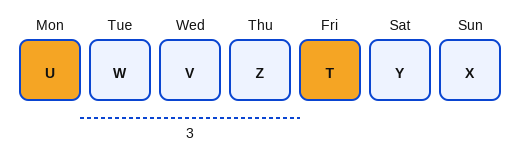
Each of T, U, V, W, X, Y and Z has an engagement on a different day of a week starting from Monday and ending on Sunday of the same week. V has
engagement on the third day of the week. Only one person has engagement after Y. Only three people have engagement between V and X. Only one person has engagement between W and Z. T has engagement immediately after Z. How many people have engagement between U and T?
T, U, V, W, X, Y और Z में से प्रत्येक का एक ही सप्ताह के सोमवार से रविवार तक के अलग-अलग दिन एक कार्यक्रम (engagement) है। V का
कार्यक्रम सप्ताह के तीसरे दिन है। Y के बाद केवल एक व्यक्ति का कार्यक्रम है। V और X के बीच केवल तीन व्यक्तियों का कार्यक्रम है। W और Z के बीच केवल एक व्यक्ति का कार्यक्रम है। T का कार्यक्रम Z के ठीक बाद है। U और T के बीच कितने व्यक्तियों का कार्यक्रम है?
  1. AOneएक
  2. BThreeतीन
  3. CFourचार
  4. DTwoदो
Show answer

Concept: Fix the definite positions first (V, Y, X), then fit the pair Z–T and W.

  1. V = Wednesday. Only one after Y → Y = Saturday. Three between V and X → X = Sunday.
  2. Z and T are consecutive (T right after Z) in the free days Mon, Tue, Thu, Fri. If Z = Mon, T = Tue, then W would need to be Wed – taken. So Z = Thu, T = Fri.
  3. One between W and Z → W = Tue (Sat is taken). U gets Monday.
  4. Between U (Mon) and T (Fri): Tue, Wed, Thu = three people.

Trick: Draw seven boxes; the 'only one after Y' type clue pins a position instantly.

Answer: (B) Three

अवधारणा: पहले निश्चित स्थान (V, Y, X) भरें, फिर Z–T की जोड़ी और W बैठाएँ।

  1. V = बुधवार। Y के बाद केवल एक → Y = शनिवार। V और X के बीच तीन → X = रविवार।
  2. Z के ठीक बाद T; खाली दिन सोम, मंगल, गुरु, शुक्र। Z = सोम, T = मंगल लें तो W बुध पर आएगा – व्यस्त। अतः Z = गुरु, T = शुक्र।
  3. W और Z के बीच एक → W = मंगल। U = सोमवार।
  4. U (सोम) और T (शुक्र) के बीच: मंगल, बुध, गुरु = तीन।

ट्रिक: सात खाने बनाएँ; 'Y के बाद केवल एक' जैसा सुराग तुरंत स्थान तय कर देता है।

उत्तर: (B) Three

RRB NTPC Graduate CBT 1General Intelligence and ReasoningScheduling puzzle (days)RRB NTPC Graduate CBT 1 2025 · 16 Mar Shift 3 →