Question bank

Q&A: practice questions with answers

Search questions on any topic. Filter by exam category, exam, subject and topic, try the question, then open the answer and explanation.

Courses – airGurukul

20,719 questions found.

Q16861.
How often does India submit its Biennial Update Reports (BURs) to the UNFCCC?
भारत UNFCCC को अपनी द्विवार्षिक अद्यतन रिपोर्ट (Biennial Update Reports – BURs) कितनी बार प्रस्तुत करता है?
  1. AEvery two yearsप्रति दो वर्ष
  2. BEvery three yearsप्रति तीन वर्ष
  3. CEvery yearप्रति वर्ष
  4. DEvery five yearsप्रति पाँच वर्ष
Show answer

Concept: Under the UNFCCC, developing countries (non-Annex I) submit Biennial Update Reports (BURs) on their greenhouse-gas inventories and mitigation actions.

  1. "Biennial" means once in two years; India has submitted BUR-1 (2016), BUR-2 (2018), BUR-3 (2021) and BUR-4 (2024).
  2. Under the Paris Agreement these are now being replaced by Biennial Transparency Reports (BTRs), also every two years.

Yaad rakhein: Bi-ennial = 2 years; Bi-annual = twice a year.

Answer: (A) Every two years

अवधारणा: UNFCCC के अंतर्गत विकासशील देश (गैर-अनुबंध I) अपने ग्रीनहाउस गैस सूची और शमन कार्यों पर द्विवार्षिक अद्यतन रिपोर्ट (BUR) प्रस्तुत करते हैं।

  1. "Biennial" का अर्थ है दो वर्ष में एक बार; भारत ने BUR-1 (2016), BUR-2 (2018), BUR-3 (2021) और BUR-4 (2024) प्रस्तुत की हैं।
  2. पेरिस समझौते के तहत अब इनकी जगह द्विवार्षिक पारदर्शिता रिपोर्ट (BTR) ले रही हैं, वे भी हर दो वर्ष में।

याद रखें: Bi-ennial = 2 वर्ष; Bi-annual = वर्ष में दो बार।

उत्तर: (A) हर दो वर्ष में
RRB NTPC Graduate CBT 1General AwarenessUNFCCC Biennial Update ReportsRRB NTPC Graduate CBT 1 2025 · 16 Mar Shift 2 →
Q16862.
Which Constitutional Amendment Act added Bodo, Dogri, Maithili, and Santhali to the Eighth Schedule of the Indian Constitution?
किस संविधान संशोधन अधिनियम ने बोडो, डोगरी, मैथिली और संथाली को भारतीय संविधान की आठवीं अनुसूची में जोड़ा?
  1. A93rd Amendment Act, 200593वाँ संशोधन अधिनियम, 2005
  2. B86th Amendment Act, 200286वाँ संशोधन अधिनियम, 2002
  3. C92nd Amendment Act, 200392वाँ संशोधन अधिनियम, 2003
  4. D91st Amendment Act, 200391वाँ संशोधन अधिनियम, 2003
Show answer

Concept: The Eighth Schedule lists the officially recognised languages; it has been expanded three times.

  1. 21st Amendment (1967) added Sindhi; 71st (1992) added Konkani, Manipuri, Nepali; 92nd Amendment Act, 2003 added Bodo, Dogri, Maithili and Santhali, taking the total to 22.
  2. 86th (2002) made education a fundamental right (Art. 21A); 91st (2003) limited the size of the council of ministers; 93rd (2005) enabled OBC reservation in educational institutions.

Yaad rakhein: 92nd → "BDMS" (Bodo, Dogri, Maithili, Santhali) → 22 languages.

Answer: (C) 92nd Amendment Act, 2003

अवधारणा: आठवीं अनुसूची में आधिकारिक रूप से मान्यता प्राप्त भाषाएँ हैं; इसका तीन बार विस्तार हुआ।

  1. 21वाँ संशोधन (1967) – सिंधी; 71वाँ (1992) – कोंकणी, मणिपुरी, नेपाली; 92वाँ संशोधन अधिनियम, 2003 – बोडो, डोगरी, मैथिली और संथाली, कुल 22 भाषाएँ।
  2. 86वाँ (2002) – शिक्षा का मौलिक अधिकार (अनु. 21A); 91वाँ (2003) – मंत्रिपरिषद का आकार सीमित; 93वाँ (2005) – शिक्षण संस्थानों में OBC आरक्षण।

याद रखें: 92वाँ → "BDMS" (बोडो, डोगरी, मैथिली, संथाली) → 22 भाषाएँ।

उत्तर: (C) 92वाँ संशोधन अधिनियम, 2003

RRB NTPC Graduate CBT 1General AwarenessEighth Schedule – 92nd AmendmentRRB NTPC Graduate CBT 1 2025 · 16 Mar Shift 2 →
Q16863.
Who were the "Samantas" in the post-Gupta period?
गुप्तोत्तर काल में "सामंत" कौन थे?
  1. AReligious headsधार्मिक प्रमुख
  2. BFarmersकिसान
  3. CArchitectsवास्तुकार
  4. DFeudal lordsसामंती सरदार (Feudal lords)
Show answer

Concept: In the post-Gupta period (6th–8th century) land grants created a class of intermediaries between the king and the peasants.

  1. Samantas were feudal lords / subordinate chiefs who held land, collected revenue, kept troops and paid tribute to the overlord – the hallmark of Indian feudalism.
  2. Over time powerful Samantas (Mahasamanta) became independent rulers, e.g. many Rajput dynasties.

Yaad rakhein: Samanta → Sam-ant = "border chief" → feudal lord; not priest, farmer or architect.

Answer: (D) Feudal lords

अवधारणा: गुप्तोत्तर काल (6वीं–8वीं शताब्दी) में भूमि-अनुदानों से राजा और किसानों के बीच मध्यस्थों का एक वर्ग बना।

  1. सामंत सामंती सरदार (feudal lords) / अधीनस्थ शासक थे जो भूमि रखते, राजस्व वसूलते, सेना रखते और अधिपति को कर देते थे – भारतीय सामंतवाद की मुख्य पहचान।
  2. समय के साथ शक्तिशाली सामंत (महासामंत) स्वतंत्र शासक बन गए, जैसे कई राजपूत वंश।

याद रखें: सामंत = "सीमा का सरदार" → सामंती स्वामी; पुजारी, किसान या वास्तुकार नहीं।

उत्तर: (D) सामंती स्वामी (Feudal lords)

RRB NTPC Graduate CBT 1General AwarenessPost-Gupta FeudalismRRB NTPC Graduate CBT 1 2025 · 16 Mar Shift 2 →
Q16864.
A major characteristic of computer systems is Diligence. Which of the following scenarios primarily highlights a limitation of the computer system that is not overcome by its diligence?
कंप्यूटर प्रणालियों की एक प्रमुख विशेषता अथक परिश्रम (Diligence) है। निम्नलिखित में से कौन-सा परिदृश्य मुख्य रूप से कंप्यूटर प्रणाली की ऐसी सीमा को दर्शाता है जिसे उसकी यह विशेषता दूर नहीं कर पाती?
  1. AA computer is used to book flights in the morning and write code in the afternoon.एक कंप्यूटर का उपयोग सुबह उड़ानें बुक करने और दोपहर में कोड लिखने के लिए किया जाता है।
  2. BA computer performs trillions of calculations a second, much faster than any human.एक कंप्यूटर प्रति सेकंड खरबों गणनाएँ करता है, जो किसी भी मनुष्य से बहुत तेज़ है।
  3. CA computer continues processing data for 72 hours straight without any loss of attention.एक कंप्यूटर बिना ध्यान भंग हुए लगातार 72 घंटे तक डेटा संसाधित करता रहता है।
  4. DA computer generates incorrect output because the initial data entered was flawed.एक कंप्यूटर गलत आउटपुट देता है क्योंकि प्रारंभ में डाला गया डेटा ही त्रुटिपूर्ण था।
Show answer

Concept: Diligence means a computer can work for hours without tiredness or loss of concentration – but it has no intelligence of its own and depends entirely on the data and instructions given (GIGO – Garbage In, Garbage Out).

  1. Option (D): wrong input → wrong output; diligence cannot fix flawed data – this is the limitation.
  2. (A) shows versatility, (B) speed and (C) diligence itself – all strengths, not limitations.

Yaad rakhein: Computer limitations = no IQ, no feelings, GIGO, needs electricity.

Answer: (D) A computer generates incorrect output because the initial data entered was flawed.

अवधारणा: Diligence (परिश्रमशीलता) का अर्थ है कंप्यूटर घंटों बिना थके या ध्यान खोए काम कर सकता है – पर उसकी अपनी कोई बुद्धि नहीं, वह पूरी तरह दिए गए डेटा और निर्देशों पर निर्भर है (GIGO – Garbage In, Garbage Out)।

  1. विकल्प (D): गलत इनपुट → गलत आउटपुट; परिश्रमशीलता त्रुटिपूर्ण डेटा को ठीक नहीं कर सकती – यही सीमा है।
  2. (A) बहुमुखी प्रतिभा, (B) गति और (C) स्वयं परिश्रमशीलता दर्शाते हैं – ये सब खूबियाँ हैं, सीमाएँ नहीं।

याद रखें: कंप्यूटर की सीमाएँ = कोई IQ नहीं, भावनाएँ नहीं, GIGO, बिजली पर निर्भर।

उत्तर: (D) प्रारंभिक डेटा त्रुटिपूर्ण होने से कंप्यूटर गलत आउटपुट देता है।

RRB NTPC Graduate CBT 1General AwarenessCharacteristics of ComputersRRB NTPC Graduate CBT 1 2025 · 16 Mar Shift 2 →
Q16865.
Which of the following cabinet committees is NOT headed by the Prime Minister?
निम्नलिखित में से किस मंत्रिमंडलीय समिति की अध्यक्षता प्रधानमंत्री नहीं करते हैं?
  1. ACabinet committee on employment and skill developmentरोजगार और कौशल विकास पर मंत्रिमंडलीय समिति
  2. BCabinet committee on economic affairsआर्थिक मामलों पर मंत्रिमंडलीय समिति
  3. CCabinet committee on investment and growthनिवेश और विकास पर मंत्रिमंडलीय समिति
  4. DCabinet committee on parliamentary affairsसंसदीय मामलों पर मंत्रिमंडलीय समिति
Show answer

Concept: Cabinet committees are extra-constitutional bodies set up under the Rules of Business; most key ones are chaired by the Prime Minister.

  1. PM chairs: Appointments, Economic Affairs, Political Affairs, Security, Investment and Growth, Employment and Skill Development.
  2. The Cabinet Committee on Parliamentary Affairs is headed by the senior-most minister (currently the Defence Minister), not the PM; the Accommodation committee is headed by the Home Minister.

Yaad rakhein: Two committees NOT under the PM – Parliamentary Affairs and Accommodation.

Answer: (D) Cabinet committee on parliamentary affairs

अवधारणा: मंत्रिमंडलीय समितियाँ संविधानेतर निकाय हैं जो कार्य-नियमों के तहत बनती हैं; अधिकांश प्रमुख समितियों की अध्यक्षता प्रधानमंत्री करते हैं।

  1. PM की अध्यक्षता: नियुक्ति, आर्थिक मामले, राजनीतिक मामले, सुरक्षा, निवेश और विकास, रोज़गार और कौशल विकास।
  2. संसदीय मामलों की मंत्रिमंडलीय समिति की अध्यक्षता वरिष्ठतम मंत्री (वर्तमान में रक्षा मंत्री) करते हैं, PM नहीं; आवास समिति की अध्यक्षता गृह मंत्री करते हैं।

याद रखें: PM के अधीन न होने वाली दो समितियाँ – संसदीय मामले और आवास।

उत्तर: (D) संसदीय मामलों की मंत्रिमंडलीय समिति

RRB NTPC Graduate CBT 1General AwarenessCabinet CommitteesRRB NTPC Graduate CBT 1 2025 · 16 Mar Shift 2 →
Q16866.
A number when increased by 25% becomes equal to another number, which is 20% less than a third number. What is the ratio of the first number to the third number?
एक संख्या में 25% की वृद्धि करने पर वह एक दूसरी संख्या के बराबर हो जाती है, जो एक तीसरी संख्या से 20% कम है। पहली संख्या और तीसरी संख्या का अनुपात क्या है?
  1. A9:16
  2. B25:36
  3. C16:25
  4. D27:38
Show answer

Concept: Convert each percentage statement into a multiplier and link the numbers.

  1. Let the numbers be A, B, C. A×125100=B and B=C×80100.
  2. So 5A4=4C5 → 25A=16C.
  3. A:C=16:25.

Trick: +25%=54, −20%=45; equate 54A=45C → A:C=45·45=16:25.

Answer: (C) 16:25

अवधारणा: हर प्रतिशत कथन को गुणक (multiplier) में बदलकर संख्याओं को जोड़ें।

  1. संख्याएँ A, B, C लें। A×125100=B और B=C×80100।
  2. अतः 5A4=4C5 → 25A=16C।
  3. A:C=16:25।

ट्रिक: +25%=54, −20%=45; 54A=45C → A:C=16:25।

उत्तर: (C) 16:25

RRB NTPC Graduate CBT 1MathematicsPercentage – Ratio of NumbersRRB NTPC Graduate CBT 1 2025 · 16 Mar Shift 2 →
Q16867.
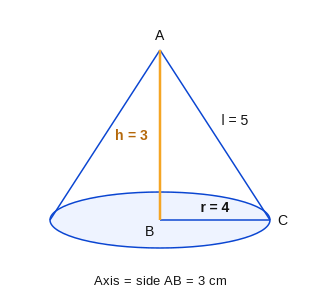
A triangle ABC with sides 3 cm, 4 cm and 5 cm is revolved about the side 3 cm. Find the volume of the solid so obtained. (Use π=3.14)
3 cm, 4 cm और 5 cm भुजाओं वाले एक त्रिभुज ABC को 3 cm वाली भुजा के परितः घुमाया जाता है। इस प्रकार प्राप्त ठोस का आयतन ज्ञात कीजिए। (π=3.14 का प्रयोग कीजिए)
  1. A55.61 cubic cm55.61 घन cm
  2. B40.55 cubic cm40.55 घन cm
  3. C42.62 cubic cm42.62 घन cm
  4. D50.24 cubic cm50.24 घन cm
Show answer

Concept: A right triangle revolved about one leg forms a cone: that leg is the height, the other leg is the radius, the hypotenuse is the slant height.

  1. Sides 3, 4, 5 form a right triangle (32+42=52). Revolving about the side 3 cm: h=3, r=4, l=5.
  2. V=13πr2h=13×3.14×16×3
  3. =3.14×16=50.24cm3.

Trick: The axis of rotation is the height; the other leg sweeps the circle (radius). Revolving about 4 cm would give 37.68 instead.

Answer: (D) 50.24 cubic cm

अवधारणा: समकोण त्रिभुज को एक भुजा के परितः घुमाने पर शंकु बनता है: वह भुजा ऊँचाई, दूसरी भुजा त्रिज्या, कर्ण तिर्यक ऊँचाई।

  1. 3, 4, 5 समकोण त्रिभुज है (32+42=52)। 3 cm भुजा के परितः घुमाने पर h=3, r=4, l=5।
  2. V=13πr2h=13×3.14×16×3
  3. =3.14×16=50.24cm3।

ट्रिक: घूर्णन अक्ष = ऊँचाई; दूसरी भुजा वृत्त बनाती है (त्रिज्या)। 4 cm के परितः घुमाने पर 37.68 आता।

उत्तर: (D) 50.24 cubic cm

RRB NTPC Graduate CBT 1MathematicsMensuration – Cone from Revolving TriangleRRB NTPC Graduate CBT 1 2025 · 16 Mar Shift 2 →
Q16868.
If the equations x2 – 3px + q = 0 and x2 – 2kx + t = 0 have one common root, and the first equation has equal roots, what is the value of (t + q)2?
यदि समीकरणों x2 – 3px + q = 0 और x2 – 2kx + t = 0 का एक मूल उभयनिष्ठ है, और पहले समीकरण के मूल समान हैं, तो (t + q)2 का मान क्या है?
  1. A0
  2. B4pk
  3. C9p2k2
  4. D(3p−2k)
Show answer

Concept: Equal roots ⇒ discriminant zero and root =−b2a; the common root satisfies both equations.

  1. x2−3px+q=0 has equal roots: 9p2=4q → q=9p24, root α=3p2.
  2. α satisfies x2−2kx+t=0: 9p24−3pk+t=0 → t=3pk−9p24.
  3. t+q=3pk → (t+q)2=9p2k2.

Trick: With equal roots, the common root is simply the repeated root 3p2 – plug it straight in.

Answer: (C) 9p2k2

अवधारणा: समान मूल ⇒ विविक्तकर (discriminant) शून्य और मूल =−b2a; उभयनिष्ठ मूल दोनों समीकरणों को संतुष्ट करता है।

  1. x2−3px+q=0 के समान मूल: 9p2=4q → q=9p24, मूल α=3p2।
  2. α को x2−2kx+t=0 में रखें: 9p24−3pk+t=0 → t=3pk−9p24।
  3. t+q=3pk → (t+q)2=9p2k2।

ट्रिक: समान मूल होने पर उभयनिष्ठ मूल वही दोहराया मूल 3p2 है – सीधे रखें।

उत्तर: (C) 9p2k2

RRB NTPC Graduate CBT 1MathematicsQuadratic Equations – Common RootRRB NTPC Graduate CBT 1 2025 · 16 Mar Shift 2 →
Q16869.
A shopkeeper professes to sell his goods at a 60% loss but uses a false balance and gains 90%. The actual weight (rounded off to one decimal place) he uses for 1 kg is:
एक दुकानदार अपना सामान 60% हानि पर बेचने का दावा करता है, परंतु गलत तराजू का प्रयोग करके 90% लाभ कमाता है। 1 kg के लिए वह वास्तव में कितना भार (एक दशमलव स्थान तक पूर्णांकित) प्रयोग करता है?
  1. A210.5 gm
  2. B214.1 gm
  3. C209.5 gm
  4. D213.6 gm
Show answer

Concept: With a false weight, the shopkeeper charges for 1000 g but gives less; his real gain depends on the goods actually given.

  1. Let cost be ₹1 per gram. He "sells 1 kg" at a 60% loss, i.e. collects ₹0.40×1000=400.
  2. Real gain is 90%, so the cost of goods actually given =4001.9=210.53 → he gives about 210.5 g.
  3. Check: cost ₹210.5, sold for ₹400 → gain 189.5210.5≈90% ✓.

Trick: Weight given=1000×100−claimed loss%100+actual gain%=1000×40190.

Answer: (A) 210.5 gm

अवधारणा: गलत बाट से दुकानदार 1000 g का दाम लेता है पर कम देता है; वास्तविक लाभ दिए गए माल पर निर्भर करता है।

  1. लागत ₹1 प्रति ग्राम लें। 60% हानि दिखाकर "1 kg" का ₹0.40×1000=400 लेता है।
  2. वास्तविक लाभ 90%, अतः दिए गए माल की लागत =4001.9=210.53 → लगभग 210.5 g देता है।
  3. जाँच: लागत ₹210.5, बिक्री ₹400 → लाभ 189.5210.5≈90% ✓।

ट्रिक: दिया गया भार=1000×100−घोषित हानि%100+वास्तविक लाभ%=1000×40190।

उत्तर: (A) 210.5 gm

RRB NTPC Graduate CBT 1MathematicsProfit & Loss – False WeightRRB NTPC Graduate CBT 1 2025 · 16 Mar Shift 2 →
Q16870.
If 15% of 80−36×2163×36=y, then the value of y is
यदि 15% of 80−36×2163×36=y है, तो y का मान है
  1. A-6
  2. B-12
  3. C-3
  4. D-10
Show answer

Concept: Evaluate roots and "of" first, then multiplication, then subtraction.

  1. 15% of 80=12; 2163=6; 36=6.
  2. 36×6×6=18.
  3. y=12−18=−6.

Trick: "of" means multiply and ranks with brackets – do it before the minus sign.

Answer: (A) −6

अवधारणा: पहले मूल और "of", फिर गुणा, फिर घटाव।

  1. 80 का 15%=12; 2163=6; 36=6।
  2. 36×6×6=18।
  3. y=12−18=−6।

ट्रिक: "of" का अर्थ गुणा है और यह कोष्ठक के स्तर का है – घटाव से पहले करें।

उत्तर: (A) −6

RRB NTPC Graduate CBT 1MathematicsSimplification – BODMASRRB NTPC Graduate CBT 1 2025 · 16 Mar Shift 2 →
Q16871.
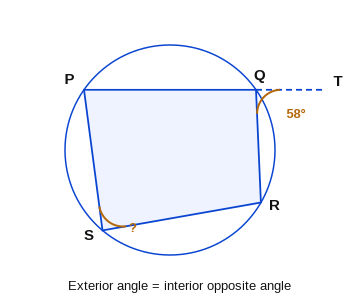
Side PQ of a cyclic quadrilateral PQRS is produced to the point T. If ∠RQT=58∘, then the measure of ∠PSR is:
एक चक्रीय चतुर्भुज PQRS की भुजा PQ को बिंदु T तक बढ़ाया जाता है। यदि ∠RQT=58∘ है, तो ∠PSR का माप है:
  1. A116°
  2. B122°
  3. C29°
  4. D58°
Show answer

Concept: In a cyclic quadrilateral the exterior angle at a vertex equals the interior opposite angle.

  1. PQ is produced to T, so ∠RQT is the exterior angle at Q.
  2. Interior opposite angle of Q is ∠PSR (at S).
  3. ∠PSR=∠RQT=58∘.
  4. Check: ∠PQR=180∘−58∘=122∘ and 122∘+58∘=180∘ ✓.

Trick: Exterior angle = opposite interior angle (because opposite angles sum to 180∘). Option A (122∘) is the trap – that is ∠PQR.

Answer: (D) 58∘

अवधारणा: चक्रीय चतुर्भुज में किसी शीर्ष का बाह्य कोण उसके सम्मुख अंतःकोण के बराबर होता है।

  1. PQ को T तक बढ़ाया गया, अतः ∠RQT शीर्ष Q का बाह्य कोण है।
  2. Q का सम्मुख अंतःकोण ∠PSR (S पर) है।
  3. ∠PSR=∠RQT=58∘।
  4. जाँच: ∠PQR=180∘−58∘=122∘ और 122∘+58∘=180∘ ✓।

ट्रिक: बाह्य कोण = सम्मुख अंतःकोण (क्योंकि सम्मुख कोणों का योग 180∘)। विकल्प A (122∘) जाल है – वह ∠PQR है।

उत्तर: (D) 58∘

RRB NTPC Graduate CBT 1MathematicsGeometry – Cyclic QuadrilateralRRB NTPC Graduate CBT 1 2025 · 16 Mar Shift 2 →
Q16872.
Suman, Kunal, and Pooja invest ₹1050, ₹1510, and ₹1280 respectively to start a business. If the profit at the end of the year is ₹1650, then what is the share of Pooja in the profit?
सुमन, कुणाल और पूजा एक व्यापार शुरू करने के लिए क्रमशः ₹1050, ₹1510 और ₹1280 का निवेश करते हैं। यदि वर्ष के अंत में लाभ ₹1650 है, तो लाभ में पूजा का हिस्सा क्या है?
  1. A₹550
  2. B₹549
  3. C₹551
  4. D₹548
Show answer

Concept: For equal time, profit is shared in the ratio of capitals.

  1. Ratio =1050:1510:1280=105:151:128 (divide by 10).
  2. Total =105+151+128=384.
  3. Pooja's share =128384×1650=13×1650=550.

Trick: 128×3=384, so Pooja gets exactly one-third of the profit – no long division needed.

Answer: (A) ₹550

अवधारणा: समान समय के लिए लाभ पूँजी के अनुपात में बँटता है।

  1. अनुपात =1050:1510:1280=105:151:128।
  2. योग =105+151+128=384।
  3. Pooja का हिस्सा =128384×1650=13×1650=550।

ट्रिक: 128×3=384, अतः Pooja को लाभ का ठीक एक-तिहाई मिलता है।

उत्तर: (A) ₹550

RRB NTPC Graduate CBT 1MathematicsPartnership – Profit SharingRRB NTPC Graduate CBT 1 2025 · 16 Mar Shift 2 →
Q16873.
The LCM of two numbers is 1116 and their HCF is 186. If one of the number is 372, then the other number is
दो संख्याओं का LCM 1116 है और उनका HCF 186 है। यदि उनमें से एक संख्या 372 है, तो दूसरी संख्या है
  1. A930
  2. B465
  3. C558
  4. D372
Show answer

Concept: For two numbers, HCF×LCM=Product of the numbers.

  1. Other number =1116×186372.
  2. 1116372=3, so the number =3×186=558.
  3. Check: HCF(372, 558) = 186 and LCM = 1116 ✓.

Trick: Cancel first: 372=2×186 and 1116=3×372 → answer =3×186.

Answer: (C) 558

अवधारणा: दो संख्याओं के लिए HCF×LCM=संख्याओं का गुणनफल।

  1. दूसरी संख्या =1116×186372।
  2. 1116372=3, अतः संख्या =3×186=558।
  3. जाँच: HCF(372, 558) = 186 और LCM = 1116 ✓।

ट्रिक: पहले काटें: 372=2×186, 1116=3×372 → उत्तर =3×186।

उत्तर: (C) 558

RRB NTPC Graduate CBT 1MathematicsHCF and LCMRRB NTPC Graduate CBT 1 2025 · 16 Mar Shift 2 →
Q16874.
If a : b :: b : c; c = 4a; and b = 6, find the positive value of c.
यदि a : b :: b : c; c = 4a; और b = 6 है, तो c का धनात्मक मान ज्ञात कीजिए।
  1. A8
  2. B16
  3. C20
  4. D12
Show answer

Concept: If a:b::b:c, then b is the mean proportional: b2=ac.

  1. b2=ac → 36=a×4a=4a2 → a2=9 → a=3 (positive).
  2. c=4a=12.
  3. Check: 3:6::6:12 ✓.

Trick: Mean proportional: b=ac. Here a·4a=2a=6 → a=3 instantly.

Answer: (D) 12

अवधारणा: यदि a:b::b:c, तो b मध्यानुपाती है: b2=ac।

  1. b2=ac → 36=a×4a=4a2 → a2=9 → a=3 (धनात्मक)।
  2. c=4a=12।
  3. जाँच: 3:6::6:12 ✓।

ट्रिक: मध्यानुपाती b=ac। यहाँ a·4a=2a=6 → a=3 तुरंत।

उत्तर: (D) 12

RRB NTPC Graduate CBT 1MathematicsRatio & Proportion – Mean ProportionalRRB NTPC Graduate CBT 1 2025 · 16 Mar Shift 2 →
Q16875.
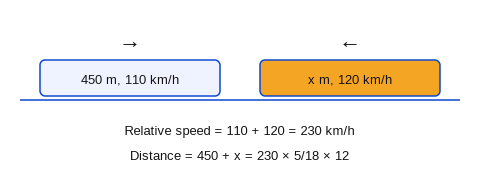
Two trains are moving in opposite directions at speeds of 110 km/hr and 120 km/hr. The length of one train is 450 m. The time taken by them to cross each other is 12 seconds. The length (in m) of the other train (rounded off to 2 decimal places) is:
दो रेलगाड़ियाँ 110 km/hr और 120 km/hr की चाल से विपरीत दिशाओं में चल रही हैं। एक रेलगाड़ी की लंबाई 450 m है। उन्हें एक-दूसरे को पार करने में 12 सेकंड लगते हैं। दूसरी रेलगाड़ी की लंबाई (m में) (2 दशमलव स्थानों तक पूर्णांकित) है:
  1. A316.67
  2. B318.7
  3. C317.34
  4. D314.28
Show answer

Concept: Trains crossing in opposite directions: relative speed = sum of speeds; distance covered = sum of lengths.

  1. Relative speed =110+120=230km/h=230×518=5759m/s.
  2. Total length =5759×12=23003=766.67m.
  3. Other train =766.67−450=316.67m.

Trick: Opposite directions → add speeds; same direction → subtract. Convert km/h to m/s with ×518.

Answer: (A) 316.67

अवधारणा: विपरीत दिशा में पार करती रेलगाड़ियाँ: सापेक्ष चाल = चालों का योग; तय दूरी = लंबाइयों का योग।

  1. सापेक्ष चाल =110+120=230km/h=230×518=5759m/s।
  2. कुल लंबाई =5759×12=23003=766.67m।
  3. दूसरी रेलगाड़ी =766.67−450=316.67m।

ट्रिक: विपरीत दिशा → चालें जोड़ें; समान दिशा → घटाएँ। km/h से m/s: ×518।

उत्तर: (A) 316.67

RRB NTPC Graduate CBT 1MathematicsTrains – Opposite DirectionsRRB NTPC Graduate CBT 1 2025 · 16 Mar Shift 2 →
Q16876.
Reema and Juhi, when each is working alone, can complete a piece of work in, respectively, 12 days and 36 days. Each work on alternate days, with Reema and Juhi starting to work on Day 1 and Day 2, respectively. How many days in all will it take to complete the work?
रीमा और जूही अकेले कार्य करते हुए एक कार्य को क्रमशः 12 दिनों और 36 दिनों में पूरा कर सकती हैं। दोनों एकांतर दिनों (alternate days) पर कार्य करती हैं, जिसमें रीमा दिन 1 को और जूही दिन 2 को कार्य शुरू करती हैं। कार्य पूरा होने में कुल कितने दिन लगेंगे?
  1. A16
  2. B24
  3. C18
  4. D28
Show answer

Concept: Take total work = LCM of days; work in 2-day cycles, then finish the remainder day by day.

  1. Work =36 units. Reema =3 units/day, Juhi =1 unit/day.
  2. One cycle (Reema day + Juhi day) =4 units in 2 days. 8 cycles =32 units in 16 days.
  3. Day 17 (Reema): 32+3=35. Day 18 (Juhi): 35+1=36 – done.
  4. Total =18 days.

Trick: Never divide 36÷4=9 cycles blindly – the last cycle may end mid-way; always check the final days.

Answer: (C) 18

अवधारणा: कुल कार्य = दिनों का LCM; 2-दिन के चक्रों में कार्य करें, फिर शेष दिन-दर-दिन।

  1. कार्य =36 इकाई। Reema =3 इकाई/दिन, Juhi =1 इकाई/दिन।
  2. एक चक्र (Reema + Juhi) =4 इकाई, 2 दिन में। 8 चक्र =32 इकाई, 16 दिन में।
  3. दिन 17 (Reema): 32+3=35। दिन 18 (Juhi): 35+1=36 – पूर्ण।
  4. कुल =18 दिन।

ट्रिक: 36÷4=9 चक्र आँख मूँदकर न लें – अंतिम चक्र बीच में खत्म हो सकता है; अंतिम दिन अवश्य जाँचें।

उत्तर: (C) 18

RRB NTPC Graduate CBT 1MathematicsTime & Work – Alternate DaysRRB NTPC Graduate CBT 1 2025 · 16 Mar Shift 2 →
Q16877.
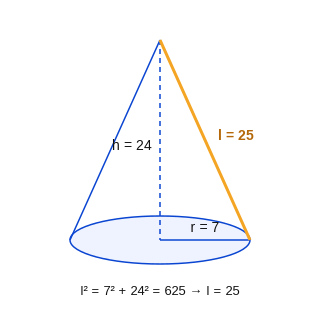
A conical tent is to be made for a school event. The radius of the base is 7 metres, and the height of the tent is 24 metres. A decorative cloth is to be used to cover the entire curved surface area of the tent. The cloth costs ₹40 per square metre. What will be the total cost of the cloth required? (Use π=227)
एक विद्यालय के कार्यक्रम के लिए एक शंक्वाकार तंबू बनाया जाना है। आधार की त्रिज्या 7 मीटर है और तंबू की ऊँचाई 24 मीटर है। तंबू के संपूर्ण वक्र पृष्ठीय क्षेत्रफल को ढकने के लिए एक सजावटी कपड़े का प्रयोग किया जाना है। कपड़े की कीमत ₹40 प्रति वर्ग मीटर है। आवश्यक कपड़े की कुल लागत क्या होगी? (π=227 का प्रयोग कीजिए)
  1. A₹21,000
  2. B₹22,000
  3. C₹23,800
  4. D₹22,800
Show answer

Concept: Curved surface area of a cone =πrl, where slant height l=r2+h2.

  1. l=72+242=49+576=625=25m.
  2. CSA =227×7×25=550m2.
  3. Cost =550×40= ₹22,000.

Trick: 7–24–25 is a Pythagorean triplet; with r=7 and π=227 the 7 cancels → CSA =22×l.

Answer: (B) ₹22,000

अवधारणा: शंकु का वक्र पृष्ठीय क्षेत्रफल =πrl, जहाँ तिर्यक ऊँचाई l=r2+h2।

  1. l=72+242=49+576=625=25m।
  2. CSA =227×7×25=550m2।
  3. लागत =550×40= ₹22,000।

ट्रिक: 7–24–25 पाइथागोरस त्रिक है; r=7 और π=227 में 7 कट जाता है → CSA =22×l।

उत्तर: (B) ₹22,000

RRB NTPC Graduate CBT 1MathematicsMensuration – Cone (CSA)RRB NTPC Graduate CBT 1 2025 · 16 Mar Shift 2 →
Q16878.
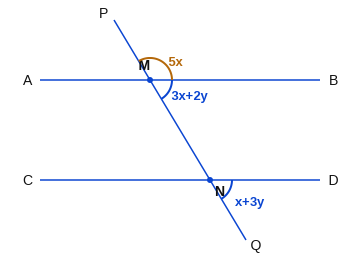
Line AB is parallel to line CD. A transversal PQ intersects AB at M and CD at N. If ∠PMB=(5x)∘, ∠BMN=(3x+2y)∘ and ∠DNQ=(x+3y)∘, then find the value of ∠BMN.
रेखा AB रेखा CD के समांतर है। एक तिर्यक रेखा PQ, AB को M पर और CD को N पर काटती है। यदि ∠PMB=(5x)∘, ∠BMN=(3x+2y)∘ और ∠DNQ=(x+3y)∘ है, तो ∠BMN का मान ज्ञात कीजिए।
  1. A112∘
  2. B100∘
  3. C98∘
  4. D105∘
Show answer

Concept: On a straight line adjacent angles sum to 180∘; for parallel lines, corresponding angles are equal.

  1. At M, ∠PMB and ∠BMN form a linear pair: 5x+3x+2y=180 → 8x+2y=180 … (i)
  2. ∠BMN and ∠DNQ are corresponding angles (AB ∥ CD): 3x+2y=x+3y → y=2x … (ii)
  3. From (i): 8x+4x=180 → x=15, y=30.
  4. ∠BMN=3(15)+2(30)=45+60=105∘.

Trick: Check: ∠PMB=75∘ and 75∘+105∘=180∘ ✓; ∠DNQ=15+90=105∘ ✓.

Answer: (D) 105∘

अवधारणा: सरल रेखा पर आसन्न कोणों का योग 180∘; समांतर रेखाओं के संगत कोण बराबर।

  1. M पर ∠PMB और ∠BMN रैखिक युग्म: 5x+3x+2y=180 → 8x+2y=180 … (i)
  2. ∠BMN और ∠DNQ संगत कोण (AB ∥ CD): 3x+2y=x+3y → y=2x … (ii)
  3. (i) से: 8x+4x=180 → x=15, y=30।
  4. ∠BMN=3(15)+2(30)=45+60=105∘।

ट्रिक: जाँच: ∠PMB=75∘, 75∘+105∘=180∘ ✓; ∠DNQ=15+90=105∘ ✓।

उत्तर: (D) 105∘

RRB NTPC Graduate CBT 1MathematicsGeometry – Parallel Lines & TransversalRRB NTPC Graduate CBT 1 2025 · 16 Mar Shift 2 →
Q16879.
The average of 11 results is 61. If the average of the first 6 results is 64 and that of the last 6 is 61, find the 6th result.
11 परिणामों का औसत 61 है। यदि पहले 6 परिणामों का औसत 64 है और अंतिम 6 परिणामों का औसत 61 है, तो 6वाँ परिणाम ज्ञात कीजिए।
  1. A81
  2. B80
  3. C78
  4. D79
Show answer

Concept: Sum = Average × Number. The 6th result is counted in both the first six and the last six, so it appears twice when the two sums are added.

  1. Total of 11 results =11×61=671.
  2. First 6: 6×64=384; last 6: 6×61=366; together =750.
  3. 6th result =750−671=79.

Trick: Middle term = (sum of first group + sum of last group) − total sum.

Answer: (D) 79

अवधारणा: योग = औसत × संख्या। 6वाँ परिणाम पहले छह और अंतिम छह दोनों में गिना जाता है, इसलिए दोनों योग जोड़ने पर वह दो बार आता है।

  1. 11 परिणामों का योग =11×61=671।
  2. पहले 6: 6×64=384; अंतिम 6: 6×61=366; कुल =750।
  3. 6वाँ परिणाम =750−671=79।

ट्रिक: मध्य पद = (पहले समूह का योग + अंतिम समूह का योग) − कुल योग।

उत्तर: (D) 79

RRB NTPC Graduate CBT 1MathematicsAverageRRB NTPC Graduate CBT 1 2025 · 16 Mar Shift 2 →
Q16880.
What is the mode of the data given below? [Give your answer correct to 2 decimal places.]
Age in years20-3030-4040-5050-6060-7070-8080-90
No. of patients36293522183826
नीचे दिए गए आँकड़ों का बहुलक (mode) क्या है? [अपना उत्तर 2 दशमलव स्थानों तक सही दीजिए।]
आयु (वर्षों में): 20-30, 30-40, 40-50, 50-60, 60-70, 70-80, 80-90
रोगियों की संख्या: 36, 29, 35, 22, 18, 38, 26
  1. A74.25
  2. B72.25
  3. C78.25
  4. D76.25
Show answer

Concept: For grouped data, Mode=l+f1−f02f1−f0−f2×h, where l = lower limit of the modal class (highest frequency), f1 its frequency, f0 and f2 the frequencies just before and after, h = class width.

  1. Highest frequency 38 → modal class 70–80, so l=70, f1=38, f0=18, f2=26, h=10.
  2. Mode=70+38−1876−18−26×10=70+2032×10.
  3. =70+6.25=76.25.

Trick: The denominator is simply (f1−f0)+(f1−f2)=20+12=32.

Answer: (D) 76.25

अवधारणा: वर्गीकृत आँकड़ों के लिए बहुलक=l+f1−f02f1−f0−f2×h, जहाँ l = बहुलक वर्ग (सबसे अधिक बारंबारता) की निचली सीमा, f1 उसकी बारंबारता, f0 व f2 ठीक पहले व बाद के वर्गों की बारंबारताएँ, h = वर्ग अंतराल।

  1. अधिकतम बारंबारता 38 → बहुलक वर्ग 70–80, अतः l=70, f1=38, f0=18, f2=26, h=10।
  2. बहुलक=70+38−1876−18−26×10=70+2032×10।
  3. =70+6.25=76.25।

ट्रिक: हर (denominator) बस (f1−f0)+(f1−f2)=20+12=32 है।

उत्तर: (D) 76.25

RRB NTPC Graduate CBT 1MathematicsMode of Grouped DataRRB NTPC Graduate CBT 1 2025 · 16 Mar Shift 2 →