Question bank

Q&A: practice questions with answers

Search questions on any topic. Filter by exam category, exam, subject and topic, try the question, then open the answer and explanation.

Courses – airGurukul

20,719 questions found.

Q1681.
A company offers three schemes of successive discounts.
First: 25%, 10%
Second: 20 %, 15%
Third: 30%, 5%
Which scheme is best for the company?
एक कंपनी क्रमिक छूट की तीन योजनाएँ प्रस्तुत करती है।
पहली: 25%, 10%
दूसरी: 20 %, 15%
तीसरी: 30%, 5%
कंपनी के लिए कौन-सी योजना सबसे अच्छी है?
  1. AFirst schemeपहली योजना
  2. BThird schemeतीसरी योजना
  3. CAll the schemes are sameसभी योजनाएँ समान हैं
  4. DSecond schemeदूसरी योजना
Show answer

Concept: Two successive discounts a% and b% equal a single discount of a+b−ab100 %. The scheme with the LEAST discount is best for the company.

  1. First: 25+10−250100=32.5%.
  2. Second: 20+15−300100=32%.
  3. Third: 30+5−150100=33.5%.
  4. Least discount =32% → Second scheme.

Trick: Best for the buyer = biggest discount; best for the seller/company = smallest discount.

Answer: (D) Second scheme

अवधारणा: दो क्रमिक छूट a%, b% = एकल छूट a+b−ab100 %। कंपनी के लिए वही योजना अच्छी है जिसमें छूट सबसे कम हो।

  1. पहली: 25+10−2.5=32.5%।
  2. दूसरी: 20+15−3=32%।
  3. तीसरी: 30+5−1.5=33.5%।
  4. सबसे कम छूट 32% → दूसरी योजना।

ट्रिक: ग्राहक के लिए सबसे अधिक छूट, कंपनी (विक्रेता) के लिए सबसे कम छूट वाली योजना अच्छी।

उत्तर: (D) दूसरी योजना (Second scheme)
RRB NTPC Undergraduate CBT 1MathematicsSuccessive discountsRRB NTPC Undergraduate CBT 1 2024 · 22 Aug Shift 1 →
Q1682.
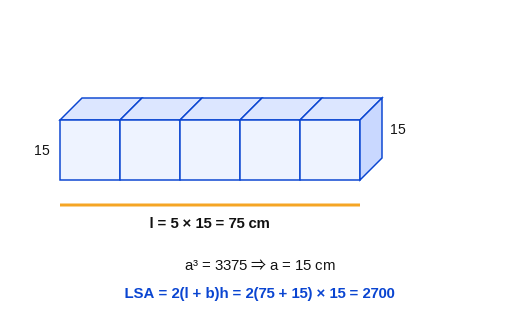
Five solid cubes, each of volume 3375 cm3, are joined end to end to form a cuboid. What is the lateral surface area (in cm2) of the cuboid?
पाँच ठोस घन, जिनमें से प्रत्येक का आयतन 3375 cm3 है, को सिरे से सिरा मिलाकर एक घनाभ बनाया जाता है। घनाभ का पार्श्व पृष्ठीय क्षेत्रफल (cm2 में) कितना है?
  1. A2700
  2. B2409
  3. C2801
  4. D2694
Show answer

Concept: Lateral surface area of a cuboid =2(l+b)h.

  1. Side of each cube: a3=3375⇒a=15cm.
  2. Five cubes in a row: l=75, b=15, h=15.
  3. LSA =2(75+15)×15=2×90×15=2700cm2.

Trick: For n cubes of side a joined in a line, LSA =2(n+1)a2=2×6×225=2700.

Answer: (A) 2700

अवधारणा: घनाभ का पार्श्व पृष्ठीय क्षेत्रफल (LSA) =2(l+b)h।

  1. प्रत्येक घन की भुजा: a3=3375⇒a=15cm।
  2. पाँच घन एक पंक्ति में: l=75, b=15, h=15।
  3. LSA =2(75+15)×15=2700cm2।

ट्रिक: n घन एक सीध में: LSA =2(n+1)a2=2×6×225=2700।

उत्तर: (A) 2700

RRB NTPC Undergraduate CBT 1MathematicsCube and cuboidRRB NTPC Undergraduate CBT 1 2024 · 22 Aug Shift 1 →
Q1683.
Anjali can do a certain piece of work in 21 days. Anjali and Ayushi can together do the same work in 12 days, and Anjali, Ayushi and Ankita can do the same work together in 8 days. In how many days can Anjali and Ankita do the same work?
अंजलि किसी कार्य को 21 दिनों में कर सकती है। अंजलि और आयुषी मिलकर उसी कार्य को 12 दिनों में कर सकती हैं, और अंजलि, आयुषी और अंकिता मिलकर उसी कार्य को 8 दिनों में कर सकती हैं। अंजलि और अंकिता मिलकर उसी कार्य को कितने दिनों में कर सकती हैं?
  1. A476
  2. B577
  3. C485
  4. D565
Show answer

Concept: One-day work adds up: if a group does a job in d days, its one-day work is 1d.

  1. Anjali =121; Ayushi =112−121=7−484=128.
  2. Ankita =18−112=3−224=124.
  3. Anjali + Ankita =121+124=8+7168=15168=556.
  4. Days =565.

Trick: Take total work = LCM(21, 12, 8) = 168 units: Anjali 8/day, all three 21/day, Anjali+Ayushi 14/day → Ankita 7/day → 1688+7=565.

Answer: (D) 565 days

अवधारणा: एक दिन का काम जुड़ता है: कोई समूह काम d दिन में करे तो एक दिन का काम 1d।

  1. अंजलि =121; आयुषी =112−121=128।
  2. अंकिता =18−112=124।
  3. अंजलि + अंकिता =121+124=15168=556।
  4. दिन =565।

ट्रिक: कुल काम = LCM(21, 12, 8) = 168 इकाई: अंजलि 8/दिन, तीनों 21/दिन, अंजलि+आयुषी 14/दिन → अंकिता 7/दिन → 16815=565।

उत्तर: (D) 565 दिन

RRB NTPC Undergraduate CBT 1MathematicsTime and workRRB NTPC Undergraduate CBT 1 2024 · 22 Aug Shift 1 →
Q1684.
If M=1+cosA1−cosA−cosecA−cotA, and A is an acute angle, then value of M is
यदि M=1+cosA1−cosA−cosecA−cotA, और A एक न्यून कोण है, तो M का मान है
  1. A1
  2. B0
  3. C2
  4. D-1
Show answer

Concept: Rationalise: 1+cosA1−cosA=1+cosAsinA, using 1−cos2A=sin2A.

  1. Multiply inside by 1+cosA1+cosA: (1+cosA)2sin2A=1+cosAsinA (positive for acute A).
  2. 1+cosAsinA=cosecA+cotA.
  3. M=(cosecA+cotA)−cosecA−cotA=0.

Trick: Put A=60∘: 1.50.5=3 and cosec60∘+cot60∘=23+13=3, so M=0.

Answer: (B) 0

अवधारणा: परिमेयकरण: 1+cosA1−cosA=1+cosAsinA, क्योंकि 1−cos2A=sin2A।

  1. अंश-हर को (1+cosA) से गुणा: (1+cosA)2sin2A=1+cosAsinA (न्यून कोण A के लिए धनात्मक)।
  2. 1+cosAsinA=cosecA+cotA।
  3. M=(cosecA+cotA)−cosecA−cotA=0।

ट्रिक: A=60∘ रखें: 3−23−13=0।

उत्तर: (B) 0

RRB NTPC Undergraduate CBT 1MathematicsTrigonometric identitiesRRB NTPC Undergraduate CBT 1 2024 · 22 Aug Shift 1 →
Q1685.
The sum of two numbers is 52 and their LCM is 627. The two numbers are:
दो संख्याओं का योग 52 है और उनका LCM 627 है। दोनों संख्याएँ हैं:
  1. A19, 33
  2. B12, 40
  3. C17, 35
  4. D24, 28
Show answer

Concept: When the sum and LCM are given, test options: the pair must add to 52 and have LCM 627.

  1. 627=3×11×19=19×33.
  2. 19 and 33 are co-prime, so LCM =19×33=627 ✓ and 19+33=52 ✓.
  3. Others fail: LCM(12, 40) = 120, LCM(17, 35) = 595, LCM(24, 28) = 168.

Trick: Factorise the LCM and look for two factors whose sum is 52.

Answer: (A) 19, 33

अवधारणा: योग और LCM दिए हों तो विकल्प जाँचें: जोड़ी का योग 52 और LCM 627 हो।

  1. 627=3×11×19=19×33।
  2. 19 और 33 सह-अभाज्य हैं, अतः LCM =627 ✓ और 19+33=52 ✓।
  3. बाकी: LCM(12, 40) = 120, LCM(17, 35) = 595, LCM(24, 28) = 168।

ट्रिक: LCM के गुणनखंड करें और ऐसे दो गुणनखंड खोजें जिनका योग 52 हो।

उत्तर: (A) 19, 33

RRB NTPC Undergraduate CBT 1MathematicsHCF and LCMRRB NTPC Undergraduate CBT 1 2024 · 22 Aug Shift 1 →
Q1686.
In covering a distance of 156 km, Abhay takes 5 hours more than Sameer. If Abhay doubles his speed, then he would take 8 hours less than Sameer. Abhay's speed is:
156 km की दूरी तय करने में अभय, समीर से 5 घंटे अधिक लेता है। यदि अभय अपनी चाल दोगुनी कर दे, तो वह समीर से 8 घंटे कम लेगा। अभय की चाल है:
  1. A16 km/hr
  2. B1 km/hr
  3. C6 km/hr
  4. D7 km/hr
Show answer

Concept: Time =DistanceSpeed. Let Abhay's speed be a and Sameer's time be t.

  1. 156a=t+5 … (1)
  2. With double speed: 1562a=78a=t−8 … (2)
  3. (1) − (2): 78a=13⇒a=6km/h.
  4. Check: Abhay 26 h, Sameer 21 h, doubled speed 13 h =21−8 ✓.

Trick: Doubling speed halves the time: half of Abhay's time is saved, and that saving =5+8=13 h, so full time =26 h → 156÷26=6.

Answer: (C) 6 km/hr

अवधारणा: समय =दूरीचाल। अभय की चाल a तथा समीर का समय t मानें।

  1. 156a=t+5 … (1)
  2. दोगुनी चाल: 78a=t−8 … (2)
  3. (1) − (2): 78a=13⇒a=6km/h।
  4. जाँच: अभय 26 घंटे, समीर 21 घंटे, दोगुनी चाल पर 13 घंटे =21−8 ✓।

ट्रिक: चाल दोगुनी → समय आधा; बचा समय =5+8=13 घंटे = आधा समय, तो पूरा समय 26 घंटे → 156÷26=6।

उत्तर: (C) 6 km/hr

RRB NTPC Undergraduate CBT 1MathematicsSpeed, distance and timeRRB NTPC Undergraduate CBT 1 2024 · 22 Aug Shift 1 →
Q1687.
Evaluate: (-9) - (-60) ÷ (-10) + (-2) × 6
मान ज्ञात कीजिए: (-9) - (-60) ÷ (-10) + (-2) × 6
  1. A-27
  2. B-30
  3. C-26
  4. D-29
Show answer

Concept: BODMAS: do division and multiplication before addition and subtraction; watch the signs.

  1. (−60)÷(−10)=6.
  2. (−2)×6=−12.
  3. (−9)−6+(−12)=−9−6−12=−27.

Trick: Negative ÷ negative = positive; then simply add all negatives: 9+6+12=27.

Answer: (A) −27

अवधारणा: BODMAS: पहले भाग और गुणा, फिर जोड़-घटाव; चिह्नों का ध्यान रखें।

  1. (−60)÷(−10)=6।
  2. (−2)×6=−12।
  3. (−9)−6+(−12)=−27।

ट्रिक: ऋणात्मक ÷ ऋणात्मक = धनात्मक; फिर सभी ऋणात्मक जोड़ें: 9+6+12=27।

उत्तर: (A) −27

RRB NTPC Undergraduate CBT 1MathematicsSimplification (BODMAS)RRB NTPC Undergraduate CBT 1 2024 · 22 Aug Shift 1 →
Q1688.
The product of two positive numbers is 10125. If the first number is five times the second number, then the sum of the two numbers is:
दो धनात्मक संख्याओं का गुणनफल 10125 है। यदि पहली संख्या, दूसरी संख्या की पाँच गुनी है, तो दोनों संख्याओं का योग है:
  1. A265
  2. B286
  3. C264
  4. D270
Show answer

Concept: Write both numbers in terms of one variable and use the product.

  1. Second =x, first =5x.
  2. 5x2=10125⇒x2=2025⇒x=45.
  3. Sum =x+5x=6x=270.

Trick: 2025=452 is worth remembering (also a year!).

Answer: (D) 270

अवधारणा: दोनों संख्याओं को एक चर में लिखकर गुणनफल का प्रयोग करें।

  1. दूसरी =x, पहली =5x।
  2. 5x2=10125⇒x2=2025⇒x=45।
  3. योग =6x=270।

ट्रिक: 2025=452 याद रखें।

उत्तर: (D) 270

RRB NTPC Undergraduate CBT 1MathematicsNumbersRRB NTPC Undergraduate CBT 1 2024 · 22 Aug Shift 1 →
Q1689.
If the interest earned during the 2nd year on a certain sum is ₹5,214, and the rate of interest is 10% per annum compounded annually, then the sum is:
यदि किसी निश्चित धनराशि पर 2रे वर्ष के दौरान अर्जित ब्याज ₹5,214 है, और ब्याज की दर 10% वार्षिक, वार्षिक रूप से चक्रवृद्धि है, तो धनराशि है:
  1. A₹47,755
  2. B₹46,650
  3. C₹47,320
  4. D₹47,400
Show answer

Concept: CI of the 2nd year = interest on (P + 1st year interest) =P×R100×(1+R100).

  1. 2nd-year interest =P×0.1×1.1=0.11P.
  2. 0.11P=5214⇒P=52140.11=47400.

Trick: At 10%, 1st year interest =10% of P, 2nd year =11% of P. So P=5214×10011.

Answer: (D) ₹47,400

अवधारणा: दूसरे वर्ष का CI = (P + पहले वर्ष का ब्याज) पर ब्याज =P×R100×(1+R100)।

  1. दूसरे वर्ष का ब्याज =P×0.1×1.1=0.11P।
  2. 0.11P=5214⇒P=47400।

ट्रिक: 10% पर पहले वर्ष ब्याज = P का 10%, दूसरे वर्ष = P का 11%; P=5214×10011।

उत्तर: (D) ₹47,400

RRB NTPC Undergraduate CBT 1MathematicsCompound interestRRB NTPC Undergraduate CBT 1 2024 · 22 Aug Shift 1 →
Q1690.
A trader claims to sell pulses at a profit of 3%, but also dishonestly uses a weight which is 15% less than what is mentioned on it. Find the total percentage of profit earned by the trader. (Round off the answer to the nearest whole number.)
एक व्यापारी 3% लाभ पर दालें बेचने का दावा करता है, परंतु साथ ही बेईमानी से ऐसे बाट का उपयोग करता है जो उस पर अंकित भार से 15% कम है। व्यापारी द्वारा अर्जित कुल लाभ प्रतिशत ज्ञात कीजिए। (उत्तर को निकटतम पूर्ण संख्या तक पूर्णांकित कीजिए।)
  1. A26%
  2. B20%
  3. C21%
  4. D16%
Show answer

Concept: With a false weight the trader gives only 85% of the goods but charges the price of 100%, plus 3% profit on that price.

  1. Cost of goods actually given =0.85 (per unit of true price).
  2. Money received =1.03.
  3. Profit %=1.03−0.850.85×100=1885×100≈21.18%≈21%.

Trick: Profit %=(100+p)−(100−w)100−w×100=103−8585×100.

Answer: (C) 21%

अवधारणा: कम तौल से व्यापारी केवल 85% माल देता है पर दाम 100% का लेता है, और उस पर 3% लाभ भी।

  1. वास्तव में दिए माल का क्रय मूल्य =0.85।
  2. प्राप्त राशि =1.03।
  3. लाभ%=1.03−0.850.85×100=1885×100≈21%।

ट्रिक: लाभ%=(100+p)−(100−w)100−w×100=103−8585×100।

उत्तर: (C) 21%

RRB NTPC Undergraduate CBT 1MathematicsProfit and loss (false weight)RRB NTPC Undergraduate CBT 1 2024 · 22 Aug Shift 1 →
Q1691.
Kushal and Brijesh together invested ₹63,300 in a business. At the end of the year, out of a total profit of ₹17,600, Brijesh's share was ₹2,200. What was the difference between their investments?
कुशल और बृजेश ने मिलकर एक व्यवसाय में ₹63,300 का निवेश किया। वर्ष के अंत में, ₹17,600 के कुल लाभ में से बृजेश का हिस्सा ₹2,200 था। उनके निवेशों के बीच कितना अंतर था?
  1. A₹48,876
  2. B₹45,979
  3. C₹47,475
  4. D₹46,154
Show answer

Concept: For the same period, profit is shared in the ratio of investments.

  1. Brijesh's share =220017600=18 of profit, so Kushal's =78.
  2. Investment ratio K : B =7:1; total =63300, so 1 part =633008=7912.5.
  3. Difference =7−1=6 parts =6×7912.5=47475.

Trick: Difference =7−18×63300=34×63300=47475.

Answer: (C) ₹47,475

अवधारणा: समान अवधि हो तो लाभ निवेश के अनुपात में बँटता है।

  1. बृजेश का हिस्सा =220017600=18, कुशल का =78।
  2. निवेश अनुपात K : B =7:1; 1 भाग =633008=7912.5।
  3. अंतर =6 भाग =6×7912.5=47475।

ट्रिक: अंतर =68×63300=34×63300=47475।

उत्तर: (C) ₹47,475

RRB NTPC Undergraduate CBT 1MathematicsPartnershipRRB NTPC Undergraduate CBT 1 2024 · 22 Aug Shift 1 →
Q1692.
Pipe A can fill a tank in 13 hours, pipe B can fill the same tank in 29 hours and pipe C can fill the same tank in 10 hours. The time taken by them to fill the same tank if they operate together is::
पाइप A एक टंकी को 13 घंटे में भर सकता है, पाइप B उसी टंकी को 29 घंटे में भर सकता है और पाइप C उसी टंकी को 10 घंटे में भर सकता है। यदि वे एक साथ कार्य करें, तो उसी टंकी को भरने में उनके द्वारा लिया गया समय है:
  1. A11582797 hours11582797 घंटे
  2. B3582797 hours3582797 घंटे
  3. C4582797 hours4582797 घंटे
  4. D10582797 hours10582797 घंटे
Show answer

Concept: Pipes working together: add their one-hour work.

  1. 113+129+110=290+130+3773770=7973770.
  2. Time =3770797 hours.
  3. 797×4=3188, remainder 3770−3188=582, so time =4582797 hours.

Trick: Estimate first: C alone takes 10 h, so together it must be well below 10 h; and 3770797≈4.7, so only 4582797 fits.

Answer: (C) 4582797 hours

अवधारणा: साथ चलने पर एक घंटे का काम जोड़ें।

  1. 113+129+110=290+130+3773770=7973770।
  2. समय =3770797 घंटे।
  3. 797×4=3188, शेष 582, अतः समय =4582797 घंटे।

ट्रिक: अनुमान: अकेला C 10 घंटे लेता है, तो साथ में समय 10 से काफ़ी कम होगा; 3770797≈4.7।

उत्तर: (C) 4582797 घंटे

RRB NTPC Undergraduate CBT 1MathematicsPipes and cisternsRRB NTPC Undergraduate CBT 1 2024 · 22 Aug Shift 1 →
Q1693.
The average runs scored by a batsman in 23 matches is 42. In the next 10 matches, the batsman scored an average of 14 runs. Find his average runs scored (rounded off to two decimal places) in all the 33 matches.
एक बल्लेबाज़ द्वारा 23 मैचों में बनाए गए रनों का औसत 42 है। अगले 10 मैचों में बल्लेबाज़ ने 14 रन का औसत बनाया। सभी 33 मैचों में उसके द्वारा बनाए गए रनों का औसत (दो दशमलव स्थानों तक पूर्णांकित) ज्ञात कीजिए।
  1. A33.52
  2. B32.52
  3. C35.52
  4. D34.52
Show answer

Concept: Overall average =total runstotal matches.

  1. Runs in 23 matches =23×42=966.
  2. Runs in next 10 =10×14=140.
  3. Average =966+14033=110633≈33.52.

Trick: Deviation method: 42−10×(42−14)33=42−28033=42−8.48=33.52.

Answer: (A) 33.52

अवधारणा: कुल औसत =कुल रनकुल मैच।

  1. 23 मैचों के रन =23×42=966।
  2. अगले 10 के रन =10×14=140।
  3. औसत =110633≈33.52।

ट्रिक: विचलन विधि: 42−10×2833=42−8.48=33.52।

उत्तर: (A) 33.52

RRB NTPC Undergraduate CBT 1MathematicsAverageRRB NTPC Undergraduate CBT 1 2024 · 22 Aug Shift 1 →
Q1694.
The income of Raman is ₹60,500. He saves 26% of his income. If his income increases by 17% and expenditure increases by 50%, then his savings will:
रमन की आय ₹60,500 है। वह अपनी आय का 26% बचाता है। यदि उसकी आय में 17% की वृद्धि होती है और व्यय में 50% की वृद्धि होती है, तो उसकी बचत:
  1. Aincrease by ₹12,099₹12,099 बढ़ जाएगी
  2. Bdecrease by ₹12,095₹12,095 घट जाएगी
  3. Cdecrease by ₹12,100₹12,100 घट जाएगी
  4. Dincrease by ₹12,098₹12,098 बढ़ जाएगी
Show answer

Concept: Savings = Income − Expenditure; apply each percentage change to its own base.

  1. Savings =26% of 60500 =15730; expenditure =60500−15730=44770.
  2. New income =1.17×60500=70785; new expenditure =1.5×44770=67155.
  3. New savings =70785−67155=3630.
  4. Change =3630−15730=−12100 → decrease of ₹12,100.

Trick: Change in savings = change in income − change in expenditure =10285−22385=−12100.

Answer: (C) decrease by ₹12,100

अवधारणा: बचत = आय − व्यय; हर प्रतिशत परिवर्तन अपने आधार पर लगाएँ।

  1. बचत =60500 का 26%=15730; व्यय =44770।
  2. नई आय =1.17×60500=70785; नया व्यय =1.5×44770=67155।
  3. नई बचत =70785−67155=3630।
  4. परिवर्तन =3630−15730=−12100 → ₹12,100 की कमी।

ट्रिक: बचत में बदलाव = आय में बदलाव − व्यय में बदलाव =10285−22385=−12100।

उत्तर: (C) ₹12,100 की कमी (decrease by ₹12,100)

RRB NTPC Undergraduate CBT 1MathematicsIncome, expenditure and savingsRRB NTPC Undergraduate CBT 1 2024 · 22 Aug Shift 1 →
Q1695.
Mr. Sharma, Mr. Gupta and Ms. Sinha invested ₹4,000, ₹8,000 and ₹6,000, respectively, in a business. Mr. Sharma left the business after 6 months. If after 8 months, there was a gain of ₹34,000, then what will be the share of Mr. Gupta?
श्री शर्मा, श्री गुप्ता और सुश्री सिन्हा ने एक व्यवसाय में क्रमशः ₹4,000, ₹8,000 और ₹6,000 का निवेश किया। श्री शर्मा ने 6 माह बाद व्यवसाय छोड़ दिया। यदि 8 माह बाद ₹34,000 का लाभ हुआ, तो श्री गुप्ता का हिस्सा कितना होगा?
  1. A₹12,000
  2. B₹20,000
  3. C₹16,000
  4. D₹14,000
Show answer

Concept: Profit share ∝ investment × time.

  1. Sharma: 4000×6=24000; Gupta: 8000×8=64000; Sinha: 6000×8=48000.
  2. Ratio =24:64:48=3:8:6 (total 17).
  3. Gupta's share =817×34000=16000.

Trick: Cancel the 1000s and common factors early: (4×6):(8×8):(6×8)=3:8:6.

Answer: (C) ₹16,000

अवधारणा: लाभ का हिस्सा ∝ निवेश × समय।

  1. शर्मा: 4000×6=24000; गुप्ता: 8000×8=64000; सिन्हा: 6000×8=48000।
  2. अनुपात =3:8:6 (कुल 17)।
  3. गुप्ता का हिस्सा =817×34000=16000।

ट्रिक: हज़ार हटाकर सरल करें: (4×6):(8×8):(6×8)=3:8:6।

उत्तर: (C) ₹16,000

RRB NTPC Undergraduate CBT 1MathematicsPartnershipRRB NTPC Undergraduate CBT 1 2024 · 22 Aug Shift 1 →
Q1696.
Based on the English alphabetical order, three of the following four letter-cluster pairs are alike in a certain way and thus form a group. Which letter-cluster pair DOES NOT belong to that group?
(Note: The odd one out is not based on the number of consonants/vowels or their position in the letter-cluster.)
अंग्रेज़ी वर्णमाला क्रम के आधार पर, निम्नलिखित चार अक्षर-समूह युग्मों में से तीन किसी निश्चित प्रकार से एकसमान हैं और इस प्रकार एक समूह बनाते हैं। कौन-सा अक्षर-समूह युग्म उस समूह से संबंधित नहीं है?
(ध्यान दें: असंगत अक्षर-समूह, उस अक्षर-समूह में व्यंजनों/स्वरों की संख्या या उनके स्थान पर आधारित नहीं है।)
  1. AGI-LE
  2. BJL-OH
  3. CMO-RK
  4. DDF-IC
Show answer

Concept: Check the letter gaps inside each pair: 1st→2nd, 2nd→3rd, 3rd→4th letter.

  1. GI-LE: G +2 I, I +3 L, L −7 E.
  2. JL-OH: J +2 L, L +3 O, O −7 H; MO-RK: M +2 O, O +3 R, R −7 K.
  3. DF-IC: D +2 F, F +3 I, but I −6 C → breaks the pattern.

Trick: Write positions (G7, I9, L12, E5) and compare differences; the last gap is the giveaway.

Answer: (D) DF-IC

अवधारणा: हर जोड़ी में अक्षरों का अंतर देखें: पहला→दूसरा, दूसरा→तीसरा, तीसरा→चौथा।

  1. GI-LE: G +2 I, I +3 L, L −7 E।
  2. JL-OH: +2, +3, −7; MO-RK: +2, +3, −7।
  3. DF-IC: +2, +3, पर I −6 C → अलग।

ट्रिक: स्थानांक लिखें (G7, I9, L12, E5) और अंतर मिलाएँ; अंतिम अंतर से ही विषम पकड़ में आता है।

उत्तर: (D) DF-IC

RRB NTPC Undergraduate CBT 1General Intelligence and ReasoningLetter-cluster odd one outRRB NTPC Undergraduate CBT 1 2024 · 22 Aug Shift 1 →
Q1697.
What will come in the place of the question mark (?) in the following equation, if ‘÷’ and ‘×’ are interchanged and ‘−‘ and ‘+’ are interchanged?
117 + 16 − 10 × 2 ÷ 2 − 68 + 10 × 5 − 9 = ?
यदि ‘÷’ और ‘×’ को आपस में बदल दिया जाए तथा ‘−‘ और ‘+’ को आपस में बदल दिया जाए, तो निम्नलिखित समीकरण में प्रश्न चिह्न (?) के स्थान पर क्या आएगा?
117 + 16 − 10 × 2 ÷ 2 − 68 + 10 × 5 − 9 = ?
  1. A124
  2. B96
  3. C168
  4. D186
Show answer

Concept: Swap the signs first, then solve with BODMAS.

  1. After swapping: 117−16+10÷2×2+68−10÷5+9.
  2. 10÷2×2=10 and 10÷5=2.
  3. 117−16+10+68−2+9=186.

Trick: Rewrite the whole expression once with new signs before calculating — avoids sign slips.

Answer: (D) 186

अवधारणा: पहले चिह्न बदलें, फिर BODMAS लगाएँ।

  1. बदलने के बाद: 117−16+10÷2×2+68−10÷5+9।
  2. 10÷2×2=10 और 10÷5=2।
  3. 117−16+10+68−2+9=186।

ट्रिक: नए चिह्नों के साथ पूरा व्यंजक एक बार दोबारा लिखें, फिर हल करें।

उत्तर: (D) 186

RRB NTPC Undergraduate CBT 1General Intelligence and ReasoningMathematical operationsRRB NTPC Undergraduate CBT 1 2024 · 22 Aug Shift 1 →
Q1698.
Based on the English alphabetical order, three of the following four letter-clusters are alike in a certain way and thus form a group. Which letter-cluster DOES NOT belong to that group?
(Note: The odd one out is not based on the number of consonants/vowels or their position in the letter-cluster.)
अंग्रेज़ी वर्णमाला क्रम के आधार पर, निम्नलिखित चार अक्षर-समूहों में से तीन किसी निश्चित प्रकार से एकसमान हैं और इस प्रकार एक समूह बनाते हैं। कौन-सा अक्षर-समूह उस समूह से संबंधित नहीं है?
(ध्यान दें: असंगत अक्षर-समूह, उस अक्षर-समूह में व्यंजनों/स्वरों की संख्या या उनके स्थान पर आधारित नहीं है।)
  1. AINS
  2. BQBA
  3. CTYD
  4. DUZE
Show answer

Concept: Find the gap between consecutive letters (positions, counting cyclically after Z).

  1. INS: I(9) +5 N(14) +5 S(19).
  2. TYD: T(20) +5 Y(25) +5 D(4, after Z); UZE: U(21) +5 Z(26) +5 E(5).
  3. QBA: Q(17) → B(2) → A(1) — not +5, +5.

Trick: Use the EJOTY landmarks (5, 10, 15, 20, 25) to count +5 jumps fast.

Answer: (B) QBA

अवधारणा: क्रमागत अक्षरों का अंतर देखें (Z के बाद फिर A से गिनें)।

  1. INS: I(9) +5 N(14) +5 S(19)।
  2. TYD: T(20) +5 Y(25) +5 D; UZE: U(21) +5 Z(26) +5 E।
  3. QBA: Q(17) → B(2) → A(1) — +5, +5 नहीं।

ट्रिक: EJOTY (5, 10, 15, 20, 25) से +5 की छलांग जल्दी गिनें।

उत्तर: (B) QBA

RRB NTPC Undergraduate CBT 1General Intelligence and ReasoningLetter-cluster odd one outRRB NTPC Undergraduate CBT 1 2024 · 22 Aug Shift 1 →
Q1699.
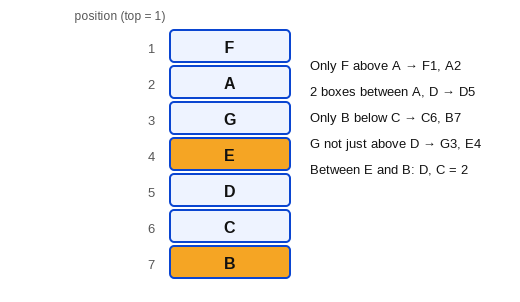
Seven boxes, A, B, C, D, E, F and G, are kept one over the other but not necessarily in the same order.
Only F is kept above A. Only two boxes are kept between A and D. Only B is kept below C. G is not kept immediately above D.
How many boxes are kept between B and E?
सात बक्से, A, B, C, D, E, F और G, एक के ऊपर एक रखे गए हैं, परंतु आवश्यक नहीं कि इसी क्रम में हों।
A के ऊपर केवल F रखा गया है। A और D के बीच केवल दो बक्से रखे गए हैं। C के नीचे केवल B रखा गया है। G को D के ठीक ऊपर नहीं रखा गया है।
B और E के बीच कितने बक्से रखे गए हैं?
  1. A1
  2. B4
  3. C3
  4. D2
Show answer

Concept: Number positions from the top (1) to the bottom (7) and place the fixed clues first.

  1. Only F above A → F at 1, A at 2.
  2. Two boxes between A and D → D at 5. Only B below C → C at 6, B at 7.
  3. E and G fill 3, 4; G is not immediately above D (not 4) → G 3, E 4.
  4. Between E (4) and B (7): D and C → 2 boxes.

Trick: 'Only X above Y' puts X at the top and Y second — always start from such clues.

Answer: (D) 2

अवधारणा: स्थान ऊपर से (1) नीचे (7) तक गिनें और पहले निश्चित संकेत लगाएँ।

  1. केवल F, A के ऊपर → F 1, A 2।
  2. A और D के बीच दो → D 5। केवल B, C के नीचे → C 6, B 7।
  3. E, G को 3, 4 में; G, D के ठीक ऊपर नहीं (4 नहीं) → G 3, E 4।
  4. E (4) और B (7) के बीच: D, C → 2 बॉक्स।

ट्रिक: 'केवल X, Y के ऊपर' का अर्थ X सबसे ऊपर और Y दूसरा — ऐसे संकेत से शुरू करें।

उत्तर: (D) 2

RRB NTPC Undergraduate CBT 1General Intelligence and ReasoningBox arrangementRRB NTPC Undergraduate CBT 1 2024 · 22 Aug Shift 1 →
Q1700.
What should come in place of the question mark (?) in the given series based on the English alphabetical order?
RUM ORJ LOG ILD ?
अंग्रेज़ी वर्णमाला क्रम के आधार पर दी गई शृंखला में प्रश्न चिह्न (?) के स्थान पर क्या आना चाहिए?
RUM ORJ LOG ILD ?
  1. AFJA
  2. BFIA
  3. CFIB
  4. DFJB
Show answer

Concept: Track each letter position separately.

  1. 1st letters: R, O, L, I → −3 each → F.
  2. 2nd letters: U, R, O, L → −3 → I.
  3. 3rd letters: M, J, G, D → −3 → A.

Trick: All three positions move −3 together, so just shift ILD back by 3: FIA.

Answer: (B) FIA

अवधारणा: हर स्थान के अक्षर को अलग से देखें।

  1. पहले अक्षर: R, O, L, I → −3 → F।
  2. दूसरे: U, R, O, L → −3 → I।
  3. तीसरे: M, J, G, D → −3 → A।

ट्रिक: तीनों अक्षर −3 से चलते हैं, तो ILD को 3 पीछे करें: FIA।

उत्तर: (B) FIA

RRB NTPC Undergraduate CBT 1General Intelligence and ReasoningLetter seriesRRB NTPC Undergraduate CBT 1 2024 · 22 Aug Shift 1 →