Question bank

Q&A: practice questions with answers

Search questions on any topic. Filter by exam category, exam, subject and topic, try the question, then open the answer and explanation.

Courses – airGurukul

20,719 questions found.

Q1701.
Read the given statements and conclusions carefully. Assuming that the information given in the statements is true, even if it appears to be at variance with commonly known facts, decide which of the given conclusions logically follow(s) from the statements.
Statements: Some kites are hats. No hat is a ant.
Conclusion (I): Some kites are ants.
Conclusion (II): Some hats are kites.
दिए गए कथनों और निष्कर्षों को ध्यानपूर्वक पढ़िए। यह मानते हुए कि कथनों में दी गई जानकारी सत्य है, भले ही वह सामान्य रूप से ज्ञात तथ्यों से भिन्न प्रतीत होती हो, निर्णय लीजिए कि दिए गए निष्कर्षों में से कौन-सा/कौन-से निष्कर्ष कथनों का तार्किक रूप से अनुसरण करता है/करते हैं।
कथन: कुछ पतंगें, टोपियाँ हैं। कोई टोपी, चींटी नहीं है।
निष्कर्ष (I): कुछ पतंगें, चींटियाँ हैं।
निष्कर्ष (II): कुछ टोपियाँ, पतंगें हैं।
  1. AOnly conclusion (I) follows.केवल निष्कर्ष (I) अनुसरण करता है।
  2. BOnly conclusion (II) follows.केवल निष्कर्ष (II) अनुसरण करता है।
  3. CNeither conclusion (I) nor (II) follows.न तो निष्कर्ष (I) और न ही (II) अनुसरण करता है।
  4. DBoth conclusions (I) and (II) follow.दोनों निष्कर्ष (I) और (II) अनुसरण करते हैं।
Show answer

Concept: 'Some A are B' can be reversed to 'Some B are A'. A link through a 'No' statement gives no definite 'Some' conclusion.
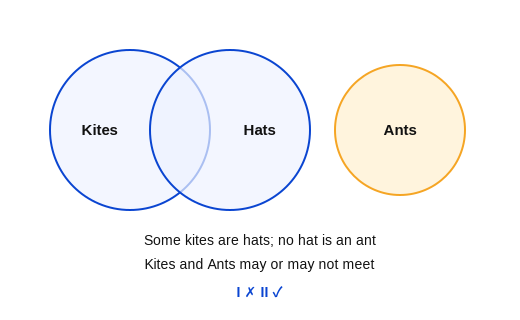
  1. II: 'Some kites are hats' → 'Some hats are kites' (conversion) → follows.
  2. I: Hats and ants never meet, but kites outside hats may or may not be ants → not definite → does not follow.

Yaad rakhein: Some + No ⇒ only 'Some A are not C'; never 'Some A are C'.

Answer: (B) Only conclusion (II) follows.

अवधारणा: 'कुछ A, B हैं' को उलटकर 'कुछ B, A हैं' लिख सकते हैं। 'कोई नहीं' वाले कथन से होकर निश्चित 'कुछ' निष्कर्ष नहीं बनता।

  1. II: 'कुछ पतंग टोपियाँ हैं' → 'कुछ टोपियाँ पतंग हैं' → अनुसरण करता है।
  2. I: टोपी और चींटी कभी नहीं मिलते, पर टोपी से बाहर वाली पतंगें चींटी हो भी सकती हैं, नहीं भी → निश्चित नहीं।

याद रखें: कुछ + कोई नहीं ⇒ केवल 'कुछ A, C नहीं हैं'; 'कुछ A, C हैं' कभी नहीं।

उत्तर: (B) केवल निष्कर्ष (II) अनुसरण करता है।
RRB NTPC Undergraduate CBT 1General Intelligence and ReasoningSyllogismRRB NTPC Undergraduate CBT 1 2024 · 22 Aug Shift 1 →
Q1702.
Each of the digits in the number 7231456 is arranged in ascending order from left to right. What will be the sum of the digits which are second from the left and second from the right in the new number thus formed?
संख्या 7231456 के प्रत्येक अंक को बाएँ से दाएँ आरोही क्रम में व्यवस्थित किया जाता है। इस प्रकार बनी नई संख्या में बाएँ से दूसरे और दाएँ से दूसरे अंकों का योग क्या होगा?
  1. A7
  2. B10
  3. C8
  4. D5
Show answer

Concept: Rearrange the digits as asked, then pick positions.

  1. Digits 7, 2, 3, 1, 4, 5, 6 in ascending order: 1234567.
  2. 2nd from left = 2; 2nd from right = 6.
  3. Sum =2+6=8.

Trick: Ascending order of 1–7 is just 1234567 — no writing needed.

Answer: (C) 8

अवधारणा: अंकों को बताए क्रम में लगाकर स्थान चुनें।

  1. 7, 2, 3, 1, 4, 5, 6 आरोही क्रम में: 1234567।
  2. बाएँ से दूसरा = 2; दाएँ से दूसरा = 6।
  3. योग =2+6=8।

ट्रिक: 1–7 का आरोही क्रम सीधा 1234567 है।

उत्तर: (C) 8

RRB NTPC Undergraduate CBT 1General Intelligence and ReasoningDigit arrangementRRB NTPC Undergraduate CBT 1 2024 · 22 Aug Shift 1 →
Q1703.
Seven boxes F, G, H, M, N, O and P are kept one over the other but not necessarily in the same order.Only three boxes are kept below H. Only two boxes are kept between H and O. Only N is kept above G. F is kept at some place below M and at some place above P. Which box is kept at second position from the bottom?
सात बक्से F, G, H, M, N, O और P एक के ऊपर एक रखे गए हैं, परंतु आवश्यक नहीं कि इसी क्रम में हों। H के नीचे केवल तीन बक्से रखे गए हैं। H और O के बीच केवल दो बक्से रखे गए हैं। G के ऊपर केवल N रखा गया है। F को M के नीचे किसी स्थान पर और P के ऊपर किसी स्थान पर रखा गया है। नीचे से दूसरे स्थान पर कौन-सा बक्सा रखा गया है?
  1. AF
  2. BP
  3. CG
  4. DN
Show answer

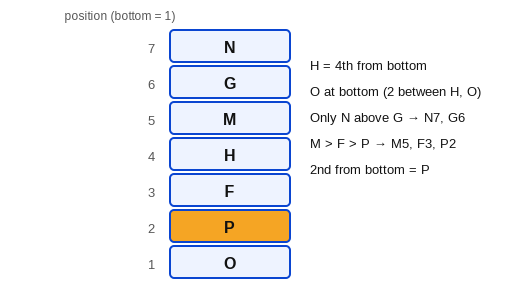
Concept: Number positions from the bottom (1) to the top (7).

  1. Only three below H → H at 4. Two boxes between H and O → O at 1 or 7.
  2. Only N above G → N at 7, G at 6; so O at 1.
  3. M above F above P in 2, 3, 5 → P 2, F 3, M 5.
  4. Second from bottom = P.

Trick: When a clue fixes the top two (N, G), the 'either-end' box (O) is forced to the other end.

Answer: (B) P

अवधारणा: स्थान नीचे से (1) ऊपर (7) तक गिनें।

  1. H के नीचे केवल तीन → H 4। H और O के बीच दो → O 1 या 7।
  2. केवल N, G के ऊपर → N 7, G 6; अतः O 1।
  3. M > F > P (ऊपर से) 2, 3, 5 में → P 2, F 3, M 5।
  4. नीचे से दूसरा = P।

ट्रिक: ऊपर के दो स्थान (N, G) तय हुए तो O अपने-आप नीचे वाले छोर पर जाएगा।

उत्तर: (B) P

RRB NTPC Undergraduate CBT 1General Intelligence and ReasoningBox arrangementRRB NTPC Undergraduate CBT 1 2024 · 22 Aug Shift 1 →
Q1704.
What should come in place of the question mark (?) in the given series?
1200, 1200, 1800, 3600, 9000, ?
दी गई शृंखला में प्रश्न चिह्न (?) के स्थान पर क्या आना चाहिए?
1200, 1200, 1800, 3600, 9000, ?
  1. A18000
  2. B12000
  3. C15000
  4. D27000
Show answer

Concept: Check ratios of consecutive terms.

  1. 1200×1=1200, ×1.5=1800, ×2=3600, ×2.5=9000.
  2. Multipliers rise by 0.5, so next =9000×3=27000.

Trick: When terms grow fast, try multiplication factors: 1, 1.5, 2, 2.5, 3.

Answer: (D) 27000

अवधारणा: क्रमागत पदों का अनुपात देखें।

  1. 1200×1=1200, ×1.5=1800, ×2=3600, ×2.5=9000।
  2. गुणक 0.5 से बढ़ता है, अतः अगला =9000×3=27000।

ट्रिक: पद तेज़ी से बढ़ें तो गुणक देखें: 1, 1.5, 2, 2.5, 3।

उत्तर: (D) 27000

RRB NTPC Undergraduate CBT 1General Intelligence and ReasoningNumber seriesRRB NTPC Undergraduate CBT 1 2024 · 22 Aug Shift 1 →
Q1705.
Refer to the following number and symbol series and answer the question that follows. All numbers are single-digits. Counting to be done from left to right only.
(Left) & 1 # 6 * ^ @ 3 & $ 7 Ω $ 2 # 6 @ 2 % 9 (Right)
If all the symbols are dropped from the series, which of the following will be third from the left?
निम्नलिखित संख्या और प्रतीक शृंखला को देखिए और उसके बाद आने वाले प्रश्न का उत्तर दीजिए। सभी संख्याएँ एक-अंकीय हैं। गिनती केवल बाएँ से दाएँ की जानी है।
(बाएँ) & 1 # 6 * ^ @ 3 & $ 7 Ω $ 2 # 6 @ 2 % 9 (दाएँ)
यदि शृंखला से सभी प्रतीक हटा दिए जाएँ, तो निम्नलिखित में से कौन-सा बाएँ से तीसरे स्थान पर होगा?
  1. A6
  2. B3
  3. C7
  4. D1
Show answer

Concept: Drop the symbols, keep only the digits in order.

  1. Digits from left: 1, 6, 3, 7, 2, 6, 2, 9.
  2. Third from left = 3.

Trick: No need to rewrite all — just count digits from the left until the third one.

Answer: (B) 3

अवधारणा: प्रतीक हटाकर केवल अंक क्रम में रखें।

  1. बाएँ से अंक: 1, 6, 3, 7, 2, 6, 2, 9।
  2. बाएँ से तीसरा = 3।

ट्रिक: पूरी श्रृंखला लिखने की ज़रूरत नहीं — बाएँ से अंक गिनते जाएँ।

उत्तर: (B) 3

RRB NTPC Undergraduate CBT 1General Intelligence and ReasoningNumber-symbol seriesRRB NTPC Undergraduate CBT 1 2024 · 22 Aug Shift 1 →
Q1706.
In the following triads, each group of letters is related to the subsequent one following a certain logic. Select from the given options, the one which follows the same logic. BURN - BNRU - NRUB
SONG - SGNO - GNOS
निम्नलिखित त्रिकों में, अक्षरों का प्रत्येक समूह एक निश्चित तर्क के अनुसार अपने बाद वाले समूह से संबंधित है। दिए गए विकल्पों में से उसका चयन कीजिए, जो उसी तर्क का अनुसरण करता है। BURN - BNRU - NRUB
SONG - SGNO - GNOS
  1. ARAIL - ARIL - LAIR
  2. BCAME - CEMA - EMAC
  3. CWINK - WNIK - KNIW
  4. DCODE - COED - ODEC
Show answer

Concept: Track letter positions: word 1234 → second word 1-4-3-2 → third word 4-3-2-1 (reverse).

  1. BURN → B N R U (1, 4, 3, 2) → NRUB (reverse); SONG → SGNO → GNOS ✓.
  2. CAME → C E M A (1, 4, 3, 2) ✓ → EMAC (reverse) ✓.
  3. RAIL → ARIL ✗; WINK → WNIK ✗ (should be WKNI); CODE → COED ✗ (should be CEDO).

Trick: Check the easy part first: the 3rd word must be the 1st word reversed — then confirm the middle word.

Answer: (B) CAME - CEMA - EMAC

अवधारणा: अक्षरों के स्थान देखें: शब्द 1234 → दूसरा शब्द 1-4-3-2 → तीसरा 4-3-2-1 (उल्टा)।

  1. BURN → BNRU (1, 4, 3, 2) → NRUB (उल्टा); SONG → SGNO → GNOS ✓।
  2. CAME → CEMA (1, 4, 3, 2) ✓ → EMAC (उल्टा) ✓।
  3. RAIL → ARIL ✗; WINK → WNIK ✗ (WKNI होना चाहिए); CODE → COED ✗ (CEDO होना चाहिए)।

ट्रिक: पहले तीसरा शब्द जाँचें (पहले का उल्टा), फिर बीच वाला।

उत्तर: (B) CAME - CEMA - EMAC

RRB NTPC Undergraduate CBT 1General Intelligence and ReasoningLetter analogy (triads)RRB NTPC Undergraduate CBT 1 2024 · 22 Aug Shift 1 →
Q1707.
Read the given statements and conclusions carefully. Assuming that the information given in the statements is true, even if it appears to be at variance with commonly known facts, decide which of the given conclusion(s) logically follow(s) from the statements.
Statements:
All actors are dancers.
Some dancers are singers.
Conclusions:
(I) All dancers are actors.
(II) No singer is a dancer.
दिए गए कथनों और निष्कर्षों को ध्यानपूर्वक पढ़िए। यह मानते हुए कि कथनों में दी गई जानकारी सत्य है, भले ही वह सामान्य रूप से ज्ञात तथ्यों से भिन्न प्रतीत होती हो, निर्णय लीजिए कि दिए गए निष्कर्षों में से कौन-सा/कौन-से निष्कर्ष कथनों का तार्किक रूप से अनुसरण करता है/करते हैं।
कथन:
सभी अभिनेता, नर्तक हैं।
कुछ नर्तक, गायक हैं।
निष्कर्ष:
(I) सभी नर्तक, अभिनेता हैं।
(II) कोई गायक, नर्तक नहीं है।
  1. ABoth conclusions (I) and (II) follow.दोनों निष्कर्ष (I) और (II) अनुसरण करते हैं।
  2. BOnly conclusion (I) follows.केवल निष्कर्ष (I) अनुसरण करता है।
  3. CNeither conclusion (I) nor (II) follows.न तो निष्कर्ष (I) और न ही (II) अनुसरण करता है।
  4. DOnly conclusion (II) follows.केवल निष्कर्ष (II) अनुसरण करता है।
Show answer

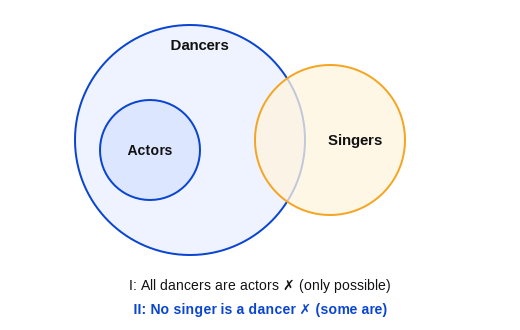
Concept: Draw the least-overlap Venn diagram: actors inside dancers, and singers overlapping dancers only partly.

  1. I: 'All actors are dancers' cannot be reversed to 'All dancers are actors' → does not follow.
  2. II: 'Some dancers are singers' directly contradicts 'No singer is a dancer' → does not follow.

Yaad rakhein: 'All A are B' converts only to 'Some B are A', never 'All B are A'.

Answer: (C) Neither conclusion (I) nor (II) follows.

अवधारणा: न्यूनतम-मेल वाला वेन आरेख बनाएँ: अभिनेता नर्तकों के अंदर, गायक नर्तकों से आंशिक रूप से मिलते हैं।

  1. I: 'सभी अभिनेता नर्तक हैं' को उलटकर 'सभी नर्तक अभिनेता हैं' नहीं कह सकते → अनुसरण नहीं करता।
  2. II: 'कुछ नर्तक गायक हैं', 'कोई गायक नर्तक नहीं' का सीधा विरोध है → अनुसरण नहीं करता।

याद रखें: 'सभी A, B हैं' का रूपांतरण केवल 'कुछ B, A हैं' होता है, 'सभी B, A हैं' नहीं।

उत्तर: (C) न तो निष्कर्ष (I) और न ही (II) अनुसरण करता है।

RRB NTPC Undergraduate CBT 1General Intelligence and ReasoningSyllogismRRB NTPC Undergraduate CBT 1 2024 · 22 Aug Shift 1 →
Q1708.
Refer to the following number and symbol series and answer the question that follows. Counting to be done from left to right only. (Note: All numbers are single digit numbers only.)
(Left) 4 7 + $ 1 * £ 3 & % 5 @ Ω 6 2 9 # 8 (Right)
How many such numbers are there each of which is immediately preceded by a symbol and also immediately followed by another symbol?
निम्नलिखित संख्या और प्रतीक शृंखला को देखिए और उसके बाद आने वाले प्रश्न का उत्तर दीजिए। गिनती केवल बाएँ से दाएँ की जानी है। (ध्यान दें: सभी संख्याएँ केवल एक-अंकीय संख्याएँ हैं।)
(बाएँ) 4 7 + $ 1 * £ 3 & % 5 @ Ω 6 2 9 # 8 (दाएँ)
ऐसी कितनी संख्याएँ हैं, जिनमें से प्रत्येक के ठीक पहले एक प्रतीक है और ठीक बाद भी एक अन्य प्रतीक है?
  1. A5
  2. B2
  3. C3
  4. D4
Show answer

Concept: Look at each digit and check both neighbours: symbol on the left AND symbol on the right.

  1. 1: between $ and * ✓; 3: between £ and & ✓; 5: between % and @ ✓.
  2. 4, 7 (start / next to a digit), 6, 2, 9 (next to digits) and 8 (end) fail.
  3. Count = 3.

Trick: Skip any digit that touches another digit — only isolated digits can qualify.

Answer: (C) 3

अवधारणा: हर अंक के दोनों पड़ोसी देखें: बाईं ओर प्रतीक और दाईं ओर भी प्रतीक।

  1. 1: $ और * के बीच ✓; 3: £ और & के बीच ✓; 5: % और @ के बीच ✓।
  2. 4, 7, 6, 2, 9 (किसी अंक से सटे) और 8 (अंत में) नहीं।
  3. संख्या = 3।

ट्रिक: जो अंक दूसरे अंक से सटा हो उसे छोड़ दें — केवल अकेले अंक ही योग्य।

उत्तर: (C) 3

RRB NTPC Undergraduate CBT 1General Intelligence and ReasoningNumber-symbol seriesRRB NTPC Undergraduate CBT 1 2024 · 22 Aug Shift 1 →
Q1709.
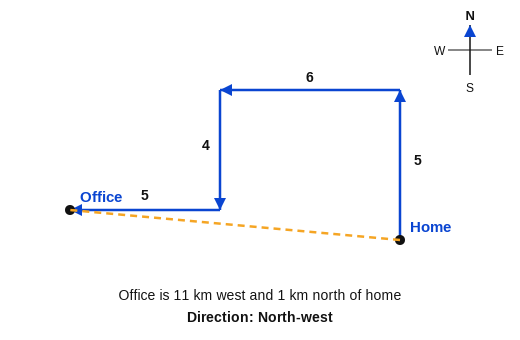
Atul starts from his home and drives 5 km towards north. He then takes a left turn, drives 6 km, turns left, and drives 4 km. He then takes a right turn and drives 5 km and reaches his office. In which direction is the office with respect to his home?
(Note: All turns are 90° turns only, unless specified.)
अतुल अपने घर से चलना शुरू करता है और उत्तर की ओर 5 km गाड़ी चलाता है। फिर वह बाएँ मुड़ता है, 6 km गाड़ी चलाता है, बाएँ मुड़ता है, और 4 km गाड़ी चलाता है। फिर वह दाएँ मुड़ता है और 5 km गाड़ी चलाकर अपने कार्यालय पहुँचता है। कार्यालय उसके घर के सापेक्ष किस दिशा में है?
(ध्यान दें: जब तक निर्दिष्ट न किया जाए, सभी मोड़ केवल 90° के मोड़ हैं।)
  1. ANorth-westउत्तर-पश्चिम
  2. BEastपूर्व
  3. CWestपश्चिम
  4. DNorthउत्तर
Show answer

Concept: Trace the path on N–E axes with home at the origin; a left turn while facing north means west, facing west means south, and a right turn while facing south means west.

  1. 5 km north → (0, 5). Left (west) 6 km → (−6, 5).
  2. Left (south) 4 km → (−6, 1). Right (west) 5 km → (−11, 1).
  3. Office is 11 km west and 1 km north of home → north-west.

Trick: Net movement: West 6+5=11, North 5−4=1; both non-zero → a diagonal direction (NW).

Answer: (A) North-west

अवधारणा: घर को मूल बिंदु मानकर पथ बनाएँ; उत्तर की ओर मुख होने पर बायाँ = पश्चिम, पश्चिम की ओर बायाँ = दक्षिण, दक्षिण की ओर दायाँ = पश्चिम।

  1. 5 km उत्तर → (0, 5)। बाएँ (पश्चिम) 6 km → (−6, 5)।
  2. बाएँ (दक्षिण) 4 km → (−6, 1)। दाएँ (पश्चिम) 5 km → (−11, 1)।
  3. ऑफिस घर से 11 km पश्चिम और 1 km उत्तर → उत्तर-पश्चिम।

ट्रिक: कुल: पश्चिम 6+5=11, उत्तर 5−4=1; दोनों शून्य नहीं → तिरछी दिशा (NW)।

उत्तर: (A) उत्तर-पश्चिम (North-west)

RRB NTPC Undergraduate CBT 1General Intelligence and ReasoningDirection senseRRB NTPC Undergraduate CBT 1 2024 · 22 Aug Shift 1 →
Q1710.
Select the set in which the numbers are related in the same way as are the numbers of the following sets.
(NOTE: Operations should be performed on the whole numbers, without breaking down the numbers into their constituent digits. E.g. 13 – Operations on 13 such as adding to/subtracting from/multiplying with 13 can be performed. Breaking down 13 into 1 and 3 and then performing mathematical operations on 1 and 3 is not allowed.)
(196, 142, 338)
(145, 198, 343)
उस समुच्चय का चयन कीजिए, जिसमें संख्याएँ उसी प्रकार संबंधित हैं, जिस प्रकार निम्नलिखित समुच्चयों की संख्याएँ संबंधित हैं।
(ध्यान दें: संख्याओं को उनके घटक अंकों में तोड़े बिना, संक्रियाएँ पूर्ण संख्याओं पर की जानी चाहिए। उदाहरण के लिए 13 – 13 पर संक्रियाएँ जैसे 13 में जोड़ना/घटाना/गुणा करना आदि की जा सकती हैं। 13 को 1 और 3 में तोड़ना और फिर 1 और 3 पर गणितीय संक्रियाएँ करने की अनुमति नहीं है।)
(196, 142, 338)
(145, 198, 343)
  1. A(149, 152, 300)
  2. B(183, 209, 392)
  3. C(184, 130, 318)
  4. D(164, 178, 352)
Show answer

Concept: Find the rule linking the three numbers: third = first + second.

  1. 196+142=338 ✓; 145+198=343 ✓.
  2. (B): 183+209=392 ✓.
  3. (A) 149+152=301, (C) 184+130=314, (D) 164+178=342 — all fail.

Trick: For three-number sets, try first + second = third before anything else.

Answer: (B) (183, 209, 392)

अवधारणा: तीनों संख्याओं का नियम: तीसरी = पहली + दूसरी।

  1. 196+142=338 ✓; 145+198=343 ✓।
  2. (B): 183+209=392 ✓।
  3. (A) 301, (C) 314, (D) 342 — मेल नहीं।

ट्रिक: तीन संख्याओं वाले समूह में सबसे पहले 'पहली + दूसरी = तीसरी' जाँचें।

उत्तर: (B) (183, 209, 392)

RRB NTPC Undergraduate CBT 1General Intelligence and ReasoningNumber analogy (sets)RRB NTPC Undergraduate CBT 1 2024 · 22 Aug Shift 1 →
Q1711.
Select the pair that follows the same pattern as that followed by the two pairs given below. Both pairs follow the same pattern.
TYP : UZQ
ETQ : FUR
उस युग्म का चयन कीजिए, जो उसी पैटर्न का अनुसरण करता है, जिसका अनुसरण नीचे दिए गए दो युग्मों द्वारा किया जाता है। दोनों युग्म एक ही पैटर्न का अनुसरण करते हैं।
TYP : UZQ
ETQ : FUR
  1. AWER : ZFS
  2. BELA : FCD
  3. CUIP : VJR
  4. DOUT : PVU
Show answer

Concept: Compare letter by letter: each letter moves +1.

  1. TYP → UZQ: T+1, Y+1, P+1. ETQ → FUR: +1, +1, +1.
  2. OUT → PVU: +1, +1, +1 ✓.
  3. WER → ZFS (+3), ELA → FCD, UIP → VJR (P+2) — fail.

Trick: If the first pair is +1 everywhere, just shift each option's first word by 1 and match.

Answer: (D) OUT : PVU

अवधारणा: अक्षर-दर-अक्षर तुलना करें: हर अक्षर +1 चलता है।

  1. TYP → UZQ: +1, +1, +1। ETQ → FUR: +1, +1, +1।
  2. OUT → PVU: +1, +1, +1 ✓।
  3. WER → ZFS (+3), ELA → FCD, UIP → VJR (P+2) — मेल नहीं।

ट्रिक: हर विकल्प के पहले शब्द को 1 आगे खिसकाकर मिलाएँ।

उत्तर: (D) OUT : PVU

RRB NTPC Undergraduate CBT 1General Intelligence and ReasoningLetter analogyRRB NTPC Undergraduate CBT 1 2024 · 22 Aug Shift 1 →
Q1712.
What should come in place of ? in the given series based on the English alphabetical order?
​BJS CLT DNU EPV ?
अंग्रेज़ी वर्णमाला क्रम के आधार पर दी गई शृंखला में ? के स्थान पर क्या आना चाहिए?
​BJS CLT DNU EPV ?
  1. AGRV
  2. BGSV
  3. CFRV
  4. DFRW
Show answer

Concept: Track each letter position separately.

  1. 1st letters: B, C, D, E → +1 → F.
  2. 2nd letters: J, L, N, P → +2 → R.
  3. 3rd letters: S, T, U, V → +1 → W.

Trick: Only FRW has F, R and W; the others fail at one position.

Answer: (D) FRW

अवधारणा: हर स्थान के अक्षर को अलग से देखें।

  1. पहले: B, C, D, E → +1 → F।
  2. दूसरे: J, L, N, P → +2 → R।
  3. तीसरे: S, T, U, V → +1 → W।

ट्रिक: केवल FRW में F, R और W तीनों हैं।

उत्तर: (D) FRW

RRB NTPC Undergraduate CBT 1General Intelligence and ReasoningLetter seriesRRB NTPC Undergraduate CBT 1 2024 · 22 Aug Shift 1 →
Q1713.
FNJG is related to DLHE in a certain way based on the English alphabetical order. In the same way, IQMJ is related to GOKH. To which of the given options is MUQN related, following the same logic?
अंग्रेज़ी वर्णमाला क्रम के आधार पर FNJG एक निश्चित प्रकार से DLHE से संबंधित है। उसी प्रकार, IQMJ, GOKH से संबंधित है। समान तर्क का अनुसरण करते हुए, MUQN दिए गए विकल्पों में से किससे संबंधित है?
  1. ASKOL
  2. BSKLO
  3. CKSOL
  4. DKSLO
Show answer

Concept: Each letter shifts back by 2.

  1. FNJG → DLHE: F−2=D, N−2=L, J−2=H, G−2=E.
  2. IQMJ → GOKH: −2 each ✓.
  3. MUQN → K S O L.

Trick: Same −2 shift for every letter: just write each letter two steps back.

Answer: (C) KSOL

अवधारणा: हर अक्षर 2 पीछे जाता है।

  1. FNJG → DLHE: F−2=D, N−2=L, J−2=H, G−2=E।
  2. IQMJ → GOKH: हर अक्षर −2 ✓।
  3. MUQN → K S O L।

ट्रिक: हर अक्षर को दो कदम पीछे लिखें।

उत्तर: (C) KSOL

RRB NTPC Undergraduate CBT 1General Intelligence and ReasoningLetter analogyRRB NTPC Undergraduate CBT 1 2024 · 22 Aug Shift 1 →
Q1714.
What should come in place of the question mark (?) in the given series?
195 189 180 174 165 159 ?
दी गई शृंखला में प्रश्न चिह्न (?) के स्थान पर क्या आना चाहिए?
195 189 180 174 165 159 ?
  1. A149
  2. B153
  3. C155
  4. D150
Show answer

Concept: Look at the differences between consecutive terms.

  1. 195−6=189, 189−9=180, 180−6=174, 174−9=165, 165−6=159.
  2. Pattern −6, −9 repeats → next 159−9=150.

Trick: Alternating differences: once you see −6, −9, −6 … just continue the cycle.

Answer: (D) 150

अवधारणा: क्रमागत पदों का अंतर देखें।

  1. 195−6=189, 189−9=180, 180−6=174, 174−9=165, 165−6=159।
  2. −6, −9 दोहराता है → अगला 159−9=150।

ट्रिक: बारी-बारी अंतर −6, −9 — चक्र जारी रखें।

उत्तर: (D) 150

RRB NTPC Undergraduate CBT 1General Intelligence and ReasoningNumber seriesRRB NTPC Undergraduate CBT 1 2024 · 22 Aug Shift 1 →
Q1715.
Seven people A, B, C, D, E, F and G are sitting in a row, facing north.
Only two people sit between D and C. Only G sits to the right of E. Only one person sits between C and E. A sits at some place to the right of F but at some place to the left of B. How many people sit to the right of A?
सात व्यक्ति A, B, C, D, E, F और G उत्तर की ओर मुख करके एक पंक्ति में बैठे हैं।
D और C के बीच केवल दो व्यक्ति बैठे हैं। E के दाईं ओर केवल G बैठा है। C और E के बीच केवल एक व्यक्ति बैठा है। A, F के दाईं ओर किसी स्थान पर, परंतु B के बाईं ओर किसी स्थान पर बैठा है। A के दाईं ओर कितने व्यक्ति बैठे हैं?
  1. A4
  2. B3
  3. C5
  4. D2
Show answer

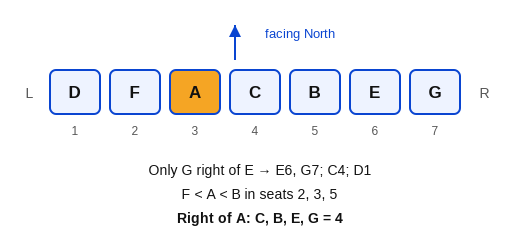
Concept: Facing north, your right = east end of the row. Number seats 1 (left) to 7 (right).

  1. Only G to the right of E → E 6, G 7.
  2. One person between C and E → C 4. Two between D and C → D 1 (7 is taken).
  3. F, A, B in 2, 3, 5 with F left of A left of B → F 2, A 3, B 5.
  4. Right of A: C, B, E, G → 4 people.

Trick: 'Only X sits to the right of Y' fixes Y at seat 6 and X at seat 7.

Answer: (A) 4

अवधारणा: उत्तर की ओर मुख होने पर दायाँ = पंक्ति का दायाँ छोर। स्थान 1 (बाएँ) से 7 (दाएँ)।

  1. E के दाईं ओर केवल G → E 6, G 7।
  2. C और E के बीच एक → C 4। D और C के बीच दो → D 1।
  3. F, A, B को 2, 3, 5 में, F < A < B → F 2, A 3, B 5।
  4. A के दाईं ओर: C, B, E, G → 4 व्यक्ति।

ट्रिक: 'केवल X, Y के दाईं ओर' → Y स्थान 6 पर, X स्थान 7 पर।

उत्तर: (A) 4

RRB NTPC Undergraduate CBT 1General Intelligence and ReasoningLinear seating arrangementRRB NTPC Undergraduate CBT 1 2024 · 22 Aug Shift 1 →
Q1716.
If + means ‘subtraction’, − means ‘division’, ÷ means ‘multiplication’, × means ‘addition’, then what will come in place of the question mark (?) in the following equation? 9 − 3 × 756 + 84 ÷ 3 = ?
यदि + का अर्थ ‘घटाना’, − का अर्थ ‘भाग देना’, ÷ का अर्थ ‘गुणा करना’, × का अर्थ ‘जोड़ना’ है, तो निम्नलिखित समीकरण में प्रश्न चिह्न (?) के स्थान पर क्या आएगा? 9 − 3 × 756 + 84 ÷ 3 = ?
  1. A509
  2. B510
  3. C508
  4. D507
Show answer

Concept: Replace each symbol by its meaning, then apply BODMAS.

  1. 9−3×756+84÷3 becomes 9÷3+756−84×3.
  2. =3+756−252.
  3. =507.

Trick: Write the substituted expression fully before solving — the mistake usually happens in substitution.

Answer: (D) 507

अवधारणा: हर चिह्न को उसके अर्थ से बदलें, फिर BODMAS लगाएँ।

  1. 9−3×756+84÷3 बन जाता है 9÷3+756−84×3।
  2. =3+756−252।
  3. =507।

ट्रिक: बदला हुआ व्यंजक पूरा लिखें, फिर हल करें — गलती अक्सर चिह्न बदलने में होती है।

उत्तर: (D) 507

RRB NTPC Undergraduate CBT 1General Intelligence and ReasoningMathematical operationsRRB NTPC Undergraduate CBT 1 2024 · 22 Aug Shift 1 →
Q1717.
Prabash starts from Point A and drives 6 km towards east. He then takes a left turn, drives 4 km, turns left and drives 9 km. He then takes a left turn and drives 7 km. He takes a final left turn, drives 3 km and stops at Point P. How far (shortest distance) and towards which direction should he drive in order to reach Point A again? (Note: All turns are 90-degree turns only unless specified.)
प्रभाष बिंदु A से चलना शुरू करता है और पूर्व की ओर 6 km गाड़ी चलाता है। फिर वह बाएँ मुड़ता है, 4 km गाड़ी चलाता है, बाएँ मुड़ता है और 9 km गाड़ी चलाता है। फिर वह बाएँ मुड़ता है और 7 km गाड़ी चलाता है। वह अंतिम बार बाएँ मुड़ता है, 3 km गाड़ी चलाता है और बिंदु P पर रुक जाता है। बिंदु A पर पुनः पहुँचने के लिए उसे कितनी दूर (न्यूनतम दूरी) और किस दिशा में गाड़ी चलानी चाहिए? (ध्यान दें: जब तक निर्दिष्ट न किया जाए, सभी मोड़ केवल 90 डिग्री के मोड़ हैं।)
  1. A2 km to the northउत्तर की ओर 2 km
  2. B4 km to the northउत्तर की ओर 4 km
  3. C3 km to the northउत्तर की ओर 3 km
  4. D1 km to the northउत्तर की ओर 1 km
Show answer

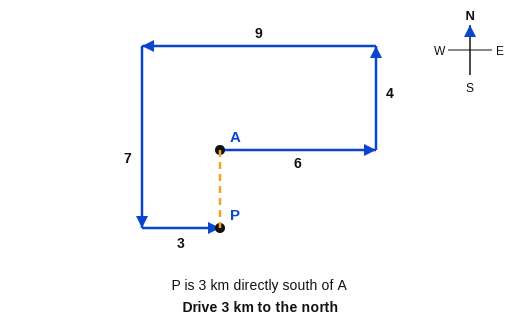
Concept: Plot each move with A at the origin: east is +x, north is +y.

  1. 6 km east → (6, 0). Left (north) 4 → (6, 4).
  2. Left (west) 9 → (−3, 4). Left (south) 7 → (−3, −3).
  3. Left (east) 3 → (0, −3) = P.
  4. P is 3 km directly south of A → drive 3 km to the north.

Trick: Net: East 6−9+3=0, North 4−7=−3 → P is 3 km south of A.

Answer: (C) 3 km to the north

अवधारणा: A को मूल बिंदु मानें: पूर्व = +x, उत्तर = +y।

  1. 6 km पूर्व → (6, 0)। बाएँ (उत्तर) 4 → (6, 4)।
  2. बाएँ (पश्चिम) 9 → (−3, 4)। बाएँ (दक्षिण) 7 → (−3, −3)।
  3. बाएँ (पूर्व) 3 → (0, −3) = P।
  4. P, A से 3 km दक्षिण में → 3 km उत्तर की ओर जाना होगा।

ट्रिक: कुल: पूर्व 6−9+3=0, उत्तर 4−7=−3 → P, A से 3 km दक्षिण।

उत्तर: (C) 3 km उत्तर की ओर (3 km to the north)

RRB NTPC Undergraduate CBT 1General Intelligence and ReasoningDirection senseRRB NTPC Undergraduate CBT 1 2024 · 22 Aug Shift 1 →
Q1718.
In a certain code language, ‘GLUE’ is coded as ‘4627’ and ‘LOAD’ is coded as ‘1375’. What is the code for ‘L’ in the given code language?
एक निश्चित कूट भाषा में, ‘GLUE’ को ‘4627’ के रूप में कूटबद्ध किया जाता है और ‘LOAD’ को ‘1375’ के रूप में कूटबद्ध किया जाता है। दी गई कूट भाषा में ‘L’ के लिए कूट क्या है?
  1. A3
  2. B7
  3. C6
  4. D1
Show answer

Concept: Codes may be jumbled; the letter common to both words takes the digit common to both codes.

  1. GLUE → 4627 and LOAD → 1375.
  2. Common letter: L. Common digit: 7.
  3. So L = 7.

Trick: Common letter ↔ common digit — no need to decode the rest.

Answer: (B) 7

अवधारणा: कोड क्रम में न भी हों; दोनों शब्दों का साझा अक्षर दोनों कोडों के साझा अंक से जुड़ता है।

  1. GLUE → 4627 और LOAD → 1375।
  2. साझा अक्षर: L। साझा अंक: 7।
  3. अतः L = 7।

ट्रिक: साझा अक्षर ↔ साझा अंक — बाकी डिकोड करने की ज़रूरत नहीं।

उत्तर: (B) 7

RRB NTPC Undergraduate CBT 1General Intelligence and ReasoningCoding-decodingRRB NTPC Undergraduate CBT 1 2024 · 22 Aug Shift 1 →
Q1719.
Based on the English alphabetical order, three of the following four letter-cluster pairs are alike in a certain way and thus form a group. Which letter-cluster pair DOES NOT belong to that group?
(Note: The odd one out is not based on the number of consonants/vowels or their position in the letter-cluster pair.)
अंग्रेज़ी वर्णमाला क्रम के आधार पर, निम्नलिखित चार अक्षर-समूह युग्मों में से तीन किसी निश्चित प्रकार से एकसमान हैं और इस प्रकार एक समूह बनाते हैं। कौन-सा अक्षर-समूह युग्म उस समूह से संबंधित नहीं है?
(ध्यान दें: असंगत अक्षर-समूह युग्म, उस अक्षर-समूह युग्म में व्यंजनों/स्वरों की संख्या या उनके स्थान पर आधारित नहीं है।)
  1. ATP-AX
  2. BGC-OK
  3. CHD-PL
  4. DNJ-VR
Show answer

Concept: Check gaps between consecutive letters (counting cyclically).

  1. GC-OK: G −4 C, C +12 O, O −4 K.
  2. HD-PL: −4, +12, −4; NJ-VR: −4, +12, −4.
  3. TP-AX: T −4 P, but P → A is +11 and A → X is −3 → odd.

Trick: Compare the first letters of the two clusters: G→O, H→P, N→V are all +8; T→A is +7.

Answer: (A) TP-AX

अवधारणा: क्रमागत अक्षरों का अंतर देखें (Z के बाद चक्रीय गिनती)।

  1. GC-OK: G −4 C, C +12 O, O −4 K।
  2. HD-PL: −4, +12, −4; NJ-VR: −4, +12, −4।
  3. TP-AX: T −4 P, पर P → A +11 और A → X −3 → विषम।

ट्रिक: दोनों समूहों के पहले अक्षर: G→O, H→P, N→V सब +8; T→A केवल +7।

उत्तर: (A) TP-AX

RRB NTPC Undergraduate CBT 1General Intelligence and ReasoningLetter-cluster odd one outRRB NTPC Undergraduate CBT 1 2024 · 22 Aug Shift 1 →
Q1720.
In a certain code language, ‘DEAR’ is coded as ‘4627’ and ‘TURN’ is coded as ‘1375’. What is the code for ‘R’ in the given code language?
एक निश्चित कूट भाषा में, ‘DEAR’ को ‘4627’ के रूप में कूटबद्ध किया जाता है और ‘TURN’ को ‘1375’ के रूप में कूटबद्ध किया जाता है। दी गई कूट भाषा में ‘R’ के लिए कूट क्या है?
  1. A5
  2. B7
  3. C1
  4. D6
Show answer

Concept: The letter common to both words takes the digit common to both codes.

  1. DEAR → 4627 and TURN → 1375.
  2. Common letter: R. Common digit: 7.
  3. So R = 7.

Trick: Common letter ↔ common digit.

Answer: (B) 7

अवधारणा: दोनों शब्दों का साझा अक्षर दोनों कोडों के साझा अंक से जुड़ता है।

  1. DEAR → 4627 और TURN → 1375।
  2. साझा अक्षर: R। साझा अंक: 7।
  3. अतः R = 7।

ट्रिक: साझा अक्षर ↔ साझा अंक।

उत्तर: (B) 7

RRB NTPC Undergraduate CBT 1General Intelligence and ReasoningCoding-decodingRRB NTPC Undergraduate CBT 1 2024 · 22 Aug Shift 1 →