Question bank

Q&A: practice questions with answers

Search questions on any topic. Filter by exam category, exam, subject and topic, try the question, then open the answer and explanation.

Courses – airGurukul

20,719 questions found.

Q17281.
In an isosceles triangle, the vertex angle measures 76°. What is the measure of each of the base angles?
एक समद्विबाहु त्रिभुज में शीर्ष कोण 76° है। प्रत्येक आधार कोण का माप क्या है?
  1. A32° and 49°32° और 49°
  2. B55° and 49°55° और 49°
  3. C52° and 52°52° और 52°
  4. D43° and 62°43° और 62°
Show answer

Concept: In an isosceles triangle the two base angles are equal, and the three angles add to 180∘.

  1. Vertex angle =76∘, so the two base angles together =180∘−76∘=104∘.
  2. Each base angle =104∘2=52∘.
  3. Options with two unequal angles cannot be base angles of an isosceles triangle.

Trick: Base angle =180∘−vertex angle2; only the option with equal angles can be right.

Answer: (C) 52∘ and 52∘

अवधारणा: समद्विबाहु त्रिभुज में दोनों आधार कोण बराबर होते हैं, और तीनों कोणों का योग 180∘।

  1. शीर्ष कोण =76∘, अतः दोनों आधार कोणों का योग =180∘−76∘=104∘।
  2. प्रत्येक आधार कोण =104∘2=52∘।
  3. दो असमान कोणों वाले विकल्प समद्विबाहु त्रिभुज के आधार कोण नहीं हो सकते।

ट्रिक: आधार कोण =180∘−शीर्ष कोण2; केवल समान कोणों वाला विकल्प सही हो सकता है।

उत्तर: (C) 52∘ और 52∘

RRB Technician Grade I (Signal)MathematicsGeometry – isosceles triangleRRB Technician Grade I (Signal) 2024 · 19 Dec Shift 2 →
Q17282.
The value of 13−82+(364)2−0+2×5= _____
13−82+(364)2−0+2×5= का मान _____
  1. A28
  2. B27
  3. C37
  4. D38
Show answer

Concept: Evaluate powers first, then multiplication, then addition/subtraction from left to right (BODMAS).

  1. 13=1, 82=64, (364)2=92=81, 2×5=10.
  2. Expression =1−64+81−0+10.
  3. 1−64=−63; −63+81=18; 18+10=28.

Trick: Simplify the bracket 364=9 before squaring; it avoids big numbers like 1296.

Answer: (A) 28

अवधारणा: पहले घात, फिर गुणा, फिर बाएँ से दाएँ जोड़/घटाव (BODMAS)।

  1. 13=1, 82=64, (364)2=92=81, 2×5=10।
  2. व्यंजक =1−64+81−0+10।
  3. 1−64=−63; −63+81=18; 18+10=28।

ट्रिक: वर्ग करने से पहले कोष्ठक 364=9 सरल कर लें; इससे 1296 जैसी बड़ी संख्या से बचते हैं।

उत्तर: (A) 28

RRB Technician Grade I (Signal)MathematicsSimplification (BODMAS)RRB Technician Grade I (Signal) 2024 · 19 Dec Shift 2 →
Q17283.
Evaluate: 1(23)+(35)÷839
मान ज्ञात कीजिए: 1(23)+(35)÷839
  1. A31619
  2. B31723
  3. C32833
  4. D36576
Show answer

Concept: Simplify the denominator first, then change division by a fraction into multiplication by its reciprocal.

  1. 23+35=10+915=1915, so the first part =119/15=1519.
  2. 1519÷839=1519×398=585152.
  3. 585152=3129152≈3.8487. Among the options, 32833=12733≈3.8485 is practically equal to this value (31619≈3.84, 31723≈3.74, 36576≈3.86 are farther).

Trick: 1a/b=ba – flip the fraction instead of dividing.

Answer: (C) 32833

अवधारणा: पहले हर (denominator) सरल करें, फिर भिन्न से भाग को उसके व्युत्क्रम से गुणा में बदलें।

  1. 23+35=10+915=1915, अतः पहला भाग =119/15=1519।
  2. 1519÷839=1519×398=585152।
  3. 585152=3129152≈3.8487। विकल्पों में 32833=12733≈3.8485 इस मान के लगभग बराबर है (31619≈3.84, 31723≈3.74, 36576≈3.86 दूर हैं)।

ट्रिक: 1a/b=ba – भाग देने के बजाय भिन्न पलट दें।

उत्तर: (C) 32833

RRB Technician Grade I (Signal)MathematicsFractions – simplificationRRB Technician Grade I (Signal) 2024 · 19 Dec Shift 2 →
Q17284.
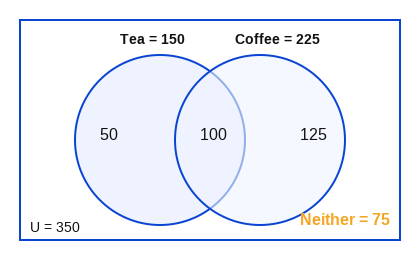
In a survey of 350 students in a college, 150 students were found to be taking tea and 225 taking coffee, 100 were taking both tea and coffee. Find how many students were taking neither tea nor coffee?
एक कॉलेज के 350 विद्यार्थियों के सर्वेक्षण में, 150 विद्यार्थी चाय लेते हुए और 225 कॉफ़ी लेते हुए पाए गए, 100 विद्यार्थी चाय और कॉफ़ी दोनों लेते थे। ज्ञात कीजिए कि कितने विद्यार्थी न तो चाय और न ही कॉफ़ी लेते थे?
  1. A85
  2. B65
  3. C75
  4. D55
Show answer

Concept: n(T∪C)=n(T)+n(C)−n(T∩C); neither = total −n(T∪C).

  1. n(T∪C)=150+225−100=275.
  2. Neither tea nor coffee =350−275=75.
  3. Check from the figure: only tea 50, both 100, only coffee 125, neither 75; 50+100+125+75=350.

Trick: The 100 'both' students are counted twice in 150+225, so subtract them once.

Answer: (C) 75

अवधारणा: n(T∪C)=n(T)+n(C)−n(T∩C); कोई नहीं = कुल −n(T∪C)।

  1. n(T∪C)=150+225−100=275।
  2. न चाय न कॉफ़ी =350−275=75।
  3. आकृति से जाँच: केवल चाय 50, दोनों 100, केवल कॉफ़ी 125, कोई नहीं 75; 50+100+125+75=350।

ट्रिक: 'दोनों' वाले 100 छात्र 150+225 में दो बार गिने गए हैं, इसलिए एक बार घटाएँ।

उत्तर: (C) 75

RRB Technician Grade I (Signal)MathematicsSets – Venn diagramRRB Technician Grade I (Signal) 2024 · 19 Dec Shift 2 →
Q17285.
If A = { 3, 5, 7, 9, 11 }, B = {7, 9, 11, 13}, C = {11, 13, 15}, find A ∩ (B ∪ C).
यदि A = { 3, 5, 7, 9, 11 }, B = {7, 9, 11, 13}, C = {11, 13, 15} है, तो A ∩ (B ∪ C) ज्ञात कीजिए।
  1. A{7, 9, 11}
  2. B{3, 5, 7, 9, 11}
  3. C{5, 7, 9, 11}
  4. D{3, 7, 9, 11}
Show answer

Concept: Work inside the bracket first: union collects all elements, intersection keeps common ones.

  1. B∪C={7,9,11,13,15}.
  2. A∩(B∪C) = elements of A={3,5,7,9,11} that are also in B∪C = {7,9,11}.

Trick: Result of A∩(…) can never contain 3 or 5 (absent from B and C) – options B, C, D drop out.

Answer: (A) {7,9,11}

अवधारणा: पहले कोष्ठक हल करें: सम्मिलन (union) सभी अवयव लेता है, सर्वनिष्ठ (intersection) केवल उभयनिष्ठ।

  1. B∪C={7,9,11,13,15}।
  2. A∩(B∪C) = A={3,5,7,9,11} के वे अवयव जो B∪C में भी हैं = {7,9,11}।

ट्रिक: A∩(…) में 3 या 5 कभी नहीं आ सकते (B और C में नहीं हैं) – विकल्प B, C, D कट जाते हैं।

उत्तर: (A) {7,9,11}

RRB Technician Grade I (Signal)MathematicsSet operationsRRB Technician Grade I (Signal) 2024 · 19 Dec Shift 2 →
Q17286.
The probability that a student passes a Mathematics test is 34 and the probability that he passes both the Mathematics and a Physics test is 1336. The probability that he passes at least one test is 56. What is the probability that he passes the Physics test?
एक विद्यार्थी के गणित की परीक्षा में उत्तीर्ण होने की प्रायिकता 34 है और उसके गणित तथा भौतिकी दोनों परीक्षाओं में उत्तीर्ण होने की प्रायिकता 1336 है। उसके कम से कम एक परीक्षा में उत्तीर्ण होने की प्रायिकता 56 है। उसके भौतिकी की परीक्षा में उत्तीर्ण होने की प्रायिकता क्या है?
  1. A536
  2. B49
  3. C79
  4. D59
Show answer

Concept: P(M∪Ph)=P(M)+P(Ph)−P(M∩Ph).

  1. Given P(M)=34, P(M∩Ph)=1336, P(M∪Ph)=56.
  2. P(Ph)=56−34+1336=30−27+1336=1636.
  3. =49.

Trick: Take LCM 36 for all three fractions at once: 30,27,13.

Answer: (B) 49

अवधारणा: P(M∪Ph)=P(M)+P(Ph)−P(M∩Ph)।

  1. दिया है P(M)=34, P(M∩Ph)=1336, P(M∪Ph)=56।
  2. P(Ph)=56−34+1336=30−27+1336=1636।
  3. =49।

ट्रिक: तीनों भिन्नों का LCM 36 एक साथ लें: 30,27,13।

उत्तर: (B) 49

RRB Technician Grade I (Signal)MathematicsProbability – addition ruleRRB Technician Grade I (Signal) 2024 · 19 Dec Shift 2 →
Q17287.
The value of 33−52+(2613)2−8+0×9= _____
33−52+(2613)2−8+0×9= का मान _____
  1. A-3
  2. B-5
  3. C-4
  4. D-2
Show answer

Concept: Powers first, then multiplication, then addition/subtraction left to right.

  1. 33=27, 52=25, (2613)2=22=4, 0×9=0.
  2. Expression =27−25+4−8+0.
  3. 27−25=2; 2+4=6; 6−8=−2.

Trick: Simplify 2613=2 inside the bracket before squaring.

Answer: (D) −2

अवधारणा: पहले घात, फिर गुणा, फिर बाएँ से दाएँ जोड़/घटाव।

  1. 33=27, 52=25, (2613)2=22=4, 0×9=0।
  2. व्यंजक =27−25+4−8+0।
  3. 27−25=2; 2+4=6; 6−8=−2।

ट्रिक: वर्ग करने से पहले कोष्ठक में 2613=2 सरल करें।

उत्तर: (D) −2

RRB Technician Grade I (Signal)MathematicsSimplification (BODMAS)RRB Technician Grade I (Signal) 2024 · 19 Dec Shift 2 →
Q17288.
Two parallel current-carrying conductors attract each other with a force of 3 N when placed 2 cm apart. The currents in both conductors are initially the same, and the length of the conductors is constant. If the currents in both conductors are doubled and the distance between them is halved, what will be the new force?
दो समांतर धारावाही चालक 2 cm की दूरी पर रखे जाने पर एक-दूसरे को 3 N के बल से आकर्षित करते हैं। दोनों चालकों में धाराएँ प्रारंभ में समान हैं, और चालकों की लंबाई नियत है। यदि दोनों चालकों में धाराएँ दोगुनी कर दी जाएँ और उनके बीच की दूरी आधी कर दी जाए, तो नया बल क्या होगा?
  1. A96 N
  2. B24 N
  3. C12 N
  4. D48 N
Show answer

Concept: Force per unit length between two parallel conductors: FL=μ0I1I22πd, i.e. F∝I1I2d for fixed length.

  1. Initially I1=I2=I, distance d: F1=3N.
  2. New currents 2I and 2I → product becomes 4 times; distance d2 → force becomes 2 times.
  3. F2=3×4×2=24N.

Trick: Doubling both currents ×4, halving the gap ×2 → total ×8. Like currents attract, opposite currents repel.

Answer: (B) 24 N

अवधारणा: दो समांतर चालकों के बीच प्रति इकाई लंबाई बल: FL=μ0I1I22πd, अर्थात नियत लंबाई के लिए F∝I1I2d।

  1. प्रारंभ में I1=I2=I, दूरी d: F1=3N।
  2. नई धाराएँ 2I और 2I → गुणनफल 4 गुना; दूरी d2 → बल 2 गुना।
  3. F2=3×4×2=24N।

ट्रिक: दोनों धाराएँ दुगुनी → ×4, दूरी आधी → ×2 → कुल ×8। समान दिशा की धाराएँ आकर्षित, विपरीत दिशा की प्रतिकर्षित करती हैं।

उत्तर: (B) 24 N

RRB Technician Grade I (Signal)Basic Science and EngineeringForce between parallel current-carrying conductorsRRB Technician Grade I (Signal) 2024 · 19 Dec Shift 2 →
Q17289.
Which of the following orders is correct for the doping level in transistors?
ट्रांजिस्टर में डोपिंग स्तर (doping level) के लिए निम्नलिखित में से कौन-सा क्रम सही है?
  1. AEmitter < base < collectorउत्सर्जक (Emitter) < आधार (base) < संग्राहक (collector)
  2. BBase < emitter < collectorआधार (Base) < उत्सर्जक (emitter) < संग्राहक (collector)
  3. CCollector < base < emitterसंग्राहक (Collector) < आधार (base) < उत्सर्जक (emitter)
  4. DBase < collector < emitterआधार (Base) < संग्राहक (collector) < उत्सर्जक (emitter)
Show answer

Concept: In a BJT the three regions are doped differently to suit their jobs.

  1. Emitter is most heavily doped – it must inject a large number of charge carriers into the base.
  2. Base is very lightly doped (and thin) so that most carriers cross it without recombining.
  3. Collector is moderately doped and largest in size to collect carriers and dissipate heat.
  4. Order: Base < Collector < Emitter.

Yaad rakhein: Doping: E > C > B; Size: C > E > B; Thickness: base is the thinnest.

Answer: (D) Base < collector < emitter

अवधारणा: BJT के तीनों क्षेत्र अपने कार्य के अनुसार अलग-अलग डोप किए जाते हैं।

  1. उत्सर्जक (Emitter) सबसे अधिक डोप – इसे आधार में बड़ी संख्या में आवेश वाहक भेजने होते हैं।
  2. आधार (Base) बहुत हल्का डोप (और पतला) – ताकि अधिकांश वाहक बिना पुनर्संयोजन के पार हो जाएँ।
  3. संग्राहक (Collector) मध्यम डोप और आकार में सबसे बड़ा – वाहक एकत्र करने और ऊष्मा निकालने के लिए।
  4. क्रम: Base < Collector < Emitter।

याद रखें: डोपिंग: E > C > B; आकार: C > E > B; मोटाई: आधार सबसे पतला।

उत्तर: (D) Base < collector < emitter

RRB Technician Grade I (Signal)Basic Science and EngineeringTransistor – doping levelsRRB Technician Grade I (Signal) 2024 · 19 Dec Shift 2 →
Q17290.
Which of the following statements is correct about a transistor?
ट्रांजिस्टर के बारे में निम्नलिखित में से कौन-सा कथन सही है?
  1. AEmitter region is much thinner as compared to base and collector.उत्सर्जक (emitter) क्षेत्र आधार और संग्राहक की तुलना में बहुत पतला होता है।
  2. BAll the three regions emitter, base and collector have the same size.उत्सर्जक, आधार और संग्राहक तीनों क्षेत्रों का आकार समान होता है।
  3. CCollector region is much thinner as compared to emitter and base.संग्राहक (collector) क्षेत्र उत्सर्जक और आधार की तुलना में बहुत पतला होता है।
  4. DBase region is much thinner as compared to emitter and collector.आधार (base) क्षेत्र उत्सर्जक और संग्राहक की तुलना में बहुत पतला होता है।
Show answer

Concept: Physical construction of a bipolar junction transistor.

  1. The base is made very thin (a few microns) and lightly doped so that carriers injected by the emitter pass through to the collector with little recombination – this gives a high current gain.
  2. The emitter is moderately sized and heavily doped; the collector is the largest region, to collect carriers and dissipate the heat produced at the collector junction.
  3. Hence options A, B and C are wrong.

Yaad rakhein: Thin + lightly doped base = heart of transistor action; collector is biggest (heat), emitter is most doped (carriers).

Answer: (D) Base region is much thinner as compared to emitter and collector.

अवधारणा: द्विध्रुवी संधि ट्रांजिस्टर (BJT) की भौतिक बनावट।

  1. आधार (Base) बहुत पतला (कुछ माइक्रॉन) और हल्का डोप होता है ताकि उत्सर्जक से आए वाहक बिना अधिक पुनर्संयोजन के संग्राहक तक पहुँच जाएँ – इससे उच्च धारा लाभ मिलता है।
  2. उत्सर्जक मध्यम आकार का और भारी डोप; संग्राहक सबसे बड़ा क्षेत्र – वाहक एकत्र करने और संग्राहक संधि पर उत्पन्न ऊष्मा निकालने के लिए।
  3. अतः विकल्प A, B और C गलत हैं।

याद रखें: पतला + हल्का डोप आधार = ट्रांजिस्टर क्रिया का मूल; संग्राहक सबसे बड़ा (ऊष्मा), उत्सर्जक सबसे अधिक डोप (वाहक)।

उत्तर: (D) आधार क्षेत्र उत्सर्जक और संग्राहक की तुलना में बहुत पतला होता है।

RRB Technician Grade I (Signal)Basic Science and EngineeringTransistor – structureRRB Technician Grade I (Signal) 2024 · 19 Dec Shift 2 →
Q17291.
Select the most appropriate options to fill in the blanks.
L.V.D.T. shows ____ hysteresis and hence repeatability is ____ under all conditions.
रिक्त स्थानों की पूर्ति के लिए सबसे उपयुक्त विकल्पों का चयन कीजिए।
L.V.D.T. ____ हिस्टैरिसिस (hysteresis) दर्शाता है और इसलिए सभी परिस्थितियों में इसकी पुनरावर्तनीयता (repeatability) ____ होती है।
  1. Ahigh; excellentउच्च; उत्कृष्ट
  2. Blow; excellentनिम्न; उत्कृष्ट
  3. Clow; badनिम्न; खराब
  4. Dhigh; badउच्च; खराब
Show answer

Concept: LVDT (Linear Variable Differential Transformer) is a displacement transducer whose core moves without touching the windings.

  1. Because there is no friction or mechanical contact between core and coils, the LVDT shows low hysteresis.
  2. Low hysteresis means the output for the same displacement is practically identical each time → excellent repeatability under all conditions.
  3. Other advantages: high sensitivity, infinite resolution, ruggedness, low power consumption.

Yaad rakhein: LVDT – no contact → no friction → low hysteresis → excellent repeatability; disadvantage – sensitive to stray magnetic fields.

Answer: (B) low; excellent

अवधारणा: LVDT (Linear Variable Differential Transformer) एक विस्थापन ट्रांसड्यूसर है जिसका कोर कुंडलियों को छुए बिना चलता है।

  1. कोर और कुंडली के बीच घर्षण या यांत्रिक संपर्क न होने से LVDT में कम हिस्टेरिसिस (low hysteresis) होता है।
  2. कम हिस्टेरिसिस का अर्थ है समान विस्थापन पर हर बार लगभग समान आउटपुट → सभी परिस्थितियों में उत्कृष्ट पुनरावृत्ति (excellent repeatability)।
  3. अन्य लाभ: उच्च संवेदनशीलता, अनंत विभेदन, मज़बूती, कम शक्ति खपत।

याद रखें: LVDT – संपर्क नहीं → घर्षण नहीं → कम हिस्टेरिसिस → उत्कृष्ट repeatability; कमी – आवारा चुंबकीय क्षेत्र से प्रभावित।

उत्तर: (B) low; excellent

RRB Technician Grade I (Signal)Basic Science and EngineeringTransducers – LVDTRRB Technician Grade I (Signal) 2024 · 19 Dec Shift 2 →
Q17292.
Which of the following is true according to the work-energy theorem?
कार्य-ऊर्जा प्रमेय (work-energy theorem) के अनुसार निम्नलिखित में से कौन-सा सत्य है?
  1. AWork done on an object can either increase or decrease its kinetic energyकिसी वस्तु पर किया गया कार्य उसकी गतिज ऊर्जा को बढ़ा या घटा सकता है
  2. BThe work done on an object is always positiveकिसी वस्तु पर किया गया कार्य सदैव धनात्मक होता है
  3. CWork done on an object always increases its kinetic energyकिसी वस्तु पर किया गया कार्य सदैव उसकी गतिज ऊर्जा को बढ़ाता है
  4. DKinetic energy is always conservedगतिज ऊर्जा सदैव संरक्षित रहती है
Show answer

Concept: Work-energy theorem: net work done on a body equals the change in its kinetic energy, Wnet=ΔK=Kf−Ki.

  1. If the net work is positive, kinetic energy increases (e.g. a falling ball); if negative, kinetic energy decreases (e.g. friction stopping a sliding block).
  2. So work done can either increase or decrease kinetic energy → option A.
  3. Options B and C ignore negative work; option D is false – kinetic energy alone is not conserved (only total mechanical energy is, and that too only for conservative forces).

Yaad rakhein: W=ΔK: sign of work = sign of change in K.E.

Answer: (A) Work done on an object can either increase or decrease its kinetic energy

अवधारणा: कार्य-ऊर्जा प्रमेय: किसी वस्तु पर किया गया कुल कार्य उसकी गतिज ऊर्जा में परिवर्तन के बराबर होता है, Wnet=ΔK=Kf−Ki।

  1. कुल कार्य धनात्मक → गतिज ऊर्जा बढ़ती है (जैसे गिरती गेंद); ऋणात्मक → गतिज ऊर्जा घटती है (जैसे घर्षण से रुकता ब्लॉक)।
  2. अतः किया गया कार्य गतिज ऊर्जा को बढ़ा या घटा सकता है → विकल्प A।
  3. विकल्प B और C ऋणात्मक कार्य की उपेक्षा करते हैं; विकल्प D गलत – केवल गतिज ऊर्जा संरक्षित नहीं रहती (कुल यांत्रिक ऊर्जा वह भी केवल संरक्षी बलों के लिए)।

याद रखें: W=ΔK: कार्य का चिह्न = गतिज ऊर्जा परिवर्तन का चिह्न।

उत्तर: (A) वस्तु पर किया गया कार्य उसकी गतिज ऊर्जा को बढ़ा या घटा सकता है

RRB Technician Grade I (Signal)Basic Science and EngineeringWork-Energy TheoremRRB Technician Grade I (Signal) 2024 · 19 Dec Shift 2 →
Q17293.
The direction of magnetic field lines inside a bar magnet is _____.
छड़ चुंबक के अंदर चुंबकीय क्षेत्र रेखाओं की दिशा _____ होती है।
  1. Afrom North Pole to South Poleउत्तरी ध्रुव से दक्षिणी ध्रुव की ओर
  2. Bperpendicular to the magnetic axisचुंबकीय अक्ष के लंबवत
  3. Crandomयादृच्छिक
  4. Dfrom South Pole to North Poleदक्षिणी ध्रुव से उत्तरी ध्रुव की ओर
Show answer

Concept: Magnetic field lines form closed loops – they have no beginning or end.

  1. Outside the magnet the lines go from the North pole to the South pole.
  2. To close the loop, inside the magnet the lines run from the South pole to the North pole.
  3. Inside, the lines are nearly parallel to the magnetic axis and crowded (strong field), not random or perpendicular.

Yaad rakhein: Outside N → S, inside S → N; this is what makes magnetic lines closed curves (unlike electric field lines).

Answer: (D) from South Pole to North Pole

अवधारणा: चुंबकीय क्षेत्र रेखाएँ बंद लूप बनाती हैं – उनका कोई आरंभ या अंत नहीं होता।

  1. चुंबक के बाहर रेखाएँ उत्तरी ध्रुव से दक्षिणी ध्रुव की ओर जाती हैं।
  2. लूप पूरा करने के लिए चुंबक के अंदर रेखाएँ दक्षिणी ध्रुव से उत्तरी ध्रुव की ओर चलती हैं।
  3. अंदर रेखाएँ चुंबकीय अक्ष के लगभग समांतर और सघन (प्रबल क्षेत्र) होती हैं – यादृच्छिक या लंबवत नहीं।

याद रखें: बाहर N → S, अंदर S → N; इसी से चुंबकीय रेखाएँ बंद वक्र बनती हैं (विद्युत क्षेत्र रेखाओं के विपरीत)।

उत्तर: (D) दक्षिणी ध्रुव से उत्तरी ध्रुव की ओर

RRB Technician Grade I (Signal)Basic Science and EngineeringMagnetism – field lines of a bar magnetRRB Technician Grade I (Signal) 2024 · 19 Dec Shift 2 →
Q17294.
The work done by non-conservative forces in a closed loop is ______.
एक बंद लूप में असंरक्षी बलों (non-conservative forces) द्वारा किया गया कार्य ______ होता है।
  1. Aalways zeroसदैव शून्य
  2. Bindependent of the pathपथ से स्वतंत्र
  3. Cdependent on the pathपथ पर निर्भर
  4. Dnegativeऋणात्मक
Show answer

Concept: A force is conservative if the work it does around any closed path is zero (gravity, spring force, electrostatic force). Non-conservative forces (friction, air drag, viscous force) do not satisfy this.

  1. Work done by friction is always against motion, so around a closed loop it keeps adding up (negative) instead of cancelling – it depends on the length of the path travelled.
  2. Hence the closed-loop work of a non-conservative force is path-dependent and generally non-zero; "always zero" and "independent of path" describe conservative forces.
  3. Option D ("negative") is true for friction but not a general definition – e.g. an applied push can do positive work.

Yaad rakhein: Conservative → closed-loop work =0, path-independent; Non-conservative → path-dependent.

Answer: (C) dependent on the path

अवधारणा: कोई बल संरक्षी (conservative) है यदि किसी भी बंद पथ पर उसका कार्य शून्य हो (गुरुत्व, स्प्रिंग बल, स्थिरवैद्युत बल)। असंरक्षी बल (घर्षण, वायु प्रतिरोध, श्यान बल) यह शर्त पूरी नहीं करते।

  1. घर्षण का कार्य सदैव गति के विरुद्ध होता है, अतः बंद लूप में यह निरस्त होने के बजाय जुड़ता जाता है – यह तय किए गए पथ की लंबाई पर निर्भर है।
  2. इसलिए असंरक्षी बल का बंद-लूप कार्य पथ पर निर्भर और सामान्यतः अशून्य होता है; "सदैव शून्य" और "पथ से स्वतंत्र" संरक्षी बल के गुण हैं।
  3. विकल्प D ("ऋणात्मक") घर्षण के लिए सही है पर सामान्य परिभाषा नहीं – जैसे लगाया गया धक्का धनात्मक कार्य कर सकता है।

याद रखें: संरक्षी → बंद-लूप कार्य =0, पथ से स्वतंत्र; असंरक्षी → पथ पर निर्भर।

उत्तर: (C) पथ पर निर्भर

RRB Technician Grade I (Signal)Basic Science and EngineeringConservative and non-conservative forcesRRB Technician Grade I (Signal) 2024 · 19 Dec Shift 2 →
Q17295.
In the equation x = A cos(ωt+ϕ), where x is displacement, ω is angular frequency, and ϕ is phase angle, the equation is dimensionally consistent if __________.
समीकरण x = A cos(ωt+ϕ) में, जहाँ x विस्थापन है, ω कोणीय आवृत्ति है और ϕ कला कोण है, समीकरण विमीय रूप से संगत है यदि __________।
  1. Aωt has dimensions of length and ϕ is dimensionlessωt की विमा लंबाई की है और ϕ विमाहीन है
  2. BA has dimensions of time and ωt has dimensions of frequencyA की विमा समय की है और ωt की विमा आवृत्ति की है
  3. CA has dimensions of length and ωt is dimensionlessA की विमा लंबाई की है और ωt विमाहीन है
  4. DA has dimensions of length and ϕ has dimensions of timeA की विमा लंबाई की है और ϕ की विमा समय की है
Show answer

Concept: In a dimensionally consistent equation both sides have the same dimensions, and the argument of a trigonometric function must be dimensionless.

  1. x=Acos(ωt+ϕ): cos(…) is a pure number, so A must carry the dimension of x → A has dimensions of length (it is the amplitude).
  2. The argument ωt+ϕ must be dimensionless (an angle): ω in rad/s × t in s → dimensionless; hence ϕ is dimensionless too.
  3. Options B and D give wrong dimensions to A or ϕ; option A wrongly gives ωt a dimension.

Yaad rakhein: Arguments of sin, cos, log, exp are always dimensionless; the coefficient in front carries the physical dimension.

Answer: (C) A has dimensions of length and ωt is dimensionless

अवधारणा: विमीय रूप से संगत समीकरण में दोनों पक्षों की विमाएँ समान होती हैं, और त्रिकोणमितीय फलन का कोणांक (argument) विमाहीन होना चाहिए।

  1. x=Acos(ωt+ϕ): cos(…) शुद्ध संख्या है, अतः A की विमा x की होनी चाहिए → A की विमा लंबाई (यह आयाम है)।
  2. कोणांक ωt+ϕ विमाहीन (कोण) होना चाहिए: ω (rad/s) × t (s) → विमाहीन; अतः ϕ भी विमाहीन।
  3. विकल्प B और D में A या ϕ को गलत विमा दी गई है; विकल्प A में ωt को गलत विमा दी गई है।

याद रखें: sin, cos, log, exp के कोणांक सदैव विमाहीन होते हैं; सामने का गुणांक भौतिक विमा रखता है।

उत्तर: (C) A की विमा लंबाई है और ωt विमाहीन है

RRB Technician Grade I (Signal)Basic Science and EngineeringDimensional analysis – SHM equationRRB Technician Grade I (Signal) 2024 · 19 Dec Shift 2 →
Q17296.
In which of the following cases will there be NO induced EMF in a coil?
निम्नलिखित में से किस स्थिति में कुंडली में कोई प्रेरित विद्युत वाहक बल (EMF) नहीं होगा?
  1. AThe magnetic flux through the coil is changing.कुंडली से गुज़रने वाला चुंबकीय फ्लक्स परिवर्तित हो रहा है।
  2. BThe coil is moved parallel to the magnetic field lines.कुंडली को चुंबकीय क्षेत्र रेखाओं के समांतर गतिमान किया जाता है।
  3. CThe coil is rotated in a magnetic field.कुंडली को चुंबकीय क्षेत्र में घुमाया जाता है।
  4. DThe coil is moved perpendicular to the magnetic field lines.कुंडली को चुंबकीय क्षेत्र रेखाओं के लंबवत गतिमान किया जाता है।
Show answer

Concept: Faraday's law – EMF is induced only when the magnetic flux ϕ=BAcosθ through the coil changes.

  1. Moving the coil parallel to the field lines does not change the number of lines passing through it → flux constant → no EMF.
  2. Changing flux (A), rotating the coil (C – θ changes) and moving the coil perpendicular to the lines in a non-uniform field (D – the coil cuts field lines) all produce an induced EMF.

Yaad rakhein: No flux change = no EMF. Motion along the field lines never cuts them.

Answer: (B) The coil is moved parallel to the magnetic field lines.

अवधारणा: फैराडे का नियम – EMF तभी प्रेरित होता है जब कुंडली से गुज़रने वाला चुंबकीय फ्लक्स ϕ=BAcosθ बदले।

  1. कुंडली को क्षेत्र रेखाओं के समांतर ले जाने से उसमें से गुज़रने वाली रेखाओं की संख्या नहीं बदलती → फ्लक्स नियत → कोई EMF नहीं।
  2. बदलता फ्लक्स (A), कुंडली का घूर्णन (C – θ बदलता है) और असमान क्षेत्र में रेखाओं के लंबवत गति (D – कुंडली रेखाओं को काटती है) – सभी में EMF प्रेरित होता है।

याद रखें: फ्लक्स परिवर्तन नहीं = EMF नहीं। क्षेत्र रेखाओं के साथ-साथ गति उन्हें कभी नहीं काटती।

उत्तर: (B) कुंडली को चुंबकीय क्षेत्र रेखाओं के समांतर ले जाया जाए।

RRB Technician Grade I (Signal)Basic Science and EngineeringElectromagnetic inductionRRB Technician Grade I (Signal) 2024 · 19 Dec Shift 2 →
Q17297.
When a conductor moves through a magnetic field, an induced current is produced. The direction of the induced current is determined by ___________.
जब कोई चालक चुंबकीय क्षेत्र में गति करता है, तो प्रेरित धारा उत्पन्न होती है। प्रेरित धारा की दिशा ___________ द्वारा निर्धारित होती है।
  1. ALenz’s Lawलेंज़ का नियम (Lenz's Law)
  2. BFaraday’s Lawफैराडे का नियम (Faraday's Law)
  3. CCoulomb's Lawकूलॉम का नियम (Coulomb's Law)
  4. DAmpere’s Lawऐम्पियर का नियम (Ampere's Law)
Show answer

Concept: Faraday's law gives the magnitude of induced EMF; Lenz's law gives its direction.

  1. Lenz's law: the induced current flows in such a direction that it opposes the change (in flux/motion) that produced it – this fixes the direction of induced current.
  2. Faraday's law: ε=−dϕdt (magnitude; the minus sign is Lenz's law). Coulomb's law – force between charges; Ampere's law – magnetic field due to current.
  3. For a straight conductor the direction is found practically by Fleming's right-hand rule, which is consistent with Lenz's law.

Yaad rakhein: Faraday = how much, Lenz = which way; Lenz's law is a consequence of energy conservation.

Answer: (A) Lenz's Law

अवधारणा: फैराडे का नियम प्रेरित EMF का परिमाण देता है; लेन्ज़ का नियम उसकी दिशा।

  1. लेन्ज़ का नियम: प्रेरित धारा की दिशा ऐसी होती है कि वह उस परिवर्तन (फ्लक्स/गति) का विरोध करे जिसने उसे उत्पन्न किया – यही प्रेरित धारा की दिशा तय करता है।
  2. फैराडे का नियम: ε=−dϕdt (परिमाण; ऋण चिह्न ही लेन्ज़ का नियम है)। कूलॉम का नियम – आवेशों के बीच बल; ऐम्पियर का नियम – धारा से चुंबकीय क्षेत्र।
  3. सीधे चालक के लिए दिशा व्यावहारिक रूप से फ्लेमिंग के दाएँ हाथ के नियम से मिलती है, जो लेन्ज़ के नियम के अनुरूप है।

याद रखें: फैराडे = कितना, लेन्ज़ = किस दिशा में; लेन्ज़ का नियम ऊर्जा संरक्षण का परिणाम है।

उत्तर: (A) लेन्ज़ का नियम

RRB Technician Grade I (Signal)Basic Science and EngineeringElectromagnetic induction – Lenz's lawRRB Technician Grade I (Signal) 2024 · 19 Dec Shift 2 →
Q17298.
Select the most appropriate options to fill in the blanks.
Microprocessor 8085 has ________ address line, hence it can access ________ of the memory.
रिक्त स्थानों की पूर्ति के लिए सबसे उपयुक्त विकल्पों का चयन कीजिए।
माइक्रोप्रोसेसर 8085 में ________ एड्रेस लाइन होती हैं, इसलिए यह ________ मेमोरी तक पहुँच सकता है।
  1. A16; 32 kilobytes16; 32 किलोबाइट
  2. B8; 32 kilobytes8; 32 किलोबाइट
  3. C8; 64 kilobytes8; 64 किलोबाइट
  4. D16; 64 kilobytes16; 64 किलोबाइट
Show answer

Concept: The number of address lines decides the addressable memory: n lines → 2n locations.

  1. 8085 is an 8-bit microprocessor with a 16-bit address bus (A0–A15; the lower 8 lines AD0–AD7 are multiplexed with data).
  2. Addressable memory =216=65536 bytes =64 kilobytes.
  3. 8 lines would give only 28=256 bytes – far too small.

Yaad rakhein: 8085: 8-bit data, 16-bit address, 64 KB memory, 40-pin IC, 3 MHz clock.

Answer: (D) 16; 64 kilobytes

अवधारणा: एड्रेस लाइनों की संख्या से संबोधित की जा सकने वाली मेमोरी तय होती है: n लाइनें → 2n स्थान।

  1. 8085 एक 8-बिट माइक्रोप्रोसेसर है जिसकी 16-बिट एड्रेस बस है (A0–A15; निचली 8 लाइनें AD0–AD7 डेटा के साथ मल्टीप्लेक्स्ड)।
  2. संबोधित मेमोरी =216=65536 बाइट =64 किलोबाइट।
  3. 8 लाइनों से केवल 28=256 बाइट – बहुत कम।

याद रखें: 8085: 8-बिट डेटा, 16-बिट एड्रेस, 64 KB मेमोरी, 40-पिन IC, 3 MHz क्लॉक।

उत्तर: (D) 16; 64 किलोबाइट

RRB Technician Grade I (Signal)Basic Science and EngineeringMicroprocessor 8085 – address busRRB Technician Grade I (Signal) 2024 · 19 Dec Shift 2 →
Q17299.
Dead time is the time required by an instrument to _____ to respond to change in _____ quantity.
मृत काल (Dead time) वह समय है जो किसी उपकरण को _____ राशि में परिवर्तन पर प्रतिक्रिया _____ करने के लिए आवश्यक होता है।
  1. Astop; outputबंद; निर्गत (output)
  2. Bbegin; outputआरंभ; निर्गत (output)
  3. Cbegin; inputआरंभ; निवेश (input)
  4. Dstop; inputबंद; निवेश (input)
Show answer

Concept: Dynamic characteristics of instruments describe how they respond to changing inputs.

  1. Dead time is the time required by an instrument to begin to respond to a change in the input (measured) quantity – the output stays unchanged during this interval.
  2. It is different from dead zone (the largest change of input to which the instrument does not respond) and from lag (delay in reaching the final value).
  3. Responses always refer to the input (measurand), so options with "output" are wrong.

Yaad rakhein: Dead time = delay before response starts; Dead zone = input range with no response; Speed of response = how fast it follows.

Answer: (C) begin; input

अवधारणा: उपकरणों के गतिक अभिलक्षण बताते हैं कि वे बदलते इनपुट पर कैसे प्रतिक्रिया देते हैं।

  1. Dead time (मृत काल) वह समय है जो उपकरण को इनपुट (मापी जा रही) राशि में परिवर्तन पर प्रतिक्रिया शुरू करने में लगता है – इस अंतराल में आउटपुट अपरिवर्तित रहता है।
  2. यह dead zone (इनपुट का सबसे बड़ा परिवर्तन जिस पर उपकरण प्रतिक्रिया न दे) और lag (अंतिम मान तक पहुँचने की देरी) से भिन्न है।
  3. प्रतिक्रिया सदैव इनपुट (measurand) के संदर्भ में होती है, अतः "output" वाले विकल्प गलत हैं।

याद रखें: Dead time = प्रतिक्रिया शुरू होने से पहले की देरी; Dead zone = बिना प्रतिक्रिया वाला इनपुट परास; Speed of response = कितनी तेज़ी से अनुसरण।

उत्तर: (C) begin; input

RRB Technician Grade I (Signal)Basic Science and EngineeringMeasurement – dynamic characteristicsRRB Technician Grade I (Signal) 2024 · 19 Dec Shift 2 →
Q17300.
LCDs typically have response times in the range of _____ to _____, whereas LEDs are available with response times below _____.
LCD का प्रतिक्रिया समय (response time) सामान्यतः _____ से _____ की सीमा में होता है, जबकि LED _____ से कम प्रतिक्रिया समय के साथ उपलब्ध हैं।
  1. A100 ms; 300 ms; 1000 ns
  2. B10 ms; 30 ms; 10 ns
  3. C10 ms; 30 ms; 100 ns
  4. D100 ms; 300 ms; 100 ns
Show answer

Concept: Response time is the time a display element takes to switch between states; it is a key difference between LCDs and LEDs.

  1. LCDs work by physically re-orienting liquid-crystal molecules, which is slow: typical response times are 100 ms to 300 ms.
  2. LEDs are semiconductor junctions that switch electronically, with response times below 100 ns – about a million times faster.
  3. This is why LCDs are used for low-power static displays (watches, meters) while LEDs suit fast indicators and high-speed signalling.

Yaad rakhein: LCD – milliseconds (100–300 ms), low power; LED – nanoseconds (<100 ns), more power.

Answer: (D) 100 ms; 300 ms; 100 ns

अवधारणा: Response time वह समय है जो प्रदर्शन तत्व को अवस्था बदलने में लगता है; यह LCD और LED का प्रमुख अंतर है।

  1. LCD द्रव-क्रिस्टल अणुओं को भौतिक रूप से पुनर्व्यवस्थित करके काम करता है, जो धीमा है: सामान्य response time 100 ms से 300 ms।
  2. LED अर्धचालक संधि है जो इलेक्ट्रॉनिक रूप से स्विच होती है, response time 100 ns से कम – लगभग दस लाख गुना तेज़।
  3. इसीलिए LCD कम शक्ति वाले स्थिर डिस्प्ले (घड़ी, मीटर) में और LED तेज़ संकेतकों व उच्च गति सिग्नलिंग में उपयोग होते हैं।

याद रखें: LCD – मिलीसेकंड (100–300 ms), कम शक्ति; LED – नैनोसेकंड (<100 ns), अधिक शक्ति।

उत्तर: (D) 100 ms; 300 ms; 100 ns

RRB Technician Grade I (Signal)Basic Science and EngineeringDisplay devices – LCD vs LEDRRB Technician Grade I (Signal) 2024 · 19 Dec Shift 2 →