Q17561.
Read the given statements and conclusions carefully. You have to take the given statements to be true even if they seem to be at variance from commonly known facts and decide which conclusion(s) logically follow(s) from the given statements.
Statements:
Some games are boards.
No board is a dice.
No remote is a game.
Conclusions:
(I) No game is a dice.
(II) Some remotes are boards.
दिए गए कथनों और निष्कर्षों को ध्यानपूर्वक पढ़िए। आपको दिए गए कथनों को सत्य मानना है, भले ही वे सामान्य रूप से ज्ञात तथ्यों से भिन्न प्रतीत होते हों, और निर्णय लेना है कि कौन-सा/से निष्कर्ष तार्किक रूप से दिए गए कथनों का अनुसरण करता/करते है/हैं।
कथन:
कुछ खेल, बोर्ड हैं।
कोई भी बोर्ड, पासा नहीं है।
कोई भी रिमोट, खेल नहीं है।
निष्कर्ष:
(I) कोई भी खेल, पासा नहीं है।
(II) कुछ रिमोट, बोर्ड हैं।
- AOnly conclusion (II) follows.केवल निष्कर्ष (II) अनुसरण करता है।
- BBoth conclusions (I) and (II) follow.निष्कर्ष (I) और (II) दोनों अनुसरण करते हैं।
- CNeither conclusion (I) nor (II) follows.न तो निष्कर्ष (I) और न ही (II) अनुसरण करता है।
- DOnly conclusion (I) follows.केवल निष्कर्ष (I) अनुसरण करता है।
Show answer
Concept: A conclusion is valid only if it holds in every possible diagram.
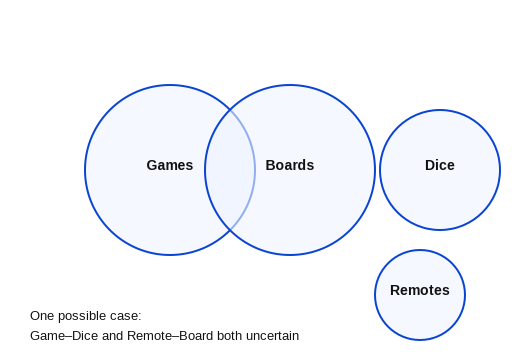
- Games overlap Boards; Dice are away from Boards; Remotes are away from Games.
- (I) No game is a dice: the part of Games outside Boards may touch Dice → not certain.
- (II) Some remotes are boards: Remotes may stay outside Boards → not certain.
Trick: Two negatives about different classes never give a definite 'No' or 'Some' between the third pair.
Answer: (C) Neither conclusion (I) nor (II) follows.
अवधारणा: निष्कर्ष तभी मान्य है जब वह हर संभव आरेख में सत्य हो।
- खेल और बोर्ड आंशिक रूप से मिलते हैं; पासे बोर्ड से अलग; रिमोट खेल से अलग।
- (I) कोई खेल पासा नहीं: खेल का बोर्ड से बाहर वाला भाग पासे से मिल सकता है → निश्चित नहीं।
- (II) कुछ रिमोट बोर्ड हैं: रिमोट बोर्ड से बाहर भी रह सकते हैं → निश्चित नहीं।
ट्रिक: अलग-अलग वर्गों के नकारात्मक कथनों से तीसरे युग्म में निश्चित 'कोई नहीं' या 'कुछ' नहीं बनता।
उत्तर: (C) न तो निष्कर्ष (I) और न ही (II) अनुसरण करता है।