Question bank

Q&A: practice questions with answers

Search questions on any topic. Filter by exam category, exam, subject and topic, try the question, then open the answer and explanation.

Courses – airGurukul

20,719 questions found.

Q1861.
Which player was honoured with the 2025 Football Writers' Association Men's Footballer of the Year award?
किस खिलाड़ी को 2025 फ़ुटबॉल राइटर्स एसोसिएशन मेन्स फ़ुटबॉलर ऑफ़ द ईयर पुरस्कार से सम्मानित किया गया?
  1. AErling Haalandअर्लिंग हालैंड
  2. BMohamed Salahमोहम्मद सलाह
  3. CHarry Kaneहैरी केन
  4. DBukayo Sakaबुकायो साका
Show answer

Concept: The Football Writers' Association (FWA) in England names a Footballer of the Year each season.

  1. Mohamed Salah of Liverpool won the 2025 FWA Men's Footballer of the Year after leading Liverpool to the Premier League title.
  2. It was his third FWA award (2018, 2022, 2025), a record shared with Thierry Henry.
  3. He also won the PFA Players' Player of the Year 2025.

Yaad rakhein: 2024–25 season: Liverpool champions → Salah sweeps FWA + PFA.

Answer: (B) Mohamed Salah

अवधारणा: इंग्लैंड का फ़ुटबॉल राइटर्स एसोसिएशन (FWA) हर सीज़न 'फ़ुटबॉलर ऑफ़ द ईयर' चुनता है।

  1. लिवरपूल के मोहम्मद सलाह ने टीम को प्रीमियर लीग ख़िताब दिलाने के बाद 2025 का FWA पुरुष फ़ुटबॉलर ऑफ़ द ईयर जीता।
  2. यह उनका तीसरा FWA पुरस्कार (2018, 2022, 2025) था — थियरी हेनरी के रिकॉर्ड की बराबरी।
  3. उन्होंने 2025 का PFA प्लेयर्स प्लेयर ऑफ़ द ईयर भी जीता।

याद रखें: 2024–25: लिवरपूल चैंपियन → सलाह को FWA + PFA।

उत्तर: (B) मोहम्मद सलाह
RRB NTPC Undergraduate CBT 1General AwarenessCurrent Affairs – Sports AwardsRRB NTPC Undergraduate CBT 1 2024 · 21 Aug Shift 1 →
Q1862.
Which type of mountain range is formed by the uplifted folded sedimentary rocks?
ऊपर उठी हुई वलित अवसादी चट्टानों से किस प्रकार की पर्वत श्रेणी बनती है?
  1. AVolcanic Mountainsज्वालामुखी पर्वत
  2. BBlock Mountainsब्लॉक पर्वत
  3. CFold Mountainsवलित पर्वत
  4. DResidual Mountainsअवशिष्ट पर्वत
Show answer

Concept: Mountains are classified by origin: fold, block, volcanic and residual.

  1. Fold mountains form when compressional forces push layers of sedimentary rock into folds (anticlines and synclines) and uplift them.
  2. Examples: Himalayas, Alps, Andes, Rockies (young); Aravallis (old).
  3. Block mountains form by faulting; volcanic by eruption; residual by erosion.

Yaad rakhein: Folded sedimentary layers = Fold mountains (Himalayas).

Answer: (C) Fold Mountains

अवधारणा: उत्पत्ति के आधार पर पर्वत चार प्रकार के हैं: वलित, खंड (ब्लॉक), ज्वालामुखी और अवशिष्ट।

  1. संपीडन बल से अवसादी चट्टानों की परतें मुड़कर (अपनति व अभिनति) ऊपर उठती हैं, तो वलित पर्वत बनते हैं।
  2. उदाहरण: हिमालय, आल्प्स, एंडीज़, रॉकीज़ (नवीन); अरावली (प्राचीन)।
  3. ब्लॉक पर्वत भ्रंशन से, ज्वालामुखी पर्वत उद्गार से और अवशिष्ट पर्वत अपरदन से बनते हैं।

याद रखें: मुड़ी हुई अवसादी परतें = वलित पर्वत (हिमालय)।

उत्तर: (C) वलित पर्वत (Fold Mountains)

RRB NTPC Undergraduate CBT 1General AwarenessGeography – MountainsRRB NTPC Undergraduate CBT 1 2024 · 21 Aug Shift 1 →
Q1863.
During the period of medieval Indian literature, which language began to decline as the dominant medium for Buddhist literary expression and scholarship?
मध्यकालीन भारतीय साहित्य की अवधि के दौरान, बौद्ध साहित्यिक अभिव्यक्ति और विद्वत्ता के प्रमुख माध्यम के रूप में किस भाषा का पतन होने लगा?
  1. APaliपालि
  2. BSanskritसंस्कृत
  3. CApabhramshaअपभ्रंश
  4. DPrakritप्राकृत
Show answer

Concept: Pali was the language of the earliest Buddhist canon (Tipitaka) and Theravada scholarship.

  1. Over time Mahayana Buddhists in India shifted to Sanskrit for their texts and philosophy.
  2. In the medieval period, with Buddhism's decline in India, Pali lost its place as the main medium of Buddhist literature in India (it survived in Sri Lanka and Southeast Asia).
  3. Apabhramsha and regional languages were rising, not declining.

Yaad rakhein: Tipitaka = Pali; Mahayana = Sanskrit.

Answer: (A) Pali

अवधारणा: पालि सबसे प्राचीन बौद्ध ग्रंथ-संग्रह (त्रिपिटक) और थेरवाद अध्ययन की भाषा थी।

  1. समय के साथ भारत के महायान बौद्धों ने अपने ग्रंथों और दर्शन के लिए संस्कृत अपनाई।
  2. मध्यकाल में भारत में बौद्ध धर्म के पतन के साथ पालि बौद्ध साहित्य का मुख्य माध्यम नहीं रही (यह श्रीलंका व दक्षिण-पूर्व एशिया में बची रही)।
  3. अपभ्रंश और क्षेत्रीय भाषाएँ उस समय उभर रही थीं।

याद रखें: त्रिपिटक = पालि; महायान = संस्कृत।

उत्तर: (A) पालि

RRB NTPC Undergraduate CBT 1General AwarenessMedieval Literature – LanguagesRRB NTPC Undergraduate CBT 1 2024 · 21 Aug Shift 1 →
Q1864.
The RTI Act applies to which of the followings in India?
भारत में RTI अधिनियम निम्नलिखित में से किन पर लागू होता है?
  1. AOnly Judiciaryकेवल न्यायपालिका
  2. BOnly Central Governmentकेवल केंद्र सरकार
  3. CAll Public Authoritiesसभी सार्वजनिक प्राधिकरण
  4. DOnly State Governmentकेवल राज्य सरकार
Show answer

Concept: The Right to Information Act, 2005 lets citizens seek information from 'public authorities'.

  1. Section 2(h) defines public authorities: bodies set up by the Constitution, Parliament, State legislatures or government notification, and bodies substantially financed by government.
  2. So it covers Central and State governments, courts, legislatures, PSUs and funded NGOs — not just one branch.
  3. Some security/intelligence bodies are exempted under Section 24.

Yaad rakhein: RTI = all public authorities (Centre + States + local bodies).

Answer: (C) All Public Authorities

अवधारणा: सूचना का अधिकार अधिनियम, 2005 नागरिकों को 'लोक प्राधिकरणों' से सूचना माँगने का अधिकार देता है।

  1. धारा 2(h) के अनुसार लोक प्राधिकरण वे निकाय हैं जो संविधान, संसद, राज्य विधानमंडल या सरकारी अधिसूचना से बने हों, या सरकार से पर्याप्त वित्तपोषित हों।
  2. अतः यह केंद्र व राज्य सरकारों, न्यायालयों, विधानमंडलों, PSU और वित्तपोषित NGO सब पर लागू है।
  3. कुछ सुरक्षा/ख़ुफ़िया संस्थाएँ धारा 24 के तहत छूट प्राप्त हैं।

याद रखें: RTI = सभी लोक प्राधिकरण (केंद्र + राज्य + स्थानीय निकाय)।

उत्तर: (C) सभी लोक प्राधिकरण

RRB NTPC Undergraduate CBT 1General AwarenessPolity – Right to InformationRRB NTPC Undergraduate CBT 1 2024 · 21 Aug Shift 1 →
Q1865.
Which Indian institute developed a fluorescent sensor capable of detecting cyanide in water and human cells, using just a UV light source?
किस भारतीय संस्थान ने केवल एक UV प्रकाश स्रोत का उपयोग करके जल और मानव कोशिकाओं में सायनाइड का पता लगाने में सक्षम एक प्रतिदीप्त संवेदक (fluorescent sensor) विकसित किया?
  1. AIIT DelhiIIT दिल्ली
  2. BIIT BombayIIT बॉम्बे
  3. CIIT MadrasIIT मद्रास
  4. DIIT GuwahatiIIT गुवाहाटी
Show answer

Concept: Cyanide is highly toxic even in very small amounts, so quick detection in water and cells is important.

  1. Researchers at IIT Guwahati developed a fluorescent chemical sensor that detects cyanide in water and in living human cells.
  2. The sensor changes its glow under a simple UV light, so detection needs no costly equipment.
  3. It is useful for water-quality testing and biological studies.

Yaad rakhein: Cyanide + UV fluorescent sensor (2025) → IIT Guwahati.

Answer: (D) IIT Guwahati

अवधारणा: साइनाइड बहुत कम मात्रा में भी अत्यंत विषैला है, अतः पानी और कोशिकाओं में इसकी त्वरित पहचान ज़रूरी है।

  1. IIT गुवाहाटी के शोधकर्ताओं ने एक फ़्लोरोसेंट रासायनिक सेंसर बनाया जो पानी और जीवित मानव कोशिकाओं में साइनाइड पहचानता है।
  2. साधारण UV प्रकाश में सेंसर की चमक बदल जाती है, इसलिए महँगे उपकरण की ज़रूरत नहीं।
  3. यह जल-गुणवत्ता जाँच और जैविक अध्ययन में उपयोगी है।

याद रखें: साइनाइड + UV फ़्लोरोसेंट सेंसर (2025) → IIT गुवाहाटी।

उत्तर: (D) IIT गुवाहाटी

RRB NTPC Undergraduate CBT 1General AwarenessCurrent Affairs – Science and TechnologyRRB NTPC Undergraduate CBT 1 2024 · 21 Aug Shift 1 →
Q1866.
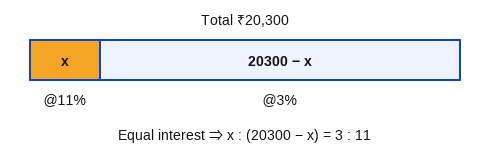
Sapna invested ₹20,300 on simple interest, partly at 11% per annum and partly at 3% per annum. If she earns equal interests from the two investments after 5 years, then find the sum invested at 11% per annum (in ₹).
सपना ने ₹20,300 साधारण ब्याज पर निवेश किए, जिसका कुछ भाग 11% वार्षिक दर पर और कुछ भाग 3% वार्षिक दर पर था। यदि 5 वर्ष बाद उसे दोनों निवेशों से समान ब्याज प्राप्त होता है, तो 11% वार्षिक दर पर निवेश की गई राशि (₹ में) ज्ञात कीजिए।
  1. A4,350
  2. B4,351
  3. C4,347
  4. D4,352
Show answer

Concept: For the same time, equal simple interest means P1R1=P2R2, i.e. principal is inversely proportional to rate.

  1. Let ₹x be at 11% and ₹(20300−x) at 3%, both for 5 years.
  2. x×11×5100=(20300−x)×3×5100⇒11x=60900−3x
  3. 14x=60900⇒x=4350

Trick: Ratio of sums =3:11 (inverse of rates). Sum at 11%=314×20300=4350.

Answer: (A) 4,350

अवधारणा: समान समय के लिए बराबर साधारण ब्याज का अर्थ P1R1=P2R2, अर्थात मूलधन दर के व्युत्क्रमानुपाती है।

  1. माना ₹x को 11% पर और ₹(20300−x) को 3% पर 5 वर्ष के लिए लगाया।
  2. x×11×5100=(20300−x)×3×5100⇒11x=60900−3x
  3. 14x=60900⇒x=4350

ट्रिक: राशियों का अनुपात =3:11 (दरों का उल्टा)। 11% वाली राशि =314×20300=4350।

उत्तर: (A) 4,350

RRB NTPC Undergraduate CBT 1MathematicsSimple InterestRRB NTPC Undergraduate CBT 1 2024 · 21 Aug Shift 1 →
Q1867.
The number of prime numbers lying between 430 and 443, both included, is:
430 और 443 के बीच (दोनों को सम्मिलित करते हुए) स्थित अभाज्य संख्याओं की संख्या कितनी है?
  1. A4
  2. B2
  3. C3
  4. D5
Show answer

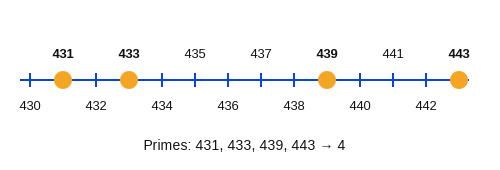
Concept: To test a number n for primality, check divisibility by primes up to n; here 443<21, so test 2, 3, 5, 7, 11, 13, 17, 19.

  1. Even numbers and those ending in 5 are out; left: 431, 433, 437, 439, 441, 443.
  2. 441=212 (divisible by 3) and 437=19×23 — not prime.
  3. 431, 433, 439, 443 pass all tests — prime.

Trick: After removing evens and multiples of 5, check only 3, 7, 11, 13, 17, 19 on the remaining odd numbers.

Answer: (A) 4

अवधारणा: किसी संख्या n के अभाज्य होने की जाँच के लिए n तक की अभाज्य संख्याओं से भाग देखें; यहाँ 443<21, अतः 2, 3, 5, 7, 11, 13, 17, 19 से जाँचें।

  1. सम संख्याएँ और 5 पर समाप्त होने वाली हटाएँ; बचीं: 431, 433, 437, 439, 441, 443।
  2. 441=212 (3 से विभाज्य) और 437=19×23 — अभाज्य नहीं।
  3. 431, 433, 439, 443 सभी जाँच में सफल — अभाज्य।

ट्रिक: सम और 5 के गुणज हटाकर बची विषम संख्याओं को केवल 3, 7, 11, 13, 17, 19 से जाँचें।

उत्तर: (A) 4

RRB NTPC Undergraduate CBT 1MathematicsNumber System – Prime NumbersRRB NTPC Undergraduate CBT 1 2024 · 21 Aug Shift 1 →
Q1868.
By how much is 65% of 65 greater than 15 of 25?
65% × 65 का मान, 15 × 25 के मान से कितना अधिक है?
  1. A31.25
  2. B37.25
  3. C35.25
  4. D34.25
Show answer

Concept: x% of y=x100×y; 'greater by' means take the difference.

  1. 65% of 65=65×65100=4225100=42.25
  2. 15 of 25=5
  3. Difference =42.25−5=37.25

Trick: 652=4225 (number ending in 5: 6×7=42, then 25) → 42.25.

Answer: (B) 37.25

अवधारणा: y का x%=x100×y; 'कितना अधिक' का अर्थ है अंतर निकालना।

  1. 65 का 65%=65×65100=4225100=42.25
  2. 25 का 15=5
  3. अंतर =42.25−5=37.25

ट्रिक: 652=4225 (5 पर ख़त्म संख्या: 6×7=42, फिर 25) → 42.25।

उत्तर: (B) 37.25

RRB NTPC Undergraduate CBT 1MathematicsPercentageRRB NTPC Undergraduate CBT 1 2024 · 21 Aug Shift 1 →
Q1869.
Two times the present age of P exceeds the present age of Q by 41 years. After 7 years, nine times Q’s age will be 24 years less than six times P’s age at that time. What is the present age (in years) of Q?
P की वर्तमान आयु का दोगुना, Q की वर्तमान आयु से 41 वर्ष अधिक है। 7 वर्ष बाद, Q की आयु का नौ गुना, उस समय P की आयु के छह गुने से 24 वर्ष कम होगा। Q की वर्तमान आयु (वर्षों में) क्या है?
  1. A19
  2. B22
  3. C20
  4. D13
Show answer

Concept: Form two equations from the two conditions and solve them together.

  1. Present: 2P−Q=41 … (i)
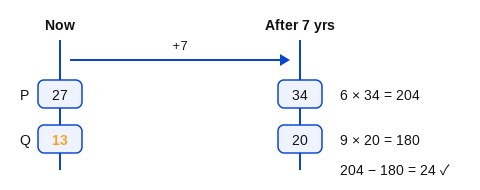
  2. After 7 years: 9(Q+7)=6(P+7)−24⇒9Q+63=6P+18⇒2P−3Q=15 … (ii)
  3. (i) − (ii): 2Q=26⇒Q=13, and P=27.

Trick: Check options: Q=13⇒P=27; after 7 years 6×34−9×20=204−180=24 ✓.

Answer: (D) 13

अवधारणा: दोनों शर्तों से दो समीकरण बनाकर साथ हल करें।

  1. वर्तमान: 2P−Q=41 … (i)
  2. 7 वर्ष बाद: 9(Q+7)=6(P+7)−24⇒9Q+63=6P+18⇒2P−3Q=15 … (ii)
  3. (i) − (ii): 2Q=26⇒Q=13, और P=27।

ट्रिक: विकल्प जाँचें: Q=13⇒P=27; 7 वर्ष बाद 6×34−9×20=204−180=24 ✓।

उत्तर: (D) 13

RRB NTPC Undergraduate CBT 1MathematicsProblems on AgesRRB NTPC Undergraduate CBT 1 2024 · 21 Aug Shift 1 →
Q1870.
Evaluate: (-9) - (-60) ÷ (-10) + (-3) × 7
मान ज्ञात कीजिए: (-9) - (-60) ÷ (-10) + (-3) × 7
  1. A-35
  2. B-38
  3. C-36
  4. D-39
Show answer

Concept: By BODMAS, do division and multiplication first, then addition and subtraction, keeping track of signs.

  1. (−60)÷(−10)=6
  2. (−3)×7=−21
  3. (−9)−6+(−21)=−9−6−21=−36

Trick: Negative ÷ negative = positive; then '− positive' subtracts.

Answer: (C) −36

अवधारणा: BODMAS के अनुसार पहले भाग और गुणा, फिर जोड़ और घटाव करें; चिह्नों का ध्यान रखें।

  1. (−60)÷(−10)=6
  2. (−3)×7=−21
  3. (−9)−6+(−21)=−9−6−21=−36

ट्रिक: ऋणात्मक ÷ ऋणात्मक = धनात्मक; फिर '− धनात्मक' घटता है।

उत्तर: (C) −36

RRB NTPC Undergraduate CBT 1MathematicsSimplification – BODMASRRB NTPC Undergraduate CBT 1 2024 · 21 Aug Shift 1 →
Q1871.
The LCM of the numbers 14.2 and 0.05 is:
संख्याओं 14.2 और 0.05 का LCM (लघुत्तम समापवर्त्य) क्या है?
  1. A14.2
  2. B0.142
  3. C142
  4. D1.42
Show answer

Concept: Make decimal places equal, find the LCM of the numbers without decimals, then put back the same decimal places.

  1. 14.2=14.20=1420100 and 0.05=5100
  2. LCM(1420,5)=1420 (since 1420 is a multiple of 5)
  3. LCM =1420100=14.2

Trick: If the bigger number is a multiple of the smaller (14.2=284×0.05), the bigger number itself is the LCM.

Answer: (A) 14.2

अवधारणा: दशमलव स्थान बराबर करें, बिना दशमलव की संख्याओं का LCM निकालें, फिर उतने ही दशमलव स्थान लगाएँ।

  1. 14.2=14.20=1420100 और 0.05=5100
  2. LCM(1420,5)=1420 (क्योंकि 1420, 5 का गुणज है)
  3. LCM =1420100=14.2

ट्रिक: यदि बड़ी संख्या छोटी का गुणज हो (14.2=284×0.05), तो बड़ी संख्या ही LCM है।

उत्तर: (A) 14.2

RRB NTPC Undergraduate CBT 1MathematicsLCM of DecimalsRRB NTPC Undergraduate CBT 1 2024 · 21 Aug Shift 1 →
Q1872.
Find the mean proportional of 400 and 4.
400 और 4 का मध्यानुपाती ज्ञात कीजिए।
  1. A37
  2. B39
  3. C40
  4. D41
Show answer

Concept: Mean proportional of a and b is x where a:x=x:b, so x=ab.

  1. x=400×4
  2. =1600=40

Trick: 400×4=20×2=40.

Answer: (C) 40

अवधारणा: a और b का मध्यानुपाती x वह है जिसमें a:x=x:b, अतः x=ab।

  1. x=400×4
  2. =1600=40

ट्रिक: 400×4=20×2=40।

उत्तर: (C) 40

RRB NTPC Undergraduate CBT 1MathematicsRatio – Mean ProportionalRRB NTPC Undergraduate CBT 1 2024 · 21 Aug Shift 1 →
Q1873.
A shopkeeper lists the price of a fan at 44% above its cost price and offers a 25% discount on its list price. If he earns a profit of ₹126, then what is the list price (in ₹) of the fan?
एक दुकानदार एक पंखे का मूल्य उसके क्रय मूल्य से 44% अधिक अंकित करता है और उसके सूची मूल्य पर 25% की छूट देता है। यदि उसे ₹126 का लाभ होता है, तो पंखे का सूची मूल्य (₹ में) क्या है?
  1. A1,968
  2. B2,192
  3. C2,098
  4. D2,268
Show answer

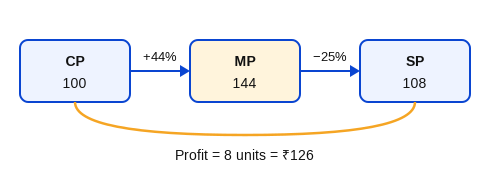
Concept: Take CP =100 units and apply mark-up and discount one after another.

  1. MP =100×1.44=144 units
  2. SP =144×0.75=108 units, so profit =8 units
  3. 8 units=126⇒1 unit=15.75
  4. MP =144×15.75=2268

Trick: Net profit %=44−25−44×25100=8%; MP =1448×126=18×126=2268.

Answer: (D) 2,268

अवधारणा: क्रय मूल्य (CP) =100 इकाई मानें और अंकन (mark-up) व छूट क्रम से लगाएँ।

  1. अंकित मूल्य (MP) =100×1.44=144 इकाई
  2. विक्रय मूल्य (SP) =144×0.75=108 इकाई, अतः लाभ =8 इकाई
  3. 8 इकाई=126⇒1 इकाई=15.75
  4. MP =144×15.75=2268

ट्रिक: शुद्ध लाभ %=44−25−44×25100=8%; MP =1448×126=18×126=2268।

उत्तर: (D) 2,268

RRB NTPC Undergraduate CBT 1MathematicsProfit, Loss and DiscountRRB NTPC Undergraduate CBT 1 2024 · 21 Aug Shift 1 →
Q1874.
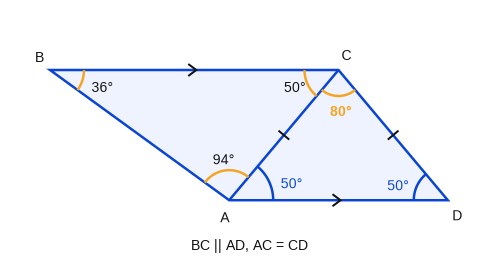
ABCD is a trapezium in which BC∥AD and AC=CD. If ∠ABC=36∘ and ∠BAC=94∘, then what is the measure of ∠ACD (in degree)?
ABCD एक समलंब चतुर्भुज है, जिसमें BC∥AD और AC=CD है। यदि ∠ABC=36∘ और ∠BAC=94∘ है, तो ∠ACD का माप (डिग्री में) क्या है?
  1. A159°
  2. B186°
  3. C80°
  4. D163°
Show answer

Concept: Use the angle-sum of a triangle, alternate angles between parallel lines, and equal angles opposite equal sides.

  1. In △ABC: ∠BCA=180∘−36∘−94∘=50∘
  2. BC∥AD with transversal AC: ∠CAD=∠BCA=50∘ (alternate angles)
  3. AC=CD⇒∠CDA=∠CAD=50∘
  4. In △ACD: ∠ACD=180∘−50∘−50∘=80∘

Trick: ∠ACD=180∘−2×∠BCA when AC=CD and BC∥AD.

Answer: (C) 80∘

अवधारणा: त्रिभुज के कोणों का योग, समांतर रेखाओं के एकांतर कोण और बराबर भुजाओं के सामने बराबर कोण का उपयोग करें।

  1. △ABC में: ∠BCA=180∘−36∘−94∘=50∘
  2. BC∥AD और तिर्यक रेखा AC: ∠CAD=∠BCA=50∘ (एकांतर कोण)
  3. AC=CD⇒∠CDA=∠CAD=50∘
  4. △ACD में: ∠ACD=180∘−50∘−50∘=80∘

ट्रिक: जब AC=CD और BC∥AD, तब ∠ACD=180∘−2×∠BCA।

उत्तर: (C) 80∘

RRB NTPC Undergraduate CBT 1MathematicsGeometry – Trapezium and TrianglesRRB NTPC Undergraduate CBT 1 2024 · 21 Aug Shift 1 →
Q1875.
A bus travelling at 84 km/hr completes a journey in 20 hours. What should its speed be to cover the same distance in 10 hours?
84 km/hr की चाल से चलने वाली एक बस 20 घंटे में एक यात्रा पूरी करती है। समान दूरी 10 घंटे में तय करने के लिए उसकी चाल कितनी होनी चाहिए?
  1. A167 km/hr
  2. B165 km/hr
  3. C171 km/hr
  4. D168 km/hr
Show answer

Concept: For a fixed distance, speed is inversely proportional to time: S1T1=S2T2.

  1. Distance =84×20=1680km
  2. Required speed =168010=168km/hr

Trick: Time halved (20→10) ⇒ speed doubled: 84×2=168.

Answer: (D) 168km/hr

अवधारणा: निश्चित दूरी के लिए चाल समय के व्युत्क्रमानुपाती होती है: S1T1=S2T2।

  1. दूरी =84×20=1680km
  2. आवश्यक चाल =168010=168km/hr

ट्रिक: समय आधा (20→10) ⇒ चाल दोगुनी: 84×2=168।

उत्तर: (D) 168km/hr

RRB NTPC Undergraduate CBT 1MathematicsSpeed, Time and DistanceRRB NTPC Undergraduate CBT 1 2024 · 21 Aug Shift 1 →
Q1876.
X, Y and Z invested a sum in the ratio of 19 : 88 : 18, respectively. If they earned a total profit of ₹2,200 at the end of the year, what is the difference between the shares of Y and Z?
X, Y और Z ने क्रमशः 19 : 88 : 18 के अनुपात में एक राशि का निवेश किया। यदि वर्ष के अंत में उन्होंने कुल ₹2,200 का लाभ अर्जित किया, तो Y और Z के हिस्सों के बीच का अंतर क्या है?
  1. A₹1,181
  2. B₹1,391
  3. C₹1,302
  4. D₹1,232
Show answer

Concept: Profit is shared in the ratio of investment.

  1. Sum of ratio terms =19+88+18=125.
  2. One part =2200125=17.6.
  3. Difference of Y and Z =(88−18)×17.6=70×17.6=1232.

Trick: Work with the ratio difference only: 70 parts ×17.6.

Answer: (D) ₹1,232

अवधारणा: लाभ निवेश के अनुपात में बँटता है।

  1. अनुपात का योग =19+88+18=125।
  2. एक भाग =2200125=17.6।
  3. Y और Z का अंतर =(88−18)×17.6=70×17.6=1232।

ट्रिक: सिर्फ़ अनुपात के अंतर से काम करें: 70 भाग ×17.6।

उत्तर: (D) ₹1,232

RRB NTPC Undergraduate CBT 1MathematicsPartnershipRRB NTPC Undergraduate CBT 1 2024 · 21 Aug Shift 1 →
Q1877.
Find the simple interest on ₹4,000 at 7.5% per annum rate of interest deposited on 9 February 2024 and withdrawn on 10 April 2024.
9 फ़रवरी 2024 को जमा की गई और 10 अप्रैल 2024 को निकाली गई ₹4,000 की राशि पर 7.5% वार्षिक ब्याज दर से साधारण ब्याज ज्ञात कीजिए।
  1. A₹51
  2. B₹48
  3. C₹49
  4. D₹50
Show answer

Concept: SI=P×R×T100; for dates count the days (exclude the deposit day, include the withdrawal day). 2024 is a leap year (366 days).

  1. Days: February 29−9=20, March 31, April 10 → total 61 days.
  2. T=61366=16 year.
  3. SI=4000×7.5×1100×6=3006=50.

Trick: 61 days of a leap year is exactly 16 year, so SI =16 of yearly interest ₹300.

Answer: (D) ₹50

अवधारणा: SI=P×R×T100; तारीखों में दिन गिनें (जमा का दिन छोड़ें, निकासी का दिन जोड़ें)। 2024 लीप वर्ष है (366 दिन)।

  1. दिन: फ़रवरी 29−9=20, मार्च 31, अप्रैल 10 → कुल 61 दिन।
  2. T=61366=16 वर्ष।
  3. SI=4000×7.5×1100×6=3006=50।

ट्रिक: लीप वर्ष के 61 दिन ठीक 16 वर्ष हैं, इसलिए SI = वार्षिक ब्याज ₹300 का 16।

उत्तर: (D) ₹50

RRB NTPC Undergraduate CBT 1MathematicsSimple InterestRRB NTPC Undergraduate CBT 1 2024 · 21 Aug Shift 1 →
Q1878.
The marks scored by 10 students are given below.
18, 10, 15, 18, 18, 13, 20, 18, 17, 19
The mode of the given data is:
10 विद्यार्थियों द्वारा प्राप्त अंक नीचे दिए गए हैं।
18, 10, 15, 18, 18, 13, 20, 18, 17, 19
दिए गए आँकड़ों का बहुलक क्या है?
  1. A18
  2. B15
  3. C10
  4. D13
Show answer

Concept: Mode is the value that occurs most often in the data.

  1. Count each value: 18 occurs 4 times.
  2. 10, 15, 13, 20, 17, 19 each occur only once.
  3. So the most frequent value is 18.

Trick: Sort the data: 10, 13, 15, 17, 18, 18, 18, 18, 19, 20 – the repeated block is the mode.

Answer: (A) 18

अवधारणा: बहुलक (Mode) वह मान है जो आँकड़ों में सबसे अधिक बार आता है।

  1. गिनती करें: 18 चार बार आता है।
  2. 10, 15, 13, 20, 17, 19 केवल एक-एक बार आते हैं।
  3. अतः सबसे अधिक बार आने वाला मान 18 है।

ट्रिक: आँकड़ों को क्रम में लिखें: 10, 13, 15, 17, 18, 18, 18, 18, 19, 20 – दोहराया गया मान ही बहुलक है।

उत्तर: (A) 18

RRB NTPC Undergraduate CBT 1MathematicsModeRRB NTPC Undergraduate CBT 1 2024 · 21 Aug Shift 1 →
Q1879.
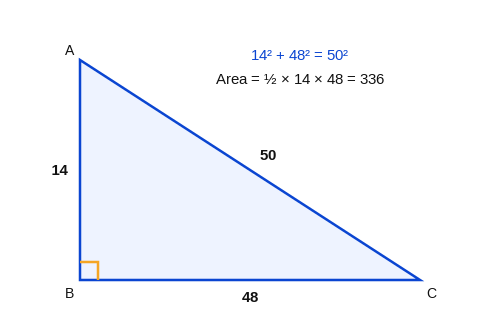
The sides of a triangle are 14 cm, 48 cm, and 50 cm. What is its area? (in cm2 )
एक त्रिभुज की भुजाएँ 14 cm, 48 cm और 50 cm हैं। इसका क्षेत्रफल क्या है? (cm2 में)
  1. A321
  2. B324
  3. C336
  4. D314
Show answer

Concept: If a2+b2=c2, the triangle is right-angled and area =12×a×b.

  1. 142+482=196+2304=2500=502, so it is a right triangle.
  2. Legs are 14 and 48 (hypotenuse 50).
  3. Area =12×14×48=336cm2.

Trick: 14,48,50=2×(7,24,25) – a known Pythagorean triplet.

Answer: (C) 336

अवधारणा: यदि a2+b2=c2 हो तो त्रिभुज समकोण है और क्षेत्रफल =12×a×b।

  1. 142+482=196+2304=2500=502, अतः समकोण त्रिभुज।
  2. भुजाएँ 14 और 48 (कर्ण 50)।
  3. क्षेत्रफल =12×14×48=336cm2।

ट्रिक: 14,48,50=2×(7,24,25) – प्रसिद्ध पाइथागोरस त्रिक (triplet)।

उत्तर: (C) 336

RRB NTPC Undergraduate CBT 1MathematicsArea of TriangleRRB NTPC Undergraduate CBT 1 2024 · 21 Aug Shift 1 →
Q1880.
Which of the following numbers divides 44,43,48,269?
निम्नलिखित में से कौन-सी संख्या 44,43,48,269 को विभाजित करती है?
  1. A12
  2. B9
  3. C10
  4. D19
Show answer

Concept: Use divisibility rules to eliminate, then divide directly.

  1. 444348269 is odd, so it is not divisible by 12 or 10.
  2. Digit sum =4+4+4+3+4+8+2+6+9=44, not a multiple of 9.
  3. 444348269÷19=23386751 exactly, since 19×23386751=444348269.

Trick: Eliminate by last digit and digit sum first – only one option remains to test.

Answer: (D) 19

अवधारणा: विभाज्यता के नियमों से विकल्प हटाएँ, फिर सीधे भाग दें।

  1. 444348269 विषम है, अतः 12 या 10 से विभाज्य नहीं।
  2. अंकों का योग =4+4+4+3+4+8+2+6+9=44, जो 9 का गुणज नहीं।
  3. 444348269÷19=23386751 पूर्ण रूप से, क्योंकि 19×23386751=444348269।

ट्रिक: पहले अंतिम अंक और अंकों के योग से विकल्प हटाएँ – केवल एक बचता है।

उत्तर: (D) 19

RRB NTPC Undergraduate CBT 1MathematicsDivisibilityRRB NTPC Undergraduate CBT 1 2024 · 21 Aug Shift 1 →