Question bank

Q&A: practice questions with answers

Search questions on any topic. Filter by exam category, exam, subject and topic, try the question, then open the answer and explanation.

Courses – airGurukul

4,570 questions found.

Q2361.
Crustal shortening takes place due to :
पटल के छोटे होने का कारण है :
  1. ANormal faultingसामान्य भ्रंशीकरण
  2. BFolding and thrustingवलनता और थ्रस्टिंग
  3. CStrike slip faultingनतिलम्ब – सर्पण भ्रंशीकरण
  4. DMetamorphismकायान्तरण
Show answer

Concept: Compression shortens and thickens the crust through folding and thrust (reverse) faulting, as in fold-and-thrust belts like the Himalaya.

  1. Normal faulting – crustal extension (lengthening).
  2. Strike-slip faulting – horizontal displacement with no net shortening.
  3. Metamorphism is a change in mineralogy/texture, not a shortening mechanism.

Short trick: Squeeze → folds + thrusts; Stretch → normal faults.

अवधारणा: संपीडन भूपर्पटी को वलन और क्षेप (थ्रस्ट) भ्रंशन द्वारा छोटा व मोटा करता है, जैसे हिमालय की वलन-क्षेप पट्टी।

  1. सामान्य भ्रंश – विस्तार (लंबाई बढ़ना)।
  2. नतिलम्ब-सर्पण भ्रंश – क्षैतिज विस्थापन, शुद्ध संकुचन नहीं।
  3. कायांतरण खनिज/गठन परिवर्तन है।

याद रखें: दबाव → वलन + थ्रस्ट; खिंचाव → सामान्य भ्रंश।
UPHESC Assistant Professor GeologyGeology / Earth SciencesCrustal shortening and extensionUPHESC Assistant Professor Geology · Booklet 1C78 (Series A) →
Q2362.
The ratio of lateral strain to longitudinal strain is known as -
पार्श्व विकृति एवं अनुदैर्ध्य विकृति के अनुपात को कहते हैं ।
  1. APoisson ratioप्वासों अनुपात
  2. BYoung's modulusटांग का गुणांक
  3. CBulk modulusआयतन प्रत्यास्थता गुणांक
  4. DModulus of rigidityप्रत्यास्थता गुणांक
Show answer

Concept: Poisson's ratio ν = lateral strain / longitudinal strain (dimensionless; about 0.25 for most rocks, 0.5 for incompressible fluids).

  1. Young's modulus E = longitudinal stress / longitudinal strain.
  2. Bulk modulus K = pressure / volumetric strain.
  3. Rigidity (shear) modulus G = shear stress / shear strain.

Short trick: Poisson = sideways ÷ lengthwise strain.

अवधारणा: प्वासों अनुपात ν = पार्श्व विकृति / अनुदैर्ध्य विकृति (विमाहीन; अधिकांश शैलों में ~0.25)।

  1. यंग गुणांक E = अनुदैर्ध्य प्रतिबल / अनुदैर्ध्य विकृति।
  2. आयतन गुणांक K = दाब / आयतन विकृति।
  3. दृढ़ता गुणांक G = अपरूपण प्रतिबल / अपरूपण विकृति।

याद रखें: प्वासों = पार्श्व ÷ अनुदैर्ध्य विकृति।

UPHESC Assistant Professor GeologyGeology / Earth SciencesElastic constantsUPHESC Assistant Professor Geology · Booklet 1C78 (Series A) →
Q2363.
Match the List-I and List-II and choose the correct answer from the code given below :
List-IList-II
(P) Initial stage(1) Alluvial fan
(Q) Youth stage(2) V shaped valley
(R) Mature stage(3) Pot holes
(S) Old stage(4) Flood plains
Codes :
सूची–I और सूची–II का मिलान कीजिए तथा नीचे दिये गये कोड से सही उत्तर दीजिए :
सूची–Iसूची–II
(P) आरंभिक चरण(1) जलोट पंखा
(Q) युवा चरण(2) V आकृति की घाटी
(R) परिपक्व चरण(3) पाट होल्स
(S) वृद्ध चरण(4) वाट के मैदान
कोड :
  1. A(P)-(1), (Q)-(2), (R)-(3), (S)-(4)
  2. B(P)-(2), (Q)-(1), (R)-(4), (S)-(3)
  3. C(P)-(4), (Q)-(3), (R)-(2), (S)-(1)
  4. D(P)-(3), (Q)-(2), (R)-(1), (S)-(4)
Show answer

Concept: Each stage of the fluvial cycle has typical landforms.

  1. Initial stage – vigorous down-cutting into bedrock by eddies with pebbles: pot holes → (3).
  2. Youth – deep V-shaped valleys, gorges → (2).
  3. Mature – where the river leaves the mountains onto the plains, its load spreads as alluvial fans → (1).
  4. Old stage – broad flood plains, meanders, ox-bow lakes → (4). Code 3-2-1-4.

Short trick: Pothole → V-valley → fan → flood plain (mountain to plain).

अवधारणा: नदी चक्र की प्रत्येक अवस्था के विशिष्ट स्थलरूप होते हैं।

  1. आरंभिक अवस्था – कंकड़-युक्त भँवरों से तल का तीव्र कटाव: जलगर्तिका (पॉट होल) → (3)।
  2. युवा – गहरी V-आकार घाटी, गॉर्ज → (2)।
  3. प्रौढ़ – पर्वत से मैदान में प्रवेश पर जलोढ़ पंख → (1)।
  4. वृद्ध – चौड़े बाढ़ मैदान, विसर्प, गोखुर झील → (4)। कोड 3-2-1-4।

याद रखें: पॉटहोल → V-घाटी → जलोढ़ पंख → बाढ़ मैदान।

UPHESC Assistant Professor GeologyGeology / Earth SciencesFluvial landforms and stages of a riverUPHESC Assistant Professor Geology · Booklet 1C78 (Series A) →
Q2364.
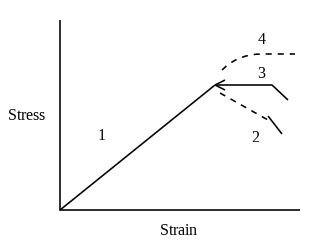
In the given stress - strain graph of rock, sector 2 represents :
किसी शैल के लिए गए प्रतिबल–विकृति ग्राफ में खण्ड 2 निरूपित करता है :
  1. AElastic deformationप्रत्यास्थ विरुपण
  2. BPlastic deformationसुघटय विरुपण
  3. CStrain hardeningविकृति दृढ़ीकरण
  4. DStrain softeningविकृति मृदुलन
Show answer

Concept: After the elastic straight line (1) and the yield point, the curve can follow three paths: horizontal (3) = ideal plastic flow, rising (4) = strain hardening (more stress needed for more strain), falling (2) = strain softening (stress needed drops as strain increases).

  1. Sector 2 slopes downward beyond yield – the rock weakens with continued strain → strain softening.
  2. Sector 1 – elastic; sector 3 – perfectly plastic; sector 4 – strain hardening.

Short trick: After yield: up = hardening, flat = plastic, down = softening.

अवधारणा: प्रत्यास्थ सीधी रेखा (1) व पराभव बिंदु के बाद वक्र तीन मार्ग ले सकता है: क्षैतिज (3) = आदर्श सुघट्य प्रवाह, ऊपर उठता (4) = विकृति दृढ़ीकरण, नीचे गिरता (2) = विकृति मृदुलन।

  1. खंड 2 पराभव के बाद नीचे झुकता है – विकृति बढ़ने पर शैल कमजोर होता है → विकृति मृदुलन।
  2. खंड 1 – प्रत्यास्थ; 3 – पूर्ण सुघट्य; 4 – विकृति दृढ़ीकरण।

याद रखें: पराभव के बाद: ऊपर = दृढ़ीकरण, सपाट = सुघट्य, नीचे = मृदुलन।

UPHESC Assistant Professor GeologyGeology / Earth SciencesStress–strain behaviour of rocksUPHESC Assistant Professor Geology · Booklet 1C78 (Series A) →
Q2365.
In northern hemisphere oceanic circulation happens :
उत्तरी हेमिस्फीयर में समुद्र का सरकुलेशन किस तरीके का होता है :
  1. AAnti clockwiseएन्टीक्लाकवाइज
  2. BClockwiseक्लाक वाइज
  3. CParallel to equatorइक्वेटर के समानन्तर
  4. DParallel to poleपोल के समानान्तर
Show answer

Concept: Driven by the trade winds and westerlies and deflected to the right by the Coriolis force, the major subtropical ocean gyres circulate clockwise in the Northern Hemisphere and anticlockwise in the Southern Hemisphere.

  1. N. Atlantic gyre: Gulf Stream → N. Atlantic Drift → Canary → N. Equatorial current (clockwise).
  2. N. Pacific: Kuroshio → N. Pacific → California → N. Equatorial (clockwise).

Short trick: North – Coriolis to the right – clockwise gyres.

अवधारणा: व्यापारिक पवनों व पछुआ पवनों से संचालित तथा कोरिऑलिस बल से दाईं ओर विक्षेपित होकर, उत्तरी गोलार्ध में प्रमुख उपोष्ण महासागरीय भँवर दक्षिणावर्त (क्लॉकवाइज़) और दक्षिणी गोलार्ध में वामावर्त घूमते हैं।

  1. उत्तरी अटलांटिक: गल्फ स्ट्रीम → उ. अटलांटिक ड्रिफ्ट → कैनरी → उ. विषुवतीय धारा।
  2. उत्तरी प्रशांत: क्यूरोशियो → उ. प्रशांत → कैलिफ़ोर्निया धारा।

याद रखें: उत्तर – कोरिऑलिस दाईं ओर – दक्षिणावर्त।

UPHESC Assistant Professor GeologyGeology / Earth SciencesOcean gyresUPHESC Assistant Professor Geology · Booklet 1C78 (Series A) →
Q2366.
The largest highest and most extensive reefs of all type of coral reefs :
सभी प्रकार की मूंगे की भितियों में विशालतम उच्चतम और सबसे लायक भिति है :
  1. ABarrier reefsवैरियर भितियाँ
  2. BAtollsप्रवाल द्वीप
  3. CFringing reefsसजावटी भितियाँ
  4. DLagoon reefsलैगून भितियाँ
Show answer

Concept: Barrier reefs, separated from the coast by a wide, deep lagoon, are the largest, highest and most extensive of all reef types; the Great Barrier Reef of Australia extends ~2300 km.

  1. Fringing reefs – narrow reefs attached to the shore; most common but small.
  2. Atolls – ring-shaped reefs around a lagoon, no central island (e.g. Lakshadweep).

Short trick: Great Barrier Reef = the biggest reef = barrier type.

अवधारणा: अवरोधक (बैरियर) भित्तियाँ, जो तट से चौड़े-गहरे लैगून द्वारा अलग होती हैं, सभी प्रकारों में सबसे बड़ी, ऊँची और विस्तृत होती हैं; ऑस्ट्रेलिया की ग्रेट बैरियर रीफ ~2300 किमी लंबी है।

  1. तटीय (फ्रिंजिंग) भित्ति – तट से जुड़ी संकरी भित्ति।
  2. एटॉल – लैगून को घेरती वलयाकार भित्ति (लक्षद्वीप)।

याद रखें: ग्रेट बैरियर रीफ = सबसे बड़ी = अवरोधक भित्ति।

UPHESC Assistant Professor GeologyGeology / Earth SciencesCoral reefsUPHESC Assistant Professor Geology · Booklet 1C78 (Series A) →
Q2367.
Thermohaline circulation is related to which of the following ?
थरमोहेलाइन परिसरचण निम्न में से किससे सम्बन्धित है ?
  1. ATemperature gradient in mantleमेन्टल के तापमान प्रवणता
  2. BSurface currents in oceanसमुद्र में सतहीय प्रवाह
  3. CDifference in salinity and temperature of oceanic waterसमुद्रीय जल की लवणता एवं तापमान के अन्तर
  4. DConvection currents in troposphereट्रोपोस्फीयर में कन्वेक्शन करेन्ट
Show answer

Concept: Thermohaline ('thermo' = heat, 'haline' = salt) circulation is the global deep-ocean 'conveyor belt' driven by density differences caused by temperature and salinity.

  1. Cold, salty water sinks in the North Atlantic and around Antarctica, flows along the deep ocean and upwells elsewhere.
  2. Surface currents are mainly wind-driven, not thermohaline.

Short trick: Thermo + haline = temperature + salt → density-driven deep currents.

अवधारणा: तापलवणीय (थर्मो = ताप, हेलाइन = लवण) परिसंचरण ताप व लवणता से उत्पन्न घनत्व-अंतर से चलने वाला वैश्विक गहन महासागरीय 'कन्वेयर बेल्ट' है।

  1. ठंडा, खारा जल उत्तरी अटलांटिक व अंटार्कटिका के पास डूबता है और गहराई में बहकर अन्यत्र ऊपर आता है।
  2. सतही धाराएँ मुख्यतः पवन-चालित हैं।

याद रखें: थर्मो + हेलाइन = ताप + लवण → घनत्व-चालित गहन धाराएँ।

UPHESC Assistant Professor GeologyGeology / Earth SciencesThermohaline circulationUPHESC Assistant Professor Geology · Booklet 1C78 (Series A) →
Q2368.
What is the rate of terrigenous sediment accumulation on the deep ocean floor ?
डीप समुद्र सतह पर टेरीजीनस सेडीमेंट संचय होने की दर क्या होती है ?
  1. A2 mm/year
  2. B2 mm/100 year
  3. C3.1 mm/year
  4. D2 mm/1000 year
Show answer

Concept: Fine terrigenous (wind- and current-borne) clay settles on the abyssal floor extremely slowly – of the order of 1–2 mm per 1000 years (pelagic red/brown clay).

  1. Biogenic oozes accumulate faster, ~1–3 cm/1000 yr.
  2. mm/year rates are typical of continental shelves, deltas and lakes – far too fast for the deep ocean.

Short trick: Deep-sea clay: about a millimetre per millennium.

अवधारणा: महीन स्थलजात (पवन व धारा-वाहित) क्ले गहन सागर तल पर अत्यंत धीरे जमती है – लगभग 1–2 मिमी प्रति 1000 वर्ष (पेलैजिक लाल/भूरी क्ले)।

  1. जैवजनित ऊज़ इससे तेज़, ~1–3 सेमी/1000 वर्ष।
  2. मिमी/वर्ष दर महाद्वीपीय शेल्फ, डेल्टा व झीलों की होती है।

याद रखें: गहन सागर क्ले: लगभग 1 मिमी प्रति सहस्राब्दी।

UPHESC Assistant Professor GeologyGeology / Earth SciencesDeep-sea sedimentation ratesUPHESC Assistant Professor Geology · Booklet 1C78 (Series A) →
Q2369.
Which ooze in the most common found on the ocean floor around the Antarctica ?
अंटार्कटिका के चारों तरफ समुद्र सतह पर कौन सा ऊज सामान्य तौर पर मिलता है :
  1. ARadiolarean oozeरेडियोलेरियन ऊज
  2. BDiatom oozeडाइएटम ऊज
  3. CCarbonate oozeकारबोनेट ऊज
  4. DAll of the aboveउपरोक्त सभी
Show answer

Concept: A broad belt of siliceous diatom ooze encircles Antarctica (Southern Ocean) and also occurs in the high-latitude North Pacific, where cold, nutrient-rich upwelling waters support diatom blooms.

  1. Radiolarian ooze – mainly the equatorial Pacific.
  2. Carbonate (Globigerina) ooze – warm, shallower (above CCD) floors of the Atlantic; carbonate dissolves in cold Antarctic waters.

Short trick: Diatoms – cold poles; Radiolaria – equator; Globigerina – warm, above CCD.

अवधारणा: अंटार्कटिका (दक्षिणी महासागर) के चारों ओर सिलिकामय डायटम ऊज़ की चौड़ी पट्टी है (उत्तरी प्रशांत के उच्च अक्षांशों में भी), जहाँ ठंडा, पोषक-समृद्ध उत्प्रवाह डायटम को बढ़ाता है।

  1. रेडियोलेरियन ऊज़ – मुख्यतः विषुवतीय प्रशांत।
  2. कार्बोनेट (ग्लोबिजेराइना) ऊज़ – गर्म, CCD से ऊपर के तल; ठंडे जल में कार्बोनेट घुल जाता है।

याद रखें: डायटम – ठंडे ध्रुव; रेडियोलेरिया – विषुवत; ग्लोबिजेराइना – गर्म।

UPHESC Assistant Professor GeologyGeology / Earth SciencesPelagic oozes – distributionUPHESC Assistant Professor Geology · Booklet 1C78 (Series A) →
Q2370.
In an area, where piezometric surface overlies the ground surface, which one of the following well types will result ?
किसी क्षेत्र में पीजोमेट्रीक तल यदि सतही तल के उपर पाया जाता है तो इनमें से किस तरह के वेल (कुंए well) पाये जायेगें ?
  1. AOrdinary wellसामान्य वेल (कुंए)
  2. BDry wellसुखे हुए कुंए
  3. CFlowing wellबहता हुआ वेल (कुंआ)
  4. DNone of theseइनमें से कोई नहीं
Show answer

Concept: In a confined aquifer, water in a well rises to the piezometric (potentiometric) surface; where this surface lies above ground level, water flows out at the surface without pumping – a flowing artesian well.

  1. If the piezometric surface is above the aquifer top but below ground → non-flowing artesian well.
  2. Classic example: Great Artesian Basin, Australia.

Short trick: Piezometric surface above ground = free-flowing artesian well.

अवधारणा: परिरुद्ध जलभृत में कुएँ का जल दाब-मितीय (पीज़ोमेट्रिक) तल तक उठता है; जहाँ यह तल भूमि सतह से ऊपर हो, वहाँ बिना पम्प के जल अपने आप बाहर बहता है – प्रवाही आर्टिज़ियन कुआँ।

  1. यदि पीज़ोमेट्रिक तल जलभृत से ऊपर पर सतह से नीचे हो → अप्रवाही आर्टिज़ियन कुआँ।
  2. उदाहरण: ऑस्ट्रेलिया का ग्रेट आर्टिज़ियन बेसिन।

याद रखें: पीज़ोमेट्रिक तल सतह से ऊपर = स्वतः बहता कुआँ।

UPHESC Assistant Professor GeologyGeology / Earth SciencesArtesian (flowing) wellsUPHESC Assistant Professor Geology · Booklet 1C78 (Series A) →
Q2371.
When was first solar mission of India ‘Aditya L1’ launched ?
भारत का पहला सौर मिशन ‘आदित्य एल1’ कब प्रक्षेपित किया गया था ?
  1. ASeptember 2023सितम्बर 2023
  2. BOctober 2024अक्टूबर 2024
  3. CJune 2023जून 2023
  4. DNovember 2023नवम्बर 2023
Show answer

Concept: Aditya-L1 is ISRO's first space-based observatory to study the Sun.

  1. Launched on 2 September 2023 by PSLV-C57 from Sriharikota.
  2. It was inserted into a halo orbit around Lagrange point L1 (about 1.5 million km from Earth) on 6 January 2024.
  3. October 2024 / June 2023 / November 2023 do not match the launch date.

Short trick: Chandrayaan-3 landed 23 Aug 2023 → Aditya-L1 left ten days later, 2 Sept 2023.

अवधारणा: आदित्य-एल1 सूर्य के अध्ययन हेतु इसरो की पहली अंतरिक्ष-आधारित वेधशाला है।

  1. 2 सितम्बर 2023 को PSLV-C57 द्वारा श्रीहरिकोटा से प्रक्षेपित।
  2. 6 जनवरी 2024 को लैग्रेंज बिंदु L1 (पृथ्वी से लगभग 15 लाख किमी) की हेलो कक्षा में स्थापित।
  3. अन्य तिथियाँ प्रक्षेपण से मेल नहीं खातीं।

याद रखें: चंद्रयान-3 की लैंडिंग (23 अगस्त 2023) के दस दिन बाद आदित्य-एल1 – 2 सितम्बर 2023।

UPHESC Assistant Professor GeographyGeneral KnowledgeSpace missions – Aditya-L1UPHESC Assistant Professor Geography 2025 · 16 Apr Shift 2 →
Q2372.
In which city Para Asian Games, 2023 were held ?
किस शहर में पैरा एशियाई खेल, 2023 आयोजित किये गये थे ?
  1. ABeijingबीजिंग
  2. BGuangzhouगुआंगजौ
  3. CHangzhouहांगजौ
  4. DShanghaiशंघाई
Show answer

Concept: The 4th Asian Para Games were held in Hangzhou, China (22–28 October 2023).

  1. Hangzhou also hosted the 19th Asian Games (Sept–Oct 2023).
  2. India won a record 111 medals (29 gold) at these Para Games.
  3. Guangzhou hosted the 1st Asian Para Games (2010); Beijing and Shanghai did not host the 2023 edition.

Short trick: 2023: Asian Games + Para Games – both in Hangzhou; India's Para medal tally = 111.

अवधारणा: चौथे एशियाई पैरा खेल हांगजौ (चीन) में 22–28 अक्टूबर 2023 को हुए।

  1. हांगजौ ने ही 19वें एशियाई खेल (सितम्बर–अक्टूबर 2023) आयोजित किए।
  2. भारत ने इनमें रिकॉर्ड 111 पदक (29 स्वर्ण) जीते।
  3. गुआंगजौ में पहले एशियाई पैरा खेल (2010) हुए थे; बीजिंग/शंघाई 2023 के मेजबान नहीं थे।

याद रखें: 2023 – एशियाई खेल और पैरा खेल दोनों हांगजौ में; भारत के पैरा पदक = 111।

UPHESC Assistant Professor GeographyGeneral KnowledgeSports – Asian Para Games 2023UPHESC Assistant Professor Geography 2025 · 16 Apr Shift 2 →
Q2373.
Who was appointed as the Chairperson of the Securities and Exchange Board of India (SEBI) in 2024 ?
2024 में भारतीय प्रतिभूति एवं विनिमय बोर्ड (सेबी) का अध्यक्ष किसे नियुक्त किया गया था ?
  1. AAjay Tyagiअजय त्यागी
  2. BMadhabi Puri Buchमाधबी पुरी बुच
  3. CU. K. Sinhaयू. के. सिन्हा
  4. DD. R. Mehtaडी. आर. मेहता
Show answer

Concept: No SEBI Chairperson was appointed in 2024. Madhabi Puri Buch was appointed in 2022 (took charge 2 March 2022) and headed SEBI throughout 2024 until 28 Feb 2025; Tuhin Kanta Pandey was appointed in 2025.

  1. D. R. Mehta (1995–2002), U. K. Sinha (2011–2017) and Ajay Tyagi (2017–2022) are earlier chairpersons – clearly wrong.
  2. Madhabi Puri Buch held the post in 2024 but was not appointed in 2024, so option (B) fits only if 'appointed in 2024' is read as 'serving in 2024'.
  3. As printed, no option was appointed in 2024 → the question is treated as a bonus. Remember: Buch – first woman SEBI chief (2022–2025).

Short trick: SEBI chiefs: Mehta → … → Sinha → Tyagi → Buch (2022) → Pandey (2025).

अवधारणा: 2024 में सेबी का कोई अध्यक्ष नियुक्त नहीं हुआ। माधबी पुरी बुच 2022 में नियुक्त हुईं (2 मार्च 2022 को पदभार) और 2024 भर से 28 फरवरी 2025 तक सेबी की अध्यक्ष रहीं; तुहिन कांत पांडेय 2025 में नियुक्त हुए।

  1. डी. आर. मेहता (1995–2002), यू. के. सिन्हा (2011–2017), अजय त्यागी (2017–2022) पूर्व अध्यक्ष – स्पष्टतः गलत।
  2. माधबी पुरी बुच 2024 में पद पर थीं, पर 2024 में नियुक्त नहीं हुईं; विकल्प (B) तभी सही होगा जब 'नियुक्त' को 'पदासीन' पढ़ा जाए।
  3. अतः छपे रूप में कोई विकल्प 2024 में नियुक्त नहीं — प्रश्न बोनस माना गया। याद रखें: बुच – सेबी की पहली महिला अध्यक्ष (2022–2025)।

याद रखें: क्रम: मेहता → … → सिन्हा → त्यागी → बुच (2022) → पांडेय (2025)।

UPHESC Assistant Professor GeographyGeneral KnowledgeRegulatory bodies – SEBI chairpersonsUPHESC Assistant Professor Geography 2025 · 16 Apr Shift 2 →
Q2374.
Who launched ‘Tamilaga Vettri Kazhagam’, a new political party in Tamil Nadu ?
तमिलनाडु में एक नयी राजनीतिक पार्टी ‘‘तमिलागा वेट्री कज़गम’’ किसके द्वारा शुरू की गयी ?
  1. AKamal Hasanकमल हसन
  2. BRajnikantरजनीकांत
  3. CAjith Kumarअजित कुमार
  4. DJoseph Vijay Chandrashekharजोसेफ विजय चन्द्रशेखर
Show answer

Concept: Tamilaga Vettri Kazhagam (TVK) was launched in February 2024 by Tamil film actor Vijay (full name Joseph Vijay Chandrasekhar).

  1. Kamal Haasan founded Makkal Needhi Maiam (2018).
  2. Rajinikanth announced a party but withdrew in 2020.
  3. Ajith Kumar has not launched a party.

Short trick: TVK = 'Thalapathy' Vijay; MNM = Kamal Haasan.

अवधारणा: तमिलागा वेट्री कज़गम (TVK) की स्थापना फरवरी 2024 में तमिल अभिनेता विजय (पूरा नाम जोसेफ विजय चन्द्रशेखर) ने की।

  1. कमल हसन ने ‘मक्कल नीधि मय्यम’ (2018) बनाई।
  2. रजनीकांत ने पार्टी की घोषणा की थी पर 2020 में पीछे हट गए।
  3. अजित कुमार ने कोई दल नहीं बनाया।

याद रखें: TVK = ‘थलपति’ विजय; MNM = कमल हसन।

UPHESC Assistant Professor GeographyGeneral KnowledgeCurrent affairs – political partiesUPHESC Assistant Professor Geography 2025 · 16 Apr Shift 2 →
Q2375.
Where was 19th G-20 Summit held ?
19 वाँ जी–20 शिखर सम्मेलन कहाँ आयोजित किया गया था ?
  1. ANew Delhi, Indiaनई दिल्ली, भारत
  2. BRio de Janeiro, Brazilरियो डि जनेरो, ब्राजील
  3. CJakarta, Indonesiaजकार्ता, इण्डोनेशिया
  4. DMoscow, Russiaमास्को, रूस
Show answer

Concept: The 19th G20 Summit was held at Rio de Janeiro, Brazil on 18–19 November 2024.

  1. 17th summit: Bali, Indonesia (2022); 18th: New Delhi, India (Sept 2023).
  2. 20th summit: Johannesburg, South Africa (2025).
  3. Jakarta and Moscow have never hosted a G20 leaders' summit (Russia hosted at St Petersburg, 2013).

Short trick: Troika order: Indonesia (17) → India (18) → Brazil (19) → South Africa (20).

अवधारणा: 19वाँ जी-20 शिखर सम्मेलन 18–19 नवम्बर 2024 को रियो डि जनेरो (ब्राजील) में हुआ।

  1. 17वाँ: बाली, इण्डोनेशिया (2022); 18वाँ: नई दिल्ली, भारत (सितम्बर 2023)।
  2. 20वाँ: जोहान्सबर्ग, दक्षिण अफ्रीका (2025)।
  3. जकार्ता व मास्को में कभी जी-20 नेता सम्मेलन नहीं हुआ (रूस में 2013 में सेंट पीटर्सबर्ग में)।

याद रखें: क्रम: इण्डोनेशिया (17) → भारत (18) → ब्राजील (19) → दक्षिण अफ्रीका (20)।

UPHESC Assistant Professor GeographyGeneral KnowledgeInternational summits – G20UPHESC Assistant Professor Geography 2025 · 16 Apr Shift 2 →
Q2376.
When Swachha Bharat Mission was started ?
स्वच्छ भारत अभियान की शुरुआत कब हुयी ?
  1. A2 October, 20142 अक्टूबर, 2014
  2. B21 August, 201421 अगस्त, 2014
  3. C22 January, 201522 जनवरी, 2015
  4. D28 August, 201428 अगस्त, 2014
Show answer

Concept: Swachh Bharat Mission was launched on 2 October 2014, Gandhi Jayanti.

  1. 28 August 2014 = Pradhan Mantri Jan Dhan Yojana.
  2. 22 January 2015 = Beti Bachao Beti Padhao (Panipat).
  3. Target: an Open-Defecation-Free India by 2 Oct 2019 (Gandhi's 150th birth anniversary).

Short trick: Cleanliness → Gandhi → 2 October.

अवधारणा: स्वच्छ भारत मिशन 2 अक्टूबर 2014 (गाँधी जयंती) को आरम्भ हुआ।

  1. 28 अगस्त 2014 = प्रधानमंत्री जन धन योजना।
  2. 22 जनवरी 2015 = बेटी बचाओ बेटी पढ़ाओ (पानीपत)।
  3. लक्ष्य: 2 अक्टूबर 2019 (गाँधी की 150वीं जयंती) तक खुले में शौच मुक्त भारत।

याद रखें: स्वच्छता → गाँधी → 2 अक्टूबर।

UPHESC Assistant Professor GeographyGeneral KnowledgeGovernment schemes – launch datesUPHESC Assistant Professor Geography 2025 · 16 Apr Shift 2 →
Q2377.
Who was the first to apply the sociometric test ?
समाजमिति परीक्षण का प्रयोग सर्वप्रथम किसने किया था ?
  1. AJ. A. Davisजे. ए. डेविस
  2. BA. J. Reissए. जे. रेइस
  3. CJ. L. Morenoजे. एल. मोरेनो
  4. DA. M. Edwardsए. एम. एडवर्ड्स
Show answer

Concept: Sociometry (measuring attraction/rejection in a group) was developed by Jacob L. Moreno.

  1. Moreno introduced the sociometric test and the sociogram in 'Who Shall Survive?' (1934).
  2. Reiss and Edwards are known for occupational-status scales; J. A. Davis for survey research – not sociometry.
  3. Moreno is also the founder of psychodrama.

Short trick: Moreno = Sociogram + Psychodrama.

अवधारणा: समाजमिति (समूह में आकर्षण/विकर्षण का मापन) का विकास जैकब एल. मोरेनो ने किया।

  1. मोरेनो ने ‘Who Shall Survive?’ (1934) में समाजमिति परीक्षण व समाजालेख (सोशियोग्राम) प्रस्तुत किए।
  2. रेइस व एडवर्ड्स व्यावसायिक प्रस्थिति मापनी के लिए, डेविस सर्वेक्षण शोध के लिए जाने जाते हैं।
  3. मोरेनो साइकोड्रामा के भी जनक हैं।

याद रखें: मोरेनो = सोशियोग्राम + साइकोड्रामा।

UPHESC Assistant Professor GeographyGeneral KnowledgeResearch methods – sociometryUPHESC Assistant Professor Geography 2025 · 16 Apr Shift 2 →
Q2378.
Arrange the following in a sequence :
I. Raw Data
II. Data Processing
III. Analysis of Data
IV. Presentation of Data
Choose the correct answer from the code given below :
Code :
निम्नलिखित को एक अनुक्रम में व्यवस्थित कीजिए :
I. प्रारम्भिक समंक
II. समंको का प्रसंस्करण
III. समंको का विश्लेषण
IV. समंको का प्रस्तुतीकरण
नीचे दिए गए कूट में से सही उत्तर चुनिए :
कूट :
  1. AI, II, IV, III
  2. BI, IV, III, II
  3. CII, III, IV, I
  4. DI, III, II, IV
Show answer

Concept: A statistical investigation runs: collection → organisation/processing → presentation → analysis → interpretation.

  1. Raw (primary) data are collected first (I).
  2. They are processed – edited, coded, classified, tabulated (II).
  3. The organised data are presented in tables, diagrams and graphs (IV).
  4. Only then are they analysed with averages, dispersion, correlation, etc. (III) – giving I, II, IV, III.

Short trick: C-O-P-A-I: Collect, Organise, Present, Analyse, Interpret.

अवधारणा: सांख्यिकीय अनुसंधान का क्रम: संकलन → संगठन/प्रसंस्करण → प्रस्तुतीकरण → विश्लेषण → निर्वचन।

  1. सबसे पहले प्रारम्भिक (कच्चे) समंक एकत्र होते हैं (I)।
  2. फिर उनका प्रसंस्करण – सम्पादन, कूटन, वर्गीकरण, सारणीयन (II)।
  3. व्यवस्थित समंकों का सारणी, चित्र व ग्राफ द्वारा प्रस्तुतीकरण (IV)।
  4. अन्त में माध्य, अपकिरण, सहसंबंध आदि से विश्लेषण (III) – अतः I, II, IV, III।

याद रखें: संकलन → संगठन → प्रस्तुतीकरण → विश्लेषण → निर्वचन।

UPHESC Assistant Professor GeographyGeneral KnowledgeStages of statistical investigationUPHESC Assistant Professor Geography 2025 · 16 Apr Shift 2 →
Q2379.
Which one among the following is a primary ethical consideration when conducting research involving human participants ?
निम्नलिखित में से कौन–सा एक मानव प्रतिभागियों को शामिल करने वाले शोध का प्राथमिक नैतिक विचार है ?
  1. AEnsuring statistical significanceसांख्यिकीय महत्व सुनिश्चित करना
  2. BAchieving a large sample sizeविशाल प्रतिदर्श आकार प्राप्त करना
  3. CUtilizing advanced research methodologyउन्नत शोध पद्धतियों का प्रयोग करना
  4. DMaintaining participant anonymityप्रतिभागियों की गोपनियता बनाये रखना
Show answer

Concept: Research ethics with human subjects rests on informed consent, voluntary participation, no harm, and anonymity/confidentiality.

  1. Protecting participants' identity (anonymity) is a core ethical duty.
  2. Statistical significance, large samples and advanced methods are matters of research quality/design, not ethics.

Short trick: Ethics = protect the person (consent, no harm, privacy); design = protect the result.

अवधारणा: मानव प्रतिभागियों वाले शोध की नैतिकता: सूचित सहमति, स्वैच्छिक भागीदारी, हानि न पहुँचाना तथा गुमनामी/गोपनीयता।

  1. प्रतिभागी की पहचान गुप्त रखना मूल नैतिक दायित्व है।
  2. सांख्यिकीय महत्व, बड़ा प्रतिदर्श व उन्नत पद्धति शोध की गुणवत्ता/अभिकल्प से जुड़े हैं, नैतिकता से नहीं।

याद रखें: नैतिकता = व्यक्ति की रक्षा (सहमति, हानि नहीं, निजता)।

UPHESC Assistant Professor GeographyGeneral KnowledgeResearch ethicsUPHESC Assistant Professor Geography 2025 · 16 Apr Shift 2 →
Q2380.
Who introduced discovery learning method of inquiry based education ?
खोजपरक अधिगम जो अन्वेषण आधारित शिक्षण की विधि है, किसके द्वारा आरम्भ की गयी ?
  1. AWilliam Jamesविलियम जेम्स
  2. BJerome Brunerजेरोम ब्रूनर
  3. CJohn Deweyजॉन डेवी
  4. DJean Piagetजीन पियाजे
Show answer

Concept: Discovery learning was proposed by Jerome Bruner (1961, 'The Act of Discovery').

  1. Bruner: learners construct knowledge by exploring; also gave the spiral curriculum and enactive–iconic–symbolic modes.
  2. Dewey stressed 'learning by doing' (pragmatism); Piaget gave cognitive-development stages; William James – functionalism in psychology.

Short trick: Bruner = Discovery + Spiral curriculum.

अवधारणा: खोजपरक अधिगम का प्रतिपादन जेरोम ब्रूनर (1961, ‘The Act of Discovery’) ने किया।

  1. ब्रूनर: शिक्षार्थी स्वयं खोज कर ज्ञान का निर्माण करता है; सर्पिल पाठ्यक्रम तथा क्रियात्मक–प्रतिबिम्बात्मक–प्रतीकात्मक अवस्थाएँ भी उन्हीं की देन।
  2. डेवी – ‘करके सीखना’; पियाजे – संज्ञानात्मक विकास की अवस्थाएँ; विलियम जेम्स – प्रकार्यवाद।

याद रखें: ब्रूनर = खोज अधिगम + सर्पिल पाठ्यक्रम।

UPHESC Assistant Professor GeographyGeneral KnowledgeTeaching aptitude – learning theoriesUPHESC Assistant Professor Geography 2025 · 16 Apr Shift 2 →