Question bank

Q&A: practice questions with answers

Search questions on any topic. Filter by exam category, exam, subject and topic, try the question, then open the answer and explanation.

Courses – airGurukul

2,400 questions found.

Q2061.
What should come in place of ‘?’ in the given series?
19 20 28 55 119 ?
दी गई श्रेणी में ‘?’ के स्थान पर क्या आना चाहिए?
19 20 28 55 119 ?
  1. A144
  2. B142
  3. C244
  4. D245
Show answer

Concept: Check the differences between consecutive terms; they often form a known pattern (squares, cubes, primes).

  1. 20−19=1=13, 28−20=8=23, 55−28=27=33, 119−55=64=43.
  2. Next difference =53=125.
  3. ?=119+125=244.

Trick: Differences 1, 8, 27, 64 → cubes. Memorise cubes up to 15.

Answer: (C) 244

अवधारणा: क्रमागत पदों के अंतर देखें; वे प्रायः किसी ज्ञात पैटर्न (वर्ग, घन, अभाज्य) में होते हैं।

  1. 20−19=1=13, 28−20=8=23, 55−28=27=33, 119−55=64=43।
  2. अगला अंतर =53=125।
  3. ?=119+125=244।

ट्रिक: अंतर 1, 8, 27, 64 → घन (cubes)। 15 तक के घन याद रखें।

उत्तर: (C) 244
RRB NTPC Graduate CBT 1MathematicsNumber seriesRRB NTPC Graduate CBT 1 2025 · 17 Mar Shift 1 →
Q2062.
₹7770 is divided among A, B, C, and D in such a way that the shares of A and B, B and C, and C and D are in the ratios of 2 : 3, 4 : 5, and 6 : 7, respectively. The share of A (in ₹) is:
₹7770 को A, B, C और D के बीच इस प्रकार बाँटा जाता है कि A और B, B और C, तथा C और D के हिस्से क्रमशः 2 : 3, 4 : 5 और 6 : 7 के अनुपात में हैं। A का हिस्सा (₹ में) है:
  1. A1224
  2. B1184
  3. C1154
  4. D1124
Show answer

Concept: Combine chained ratios by making the common term equal.

  1. A:B=2:3, B:C=4:5, C:D=6:7.
  2. A:B:C:D=(2×4×6):(3×4×6):(3×5×6):(3×5×7)=48:72:90:105.
  3. Sum of parts =315. One part =7770315=2423.
  4. Share of A =48×7770315=7770×16105=74×16=1184.

Trick: For a:b, c:d, e:f → A=ace, B=bce, C=bde, D=bdf.

Answer: (B) ₹1184

अवधारणा: श्रृंखलित अनुपातों को उभयनिष्ठ पद बराबर करके जोड़ें।

  1. A:B=2:3, B:C=4:5, C:D=6:7।
  2. A:B:C:D=(2×4×6):(3×4×6):(3×5×6):(3×5×7)=48:72:90:105।
  3. भागों का योग =315। एक भाग =7770315=2423।
  4. A का हिस्सा =48×7770315=7770×16105=74×16=1184।

ट्रिक: a:b, c:d, e:f के लिए → A=ace, B=bce, C=bde, D=bdf।

उत्तर: (B) ₹1184

RRB NTPC Graduate CBT 1MathematicsRatio – chained ratiosRRB NTPC Graduate CBT 1 2025 · 17 Mar Shift 1 →
Q2063.
A and B start running on a circular track of length 900 m. A runs at 225 m/min and B at 180 m/min. Every time A overtakes B, both reduce their speeds by 5% of their then speeds before continuing. After how many minutes (correct to two decimal places) does A overtake B for the 3rd time?
A और B, 900 m लंबे एक वृत्ताकार ट्रैक पर दौड़ना शुरू करते हैं। A 225 m/min और B 180 m/min की चाल से दौड़ता है। जब भी A, B को पीछे छोड़ता (overtake करता) है, दोनों आगे बढ़ने से पहले अपनी तत्कालीन चाल का 5% कम कर देते हैं। कितने मिनट बाद (दो दशमलव स्थानों तक सही) A, B को 3री बार पीछे छोड़ता है?
  1. A62.11 min62.11 मिनट
  2. B64.41 min64.41 मिनट
  3. C64.21 min64.21 मिनट
  4. D63.21 min63.21 मिनट
Show answer

Concept: On a circular track, A overtakes B each time A gains one full lap: time =track lengthrelative speed.

  1. 1st overtake: relative speed =225−180=45 m/min → t1=90045=20 min.
  2. Speeds drop by 5%, so relative speed also drops by 5%: 45×0.95=42.75 → t2=90042.75≈21.05 min.
  3. Again ×0.95: 40.6125 → t3=90040.6125≈22.16 min.
  4. Total =20+21.05+22.16=63.21 min.

Trick: Each stage's time is the previous one ÷0.95: 20(1+10.95+10.952)≈63.21.

Answer: (D) 63.21 min

अवधारणा: वृत्ताकार ट्रैक पर A, B को तब ओवरटेक करता है जब A एक पूरा चक्कर आगे निकल जाए: समय =ट्रैक की लंबाईसापेक्ष चाल।

  1. पहला ओवरटेक: सापेक्ष चाल =225−180=45 m/min → t1=90045=20 मिनट।
  2. चालें 5% घटती हैं, तो सापेक्ष चाल भी 5% घटती है: 45×0.95=42.75 → t2=90042.75≈21.05 मिनट।
  3. फिर ×0.95: 40.6125 → t3=90040.6125≈22.16 मिनट।
  4. कुल =20+21.05+22.16=63.21 मिनट।

ट्रिक: हर चरण का समय पिछले का ÷0.95: 20(1+10.95+10.952)≈63.21।

उत्तर: (D) 63.21 min

RRB NTPC Graduate CBT 1MathematicsCircular track – overtakingRRB NTPC Graduate CBT 1 2025 · 17 Mar Shift 1 →
Q2064.
What is the average of all the natural numbers from 1 to 63?
1 से 63 तक की सभी प्राकृत संख्याओं का औसत क्या है?
  1. A31.5
  2. B32.5
  3. C32
  4. D33
Show answer

Concept: Average of the first n natural numbers =n+12 (average of an AP = mean of first and last term).

  1. Here n=63.
  2. Average =63+12=642=32.

Trick: For consecutive numbers, average = middle term. The middle of 1…63 is the 32nd term = 32.

Answer: (C) 32

अवधारणा: प्रथम n प्राकृत संख्याओं का औसत =n+12 (AP का औसत = पहले और अंतिम पद का माध्य)।

  1. यहाँ n=63।
  2. औसत =63+12=642=32।

ट्रिक: क्रमागत संख्याओं का औसत = बीच वाला पद। 1…63 का बीच वाला 32वाँ पद = 32।

उत्तर: (C) 32

RRB NTPC Graduate CBT 1MathematicsAverage of natural numbersRRB NTPC Graduate CBT 1 2025 · 17 Mar Shift 1 →
Q2065.
The population of a village was 2,90,000. It increased by 10% in the first year and increased by 20% in the second year. Its population after two years is _______.
एक गाँव की जनसंख्या 2,90,000 थी। पहले वर्ष में इसमें 10% की वृद्धि हुई और दूसरे वर्ष में 20% की वृद्धि हुई। दो वर्षों के बाद इसकी जनसंख्या _______ है।
  1. A3,19,000
  2. B3,48,000
  3. C3,82,800
  4. D3,77,000
Show answer

Concept: Successive increases multiply: final =P(1+a100)(1+b100).

  1. After 1st year: 2,90,000×1.10=3,19,000.
  2. After 2nd year: 3,19,000×1.20=3,82,800.

Trick: Net change =a+b+ab100=10+20+2=32%; 2,90,000×1.32=3,82,800.

Answer: (C) 3,82,800

अवधारणा: क्रमिक वृद्धियाँ गुणा होती हैं: अंतिम =P(1+a100)(1+b100)।

  1. पहले वर्ष बाद: 2,90,000×1.10=3,19,000।
  2. दूसरे वर्ष बाद: 3,19,000×1.20=3,82,800।

ट्रिक: नेट परिवर्तन =a+b+ab100=10+20+2=32%; 2,90,000×1.32=3,82,800।

उत्तर: (C) 3,82,800

RRB NTPC Graduate CBT 1MathematicsSuccessive percentage changeRRB NTPC Graduate CBT 1 2025 · 17 Mar Shift 1 →
Q2066.
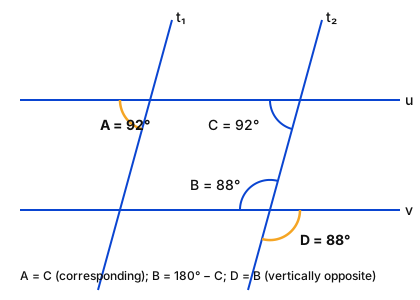
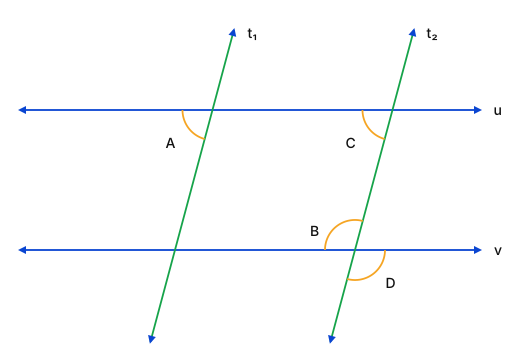
In the given figure, if u∥v, t1∥t2 and ∠A=92∘, find ∠D.
दी गई आकृति में, यदि u∥v, t1∥t2 और ∠A=92∘ है, तो ∠D ज्ञात कीजिए।
  1. A88∘
  2. B82∘
  3. C78∘
  4. D92∘
Show answer

Concept: With parallel lines, corresponding angles are equal, co-interior angles add to 180∘ and vertically opposite angles are equal.

  1. t1∥t2 cut by line u: ∠C is corresponding to ∠A → ∠C=92∘.
  2. u∥v cut by t2: ∠B and ∠C are co-interior → ∠B=180∘−92∘=88∘.
  3. ∠D is vertically opposite to ∠B → ∠D=88∘.

Trick: Two pairs of parallel lines form a parallelogram; ∠A and ∠D are at opposite corners but ∠D is the exterior angle there, so ∠D=180∘−∠A.

Answer: (A) 88∘

अवधारणा: समांतर रेखाओं में संगत कोण बराबर, सह-अंतःकोणों का योग 180∘ और शीर्षाभिमुख कोण बराबर होते हैं।

  1. t1∥t2 को रेखा u काटती है: ∠C, ∠A का संगत कोण → ∠C=92∘।
  2. u∥v को t2 काटती है: ∠B और ∠C सह-अंतःकोण → ∠B=180∘−92∘=88∘।
  3. ∠D, ∠B का शीर्षाभिमुख कोण → ∠D=88∘।

ट्रिक: समांतर रेखाओं के दो युग्म समांतर चतुर्भुज बनाते हैं; ∠D विपरीत कोने पर बाह्य कोण है, अतः ∠D=180∘−∠A।

उत्तर: (A) 88∘

RRB NTPC Graduate CBT 1MathematicsParallel lines – anglesRRB NTPC Graduate CBT 1 2025 · 17 Mar Shift 1 →
Q2067.
A shopkeeper professes to sell his goods at a 25% loss but uses a false balance and gains 70%. The actual weight (rounded off to one decimal place) that he uses instead of 1 kg is:
एक दुकानदार अपना सामान 25% हानि पर बेचने का दावा करता है, परंतु गलत तराजू का उपयोग करता है और 70% लाभ प्राप्त करता है। 1 kg के स्थान पर वह जो वास्तविक भार (एक दशमलव स्थान तक पूर्णांकित) उपयोग करता है, वह है:
  1. A443.3 gm443.3 ग्राम
  2. B441.2 gm441.2 ग्राम
  3. C438.1 gm438.1 ग्राम
  4. D436.4 gm436.4 ग्राम
Show answer

Concept: With a false weight, the dealer charges for 1 kg but hands over only w kg; his real cost is for w kg.

  1. Let cost price = ₹100 per kg. Professed 25% loss → selling price of "1 kg" =75.
  2. Actual goods given =w kg, costing 100w. Gain 70% → 75=1.7×100w.
  3. w=75170=0.4412 kg =441.2 g.

Trick: True weightFalse weight=100+gain%100−loss% → 1000w=17075, w=441.2 g.

Answer: (B) 441.2 gm

अवधारणा: गलत बाट से व्यापारी 1 kg का दाम लेता है पर केवल w kg देता है; उसकी वास्तविक लागत w kg की है।

  1. माना क्रय मूल्य = ₹100 प्रति kg। कथित 25% हानि → "1 kg" का विक्रय मूल्य =75।
  2. वास्तव में दिया माल =w kg, लागत 100w। लाभ 70% → 75=1.7×100w।
  3. w=75170=0.4412 kg =441.2 g।

ट्रिक: सही बाटगलत बाट=100+लाभ%100−हानि% → 1000w=17075, w=441.2 g।

उत्तर: (B) 441.2 gm

RRB NTPC Graduate CBT 1MathematicsDishonest dealer – false weightRRB NTPC Graduate CBT 1 2025 · 17 Mar Shift 1 →
Q2068.
Two taps can fill a cistern in 4 hours and 27 hours respectively. A third tap can empty it in 27 hours. How long (in hours) will it take to fill one-fourth of the empty cistern, if all of them are opened together?
दो नल एक टंकी को क्रमशः 4 घंटे और 27 घंटे में भर सकते हैं। एक तीसरा नल इसे 27 घंटे में खाली कर सकता है। यदि इन सभी को एक साथ खोल दिया जाए, तो खाली टंकी के एक-चौथाई भाग को भरने में कितना समय (घंटों में) लगेगा?
  1. A4
  2. B2
  3. C1
  4. D3
Show answer

Concept: Add the per-hour work of filling taps and subtract that of the emptying tap.

  1. Net work per hour =14+127−127=14.
  2. So the full cistern fills in 4 hours.
  3. One-fourth of the cistern =14×4=1 hour.

Trick: The 27-hour filler and the 27-hour emptier cancel each other – only the 4-hour tap matters.

Answer: (C) 1

अवधारणा: भरने वाले नलों का प्रति घंटा कार्य जोड़ें और खाली करने वाले का घटाएँ।

  1. नेट कार्य प्रति घंटा =14+127−127=14।
  2. अतः पूरी टंकी 4 घंटे में भरती है।
  3. टंकी का एक-चौथाई =14×4=1 घंटा।

ट्रिक: 27 घंटे वाला भरने वाला और 27 घंटे वाला खाली करने वाला नल एक-दूसरे को काट देते हैं – केवल 4 घंटे वाला नल मायने रखता है।

उत्तर: (C) 1

RRB NTPC Graduate CBT 1MathematicsPipes and cisternsRRB NTPC Graduate CBT 1 2025 · 17 Mar Shift 1 →
Q2069.
The median for the following frequency distribution is:
x123456789
f810111620251596
निम्नलिखित बारंबारता बंटन की माध्यिका है:
x: 1, 2, 3, 4, 5, 6, 7, 8, 9
f: 8, 10, 11, 16, 20, 25, 15, 9, 6
  1. A6
  2. B8
  3. C4
  4. D5
Show answer

Concept: For a discrete frequency distribution, median is the value of x whose cumulative frequency first reaches or exceeds N2.

  1. N=8+10+11+16+20+25+15+9+6=120, so N2=60.
  2. Cumulative frequencies: 8, 18, 29, 45, 65, 90, 105, 114, 120.
  3. The first cumulative frequency ≥60 is 65, at x=5 → median =5.

Trick: Both the 60th and 61st observations lie in the x=5 group (46th to 65th), so median = 5 without any averaging.

Answer: (D) 5

अवधारणा: असतत बारंबारता बंटन में माध्यिका वह x है जिसकी संचयी बारंबारता पहली बार N2 के बराबर या अधिक हो।

  1. N=8+10+11+16+20+25+15+9+6=120, अतः N2=60।
  2. संचयी बारंबारता: 8, 18, 29, 45, 65, 90, 105, 114, 120।
  3. पहली संचयी बारंबारता ≥60 है 65, जो x=5 पर है → माध्यिका =5।

ट्रिक: 60वाँ और 61वाँ दोनों प्रेक्षण x=5 समूह (46वें से 65वें) में हैं, अतः बिना औसत निकाले माध्यिका = 5।

उत्तर: (D) 5

RRB NTPC Graduate CBT 1MathematicsStatistics – medianRRB NTPC Graduate CBT 1 2025 · 17 Mar Shift 1 →
Q2070.
A man sold an article for ₹132 by first giving a d% discount on its marked price, and then another discount having the same nominal value (in ₹). If the marked price of the article is ₹880, then what is the value of d?
एक व्यक्ति ने एक वस्तु को उसके अंकित मूल्य पर पहले d% की छूट और फिर उसी सांकेतिक मान (₹ में) की एक और छूट देकर ₹132 में बेचा। यदि वस्तु का अंकित मूल्य ₹880 है, तो d का मान क्या है?
  1. A42.5
  2. B46
  3. C39.5
  4. D37.3
Show answer

Concept: A percentage discount on the marked price is a fixed rupee amount; the second discount here is that same rupee amount again.

  1. First discount =d% of 880 =8.8d rupees.
  2. Second discount = the same amount =8.8d. Total discount =17.6d.
  3. 880−17.6d=132⇒17.6d=748⇒d=42.5.

Trick: Total discount =880−132=748 = two equal discounts → each =374 = 374880×100=42.5%.

Answer: (A) 42.5

अवधारणा: अंकित मूल्य पर प्रतिशत छूट एक निश्चित रुपये की राशि है; यहाँ दूसरी छूट उतनी ही रुपये की राशि है।

  1. पहली छूट =880 का d%=8.8d रुपये।
  2. दूसरी छूट = वही राशि =8.8d। कुल छूट =17.6d।
  3. 880−17.6d=132⇒17.6d=748⇒d=42.5।

ट्रिक: कुल छूट =880−132=748 = दो बराबर छूट → प्रत्येक =374 = 374880×100=42.5%।

उत्तर: (A) 42.5

RRB NTPC Graduate CBT 1MathematicsDiscount – equal rupee discountsRRB NTPC Graduate CBT 1 2025 · 17 Mar Shift 1 →
Q2071.
If a : b : c = 3 : 4 : 5 and 2a - 3b + 4c = 56, then the value of c is:
यदि a : b : c = 3 : 4 : 5 और 2a - 3b + 4c = 56 है, तो c का मान है:
  1. A20
  2. B22
  3. C21
  4. D24
Show answer

Concept: Write the ratio terms with a common multiplier k and substitute in the equation.

  1. Let a=3k, b=4k, c=5k.
  2. 2a−3b+4c=6k−12k+20k=14k=56⇒k=4.
  3. c=5k=20.

Trick: Compute the "ratio value" of the expression first: 2(3)−3(4)+4(5)=14; then k=5614=4.

Answer: (A) 20

अवधारणा: अनुपात के पदों को उभयनिष्ठ गुणक k से लिखें और समीकरण में रखें।

  1. माना a=3k, b=4k, c=5k।
  2. 2a−3b+4c=6k−12k+20k=14k=56⇒k=4।
  3. c=5k=20।

ट्रिक: पहले व्यंजक का "अनुपात मान" निकालें: 2(3)−3(4)+4(5)=14; फिर k=5614=4।

उत्तर: (A) 20

RRB NTPC Graduate CBT 1MathematicsRatio – linear equationRRB NTPC Graduate CBT 1 2025 · 17 Mar Shift 1 →
Q2072.
Refer to the following letter and symbol series and answer the question that follows. Counting to be done from left to right only.
(Left) T O @ $ J $ S € M L I * N G © Y & T P £ Y T (Right)
How many such symbols are there each of which is immediately preceded by a letter and also immediately followed by a symbol?
निम्नलिखित अक्षर और प्रतीक श्रेणी को देखिए और उसके बाद दिए गए प्रश्न का उत्तर दीजिए। गिनती केवल बाएँ से दाएँ की जानी है।
(बाएँ) T O @ $ J $ S € M L I * N G © Y & T P £ Y T (दाएँ)
ऐसे कितने प्रतीक हैं, जिनमें से प्रत्येक के ठीक पहले एक अक्षर है और ठीक बाद भी एक प्रतीक है?
  1. A4
  2. B2
  3. C1
  4. D3
Show answer

Concept: Scan each symbol and check its left neighbour (must be a letter) and right neighbour (must be a symbol).

  1. Series: T O @ $ J $ S € M L I * N G © Y & T P £ Y T.
  2. @ : left O (letter), right $ (symbol) ✓.
  3. Other symbols ($, €, *, ©, &, £) are each followed by a letter, so they fail.

Trick: Look only for the pattern Letter–Symbol–Symbol; the middle one counts.

Answer: (C) 1

अवधारणा: हर प्रतीक के लिए बायाँ पड़ोसी अक्षर और दायाँ पड़ोसी प्रतीक होना चाहिए।

  1. श्रृंखला: T O @ $ J $ S € M L I * N G © Y & T P £ Y T।
  2. @ : बाएँ O (अक्षर), दाएँ $ (प्रतीक) ✓।
  3. बाकी प्रतीकों ($, €, *, ©, &, £) के दाएँ अक्षर है, अतः वे नहीं गिने जाएँगे।

ट्रिक: केवल अक्षर–प्रतीक–प्रतीक पैटर्न खोजिए; बीच वाला गिना जाता है।

उत्तर: (C) 1

RRB NTPC Graduate CBT 1General Intelligence and ReasoningLetter-Symbol SeriesRRB NTPC Graduate CBT 1 2025 · 17 Mar Shift 1 →
Q2073.
Select the set in which the numbers are related in the same way as are the numbers of the following sets.
(NOTE: Operations should be performed on the whole numbers, without breaking down the numbers into their constituent digits. E.g. 13 – Operations on 13 such as adding/ subtracting /multiplying to 13 can be performed. Breaking down 13 into 1 and 3 and then performing mathematical operations on 1 and 3 is not allowed.)
(336, 216, 156)
(379, 259, 199)
उस समुच्चय का चयन कीजिए जिसमें संख्याएँ उसी प्रकार संबंधित हैं जिस प्रकार निम्नलिखित समुच्चयों की संख्याएँ संबंधित हैं।
(नोट: संक्रियाएँ पूर्ण संख्याओं पर की जानी चाहिए, संख्याओं को उनके घटक अंकों में तोड़े बिना। उदाहरण के लिए 13 – 13 पर संक्रियाएँ जैसे 13 में जोड़ना/घटाना/गुणा करना किया जा सकता है। 13 को 1 और 3 में तोड़कर फिर 1 और 3 पर गणितीय संक्रियाएँ करने की अनुमति नहीं है।)
(336, 216, 156)
(379, 259, 199)
  1. A(432, 332, 252)
  2. B(394, 264, 204)
  3. C(412, 292, 232)
  4. D(449, 329, 249)
Show answer

Concept: Find the operation linking the three numbers of each given set.

  1. 336−216=120, 216−156=60; 379−259=120, 259−199=60.
  2. Rule: 1st − 120 = 2nd, 2nd − 60 = 3rd.
  3. Check (C): 412−120=292, 292−60=232 ✓. Others fail (e.g. 432−332=100).

Trick: Check the first difference (120) – only option (C) has it.

Answer: (C) (412, 292, 232)

अवधारणा: हर समुच्चय की तीनों संख्याओं को जोड़ने वाली संक्रिया खोजिए।

  1. 336−216=120, 216−156=60; 379−259=120, 259−199=60।
  2. नियम: पहली − 120 = दूसरी, दूसरी − 60 = तीसरी।
  3. (C): 412−120=292, 292−60=232 ✓। बाकी असफल (जैसे 432−332=100)।

ट्रिक: पहला अंतर (120) जाँचिए – केवल (C) में है।

उत्तर: (C) (412, 292, 232)

RRB NTPC Graduate CBT 1General Intelligence and ReasoningNumber AnalogyRRB NTPC Graduate CBT 1 2025 · 17 Mar Shift 1 →
Q2074.
Below are given two sets of numbers. In each set of numbers, a certain mathematical operation on the first number results in the second number. Similarly, a certain mathematical operation on the second number results in the third number and so on. Which of the given options follows the same set of operations as in the question? (NOTE – A two/three-digit number cannot be broken into individual digits for
operations. E.g. if 37 is followed by 10, the operation cannot be 3+7 as a two-digit number cannot be broken into individual digits.)
157 – 162 – 172 – 86
93 – 98 – 108 – 54
नीचे संख्याओं के दो समुच्चय दिए गए हैं। संख्याओं के प्रत्येक समुच्चय में, पहली संख्या पर एक निश्चित गणितीय संक्रिया करने से दूसरी संख्या प्राप्त होती है। इसी प्रकार, दूसरी संख्या पर एक निश्चित गणितीय संक्रिया करने से तीसरी संख्या प्राप्त होती है, और इसी तरह आगे। दिए गए विकल्पों में से कौन-सा प्रश्न में दी गई संक्रियाओं के उसी समुच्चय का अनुसरण करता है? (नोट – दो/तीन अंकों की संख्या को संक्रियाओं के लिए
अलग-अलग अंकों में नहीं तोड़ा जा सकता। उदाहरण के लिए यदि 37 के बाद 10 है, तो संक्रिया 3+7 नहीं हो सकती, क्योंकि दो अंकों की संख्या को अलग-अलग अंकों में नहीं तोड़ा जा सकता।)
157 – 162 – 172 – 86
93 – 98 – 108 – 54
  1. A98 – 103 – 113 – 133
  2. B112 – 116 – 126 – 63
  3. C185 – 190 – 200 – 100
  4. D65 – 70 – 80 – 160
Show answer

Concept: Find the chain of operations in the given sets and apply it to the options.

  1. 157→+5162→+10172→÷286; 93→+598→+10108→÷254.
  2. (C): 185+5=190, 190+10=200, 200÷2=100 ✓.
  3. (A) ends with +20, (B) starts with +4, (D) ends with ×2.

Trick: Check the last step first – only (C) halves the third number.

Answer: (C) 185 – 190 – 200 – 100

अवधारणा: दिए गए समुच्चयों में संक्रियाओं की शृंखला पहचानकर विकल्पों पर लगाइए।

  1. 157→+5162→+10172→÷286; 93→+598→+10108→÷254।
  2. (C): 185+5=190, 190+10=200, 200÷2=100 ✓।
  3. (A) का अंत +20, (B) की शुरुआत +4, (D) का अंत ×2 से है।

ट्रिक: पहले अंतिम चरण जाँचिए – केवल (C) में तीसरी संख्या आधी होती है।

उत्तर: (C) 185 – 190 – 200 – 100

RRB NTPC Graduate CBT 1General Intelligence and ReasoningNumber Series OperationsRRB NTPC Graduate CBT 1 2025 · 17 Mar Shift 1 →
Q2075.
A is the wife of B. B is the father of C. D is the brother of C. E is the son of D. How is A related to E?
A, B की पत्नी है। B, C का पिता है। D, C का भाई है। E, D का पुत्र है। A, E से किस प्रकार संबंधित है?
  1. AFather's motherपिता की माता
  2. BMother's motherमाता की माता
  3. CHusband's wifeपति की पत्नी
  4. DMotherमाता
Show answer

Concept: Draw the family tree generation by generation.

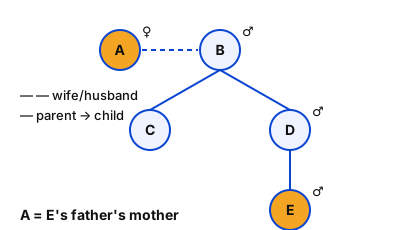
  1. A is B's wife; B is father of C and D (D is C's brother) → A is mother of D.
  2. E is D's son → A is the mother of E's father.

Trick: Trace E upward: E → D (father) → A (D's mother) = paternal grandmother.

Answer: (A) Father's mother

अवधारणा: पीढ़ी-दर-पीढ़ी वंश-वृक्ष बनाइए।

  1. A, B की पत्नी; B, C और D का पिता (D, C का भाई) → A, D की माँ।
  2. E, D का पुत्र → A, E के पिता की माँ (दादी)।

ट्रिक: E से ऊपर जाइए: E → D (पिता) → A (D की माँ) = दादी।

उत्तर: (A) पिता की माँ

RRB NTPC Graduate CBT 1General Intelligence and ReasoningBlood RelationsRRB NTPC Graduate CBT 1 2025 · 17 Mar Shift 1 →
Q2076.
Refer to the following letter, symbol series and answer the question. Counting to be done from left to right only.
(Left) O N & # K € S * P # £ * G I & * @ I A * @ © (Right)
How many such letters are there each of which is immediately preceded by a letter and also immediately followed by a symbol?
निम्नलिखित अक्षर, प्रतीक श्रेणी को देखिए और प्रश्न का उत्तर दीजिए। गिनती केवल बाएँ से दाएँ की जानी है।
(बाएँ) O N & # K € S * P # £ * G I & * @ I A * @ © (दाएँ)
ऐसे कितने अक्षर हैं, जिनमें से प्रत्येक के ठीक पहले एक अक्षर है और ठीक बाद एक प्रतीक है?
  1. A5
  2. B4
  3. C3
  4. D2
Show answer

Concept: Look for the pattern Letter–Letter–Symbol; the middle letter is counted.

  1. Series: O N & # K € S * P # £ * G I & * @ I A * @ ©.
  2. N (O before, & after) ✓; I (G before, & after) ✓; A (I before, * after) ✓.
  3. S and P are preceded by symbols, so they do not count. Total 3.

Trick: Underline every letter whose right neighbour is a symbol, then check its left neighbour.

Answer: (C) 3

अवधारणा: अक्षर–अक्षर–प्रतीक पैटर्न खोजिए; बीच वाला अक्षर गिना जाता है।

  1. श्रृंखला: O N & # K € S * P # £ * G I & * @ I A * @ ©।
  2. N (पहले O, बाद &) ✓; I (पहले G, बाद &) ✓; A (पहले I, बाद *) ✓।
  3. S और P से पहले प्रतीक हैं, अतः नहीं गिने जाएँगे। कुल 3।

ट्रिक: जिन अक्षरों के दाएँ प्रतीक है उन्हें रेखांकित करें, फिर बायाँ पड़ोसी जाँचें।

उत्तर: (C) 3

RRB NTPC Graduate CBT 1General Intelligence and ReasoningLetter-Symbol SeriesRRB NTPC Graduate CBT 1 2025 · 17 Mar Shift 1 →
Q2077.
Which of the following letter-clusters should replace # and % so that the pattern and relationship followed between the letter-cluster pair on the left side of :: is the same as that on the right side of :: ?
# : NMH :: VUP : %
निम्नलिखित में से कौन-से अक्षर-समूह # और % के स्थान पर आने चाहिए, ताकि :: के बाईं ओर के अक्षर-समूह युग्म के बीच का पैटर्न और संबंध :: के दाईं ओर के युग्म के समान हो?
# : NMH :: VUP : %
  1. A# = SVC % = OIK
  2. B# = IBM % = QKL
  3. C# = SRO % = ZPK
  4. D# = SRM % = QPK
Show answer

Concept: The same letter-shift must convert # to NMH and VUP to %.

  1. Test (D): S→N, R→M, M→H – each letter moves back 5 (S=19→N=14, R=18→M=13, M=13→H=8).
  2. Apply −5 to VUP: V(22)→Q(17), U(21)→P(16), P(16)→K(11) = QPK ✓.
  3. Other options do not give a uniform shift on both sides.

Trick: Options give # directly – check which one differs from NMH by a constant.

Answer: (D) # = SRM, % = QPK

अवधारणा: एक ही अक्षर-स्थानांतरण से # से NMH और VUP से % बनना चाहिए।

  1. (D) जाँचें: S→N, R→M, M→H – हर अक्षर 5 पीछे (19→14, 18→13, 13→8)।
  2. VUP पर −5: V(22)→Q(17), U(21)→P(16), P(16)→K(11) = QPK ✓।
  3. अन्य विकल्पों में दोनों ओर समान स्थानांतरण नहीं मिलता।

ट्रिक: विकल्प # देते हैं – देखें किसमें NMH से स्थिर अंतर है।

उत्तर: (D) # = SRM, % = QPK

RRB NTPC Graduate CBT 1General Intelligence and ReasoningLetter AnalogyRRB NTPC Graduate CBT 1 2025 · 17 Mar Shift 1 →
Q2078.
In a certain code language, ‘ROAD’ is coded as ‘9416’ and ‘DORM’ is coded as ‘3691’. What is the code for ‘M’ in the given code language?
एक निश्चित कूट भाषा में, ‘ROAD’ को ‘9416’ के रूप में और ‘DORM’ को ‘3691’ के रूप में कूटबद्ध किया जाता है। दी गई कूट भाषा में ‘M’ का कूट क्या है?
  1. A6
  2. B3
  3. C1
  4. D9
Show answer

Concept: Letters common to both words share the common digits; the leftover letter takes the leftover digit.

  1. ROAD → 9416, DORM → 3691. Common letters: R, O, D; common digits: 9, 1, 6.
  2. In DORM, the extra letter M takes the extra digit 3.
  3. (Similarly A = 4 in ROAD.)

Trick: Subtract the common digits from the second code – what remains is the new letter's code.

Answer: (B) 3

अवधारणा: दोनों शब्दों के साझा अक्षरों के कोड साझा अंक होते हैं; बचा अक्षर बचा अंक लेता है।

  1. ROAD → 9416, DORM → 3691। साझा अक्षर: R, O, D; साझा अंक: 9, 1, 6।
  2. DORM में अतिरिक्त अक्षर M का कोड अतिरिक्त अंक 3।
  3. (इसी तरह ROAD में A = 4।)

ट्रिक: दूसरे कोड से साझा अंक हटाइए – जो बचे वही नए अक्षर का कोड है।

उत्तर: (B) 3

RRB NTPC Graduate CBT 1General Intelligence and ReasoningCoding-DecodingRRB NTPC Graduate CBT 1 2025 · 17 Mar Shift 1 →
Q2079.
If 1 is added to each odd digit and 1 is subtracted from each even digit in the number 21673458, what will be the product of the greatest and smallest digit in the new number thus formed?
यदि संख्या 21673458 के प्रत्येक विषम अंक में 1 जोड़ा जाए और प्रत्येक सम अंक से 1 घटाया जाए, तो इस प्रकार बनी नई संख्या के सबसे बड़े और सबसे छोटे अंक का गुणनफल क्या होगा?
  1. A0
  2. B9
  3. C8
  4. D16
Show answer

Concept: Change every digit by the rule, then pick the greatest and smallest.

  1. 21673458: odd digits +1, even digits −1 → 2→1, 1→2, 6→5, 7→8, 3→4, 4→3, 5→6, 8→7.
  2. New number: 12584367.
  3. Greatest 8, smallest 1 → product =8×1=8.

Trick: Odd digits become even and even become odd; 7→8 is the largest, 2→1 the smallest.

Answer: (C) 8

अवधारणा: हर अंक को नियम से बदलिए, फिर सबसे बड़ा और सबसे छोटा चुनिए।

  1. 21673458: विषम +1, सम −1 → 2→1, 1→2, 6→5, 7→8, 3→4, 4→3, 5→6, 8→7।
  2. नई संख्या: 12584367।
  3. सबसे बड़ा 8, सबसे छोटा 1 → गुणनफल =8×1=8।

ट्रिक: विषम अंक सम और सम अंक विषम बनते हैं; 7→8 सबसे बड़ा, 2→1 सबसे छोटा।

उत्तर: (C) 8

RRB NTPC Graduate CBT 1General Intelligence and ReasoningDigit OperationsRRB NTPC Graduate CBT 1 2025 · 17 Mar Shift 1 →
Q2080.
In a certain code language,
A @ B means ‘A is the son of B’,
A # B means ‘A is the sister of B’,
A + B means ‘A is the wife of B’ and
A % B means ‘A is the father of B’.
Based on the above, how is E related to B if ‘E % R # D + N @ B’?
एक निश्चित कूट भाषा में,
A @ B का अर्थ है ‘A, B का पुत्र है’,
A # B का अर्थ है ‘A, B की बहन है’,
A + B का अर्थ है ‘A, B की पत्नी है’ और
A % B का अर्थ है ‘A, B का पिता है’।
उपर्युक्त के आधार पर, यदि ‘E % R # D + N @ B’ है, तो E, B से किस प्रकार संबंधित है?
  1. AWife's brotherपत्नी का भाई
  2. BWife's fatherपत्नी का पिता
  3. CSon's wife's fatherपुत्र की पत्नी का पिता
  4. DSon's wife's brotherपुत्र की पत्नी का भाई
Show answer

Concept: Decode each symbol pair from right to left starting at B.

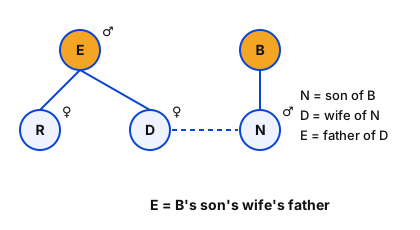
  1. N @ B: N is son of B. D + N: D is wife of N → D is B's son's wife.
  2. R # D: R is sister of D. E % R: E is father of R → E is also father of D.
  3. So E is the father of B's son's wife.

Trick: Build the tree from the person asked about (B) and move link by link.

Answer: (C) Son's wife's father

अवधारणा: B से शुरू कर दाएँ से बाएँ हर प्रतीक-जोड़ी को डिकोड कीजिए।

  1. N @ B: N, B का पुत्र। D + N: D, N की पत्नी → D, B की पुत्रवधू।
  2. R # D: R, D की बहन। E % R: E, R का पिता → E, D का भी पिता।
  3. अतः E, B के पुत्र की पत्नी का पिता है।

ट्रिक: जिसके बारे में पूछा है (B) उससे वृक्ष बनाइए और कड़ी-दर-कड़ी बढ़िए।

उत्तर: (C) पुत्र की पत्नी का पिता

RRB NTPC Graduate CBT 1General Intelligence and ReasoningCoded Blood RelationsRRB NTPC Graduate CBT 1 2025 · 17 Mar Shift 1 →