Question bank

Q&A: practice questions with answers

Search questions on any topic. Filter by exam category, exam, subject and topic, try the question, then open the answer and explanation.

Courses – airGurukul

2,400 questions found.

Q2241.
A number when increased by 25% becomes equal to another number, which is 20% less than a third number. What is the ratio of the first number to the third number?
एक संख्या में 25% की वृद्धि करने पर वह एक दूसरी संख्या के बराबर हो जाती है, जो एक तीसरी संख्या से 20% कम है। पहली संख्या और तीसरी संख्या का अनुपात क्या है?
  1. A9:16
  2. B25:36
  3. C16:25
  4. D27:38
Show answer

Concept: Convert each percentage statement into a multiplier and link the numbers.

  1. Let the numbers be A, B, C. A×125100=B and B=C×80100.
  2. So 5A4=4C5 → 25A=16C.
  3. A:C=16:25.

Trick: +25%=54, −20%=45; equate 54A=45C → A:C=45·45=16:25.

Answer: (C) 16:25

अवधारणा: हर प्रतिशत कथन को गुणक (multiplier) में बदलकर संख्याओं को जोड़ें।

  1. संख्याएँ A, B, C लें। A×125100=B और B=C×80100।
  2. अतः 5A4=4C5 → 25A=16C।
  3. A:C=16:25।

ट्रिक: +25%=54, −20%=45; 54A=45C → A:C=16:25।

उत्तर: (C) 16:25

RRB NTPC Graduate CBT 1MathematicsPercentage – Ratio of NumbersRRB NTPC Graduate CBT 1 2025 · 16 Mar Shift 2 →
Q2242.
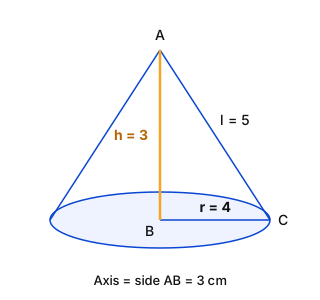
A triangle ABC with sides 3 cm, 4 cm and 5 cm is revolved about the side 3 cm. Find the volume of the solid so obtained. (Use π=3.14)
3 cm, 4 cm और 5 cm भुजाओं वाले एक त्रिभुज ABC को 3 cm वाली भुजा के परितः घुमाया जाता है। इस प्रकार प्राप्त ठोस का आयतन ज्ञात कीजिए। (π=3.14 का प्रयोग कीजिए)
  1. A55.61 cubic cm55.61 घन cm
  2. B40.55 cubic cm40.55 घन cm
  3. C42.62 cubic cm42.62 घन cm
  4. D50.24 cubic cm50.24 घन cm
Show answer

Concept: A right triangle revolved about one leg forms a cone: that leg is the height, the other leg is the radius, the hypotenuse is the slant height.

  1. Sides 3, 4, 5 form a right triangle (32+42=52). Revolving about the side 3 cm: h=3, r=4, l=5.
  2. V=13πr2h=13×3.14×16×3
  3. =3.14×16=50.24cm3.

Trick: The axis of rotation is the height; the other leg sweeps the circle (radius). Revolving about 4 cm would give 37.68 instead.

Answer: (D) 50.24 cubic cm

अवधारणा: समकोण त्रिभुज को एक भुजा के परितः घुमाने पर शंकु बनता है: वह भुजा ऊँचाई, दूसरी भुजा त्रिज्या, कर्ण तिर्यक ऊँचाई।

  1. 3, 4, 5 समकोण त्रिभुज है (32+42=52)। 3 cm भुजा के परितः घुमाने पर h=3, r=4, l=5।
  2. V=13πr2h=13×3.14×16×3
  3. =3.14×16=50.24cm3।

ट्रिक: घूर्णन अक्ष = ऊँचाई; दूसरी भुजा वृत्त बनाती है (त्रिज्या)। 4 cm के परितः घुमाने पर 37.68 आता।

उत्तर: (D) 50.24 cubic cm

RRB NTPC Graduate CBT 1MathematicsMensuration – Cone from Revolving TriangleRRB NTPC Graduate CBT 1 2025 · 16 Mar Shift 2 →
Q2243.
If the equations x2 – 3px + q = 0 and x2 – 2kx + t = 0 have one common root, and the first equation has equal roots, what is the value of (t + q)2?
यदि समीकरणों x2 – 3px + q = 0 और x2 – 2kx + t = 0 का एक मूल उभयनिष्ठ है, और पहले समीकरण के मूल समान हैं, तो (t + q)2 का मान क्या है?
  1. A0
  2. B4pk
  3. C9p2k2
  4. D(3p−2k)
Show answer

Concept: Equal roots ⇒ discriminant zero and root =−b2a; the common root satisfies both equations.

  1. x2−3px+q=0 has equal roots: 9p2=4q → q=9p24, root α=3p2.
  2. α satisfies x2−2kx+t=0: 9p24−3pk+t=0 → t=3pk−9p24.
  3. t+q=3pk → (t+q)2=9p2k2.

Trick: With equal roots, the common root is simply the repeated root 3p2 – plug it straight in.

Answer: (C) 9p2k2

अवधारणा: समान मूल ⇒ विविक्तकर (discriminant) शून्य और मूल =−b2a; उभयनिष्ठ मूल दोनों समीकरणों को संतुष्ट करता है।

  1. x2−3px+q=0 के समान मूल: 9p2=4q → q=9p24, मूल α=3p2।
  2. α को x2−2kx+t=0 में रखें: 9p24−3pk+t=0 → t=3pk−9p24।
  3. t+q=3pk → (t+q)2=9p2k2।

ट्रिक: समान मूल होने पर उभयनिष्ठ मूल वही दोहराया मूल 3p2 है – सीधे रखें।

उत्तर: (C) 9p2k2

RRB NTPC Graduate CBT 1MathematicsQuadratic Equations – Common RootRRB NTPC Graduate CBT 1 2025 · 16 Mar Shift 2 →
Q2244.
A shopkeeper professes to sell his goods at a 60% loss but uses a false balance and gains 90%. The actual weight (rounded off to one decimal place) he uses for 1 kg is:
एक दुकानदार अपना सामान 60% हानि पर बेचने का दावा करता है, परंतु गलत तराजू का प्रयोग करके 90% लाभ कमाता है। 1 kg के लिए वह वास्तव में कितना भार (एक दशमलव स्थान तक पूर्णांकित) प्रयोग करता है?
  1. A210.5 gm
  2. B214.1 gm
  3. C209.5 gm
  4. D213.6 gm
Show answer

Concept: With a false weight, the shopkeeper charges for 1000 g but gives less; his real gain depends on the goods actually given.

  1. Let cost be ₹1 per gram. He "sells 1 kg" at a 60% loss, i.e. collects ₹0.40×1000=400.
  2. Real gain is 90%, so the cost of goods actually given =4001.9=210.53 → he gives about 210.5 g.
  3. Check: cost ₹210.5, sold for ₹400 → gain 189.5210.5≈90% ✓.

Trick: Weight given=1000×100−claimed loss%100+actual gain%=1000×40190.

Answer: (A) 210.5 gm

अवधारणा: गलत बाट से दुकानदार 1000 g का दाम लेता है पर कम देता है; वास्तविक लाभ दिए गए माल पर निर्भर करता है।

  1. लागत ₹1 प्रति ग्राम लें। 60% हानि दिखाकर "1 kg" का ₹0.40×1000=400 लेता है।
  2. वास्तविक लाभ 90%, अतः दिए गए माल की लागत =4001.9=210.53 → लगभग 210.5 g देता है।
  3. जाँच: लागत ₹210.5, बिक्री ₹400 → लाभ 189.5210.5≈90% ✓।

ट्रिक: दिया गया भार=1000×100−घोषित हानि%100+वास्तविक लाभ%=1000×40190।

उत्तर: (A) 210.5 gm

RRB NTPC Graduate CBT 1MathematicsProfit & Loss – False WeightRRB NTPC Graduate CBT 1 2025 · 16 Mar Shift 2 →
Q2245.
If 15% of 80−36×2163×36=y, then the value of y is
यदि 15% of 80−36×2163×36=y है, तो y का मान है
  1. A-6
  2. B-12
  3. C-3
  4. D-10
Show answer

Concept: Evaluate roots and "of" first, then multiplication, then subtraction.

  1. 15% of 80=12; 2163=6; 36=6.
  2. 36×6×6=18.
  3. y=12−18=−6.

Trick: "of" means multiply and ranks with brackets – do it before the minus sign.

Answer: (A) −6

अवधारणा: पहले मूल और "of", फिर गुणा, फिर घटाव।

  1. 80 का 15%=12; 2163=6; 36=6।
  2. 36×6×6=18।
  3. y=12−18=−6।

ट्रिक: "of" का अर्थ गुणा है और यह कोष्ठक के स्तर का है – घटाव से पहले करें।

उत्तर: (A) −6

RRB NTPC Graduate CBT 1MathematicsSimplification – BODMASRRB NTPC Graduate CBT 1 2025 · 16 Mar Shift 2 →
Q2246.
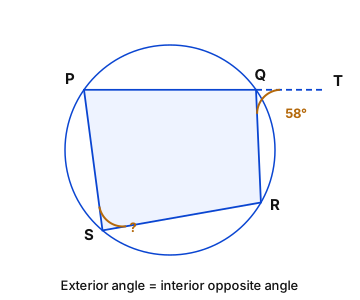
Side PQ of a cyclic quadrilateral PQRS is produced to the point T. If ∠RQT=58∘, then the measure of ∠PSR is:
एक चक्रीय चतुर्भुज PQRS की भुजा PQ को बिंदु T तक बढ़ाया जाता है। यदि ∠RQT=58∘ है, तो ∠PSR का माप है:
  1. A116°
  2. B122°
  3. C29°
  4. D58°
Show answer

Concept: In a cyclic quadrilateral the exterior angle at a vertex equals the interior opposite angle.

  1. PQ is produced to T, so ∠RQT is the exterior angle at Q.
  2. Interior opposite angle of Q is ∠PSR (at S).
  3. ∠PSR=∠RQT=58∘.
  4. Check: ∠PQR=180∘−58∘=122∘ and 122∘+58∘=180∘ ✓.

Trick: Exterior angle = opposite interior angle (because opposite angles sum to 180∘). Option A (122∘) is the trap – that is ∠PQR.

Answer: (D) 58∘

अवधारणा: चक्रीय चतुर्भुज में किसी शीर्ष का बाह्य कोण उसके सम्मुख अंतःकोण के बराबर होता है।

  1. PQ को T तक बढ़ाया गया, अतः ∠RQT शीर्ष Q का बाह्य कोण है।
  2. Q का सम्मुख अंतःकोण ∠PSR (S पर) है।
  3. ∠PSR=∠RQT=58∘।
  4. जाँच: ∠PQR=180∘−58∘=122∘ और 122∘+58∘=180∘ ✓।

ट्रिक: बाह्य कोण = सम्मुख अंतःकोण (क्योंकि सम्मुख कोणों का योग 180∘)। विकल्प A (122∘) जाल है – वह ∠PQR है।

उत्तर: (D) 58∘

RRB NTPC Graduate CBT 1MathematicsGeometry – Cyclic QuadrilateralRRB NTPC Graduate CBT 1 2025 · 16 Mar Shift 2 →
Q2247.
Suman, Kunal, and Pooja invest ₹1050, ₹1510, and ₹1280 respectively to start a business. If the profit at the end of the year is ₹1650, then what is the share of Pooja in the profit?
सुमन, कुणाल और पूजा एक व्यापार शुरू करने के लिए क्रमशः ₹1050, ₹1510 और ₹1280 का निवेश करते हैं। यदि वर्ष के अंत में लाभ ₹1650 है, तो लाभ में पूजा का हिस्सा क्या है?
  1. A₹550
  2. B₹549
  3. C₹551
  4. D₹548
Show answer

Concept: For equal time, profit is shared in the ratio of capitals.

  1. Ratio =1050:1510:1280=105:151:128 (divide by 10).
  2. Total =105+151+128=384.
  3. Pooja's share =128384×1650=13×1650=550.

Trick: 128×3=384, so Pooja gets exactly one-third of the profit – no long division needed.

Answer: (A) ₹550

अवधारणा: समान समय के लिए लाभ पूँजी के अनुपात में बँटता है।

  1. अनुपात =1050:1510:1280=105:151:128।
  2. योग =105+151+128=384।
  3. Pooja का हिस्सा =128384×1650=13×1650=550।

ट्रिक: 128×3=384, अतः Pooja को लाभ का ठीक एक-तिहाई मिलता है।

उत्तर: (A) ₹550

RRB NTPC Graduate CBT 1MathematicsPartnership – Profit SharingRRB NTPC Graduate CBT 1 2025 · 16 Mar Shift 2 →
Q2248.
The LCM of two numbers is 1116 and their HCF is 186. If one of the number is 372, then the other number is
दो संख्याओं का LCM 1116 है और उनका HCF 186 है। यदि उनमें से एक संख्या 372 है, तो दूसरी संख्या है
  1. A930
  2. B465
  3. C558
  4. D372
Show answer

Concept: For two numbers, HCF×LCM=Product of the numbers.

  1. Other number =1116×186372.
  2. 1116372=3, so the number =3×186=558.
  3. Check: HCF(372, 558) = 186 and LCM = 1116 ✓.

Trick: Cancel first: 372=2×186 and 1116=3×372 → answer =3×186.

Answer: (C) 558

अवधारणा: दो संख्याओं के लिए HCF×LCM=संख्याओं का गुणनफल।

  1. दूसरी संख्या =1116×186372।
  2. 1116372=3, अतः संख्या =3×186=558।
  3. जाँच: HCF(372, 558) = 186 और LCM = 1116 ✓।

ट्रिक: पहले काटें: 372=2×186, 1116=3×372 → उत्तर =3×186।

उत्तर: (C) 558

RRB NTPC Graduate CBT 1MathematicsHCF and LCMRRB NTPC Graduate CBT 1 2025 · 16 Mar Shift 2 →
Q2249.
If a : b :: b : c; c = 4a; and b = 6, find the positive value of c.
यदि a : b :: b : c; c = 4a; और b = 6 है, तो c का धनात्मक मान ज्ञात कीजिए।
  1. A8
  2. B16
  3. C20
  4. D12
Show answer

Concept: If a:b::b:c, then b is the mean proportional: b2=ac.

  1. b2=ac → 36=a×4a=4a2 → a2=9 → a=3 (positive).
  2. c=4a=12.
  3. Check: 3:6::6:12 ✓.

Trick: Mean proportional: b=ac. Here a·4a=2a=6 → a=3 instantly.

Answer: (D) 12

अवधारणा: यदि a:b::b:c, तो b मध्यानुपाती है: b2=ac।

  1. b2=ac → 36=a×4a=4a2 → a2=9 → a=3 (धनात्मक)।
  2. c=4a=12।
  3. जाँच: 3:6::6:12 ✓।

ट्रिक: मध्यानुपाती b=ac। यहाँ a·4a=2a=6 → a=3 तुरंत।

उत्तर: (D) 12

RRB NTPC Graduate CBT 1MathematicsRatio & Proportion – Mean ProportionalRRB NTPC Graduate CBT 1 2025 · 16 Mar Shift 2 →
Q2250.
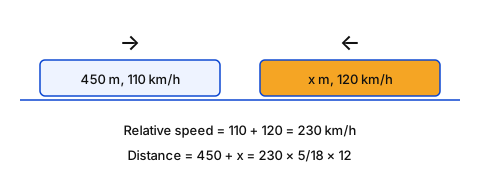
Two trains are moving in opposite directions at speeds of 110 km/hr and 120 km/hr. The length of one train is 450 m. The time taken by them to cross each other is 12 seconds. The length (in m) of the other train (rounded off to 2 decimal places) is:
दो रेलगाड़ियाँ 110 km/hr और 120 km/hr की चाल से विपरीत दिशाओं में चल रही हैं। एक रेलगाड़ी की लंबाई 450 m है। उन्हें एक-दूसरे को पार करने में 12 सेकंड लगते हैं। दूसरी रेलगाड़ी की लंबाई (m में) (2 दशमलव स्थानों तक पूर्णांकित) है:
  1. A316.67
  2. B318.7
  3. C317.34
  4. D314.28
Show answer

Concept: Trains crossing in opposite directions: relative speed = sum of speeds; distance covered = sum of lengths.

  1. Relative speed =110+120=230km/h=230×518=5759m/s.
  2. Total length =5759×12=23003=766.67m.
  3. Other train =766.67−450=316.67m.

Trick: Opposite directions → add speeds; same direction → subtract. Convert km/h to m/s with ×518.

Answer: (A) 316.67

अवधारणा: विपरीत दिशा में पार करती रेलगाड़ियाँ: सापेक्ष चाल = चालों का योग; तय दूरी = लंबाइयों का योग।

  1. सापेक्ष चाल =110+120=230km/h=230×518=5759m/s।
  2. कुल लंबाई =5759×12=23003=766.67m।
  3. दूसरी रेलगाड़ी =766.67−450=316.67m।

ट्रिक: विपरीत दिशा → चालें जोड़ें; समान दिशा → घटाएँ। km/h से m/s: ×518।

उत्तर: (A) 316.67

RRB NTPC Graduate CBT 1MathematicsTrains – Opposite DirectionsRRB NTPC Graduate CBT 1 2025 · 16 Mar Shift 2 →
Q2251.
Reema and Juhi, when each is working alone, can complete a piece of work in, respectively, 12 days and 36 days. Each work on alternate days, with Reema and Juhi starting to work on Day 1 and Day 2, respectively. How many days in all will it take to complete the work?
रीमा और जूही अकेले कार्य करते हुए एक कार्य को क्रमशः 12 दिनों और 36 दिनों में पूरा कर सकती हैं। दोनों एकांतर दिनों (alternate days) पर कार्य करती हैं, जिसमें रीमा दिन 1 को और जूही दिन 2 को कार्य शुरू करती हैं। कार्य पूरा होने में कुल कितने दिन लगेंगे?
  1. A16
  2. B24
  3. C18
  4. D28
Show answer

Concept: Take total work = LCM of days; work in 2-day cycles, then finish the remainder day by day.

  1. Work =36 units. Reema =3 units/day, Juhi =1 unit/day.
  2. One cycle (Reema day + Juhi day) =4 units in 2 days. 8 cycles =32 units in 16 days.
  3. Day 17 (Reema): 32+3=35. Day 18 (Juhi): 35+1=36 – done.
  4. Total =18 days.

Trick: Never divide 36÷4=9 cycles blindly – the last cycle may end mid-way; always check the final days.

Answer: (C) 18

अवधारणा: कुल कार्य = दिनों का LCM; 2-दिन के चक्रों में कार्य करें, फिर शेष दिन-दर-दिन।

  1. कार्य =36 इकाई। Reema =3 इकाई/दिन, Juhi =1 इकाई/दिन।
  2. एक चक्र (Reema + Juhi) =4 इकाई, 2 दिन में। 8 चक्र =32 इकाई, 16 दिन में।
  3. दिन 17 (Reema): 32+3=35। दिन 18 (Juhi): 35+1=36 – पूर्ण।
  4. कुल =18 दिन।

ट्रिक: 36÷4=9 चक्र आँख मूँदकर न लें – अंतिम चक्र बीच में खत्म हो सकता है; अंतिम दिन अवश्य जाँचें।

उत्तर: (C) 18

RRB NTPC Graduate CBT 1MathematicsTime & Work – Alternate DaysRRB NTPC Graduate CBT 1 2025 · 16 Mar Shift 2 →
Q2252.
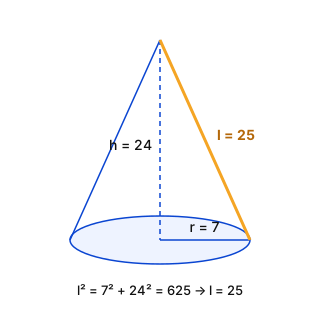
A conical tent is to be made for a school event. The radius of the base is 7 metres, and the height of the tent is 24 metres. A decorative cloth is to be used to cover the entire curved surface area of the tent. The cloth costs ₹40 per square metre. What will be the total cost of the cloth required? (Use π=227)
एक विद्यालय के कार्यक्रम के लिए एक शंक्वाकार तंबू बनाया जाना है। आधार की त्रिज्या 7 मीटर है और तंबू की ऊँचाई 24 मीटर है। तंबू के संपूर्ण वक्र पृष्ठीय क्षेत्रफल को ढकने के लिए एक सजावटी कपड़े का प्रयोग किया जाना है। कपड़े की कीमत ₹40 प्रति वर्ग मीटर है। आवश्यक कपड़े की कुल लागत क्या होगी? (π=227 का प्रयोग कीजिए)
  1. A₹21,000
  2. B₹22,000
  3. C₹23,800
  4. D₹22,800
Show answer

Concept: Curved surface area of a cone =πrl, where slant height l=r2+h2.

  1. l=72+242=49+576=625=25m.
  2. CSA =227×7×25=550m2.
  3. Cost =550×40= ₹22,000.

Trick: 7–24–25 is a Pythagorean triplet; with r=7 and π=227 the 7 cancels → CSA =22×l.

Answer: (B) ₹22,000

अवधारणा: शंकु का वक्र पृष्ठीय क्षेत्रफल =πrl, जहाँ तिर्यक ऊँचाई l=r2+h2।

  1. l=72+242=49+576=625=25m।
  2. CSA =227×7×25=550m2।
  3. लागत =550×40= ₹22,000।

ट्रिक: 7–24–25 पाइथागोरस त्रिक है; r=7 और π=227 में 7 कट जाता है → CSA =22×l।

उत्तर: (B) ₹22,000

RRB NTPC Graduate CBT 1MathematicsMensuration – Cone (CSA)RRB NTPC Graduate CBT 1 2025 · 16 Mar Shift 2 →
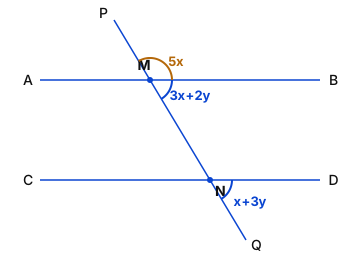
Q2253.
Line AB is parallel to line CD. A transversal PQ intersects AB at M and CD at N. If ∠PMB=(5x)∘, ∠BMN=(3x+2y)∘ and ∠DNQ=(x+3y)∘, then find the value of ∠BMN.
रेखा AB रेखा CD के समांतर है। एक तिर्यक रेखा PQ, AB को M पर और CD को N पर काटती है। यदि ∠PMB=(5x)∘, ∠BMN=(3x+2y)∘ और ∠DNQ=(x+3y)∘ है, तो ∠BMN का मान ज्ञात कीजिए।
  1. A112∘
  2. B100∘
  3. C98∘
  4. D105∘
Show answer

Concept: On a straight line adjacent angles sum to 180∘; for parallel lines, corresponding angles are equal.

  1. At M, ∠PMB and ∠BMN form a linear pair: 5x+3x+2y=180 → 8x+2y=180 … (i)
  2. ∠BMN and ∠DNQ are corresponding angles (AB ∥ CD): 3x+2y=x+3y → y=2x … (ii)
  3. From (i): 8x+4x=180 → x=15, y=30.
  4. ∠BMN=3(15)+2(30)=45+60=105∘.

Trick: Check: ∠PMB=75∘ and 75∘+105∘=180∘ ✓; ∠DNQ=15+90=105∘ ✓.

Answer: (D) 105∘

अवधारणा: सरल रेखा पर आसन्न कोणों का योग 180∘; समांतर रेखाओं के संगत कोण बराबर।

  1. M पर ∠PMB और ∠BMN रैखिक युग्म: 5x+3x+2y=180 → 8x+2y=180 … (i)
  2. ∠BMN और ∠DNQ संगत कोण (AB ∥ CD): 3x+2y=x+3y → y=2x … (ii)
  3. (i) से: 8x+4x=180 → x=15, y=30।
  4. ∠BMN=3(15)+2(30)=45+60=105∘।

ट्रिक: जाँच: ∠PMB=75∘, 75∘+105∘=180∘ ✓; ∠DNQ=15+90=105∘ ✓।

उत्तर: (D) 105∘

RRB NTPC Graduate CBT 1MathematicsGeometry – Parallel Lines & TransversalRRB NTPC Graduate CBT 1 2025 · 16 Mar Shift 2 →
Q2254.
The average of 11 results is 61. If the average of the first 6 results is 64 and that of the last 6 is 61, find the 6th result.
11 परिणामों का औसत 61 है। यदि पहले 6 परिणामों का औसत 64 है और अंतिम 6 परिणामों का औसत 61 है, तो 6वाँ परिणाम ज्ञात कीजिए।
  1. A81
  2. B80
  3. C78
  4. D79
Show answer

Concept: Sum = Average × Number. The 6th result is counted in both the first six and the last six, so it appears twice when the two sums are added.

  1. Total of 11 results =11×61=671.
  2. First 6: 6×64=384; last 6: 6×61=366; together =750.
  3. 6th result =750−671=79.

Trick: Middle term = (sum of first group + sum of last group) − total sum.

Answer: (D) 79

अवधारणा: योग = औसत × संख्या। 6वाँ परिणाम पहले छह और अंतिम छह दोनों में गिना जाता है, इसलिए दोनों योग जोड़ने पर वह दो बार आता है।

  1. 11 परिणामों का योग =11×61=671।
  2. पहले 6: 6×64=384; अंतिम 6: 6×61=366; कुल =750।
  3. 6वाँ परिणाम =750−671=79।

ट्रिक: मध्य पद = (पहले समूह का योग + अंतिम समूह का योग) − कुल योग।

उत्तर: (D) 79

RRB NTPC Graduate CBT 1MathematicsAverageRRB NTPC Graduate CBT 1 2025 · 16 Mar Shift 2 →
Q2255.
What is the mode of the data given below? [Give your answer correct to 2 decimal places.]
Age in years20-3030-4040-5050-6060-7070-8080-90
No. of patients36293522183826
नीचे दिए गए आँकड़ों का बहुलक (mode) क्या है? [अपना उत्तर 2 दशमलव स्थानों तक सही दीजिए।]
आयु (वर्षों में): 20-30, 30-40, 40-50, 50-60, 60-70, 70-80, 80-90
रोगियों की संख्या: 36, 29, 35, 22, 18, 38, 26
  1. A74.25
  2. B72.25
  3. C78.25
  4. D76.25
Show answer

Concept: For grouped data, Mode=l+f1−f02f1−f0−f2×h, where l = lower limit of the modal class (highest frequency), f1 its frequency, f0 and f2 the frequencies just before and after, h = class width.

  1. Highest frequency 38 → modal class 70–80, so l=70, f1=38, f0=18, f2=26, h=10.
  2. Mode=70+38−1876−18−26×10=70+2032×10.
  3. =70+6.25=76.25.

Trick: The denominator is simply (f1−f0)+(f1−f2)=20+12=32.

Answer: (D) 76.25

अवधारणा: वर्गीकृत आँकड़ों के लिए बहुलक=l+f1−f02f1−f0−f2×h, जहाँ l = बहुलक वर्ग (सबसे अधिक बारंबारता) की निचली सीमा, f1 उसकी बारंबारता, f0 व f2 ठीक पहले व बाद के वर्गों की बारंबारताएँ, h = वर्ग अंतराल।

  1. अधिकतम बारंबारता 38 → बहुलक वर्ग 70–80, अतः l=70, f1=38, f0=18, f2=26, h=10।
  2. बहुलक=70+38−1876−18−26×10=70+2032×10।
  3. =70+6.25=76.25।

ट्रिक: हर (denominator) बस (f1−f0)+(f1−f2)=20+12=32 है।

उत्तर: (D) 76.25

RRB NTPC Graduate CBT 1MathematicsMode of Grouped DataRRB NTPC Graduate CBT 1 2025 · 16 Mar Shift 2 →
Q2256.
A shopkeeper purchased 59 dozens of articles at the rate of ₹520 per dozen. He sold each one of them at the rate of ₹52. What percentage profit did he make?
एक दुकानदार ने ₹520 प्रति दर्जन की दर से 59 दर्जन वस्तुएँ खरीदीं। उसने उनमें से प्रत्येक को ₹52 की दर से बेचा। उसे कितने प्रतिशत लाभ हुआ?
  1. A19%
  2. B23%
  3. C21%
  4. D20%
Show answer

Concept: Compare cost and selling price of the same unit (one dozen) – the number of dozens does not change the percentage.

  1. CP of one dozen = ₹520.
  2. SP of one dozen =12×52= ₹624.
  3. Profit =624−520=104; Profit% =104520×100=20%.

Trick: 624520=1.2 → 20% profit at a glance; "59 dozens" is just a distraction.

Answer: (D) 20%

अवधारणा: एक ही इकाई (एक दर्जन) के क्रय और विक्रय मूल्य की तुलना करें – दर्जनों की संख्या प्रतिशत नहीं बदलती।

  1. एक दर्जन का CP = ₹520।
  2. एक दर्जन का SP =12×52= ₹624।
  3. लाभ =624−520=104; लाभ% =104520×100=20%।

ट्रिक: 624520=1.2 → सीधे 20% लाभ; "59 दर्जन" केवल ध्यान भटकाने के लिए है।

उत्तर: (D) 20%

RRB NTPC Graduate CBT 1MathematicsProfit and LossRRB NTPC Graduate CBT 1 2025 · 16 Mar Shift 2 →
Q2257.
Solve the following system of 3 equations in 3 unknowns.
x − 3z = −5
2x − y + 2z = 16
7x − 3y − 5z = 19
3 अज्ञात राशियों वाले निम्नलिखित 3 समीकरणों के निकाय को हल कीजिए।
x − 3z = −5
2x − y + 2z = 16
7x − 3y − 5z = 19
  1. Ax = 4, y = −2, z = −3
  2. Bx = 4, y = −2, z = 3
  3. Cx = −4, y = 2, z = −3
  4. Dx = −4, y = 3, z = −2
Show answer

Concept: Express x from the simplest equation, substitute, and reduce to two equations in y and z – or simply test the options.

  1. From x−3z=−5: x=3z−5.
  2. Put in the 2nd: 2(3z−5)−y+2z=16⇒8z−y=26. Put in the 3rd: 7(3z−5)−3y−5z=19⇒16z−3y=54.
  3. From y=8z−26: 16z−24z+78=54⇒z=3, y=−2, x=4.
  4. Check: 4−9=−5 ✓, 8+2+6=16 ✓, 28+6−15=19 ✓.

Trick: In the exam, plug each option into x−3z=−5 first – only (B) satisfies it (4−9=−5), so no further work is needed.

Answer: (B) x=4, y=−2, z=3

अवधारणा: सबसे सरल समीकरण से x निकालकर प्रतिस्थापित करें और y, z के दो समीकरण बनाएँ – या सीधे विकल्प जाँचें।

  1. x−3z=−5 से: x=3z−5।
  2. दूसरे में रखें: 2(3z−5)−y+2z=16⇒8z−y=26। तीसरे में: 7(3z−5)−3y−5z=19⇒16z−3y=54।
  3. y=8z−26 से: 16z−24z+78=54⇒z=3, y=−2, x=4।
  4. जाँच: 4−9=−5 ✓, 8+2+6=16 ✓, 28+6−15=19 ✓।

ट्रिक: परीक्षा में विकल्पों को पहले x−3z=−5 में रखें – केवल (B) इसे संतुष्ट करता है (4−9=−5), आगे कुछ करने की ज़रूरत नहीं।

उत्तर: (B) x=4, y=−2, z=3

RRB NTPC Graduate CBT 1MathematicsLinear Equations in 3 VariablesRRB NTPC Graduate CBT 1 2025 · 16 Mar Shift 2 →
Q2258.
The price of fuel decreases by 40%, 60% and 60% in three successive months, but increases by 70% in the fourth month. What is the percentage increase or decrease in the price of fuel in the fourth month as compared to its original price?
ईंधन की कीमत तीन क्रमागत महीनों में 40%, 60% और 60% घटती है, परंतु चौथे महीने में 70% बढ़ती है। चौथे महीने में ईंधन की कीमत में उसकी मूल कीमत की तुलना में कितने प्रतिशत की वृद्धि या कमी हुई?
  1. AIncrease by 87.04%87.04% की वृद्धि
  2. BDecrease by 84.38%84.38% की कमी
  3. CIncrease by 80.38%80.38% की वृद्धि
  4. DDecrease by 83.68%83.68% की कमी
Show answer

Concept: Successive changes multiply: final =initial×(1±r1)(1±r2)…

  1. Let original price =100.
  2. After three decreases: 100×0.6×0.4×0.4=9.6.
  3. After 70% increase: 9.6×1.7=16.32.
  4. Net change =16.32−100=−83.68 → decrease of 83.68%.

Trick: Only option (B) and (D) are decreases; 0.6×0.4×0.4×1.7 ends in …32, so 83.68.

Answer: (D) Decrease by 83.68%

अवधारणा: क्रमिक परिवर्तन गुणा होते हैं: अंतिम =प्रारंभिक×(1±r1)(1±r2)…

  1. मूल मूल्य =100 मानें।
  2. तीन कमी के बाद: 100×0.6×0.4×0.4=9.6।
  3. 70% वृद्धि के बाद: 9.6×1.7=16.32।
  4. शुद्ध परिवर्तन =16.32−100=−83.68 → 83.68% की कमी।

ट्रिक: केवल (B) और (D) कमी हैं; 0.6×0.4×0.4×1.7 का अंत …32 है, अतः 83.68।

उत्तर: (D) 83.68% की कमी

RRB NTPC Graduate CBT 1MathematicsSuccessive Percentage ChangeRRB NTPC Graduate CBT 1 2025 · 16 Mar Shift 2 →
Q2259.
The average of the first 62 even natural numbers is:
प्रथम 62 सम प्राकृत संख्याओं का औसत है:
  1. A61
  2. B63
  3. C62
  4. D64
Show answer

Concept: The first n even natural numbers are 2,4,…,2n – an AP, so the average is the mean of the first and last terms.

  1. Sum =2+4+⋯+2n=n(n+1), so average =n(n+1)n=n+1.
  2. For n=62: average =62+1=63.

Trick: First n even numbers → average n+1; first n odd numbers → average n.

Answer: (B) 63

अवधारणा: पहली n सम प्राकृत संख्याएँ 2,4,…,2n एक समांतर श्रेढ़ी हैं, अतः औसत = पहले और अंतिम पद का माध्य।

  1. योग =2+4+⋯+2n=n(n+1), अतः औसत =n(n+1)n=n+1।
  2. n=62 के लिए: औसत =62+1=63।

ट्रिक: पहली n सम संख्याएँ → औसत n+1; पहली n विषम संख्याएँ → औसत n।

उत्तर: (B) 63

RRB NTPC Graduate CBT 1MathematicsAverage of Even NumbersRRB NTPC Graduate CBT 1 2025 · 16 Mar Shift 2 →
Q2260.
Which ratio is the largest among 5 : 12, 14 : 31, 8 : 33 and 17 : 39?
5 : 12, 14 : 31, 8 : 33 और 17 : 39 में से कौन-सा अनुपात सबसे बड़ा है?
  1. A8 : 33
  2. B14 : 31
  3. C5 : 12
  4. D17 : 39
Show answer

Concept: Convert each ratio to a decimal (or compare with a benchmark like 12) and pick the largest.

  1. 512=0.417, 1431=0.452, 833=0.242, 1739=0.436.
  2. Largest value is 0.452 → 14 : 31.

Trick: Compare with 12: 14 is short of 15.5 by 1.5 (least gap relative to 31), so 14 : 31 is closest to half and the biggest.

Answer: (B) 14 : 31

अवधारणा: हर अनुपात को दशमलव में बदलें (या 12 जैसे मानक से तुलना करें) और सबसे बड़ा चुनें।

  1. 512=0.417, 1431=0.452, 833=0.242, 1739=0.436।
  2. सबसे बड़ा मान 0.452 → 14 : 31।

ट्रिक: 12 से तुलना करें: 14, 15.5 से केवल 1.5 कम है (31 की तुलना में सबसे कम अंतर), अतः 14 : 31 आधे के सबसे निकट और सबसे बड़ा है।

उत्तर: (B) 14 : 31

RRB NTPC Graduate CBT 1MathematicsComparison of RatiosRRB NTPC Graduate CBT 1 2025 · 16 Mar Shift 2 →