Question bank

Q&A: practice questions with answers

Search questions on any topic. Filter by exam category, exam, subject and topic, try the question, then open the answer and explanation.

Courses – airGurukul

2,400 questions found.

Q2261.
100 men have provisions for 26 days. If 50 men have left, for how many days the same provisions would last for the remaining men?
100 आदमियों के लिए 26 दिनों की खाद्य सामग्री है। यदि 50 आदमी चले जाते हैं, तो वही खाद्य सामग्री शेष आदमियों के लिए कितने दिनों तक चलेगी?
  1. A50
  2. B54
  3. C52
  4. D56
Show answer

Concept: Total provision is fixed: men×days = constant (inverse proportion).

  1. Provision =100×26=2600 man-days.
  2. Remaining men =100−50=50.
  3. Days =260050=52.

Trick: Half the men → double the days: 26×2=52.

Answer: (C) 52

अवधारणा: कुल राशन निश्चित है: आदमी×दिन = स्थिर (व्युत्क्रम अनुपात)।

  1. राशन =100×26=2600 आदमी-दिन।
  2. शेष आदमी =100−50=50।
  3. दिन =260050=52।

ट्रिक: आधे आदमी → दुगुने दिन: 26×2=52।

उत्तर: (C) 52

RRB NTPC Graduate CBT 1MathematicsInverse Variation (Provisions)RRB NTPC Graduate CBT 1 2025 · 16 Mar Shift 2 →
Q2262.
A dealer buys two articles X and Y for ₹800 each. He marks each of them at the same price. He sells X by giving two successive discounts of 45% and 73% and still earns ₹523 as profit. If he sells Y at a single discount of 89%, then what is the profit
percentage on Y?
एक व्यापारी दो वस्तुएँ X और Y प्रत्येक ₹800 में खरीदता है। वह दोनों पर समान अंकित मूल्य लगाता है। वह X को 45% और 73% की दो क्रमागत छूटें देकर बेचता है और फिर भी ₹523 का लाभ कमाता है। यदि वह Y को 89% की एकल छूट पर बेचता है, तो Y पर लाभ
प्रतिशत क्या है?
  1. A22%
  2. B21.5%
  3. C21%
  4. D22.5%
Show answer

Concept: SP = MP × (1 − d1)(1 − d2); both articles have the same marked price, so find MP from X and use it for Y.

  1. SP of X =800+523=1323. Also SP of X =MP×0.55×0.27=0.1485MP.
  2. SP of Y =MP×0.11. So SPYSPX=0.110.1485=2027.
  3. SP of Y =1323×2027=49×20=980.
  4. Profit% on Y =980−800800×100=22.5%.

Trick: Never compute MP (an ugly number); take the ratio of the two selling fractions instead – 1323=27×49 cancels neatly.

Answer: (D) 22.5%

अवधारणा: SP = MP × (1 − d1)(1 − d2); दोनों वस्तुओं का अंकित मूल्य समान है, अतः X से MP का संबंध निकालकर Y में प्रयोग करें।

  1. X का SP =800+523=1323। साथ ही X का SP =MP×0.55×0.27=0.1485MP।
  2. Y का SP =MP×0.11। अतः SPYSPX=0.110.1485=2027।
  3. Y का SP =1323×2027=49×20=980।
  4. Y पर लाभ% =980−800800×100=22.5%।

ट्रिक: MP (एक भद्दी संख्या) निकालने के बजाय दोनों विक्रय-भिन्नों का अनुपात लें – 1323=27×49 सफाई से कट जाता है।

उत्तर: (D) 22.5%

RRB NTPC Graduate CBT 1MathematicsSuccessive Discounts & ProfitRRB NTPC Graduate CBT 1 2025 · 16 Mar Shift 2 →
Q2263.
Simplify: 274432564×242×72
सरल कीजिए: 274432564×242×72
  1. A5
  2. B17
  3. C12
  4. D10
Show answer

Concept: 27443=14 (since 143=2744) and 2564=4 (since 44=256).

  1. Expression =144×242×72.
  2. 1442=13, so it becomes 13×24×72=13×36=12.

Trick: Memorise cubes up to 20 (143=2744) and powers of 2 (28=256).

Answer: (C) 12

अवधारणा: 27443=14 (क्योंकि 143=2744) और 2564=4 (क्योंकि 44=256)।

  1. व्यंजक =144×242×72।
  2. 1442=13, अतः 13×24×72=13×36=12।

ट्रिक: 20 तक के घन (143=2744) और 2 की घातें (28=256) याद रखें।

उत्तर: (C) 12

RRB NTPC Graduate CBT 1MathematicsCube and Fourth RootsRRB NTPC Graduate CBT 1 2025 · 16 Mar Shift 2 →
Q2264.
The following dataset represents the number of books read by 25 students in a month: 2 , 4 , 4 , 5 , 5 , 5 , 6 , 7 , 7 , 7 , 7 , 8 , 8 , 9 , 9 , 10 , 10 , 11 , 11 , 12 , 13 , 13 , 13 , 15 , 16. Calculate the mode of the dataset.
निम्नलिखित आँकड़े एक माह में 25 विद्यार्थियों द्वारा पढ़ी गई पुस्तकों की संख्या दर्शाते हैं: 2 , 4 , 4 , 5 , 5 , 5 , 6 , 7 , 7 , 7 , 7 , 8 , 8 , 9 , 9 , 10 , 10 , 11 , 11 , 12 , 13 , 13 , 13 , 15 , 16। इन आँकड़ों का बहुलक (mode) ज्ञात कीजिए।
  1. A11
  2. B13
  3. C7
  4. D5
Show answer

Concept: The mode is the value that occurs most often in the data.

  1. Count repeats: 4 → 2 times, 5 → 3, 7 → 4, 8 → 2, 9 → 2, 10 → 2, 11 → 2, 13 → 3.
  2. 7 occurs the maximum (4) times, so mode = 7.

Trick: Data is already sorted – just look for the longest run of the same number.

Answer: (C) 7

अवधारणा: बहुलक वह मान है जो आँकड़ों में सबसे अधिक बार आता है।

  1. पुनरावृत्ति गिनें: 4 → 2 बार, 5 → 3, 7 → 4, 8 → 2, 9 → 2, 10 → 2, 11 → 2, 13 → 3।
  2. 7 सबसे अधिक (4) बार आता है, अतः बहुलक = 7।

ट्रिक: आँकड़े पहले से क्रम में हैं – बस एक ही संख्या की सबसे लंबी शृंखला देखें।

उत्तर: (C) 7

RRB NTPC Graduate CBT 1MathematicsMode of Raw DataRRB NTPC Graduate CBT 1 2025 · 16 Mar Shift 2 →
Q2265.
At what rate (in percentage) per year will a sum of money 5 times itself in 16 years on simple interest?
साधारण ब्याज पर कोई धनराशि 16 वर्षों में स्वयं की 5 गुनी हो जाएगी, तो वार्षिक ब्याज दर (प्रतिशत में) क्या है?
  1. A23
  2. B25
  3. C50
  4. D27
Show answer

Concept: If a sum becomes n times in T years at simple interest, the interest is (n−1)P, so R=(n−1)×100T.

  1. 5 times → SI =4P in 16 years.
  2. R=4×10016=25% per annum.

Trick: R×T=(n−1)×100 → R=40016=25.

Answer: (B) 25

अवधारणा: यदि कोई धन साधारण ब्याज पर T वर्षों में n गुना हो जाए, तो ब्याज (n−1)P है, अतः R=(n−1)×100T।

  1. 5 गुना → 16 वर्षों में SI =4P।
  2. R=4×10016=25% वार्षिक।

ट्रिक: R×T=(n−1)×100 → R=40016=25।

उत्तर: (B) 25

RRB NTPC Graduate CBT 1MathematicsSimple InterestRRB NTPC Graduate CBT 1 2025 · 16 Mar Shift 2 →
Q2266.
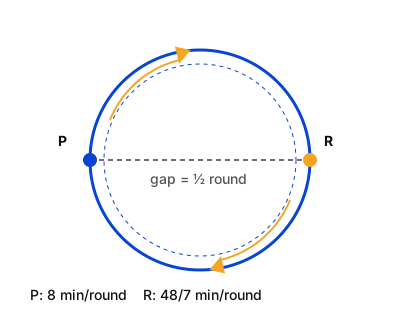
Along a circular running track, P can complete 5 rounds in 40 minutes. Time taken by R to complete 7 rounds is equal to time taken by P to complete 6 rounds. If they start running in the same direction from two different ends of a diameter, then they will meet for the first time after ____ minutes.
एक वृत्ताकार दौड़ पथ पर P 40 मिनट में 5 चक्कर पूरे कर सकता है। R द्वारा 7 चक्कर पूरे करने में लिया गया समय, P द्वारा 6 चक्कर पूरे करने में लिए गए समय के बराबर है। यदि वे एक व्यास के दो विभिन्न सिरों से एक ही दिशा में दौड़ना शुरू करते हैं, तो वे पहली बार ____ मिनट बाद मिलेंगे।
  1. A28
  2. B30
  3. C24
  4. D20
Show answer

Concept: On a circular track, two runners in the same direction meet when the faster one gains the initial gap; gain per minute = difference of their speeds (in rounds per minute).

  1. P: 5 rounds in 40 min → 8 min per round → speed 18 round/min.
  2. R does 7 rounds in the time P does 6 rounds (48 min) → speed 748 round/min.
  3. Relative speed =748−648=148 round/min.
  4. They start at opposite ends of a diameter → gap =12 round; time =1/21/48=24 min.

Trick: R gains exactly 1 round on P in 48 min, so half a round in 24 min.

Answer: (C) 24

अवधारणा: वृत्ताकार पथ पर एक ही दिशा में दौड़ते दो धावक तब मिलते हैं जब तेज़ धावक प्रारंभिक अंतर को पाट ले; प्रति मिनट बढ़त = चालों (चक्कर/मिनट) का अंतर।

  1. P: 40 मिनट में 5 चक्कर → 8 मिनट प्रति चक्कर → चाल 18 चक्कर/मिनट।
  2. R उतने समय (48 मिनट) में 7 चक्कर लगाता है जितने में P 6 → चाल 748 चक्कर/मिनट।
  3. सापेक्ष चाल =748−648=148 चक्कर/मिनट।
  4. व्यास के विपरीत सिरों से शुरू → अंतर =12 चक्कर; समय =1/21/48=24 मिनट।

ट्रिक: R, P पर 48 मिनट में ठीक 1 चक्कर की बढ़त लेता है, अतः आधा चक्कर 24 मिनट में।

उत्तर: (C) 24

RRB NTPC Graduate CBT 1MathematicsCircular Track – Meeting TimeRRB NTPC Graduate CBT 1 2025 · 16 Mar Shift 2 →
Q2267.
Jaspreet deposited a sum of ₹28,450 at 20% rate of interest per annum, compounded annually. The total amount received by Jaspreet after 2 years is:
जसप्रीत ने ₹28,450 की धनराशि 20% वार्षिक ब्याज दर पर, वार्षिक रूप से चक्रवृद्धि, जमा की। 2 वर्षों के बाद जसप्रीत को प्राप्त कुल मिश्रधन है:
  1. A₹40,624
  2. B₹40,968
  3. C₹40,958
  4. D₹41,126
Show answer

Concept: A=P(1+R100)n; for 20% and 2 years the multiplier is 1.22=1.44.

  1. A=28450×1.44.
  2. 28450×1.44=28450+28450×0.44=28450+12518=40968.

Trick: 20% twice = 20+20+20×20100=44% effective; 44% of 28450 = 12518.

Answer: (B) ₹40,968

अवधारणा: A=P(1+R100)n; 20% और 2 वर्ष के लिए गुणक 1.22=1.44।

  1. A=28450×1.44।
  2. 28450×1.44=28450+28450×0.44=28450+12518=40968।

ट्रिक: 20% दो बार = 20+20+20×20100=44% प्रभावी; 28450 का 44% = 12518।

उत्तर: (B) ₹40,968

RRB NTPC Graduate CBT 1MathematicsCompound InterestRRB NTPC Graduate CBT 1 2025 · 16 Mar Shift 2 →
Q2268.
Simplify the following expression:
[3.75+45]−[3.5−820]
निम्नलिखित व्यंजक को सरल कीजिए:
[3.75+45]−[3.5−820]
  1. A1.45
  2. B1.4
  3. C1.35
  4. D1.5
Show answer

Concept: Convert the fractions to decimals and evaluate each bracket separately.

  1. 45=0.8, 820=0.4.
  2. First bracket: 3.75+0.8=4.55; second bracket: 3.5−0.4=3.1.
  3. 4.55−3.1=1.45.

Trick: Remove brackets: 3.75−3.5=0.25 and 0.8+0.4=1.2 → 1.45.

Answer: (A) 1.45

अवधारणा: भिन्नों को दशमलव में बदलें और प्रत्येक कोष्ठक को अलग-अलग हल करें।

  1. 45=0.8, 820=0.4।
  2. पहला कोष्ठक: 3.75+0.8=4.55; दूसरा कोष्ठक: 3.5−0.4=3.1।
  3. 4.55−3.1=1.45।

ट्रिक: कोष्ठक हटाएँ: 3.75−3.5=0.25 और 0.8+0.4=1.2 → 1.45।

उत्तर: (A) 1.45

RRB NTPC Graduate CBT 1MathematicsSimplification – Decimals & FractionsRRB NTPC Graduate CBT 1 2025 · 16 Mar Shift 2 →
Q2269.
Simplify: 732×732×732+268×268×26873.2×73.2+26.8×26.8−73.2×26.8
सरल कीजिए: 732×732×732+268×268×26873.2×73.2+26.8×26.8−73.2×26.8
  1. A100
  2. B10000
  3. C100000
  4. D1000
Show answer

Concept: a3+b3=(a+b)(a2−ab+b2). Note that the denominator uses a10 and b10.

  1. Numerator =7323+2683=(732+268)(7322−732×268+2682)=1000×(7322−732×268+2682).
  2. Denominator =73.22−73.2×26.8+26.82=7322−732×268+2682100.
  3. Ratio =1000×100=100000.

Trick: When a+b is a round number (1000) and the denominator is the "a2−ab+b2" pattern scaled by 1100, the answer is (a+b)×100.

Answer: (C) 100000

अवधारणा: a3+b3=(a+b)(a2−ab+b2)। ध्यान दें कि हर में a10 और b10 हैं।

  1. अंश =7323+2683=(732+268)(7322−732×268+2682)=1000×(7322−732×268+2682)।
  2. हर =73.22−73.2×26.8+26.82=7322−732×268+2682100।
  3. अनुपात =1000×100=100000।

ट्रिक: जब a+b पूर्ण संख्या (1000) हो और हर "a2−ab+b2" पैटर्न का 1100 हो, तो उत्तर (a+b)×100।

उत्तर: (C) 100000

RRB NTPC Graduate CBT 1MathematicsAlgebraic Identity a³+b³RRB NTPC Graduate CBT 1 2025 · 16 Mar Shift 2 →
Q2270.
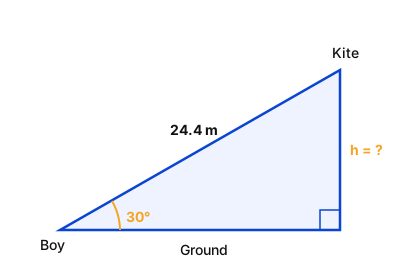
A boy flying a kite holds the string of length 24.4 m such that it makes an angle of 30° with the ground. Find the height of the kite from the ground.
पतंग उड़ाता हुआ एक लड़का 24.4 m लंबी डोर को इस प्रकार पकड़ता है कि वह ज़मीन के साथ 30° का कोण बनाती है। ज़मीन से पतंग की ऊँचाई ज्ञात कीजिए।
  1. A13.6 m
  2. B13.2 m
  3. C12.2 m
  4. D11.5 cm
Show answer

Concept: The string is the hypotenuse of a right triangle; height =string×sinθ.

  1. sin30∘=h24.4.
  2. h=24.4×12=12.2 m.

Trick: Opposite 30∘, the side is always half the hypotenuse.

Answer: (C) 12.2 m

अवधारणा: डोरी समकोण त्रिभुज का कर्ण है; ऊँचाई =डोरी×sinθ।

  1. sin30∘=h24.4।
  2. h=24.4×12=12.2 m।

ट्रिक: 30∘ के सामने वाली भुजा हमेशा कर्ण की आधी होती है।

उत्तर: (C) 12.2 m

RRB NTPC Graduate CBT 1MathematicsHeights and DistancesRRB NTPC Graduate CBT 1 2025 · 16 Mar Shift 2 →
Q2271.
What should come in place of ‘?’ in the given series?
3 10 24 45 73 ?
दी गई श्रेणी में '?' के स्थान पर क्या आना चाहिए?
3 10 24 45 73 ?
  1. A109
  2. B111
  3. C104
  4. D108
Show answer

Concept: Take successive differences and look for a pattern in them.

  1. Differences: 10−3=7, 24−10=14, 45−24=21, 73−45=28 → multiples of 7.
  2. Next difference =35, so the next term =73+35=108.

Trick: Differences 7, 14, 21, 28 are the 7-times table – next is 35.

Answer: (D) 108

अवधारणा: क्रमिक अंतर निकालें और उनमें पैटर्न देखें।

  1. अंतर: 10−3=7, 24−10=14, 45−24=21, 73−45=28 → 7 के गुणज।
  2. अगला अंतर =35, अतः अगला पद =73+35=108।

ट्रिक: अंतर 7, 14, 21, 28 सात का पहाड़ा है – अगला 35।

उत्तर: (D) 108

RRB NTPC Graduate CBT 1MathematicsNumber SeriesRRB NTPC Graduate CBT 1 2025 · 16 Mar Shift 2 →
Q2272.
Select the set in which the numbers are related in the same way as are the numbers of the following sets.
(NOTE : Operations should be performed on the whole numbers, without breaking down the numbers into their constituent digits. E.g. 13 – Operations on 13 such as adding / subtracting / multiplying etc. to 13 can be performed. Breaking down 13 into 1 and 3 and then performing mathematical operations on 1 and 3 is not allowed.)
(19,21,55)
(8,9,23)
उस समुच्चय का चयन कीजिए जिसमें संख्याएँ उसी प्रकार संबंधित हैं जिस प्रकार निम्नलिखित समुच्चयों की संख्याएँ संबंधित हैं।
(नोट : संक्रियाएँ पूर्ण संख्याओं पर की जानी चाहिए, संख्याओं को उनके घटक अंकों में तोड़े बिना। उदाहरण के लिए 13 – 13 पर संक्रियाएँ जैसे 13 में जोड़ना / घटाना / गुणा करना आदि की जा सकती हैं। 13 को 1 और 3 में तोड़कर फिर 1 और 3 पर गणितीय संक्रियाएँ करने की अनुमति नहीं है।)
(19,21,55)
(8,9,23)
  1. A(22,21,67)
  2. B(1,21,19)
  3. C(7,5,3)
  4. D(20,12,79)
Show answer

Concept: Find one rule linking the three numbers of each given set and test the options with it.

  1. Try the form c=4a−b: (19,21,55): 4×19−21=76−21=55 ✓
  2. (8,9,23): 4×8−9=32−9=23 ✓
  3. Option A (22,21,67): 4×22−21=88−21=67 ✓
  4. Others fail: (1,21,19) gives −17; (7,5,3) gives 23; (20,12,79) gives 68.

Trick: When sums/products fail, try ka±b with small k (2, 3, 4) – both sets must obey the same k.

Answer: (A) (22,21,67)

अवधारणा: दिए गए दोनों सेटों में तीनों संख्याओं को जोड़ने वाला एक नियम खोजें और विकल्पों पर जाँचें।

  1. c=4a−b आज़माएँ: (19,21,55): 4×19−21=76−21=55 ✓
  2. (8,9,23): 4×8−9=32−9=23 ✓
  3. विकल्प A (22,21,67): 4×22−21=88−21=67 ✓
  4. बाकी असफल: (1,21,19) से −17; (7,5,3) से 23; (20,12,79) से 68।

ट्रिक: जब योग/गुणनफल काम न करे तो ka±b (k=2,3,4) आज़माएँ – दोनों सेटों में एक ही k चलना चाहिए।

उत्तर: (A) (22,21,67)

RRB NTPC Graduate CBT 1General Intelligence and ReasoningNumber Analogy (Sets)RRB NTPC Graduate CBT 1 2025 · 16 Mar Shift 2 →
Q2273.
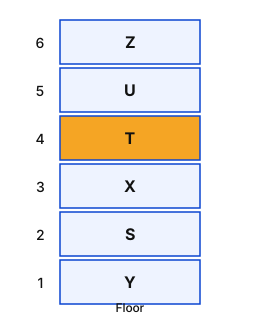
X, Y, Z, S, T and U live on six different floors of the same building. The lowermost floor in the building is numbered 1, the floor above it, number 2 and so on till the topmost floor is numbered 6. Only Z lives above U. T lives immediately below U. Only Y lives below S. Who lives on floor numbered 4?
X, Y, Z, S, T और U एक ही भवन की छह अलग-अलग मंज़िलों पर रहते हैं। भवन की सबसे निचली मंज़िल की संख्या 1 है, उसके ऊपर की मंज़िल की संख्या 2 है और इसी प्रकार सबसे ऊपरी मंज़िल की संख्या 6 है। केवल Z, U से ऊपर रहता है। T, U के ठीक नीचे रहता है। केवल Y, S से नीचे रहता है। मंज़िल संख्या 4 पर कौन रहता है?
  1. AZ
  2. BT
  3. CS
  4. DU
Show answer

Concept: Fix the extreme clues first ("only one above/below"), then fill the rest.

  1. Only Z lives above U → Z = 6, U = 5.
  2. T lives immediately below U → T = 4.
  3. Only Y lives below S → Y = 1, S = 2; the remaining X = 3.
  4. Floor 4 → T.

Trick: "Only X lives above Y" pins two floors at once – the top two. Start there.

Answer: (B) T

अवधारणा: पहले "केवल एक ऊपर/नीचे" वाले संकेतों से किनारे की मंज़िलें तय करें, फिर बाकी भरें।

  1. U के ऊपर केवल Z → Z = 6, U = 5.
  2. T, U के ठीक नीचे → T = 4.
  3. S के नीचे केवल Y → Y = 1, S = 2; बचा X = 3.
  4. मंज़िल 4 → T.

ट्रिक: "Y के ऊपर केवल X" एक साथ दो मंज़िलें (सबसे ऊपर की) तय कर देता है – वहीं से शुरू करें।

उत्तर: (B) T

RRB NTPC Graduate CBT 1General Intelligence and ReasoningFloor PuzzleRRB NTPC Graduate CBT 1 2025 · 16 Mar Shift 2 →
Q2274.
In this question, a question is followed by two statements numbered (I) and (II). You have to decide whether the data provided in the statements are sufficient to answer the question. Read both the statements and decide the appropriate answer.
Q. Five friends – Gaurav, Himanshu, Ishan, Lokesh, and Mukul – are of different ages. Who is the third oldest?
(I) Ishan is older than Gaurav but younger than Lokesh.
(II) Mukul is older than Ishan but younger than Lokesh.
इस प्रश्न में, एक प्रश्न के बाद (I) और (II) क्रमांकित दो कथन दिए गए हैं। आपको यह निर्णय करना है कि कथनों में दिए गए आँकड़े प्रश्न का उत्तर देने के लिए पर्याप्त हैं या नहीं। दोनों कथनों को पढ़िए और उचित उत्तर का निर्णय कीजिए।
प्रश्न. पाँच मित्र – गौरव, हिमांशु, ईशान, लोकेश और मुकुल – अलग-अलग आयु के हैं। तीसरा सबसे बड़ा कौन है?
(I) ईशान, गौरव से बड़ा है परंतु लोकेश से छोटा है।
(II) मुकुल, ईशान से बड़ा है परंतु लोकेश से छोटा है।
  1. AData in Statement II alone is sufficient to answer the question while data in Statement I is notकथन II के आँकड़े अकेले प्रश्न का उत्तर देने के लिए पर्याप्त हैं, जबकि कथन I के आँकड़े पर्याप्त नहीं हैं
  2. BBoth statements I and II together (and not statement I alone or statement II alone) are sufficient to answer the questionकथन I और II दोनों मिलकर (न कि केवल कथन I अकेले या केवल कथन II अकेले) प्रश्न का उत्तर देने के लिए पर्याप्त हैं
  3. CData in Statement I alone is sufficient to answer the question while data in Statement II is notकथन I के आँकड़े अकेले प्रश्न का उत्तर देने के लिए पर्याप्त हैं, जबकि कथन II के आँकड़े पर्याप्त नहीं हैं
  4. DBoth statements I and II together are NOT sufficient to answer the questionकथन I और II दोनों मिलकर भी प्रश्न का उत्तर देने के लिए पर्याप्त नहीं हैं
Show answer

Concept: To name the third oldest of five, the full order (at least the top three) must be fixed.

  1. Statement I: Lokesh > Ishan > Gaurav – Himanshu and Mukul unplaced → insufficient.
  2. Statement II: Lokesh > Mukul > Ishan – two people unplaced → insufficient.
  3. Together: Lokesh > Mukul > Ishan > Gaurav, but Himanshu can be anywhere, so the third oldest may be Ishan, Mukul or Himanshu.

Trick: If even one person is never mentioned in any statement, a "who is at position k" question is usually not answerable.

Answer: (D) Both statements I and II together are NOT sufficient to answer the question

अवधारणा: पाँच में से तीसरा सबसे बड़ा बताने के लिए (कम से कम ऊपर के तीन का) पूरा क्रम तय होना चाहिए।

  1. कथन I: Lokesh > Ishan > Gaurav – Himanshu व Mukul का स्थान नहीं → अपर्याप्त।
  2. कथन II: Lokesh > Mukul > Ishan – दो लोग छूटे → अपर्याप्त।
  3. दोनों मिलाकर: Lokesh > Mukul > Ishan > Gaurav, पर Himanshu कहीं भी हो सकता है, अतः तीसरा Ishan, Mukul या Himanshu हो सकता है।

ट्रिक: यदि कोई व्यक्ति किसी भी कथन में नहीं आया, तो "k-वें स्थान पर कौन" प्रायः तय नहीं हो पाता।

उत्तर: (D) Both statements I and II together are NOT sufficient to answer the question

RRB NTPC Graduate CBT 1General Intelligence and ReasoningData Sufficiency – OrderingRRB NTPC Graduate CBT 1 2025 · 16 Mar Shift 2 →
Q2275.
In a certain code language,
A + B means ‘A is the daughter of B’
A - B means ‘A is the mother of B’
A x B means ‘A is the wife of B’
A ÷ B means ‘A is the father of B’
Based on the above, how is G related to M if 'G + R x W ÷ D - M’?
एक निश्चित कूट भाषा में,
A + B का अर्थ है 'A, B की पुत्री है'
A - B का अर्थ है 'A, B की माता है'
A x B का अर्थ है 'A, B की पत्नी है'
A ÷ B का अर्थ है 'A, B का पिता है'
उपर्युक्त के आधार पर, यदि 'G + R x W ÷ D - M' है, तो G का M से क्या संबंध है?
  1. ASisterबहन
  2. BMother's sisterमाता की बहन
  3. CMotherमाता
  4. DMother's motherमाता की माता
Show answer

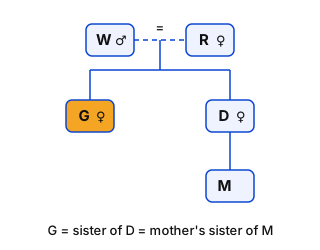
Concept: Decode left to right and draw the family tree.

  1. G + R: G is the daughter of R. R × W: R is the wife of W → G is the daughter of W and R.
  2. W ÷ D: W is the father of D → D and G are sisters.
  3. D − M: D is the mother of M.
  4. So G is the sister of M's mother → mother's sister (maternal aunt).

Trick: Mark generations: G and D same level (siblings), M one level below → G = aunt.

Answer: (B) Mother's sister

अवधारणा: बाएँ से दाएँ कोड खोलकर वंश-वृक्ष बनाएँ।

  1. G + R: G, R की बेटी। R × W: R, W की पत्नी → G, W और R की बेटी।
  2. W ÷ D: W, D का पिता → D और G बहनें।
  3. D − M: D, M की माँ।
  4. अतः G, M की माँ की बहन → मौसी (mother's sister)।

ट्रिक: पीढ़ियाँ चिह्नित करें: G और D एक स्तर (बहनें), M एक स्तर नीचे → G = मौसी।

उत्तर: (B) Mother's sister

RRB NTPC Graduate CBT 1General Intelligence and ReasoningBlood Relations (Coded)RRB NTPC Graduate CBT 1 2025 · 16 Mar Shift 2 →
Q2276.
What should come in place of the question mark (?) in the given series?
20 22 25 30 37 ?
दी गई श्रेणी में प्रश्नचिह्न (?) के स्थान पर क्या आना चाहिए?
20 22 25 30 37 ?
  1. A49
  2. B55
  3. C48
  4. D51
Show answer

Concept: Check the differences between consecutive terms.

  1. 22−20=2, 25−22=3, 30−25=5, 37−30=7 – the differences are consecutive primes 2, 3, 5, 7.
  2. Next prime = 11 → 37+11=48.

Trick: Differences 2, 3, 5, 7, 11, 13 … = prime series; it appears very often in RRB papers.

Answer: (C) 48

अवधारणा: क्रमागत पदों के अंतर देखें।

  1. 22−20=2, 25−22=3, 30−25=5, 37−30=7 – अंतर क्रमागत अभाज्य संख्याएँ 2, 3, 5, 7।
  2. अगली अभाज्य = 11 → 37+11=48।

ट्रिक: अंतर 2, 3, 5, 7, 11, 13 … = अभाज्य श्रृंखला; RRB में बहुत आम।

उत्तर: (C) 48

RRB NTPC Graduate CBT 1General Intelligence and ReasoningNumber SeriesRRB NTPC Graduate CBT 1 2025 · 16 Mar Shift 2 →
Q2277.
In a certain code language,
T + J means ‘ T is the father of J',
T - J means ‘ T is the daughter of J',
T X J means ‘ T is the mother of J', and
T # J means ‘ T is the husband of J ’.
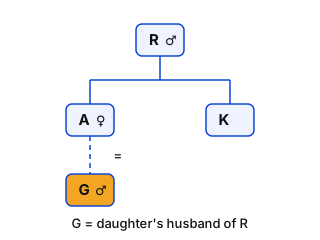
Based on the above, how is G related to R if ' G # A - R + K'?
एक निश्चित कूट भाषा में,
T + J का अर्थ है 'T, J का पिता है',
T - J का अर्थ है 'T, J की पुत्री है',
T X J का अर्थ है 'T, J की माता है', और
T # J का अर्थ है 'T, J का पति है'।
उपर्युक्त के आधार पर, यदि 'G # A - R + K' है, तो G का R से क्या संबंध है?
  1. ADaughter's husbandपुत्री का पति
  2. BSister's husbandबहन का पति
  3. CHusband's brotherपति का भाई
  4. DHusbandपति
Show answer

Concept: Decode each symbol and build the tree from the person asked about.

  1. G # A: G is the husband of A.
  2. A − R: A is the daughter of R.
  3. R + K: R is the father of K (K is just A's sibling).
  4. G is married to R's daughter → G is R's daughter's husband (son-in-law).

Trick: The last relation (R + K) is a distractor – the answer only needs G–A–R.

Answer: (A) Daughter's husband

अवधारणा: हर चिह्न खोलें और पूछे गए व्यक्ति से वंश-वृक्ष बनाएँ।

  1. G # A: G, A का पति।
  2. A − R: A, R की बेटी।
  3. R + K: R, K का पिता (K केवल A का भाई/बहन)।
  4. G का विवाह R की बेटी से → G, R का दामाद (daughter's husband)।

ट्रिक: अंतिम संबंध (R + K) भटकाने वाला है – उत्तर के लिए केवल G–A–R चाहिए।

उत्तर: (A) Daughter's husband

RRB NTPC Graduate CBT 1General Intelligence and ReasoningBlood Relations (Coded)RRB NTPC Graduate CBT 1 2025 · 16 Mar Shift 2 →
Q2278.
Refer to the following letter, symbol series and answer the question. Counting to be done from left to right only.
(Left) B * £ J E % $ * V € G * D H @ A £ O V $ T Y (Right)
How many such letters are there each of which is immediately preceded by a symbol and also immediately followed by a symbol?
निम्नलिखित अक्षर, प्रतीक श्रेणी को देखिए और प्रश्न का उत्तर दीजिए। गिनती केवल बाएँ से दाएँ की जानी है।
(बाएँ) B * £ J E % $ * V € G * D H @ A £ O V $ T Y (दाएँ)
ऐसे कितने अक्षर हैं जिनमें से प्रत्येक के ठीक पहले एक प्रतीक है और ठीक बाद भी एक प्रतीक है?
  1. A2
  2. B4
  3. C5
  4. D3
Show answer

Concept: Scan each letter and check both neighbours.

  1. Series: B * £ J E % $ * V € G * D H @ A £ O V $ T Y.
  2. Letters with a symbol on both sides: * V €, € G *, @ A £.
  3. J (£ J E), D (* D H), O (£ O V), T ($ T Y) have a letter on one side → not counted.
  4. Count = 3.

Trick: Look only at symbol pairs with exactly one character between them – a letter there is a hit.

Answer: (D) 3

अवधारणा: हर अक्षर के दोनों पड़ोसी जाँचें।

  1. श्रृंखला: B * £ J E % $ * V € G * D H @ A £ O V $ T Y।
  2. दोनों ओर प्रतीक वाले अक्षर: * V €, € G *, @ A £।
  3. J (£ J E), D (* D H), O (£ O V), T ($ T Y) के एक ओर अक्षर है → नहीं गिने जाएँगे।
  4. गिनती = 3।

ट्रिक: केवल उन प्रतीक-जोड़ों को देखें जिनके बीच ठीक एक अक्षर है।

उत्तर: (D) 3

RRB NTPC Graduate CBT 1General Intelligence and ReasoningLetter-Symbol SeriesRRB NTPC Graduate CBT 1 2025 · 16 Mar Shift 2 →
Q2279.
Which of the following letter-number clusters will replace the question mark “?” in the given series to make it logically complete?
QIL 14, UMP 18, YQT 22, CUX 26, ?
निम्नलिखित में से कौन-सा अक्षर-संख्या समूह दी गई श्रेणी में प्रश्नचिह्न "?" के स्थान पर आकर इसे तार्किक रूप से पूर्ण करेगा?
QIL 14, UMP 18, YQT 22, CUX 26, ?
  1. AHZC 29
  2. BGZD 30
  3. CGXZ 32
  4. DGYB 30
Show answer

Concept: Track each letter position and the number separately.

  1. Letters: Q(17)→U(21)→Y(25)→C(3)→G(7): each +4.
  2. I(9)→M(13)→Q(17)→U(21)→Y(25); L(12)→P(16)→T(20)→X(24)→B(28−26=2): +4 each.
  3. Numbers: 14, 18, 22, 26 → 30.
  4. Next term = GYB 30.

Trick: All three letters jump +4 – pattern = +4 everywhere, so just add 4 (wrap after Z).

Answer: (D) GYB 30

अवधारणा: हर अक्षर की स्थिति और संख्या को अलग-अलग देखें।

  1. अक्षर: Q(17)→U(21)→Y(25)→C(3)→G(7): हर बार +4।
  2. I→M→Q→U→Y; L→P→T→X→B (28−26=2): +4।
  3. संख्याएँ: 14, 18, 22, 26 → 30।
  4. अगला पद = GYB 30।

ट्रिक: तीनों अक्षर +4 कूदते हैं – हर जगह बस 4 जोड़ें (Z के बाद A से)।

उत्तर: (D) GYB 30

RRB NTPC Graduate CBT 1General Intelligence and ReasoningAlphanumeric SeriesRRB NTPC Graduate CBT 1 2025 · 16 Mar Shift 2 →
Q2280.
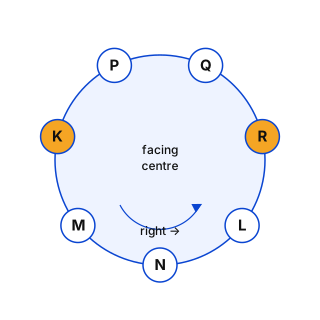
Seven people, K, L, M, N, P, Q and R, are sitting around a circular table facing the centre of the table but not necessarily in the same order. Only two people sit between N and Q when counted from the right of N. Only two people sit between Q and M. Only three people sit between N and P. L sits to the immediate left of R. Who sits third to the left of K?
सात व्यक्ति, K, L, M, N, P, Q और R, एक वृत्ताकार मेज़ के चारों ओर मेज़ के केंद्र की ओर मुख करके बैठे हैं, परंतु आवश्यक नहीं कि इसी क्रम में हों। N के दाईं ओर से गिनने पर N और Q के बीच केवल दो व्यक्ति बैठे हैं। Q और M के बीच केवल दो व्यक्ति बैठे हैं। N और P के बीच केवल तीन व्यक्ति बैठे हैं। L, R के ठीक बाएँ बैठा है। K के बाएँ तीसरे स्थान पर कौन बैठा है?
  1. AN
  2. BP
  3. CL
  4. DR
Show answer

Concept: Facing the centre, "right" is anticlockwise and "left" is clockwise.

  1. Place N. Two people between N and Q from N's right → Q is 3rd to N's right.
  2. Two between Q and M, and three between N and P: M is 3rd to the left of N (the other spot is N itself), P is opposite-ish, 4th from N.
  3. Remaining three seats (1st, 2nd to N's right and 2nd to N's left) go to L, R, K with L immediately left of R → L 1st right of N, R 2nd right, K on the other side.
  4. Counting to the left of K: P, Q, R → R is third to the left of K.

Trick: Facing centre: right = anticlockwise. Fix one person and draw – never solve seating in the head.

Answer: (D) R

अवधारणा: केंद्र की ओर मुख होने पर "दायाँ" = वामावर्त (anticlockwise) और "बायाँ" = दक्षिणावर्त।

  1. N रखें। N के दाएँ से N और Q के बीच दो → Q, N के दाएँ तीसरा।
  2. Q और M के बीच दो, N और P के बीच तीन: M, N के बाएँ तीसरा; P, N से चौथा।
  3. बची तीन सीटें L, R, K को; L, R के ठीक बाएँ → L, N के ठीक दाएँ; R उसके बाद; K दूसरी ओर।
  4. K के बाएँ गिनें: P, Q, R → R, K के बाएँ तीसरा।

ट्रिक: केंद्र की ओर मुख: दायाँ = वामावर्त। एक व्यक्ति फिक्स कर चित्र बनाएँ – बैठक मन में कभी न सुलझाएँ।

उत्तर: (D) R

RRB NTPC Graduate CBT 1General Intelligence and ReasoningCircular SeatingRRB NTPC Graduate CBT 1 2025 · 16 Mar Shift 2 →