Question bank

Q&A: practice questions with answers

Search questions on any topic. Filter by exam category, exam, subject and topic, try the question, then open the answer and explanation.

Courses – airGurukul

2,400 questions found.

Q2281.
This question is based on the five, three-digit numbers given below.
(Left) 547 589 652 598 637 (Right)
(Example- 697 – First digit = 6, second digit = 9 and third digit = 7)
NOTE: All operations to be done from left to right.
What will be the resultant if the second digit of the highest number is added to the second digit of the lowest number?
यह प्रश्न नीचे दी गई पाँच तीन-अंकीय संख्याओं पर आधारित है।
(बाएँ) 547 589 652 598 637 (दाएँ)
(उदाहरण- 697 – पहला अंक = 6, दूसरा अंक = 9 और तीसरा अंक = 7)
नोट: सभी संक्रियाएँ बाएँ से दाएँ की जानी हैं।
यदि सबसे बड़ी संख्या के दूसरे अंक को सबसे छोटी संख्या के दूसरे अंक में जोड़ा जाए, तो परिणाम क्या होगा?
  1. A9
  2. B14
  3. C11
  4. D12
Show answer

Concept: Identify the required numbers, then pick the asked digit.

  1. Numbers: 547, 589, 652, 598, 637. Highest = 652, lowest = 547.
  2. Second digit of 652 = 5; second digit of 547 = 4.
  3. 5+4=9.

Trick: Compare hundreds digits first (6 > 5) to spot the highest/lowest instantly.

Answer: (A) 9

अवधारणा: पहले आवश्यक संख्याएँ पहचानें, फिर पूछा गया अंक लें।

  1. संख्याएँ: 547, 589, 652, 598, 637। सबसे बड़ी = 652, सबसे छोटी = 547।
  2. 652 का दूसरा अंक = 5; 547 का दूसरा अंक = 4।
  3. 5+4=9।

ट्रिक: पहले सैकड़े का अंक देखें (6 > 5) – सबसे बड़ी/छोटी तुरंत मिल जाती है।

उत्तर: (A) 9
RRB NTPC Graduate CBT 1General Intelligence and ReasoningNumber ArrangementRRB NTPC Graduate CBT 1 2025 · 16 Mar Shift 2 →
Q2282.
Each of P, Q, R, S, T, U and V has an exam on a different day of a week starting from Monday and ending on Sunday of the same week.
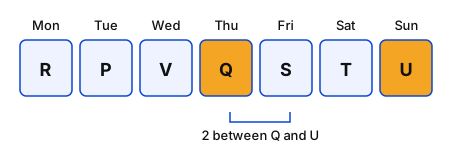
Only four people have exams after V. Only four people have exams before S. P has the exam after R but before V. T has the exam on some day after Q but not on Sunday. How many people have exams between Q and U?
P, Q, R, S, T, U और V में से प्रत्येक की परीक्षा एक ही सप्ताह के सोमवार से शुरू होकर रविवार को समाप्त होने वाले सप्ताह के अलग-अलग दिन है।
V के बाद केवल चार व्यक्तियों की परीक्षा है। S से पहले केवल चार व्यक्तियों की परीक्षा है। P की परीक्षा R के बाद परंतु V से पहले है। T की परीक्षा Q के बाद किसी दिन है, परंतु रविवार को नहीं। Q और U के बीच कितने व्यक्तियों की परीक्षा है?
  1. AOneएक
  2. BFourचार
  3. CThreeतीन
  4. DTwoदो
Show answer

Concept: Count-based clues ("only four after/before") fix exact days; then place the rest.

  1. Only four after V → V = Wednesday. Only four before S → S = Friday.
  2. R before P before V → R = Monday, P = Tuesday.
  3. Left: Thu, Sat, Sun for Q, T, U. T after Q and not Sunday → Q = Thursday, T = Saturday, U = Sunday.
  4. Between Q (Thu) and U (Sun): Fri, Sat → Two.

Trick: "Only four after X" in a 7-day week means X is on the 3rd day (Wednesday).

Answer: (D) Two

अवधारणा: गिनती वाले संकेत ("केवल चार बाद/पहले") सटीक दिन तय कर देते हैं; फिर बाकी रखें।

  1. V के बाद केवल चार → V = बुधवार। S से पहले केवल चार → S = शुक्रवार।
  2. R, फिर P, फिर V → R = सोमवार, P = मंगलवार।
  3. बचे गुरु, शनि, रवि – Q, T, U के लिए। T, Q के बाद और रविवार नहीं → Q = गुरुवार, T = शनिवार, U = रविवार।
  4. Q (गुरु) और U (रवि) के बीच: शुक्र, शनि → दो।

ट्रिक: 7 दिन के सप्ताह में "X के बाद केवल चार" = X तीसरे दिन (बुधवार)।

उत्तर: (D) Two

RRB NTPC Graduate CBT 1General Intelligence and ReasoningScheduling Puzzle (Days)RRB NTPC Graduate CBT 1 2025 · 16 Mar Shift 2 →
Q2283.
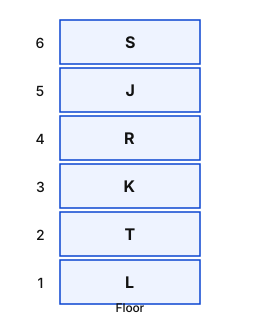
J, K, L, R, S and T live on six different floors of the same building. The lowermost floor in the building is numbered 1, the floor above it is numbered 2 and so on till the topmost floor is numbered 6. Only two people live between J and T. Only two people live between S and K. Only one person lives between L and K. L lives on floor number 1. J lives above K. How many people live between R and S?
J, K, L, R, S और T एक ही भवन की छह अलग-अलग मंज़िलों पर रहते हैं। भवन की सबसे निचली मंज़िल की संख्या 1 है, उसके ऊपर की मंज़िल की संख्या 2 है और इसी प्रकार सबसे ऊपरी मंज़िल की संख्या 6 है। J और T के बीच केवल दो व्यक्ति रहते हैं। S और K के बीच केवल दो व्यक्ति रहते हैं। L और K के बीच केवल एक व्यक्ति रहता है। L मंज़िल संख्या 1 पर रहता है। J, K से ऊपर रहता है। R और S के बीच कितने व्यक्ति रहते हैं?
  1. AThreeतीन
  2. BFourचार
  3. CTwoदो
  4. DOneएक
Show answer

Concept: Start from the fixed floor (L = 1) and chain the "between" clues.

  1. L = 1; one person between L and K → K = 3.
  2. Two between S and K → S = 6 (floor 0 doesn't exist).
  3. Two between J and T with J above K: J = 5, T = 2 (J = 4 would need T = 1 or 7).
  4. R takes floor 4. Between R (4) and S (6): only J → One.

Trick: "Two people between A and B" = gap of 3 floors; with one end fixed, test both directions and discard the impossible one.

Answer: (D) One

अवधारणा: निश्चित मंज़िल (L = 1) से शुरू कर "बीच में" वाले संकेत जोड़ें।

  1. L = 1; L और K के बीच एक → K = 3।
  2. S और K के बीच दो → S = 6 (मंज़िल 0 नहीं है)।
  3. J और T के बीच दो, J, K से ऊपर: J = 5, T = 2 (J = 4 के लिए T = 1 या 7 चाहिए, असंभव)।
  4. R को मंज़िल 4। R (4) और S (6) के बीच केवल J → एक।

ट्रिक: "A और B के बीच दो लोग" = 3 मंज़िल का अंतर; एक सिरा तय हो तो दोनों दिशाएँ जाँचें, असंभव हटाएँ।

उत्तर: (D) One

RRB NTPC Graduate CBT 1General Intelligence and ReasoningFloor PuzzleRRB NTPC Graduate CBT 1 2025 · 16 Mar Shift 2 →
Q2284.
Below are given two sets of numbers. In each set of numbers, a certain mathematical operation on the first number results in the second number. Similarly, certain
mathematical operation on the second number results in the third number and so on. Which of the given options follows the same set of operations as in question? (NOTE – A two/three-digit number cannot be broken into individual digits for operations, e.g., if 37 is followed by 10, the operation cannot be 3+7 as a two-digit number cannot be broken into individual digits.)
6 - 11 - 22 - 32; 9 - 14 - 28 - 38
नीचे संख्याओं के दो समुच्चय दिए गए हैं। संख्याओं के प्रत्येक समुच्चय में, पहली संख्या पर एक निश्चित गणितीय संक्रिया करने से दूसरी संख्या प्राप्त होती है। इसी प्रकार, दूसरी संख्या पर एक निश्चित
गणितीय संक्रिया करने से तीसरी संख्या प्राप्त होती है, और इसी प्रकार आगे। दिए गए विकल्पों में से कौन-सा प्रश्न में दी गई संक्रियाओं के समान समुच्चय का अनुसरण करता है? (नोट – संक्रियाओं के लिए दो/तीन-अंकीय संख्या को अलग-अलग अंकों में नहीं तोड़ा जा सकता, उदाहरण के लिए, यदि 37 के बाद 10 है, तो संक्रिया 3+7 नहीं हो सकती क्योंकि दो-अंकीय संख्या को अलग-अलग अंकों में नहीं तोड़ा जा सकता।)
6 - 11 - 22 - 32; 9 - 14 - 28 - 38
  1. A7-12-24-14
  2. B14-19-38-58
  3. C13-18-36-46
  4. D12-17-34-54
Show answer

Concept: Find the chain of operations in the given sets and apply it to the options.

  1. 6→+511→×222→+1032; 9→+514→×228→+1038.
  2. Option C: 13+5=18, 18×2=36, 36+10=46 ✓.
  3. A ends in 14 (should be 34), B in 58 (should be 48), D in 54 (should be 44).

Trick: The first two steps match in all options – check only the last step (+10).

Answer: (C) 13-18-36-46

अवधारणा: दिए गए सेटों में संक्रियाओं की श्रृंखला खोजें और विकल्पों पर लगाएँ।

  1. 6→+511→×222→+1032; 9→+514→×228→+1038।
  2. विकल्प C: 13+5=18, 18×2=36, 36+10=46 ✓।
  3. A का अंत 14 (34 होना चाहिए), B का 58 (48), D का 54 (44)।

ट्रिक: पहले दो चरण सभी विकल्पों में सही हैं – केवल अंतिम चरण (+10) जाँचें।

उत्तर: (C) 13-18-36-46

RRB NTPC Graduate CBT 1General Intelligence and ReasoningNumber Operation SeriesRRB NTPC Graduate CBT 1 2025 · 16 Mar Shift 2 →
Q2285.
In a certain code language, 'VAJR' is coded as '102' and 'DOTG' is coded as '92'. What is the code for 'ZELW' in the given code language?
एक निश्चित कूट भाषा में, 'VAJR' को '102' के रूप में कूटबद्ध किया जाता है और 'DOTG' को '92' के रूप में कूटबद्ध किया जाता है। उसी कूट भाषा में 'ZELW' का कूट क्या है?
  1. A121
  2. B132
  3. C124
  4. D138
Show answer

Concept: Try the sum of alphabetical positions and look for a multiplier.

  1. VAJR: 22+1+10+18=51; 51×2=102 ✓.
  2. DOTG: 4+15+20+7=46; 46×2=92 ✓.
  3. ZELW: 26+5+12+23=66; 66×2=132.

Trick: Even codes for 4-letter words → suspect (sum of positions) ×2 first.

Answer: (B) 132

अवधारणा: वर्णमाला स्थानों का योग लें और गुणक खोजें।

  1. VAJR: 22+1+10+18=51; 51×2=102 ✓।
  2. DOTG: 4+15+20+7=46; 46×2=92 ✓।
  3. ZELW: 26+5+12+23=66; 66×2=132।

ट्रिक: 4-अक्षर शब्दों के सम कोड → पहले (स्थानों का योग) ×2 जाँचें।

उत्तर: (B) 132

RRB NTPC Graduate CBT 1General Intelligence and ReasoningCoding-Decoding (Letter Values)RRB NTPC Graduate CBT 1 2025 · 16 Mar Shift 2 →
Q2286.
Based on the English alphabetical order, three of the following four letter cluster pairs are alike in a certain way and thus form a group. Which is the one that does not belong to that group?
(Note: The odd one out is not based on the number of consonants/vowels or their position in the letter cluster)
अंग्रेज़ी वर्णमाला क्रम के आधार पर, निम्नलिखित चार अक्षर-समूह युग्मों में से तीन एक निश्चित प्रकार से समान हैं और इस प्रकार एक समूह बनाते हैं। वह कौन-सा है जो उस समूह से संबंधित नहीं है?
(नोट: असंगत युग्म व्यंजनों/स्वरों की संख्या या अक्षर-समूह में उनकी स्थिति पर आधारित नहीं है)
  1. AQU-TX
  2. BZD-CG
  3. CKO-NR
  4. DFI-JM
Show answer

Concept: Compare corresponding letters of the two clusters in each pair.

  1. QU–TX: Q→T +3, U→X +3.
  2. ZD–CG: Z→C +3 (wrapping), D→G +3. KO–NR: K→N +3, O→R +3.
  3. FI–JM: F→J +4, I→M +4 → different.

Trick: Write positions quickly: F=6, J=10 gives +4 while every other pair gives +3.

Answer: (D) FI-JM

अवधारणा: हर जोड़े के दोनों समूहों के संगत अक्षरों की तुलना करें।

  1. QU–TX: Q→T +3, U→X +3।
  2. ZD–CG: Z→C +3 (घूमकर), D→G +3। KO–NR: K→N +3, O→R +3।
  3. FI–JM: F→J +4, I→M +4 → अलग।

ट्रिक: स्थान लिखें: F=6, J=10 से +4, बाकी सभी जोड़ों में +3।

उत्तर: (D) FI-JM

RRB NTPC Graduate CBT 1General Intelligence and ReasoningOdd One Out (Letter Clusters)RRB NTPC Graduate CBT 1 2025 · 16 Mar Shift 2 →
Q2287.
Refer to the following letter, number and symbol series and answer the question that follows. Counting to be done from left to right only. All numbers are single-digit numbers.
(Left) G 6 E * @ # 3 D 2 % 7 4 Y & 5 + C R K S T (Right)
How many such numbers are there each of which is immediately preceded by a symbol and also immediately followed by a letter?
निम्नलिखित अक्षर, संख्या और प्रतीक श्रेणी को देखिए और उसके बाद दिए गए प्रश्न का उत्तर दीजिए। गिनती केवल बाएँ से दाएँ की जानी है। सभी संख्याएँ एक-अंकीय संख्याएँ हैं।
(बाएँ) G 6 E * @ # 3 D 2 % 7 4 Y & 5 + C R K S T (दाएँ)
ऐसी कितनी संख्याएँ हैं जिनमें से प्रत्येक के ठीक पहले एक प्रतीक है और ठीक बाद एक अक्षर है?
  1. A2
  2. B1
  3. C0
  4. D3
Show answer

Concept: For each number, check: symbol on the left AND letter on the right.

  1. Series: G 6 E * @ # 3 D 2 % 7 4 Y & 5 + C R K S T.
  2. 6: G before (letter) ✗. 3: # before, D after ✓.
  3. 2: D before ✗. 7: % before but 4 after ✗. 4: 7 before ✗. 5: & before but + after ✗.
  4. Only one such number.

Trick: Write the type under each character (L/N/S) and look for the pattern S-N-L.

Answer: (B) 1

अवधारणा: हर संख्या के लिए जाँचें: बाएँ प्रतीक और दाएँ अक्षर।

  1. श्रृंखला: G 6 E * @ # 3 D 2 % 7 4 Y & 5 + C R K S T।
  2. 6: पहले G (अक्षर) ✗। 3: पहले #, बाद D ✓।
  3. 2: पहले D ✗। 7: पहले % पर बाद 4 ✗। 4: पहले 7 ✗। 5: पहले & पर बाद + ✗।
  4. केवल एक ऐसी संख्या।

ट्रिक: हर अक्षर के नीचे प्रकार (L/N/S) लिखें और S-N-L पैटर्न खोजें।

उत्तर: (B) 1

RRB NTPC Graduate CBT 1General Intelligence and ReasoningMixed Series (Symbol–Number–Letter)RRB NTPC Graduate CBT 1 2025 · 16 Mar Shift 2 →
Q2288.
What will come in the place of the ‘?’ in the following equation, if ‘+’ and ‘−’ are interchanged and ‘×’ and ‘÷’ are interchanged?
156 × 12 − 13 ÷ 8 + 71 = ?
यदि '+' और '−' को आपस में बदल दिया जाए तथा '×' और '÷' को आपस में बदल दिया जाए, तो निम्नलिखित समीकरण में '?' के स्थान पर क्या आएगा?
156 × 12 − 13 ÷ 8 + 71 = ?
  1. A41
  2. B45
  3. C46
  4. D43
Show answer

Concept: Swap the signs as instructed, then apply BODMAS.

  1. Given: 156×12−13÷8+71. After swapping: 156÷12+13×8−71.
  2. 156÷12=13; 13×8=104.
  3. 13+104−71=46.

Trick: Rewrite the whole expression with new signs first – never swap mentally mid-calculation.

Answer: (C) 46

अवधारणा: निर्देशानुसार चिह्न बदलें, फिर BODMAS लगाएँ।

  1. दिया: 156×12−13÷8+71। बदलने पर: 156÷12+13×8−71।
  2. 156÷12=13; 13×8=104।
  3. 13+104−71=46।

ट्रिक: पहले पूरा व्यंजक नए चिह्नों से लिखें – गणना के बीच में मन में न बदलें।

उत्तर: (C) 46

RRB NTPC Graduate CBT 1General Intelligence and ReasoningMathematical Operations (Interchange)RRB NTPC Graduate CBT 1 2025 · 16 Mar Shift 2 →
Q2289.
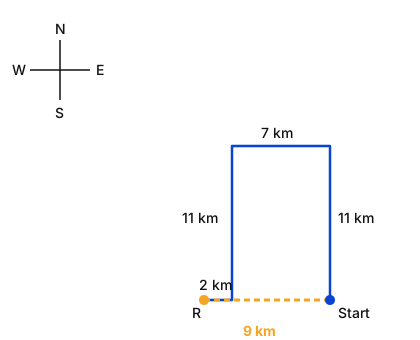
Vihaana walks 11 km North, then turns left and walks 7 km. She then turns left again and walks 11 km. She turns right and walks 2 km to reach point R.
How far and in which direction is point R from the starting point? (All turns are 90- degree turns only, unless specified.)
विहाना 11 km उत्तर की ओर चलती है, फिर बाएँ मुड़कर 7 km चलती है। फिर वह पुनः बाएँ मुड़कर 11 km चलती है। फिर वह दाएँ मुड़कर 2 km चलकर बिंदु R पर पहुँचती है।
बिंदु R प्रारंभिक बिंदु से कितनी दूर और किस दिशा में है? (जब तक अन्यथा निर्दिष्ट न हो, सभी मोड़ केवल 90 डिग्री के मोड़ हैं।)
  1. A9 km, West9 km, पश्चिम
  2. B11 km, East11 km, पूर्व
  3. C8 km, East8 km, पूर्व
  4. D10 km, West10 km, पश्चिम
Show answer

Concept: Trace the path on N–E–S–W axes; a left turn from North faces West, a left turn from West faces South, a right turn from South faces West.

  1. Start → 11 km North → turn left (West) 7 km → turn left (South) 11 km: now she is back on the starting line, 7 km West of the start.
  2. Turn right (West) 2 km → total 7+2=9 km West of the start, at point R.
  3. The two 11 km legs (North and South) cancel each other.

Trick: Equal and opposite legs cancel – just add the net East–West distances.

Answer: (A) 9 km, West

अवधारणा: N–E–S–W अक्षों पर पथ बनाएँ; उत्तर से बायाँ मुड़ने पर पश्चिम, पश्चिम से बायाँ मुड़ने पर दक्षिण और दक्षिण से दायाँ मुड़ने पर पश्चिम दिशा होती है।

  1. प्रारंभ → 11 km उत्तर → बाएँ (पश्चिम) 7 km → बाएँ (दक्षिण) 11 km: अब वह प्रारंभिक रेखा पर, प्रारंभ से 7 km पश्चिम में है।
  2. दाएँ (पश्चिम) 2 km → कुल 7+2=9 km पश्चिम, बिंदु R पर।
  3. 11 km के दोनों (उत्तर–दक्षिण) चरण एक-दूसरे को निरस्त कर देते हैं।

ट्रिक: बराबर और विपरीत चरण कट जाते हैं – केवल शुद्ध पूर्व–पश्चिम दूरी जोड़ें।

उत्तर: (A) 9 km, पश्चिम

RRB NTPC Graduate CBT 1General Intelligence and ReasoningDirection SenseRRB NTPC Graduate CBT 1 2025 · 16 Mar Shift 2 →
Q2290.
Which of the following letter-number clusters will replace the question mark (?) in the given series to make it logically complete?
JMO 50 MPR 61 PSU 72 SVX 83 ?
निम्नलिखित में से कौन-सा अक्षर-संख्या समूह दी गई श्रेणी में प्रश्नचिह्न (?) के स्थान पर आकर इसे तार्किक रूप से पूर्ण करेगा?
JMO 50 MPR 61 PSU 72 SVX 83 ?
  1. AVEO 93
  2. BVXZ 93
  3. CVYA 94
  4. DVZZ 94
Show answer

Concept: Treat the letters and the numbers as two separate series and find each pattern.

  1. Letters: J→M→P→S (+3), M→P→S→V (+3), O→R→U→X (+3). Next: S+3 = V, V+3 = Y, X+3 = A (wrap after Z) → VYA.
  2. Numbers: 50, 61, 72, 83 → +11 each → next 83+11=94.
  3. So the next cluster is VYA 94.

Trick: Within each cluster letters are at gap 3 (J-M-O is +3, +2) – check the first letter column only, then build the rest.

Answer: (C) VYA 94

अवधारणा: अक्षरों और संख्याओं को दो अलग श्रृंखलाएँ मानकर प्रत्येक का पैटर्न खोजें।

  1. अक्षर: J→M→P→S (+3), M→P→S→V (+3), O→R→U→X (+3)। अगला: S+3 = V, V+3 = Y, X+3 = A (Z के बाद फिर A से) → VYA।
  2. संख्याएँ: 50, 61, 72, 83 → प्रत्येक में +11 → अगली 83+11=94।
  3. अतः अगला पद VYA 94।

ट्रिक: पहले केवल पहले अक्षर का स्तंभ देखें (+3), फिर बाकी अक्षर उसी नियम से बनाएँ।

उत्तर: (C) VYA 94

RRB NTPC Graduate CBT 1General Intelligence and ReasoningAlphanumeric SeriesRRB NTPC Graduate CBT 1 2025 · 16 Mar Shift 2 →
Q2291.
Read the given statements and conclusions carefully. Assuming that the information given in the statements is true, even if it appears to be at variance with commonly known facts, decide which of the given conclusion(s) logically follow(s) from the statement.
Statements:
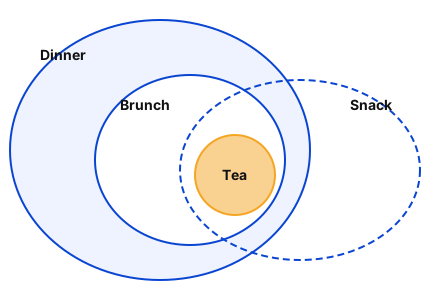
All tea is a snack. All tea is brunch. All brunches are dinner.
Conclusions:
(I) All tea is dinner.
(II) Some brunches are snacks.
दिए गए कथनों और निष्कर्षों को ध्यानपूर्वक पढ़िए। यह मानते हुए कि कथनों में दी गई जानकारी सत्य है, भले ही वह सामान्यतः ज्ञात तथ्यों से भिन्न प्रतीत होती हो, निर्णय कीजिए कि दिए गए निष्कर्षों में से कौन-सा/कौन-से निष्कर्ष कथनों का तार्किक रूप से अनुसरण करता है/करते हैं।
कथन:
सभी चाय, स्नैक हैं। सभी चाय, ब्रंच हैं। सभी ब्रंच, डिनर हैं।
निष्कर्ष:
(I) सभी चाय, डिनर हैं।
(II) कुछ ब्रंच, स्नैक हैं।
  1. AOnly conclusion (I) follows.केवल निष्कर्ष (I) अनुसरण करता है।
  2. BNeither conclusion (I) nor (II) follows.न तो निष्कर्ष (I) और न ही (II) अनुसरण करता है।
  3. CBoth conclusions (I) and (II) follow.निष्कर्ष (I) और (II) दोनों अनुसरण करते हैं।
  4. DOnly conclusion (II) follows.केवल निष्कर्ष (II) अनुसरण करता है।
Show answer

Concept: Draw the sets: Tea lies completely inside Snack and completely inside Brunch; Brunch lies completely inside Dinner.

  1. Conclusion (I): All tea ⊂ Brunch ⊂ Dinner, so every tea is a dinner – follows.
  2. Conclusion (II): Tea is part of both Brunch and Snack, so the Tea region is common to them – "Some brunches are snacks" follows.
  3. Both conclusions are definite, so both follow.

Trick: Two "All A is B" + "All A is C" statements always give "Some B is C" (through A).

Answer: (C) Both conclusions (I) and (II) follow.

अवधारणा: समुच्चय बनाएँ: Tea पूरी तरह Snack के अंदर और पूरी तरह Brunch के अंदर है; Brunch पूरी तरह Dinner के अंदर है।

  1. निष्कर्ष (I): Tea ⊂ Brunch ⊂ Dinner, अतः हर tea एक dinner है – अनुसरण करता है।
  2. निष्कर्ष (II): Tea, Brunch और Snack दोनों का हिस्सा है, अतः Tea का क्षेत्र दोनों में उभयनिष्ठ है – "कुछ brunch, snack हैं" अनुसरण करता है।
  3. दोनों निष्कर्ष निश्चित हैं, अतः दोनों अनुसरण करते हैं।

ट्रिक: "All A is B" + "All A is C" से हमेशा "Some B is C" निकलता है (A के माध्यम से)।

उत्तर: (C) निष्कर्ष (I) और (II) दोनों अनुसरण करते हैं।

RRB NTPC Graduate CBT 1General Intelligence and ReasoningSyllogismRRB NTPC Graduate CBT 1 2025 · 16 Mar Shift 2 →
Q2292.
Which of the following letter-clusters should replace # and % so that the pattern and relationship followed between the letter-cluster pair on the left side of :: is the same as that on the right side of :: ?
# : EGC :: QSO : %
निम्नलिखित में से कौन-से अक्षर-समूह # और % के स्थान पर आने चाहिए ताकि :: के बाईं ओर के अक्षर-समूह युग्म के बीच का पैटर्न और संबंध वही हो जो :: के दाईं ओर के युग्म के बीच है?
# : EGC :: QSO : %
  1. A# = HJF; % = NPL
  2. B# = GTF; % = NNH
  3. C# = NJG; % = NKJ
  4. D# = TYF; % = NHG
Show answer

Concept: The same letter-shift rule must connect # → EGC and QSO → %. Test the options.

  1. Option (A): HJF → EGC: H−3 = E, J−3 = G, F−3 = C ✓ (each letter −3).
  2. Apply −3 to QSO: Q−3 = N, S−3 = P, O−3 = L → NPL ✓, which matches option (A).
  3. Other options do not follow one uniform rule for both pairs.

Trick: Check the first letter of each pair only (H→E, Q→N: both −3) to eliminate fast.

Answer: (A) # = HJF; % = NPL

अवधारणा: एक ही अक्षर-शिफ्ट नियम # → EGC और QSO → % दोनों को जोड़ना चाहिए। विकल्प जाँचें।

  1. विकल्प (A): HJF → EGC: H−3 = E, J−3 = G, F−3 = C ✓ (हर अक्षर −3)।
  2. QSO पर −3 लगाएँ: Q−3 = N, S−3 = P, O−3 = L → NPL ✓, जो विकल्प (A) से मेल खाता है।
  3. अन्य विकल्पों में दोनों जोड़ों के लिए एक समान नियम नहीं बनता।

ट्रिक: हर जोड़े के केवल पहले अक्षर जाँचें (H→E, Q→N: दोनों −3) – तेज़ी से विकल्प हटें।

उत्तर: (A) # = HJF; % = NPL

RRB NTPC Graduate CBT 1General Intelligence and ReasoningLetter-cluster AnalogyRRB NTPC Graduate CBT 1 2025 · 16 Mar Shift 2 →
Q2293.
Select the set in which the numbers are related in the same way as are the numbers of the following sets.
(NOTE : Operations should be performed on the whole numbers, without breaking down the numbers into their constituent digits. E.g. 13 – Operations on 13 such as adding / subtracting / multiplying etc. to 13 can be performed. Breaking down 13 into 1 and 3 and then performing mathematical operations on 1 and 3 is not allowed.)
(44, 968, 22)
(26, 650, 25)
उस समुच्चय का चयन कीजिए जिसमें संख्याएँ उसी प्रकार संबंधित हैं जिस प्रकार निम्नलिखित समुच्चयों की संख्याएँ संबंधित हैं।
(नोट : संक्रियाएँ पूर्ण संख्याओं पर की जानी चाहिए, संख्याओं को उनके घटक अंकों में तोड़े बिना। उदाहरण के लिए 13 – 13 पर संक्रियाएँ जैसे 13 में जोड़ना / घटाना / गुणा करना आदि की जा सकती हैं। 13 को 1 और 3 में तोड़कर फिर 1 और 3 पर गणितीय संक्रियाएँ करने की अनुमति नहीं है।)
(44, 968, 22)
(26, 650, 25)
  1. A(34, 173, 5)
  2. B(18, 108, 6)
  3. C(15, 348, 23)
  4. D(23, 210, 9)
Show answer

Concept: Find one operation linking the first and third numbers to the middle one.

  1. (44, 968, 22): 44×22=968 ✓. (26, 650, 25): 26×25=650 ✓. Rule: middle = product of the outer two.
  2. Option (B): 18×6=108 ✓.
  3. (A) 34×5=170≠173; (C) 15×23=345≠348; (D) 23×9=207≠210.

Trick: When the middle number is much larger, try the product of the outer numbers first.

Answer: (B) (18, 108, 6)

अवधारणा: पहली और तीसरी संख्या को बीच वाली से जोड़ने वाली एक संक्रिया खोजें।

  1. (44, 968, 22): 44×22=968 ✓। (26, 650, 25): 26×25=650 ✓। नियम: बीच की संख्या = बाहरी दोनों का गुणनफल।
  2. विकल्प (B): 18×6=108 ✓।
  3. (A) 34×5=170≠173; (C) 15×23=345≠348; (D) 23×9=207≠210।

ट्रिक: बीच की संख्या बहुत बड़ी हो तो पहले बाहरी संख्याओं का गुणनफल आज़माएँ।

उत्तर: (B) (18, 108, 6)

RRB NTPC Graduate CBT 1General Intelligence and ReasoningNumber Set AnalogyRRB NTPC Graduate CBT 1 2025 · 16 Mar Shift 2 →
Q2294.
Read the given statements and conclusions carefully. Assuming that the information given in the statements is true, even if it appears to be at variance with commonly known facts, decide which of the given conclusion(s) logically follow(s) from the statements.
Statements:
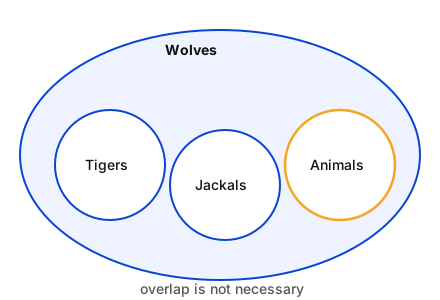
All tigers are wolves. All jackals are wolves. All animals are wolves.
Conclusions:
(I) Some animals are tigers.
(II) Some jackals are animals.
दिए गए कथनों और निष्कर्षों को ध्यानपूर्वक पढ़िए। यह मानते हुए कि कथनों में दी गई जानकारी सत्य है, भले ही वह सामान्यतः ज्ञात तथ्यों से भिन्न प्रतीत होती हो, निर्णय कीजिए कि दिए गए निष्कर्षों में से कौन-सा/कौन-से निष्कर्ष कथनों का तार्किक रूप से अनुसरण करता है/करते हैं।
कथन:
सभी बाघ, भेड़िये हैं। सभी सियार, भेड़िये हैं। सभी जानवर, भेड़िये हैं।
निष्कर्ष:
(I) कुछ जानवर, बाघ हैं।
(II) कुछ सियार, जानवर हैं।
  1. AOnly conclusion (I) follows.केवल निष्कर्ष (I) अनुसरण करता है।
  2. BNeither conclusion (I) nor (II) follows.न तो निष्कर्ष (I) और न ही (II) अनुसरण करता है।
  3. CBoth conclusions (I) and (II) follow.निष्कर्ष (I) और (II) दोनों अनुसरण करते हैं।
  4. DOnly conclusion (II) follows.केवल निष्कर्ष (II) अनुसरण करता है।
Show answer

Concept: "All X are wolves" only places X inside Wolves; it says nothing about how the different sub-groups relate to each other.

  1. Tigers, Jackals and Animals are all inside Wolves, but they may be three separate circles (as drawn) – no overlap is forced.
  2. Conclusion (I) "Some animals are tigers" – possible but not definite → does not follow.
  3. Conclusion (II) "Some jackals are animals" – also not definite → does not follow.

Trick: Three "All … are B" statements with the same predicate B never give any definite relation between the subjects.

Answer: (B) Neither conclusion (I) nor (II) follows.

अवधारणा: "All X are wolves" केवल X को Wolves के अंदर रखता है; यह अलग-अलग उपसमूहों के आपसी संबंध के बारे में कुछ नहीं कहता।

  1. Tigers, Jackals और Animals सभी Wolves के अंदर हैं, पर वे तीन अलग वृत्त हो सकते हैं (जैसा चित्र में) – कोई ओवरलैप अनिवार्य नहीं।
  2. निष्कर्ष (I) "कुछ animals, tigers हैं" – संभव है पर निश्चित नहीं → अनुसरण नहीं करता।
  3. निष्कर्ष (II) "कुछ jackals, animals हैं" – यह भी निश्चित नहीं → अनुसरण नहीं करता।

ट्रिक: एक ही विधेय B वाले तीन "All … are B" कथन उद्देश्यों के बीच कोई निश्चित संबंध नहीं देते।

उत्तर: (B) न निष्कर्ष (I) और न ही (II) अनुसरण करता है।

RRB NTPC Graduate CBT 1General Intelligence and ReasoningSyllogismRRB NTPC Graduate CBT 1 2025 · 16 Mar Shift 2 →
Q2295.
If 3 is added to each even digit and 2 is subtracted from each odd digit in the number 5723946, how many digits will appear more than once in the new number thus formed?
यदि संख्या 5723946 के प्रत्येक सम अंक में 3 जोड़ा जाए और प्रत्येक विषम अंक से 2 घटाया जाए, तो इस प्रकार बनी नई संख्या में कितने अंक एक से अधिक बार आएँगे?
  1. ANoneकोई नहीं
  2. BTwoदो
  3. COneएक
  4. DThreeतीन
Show answer

Concept: Apply the rule digit by digit: even digit → +3, odd digit → −2, then count repeated digits in the new number.

  1. 5723946 → 5−2 = 3, 7−2 = 5, 2+3 = 5, 3−2 = 1, 9−2 = 7, 4+3 = 7, 6+3 = 9.
  2. New number: 3 5 5 1 7 7 9.
  3. Digits appearing more than once: 5 and 7 → two digits.

Trick: Write the new digits under the old ones in a row – repeats become visible instantly.

Answer: (B) Two

अवधारणा: नियम हर अंक पर लगाएँ: सम अंक → +3, विषम अंक → −2, फिर नई संख्या में दोहराए गए अंक गिनें।

  1. 5723946 → 5−2 = 3, 7−2 = 5, 2+3 = 5, 3−2 = 1, 9−2 = 7, 4+3 = 7, 6+3 = 9।
  2. नई संख्या: 3 5 5 1 7 7 9।
  3. एक से अधिक बार आने वाले अंक: 5 और 7 → दो अंक।

ट्रिक: नए अंकों को पुराने अंकों के नीचे एक पंक्ति में लिखें – दोहराव तुरंत दिखता है।

उत्तर: (B) दो

RRB NTPC Graduate CBT 1General Intelligence and ReasoningDigit OperationsRRB NTPC Graduate CBT 1 2025 · 16 Mar Shift 2 →
Q2296.
Which of the following letter-clusters should replace # and % so that the pattern and relationship followed between the letter-cluster pair on the left side of :: is the same as that on the right side of :: ?
# : OIM :: ICG : %
निम्नलिखित में से कौन-से अक्षर-समूह # और % के स्थान पर आने चाहिए ताकि :: के बाईं ओर के अक्षर-समूह युग्म के बीच का पैटर्न और संबंध वही हो जो :: के दाईं ओर के युग्म के बीच है?
# : OIM :: ICG : %
  1. A# = MKO, % = GMJ
  2. B# = MKO, % = GMK
  3. C# = QKO, % = GAE
  4. D# = LPO, % = GJH
Show answer

Concept: One uniform letter shift must turn # into OIM and ICG into %. Test the options.

  1. Option (C): QKO → OIM: Q−2 = O, K−2 = I, O−2 = M ✓ (each letter −2).
  2. ICG with −2: I−2 = G, C−2 = A, G−2 = E → GAE ✓, which is given in option (C).
  3. Option (A)/(B) MKO → OIM would need +2, −2, −2 – not uniform; (D) fails too.

Trick: Check the % part first – only (C) gives GAE from ICG with a single rule.

Answer: (C) # = QKO, % = GAE

अवधारणा: एक समान अक्षर-शिफ्ट से # से OIM और ICG से % बनना चाहिए। विकल्प जाँचें।

  1. विकल्प (C): QKO → OIM: Q−2 = O, K−2 = I, O−2 = M ✓ (हर अक्षर −2)।
  2. ICG पर −2: I−2 = G, C−2 = A, G−2 = E → GAE ✓, जो विकल्प (C) में है।
  3. विकल्प (A)/(B) MKO → OIM के लिए +2, −2, −2 चाहिए – समान नहीं; (D) भी असफल।

ट्रिक: पहले % वाला भाग जाँचें – केवल (C) में ICG से एक नियम द्वारा GAE बनता है।

उत्तर: (C) # = QKO, % = GAE

RRB NTPC Graduate CBT 1General Intelligence and ReasoningLetter-cluster AnalogyRRB NTPC Graduate CBT 1 2025 · 16 Mar Shift 2 →
Q2297.
Based on the English alphabetical order, three of the following four letter cluster pairs are alike in a certain way and thus form a group. Which is the one that does not belong to that group?
(Note: The odd man out is not based on the number of consonants/vowels or their position in the letter cluster)
अंग्रेज़ी वर्णमाला क्रम के आधार पर, निम्नलिखित चार अक्षर-समूह युग्मों में से तीन एक निश्चित प्रकार से समान हैं और इस प्रकार एक समूह बनाते हैं। वह कौन-सा है जो उस समूह से संबंधित नहीं है?
(नोट: असंगत युग्म व्यंजनों/स्वरों की संख्या या अक्षर-समूह में उनकी स्थिति पर आधारित नहीं है)
  1. ALN-MO
  2. BHJ-IK
  3. CDF-EG
  4. DKM-NP
Show answer

Concept: Find the shift from the first cluster to the second in each pair.

  1. LN → MO: +1, +1. HJ → IK: +1, +1. DF → EG: +1, +1.
  2. KM → NP: K+3 = N, M+3 = P → +3, +3 – different.
  3. So KM-NP is the odd one out.

Trick: Compare only the first letters: L→M, H→I, D→E are +1; K→N is +3.

Answer: (D) KM-NP

अवधारणा: हर युग्म में पहले समूह से दूसरे समूह तक का शिफ्ट देखें।

  1. LN → MO: +1, +1। HJ → IK: +1, +1। DF → EG: +1, +1।
  2. KM → NP: K+3 = N, M+3 = P → +3, +3 – अलग।
  3. अतः KM-NP विषम है।

ट्रिक: केवल पहले अक्षर देखें: L→M, H→I, D→E +1 हैं; K→N +3।

उत्तर: (D) KM-NP

RRB NTPC Graduate CBT 1General Intelligence and ReasoningOdd One Out – Letter PairsRRB NTPC Graduate CBT 1 2025 · 16 Mar Shift 2 →
Q2298.
Which of the following letter-clusters should replace # and % so that the pattern and relationship followed between the letter-cluster pair on the left side of :: is the same as that on the right side of :: ?
# : ZJR :: PZH : %
निम्नलिखित में से कौन-से अक्षर-समूह # और % के स्थान पर आने चाहिए ताकि :: के बाईं ओर के अक्षर-समूह युग्म के बीच का पैटर्न और संबंध वही हो जो :: के दाईं ओर के युग्म के बीच है?
# : ZJR :: PZH : %
  1. A# = TDL % = VFN
  2. B# = UDL % = VFN
  3. C# = TDM % = VFN
  4. D# = TDL % = VCN
Show answer

Concept: The same letter shift must give # → ZJR and PZH → %. Work backwards from the given clusters.

  1. Options for # are TDL / UDL / TDM. TDL → ZJR: T+6 = Z, D+6 = J, L+6 = R ✓ (uniform +6).
  2. Apply +6 to PZH: P+6 = V, Z+6 = F (wrap after Z), H+6 = N → VFN ✓.
  3. Only option (A) has both TDL and VFN.

Trick: Z+6: count A(1)…F(6) after Z → F; options with VCN are instantly wrong.

Answer: (A) # = TDL % = VFN

अवधारणा: एक ही अक्षर-शिफ्ट से # → ZJR और PZH → % बनना चाहिए। दिए गए समूहों से उल्टा चलें।

  1. # के विकल्प TDL / UDL / TDM हैं। TDL → ZJR: T+6 = Z, D+6 = J, L+6 = R ✓ (समान +6)।
  2. PZH पर +6: P+6 = V, Z+6 = F (Z के बाद A से), H+6 = N → VFN ✓।
  3. केवल विकल्प (A) में TDL और VFN दोनों हैं।

ट्रिक: Z+6: Z के बाद A(1)…F(6) → F; VCN वाले विकल्प तुरंत गलत।

उत्तर: (A) # = TDL % = VFN

RRB NTPC Graduate CBT 1General Intelligence and ReasoningLetter-cluster AnalogyRRB NTPC Graduate CBT 1 2025 · 16 Mar Shift 2 →
Q2299.
In a certain code language, ‘ALIT’ is coded as ‘2159’ and ‘HILT’ is coded as ‘6912’. What is the code for ‘H’ in the given code language?
एक निश्चित कूट भाषा में, 'ALIT' को '2159' के रूप में कूटबद्ध किया जाता है और 'HILT' को '6912' के रूप में कूटबद्ध किया जाता है। उसी कूट भाषा में 'H' का कूट क्या है?
  1. A2
  2. B9
  3. C6
  4. D1
Show answer

Concept: Each letter has a fixed digit code; common letters in two words share common digits.

  1. ALIT → 2159 and HILT → 6912.
  2. Common letters L, I, T ↔ common digits 1, 9, 2.
  3. The uncommon letter in ALIT is A → leftover digit 5; the uncommon letter in HILT is H → leftover digit 6.

Trick: Cancel the common letters and common digits – whatever remains is the code of the odd letter.

Answer: (C) 6

अवधारणा: हर अक्षर का एक निश्चित अंक कोड है; दो शब्दों के उभयनिष्ठ अक्षरों के कोड भी उभयनिष्ठ होते हैं।

  1. ALIT → 2159 और HILT → 6912।
  2. उभयनिष्ठ अक्षर L, I, T ↔ उभयनिष्ठ अंक 1, 9, 2।
  3. ALIT में अलग अक्षर A → बचा अंक 5; HILT में अलग अक्षर H → बचा अंक 6।

ट्रिक: उभयनिष्ठ अक्षर और अंक काट दें – जो बचे वही अलग अक्षर का कोड है।

उत्तर: (C) 6

RRB NTPC Graduate CBT 1General Intelligence and ReasoningCoding–DecodingRRB NTPC Graduate CBT 1 2025 · 16 Mar Shift 2 →
Q2300.
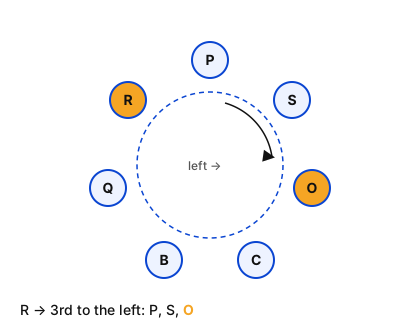
Seven people B, C, O, P, Q, R and S are sitting around a circular table facing the center of the table. Only two people sits between P and B when counted from the right of P. Only S sits between O and P. Q sits to the immediate left of B. C is not an immediate neighbor of P. Who sits third to the left of R?
सात व्यक्ति B, C, O, P, Q, R और S एक वृत्ताकार मेज़ के चारों ओर मेज़ के केंद्र की ओर मुख करके बैठे हैं। P के दाईं ओर से गिनने पर P और B के बीच केवल दो व्यक्ति बैठे हैं। O और P के बीच केवल S बैठा है। Q, B के ठीक बाएँ बैठा है। C, P का निकटतम पड़ोसी नहीं है। R के बाएँ तीसरे स्थान पर कौन बैठा है?
  1. AP
  2. BO
  3. CC
  4. DB
Show answer

Concept: All face the centre, so "left" is clockwise and "right" is anticlockwise. Fix P and place the others step by step.

  1. Two people between P and B counted from P's right → B is 3rd to the right of P (equivalently 4th to P's left).
  2. Q is immediately left of B. Only S sits between O and P: the side P–S–O must be P's left (the right side is needed for the two seats before B), so S is immediate left of P and O next.
  3. Seats left: the one immediately right of P and the one between O and B. C is not P's neighbour → C sits between O and B; R sits immediately right of P.
  4. Counting left (clockwise) from R: P (1), S (2), O (3).

Trick: "Only X sits between A and B" = A and B are 2 seats apart – place such pairs first.

Answer: (B) O

अवधारणा: सभी केंद्र की ओर मुख किए हैं, अतः "बायाँ" दक्षिणावर्त और "दायाँ" वामावर्त है। P को स्थिर कर बाकी को क्रम से बैठाएँ।

  1. P के दाएँ से गिनने पर P और B के बीच दो लोग → B, P के दाएँ तीसरा है (अर्थात P के बाएँ चौथा)।
  2. Q, B के तुरंत बाएँ है। O और P के बीच केवल S: P–S–O वाला पक्ष P का बायाँ होना चाहिए (दाएँ पक्ष की दो सीटें B से पहले चाहिए), अतः S, P के तुरंत बाएँ और उसके बाद O।
  3. शेष सीटें: P के तुरंत दाएँ वाली और O–B के बीच वाली। C, P का पड़ोसी नहीं → C, O और B के बीच; R, P के तुरंत दाएँ।
  4. R से बाएँ (दक्षिणावर्त) गिनें: P (1), S (2), O (3)।

ट्रिक: "A और B के बीच केवल X" = A और B में 2 सीटों का अंतर – ऐसे युग्म पहले बैठाएँ।

उत्तर: (B) O

RRB NTPC Graduate CBT 1General Intelligence and ReasoningCircular Seating ArrangementRRB NTPC Graduate CBT 1 2025 · 16 Mar Shift 2 →