Question bank

Q&A: practice questions with answers

Search questions on any topic. Filter by exam category, exam, subject and topic, try the question, then open the answer and explanation.

Courses – airGurukul

2,400 questions found.

Q2341.
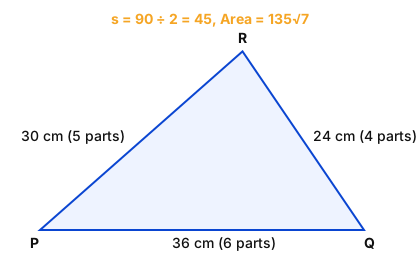
Find the area of a quadrilateral ABCD whose area is twice the area of a triangle PQR. The sides of triangle PQR are in the ratio 4:5:6 and the perimeter of the triangle is 90 cm (use 7=2.6).
एक चतुर्भुज ABCD का क्षेत्रफल ज्ञात कीजिए जिसका क्षेत्रफल त्रिभुज PQR के क्षेत्रफल का दोगुना है। त्रिभुज PQR की भुजाएँ 4:5:6 के अनुपात में हैं और त्रिभुज का परिमाप 90 cm है (7=2.6 का प्रयोग कीजिए)।
  1. A656 cm2
  2. B702 cm2
  3. C763 cm2
  4. D698 cm2
Show answer

Concept: Heron's formula: Area =s(s−a)(s−b)(s−c) where s=a+b+c2.

  1. Sides 4:5:6, perimeter 90 → sides =24, 30, 36 cm and s=45.
  2. Area =45×21×15×9=92×32×52×7=1357.
  3. With 7=2.6: area of △PQR=135×2.6=351cm2.
  4. Quadrilateral =2×351=702cm2.

Trick: Break each factor into primes and pair them up before taking the root – 45·21·15·9 gives 9·3·5 outside and only 7 left inside.

Answer: (B) 702cm2

अवधारणा: हीरोन का सूत्र: क्षेत्रफल =s(s−a)(s−b)(s−c), जहाँ s=a+b+c2।

  1. भुजाएँ 4:5:6, परिमाप 90 → भुजाएँ =24, 30, 36 cm और s=45।
  2. क्षेत्रफल =45×21×15×9=92×32×52×7=1357।
  3. 7=2.6 लेने पर △PQR का क्षेत्रफल =135×2.6=351cm2।
  4. चतुर्भुज =2×351=702cm2।

ट्रिक: मूल निकालने से पहले हर गुणनखंड को अभाज्य संख्याओं में तोड़कर जोड़े बनाइए – 45·21·15·9 से 9·3·5 बाहर आता है और अंदर सिर्फ 7 बचता है।

उत्तर: (B) 702cm2

RRB NTPC Graduate CBT 1MathematicsHeron's formulaRRB NTPC Graduate CBT 1 2025 · 16 Mar Shift 1 →
Q2342.
20% of a number is more than 20% of 620 by 210. The number is:
किसी संख्या का 20%, 620 के 20% से 210 अधिक है। वह संख्या है:
  1. A1520
  2. B1720
  3. C1670
  4. D1770
Show answer

Concept: Translate the sentence directly into an equation: 20% of x − 20% of 620=210.

  1. 20% of 620=124.
  2. 20x100=124+210=334.
  3. x=334×5=1670.

Trick: 20% of the difference =210 ⇒ difference =210×5=1050; number =620+1050=1670. No fractions needed.

Answer: (C) 1670

अवधारणा: वाक्य को सीधे समीकरण में बदलिए: x का 20% − 620 का 20% =210।

  1. 620 का 20%=124।
  2. 20x100=124+210=334।
  3. x=334×5=1670।

ट्रिक: अंतर का 20%=210 ⇒ अंतर =210×5=1050; संख्या =620+1050=1670। भिन्न की ज़रूरत ही नहीं।

उत्तर: (C) 1670

RRB NTPC Graduate CBT 1MathematicsPercentageRRB NTPC Graduate CBT 1 2025 · 16 Mar Shift 1 →
Q2343.
Anand has ₹1407 with him. He divides this amount between his two sons, Anil and Ashok, and asks them to invest their respective shares at a compound interest rate of 10% per annum, compounded annually. It is observed that Anil’s investment amounts to the same value after 15 years as Ashok’s investment does after 16 years. How much (in ₹) did Anand give to Ashok?
आनंद के पास ₹1407 हैं। वह इस राशि को अपने दो पुत्रों, अनिल और अशोक, के बीच बाँटता है और उन्हें अपने-अपने हिस्से को 10% वार्षिक चक्रवृद्धि ब्याज की दर पर, वार्षिक रूप से संयोजित, निवेश करने के लिए कहता है। यह देखा गया कि अनिल का निवेश 15 वर्षों के बाद उसी मूल्य का हो जाता है जितना अशोक का निवेश 16 वर्षों के बाद होता है। आनंद ने अशोक को कितनी राशि (₹ में) दी?
  1. A737
  2. B837
  3. C520
  4. D670
Show answer

Concept: Amount =P(1+r100)n. Equal amounts after 15 and 16 years ⇒ the shares are in the ratio 1.1:1.

  1. Anil ×(1.1)15= Ashok ×(1.1)16 ⇒ Anil =1.1× Ashok.
  2. Anil : Ashok =11:10, total 21 parts =1407 ⇒ 1 part =67.
  3. Ashok =10×67= ₹670.

Trick: "Same amount after n and n+1 years" ⇒ divide in ratio (100+r):100. Here 110:100=11:10.

Answer: (D) ₹670

अवधारणा: मिश्रधन =P(1+r100)n। 15 और 16 वर्ष बाद मिश्रधन बराबर ⇒ हिस्से 1.1:1 के अनुपात में।

  1. अनिल ×(1.1)15= अशोक ×(1.1)16 ⇒ अनिल =1.1× अशोक।
  2. अनिल : अशोक =11:10, कुल 21 भाग =1407 ⇒ 1 भाग =67।
  3. अशोक =10×67= ₹670।

ट्रिक: "n और n+1 वर्ष बाद समान मिश्रधन" ⇒ राशि को (100+r):100 में बाँटिए। यहाँ 110:100=11:10।

उत्तर: (D) ₹670

RRB NTPC Graduate CBT 1MathematicsCompound interestRRB NTPC Graduate CBT 1 2025 · 16 Mar Shift 1 →
Q2344.
The average of 13 numbers is 8. If each number is multiplied by 7, then what will the new average be:
13 संख्याओं का औसत 8 है। यदि प्रत्येक संख्या को 7 से गुणा किया जाए, तो नया औसत क्या होगा:
  1. A7
  2. B8
  3. C56
  4. D13
Show answer

Concept: If every observation is multiplied by k, the average is also multiplied by k.

  1. Sum of 13 numbers =13×8=104.
  2. New sum =104×7=728.
  3. New average =72813=56.

Trick: Skip the sum: new average =8×7=56 directly. (Adding k to each number adds k to the average too.)

Answer: (C) 56

अवधारणा: यदि हर संख्या को k से गुणा किया जाए तो औसत भी k गुना हो जाता है।

  1. 13 संख्याओं का योग =13×8=104।
  2. नया योग =104×7=728।
  3. नया औसत =72813=56।

ट्रिक: योग निकालने की ज़रूरत नहीं: नया औसत =8×7=56 सीधे। (हर संख्या में k जोड़ने पर औसत में भी k जुड़ता है।)

उत्तर: (C) 56

RRB NTPC Graduate CBT 1MathematicsAverageRRB NTPC Graduate CBT 1 2025 · 16 Mar Shift 1 →
Q2345.
If (y−12)=45, then find the value of y−3−1y−3.
यदि (y−12)=45 है, तो y−3−1y−3 का मान ज्ञात कीजिए।
  1. A6
  2. B4
  3. C8
  4. D9
Show answer

Concept: Write y−3 as a perfect square of the form (a+b)2=a+b+2ab, then use rationalisation.

  1. y=12+45 ⇒ y−3=9+45=5+4+2×25=(5+2)2.
  2. y−3=5+2 and 1y−3=15+2=5−2.
  3. Difference =(5+2)−(5−2)=4.

Trick: If x=a+b with a−b=1, then 1x=a−b and x−1x=2b. Here b=4 ⇒ 2×2=4.

Answer: (B) 4

अवधारणा: y−3 को (a+b)2=a+b+2ab रूप के पूर्ण वर्ग में लिखिए, फिर परिमेयकरण (rationalisation) कीजिए।

  1. y=12+45 ⇒ y−3=9+45=5+4+2×25=(5+2)2।
  2. y−3=5+2 और 1y−3=15+2=5−2।
  3. अंतर =(5+2)−(5−2)=4।

ट्रिक: यदि x=a+b और a−b=1, तो 1x=a−b तथा x−1x=2b। यहाँ b=4 ⇒ 2×2=4।

उत्तर: (B) 4

RRB NTPC Graduate CBT 1MathematicsSurdsRRB NTPC Graduate CBT 1 2025 · 16 Mar Shift 1 →
Q2346.
Girish scored 572 marks in an examination and was 30 marks short of 28% of maximum marks. In the same examination, his friend scored 473 marks. What is the percentage of marks scored by his friend?
गिरीश ने एक परीक्षा में 572 अंक प्राप्त किए और वह अधिकतम अंकों के 28% से 30 अंक कम रहा। उसी परीक्षा में, उसके मित्र ने 473 अंक प्राप्त किए। उसके मित्र द्वारा प्राप्त अंकों का प्रतिशत क्या है?
  1. A22%
  2. B23%
  3. C21%
  4. D24%
Show answer

Concept: First find the maximum marks from Girish's data, then convert the friend's marks to a percentage.

  1. 28% of max =572+30=602 ⇒ max =602×10028=2150.
  2. Friend's percentage =4732150×100=22%.

Trick: 602÷28=21.5, so 1%=21.5 marks; 473÷21.5=22. Working in "marks per 1%" avoids big numbers.

Answer: (A) 22%

अवधारणा: पहले गिरीश के आँकड़ों से अधिकतम अंक निकालिए, फिर मित्र के अंकों को प्रतिशत में बदलिए।

  1. अधिकतम का 28%=572+30=602 ⇒ अधिकतम =602×10028=2150।
  2. मित्र का प्रतिशत =4732150×100=22%।

ट्रिक: 602÷28=21.5, यानी 1%=21.5 अंक; 473÷21.5=22। "प्रति 1% अंक" में काम करने से बड़ी संख्याएँ बच जाती हैं।

उत्तर: (A) 22%

RRB NTPC Graduate CBT 1MathematicsPercentageRRB NTPC Graduate CBT 1 2025 · 16 Mar Shift 1 →
Q2347.
Two taps can fill a cistern in 4 hours and 38 hours respectively. A third tap can empty it in 38 hours. How long (in hours) will it take to fill one-fourth of the empty cistern, if all of them are opened together?
दो नल एक टंकी को क्रमशः 4 घंटे और 38 घंटे में भर सकते हैं। एक तीसरा नल उसे 38 घंटे में खाली कर सकता है। यदि इन सभी को एक साथ खोल दिया जाए, तो खाली टंकी के एक-चौथाई भाग को भरने में कितना समय (घंटों में) लगेगा?
  1. A1
  2. B2
  3. C3
  4. D4
Show answer

Concept: Work per hour adds up: filling taps positive, emptying tap negative.

  1. Net rate =14+138−138=14 of the cistern per hour.
  2. Full cistern in 4 hours ⇒ one-fourth in 4×14=1 hour.

Trick: A filling and an emptying tap with the same time cancel completely – just ignore both.

Answer: (A) 1

अवधारणा: प्रति घंटे का काम जुड़ता है: भरने वाले नल धनात्मक, खाली करने वाला ऋणात्मक।

  1. शुद्ध दर =14+138−138=14 टंकी प्रति घंटा।
  2. पूरी टंकी 4 घंटे में ⇒ एक-चौथाई 4×14=1 घंटे में।

ट्रिक: समान समय वाला एक भरने वाला और एक खाली करने वाला नल एक-दूसरे को पूरी तरह काट देते हैं – दोनों को छोड़ दीजिए।

उत्तर: (A) 1

RRB NTPC Graduate CBT 1MathematicsPipes and cisternsRRB NTPC Graduate CBT 1 2025 · 16 Mar Shift 1 →
Q2348.
If the median of a data is 61.54 less than its mode, then the median of the data exceeds its mean by _____. (Use the empirical formula to find the answer)
यदि किसी आँकड़े की माध्यिका उसके बहुलक से 61.54 कम है, तो आँकड़े की माध्यिका उसके माध्य से _____ अधिक है। (उत्तर ज्ञात करने के लिए आनुभविक सूत्र का प्रयोग कीजिए)
  1. A32.03
  2. B36.77
  3. C30.77
  4. D28.47
Show answer

Concept: Empirical formula: Mode=3Median−2Mean, i.e. Mode−Median=2(Median−Mean).

  1. Given Mode−Median=61.54.
  2. So Median−Mean=61.542=30.77.

Trick: Mean, Median, Mode lie in the ratio of gaps 1:2 – Median is twice as far from Mode as from Mean.

Answer: (C) 30.77

अवधारणा: आनुभविक सूत्र: बहुलक=3माध्यिका−2माध्य, अर्थात Mode−Median=2(Median−Mean)।

  1. दिया है Mode−Median=61.54।
  2. अतः Median−Mean=61.542=30.77।

ट्रिक: माध्य, माध्यिका, बहुलक के अंतराल 1:2 के अनुपात में होते हैं – माध्यिका, माध्य की तुलना में बहुलक से दोगुनी दूर होती है।

उत्तर: (C) 30.77

RRB NTPC Graduate CBT 1MathematicsStatistics – empirical relationRRB NTPC Graduate CBT 1 2025 · 16 Mar Shift 1 →
Q2349.
A train travelling at 60 km/hr crosses another train travelling in the opposite direction at 84 km/hr in 30 seconds. What is the combined length (in m) of both the trains?
60 km/hr की चाल से चलती हुई एक ट्रेन विपरीत दिशा में 84 km/hr की चाल से चलती हुई दूसरी ट्रेन को 30 सेकंड में पार करती है। दोनों ट्रेनों की संयुक्त लंबाई (m में) क्या है?
  1. A1000
  2. B1300
  3. C1200
  4. D1100
Show answer

Concept: Opposite directions ⇒ relative speed = sum of speeds; distance covered while crossing = sum of lengths.

  1. Relative speed =60+84=144km/h=144×518=40m/s.
  2. Combined length =40×30=1200 m.

Trick: km/h → m/s: multiply by 518. 144 is 18×8, so 144→8×5=40 instantly.

Answer: (C) 1200

अवधारणा: विपरीत दिशा ⇒ सापेक्ष चाल = चालों का योग; पार करने में तय दूरी = लंबाइयों का योग।

  1. सापेक्ष चाल =60+84=144km/h=144×518=40m/s।
  2. कुल लंबाई =40×30=1200 m।

ट्रिक: km/h → m/s: 518 से गुणा। 144=18×8, अतः 144→8×5=40 तुरंत।

उत्तर: (C) 1200

RRB NTPC Graduate CBT 1MathematicsTrains – relative speedRRB NTPC Graduate CBT 1 2025 · 16 Mar Shift 1 →
Q2350.
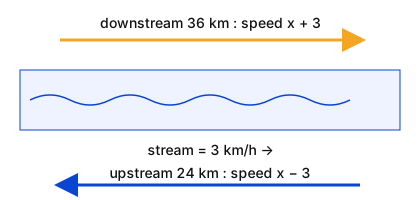
A boat can row 36 km downstream in the same time as it takes to row 24 km upstream. If the speed of the stream is 3 km/h, what is the speed of the boat in still water?
एक नाव धारा के अनुकूल 36 km उतने ही समय में चल सकती है जितने समय में वह धारा के प्रतिकूल 24 km चलती है। यदि धारा की चाल 3 km/h है, तो शांत जल में नाव की चाल क्या है?
  1. A15 km/h
  2. B12 km/h
  3. C21 km/h
  4. D18 km/h
Show answer

Concept: Same time ⇒ distances are in the ratio of speeds: downstreamupstream=x+3x−3.

  1. x+3x−3=3624=32.
  2. 2x+6=3x−9 ⇒ x=15.

Trick: Speed ratio 3:2 ⇒ boat speed =3+23−2× stream =5×3=15km/h.

Answer: (A) 15km/h

अवधारणा: समान समय ⇒ दूरियाँ चालों के अनुपात में: धारा के अनुकूलधारा के प्रतिकूल=x+3x−3।

  1. x+3x−3=3624=32।
  2. 2x+6=3x−9 ⇒ x=15।

ट्रिक: चाल अनुपात 3:2 ⇒ नाव की चाल =3+23−2× धारा =5×3=15km/h।

उत्तर: (A) 15km/h

RRB NTPC Graduate CBT 1MathematicsBoats and streamsRRB NTPC Graduate CBT 1 2025 · 16 Mar Shift 1 →
Q2351.
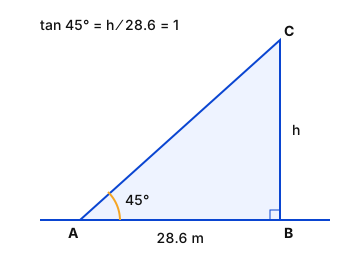
A tower stands vertically on the ground. From a point on the ground which is 28.6 m away from the foot of a tower, the angle of elevation of the top of the tower is found to be 45°. Find the height of the tower.
एक मीनार ज़मीन पर ऊर्ध्वाधर खड़ी है। ज़मीन पर मीनार के पाद से 28.6 m दूर स्थित एक बिंदु से मीनार के शीर्ष का उन्नयन कोण 45° पाया जाता है। मीनार की ऊँचाई ज्ञात कीजिए।
  1. A22.6 m
  2. B28.6 m
  3. C24.6 m
  4. D26.6 m
Show answer

Concept: In the right triangle, tanθ=heightdistance.

  1. tan45∘=h28.6.
  2. tan45∘=1 ⇒ h=28.6 m.

Trick: Angle of elevation 45∘ ⇒ height = distance from the foot, always.

Answer: (B) 28.6 m

अवधारणा: समकोण त्रिभुज में tanθ=ऊँचाईदूरी।

  1. tan45∘=h28.6।
  2. tan45∘=1 ⇒ h=28.6 m।

ट्रिक: उन्नयन कोण 45∘ ⇒ ऊँचाई = पाद से दूरी, हमेशा।

उत्तर: (B) 28.6 m

RRB NTPC Graduate CBT 1MathematicsHeights and distancesRRB NTPC Graduate CBT 1 2025 · 16 Mar Shift 1 →
Q2352.
The mean marks of the following distribution is:
Marks ObtainedNo. of Students
8115
354
733
5616
निम्नलिखित बंटन के अंकों का माध्य है:
प्राप्त अंक – छात्रों की संख्या
81 – 15
35 – 4
73 – 3
56 – 16
  1. A51
  2. B60
  3. C65
  4. D74
Show answer

Concept: Mean =∑fixi∑fi.

  1. ∑fixi=81×15+35×4+73×3+56×16=1215+140+219+896=2470.
  2. ∑fi=15+4+3+16=38.
  3. Mean =247038=65.

Trick: Options are far apart – 31 of the 38 students scored 81 or 56, so the mean must be well above 60 but below 70; only 65 fits.

Answer: (C) 65

अवधारणा: माध्य =∑fixi∑fi।

  1. ∑fixi=81×15+35×4+73×3+56×16=1215+140+219+896=2470।
  2. ∑fi=15+4+3+16=38।
  3. माध्य =247038=65।

ट्रिक: विकल्प दूर-दूर हैं – 38 में से 31 छात्रों के अंक 81 या 56 हैं, अतः माध्य 60 से काफी ऊपर पर 70 से नीचे होगा; केवल 65 फिट बैठता है।

उत्तर: (C) 65

RRB NTPC Graduate CBT 1MathematicsMean of a frequency distributionRRB NTPC Graduate CBT 1 2025 · 16 Mar Shift 1 →
Q2353.
What is the maximum value that must be assigned to A so that the 8-digit number 816A0408 is divisible by 4?
A को वह अधिकतम मान क्या दिया जाना चाहिए ताकि 8-अंकीय संख्या 816A0408, 4 से विभाज्य हो?
  1. A5
  2. B7
  3. C9
  4. D4
Show answer

Concept: A number is divisible by 4 if the number formed by its last two digits is divisible by 4.

  1. Last two digits of 816A0408 are 08, and 8÷4=2.
  2. So the number is divisible by 4 for every digit A (0 to 9); the maximum value is 9.

Trick: Divisibility by 4 (last 2 digits) and by 8 (last 3 digits) never depends on digits further left – do not waste time adding digits.

Answer: (C) 9

अवधारणा: कोई संख्या 4 से विभाज्य है यदि उसके अंतिम दो अंकों से बनी संख्या 4 से विभाज्य हो।

  1. 816A0408 के अंतिम दो अंक 08 हैं और 8÷4=2।
  2. अतः A के हर मान (0 से 9) के लिए संख्या 4 से विभाज्य है; अधिकतम मान 9।

ट्रिक: 4 (अंतिम 2 अंक) और 8 (अंतिम 3 अंक) की विभाज्यता बाईं ओर के अंकों पर कभी निर्भर नहीं करती – अंक जोड़ने में समय न गँवाएँ।

उत्तर: (C) 9

RRB NTPC Graduate CBT 1MathematicsDivisibility by 4RRB NTPC Graduate CBT 1 2025 · 16 Mar Shift 1 →
Q2354.
Evaluate: (-9) - (-56) ÷ (-14) + (-4) × 7
मान ज्ञात कीजिए: (-9) - (-56) ÷ (-14) + (-4) × 7
  1. A-40
  2. B-41
  3. C-43
  4. D-44
Show answer

Concept: BODMAS – do division and multiplication before addition and subtraction; watch the signs.

  1. (−56)÷(−14)=4 and (−4)×7=−28.
  2. Expression =−9−4+(−28)=−9−4−28=−41.

Trick: Negative ÷ negative = positive, but here it is being subtracted, so it becomes −4. Sign slips cause the wrong option −43 or −40.

Answer: (B) −41

अवधारणा: BODMAS – जोड़-घटाव से पहले भाग और गुणा; चिह्नों का ध्यान रखें।

  1. (−56)÷(−14)=4 और (−4)×7=−28।
  2. व्यंजक =−9−4+(−28)=−9−4−28=−41।

ट्रिक: ऋण ÷ ऋण = धन, पर यहाँ उसे घटाया जा रहा है, इसलिए −4 बनता है। चिह्न की चूक से −43 या −40 जैसे गलत विकल्प आते हैं।

उत्तर: (B) −41

RRB NTPC Graduate CBT 1MathematicsSimplification (BODMAS)RRB NTPC Graduate CBT 1 2025 · 16 Mar Shift 1 →
Q2355.
Three friends X, Y and Z started a business by investing a sum of money in the ratio of 4 : 2 : 5. After 6 months, X withdraws half of his capital. If the sum invested by Z is ₹23,000, then out of a total annual profit of ₹37,000, what is the difference between X's and Y's profit?
तीन मित्रों X, Y और Z ने 4 : 2 : 5 के अनुपात में धनराशि निवेश करके एक व्यवसाय शुरू किया। 6 महीने बाद, X अपनी पूँजी का आधा भाग निकाल लेता है। यदि Z द्वारा निवेश की गई राशि ₹23,000 है, तो ₹37,000 के कुल वार्षिक लाभ में से X और Y के लाभ का अंतर क्या है?
  1. A₹3700
  2. B₹5015
  3. C₹3065
  4. D₹4255
Show answer

Concept: Profit is shared in the ratio of (capital × time).

  1. Let capitals be 4k,2k,5k. X: 4k×6+2k×6=36k; Y: 2k×12=24k; Z: 5k×12=60k.
  2. Profit ratio X : Y : Z =36:24:60=3:2:5 (total 10 parts).
  3. Difference X − Y =1 part =3700010= ₹3700.

Trick: Z's ₹23,000 is a distractor – ratios alone decide the profit split. X withdrawing half for half the year makes his effective capital 4×6+312×12=36, i.e. 34 of a full year at 4.

Answer: (A) ₹3700

अवधारणा: लाभ (पूँजी × समय) के अनुपात में बँटता है।

  1. पूँजियाँ 4k,2k,5k मानें। X: 4k×6+2k×6=36k; Y: 2k×12=24k; Z: 5k×12=60k।
  2. लाभ अनुपात X : Y : Z =36:24:60=3:2:5 (कुल 10 भाग)।
  3. अंतर X − Y =1 भाग =3700010= ₹3700।

ट्रिक: Z के ₹23,000 सिर्फ भटकाने के लिए हैं – लाभ का बँटवारा अनुपात से ही तय होता है। X के आधे साल आधी पूँजी निकालने से उसकी प्रभावी पूँजी-माह 36k रह जाती है, यानी पूरे साल 4k का 34।

उत्तर: (A) ₹3700

RRB NTPC Graduate CBT 1MathematicsPartnershipRRB NTPC Graduate CBT 1 2025 · 16 Mar Shift 1 →
Q2356.
At present, Sharad is three times as old as his son, and his daughter is 3 years younger than the son. If the sum of the ages of these three people 3 years ago was 63 years, then Sharad's present age (in years) is:
वर्तमान में, शरद की आयु अपने पुत्र की आयु की तीन गुनी है, और उसकी पुत्री पुत्र से 3 वर्ष छोटी है। यदि 3 वर्ष पहले इन तीनों व्यक्तियों की आयु का योग 63 वर्ष था, तो शरद की वर्तमान आयु (वर्षों में) है:
  1. A50
  2. B55
  3. C45
  4. D35
Show answer

Concept: Express all present ages in one variable, then subtract 3 from each for "3 years ago".

  1. Son =s, Sharad =3s, daughter =s−3.
  2. 3 years ago: (3s−3)+(s−3)+(s−6)=63 ⇒ 5s−12=63 ⇒ s=15.
  3. Sharad =3×15=45 years.

Trick: Sum of present ages =63+3×3=72; 3s+s+(s−3)=72 ⇒ 5s=75 ⇒ s=15. Adding 3×(number of people) first is faster.

Answer: (C) 45

अवधारणा: सभी वर्तमान आयु एक चर में लिखिए, फिर "3 वर्ष पहले" के लिए हर एक में से 3 घटाइए।

  1. पुत्र =s, शरद =3s, पुत्री =s−3।
  2. 3 वर्ष पहले: (3s−3)+(s−3)+(s−6)=63 ⇒ 5s−12=63 ⇒ s=15।
  3. शरद =3×15=45 वर्ष।

ट्रिक: वर्तमान आयु का योग =63+3×3=72; 3s+s+(s−3)=72 ⇒ 5s=75 ⇒ s=15। पहले 3×(व्यक्तियों की संख्या) जोड़ना तेज़ है।

उत्तर: (C) 45

RRB NTPC Graduate CBT 1MathematicsAgesRRB NTPC Graduate CBT 1 2025 · 16 Mar Shift 1 →
Q2357.
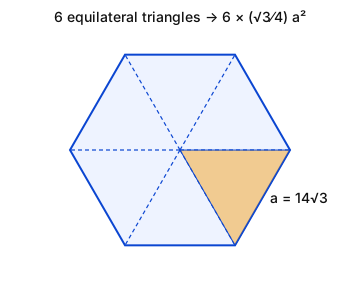
Find the area of a regular hexagon whose side measures 14√3 cm.
एक सम षट्भुज का क्षेत्रफल ज्ञात कीजिए जिसकी भुजा 14√3 cm है।
  1. A509√3 cm2
  2. B294√3 cm2
  3. C882√3 cm2
  4. D441√3 cm2
Show answer

Concept: A regular hexagon is six equilateral triangles: Area =6×34a2=332a2.

  1. a=143 ⇒ a2=196×3=588.
  2. Area =332×588=33×294=8823cm2.

Trick: With side k3, area =332×3k2=932k2; here k=14 ⇒ 9×19623=8823.

Answer: (C) 8823cm2

अवधारणा: सम षट्भुज छह समबाहु त्रिभुजों से बनता है: क्षेत्रफल =6×34a2=332a2।

  1. a=143 ⇒ a2=196×3=588।
  2. क्षेत्रफल =332×588=33×294=8823cm2।

ट्रिक: भुजा k3 हो तो क्षेत्रफल =332×3k2=932k2; यहाँ k=14 ⇒ 9×19623=8823।

उत्तर: (C) 8823cm2

RRB NTPC Graduate CBT 1MathematicsArea of a regular hexagonRRB NTPC Graduate CBT 1 2025 · 16 Mar Shift 1 →
Q2358.
By selling an article at 615 of its actual selling price, Hitesh incurs a loss of 28%. If he sells it at 89% of its actual selling price, then the profit percentage is
किसी वस्तु को उसके वास्तविक विक्रय मूल्य के 615 पर बेचने से हितेश को 28% की हानि होती है। यदि वह उसे वास्तविक विक्रय मूल्य के 89% पर बेचता है, तो लाभ प्रतिशत है
  1. A59.2%
  2. B60.5%
  3. C60.2%
  4. D60.7%
Show answer

Concept: Express the actual selling price in terms of the cost price using the loss condition, then apply the new fraction.

  1. 615×SP=72% of CP ⇒ SP=0.72×156CP=1.8CP.
  2. New price =89% of SP=0.89×1.8CP=1.602CP.
  3. Profit =60.2%.

Trick: Take CP=100: 25SP=72 ⇒ SP=180; 89% of 180=160.2 ⇒ profit 60.2%.

Answer: (C) 60.2%

अवधारणा: हानि की शर्त से वास्तविक विक्रय मूल्य को क्रय मूल्य में व्यक्त कीजिए, फिर नया भिन्न लगाइए।

  1. 615×SP=CP का 72% ⇒ SP=0.72×156CP=1.8CP।
  2. नया मूल्य =SP का 89%=0.89×1.8CP=1.602CP।
  3. लाभ =60.2%।

ट्रिक: CP=100 लें: 25SP=72 ⇒ SP=180; 180 का 89%=160.2 ⇒ लाभ 60.2%।

उत्तर: (C) 60.2%

RRB NTPC Graduate CBT 1MathematicsProfit and lossRRB NTPC Graduate CBT 1 2025 · 16 Mar Shift 1 →
Q2359.
If both the roots of the quadratic equation A(8x2 + 4) + Bx + 4x2 − 8 = 0 and 3A(2x2 + 1) + Kx + 3x2 − 6 = 0 are common, then what is the value of 9B2 − 16K2?
यदि द्विघात समीकरणों A(8x2 + 4) + Bx + 4x2 − 8 = 0 और 3A(2x2 + 1) + Kx + 3x2 − 6 = 0 के दोनों मूल उभयनिष्ठ हैं, तो 9B2 − 16K2 का मान क्या है?
  1. A−1
  2. B1
  3. C2
  4. D0
Show answer

Concept: If two quadratics have both roots common, their coefficients are proportional: a1a2=b1b2=c1c2.

  1. First: (8A+4)x2+Bx+(4A−8)=0. Second: (6A+3)x2+Kx+(3A−6)=0.
  2. 8A+46A+3=4(2A+1)3(2A+1)=43 and 4A−83A−6=43 ⇒ so BK=43 ⇒ 3B=4K.
  3. 9B2=16K2 ⇒ 9B2−16K2=0.

Trick: The second equation is just 34 of the first in x2 and constant terms – so K must be 34B; square both sides and the answer is 0.

Answer: (D) 0

अवधारणा: यदि दो द्विघात समीकरणों के दोनों मूल उभयनिष्ठ हों तो गुणांक समानुपाती होते हैं: a1a2=b1b2=c1c2।

  1. पहला: (8A+4)x2+Bx+(4A−8)=0। दूसरा: (6A+3)x2+Kx+(3A−6)=0।
  2. 8A+46A+3=4(2A+1)3(2A+1)=43 और 4A−83A−6=43 ⇒ अतः BK=43 ⇒ 3B=4K।
  3. 9B2=16K2 ⇒ 9B2−16K2=0।

ट्रिक: दूसरा समीकरण x2 और अचर पदों में पहले का ठीक 34 है – अतः K=34B होना चाहिए; दोनों पक्षों का वर्ग कीजिए, उत्तर 0।

उत्तर: (D) 0

RRB NTPC Graduate CBT 1MathematicsQuadratic equations – common rootsRRB NTPC Graduate CBT 1 2025 · 16 Mar Shift 1 →
Q2360.
If a:b=2:3, then (7a3−2b3):(b3−a3)=
यदि a:b=2:3 है, तो (7a3−2b3):(b3−a3)=
  1. A2 : 19
  2. B3 : 11
  3. C13 : 6
  4. D3 : 14
Show answer

Concept: When only a ratio is given, put the simplest values (a=2, b=3) directly into the expression.

  1. 7a3−2b3=7×8−2×27=56−54=2
  2. b3−a3=27−8=19
  3. Required ratio =2:19

Trick: Ratio questions never need variables — plug the ratio numbers and compute.

Answer: (A) 2:19

अवधारणा: जब केवल अनुपात दिया हो, तो सीधे सरलतम मान (a=2, b=3) रखकर हल करें।

  1. 7a3−2b3=7×8−2×27=56−54=2
  2. b3−a3=27−8=19
  3. अभीष्ट अनुपात =2:19

ट्रिक: अनुपात वाले प्रश्नों में चर की ज़रूरत नहीं — अनुपात की संख्याएँ रखकर गणना करें।

उत्तर: (A) 2:19

RRB NTPC Graduate CBT 1MathematicsRatio – substitutionRRB NTPC Graduate CBT 1 2025 · 16 Mar Shift 1 →