Question bank

Q&A: practice questions with answers

Search questions on any topic. Filter by exam category, exam, subject and topic, try the question, then open the answer and explanation.

Courses – airGurukul

2,400 questions found.

Q2361.
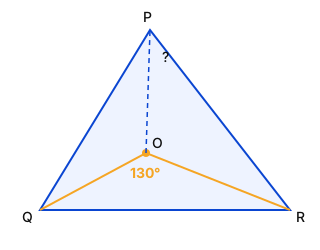
In a triangle PQR, ∠QOR = 130°, where O is the in-centre of triangle PQR. The measure of ∠QPR is:
एक त्रिभुज PQR में, ∠QOR = 130° है, जहाँ O त्रिभुज PQR का अंतःकेंद्र है। ∠QPR का माप है:
  1. A70°
  2. B80°
  3. C60°
  4. D50°
Show answer

Concept: For in-centre O of triangle PQR, ∠QOR=90∘+∠P2.

  1. 130∘=90∘+∠P2
  2. ∠P2=40∘⇒∠QPR=80∘

Yaad rakhein: In-centre: 90∘+A2; Circumcentre: 2A; Orthocentre: 180∘−A.

Answer: (B) 80∘

अवधारणा: त्रिभुज PQR के अंतःकेंद्र (in-centre) O के लिए ∠QOR=90∘+∠P2।

  1. 130∘=90∘+∠P2
  2. ∠P2=40∘⇒∠QPR=80∘

याद रखें: अंतःकेंद्र: 90∘+A2; परिकेंद्र: 2A; लंबकेंद्र: 180∘−A।

उत्तर: (B) 80∘

RRB NTPC Graduate CBT 1MathematicsGeometry – in-centre angleRRB NTPC Graduate CBT 1 2025 · 16 Mar Shift 1 →
Q2362.
Three printing machines, P, Q and R, when each is working alone, can print one lakh books in, respectively, 8 hours, 16 hours and 24 hours. These machines print books in turns of one hour each, starting with P, followed by Q and then by R. However, after a total of 9 hours, P stops functioning, but Q and R continue working alternately for an hour each, with Q working during the 10th hour, till the printing of all the one lakh books is completed. In how many hours in all did machines Q and R complete printing the remaining books?
तीन प्रिंटिंग मशीनें P, Q और R, जब प्रत्येक अकेले काम करती है, एक लाख पुस्तकें क्रमशः 8 घंटे, 16 घंटे और 24 घंटे में छाप सकती हैं। ये मशीनें P से शुरू करके, उसके बाद Q और फिर R, एक-एक घंटे की बारी से पुस्तकें छापती हैं। किंतु, कुल 9 घंटे बाद P काम करना बंद कर देती है, परंतु Q और R एक-एक घंटे बारी-बारी से काम करती रहती हैं, जिसमें 10वें घंटे में Q काम करती है, जब तक कि सभी एक लाख पुस्तकों की छपाई पूरी नहीं हो जाती। मशीनों Q और R ने शेष पुस्तकों की छपाई कुल कितने घंटों में पूरी की?
  1. A9
  2. B6
  3. C12
  4. D15
Show answer

Concept: Take total work =LCM(8,16,24)=48 units; P, Q, R do 6,3,2 units/hour.

  1. One P-Q-R round (3 h) =6+3+2=11 units; 9 h = 3 rounds =33 units.
  2. Remaining =48−33=15 units.
  3. Now Q and R alternate: every 2 h they do 3+2=5 units ⇒15 units in 155×2=6 h (Q–R–Q–R–Q–R exactly).

Trick: In alternate-work problems, first find work per full cycle, then handle the leftover cycle by cycle.

Answer: (B) 6

अवधारणा: कुल कार्य =LCM(8,16,24)=48 इकाई; P, Q, R प्रति घंटे 6,3,2 इकाई करते हैं।

  1. एक P-Q-R चक्र (3 घंटे) =6+3+2=11 इकाई; 9 घंटे = 3 चक्र =33 इकाई।
  2. शेष =48−33=15 इकाई।
  3. अब Q और R बारी-बारी: हर 2 घंटे में 3+2=5 इकाई ⇒15 इकाई 155×2=6 घंटे में (Q–R–Q–R–Q–R ठीक पूरा)।

ट्रिक: बारी-बारी कार्य में पहले एक पूरे चक्र का कार्य निकालें, फिर बचा हुआ कार्य चक्र-दर-चक्र देखें।

उत्तर: (B) 6

RRB NTPC Graduate CBT 1MathematicsTime & Work – alternate workingRRB NTPC Graduate CBT 1 2025 · 16 Mar Shift 1 →
Q2363.
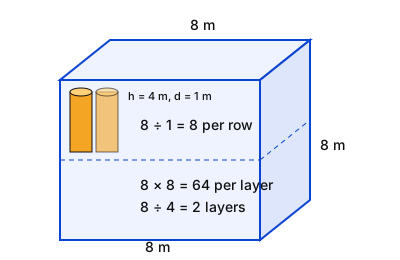
There is a wooden block in the form of a cube whose each side is 8 metres long. The maximum possible number of cylinders with a diameter of 1 metre and a height of 4 metres were cut from this block. The cylinders are to be painted at the rate of ₹14 per square metre.
What is the total amount (in ₹) needed to paint all the cylinders if we paint the entire surface of each cylinder? (Take π=227)
एक घन के आकार का लकड़ी का एक ब्लॉक है जिसकी प्रत्येक भुजा 8 मीटर लंबी है। इस ब्लॉक से 1 मीटर व्यास और 4 मीटर ऊँचाई वाले अधिकतम संभव संख्या में बेलन काटे गए। बेलनों को ₹14 प्रति वर्ग मीटर की दर से रंगा जाना है।
यदि हम प्रत्येक बेलन की संपूर्ण सतह को रंगते हैं, तो सभी बेलनों को रंगने के लिए आवश्यक कुल राशि (₹ में) क्या है? (π=227 लीजिए)
  1. A24,527
  2. B23,455
  3. C25,344
  4. D24,325
Show answer

Concept: Cylinders are cut whole, so count how many fit along each edge; then TSA of cylinder =2πr(r+h).

  1. Base 8×8 m, diameter 1 m ⇒8×8=64 cylinders per layer; height 8÷4=2 layers ⇒128 cylinders.
  2. TSA of one cylinder =2×227×12×(12+4)=227×92=997m2
  3. Total area =128×997; cost =128×997×14=128×198=25344

Trick: Keep 997 unsimplified — the rate ₹14 cancels the 7 neatly.

Answer: (C) ₹25,344

अवधारणा: बेलन पूरे-पूरे काटे जाते हैं, इसलिए हर किनारे पर कितने समाते हैं गिनें; फिर बेलन का कुल पृष्ठ =2πr(r+h)।

  1. आधार 8×8 m, व्यास 1 m ⇒8×8=64 बेलन प्रति परत; ऊँचाई 8÷4=2 परतें ⇒128 बेलन।
  2. एक बेलन का कुल पृष्ठ =2×227×12×(12+4)=227×92=997m2
  3. कुल क्षेत्रफल =128×997; लागत =128×997×14=128×198=25344

ट्रिक: 997 को सरल न करें — ₹14 की दर 7 को सीधे काट देती है।

उत्तर: (C) ₹25,344

RRB NTPC Graduate CBT 1MathematicsMensuration – cylinders from a cubeRRB NTPC Graduate CBT 1 2025 · 16 Mar Shift 1 →
Q2364.
The sum of two numbers is 56. Their difference is 17 of their sum. Their LCM is:
दो संख्याओं का योग 56 है। उनका अंतर उनके योग का 17 है। उनका LCM है:
  1. A96
  2. B63
  3. C72
  4. D84
Show answer

Concept: Find the two numbers from sum and difference, then their LCM.

  1. Difference =17×56=8
  2. Numbers =56+82=32 and 56−82=24
  3. LCM(32,24)=96

Trick: Numbers =S+D2 and S−D2; LCM =32×24HCF 8=96.

Answer: (A) 96

अवधारणा: योग और अंतर से दोनों संख्याएँ निकालें, फिर उनका LCM।

  1. अंतर =17×56=8
  2. संख्याएँ =56+82=32 और 56−82=24
  3. LCM(32,24)=96

ट्रिक: संख्याएँ =S+D2 और S−D2; LCM =32×24HCF 8=96।

उत्तर: (A) 96

RRB NTPC Graduate CBT 1MathematicsLCM of two numbersRRB NTPC Graduate CBT 1 2025 · 16 Mar Shift 1 →
Q2365.
685932564×257×168=?
  1. A28
  2. B37
  3. C30
  4. D38
Show answer

Concept: Evaluate the roots first: 193=6859 and 44=256.

  1. 68593=19,2564=4
  2. 194×257×168=19×2×1684×57
  3. 57=19×3, so =2×1684×3=33612=28

Trick: Cube ending in 9 → root ends in 9; 193=6859 is worth memorising.

Answer: (A) 28

अवधारणा: पहले मूल निकालें: 193=6859 और 44=256।

  1. 68593=19,2564=4
  2. 194×257×168=19×2×1684×57
  3. 57=19×3, अतः =2×1684×3=33612=28

ट्रिक: 9 पर समाप्त घन → मूल भी 9 पर समाप्त; 193=6859 याद रखें।

उत्तर: (A) 28

RRB NTPC Graduate CBT 1MathematicsSimplification – rootsRRB NTPC Graduate CBT 1 2025 · 16 Mar Shift 1 →
Q2366.
At what rate (in percentage) per year will a sum of money double itself in 16 years on simple interest?
साधारण ब्याज पर कोई धनराशि 16 वर्षों में स्वयं की दोगुनी किस वार्षिक दर (प्रतिशत में) पर हो जाएगी?
  1. A4.25
  2. B12.5
  3. C8.25
  4. D6.25
Show answer

Concept: Money doubles on SI when interest = principal, i.e. R×T=100.

  1. R×16=100
  2. R=10016=6.25%

Trick: Double → RT=100; triple → RT=200; n times → RT=100(n−1).

Answer: (D) 6.25

अवधारणा: साधारण ब्याज पर धन तब दोगुना होता है जब ब्याज = मूलधन, अर्थात R×T=100।

  1. R×16=100
  2. R=10016=6.25%

ट्रिक: दोगुना → RT=100; तिगुना → RT=200; n गुना → RT=100(n−1)।

उत्तर: (D) 6.25

RRB NTPC Graduate CBT 1MathematicsSimple interest – doublingRRB NTPC Graduate CBT 1 2025 · 16 Mar Shift 1 →
Q2367.
There are 78 members in group A, 22 members in group B and 34 members in group C. All the members of these groups went to a restaurant. The average amounts spent on each member of groups A, B and C are ₹136, ₹383 and ₹457, respectively. The overall average amount (in ₹) spent per member is:
समूह A में 78 सदस्य, समूह B में 22 सदस्य और समूह C में 34 सदस्य हैं। इन समूहों के सभी सदस्य एक रेस्तरां में गए। समूह A, B और C के प्रत्येक सदस्य पर खर्च की गई औसत राशि क्रमशः ₹136, ₹383 और ₹457 है। प्रति सदस्य खर्च की गई समग्र औसत राशि (₹ में) है:
  1. A256
  2. B261
  3. C258
  4. D255
Show answer

Concept: Overall average =total amounttotal members.

  1. Total =78×136+22×383+34×457=10608+8426+15538=34572
  2. Members =78+22+34=134
  3. Average =34572134=258

Trick: Check divisibility: 134×258=34572 exactly, confirming the option.

Answer: (C) 258

अवधारणा: कुल औसत =कुल राशिकुल सदस्य।

  1. कुल =78×136+22×383+34×457=10608+8426+15538=34572
  2. सदस्य =78+22+34=134
  3. औसत =34572134=258

ट्रिक: जाँच: 134×258=34572 ठीक आता है, विकल्प पुष्ट।

उत्तर: (C) 258

RRB NTPC Graduate CBT 1MathematicsWeighted averageRRB NTPC Graduate CBT 1 2025 · 16 Mar Shift 1 →
Q2368.
P sells an item to Q at 50% profit. Q sells the same item to R at 60% loss. If R paid ₹ 3234 for the item, then at what price (in ₹) is the item purchased by P?
P एक वस्तु Q को 50% लाभ पर बेचता है। Q वही वस्तु R को 60% हानि पर बेचता है। यदि R ने वस्तु के लिए ₹ 3234 का भुगतान किया, तो P ने वह वस्तु किस मूल्य (₹ में) पर खरीदी?
  1. A5390
  2. B5387
  3. C5391
  4. D5393
Show answer

Concept: Work backwards from R's price: each step is a multiplier.

  1. Q's selling price (60% loss) =0.4× Q's cost =3234⇒ Q's cost =32340.4=8085
  2. P sold at 50% profit: 1.5× P's cost =8085⇒ P's cost =80851.5=5390

Trick: CPP=32341.5×0.4=32340.6=5390 in one step.

Answer: (A) ₹5390

अवधारणा: R के मूल्य से उल्टा चलें: हर चरण एक गुणक है।

  1. Q का विक्रय मूल्य (60% हानि) =0.4× Q का क्रय मूल्य =3234⇒ Q का क्रय मूल्य =32340.4=8085
  2. P ने 50% लाभ पर बेचा: 1.5× P का क्रय मूल्य =8085⇒ P का क्रय मूल्य =80851.5=5390

ट्रिक: एक ही चरण में CPP=32341.5×0.4=32340.6=5390।

उत्तर: (A) ₹5390

RRB NTPC Graduate CBT 1MathematicsSuccessive profit & lossRRB NTPC Graduate CBT 1 2025 · 16 Mar Shift 1 →
Q2369.
A dealer buys two articles X and Y for ₹500 each. He marks each of them at the same price. He sells X by giving two successive discounts of 50% and 28% and still earns ₹958 as profit. If he sells Y at a single discount of 77%, then what is the profit
percentage on Y?
एक व्यापारी दो वस्तुएँ X और Y प्रत्येक ₹500 में खरीदता है। वह दोनों पर समान मूल्य अंकित करता है। वह X को 50% और 28% की दो क्रमागत छूट देकर बेचता है और फिर भी ₹958 का लाभ अर्जित करता है। यदि वह Y को 77% की एकल छूट पर बेचता है, तो Y पर लाभ
प्रतिशत क्या है?
  1. A86.3%
  2. B86%
  3. C85%
  4. D85.3%
Show answer

Concept: Find the common marked price from article X, then apply the 77% discount to Y.

  1. SP of X =M×0.5×0.72=0.36M; profit 958 ⇒0.36M=500+958=1458⇒M=4050
  2. SP of Y =4050×0.23=931.5
  3. Profit on Y =431.5; %=431.5500×100=86.3%

Trick: Successive discounts 50% and 28% ≡ single discount 64% (pay 36%).

Answer: (A) 86.3%

अवधारणा: वस्तु X से उभयनिष्ठ अंकित मूल्य निकालें, फिर Y पर 77% छूट लगाएँ।

  1. X का SP =M×0.5×0.72=0.36M; लाभ 958 ⇒0.36M=500+958=1458⇒M=4050
  2. Y का SP =4050×0.23=931.5
  3. Y पर लाभ =431.5; %=431.5500×100=86.3%

ट्रिक: 50% और 28% की क्रमिक छूट ≡ एकल छूट 64% (36% चुकाना)।

उत्तर: (A) 86.3%

RRB NTPC Graduate CBT 1MathematicsDiscount & profitRRB NTPC Graduate CBT 1 2025 · 16 Mar Shift 1 →
Q2370.
Find the third proportional to the numbers 16 and 24.
संख्याओं 16 और 24 का तृतीयानुपाती ज्ञात कीजिए।
  1. A40
  2. B36
  3. C32
  4. D30
Show answer

Concept: Third proportional to a and b is c such that a:b=b:c⇒c=b2a.

  1. c=24216=57616=36

Yaad rakhein: Third proportional =b2a; mean proportional =ab; fourth proportional =bca.

Answer: (B) 36

अवधारणा: a और b का तृतीयानुपाती c है जहाँ a:b=b:c⇒c=b2a।

  1. c=24216=57616=36

याद रखें: तृतीयानुपाती =b2a; मध्यानुपाती =ab; चतुर्थानुपाती =bca।

उत्तर: (B) 36

RRB NTPC Graduate CBT 1MathematicsThird proportionalRRB NTPC Graduate CBT 1 2025 · 16 Mar Shift 1 →
Q2371.
What should come in place of the question mark (?) in the given series?
89 87 84 79 72 ?
दी गई श्रेणी में प्रश्नचिह्न (?) के स्थान पर क्या आना चाहिए?
89 87 84 79 72 ?
  1. A57
  2. B59
  3. C63
  4. D61
Show answer

Concept: Look at the differences between consecutive terms – here they form the prime numbers.

  1. 89−87=2, 87−84=3, 84−79=5, 79−72=7.
  2. Differences 2,3,5,7 are consecutive primes, so the next difference is 11.
  3. ?=72−11=61.

Trick: When differences are irregular (2, 3, 5, 7…), check primes first – it is the most common pattern in NTPC series.

Answer: (D) 61

अवधारणा: क्रमागत पदों के अंतर देखिए – यहाँ अंतर अभाज्य संख्याएँ (prime numbers) हैं।

  1. 89−87=2, 87−84=3, 84−79=5, 79−72=7।
  2. अंतर 2,3,5,7 क्रमागत अभाज्य हैं, अतः अगला अंतर 11 होगा।
  3. ?=72−11=61।

ट्रिक: जब अंतर अनियमित (2, 3, 5, 7…) दिखें तो सबसे पहले अभाज्य संख्याएँ जाँचिए – NTPC श्रृंखला में यह सबसे आम पैटर्न है।

उत्तर: (D) 61

RRB NTPC Graduate CBT 1General Intelligence and ReasoningNumber seriesRRB NTPC Graduate CBT 1 2025 · 16 Mar Shift 1 →
Q2372.
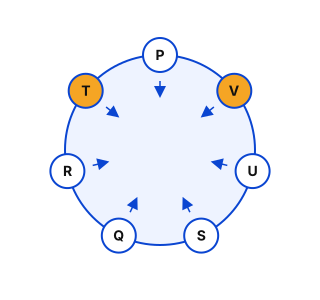
P, Q, R, S, T, U and V sit around a circular table facing the centre. Only one person sits between U and P when counted from the right of U. Only one person sits between P and R. Only one person sits between U and Q. Only two people sit between V and R. Only one person sits between T and Q. How many people sit between T and V when counted from the left of T?
P, Q, R, S, T, U और V एक गोल मेज़ के चारों ओर केंद्र की ओर मुख करके बैठे हैं। U के दाएँ से गिनने पर U और P के बीच केवल एक व्यक्ति बैठा है। P और R के बीच केवल एक व्यक्ति बैठा है। U और Q के बीच केवल एक व्यक्ति बैठा है। V और R के बीच केवल दो व्यक्ति बैठे हैं। T और Q के बीच केवल एक व्यक्ति बैठा है। T के बाएँ से गिनने पर T और V के बीच कितने व्यक्ति बैठे हैं?
  1. A3
  2. B2
  3. C4
  4. D1
Show answer

Concept: Facing the centre, "right" means anticlockwise and "left" means clockwise. Fix one person and place the rest.

  1. Fix P. One person between U and P from U's right ⇒ going clockwise from P: P, (V), U.
  2. One between P and R and two between V and R ⇒ R is 2nd anticlockwise from P. One between U and Q ⇒ Q is next to R.
  3. One between T and Q ⇒ T sits between R and P. S takes the last seat. Clockwise order: P, V, U, S, Q, R, T.
  4. From T's left (clockwise): T → P → V. Only one person (P) sits between T and V.

Trick: Always draw the circle and mark "left = clockwise, right = anticlockwise" at the top before reading the clues.

Answer: (D) 1

अवधारणा: केंद्र की ओर मुख होने पर "दाएँ" = वामावर्त (anticlockwise) और "बाएँ" = दक्षिणावर्त (clockwise)। एक व्यक्ति को स्थिर करके बाकी बैठाइए।

  1. P को स्थिर करें। U के दाएँ से U और P के बीच एक व्यक्ति ⇒ P से दक्षिणावर्त: P, (V), U।
  2. P और R के बीच एक तथा V और R के बीच दो ⇒ R, P से वामावर्त दूसरे स्थान पर। U और Q के बीच एक ⇒ Q, R के बगल में।
  3. T और Q के बीच एक ⇒ T, R और P के बीच बैठा है। S अंतिम सीट पर। दक्षिणावर्त क्रम: P, V, U, S, Q, R, T।
  4. T के बाएँ (दक्षिणावर्त) से: T → P → V। T और V के बीच केवल एक व्यक्ति (P)।

ट्रिक: सूत्र पढ़ने से पहले वृत्त बनाकर ऊपर लिख लें: "बाएँ = clockwise, दाएँ = anticlockwise"।

उत्तर: (D) 1

RRB NTPC Graduate CBT 1General Intelligence and ReasoningCircular seating arrangementRRB NTPC Graduate CBT 1 2025 · 16 Mar Shift 1 →
Q2373.
Which of the following letter-number clusters will replace the question mark “?” in the given series to make it logically complete?
VPG 7, ZTK 11, DXO 15, HBS 19, ?
निम्नलिखित में से कौन-सा अक्षर-संख्या समूह दी गई श्रेणी में प्रश्नचिह्न “?” के स्थान पर आकर उसे तार्किक रूप से पूर्ण करेगा?
VPG 7, ZTK 11, DXO 15, HBS 19, ?
  1. ALEU 23
  2. BMGX 23
  3. CLGY 24
  4. DLFW 23
Show answer

Concept: Check each letter position and the number separately.

  1. 1st letters V, Z, D, H: +4 each ⇒ next L. 2nd letters P, T, X, B: +4 ⇒ F. 3rd letters G, K, O, S: +4 ⇒ W.
  2. Numbers 7,11,15,19: +4 ⇒ 23.
  3. Required cluster: LFW 23.

Trick: Write A=1 … Z=26 once on the rough sheet; +4 with wrap-around (Z → D) becomes instant.

Answer: (D) LFW 23

अवधारणा: हर अक्षर-स्थान और संख्या को अलग-अलग जाँचिए।

  1. पहले अक्षर V, Z, D, H: हर बार +4 ⇒ अगला L। दूसरे अक्षर P, T, X, B: +4 ⇒ F। तीसरे अक्षर G, K, O, S: +4 ⇒ W।
  2. संख्याएँ 7,11,15,19: +4 ⇒ 23।
  3. अभीष्ट समूह: LFW 23।

ट्रिक: रफ शीट पर A=1 … Z=26 एक बार लिख लें; +4 (Z → D जैसी घुमाव सहित) तुरंत हो जाता है।

उत्तर: (D) LFW 23

RRB NTPC Graduate CBT 1General Intelligence and ReasoningLetter-number seriesRRB NTPC Graduate CBT 1 2025 · 16 Mar Shift 1 →
Q2374.
EGDH is related to FIFI in a certain way based on the English alphabetical order. In the same way, JMHL is related to KOJM. To which of the following is NPRS related, following the same logic?
अंग्रेज़ी वर्णमाला क्रम के आधार पर EGDH एक निश्चित प्रकार से FIFI से संबंधित है। उसी प्रकार, JMHL, KOJM से संबंधित है। उसी तर्क का अनुसरण करते हुए, NPRS निम्नलिखित में से किससे संबंधित है?
  1. AORTT
  2. BORST
  3. COSST
  4. DOOPT
Show answer

Concept: Find the position-wise shift from the first word to the second and apply the same shift.

  1. EGDH → FIFI: E+1=F, G+2=I, D+2=F, H+1=I. Pattern +1,+2,+2,+1.
  2. Check: JMHL → K, O, J, M = KOJM ✓.
  3. NPRS: N+1=O, P+2=R, R+2=T, S+1=T ⇒ ORTT.

Trick: Verify the pattern on the second given pair before applying – it rules out wrong guesses in seconds.

Answer: (A) ORTT

अवधारणा: पहले शब्द से दूसरे शब्द तक स्थान-वार बदलाव निकालिए और वही बदलाव लागू कीजिए।

  1. EGDH → FIFI: E+1=F, G+2=I, D+2=F, H+1=I। पैटर्न +1,+2,+2,+1।
  2. जाँच: JMHL → K, O, J, M = KOJM ✓।
  3. NPRS: N+1=O, P+2=R, R+2=T, S+1=T ⇒ ORTT।

ट्रिक: पैटर्न लागू करने से पहले दिए गए दूसरे जोड़े पर उसकी पुष्टि कर लें – गलत अनुमान सेकंडों में कट जाता है।

उत्तर: (A) ORTT

RRB NTPC Graduate CBT 1General Intelligence and ReasoningLetter analogyRRB NTPC Graduate CBT 1 2025 · 16 Mar Shift 1 →
Q2375.
Each of P, Q, R, S, T, U and V has an exam on a different day of a week starting from Monday and ending on Sunday of the same week.
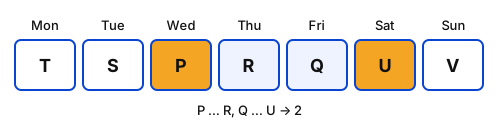
Only five people have exams between V and T. Only two people have exams between R and T. Q has the exam immediately after R. S has the exam immediately before P but after T.
How many people have exams between P and U?
P, Q, R, S, T, U और V में से प्रत्येक की परीक्षा एक ही सप्ताह के सोमवार से शुरू होकर रविवार को समाप्त होने वाले अलग-अलग दिन है।
V और T के बीच केवल पाँच लोगों की परीक्षा है। R और T के बीच केवल दो लोगों की परीक्षा है। Q की परीक्षा R के ठीक बाद है। S की परीक्षा P के ठीक पहले परंतु T के बाद है।
P और U के बीच कितने लोगों की परीक्षा है?
  1. AOneएक
  2. BTwoदो
  3. CThreeतीन
  4. DFourचार
Show answer

Concept: Seven days, seven people – start with the most restrictive clue.

  1. Five people between V and T ⇒ they occupy Monday and Sunday. S is after T, so T = Monday, V = Sunday.
  2. Two between R and T ⇒ R = Thursday; Q immediately after R ⇒ Q = Friday.
  3. S immediately before P and after T ⇒ S = Tuesday, P = Wednesday; U gets Saturday.
  4. Between P (Wed) and U (Sat): R and Q ⇒ two people.

Trick: "Five between two people" in a 7-slot row always means the two ends – place them first.

Answer: (B) Two

अवधारणा: सात दिन, सात व्यक्ति – सबसे कड़े सूत्र से शुरू कीजिए।

  1. V और T के बीच पाँच व्यक्ति ⇒ वे सोमवार और रविवार पर हैं। S, T के बाद है, अतः T = सोमवार, V = रविवार।
  2. R और T के बीच दो ⇒ R = गुरुवार; Q ठीक R के बाद ⇒ Q = शुक्रवार।
  3. S ठीक P से पहले और T के बाद ⇒ S = मंगलवार, P = बुधवार; U को शनिवार।
  4. P (बुध) और U (शनि) के बीच: R और Q ⇒ दो व्यक्ति।

ट्रिक: 7 स्थानों की पंक्ति में "दो के बीच पाँच" का मतलब हमेशा दोनों सिरे – उन्हें पहले रखिए।

उत्तर: (B) दो (Two)

RRB NTPC Graduate CBT 1General Intelligence and ReasoningLinear arrangement (days)RRB NTPC Graduate CBT 1 2025 · 16 Mar Shift 1 →
Q2376.
Refer to the following number and symbol series and answer the question that follows. Counting to be done from left to right only. All numbers are single-digit numbers only. (Left) © 3 @ 8 5 1 £ 1 6 1 5 7 2 8 # € £ © € © 1 3 (Right)
How many such numbers are there each of which is immediately preceded by a symbol and also immediately followed by a symbol?
निम्नलिखित संख्या और प्रतीक श्रेणी को देखिए और उसके बाद दिए गए प्रश्न का उत्तर दीजिए। गिनती केवल बाएँ से दाएँ की जानी है। सभी संख्याएँ केवल एक-अंकीय संख्याएँ हैं। (बाएँ) © 3 @ 8 5 1 £ 1 6 1 5 7 2 8 # € £ © € © 1 3 (दाएँ)
ऐसी कितनी संख्याएँ हैं जिनमें से प्रत्येक के ठीक पहले एक प्रतीक है और ठीक बाद भी एक प्रतीक है?
  1. A1
  2. B0
  3. C2
  4. D3
Show answer

Concept: Scan the series once, checking each number's left and right neighbours.

  1. Series: © 3 @ 8 5 1 £ 1 6 1 5 7 2 8 # € £ © € © 1 3.
  2. Numbers with a symbol on both sides: "© 3 @" ✓. The 8 before # has 2 on its left; the 1 after © has 3 on its right; the 1 after £ has 6 on its right – all fail.
  3. Count =1.

Trick: Underline every symbol first; then look only for a lone number sandwiched between two underlined marks.

Answer: (A) 1

अवधारणा: श्रृंखला को एक बार पढ़ते हुए हर संख्या के बाएँ और दाएँ पड़ोसी जाँचिए।

  1. श्रृंखला: © 3 @ 8 5 1 £ 1 6 1 5 7 2 8 # € £ © € © 1 3।
  2. दोनों ओर प्रतीक वाली संख्या: "© 3 @" ✓। # से पहले वाले 8 के बाएँ 2 है; © के बाद वाले 1 के दाएँ 3 है; £ के बाद वाले 1 के दाएँ 6 है – सब असफल।
  3. गिनती =1।

ट्रिक: पहले हर प्रतीक को रेखांकित कीजिए; फिर सिर्फ वह अकेली संख्या खोजिए जो दो रेखांकित चिह्नों के बीच फँसी हो।

उत्तर: (A) 1

RRB NTPC Graduate CBT 1General Intelligence and ReasoningNumber-symbol seriesRRB NTPC Graduate CBT 1 2025 · 16 Mar Shift 1 →
Q2377.
Which of the given letter-number clusters will replace the question mark (?) in the following series to make it logically complete?
FZN 4 XRF 6 PJX 9 HBP 13 ?
दिए गए अक्षर-संख्या समूहों में से कौन-सा निम्नलिखित श्रेणी में प्रश्नचिह्न (?) के स्थान पर आकर उसे तार्किक रूप से पूर्ण करेगा?
FZN 4 XRF 6 PJX 9 HBP 13 ?
  1. AZKW 21
  2. BLFR 17
  3. CZTH 18
  4. DXHD 19
Show answer

Concept: Letters and numbers follow separate rules – check both.

  1. Letters: F→X→P→H each is −8 (F=6, X=24, P=16, H=8). Similarly Z→R→J→B (−8) and N→F→X→P (−8).
  2. Next: H−8=Z, B−8=T, P−8=H ⇒ ZTH.
  3. Numbers 4,6,9,13: differences 2,3,4 ⇒ next +5 ⇒ 18.

Trick: A drop of 8 is the same as +18; whichever is easier with wrap-around (Z = 0 or 26).

Answer: (C) ZTH 18

अवधारणा: अक्षर और संख्याएँ अलग-अलग नियम पर चलते हैं – दोनों जाँचिए।

  1. अक्षर: F→X→P→H हर बार −8 (F=6, X=24, P=16, H=8)। इसी तरह Z→R→J→B (−8) और N→F→X→P (−8)।
  2. अगला: H−8=Z, B−8=T, P−8=H ⇒ ZTH।
  3. संख्याएँ 4,6,9,13: अंतर 2,3,4 ⇒ अगला +5 ⇒ 18।

ट्रिक: −8 और +18 एक ही बात है; घुमाव (Z = 0 या 26) में जो आसान लगे वही लीजिए।

उत्तर: (C) ZTH 18

RRB NTPC Graduate CBT 1General Intelligence and ReasoningLetter-number seriesRRB NTPC Graduate CBT 1 2025 · 16 Mar Shift 1 →
Q2378.
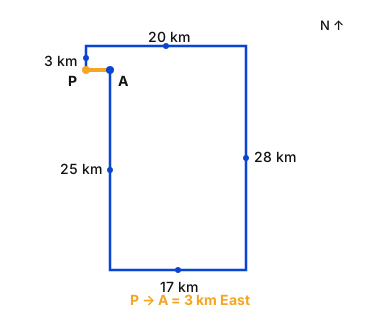
Manoj starts from Point A and drives 25 km towards South. He then takes a left turn, drives 17 km, turns left and drives 28 km. He then takes a left turn and drives 20 km. He takes a final left turn, drives 3 km and stops at Point P. How far (shortest distance) and towards which direction should he drive in order to reach Point A again? (All turns are 90 degrees turns only unless specified)
मनोज बिंदु A से शुरू करता है और दक्षिण की ओर 25 km गाड़ी चलाता है। फिर वह बाएँ मुड़ता है, 17 km चलता है, बाएँ मुड़ता है और 28 km चलता है। फिर वह बाएँ मुड़ता है और 20 km चलता है। वह अंतिम बार बाएँ मुड़ता है, 3 km चलता है और बिंदु P पर रुक जाता है। बिंदु A पर पुनः पहुँचने के लिए उसे कितनी दूर (न्यूनतम दूरी) और किस दिशा में गाड़ी चलानी चाहिए? (जब तक अन्यथा न कहा जाए, सभी मोड़ केवल 90 डिग्री के मोड़ हैं)
  1. A2 km to the west2 km पश्चिम की ओर
  2. B2 km to the east2 km पूर्व की ओर
  3. C3 km to the west3 km पश्चिम की ओर
  4. D3 km to the east3 km पूर्व की ओर
Show answer

Concept: Track the position on a grid; a left turn while facing South means facing East, and so on.

  1. A → 25 km South; left ⇒ East 17 km; left ⇒ North 28 km (now 3 km north of A's level, 17 km east).
  2. Left ⇒ West 20 km (now 3 km west of A); left ⇒ South 3 km ⇒ P is exactly 3 km due West of A.
  3. To return he must drive 3 km towards East.

Trick: Net North–South: −25+28−3=0; net East–West: +17−20=−3 (west). Net values give the answer without the full diagram.

Answer: (D) 3 km to the east

अवधारणा: ग्रिड पर स्थिति ट्रैक कीजिए; दक्षिण की ओर मुख करके बायाँ मोड़ = पूर्व, इसी तरह आगे।

  1. A → 25 km दक्षिण; बाएँ ⇒ पूर्व 17 km; बाएँ ⇒ उत्तर 28 km (अब A के स्तर से 3 km उत्तर, 17 km पूर्व)।
  2. बाएँ ⇒ पश्चिम 20 km (अब A से 3 km पश्चिम); बाएँ ⇒ दक्षिण 3 km ⇒ P, A से ठीक 3 km पश्चिम में।
  3. लौटने के लिए उसे 3 km पूर्व की ओर चलना होगा।

ट्रिक: शुद्ध उत्तर–दक्षिण: −25+28−3=0; शुद्ध पूर्व–पश्चिम: +17−20=−3 (पश्चिम)। शुद्ध मान बिना पूरे चित्र के उत्तर दे देते हैं।

उत्तर: (D) 3 km पूर्व की ओर

RRB NTPC Graduate CBT 1General Intelligence and ReasoningDirection and distanceRRB NTPC Graduate CBT 1 2025 · 16 Mar Shift 1 →
Q2379.
In a certain code language,
A + B means ‘A is the mother of B’
A - B means ‘A is the wife of B’
A × B means ‘A is the sister of B’
A ÷ B means ‘A is the father of B’
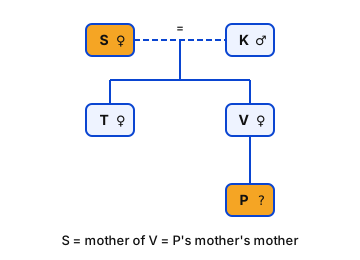
Based on the above, how is S related to P if ‘S - K ÷ T × V + P’?
एक निश्चित कूट भाषा में,
A + B का अर्थ है ‘A, B की माता है’
A - B का अर्थ है ‘A, B की पत्नी है’
A × B का अर्थ है ‘A, B की बहन है’
A ÷ B का अर्थ है ‘A, B का पिता है’
उपर्युक्त के आधार पर, यदि ‘S - K ÷ T × V + P’ है, तो S, P से किस प्रकार संबंधित है?
  1. AMother’s sisterमाता की बहन
  2. BFather’s motherपिता की माता
  3. CFather’s sisterपिता की बहन
  4. DMother’s motherमाता की माता
Show answer

Concept: Decode from the right end (P) backwards and draw the family tree.

  1. V + P: V is P's mother. T × V: T is V's sister. K ÷ T: K is father of T (hence of V too).
  2. S − K: S is K's wife ⇒ S is the mother of V.
  3. V is P's mother, so S is P's mother's mother.

Trick: In a long chain, the person next to P decides the final link (here V = mother); everyone else just tells you which side of the family.

Answer: (D) Mother's mother

अवधारणा: दाएँ सिरे (P) से पीछे की ओर डिकोड करके वंश-वृक्ष बनाइए।

  1. V + P: V, P की माँ। T × V: T, V की बहन। K ÷ T: K, T का पिता (अतः V का भी)।
  2. S − K: S, K की पत्नी ⇒ S, V की माँ।
  3. V, P की माँ है, अतः S, P की माँ की माँ (नानी) है।

ट्रिक: लंबी शृंखला में P के ठीक बगल वाला व्यक्ति अंतिम रिश्ता तय करता है (यहाँ V = माँ); बाकी सब सिर्फ यह बताते हैं कि परिवार का कौन-सा पक्ष है।

उत्तर: (D) माँ की माँ (Mother's mother)

RRB NTPC Graduate CBT 1General Intelligence and ReasoningBlood relations (coded)RRB NTPC Graduate CBT 1 2025 · 16 Mar Shift 1 →
Q2380.
In a certain code language, ‘BELI’ is coded as ‘6315’ and ‘EVIL’ is coded as ‘9653’. What is the code for ‘V’ in the given code language?
एक निश्चित कूट भाषा में, ‘BELI’ को ‘6315’ के रूप में कूटबद्ध किया जाता है और ‘EVIL’ को ‘9653’ के रूप में कूटबद्ध किया जाता है। दी गई कूट भाषा में ‘V’ का कूट क्या है?
  1. A6
  2. B3
  3. C9
  4. D7
Show answer

Concept: Compare the two words: letters common to both must share the common digits.

  1. BELI → 6 3 1 5 and EVIL → 9 6 5 3. Common letters: E, L, I. Common digits: 6, 3, 5.
  2. The leftover letter in BELI is B ⇒ code 1; the leftover letter in EVIL is V ⇒ code 9.

Trick: Do not try to match positions – just cancel the common letters and common digits; what remains pairs up.

Answer: (C) 9

अवधारणा: दोनों शब्दों की तुलना कीजिए: दोनों में साझा अक्षरों के कोड भी साझा अंक होंगे।

  1. BELI → 6 3 1 5 और EVIL → 9 6 5 3। साझा अक्षर: E, L, I। साझा अंक: 6, 3, 5।
  2. BELI में बचा अक्षर B ⇒ कोड 1; EVIL में बचा अक्षर V ⇒ कोड 9।

ट्रिक: स्थान मिलाने की कोशिश न करें – साझा अक्षर और साझा अंक काट दीजिए; जो बचे वही जोड़ी है।

उत्तर: (C) 9

RRB NTPC Graduate CBT 1General Intelligence and ReasoningCoding-decodingRRB NTPC Graduate CBT 1 2025 · 16 Mar Shift 1 →