Question bank

Q&A: practice questions with answers

Search questions on any topic. Filter by exam category, exam, subject and topic, try the question, then open the answer and explanation.

Courses – airGurukul

7,100 questions found.

Q2461.
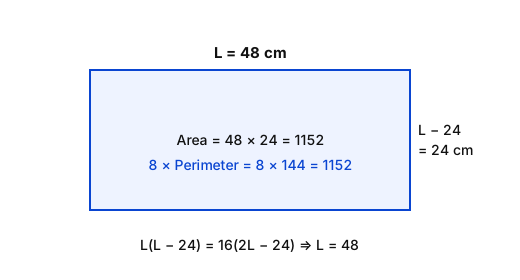
The shorter side of a rectangle is 24 cm less than the longer side. The numerical value of its area is equal to 8 times the numerical value of its perimeter. What is the length (in cm) of its longer side?
एक आयत की छोटी भुजा, बड़ी भुजा से 24 cm कम है। इसके क्षेत्रफल का संख्यात्मक मान इसके परिमाप के संख्यात्मक मान के 8 गुना के बराबर है। इसकी बड़ी भुजा की लंबाई (cm में) कितनी है?
  1. A57
  2. B48
  3. C52
  4. D54
Show answer

Concept: Area =l×b, Perimeter =2(l+b).

  1. Let longer side =L, shorter =L−24.
  2. L(L−24)=8×2(2L−24)=32L−384
  3. L2−56L+384=0⇒(L−48)(L−8)=0
  4. L=8 gives a negative side, so L=48cm.

Trick: Check options: 48×24=1152 and 8×2(48+24)=1152 ✓.

Answer: (B) 48

अवधारणा: क्षेत्रफल =l×b, परिमाप =2(l+b).

  1. लंबी भुजा =L, छोटी =L−24.
  2. L(L−24)=8×2(2L−24)=32L−384
  3. L2−56L+384=0⇒(L−48)(L−8)=0
  4. L=8 से छोटी भुजा ऋणात्मक, अतः L=48cm.

ट्रिक: विकल्प जाँचें: 48×24=1152 और 8×2(48+24)=1152 ✓.

उत्तर: (B) 48

RRB NTPC Graduate CBT 1MathematicsMensuration – RectangleRRB NTPC Graduate CBT 1 2024 · 14 Jun Shift 2 →
Q2462.
A water tank can be filled in 38 minutes by using 44 pipes of the same capacity. In how many minutes (rounded off to two decimal places) will the water tank be filled if we use 37 pipes of the same capacity as above?
समान क्षमता वाले 44 पाइपों का उपयोग करके एक पानी की टंकी को 38 मिनट में भरा जा सकता है। यदि उपरोक्त के समान क्षमता वाले 37 पाइपों का उपयोग किया जाए, तो पानी की टंकी कितने मिनट (दो दशमलव स्थानों तक पूर्णांकित) में भरेगी?
  1. A49.75
  2. B39.05
  3. C43.91
  4. D45.19
Show answer

Concept: Work is fixed, so pipes × time is constant: N1T1=N2T2.

  1. 44×38=37×T
  2. T=167237=45.189…
  3. T≈45.19 minutes

Trick: Fewer pipes ⇒ more time; answer must be a little more than 38 — only 43.91, 45.19, 49.75 qualify; 4437×38 gives 45.19.

Answer: (D) 45.19

अवधारणा: कार्य स्थिर है, अतः पाइप × समय स्थिर: N1T1=N2T2.

  1. 44×38=37×T
  2. T=167237=45.189…
  3. T≈45.19 मिनट

ट्रिक: कम पाइप ⇒ अधिक समय; 4437×38=45.19.

उत्तर: (D) 45.19

RRB NTPC Graduate CBT 1MathematicsPipes and CisternsRRB NTPC Graduate CBT 1 2024 · 14 Jun Shift 2 →
Q2463.
Find the average of all prime numbers between 20 and 40.
20 और 40 के बीच की सभी अभाज्य संख्याओं का औसत ज्ञात कीजिए।
  1. A25
  2. B28
  3. C30
  4. D20
Show answer

Concept: List the primes between 20 and 40 and take their mean.

  1. Primes: 23,29,31,37
  2. Sum =120
  3. Average =1204=30

Trick: Pairs 23 + 37 and 29 + 31 both equal 60 ⇒ average 30.

Answer: (C) 30

अवधारणा: 20 और 40 के बीच की अभाज्य संख्याएँ लिखकर औसत लें।

  1. अभाज्य: 23,29,31,37
  2. योग =120
  3. औसत =1204=30

ट्रिक: 23 + 37 और 29 + 31 दोनों 60 ⇒ औसत 30।

उत्तर: (C) 30

RRB NTPC Graduate CBT 1MathematicsAverage – Prime NumbersRRB NTPC Graduate CBT 1 2024 · 14 Jun Shift 2 →
Q2464.
A shopkeeper purchased 59 dozens of articles at the rate of ₹728 per dozen. He sold each one of them at the rate of ₹91. What percentage profit did he make?
एक दुकानदार ने ₹728 प्रति दर्जन की दर से 59 दर्जन वस्तुएँ खरीदीं। उसने उनमें से प्रत्येक को ₹91 की दर से बेचा। उसे कितने प्रतिशत लाभ हुआ?
  1. A50%
  2. B52%
  3. C48%
  4. D49%
Show answer

Concept: Profit%=SP−CPCP×100; compare per dozen.

  1. CP per dozen =728
  2. SP per dozen =91×12=1092
  3. Profit%=1092−728728×100=364728×100=50%

Trick: The number of dozens (59) does not matter — profit % is same per dozen.

Answer: (A) 50%

अवधारणा: लाभ%=SP−CPCP×100; प्रति दर्जन तुलना करें।

  1. प्रति दर्जन CP =728
  2. प्रति दर्जन SP =91×12=1092
  3. लाभ%=1092−728728×100=364728×100=50%

ट्रिक: दर्जनों की संख्या (59) से फर्क नहीं पड़ता — प्रतिशत प्रति दर्जन समान है।

उत्तर: (A) 50%

RRB NTPC Graduate CBT 1MathematicsProfit and LossRRB NTPC Graduate CBT 1 2024 · 14 Jun Shift 2 →
Q2465.
Mahesh gets a 2% increase in his sale amount in the first year and a 20% increase in the second year, and with that his present sale is ₹1,90,400. What was his sale (in ₹) two years ago? (Rounded off to two decimal places.)
महेश की बिक्री राशि में पहले वर्ष 2% और दूसरे वर्ष 20% की वृद्धि होती है, और इसके साथ उसकी वर्तमान बिक्री ₹1,90,400 है। दो वर्ष पहले उसकी बिक्री (₹ में) कितनी थी? (दो दशमलव स्थानों तक पूर्णांकित)
  1. A1,86,666.67
  2. B1,58,666.67
  3. C1,55,555.56
  4. D1,35,555.56
Show answer

Concept: After successive increases: Present =x×100+a100×100+b100.

  1. x×1.02×1.20=190400
  2. x×1.224=190400
  3. x=1904001.224=155555.56

Trick: Net increase =2+20+2×20100=22.4%; divide by 1.224.

Answer: (C) ₹1,55,555.56

अवधारणा: क्रमागत वृद्धि के बाद: वर्तमान=x×100+a100×100+b100.

  1. x×1.02×1.20=190400
  2. x×1.224=190400
  3. x=1904001.224=155555.56

ट्रिक: कुल वृद्धि =2+20+2×20100=22.4%; 1.224 से भाग दें।

उत्तर: (C) ₹1,55,555.56

RRB NTPC Graduate CBT 1MathematicsSuccessive Percentage IncreaseRRB NTPC Graduate CBT 1 2024 · 14 Jun Shift 2 →
Q2466.
Find the cost (in ₹) of digging a cuboidal pit that is 6 m long, 64 m broad and 10 m deep at the rate of ₹15 per m3.
₹15 प्रति m3 की दर से 6 m लंबा, 64 m चौड़ा और 10 m गहरा एक घनाभाकार गड्ढा खोदने की लागत (₹ में) ज्ञात कीजिए।
  1. A57,600
  2. B57,598
  3. C57,602
  4. D57,591
Show answer

Concept: Volume of cuboid =l×b×h; cost = volume × rate.

  1. Volume =6×64×10=3840m3
  2. Cost =3840×15=57600

Trick: Options differ only in last digits — volume × 15 must end in 0, so 57,600.

Answer: (A) ₹57,600

अवधारणा: घनाभ का आयतन =l×b×h; लागत = आयतन × दर।

  1. आयतन =6×64×10=3840m3
  2. लागत =3840×15=57600

ट्रिक: विकल्पों में केवल अंतिम अंक अलग — आयतन × 15 का अंतिम अंक 0 होगा, अतः 57,600।

उत्तर: (A) ₹57,600

RRB NTPC Graduate CBT 1MathematicsMensuration – CuboidRRB NTPC Graduate CBT 1 2024 · 14 Jun Shift 2 →
Q2467.
Find the value of sin268∘+sin222∘2(cos217∘+cos273∘).
sin268∘+sin222∘2(cos217∘+cos273∘) का मान ज्ञात कीजिए।
  1. A−1
  2. B0
  3. C1
  4. D12
Show answer

Concept: sin(90∘−θ)=cosθ, cos(90∘−θ)=sinθ and sin2θ+cos2θ=1.

  1. sin268∘=cos222∘ ⇒ numerator =cos222∘+sin222∘=1
  2. cos273∘=sin217∘ ⇒ bracket =cos217∘+sin217∘=1
  3. Value =12×1=12

Trick: Angles adding to 90∘ in sin2+sin2 or cos2+cos2 always give 1.

Answer: (D) 12

अवधारणा: sin(90∘−θ)=cosθ, cos(90∘−θ)=sinθ तथा sin2θ+cos2θ=1.

  1. sin268∘=cos222∘ ⇒ अंश =cos222∘+sin222∘=1
  2. cos273∘=sin217∘ ⇒ कोष्ठक =cos217∘+sin217∘=1
  3. मान =12×1=12

ट्रिक: योग 90∘ वाले कोणों के sin2+sin2 या cos2+cos2 का मान सदा 1।

उत्तर: (D) 12

RRB NTPC Graduate CBT 1MathematicsTrigonometry – Complementary AnglesRRB NTPC Graduate CBT 1 2024 · 14 Jun Shift 2 →
Q2468.
3 bags and 6 pens together cost ₹744, whereas 9 bags and 9 pens together cost ₹1,854. The cost of 6 bags exceeds the cost of 10 pens by:
3 बैग और 6 पेन का कुल मूल्य ₹744 है, जबकि 9 बैग और 9 पेन का कुल मूल्य ₹1,854 है। 6 बैग का मूल्य, 10 पेन के मूल्य से कितना अधिक है?
  1. A₹565
  2. B₹568
  3. C₹564
  4. D₹567
Show answer

Concept: Form two equations in bag price b and pen price p.

  1. 3b+6p=744⇒b+2p=248
  2. 9b+9p=1854⇒b+p=206
  3. Subtract: p=42, b=164
  4. 6b−10p=984−420=564

Trick: Divide each equation by its common factor first — the numbers become small.

Answer: (C) ₹564

अवधारणा: बैग का मूल्य b और पेन का p मानकर दो समीकरण बनाएँ।

  1. 3b+6p=744⇒b+2p=248
  2. 9b+9p=1854⇒b+p=206
  3. घटाने पर: p=42, b=164
  4. 6b−10p=984−420=564

ट्रिक: पहले हर समीकरण को उसके उभयनिष्ठ गुणनखंड से भाग दें — संख्याएँ छोटी हो जाती हैं।

उत्तर: (C) ₹564

RRB NTPC Graduate CBT 1MathematicsLinear EquationsRRB NTPC Graduate CBT 1 2024 · 14 Jun Shift 2 →
Q2469.
The number of diagonals in a regular heptagon is:
एक सम सप्तभुज में विकर्णों की संख्या है:
  1. A18
  2. B15
  3. C14
  4. D19
Show answer

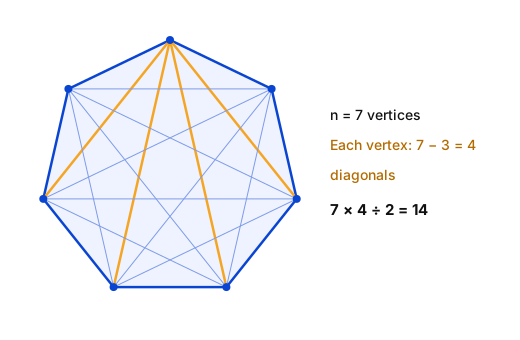
Concept: Number of diagonals of an n-sided polygon =n(n−3)2.

  1. Heptagon: n=7
  2. Each vertex joins 7−3=4 non-adjacent vertices
  3. Diagonals =7×42=14

Trick: Divide by 2 because each diagonal is counted from both ends.

Answer: (C) 14

अवधारणा: n भुजाओं वाले बहुभुज के विकर्ण =n(n−3)2.

  1. सप्तभुज (heptagon): n=7
  2. हर शीर्ष 7−3=4 अनासन्न शीर्षों से जुड़ता है
  3. विकर्ण =7×42=14

ट्रिक: 2 से भाग इसलिए क्योंकि हर विकर्ण दोनों सिरों से गिना जाता है।

उत्तर: (C) 14

RRB NTPC Graduate CBT 1MathematicsGeometry – PolygonsRRB NTPC Graduate CBT 1 2024 · 14 Jun Shift 2 →
Q2470.
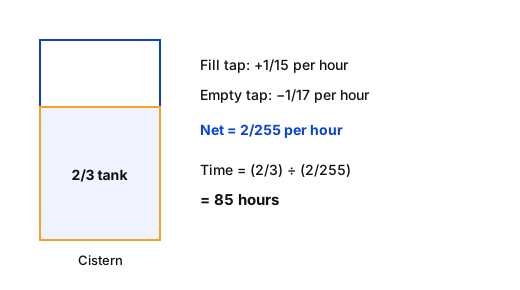
A tap fills a cistern in 15 hours. Another tap empties the full tank in 17 hours. How long (in hours) will it take to fill two-third of the tank, if the tank is empty initially and both the taps are open together?
एक नल एक टंकी को 15 घंटे में भरता है। एक अन्य नल भरी हुई टंकी को 17 घंटे में खाली कर देता है। यदि टंकी प्रारंभ में खाली हो और दोनों नल एक साथ खोल दिए जाएँ, तो टंकी का दो-तिहाई भाग भरने में कितना समय (घंटों में) लगेगा?
  1. A340
  2. B85
  3. C170
  4. D255
Show answer

Concept: Net rate = filling rate − emptying rate; time =workrate.

  1. Net rate =115−117=17−15255=2255 per hour
  2. Time for 23 tank =23÷2255=2553=85 hours

Trick: Full tank takes 15×1717−15=127.5 h; two-third of it =85 h.

Answer: (B) 85

अवधारणा: शुद्ध दर = भरने की दर − खाली करने की दर; समय =कार्यदर.

  1. शुद्ध दर =115−117=17−15255=2255 प्रति घंटा
  2. 23 टंकी का समय =23÷2255=2553=85 घंटे

ट्रिक: पूरी टंकी 15×1717−15=127.5 घंटे; उसका दो-तिहाई =85 घंटे।

उत्तर: (B) 85

RRB NTPC Graduate CBT 1MathematicsPipes and CisternsRRB NTPC Graduate CBT 1 2024 · 14 Jun Shift 2 →
Q2471.
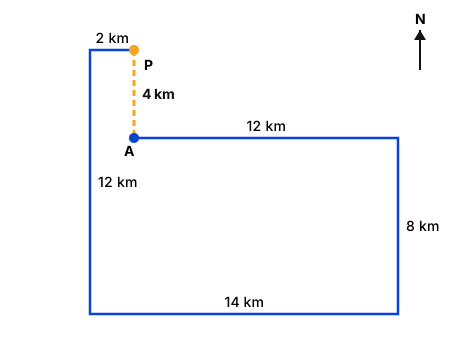
Arpan starts from Point A and drives 12 km towards East. He then takes a right turn, drives 8 km, turns right and drives 14 km. He then takes a right turn and drives 12 km. He takes a final right turn, drives 2 km and stops at Point P. How far (shortest distance) and towards which direction should he drive in order to reach Point A again? (All turns are 90° turns only, unless specified)
अर्पण बिंदु A से शुरू करता है और पूर्व की ओर 12 km गाड़ी चलाता है। फिर वह दाएँ मुड़ता है, 8 km गाड़ी चलाता है, दाएँ मुड़ता है और 14 km गाड़ी चलाता है। फिर वह दाएँ मुड़ता है और 12 km गाड़ी चलाता है। वह अंतिम बार दाएँ मुड़ता है, 2 km गाड़ी चलाता है और बिंदु P पर रुक जाता है। फिर से बिंदु A पर पहुँचने के लिए उसे कितनी दूर (न्यूनतम दूरी) और किस दिशा में गाड़ी चलानी चाहिए? (जब तक निर्दिष्ट न हो, सभी मोड़ केवल 90° के मोड़ हैं)
  1. A4 km to the southदक्षिण की ओर 4 km
  2. B3 km to the southदक्षिण की ओर 3 km
  3. C2 km to the southदक्षिण की ओर 2 km
  4. D1 km to the southदक्षिण की ओर 1 km
Show answer

Concept: Take A as origin, East = +x, North = +y; a right turn from East faces South, from South faces West, and so on.

  1. 12 km East → (12, 0); right turn, 8 km South → (12, −8).
  2. Right turn, 14 km West → (−2, −8); right turn, 12 km North → (−2, 4).
  3. Right turn, 2 km East → P (0, 4). P is exactly 4 km north of A, so he must drive 4 km south.

Trick: East-West: 12 − 14 + 2 = 0; North-South: −8 + 12 = +4 (north). Go back 4 km south.

Answer: (A) 4 km to the south

अवधारणा: A को मूल बिंदु मानें, पूर्व = +x, उत्तर = +y; पूर्व से दाएँ मुड़ने पर दक्षिण, दक्षिण से दाएँ मुड़ने पर पश्चिम।

  1. 12 km पूर्व → (12, 0); दाएँ, 8 km दक्षिण → (12, −8)।
  2. दाएँ, 14 km पश्चिम → (−2, −8); दाएँ, 12 km उत्तर → (−2, 4)।
  3. दाएँ, 2 km पूर्व → P (0, 4)। P, A से ठीक 4 km उत्तर में है, अतः 4 km दक्षिण जाना होगा।

ट्रिक: पूर्व-पश्चिम: 12 − 14 + 2 = 0; उत्तर-दक्षिण: −8 + 12 = +4 (उत्तर)। वापसी 4 km दक्षिण।

उत्तर: (A) 4 km दक्षिण की ओर

RRB NTPC Graduate CBT 1General Intelligence and ReasoningDirection and DistanceRRB NTPC Graduate CBT 1 2024 · 14 Jun Shift 2 →
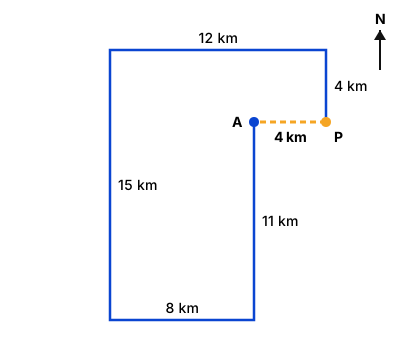
Q2472.
Ganesh starts from point A and drives 11 km towards the south. He then takes a right turn, drives 8 km, turns right and drives 15 km. He then takes a right turn and drives 12 km. He takes a final right turn, drives 4 km and stops at point P. How far (shortest distance) and towards which direction should he drive in order to reach point A again? (All turns are 90-degree turns only unless specified.)
गणेश बिंदु A से शुरू करता है और दक्षिण की ओर 11 km गाड़ी चलाता है। फिर वह दाएँ मुड़ता है, 8 km गाड़ी चलाता है, दाएँ मुड़ता है और 15 km गाड़ी चलाता है। फिर वह दाएँ मुड़ता है और 12 km गाड़ी चलाता है। वह अंतिम बार दाएँ मुड़ता है, 4 km गाड़ी चलाता है और बिंदु P पर रुक जाता है। फिर से बिंदु A पर पहुँचने के लिए उसे कितनी दूर (न्यूनतम दूरी) और किस दिशा में गाड़ी चलानी चाहिए? (जब तक निर्दिष्ट न हो, सभी मोड़ केवल 90 डिग्री के मोड़ हैं।)
  1. A4 km to the westपश्चिम की ओर 4 km
  2. B3 km to the westपश्चिम की ओर 3 km
  3. C3 km to the eastपूर्व की ओर 3 km
  4. D4 km to the eastपूर्व की ओर 4 km
Show answer

Concept: Take A as origin; a right turn from South faces West, from West faces North, from North faces East, from East faces South.

  1. 11 km South → (0, −11); right, 8 km West → (−8, −11).
  2. Right, 15 km North → (−8, 4); right, 12 km East → (4, 4).
  3. Right, 4 km South → P (4, 0). P is 4 km east of A, so he must drive 4 km west.

Trick: North-South: −11 + 15 − 4 = 0; East-West: −8 + 12 = +4 (east). Return 4 km west.

Answer: (A) 4 km to the west

अवधारणा: A को मूल बिंदु मानें; दक्षिण से दाएँ = पश्चिम, पश्चिम से दाएँ = उत्तर, उत्तर से दाएँ = पूर्व, पूर्व से दाएँ = दक्षिण।

  1. 11 km दक्षिण → (0, −11); दाएँ, 8 km पश्चिम → (−8, −11)।
  2. दाएँ, 15 km उत्तर → (−8, 4); दाएँ, 12 km पूर्व → (4, 4)।
  3. दाएँ, 4 km दक्षिण → P (4, 0)। P, A से 4 km पूर्व में है, अतः 4 km पश्चिम जाना होगा।

ट्रिक: उत्तर-दक्षिण: −11 + 15 − 4 = 0; पूर्व-पश्चिम: −8 + 12 = +4 (पूर्व)। वापसी 4 km पश्चिम।

उत्तर: (A) 4 km पश्चिम की ओर

RRB NTPC Graduate CBT 1General Intelligence and ReasoningDirection and DistanceRRB NTPC Graduate CBT 1 2024 · 14 Jun Shift 2 →
Q2473.
In a certain code language, ‘WILD’ is coded as ‘5391’ and ‘DOGS’ is coded as ‘2458’. What is the code for ‘D’ in the given code language?
एक निश्चित कूट भाषा में, ‘WILD’ को ‘5391’ के रूप में कूटबद्ध किया जाता है और ‘DOGS’ को ‘2458’ के रूप में कूटबद्ध किया जाता है। दी गई कूट भाषा में ‘D’ के लिए कूट क्या है?
  1. A1
  2. B4
  3. C2
  4. D5
Show answer

Concept: A letter common to both words gets the digit common to both codes (codes may be jumbled).

  1. WILD = 5391 and DOGS = 2458.
  2. Common letter: D. Common digit: 5.
  3. So D = 5.

Trick: Common letter ↔ common digit.

Answer: (D) 5

अवधारणा: दोनों शब्दों में उभयनिष्ठ अक्षर को दोनों कोड में उभयनिष्ठ अंक मिलता है (क्रम बदला हो सकता है)।

  1. WILD = 5391 तथा DOGS = 2458।
  2. उभयनिष्ठ अक्षर: D; उभयनिष्ठ अंक: 5।
  3. अतः D = 5।

ट्रिक: उभयनिष्ठ अक्षर ↔ उभयनिष्ठ अंक।

उत्तर: (D) 5

RRB NTPC Graduate CBT 1General Intelligence and ReasoningCoding-DecodingRRB NTPC Graduate CBT 1 2024 · 14 Jun Shift 2 →
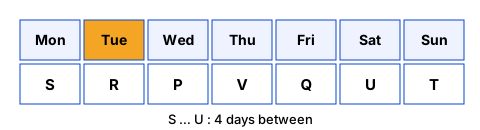
Q2474.
P, Q, R, S, T, U and V have an exam on different days of the week starting on Monday and ending on Sunday.
V has an exam on Thursday. Exactly 4 people have their exam between S and U, neither of whom has an exam on Sunday. R has an exam immediately before P. T does not have an exam on Friday. S does not have an exam after P. Who among the following has an exam on Tuesday?
P, Q, R, S, T, U और V की परीक्षा सप्ताह के अलग-अलग दिनों में है, जो सोमवार से शुरू होकर रविवार को समाप्त होता है।
V की परीक्षा गुरुवार को है। S और U के बीच ठीक 4 लोगों की परीक्षा है, इन दोनों में से किसी की भी परीक्षा रविवार को नहीं है। R की परीक्षा P से ठीक पहले है। T की परीक्षा शुक्रवार को नहीं है। S की परीक्षा P के बाद नहीं है। निम्नलिखित में से किसकी परीक्षा मंगलवार को है?
  1. AU
  2. BT
  3. CR
  4. DS
Show answer

Concept: Place the fixed person first, then the gap condition, then the pairs.

  1. V = Thursday. Exactly 4 between S and U → they are on Mon/Sat or Tue/Sun; neither on Sunday → S and U are on Mon and Sat.
  2. If S = Sat, P (not before S) would be Sun and R (just before P) Sat — clash. So S = Mon, U = Sat.
  3. R just before P: only Tue–Wed is free → R = Tue, P = Wed.
  4. T not on Friday → T = Sun, Q = Fri.

Trick: Gap of 4 between two people in 7 days → they sit at the ends: (1,6) or (2,7).

Answer: (C) R

अवधारणा: पहले निश्चित व्यक्ति, फिर अंतर वाली शर्त, फिर जोड़ियाँ रखें।

  1. V = गुरुवार। S और U के बीच ठीक 4 → सोम/शनि या मंगल/रवि; कोई भी रविवार नहीं → S, U सोमवार और शनिवार पर।
  2. यदि S = शनि, तो P = रवि और R = शनि — टकराव। अतः S = सोम, U = शनि।
  3. R ठीक P से पहले: केवल मंगल–बुध खाली → R = मंगल, P = बुध।
  4. T शुक्रवार नहीं → T = रवि, Q = शुक्र।

ट्रिक: 7 दिनों में 4 का अंतर → दोनों लगभग सिरों पर: (1,6) या (2,7)।

उत्तर: (C) R

RRB NTPC Graduate CBT 1General Intelligence and ReasoningScheduling PuzzleRRB NTPC Graduate CBT 1 2024 · 14 Jun Shift 2 →
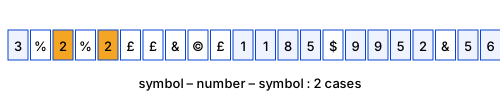
Q2475.
Refer to the following number and symbol series and answer the question that follows. Counting to be done from left to right only.
(NOTE: All numbers are single digit numbers only.)
(Left) 3 % 2 % 2 £ £ & © £ 1 1 8 5 $ 9 9 5 2 & 5 6 (Right)
How many such numbers are there each of which is immediately preceded by a symbol and also immediately followed by a symbol?
निम्नलिखित संख्या और प्रतीक श्रृंखला को देखिए और उसके बाद दिए गए प्रश्न का उत्तर दीजिए। गिनती केवल बाएँ से दाएँ की जानी है।
(नोट: सभी संख्याएँ केवल एक अंक वाली संख्याएँ हैं।)
(बाएँ) 3 % 2 % 2 £ £ & © £ 1 1 8 5 $ 9 9 5 2 & 5 6 (दाएँ)
ऐसी कितनी संख्याएँ हैं जिनमें से प्रत्येक के ठीक पहले एक प्रतीक है और ठीक बाद भी एक प्रतीक है?
  1. A2
  2. B3
  3. C1
  4. D4
Show answer

Concept: Check every number: the element just before and just after it must both be symbols.

  1. Series: 3 % 2 % 2 £ £ & © £ 1 1 8 5 $ 9 9 5 2 & 5 6.
  2. % 2 % ✓ and % 2 £ ✓.
  3. Others fail: £ 1 1, $ 9 9, & 5 6 have a number on one side.

Trick: Scan only numbers that sit inside a symbol cluster.

Answer: (A) 2

अवधारणा: हर संख्या जाँचें: उसके ठीक पहले और ठीक बाद दोनों प्रतीक होने चाहिए।

  1. श्रृंखला: 3 % 2 % 2 £ £ & © £ 1 1 8 5 $ 9 9 5 2 & 5 6।
  2. % 2 % ✓ तथा % 2 £ ✓।
  3. शेष असफल: £ 1 1, $ 9 9, & 5 6 में एक ओर संख्या है।

ट्रिक: केवल प्रतीकों के समूह के बीच फँसी संख्याएँ देखें।

उत्तर: (A) 2

RRB NTPC Graduate CBT 1General Intelligence and ReasoningNumber-Symbol SeriesRRB NTPC Graduate CBT 1 2024 · 14 Jun Shift 2 →
Q2476.
If 2 is added to each even digit and 2 is added to each odd digit in the number 7153246, what will be the sum of all the odd digits in the new number thus formed?
यदि संख्या 7153246 में प्रत्येक सम अंक में 2 जोड़ा जाए और प्रत्येक विषम अंक में 2 जोड़ा जाए, तो इस प्रकार बनी नई संख्या में सभी विषम अंकों का योग क्या होगा?
  1. A28
  2. B21
  3. C19
  4. D24
Show answer

Concept: Here 2 is added to every digit (even and odd alike); then pick the odd digits of the new number.

  1. 7153246 → 9 3 7 5 4 6 8.
  2. Odd digits: 9, 3, 7, 5.
  3. Sum = 9 + 3 + 7 + 5 = 24.

Trick: Adding 2 keeps parity: odd stays odd. So simply add 2 to each original odd digit: (7+1+5+3) + 4×2 = 24.

Answer: (D) 24

अवधारणा: यहाँ हर अंक (सम और विषम दोनों) में 2 जोड़ा जाता है; फिर नई संख्या के विषम अंक लें।

  1. 7153246 → 9 3 7 5 4 6 8।
  2. विषम अंक: 9, 3, 7, 5।
  3. योग = 9 + 3 + 7 + 5 = 24।

ट्रिक: 2 जोड़ने से सम-विषम नहीं बदलता: (7+1+5+3) + 4×2 = 24।

उत्तर: (D) 24

RRB NTPC Graduate CBT 1General Intelligence and ReasoningDigit OperationsRRB NTPC Graduate CBT 1 2024 · 14 Jun Shift 2 →
Q2477.
Based on the English alphabetical order, three of the following four letter-cluster pairs are alike in a certain way and thus form a group. Which is the letter-cluster pair that DOES NOT belong to that group?
(Note: The odd one out is not based on the number of consonants/vowels or their position in the letter-cluster.)
अंग्रेज़ी वर्णमाला क्रम के आधार पर, निम्नलिखित चार अक्षर-समूह युग्मों में से तीन किसी निश्चित प्रकार से समान हैं और इस प्रकार एक समूह बनाते हैं। वह अक्षर-समूह युग्म कौन-सा है जो उस समूह से संबंधित नहीं है?
(नोट: असंगत, अक्षर-समूह में व्यंजनों/स्वरों की संख्या या उनके स्थान पर आधारित नहीं है।)
  1. AJN - HL
  2. BLP - JK
  3. CNR - LP
  4. DOS - MQ
Show answer

Concept: Check the gap between the letters within each cluster.

  1. JN: J+4 = N; HL: H+4 = L ✓.
  2. NR: +4, LP: +4 ✓; OS: +4, MQ: +4 ✓.
  3. LP: +4 but JK: J+1 = K ✗ → odd one.

Trick: In the group, both clusters have a +4 gap and the second starts 2 letters before the first.

Answer: (B) LP - JK

अवधारणा: हर समूह के भीतर अक्षरों का अंतर देखें।

  1. JN: J+4 = N; HL: H+4 = L ✓।
  2. NR: +4, LP: +4 ✓; OS: +4, MQ: +4 ✓।
  3. LP: +4 पर JK: J+1 = K ✗ → विषम।

ट्रिक: समूह में दोनों क्लस्टर का अंतर +4 है और दूसरा क्लस्टर 2 अक्षर पहले से शुरू होता है।

उत्तर: (B) LP - JK

RRB NTPC Graduate CBT 1General Intelligence and ReasoningLetter Analogy – Odd OneRRB NTPC Graduate CBT 1 2024 · 14 Jun Shift 2 →
Q2478.
What should come in place of the question mark (?) in the given series?
113 137 106 130 99 123 ?
दी गई श्रृंखला में प्रश्न चिह्न (?) के स्थान पर क्या आना चाहिए?
113 137 106 130 99 123 ?
  1. A116
  2. B96
  3. C92
  4. D110
Show answer

Concept: Look at the differences — an alternating pattern.

  1. 113 → 137 (+24) → 106 (−31) → 130 (+24) → 99 (−31) → 123 (+24).
  2. Next: 123 − 31 = 92.

Trick: Alternate terms also fall by 7: 113, 106, 99, 92.

Answer: (C) 92

अवधारणा: अंतर देखें — एकांतर (alternating) पैटर्न।

  1. 113 → 137 (+24) → 106 (−31) → 130 (+24) → 99 (−31) → 123 (+24)।
  2. अगला: 123 − 31 = 92।

ट्रिक: एकांतर पद 7 से घटते हैं: 113, 106, 99, 92।

उत्तर: (C) 92

RRB NTPC Graduate CBT 1General Intelligence and ReasoningNumber SeriesRRB NTPC Graduate CBT 1 2024 · 14 Jun Shift 2 →
Q2479.
Select the triad that follows the same pattern as that followed by the two triads given below. Both triads follow the same pattern.
QV-SX-UW
NS-PU-RT
उस त्रिक का चयन कीजिए जो उसी पैटर्न का अनुसरण करता है जिसका अनुसरण नीचे दिए गए दो त्रिक करते हैं। दोनों त्रिक समान पैटर्न का अनुसरण करते हैं।
QV-SX-UW
NS-PU-RT
  1. AKP-MR-OQ
  2. BLP-MR-OS
  3. CKP-MR-OS
  4. DLP-NR-OS
Show answer

Concept: Find the letter-gap rule inside and between the pairs.

  1. QV-SX-UW: Q+5 = V; S = Q+2, X = V+2; U = S+2, W = X−1.
  2. NS-PU-RT follows the same: N+5 = S, P, U (+2 each), R (+2), T = U−1.
  3. KP-MR-OQ: K+5 = P; M, R (+2 each); O (+2), Q = R−1 ✓.

Trick: Quickest check: last letter = previous last letter − 1 (W after X, T after U, Q after R).

Answer: (A) KP-MR-OQ

अवधारणा: जोड़ियों के भीतर और बीच अक्षर-अंतर का नियम खोजें।

  1. QV-SX-UW: Q+5 = V; S = Q+2, X = V+2; U = S+2, W = X−1।
  2. NS-PU-RT में भी यही: N+5 = S, P, U (+2), R (+2), T = U−1।
  3. KP-MR-OQ: K+5 = P; M, R (+2); O (+2), Q = R−1 ✓।

ट्रिक: सबसे तेज़ जाँच: अंतिम अक्षर = पिछली जोड़ी का अंतिम अक्षर − 1।

उत्तर: (A) KP-MR-OQ

RRB NTPC Graduate CBT 1General Intelligence and ReasoningLetter TriadsRRB NTPC Graduate CBT 1 2024 · 14 Jun Shift 2 →
Q2480.
This question is based on the five, three-digit numbers given below.
(Left) 823 664 309 431 175 (Right)
(Example- 697 – First digit = 6, second digit = 9 and third digit = 7)
(NOTE: All operations to be done from left to right.)
What will be the resultant if the first digit of the highest number is added to the third digit of the lowest number?
यह प्रश्न नीचे दी गई तीन अंकों वाली पाँच संख्याओं पर आधारित है।
(बाएँ) 823 664 309 431 175 (दाएँ)
(उदाहरण- 697 – पहला अंक = 6, दूसरा अंक = 9 और तीसरा अंक = 7)
(नोट: सभी संक्रियाएँ बाएँ से दाएँ की जानी हैं।)
यदि सबसे बड़ी संख्या के पहले अंक को सबसे छोटी संख्या के तीसरे अंक में जोड़ा जाए, तो परिणाम क्या होगा?
  1. A16
  2. B11
  3. C13
  4. D14
Show answer

Concept: Identify the highest and lowest numbers first.

  1. Highest = 823 → first digit 8.
  2. Lowest = 175 → third digit 5.
  3. 8 + 5 = 13.

Trick: Compare hundreds digits only: 8 is largest, 1 is smallest.

Answer: (C) 13

अवधारणा: पहले सबसे बड़ी और सबसे छोटी संख्या पहचानें।

  1. सबसे बड़ी = 823 → पहला अंक 8।
  2. सबसे छोटी = 175 → तीसरा अंक 5।
  3. 8 + 5 = 13।

ट्रिक: केवल सैकड़े के अंक तुलना करें: 8 सबसे बड़ा, 1 सबसे छोटा।

उत्तर: (C) 13

RRB NTPC Graduate CBT 1General Intelligence and ReasoningNumber OperationsRRB NTPC Graduate CBT 1 2024 · 14 Jun Shift 2 →