Question bank

Q&A: practice questions with answers

Search questions on any topic. Filter by exam category, exam, subject and topic, try the question, then open the answer and explanation.

Courses – airGurukul

7,100 questions found.

Q2481.
If 1 is added to each odd digit and 2 is subtracted from each even digit in the number 7452183, then what will the difference between the highest and lowest digits in the new number thus formed be?
यदि संख्या 7452183 में प्रत्येक विषम अंक में 1 जोड़ा जाए और प्रत्येक सम अंक में से 2 घटाया जाए, तो इस प्रकार बनी नई संख्या में सबसे बड़े और सबसे छोटे अंकों के बीच का अंतर क्या होगा?
  1. A6
  2. B9
  3. C8
  4. D7
Show answer

Concept: Apply +1 to odd digits and −2 to even digits, then compare.

  1. 7452183 → 7→8, 4→2, 5→6, 2→0, 1→2, 8→6, 3→4.
  2. New number: 8 2 6 0 2 6 4.
  3. Highest 8 − lowest 0 = 8.

Trick: The 2 becomes 0 and 7 becomes 8 — the extremes are clear at once.

Answer: (C) 8

अवधारणा: विषम अंकों में +1 और सम अंकों में −2 करें, फिर तुलना करें।

  1. 7452183 → 7→8, 4→2, 5→6, 2→0, 1→2, 8→6, 3→4।
  2. नई संख्या: 8 2 6 0 2 6 4।
  3. सबसे बड़ा 8 − सबसे छोटा 0 = 8।

ट्रिक: 2 → 0 और 7 → 8 — चरम मान तुरंत दिखते हैं।

उत्तर: (C) 8
RRB NTPC Graduate CBT 1General Intelligence and ReasoningDigit OperationsRRB NTPC Graduate CBT 1 2024 · 14 Jun Shift 2 →
Q2482.
What should come in place of the question mark (?) in the given series based on the English alphabetical order?
FKP DIN BGL ZEJ ?
अंग्रेज़ी वर्णमाला क्रम के आधार पर दी गई श्रृंखला में प्रश्न चिह्न (?) के स्थान पर क्या आना चाहिए?
FKP DIN BGL ZEJ ?
  1. AXCH
  2. BCXH
  3. CXHC
  4. DCHX
Show answer

Concept: Track each position separately.

  1. 1st letters: F, D, B, Z, X (−2 each, wrapping B → Z).
  2. 2nd letters: K, I, G, E, C (−2).
  3. 3rd letters: P, N, L, J, H (−2). Answer: XCH.

Trick: Every letter moves 2 steps back; wrap around after A.

Answer: (A) XCH

अवधारणा: हर स्थान को अलग से देखें।

  1. पहला अक्षर: F, D, B, Z, X (−2, B के बाद Z)।
  2. दूसरा: K, I, G, E, C (−2)।
  3. तीसरा: P, N, L, J, H (−2)। उत्तर: XCH।

ट्रिक: हर अक्षर 2 कदम पीछे; A के बाद Z पर लौटें।

उत्तर: (A) XCH

RRB NTPC Graduate CBT 1General Intelligence and ReasoningAlphabet SeriesRRB NTPC Graduate CBT 1 2024 · 14 Jun Shift 2 →
Q2483.
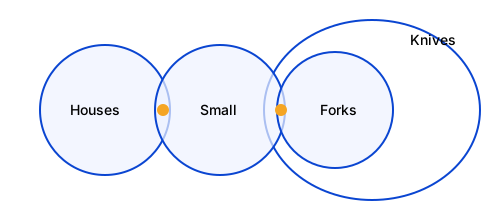
Read the given statements and conclusions carefully. Assuming that the information given in the statements is true, even if it appears to be at variance with commonly known facts, decide which of the given conclusion(s) logically follow(s) from the statements.
Statements:
Some houses are small.
Some small are forks.
All forks are knives.
Conclusions:
(I) Some small are houses.
(II) Some forks are small.
दिए गए कथनों और निष्कर्षों को ध्यानपूर्वक पढ़िए। यह मानते हुए कि कथनों में दी गई जानकारी सत्य है, भले ही वह सामान्यतः ज्ञात तथ्यों से भिन्न प्रतीत होती हो, निर्णय कीजिए कि दिए गए निष्कर्षों में से कौन-सा/से निष्कर्ष कथनों का तार्किक रूप से अनुसरण करता है/करते हैं।
कथन:
कुछ घर, छोटे हैं।
कुछ छोटे, काँटे हैं।
सभी काँटे, चाकू हैं।
निष्कर्ष:
(I) कुछ छोटे, घर हैं।
(II) कुछ काँटे, छोटे हैं।
  1. ANeither conclusion (I) nor (II) followsन तो निष्कर्ष (I) और न ही (II) अनुसरण करता है
  2. BOnly conclusion (II) followsकेवल निष्कर्ष (II) अनुसरण करता है
  3. CBoth conclusions (I) and (II) followनिष्कर्ष (I) और (II) दोनों अनुसरण करते हैं
  4. DOnly conclusion (I) followsकेवल निष्कर्ष (I) अनुसरण करता है
Show answer

Concept: 'Some A are B' can always be converted to 'Some B are A'.

  1. Some houses are small → Some small are houses: I follows.
  2. Some small are forks → Some forks are small: II follows.
  3. 'All forks are knives' is not needed here.

Trick: Conclusions that are just converses of 'Some' statements always follow.

Answer: (C) Both conclusions (I) and (II) follow

अवधारणा: 'कुछ A, B हैं' का परिवर्तन 'कुछ B, A हैं' हमेशा सही होता है।

  1. कुछ घर छोटे हैं → कुछ छोटे घर हैं: I अनुसरण करता है।
  2. कुछ छोटे काँटे हैं → कुछ काँटे छोटे हैं: II अनुसरण करता है।
  3. 'सभी काँटे चाकू हैं' की यहाँ आवश्यकता नहीं।

ट्रिक: 'कुछ' वाले कथन का उलटा (converse) हमेशा सही।

उत्तर: (C) निष्कर्ष (I) और (II) दोनों अनुसरण करते हैं

RRB NTPC Graduate CBT 1General Intelligence and ReasoningSyllogismRRB NTPC Graduate CBT 1 2024 · 14 Jun Shift 2 →
Q2484.
JR 11 is related to MV 2 in a certain way. In the same way, KL 7 is related to NP -2. To which of the given options is WO 2 related, following the same logic?
JR 11 एक निश्चित प्रकार से MV 2 से संबंधित है। उसी प्रकार, KL 7, NP -2 से संबंधित है। समान तर्क का अनुसरण करते हुए, WO 2 दिए गए विकल्पों में से किससे संबंधित है?
  1. AZT -7
  2. BAT -7
  3. CAS -5
  4. DZS -7
Show answer

Concept: Find the change in each letter and in the number.

  1. JR 11 → MV 2: J+3 = M, R+4 = V, 11 − 9 = 2.
  2. KL 7 → NP −2: K+3 = N, L+4 = P, 7 − 9 = −2 ✓.
  3. WO 2 → W+3 = Z, O+4 = S, 2 − 9 = −7 → ZS −7.

Trick: Rule: (+3, +4, −9). Check the number first: only A and D have −7, then O+4 = S picks D.

Answer: (D) ZS -7

अवधारणा: हर अक्षर और संख्या में परिवर्तन देखें।

  1. JR 11 → MV 2: J+3 = M, R+4 = V, 11 − 9 = 2।
  2. KL 7 → NP −2: K+3 = N, L+4 = P, 7 − 9 = −2 ✓।
  3. WO 2 → W+3 = Z, O+4 = S, 2 − 9 = −7 → ZS −7।

ट्रिक: नियम: (+3, +4, −9)। O+4 = S से सही विकल्प तुरंत मिलता है।

उत्तर: (D) ZS -7

RRB NTPC Graduate CBT 1General Intelligence and ReasoningAlpha-Numeric AnalogyRRB NTPC Graduate CBT 1 2024 · 14 Jun Shift 2 →
Q2485.
In a certain code language,
‘A + B’ means ‘A is the sister of B’
‘A – B’ means ‘A is the brother of B’
‘A × B’ means ‘A is the wife of B’
‘A ÷ B’ means ‘A is the father of B’.
Based on the above, how is M related to Q if ‘M ÷ N + O − P × Q’?
एक निश्चित कूट भाषा में,
‘A + B’ का अर्थ है ‘A, B की बहन है’
‘A – B’ का अर्थ है ‘A, B का भाई है’
‘A × B’ का अर्थ है ‘A, B की पत्नी है’
‘A ÷ B’ का अर्थ है ‘A, B का पिता है’।
उपरोक्त के आधार पर, यदि ‘M ÷ N + O − P × Q’ है, तो M, Q से किस प्रकार संबंधित है?
  1. ABrotherभाई
  2. BWife's Brotherपत्नी का भाई
  3. CFatherपिता
  4. DWife's Fatherपत्नी का पिता
Show answer

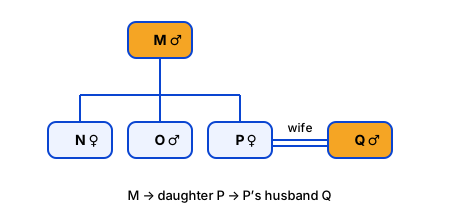
Concept: Decode each symbol from left to right and draw the family tree.

  1. M ÷ N: M is father of N. N + O: N is sister of O.
  2. O − P: O is brother of P, so P is also M's child.
  3. P × Q: P is wife of Q → P is M's daughter.
  4. M is the father of Q's wife.

Trick: Chain: M → daughter P → her husband Q ⇒ wife's father (father-in-law).

Answer: (D) Wife's Father

अवधारणा: बाएँ से दाएँ हर चिह्न को डिकोड करें और वंश-वृक्ष बनाएँ।

  1. M ÷ N: M, N का पिता है। N + O: N, O की बहन है।
  2. O − P: O, P का भाई है, अतः P भी M की संतान है।
  3. P × Q: P, Q की पत्नी है → P, M की बेटी है।
  4. M, Q की पत्नी का पिता है।

ट्रिक: श्रृंखला: M → बेटी P → उसका पति Q ⇒ पत्नी के पिता (ससुर)।

उत्तर: (D) पत्नी के पिता

RRB NTPC Graduate CBT 1General Intelligence and ReasoningCoded Blood RelationsRRB NTPC Graduate CBT 1 2024 · 14 Jun Shift 2 →
Q2486.
What will come in the place of the question mark ‘(?)’ in the following equation, if ‘+’ and ‘−’ are interchanged and ‘×’ and ‘÷’ are interchanged?
116 ÷ 5 − 423 × 3 + 13 = ?
यदि ‘+’ और ‘−’ को आपस में बदल दिया जाए तथा ‘×’ और ‘÷’ को आपस में बदल दिया जाए, तो निम्नलिखित समीकरण में प्रश्न चिह्न ‘(?)’ के स्थान पर क्या आएगा?
116 ÷ 5 − 423 × 3 + 13 = ?
  1. A508
  2. B808
  3. C708
  4. D608
Show answer

Concept: Swap the signs first, then solve using BODMAS.

  1. After interchange: 116×5+423÷3−13
  2. =580+141−13
  3. =708

Trick: Rewrite the whole expression with new signs before calculating — never mix old and new signs.

Answer: (C) 708

अवधारणा: पहले चिह्न बदलें, फिर BODMAS से हल करें।

  1. चिह्न बदलने पर: 116×5+423÷3−13
  2. =580+141−13
  3. =708

ट्रिक: गणना से पहले पूरा व्यंजक नए चिह्नों के साथ दोबारा लिखें।

उत्तर: (C) 708

RRB NTPC Graduate CBT 1General Intelligence and ReasoningMathematical OperationsRRB NTPC Graduate CBT 1 2024 · 14 Jun Shift 2 →
Q2487.
In a certain code language, ‘FIRE’ is coded as ‘5371’ and ‘ACID’ is coded as ‘8247’. What is the code for ‘I’ in the given code language?
एक निश्चित कूट भाषा में, ‘FIRE’ को ‘5371’ के रूप में कूटबद्ध किया जाता है और ‘ACID’ को ‘8247’ के रूप में कूटबद्ध किया जाता है। दी गई कूट भाषा में ‘I’ के लिए कूट क्या है?
  1. A3
  2. B2
  3. C4
  4. D7
Show answer

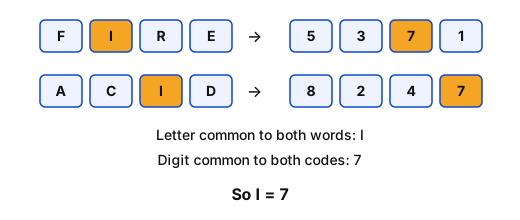
Concept: When two words share a letter and their codes share a digit, that digit is the code of the common letter.

  1. FIRE and ACID have only one common letter: I.
  2. 5371 and 8247 have only one common digit: 7.
  3. So I = 7.

Trick: Match common letters with common digits — no need to decode the full words.

Answer: (D) 7

अवधारणा: जब दो शब्दों में एक अक्षर समान हो और उनके कूट में एक अंक समान हो, तो वही अंक उस अक्षर का कूट है।

  1. FIRE और ACID में केवल एक अक्षर समान है: I
  2. 5371 और 8247 में केवल एक अंक समान है: 7
  3. अतः I = 7

ट्रिक: समान अक्षर ↔ समान अंक मिलाएँ — पूरा शब्द डिकोड करने की ज़रूरत नहीं।

उत्तर: (D) 7

RRB NTPC Graduate CBT 1General Intelligence and ReasoningCoding-DecodingRRB NTPC Graduate CBT 1 2024 · 14 Jun Shift 2 →
Q2488.
Based on the English alphabetical order, three of the following four letter-cluster pairs are alike in a certain way and thus form a group. Which letter-cluster pair DOES NOT belong to that group?
(Note: The odd one out is not based on the number of consonants/vowels or their position in the letter-cluster.)
अंग्रेज़ी वर्णमाला क्रम के आधार पर, निम्नलिखित चार अक्षर-समूह युग्मों में से तीन किसी निश्चित प्रकार से समान हैं और इस प्रकार एक समूह बनाते हैं। कौन-सा अक्षर-समूह युग्म उस समूह से संबंधित नहीं है?
(नोट: असंगत, अक्षर-समूह में व्यंजनों/स्वरों की संख्या या उनके स्थान पर आधारित नहीं है।)
  1. ABK – IF
  2. BHQ – OL
  3. CTC – AY
  4. DPY – WT
Show answer

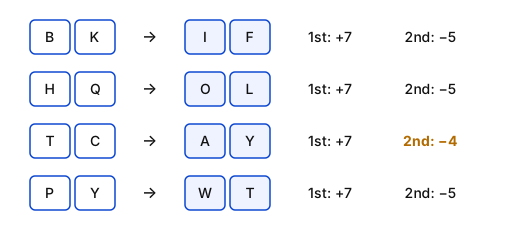
Concept: Compare the alphabet positions of corresponding letters in each pair.

  1. BK – IF: B(2)+7=I(9), K(11)−5=F(6); similarly HQ – OL and PY – WT follow +7,−5.
  2. TC – AY: T+7=A (cyclic) but C(3)→Y(25) is −4 (cyclic), not −5.
  3. So TC – AY is the odd one.

Trick: Check the second letter only: −5 from C gives X, not Y.

Answer: (C) TC – AY

अवधारणा: प्रत्येक युग्म में संगत अक्षरों की वर्णमाला स्थिति की तुलना करें।

  1. BK – IF: B(2)+7=I(9), K(11)−5=F(6); इसी प्रकार HQ – OL और PY – WT में +7,−5.
  2. TC – AY: T+7=A (चक्रीय) पर C(3)→Y(25) में −4 है, −5 नहीं।
  3. अतः TC – AY विषम है।

ट्रिक: केवल दूसरा अक्षर जाँचें: C से −5 = X होना चाहिए, Y नहीं।

उत्तर: (C) TC – AY

RRB NTPC Graduate CBT 1General Intelligence and ReasoningOdd One Out – Letter PairsRRB NTPC Graduate CBT 1 2024 · 14 Jun Shift 2 →
Q2489.
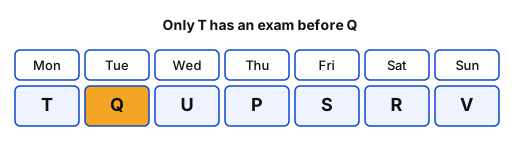
Each of P, Q, R, S, T, U and V has an exam on a different day of a week starting from Monday and ending on Sunday of the same week. U has an exam on Tuesday. Only two people have exams between P and U. V has an exam immediately before R but not on Saturday. T has an exam after P but before Q. How many people have exams between S and Q?
P, Q, R, S, T, U और V में से प्रत्येक की परीक्षा एक ही सप्ताह के अलग-अलग दिन है, जो सोमवार से शुरू होकर उसी सप्ताह के रविवार को समाप्त होता है। U की परीक्षा मंगलवार को है। P और U के बीच केवल दो लोगों की परीक्षा है। V की परीक्षा R से ठीक पहले है, लेकिन शनिवार को नहीं। T की परीक्षा P के बाद लेकिन Q से पहले है। S और Q के बीच कितने लोगों की परीक्षा है?
  1. AThreeतीन
  2. BFourचार
  3. CTwoदो
  4. DFiveपाँच
Show answer

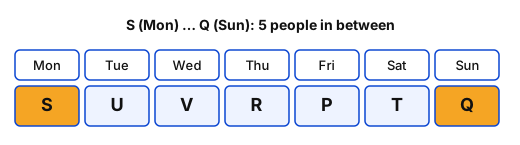
Concept: Fix the definite clue first, then place others around it (Mon = 1 … Sun = 7).

  1. U = Tue (2). Two people between P and U ⇒ P = Fri (5).
  2. T after P and before Q ⇒ T = Sat, Q = Sun.
  3. Left: Mon, Wed, Thu. V just before R (V not Sat) ⇒ V = Wed, R = Thu; S = Mon.
  4. Between S (Mon) and Q (Sun): U, V, R, P, T = 5.

Trick: Between Mon and Sun there are always 5 days.

Answer: (D) Five

अवधारणा: पहले निश्चित संकेत रखें, फिर बाकी (सोम = 1 … रवि = 7)।

  1. U = मंगल (2)। P और U के बीच दो ⇒ P = शुक्र (5)।
  2. T, P के बाद और Q से पहले ⇒ T = शनि, Q = रवि।
  3. बचे: सोम, बुध, गुरु। V ठीक R से पहले (V शनि नहीं) ⇒ V = बुध, R = गुरु; S = सोम।
  4. S (सोम) और Q (रवि) के बीच: U, V, R, P, T = 5।

ट्रिक: सोमवार और रविवार के बीच हमेशा 5 दिन होते हैं।

उत्तर: (D) Five

RRB NTPC Graduate CBT 1General Intelligence and ReasoningScheduling PuzzleRRB NTPC Graduate CBT 1 2024 · 14 Jun Shift 2 →
Q2490.
MS 14 is related to OV 8 in a certain way. In the same way, NN 5 is related to PQ −1. To which of the given options is SR 6 related, following the same logic?
MS 14 एक निश्चित प्रकार से OV 8 से संबंधित है। उसी प्रकार, NN 5, PQ −1 से संबंधित है। समान तर्क का अनुसरण करते हुए, SR 6 दिए गए विकल्पों में से किससे संबंधित है?
  1. AOO 4
  2. BUU 0
  3. CKP 3
  4. DOI 6
Show answer

Concept: Find the rule from both given pairs and apply it.

  1. MS 14 → OV 8: M+2=O, S+3=V, 14−6=8
  2. NN 5 → PQ −1: N+2=P, N+3=Q, 5−6=−1
  3. SR 6 → S+2=U, R+3=U, 6−6=0 ⇒ UU 0

Trick: Rule: +2, +3, −6.

Answer: (B) UU 0

अवधारणा: दोनों युग्मों से नियम निकालें और लागू करें।

  1. MS 14 → OV 8: M+2=O, S+3=V, 14−6=8
  2. NN 5 → PQ −1: N+2=P, N+3=Q, 5−6=−1
  3. SR 6 → S+2=U, R+3=U, 6−6=0 ⇒ UU 0

ट्रिक: नियम: +2, +3, −6.

उत्तर: (B) UU 0

RRB NTPC Graduate CBT 1General Intelligence and ReasoningAnalogy – Letters & NumbersRRB NTPC Graduate CBT 1 2024 · 14 Jun Shift 2 →
Q2491.
Refer to the following number and symbol series and answer the question that follows. Counting to be done from left to right only.
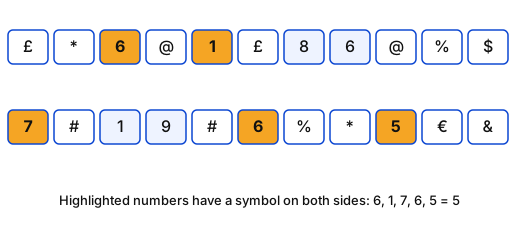
(Left) £ * 6 @ 1 £ 8 6 @ % $ 7 # 1 9 # 6 % * 5 € & (Right)
How many such numbers are there each of which is immediately preceded by a symbol and also immediately followed by a symbol?
निम्नलिखित संख्या और प्रतीक श्रृंखला को देखिए और उसके बाद दिए गए प्रश्न का उत्तर दीजिए। गिनती केवल बाएँ से दाएँ की जानी है।
(बाएँ) £ * 6 @ 1 £ 8 6 @ % $ 7 # 1 9 # 6 % * 5 € & (दाएँ)
ऐसी कितनी संख्याएँ हैं जिनमें से प्रत्येक के ठीक पहले एक प्रतीक है और ठीक बाद भी एक प्रतीक है?
  1. A6
  2. B5
  3. C7
  4. D4
Show answer

Concept: Check every number: the element just before it and just after it must both be symbols.

  1. Qualifying numbers: * 6 @, @ 1 £, $ 7 #, # 6 %, * 5 €.
  2. 8, 6 (after 8), 1, 9 fail because a neighbour is a number.
  3. Count = 5.

Trick: Scan in groups of three (symbol–number–symbol) from left to right.

Answer: (B) 5

अवधारणा: हर संख्या जाँचें: उसके ठीक पहले और ठीक बाद, दोनों प्रतीक होने चाहिए।

  1. योग्य संख्याएँ: * 6 @, @ 1 £, $ 7 #, # 6 %, * 5 €
  2. 8, (8 के बाद वाला) 6, 1, 9 — इनके पड़ोस में संख्या है, अतः अमान्य।
  3. कुल = 5

ट्रिक: बाएँ से दाएँ तीन-तीन के समूह (प्रतीक–संख्या–प्रतीक) में देखें।

उत्तर: (B) 5

RRB NTPC Graduate CBT 1General Intelligence and ReasoningSymbol-Number SeriesRRB NTPC Graduate CBT 1 2024 · 14 Jun Shift 2 →
Q2492.
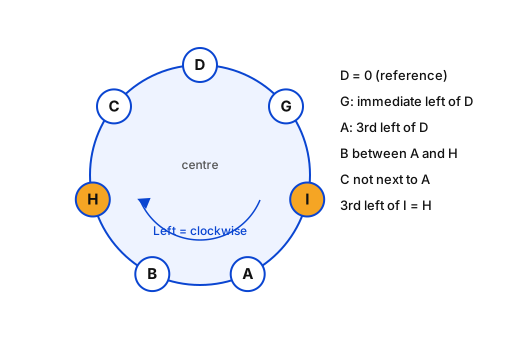
A, B, C, D, G, H and I are sitting around a circular table facing the centre of the table. Only B sits between H and A. A sits third to the left of D. G sits to the immediate left of D. C is not an immediate neighbour of A. Who sits third to the left of I?
A, B, C, D, G, H और I एक वृत्ताकार मेज़ के चारों ओर केंद्र की ओर मुख करके बैठे हैं। H और A के बीच केवल B बैठा है। A, D के बाएँ से तीसरे स्थान पर बैठा है। G, D के ठीक बाएँ बैठा है। C, A का निकटतम पड़ोसी नहीं है। I के बाएँ से तीसरे स्थान पर कौन बैठा है?
  1. AG
  2. BC
  3. CA
  4. DH
Show answer

Concept: Facing the centre, 'left' means moving clockwise.

  1. Place D. G is immediate left of D; A is 3rd to the left of D (D → G → _ → A).
  2. Only B sits between H and A ⇒ B next to A on the far side, then H.
  3. Remaining seats: one next to A and one next to D. C is not A's neighbour ⇒ C next to D, I next to A.
  4. Third to the left of I: A, B, H ⇒ H.

Trick: Draw the circle and always move clockwise for 'left' when everyone faces the centre.

Answer: (D) H

अवधारणा: केंद्र की ओर मुख होने पर 'बाएँ' = दक्षिणावर्त (clockwise) चलना।

  1. D रखें। G, D के ठीक बाएँ; A, D के बाएँ तीसरे स्थान पर (D → G → _ → A)।
  2. केवल B, H और A के बीच ⇒ B, A के दूसरी ओर, फिर H।
  3. बचे स्थान: एक A के पास, एक D के पास। C, A का पड़ोसी नहीं ⇒ C, D के पास; I, A के पास।
  4. I के बाएँ तीसरा: A, B, H ⇒ H

ट्रिक: केंद्र की ओर मुख हो तो 'बाएँ' के लिए हमेशा दक्षिणावर्त चलें।

उत्तर: (D) H

RRB NTPC Graduate CBT 1General Intelligence and ReasoningCircular Seating ArrangementRRB NTPC Graduate CBT 1 2024 · 14 Jun Shift 2 →
Q2493.
Each of P, Q, R, S, T, U and V has an exam on a different day of a week starting from Monday and ending on Sunday of the same week. U has an exam on Wednesday. Exactly 4 people have an exam between Q and V, neither of whom has an exam on Monday. P has an exam immediately before S, and R has an exam immediately after S. T has an exam immediately before Q. How many people have an exam before Q?
P, Q, R, S, T, U और V में से प्रत्येक की परीक्षा एक ही सप्ताह के अलग-अलग दिन है, जो सोमवार से शुरू होकर उसी सप्ताह के रविवार को समाप्त होता है। U की परीक्षा बुधवार को है। Q और V के बीच ठीक 4 लोगों की परीक्षा है, इन दोनों में से किसी की भी परीक्षा सोमवार को नहीं है। P की परीक्षा S से ठीक पहले है, और R की परीक्षा S के ठीक बाद है। T की परीक्षा Q से ठीक पहले है। Q से पहले कितने लोगों की परीक्षा है?
  1. A1
  2. B2
  3. C3
  4. D4
Show answer

Concept: Use the 'exactly 4 between' clue to fix Q and V (Mon = 1 … Sun = 7).

  1. 4 between Q and V ⇒ (Mon, Sat) or (Tue, Sun). Neither on Monday ⇒ Q, V are Tue and Sun.
  2. If Q = Sun, T = Sat; left Mon, Thu, Fri — no room for three consecutive P, S, R. ✗
  3. So Q = Tue, T = Mon, V = Sun; P, S, R = Thu, Fri, Sat; U = Wed.
  4. Before Q: only T ⇒ 1.

Trick: A block of three consecutive days (P-S-R) quickly rules out the wrong case.

Answer: (A) 1

अवधारणा: 'ठीक 4 बीच में' संकेत से Q और V तय करें (सोम = 1 … रवि = 7)।

  1. Q और V के बीच 4 ⇒ (सोम, शनि) या (मंगल, रवि)। सोमवार पर कोई नहीं ⇒ Q, V = मंगल और रवि।
  2. यदि Q = रवि, T = शनि; बचे सोम, गुरु, शुक्र — P, S, R लगातार नहीं आ सकते। ✗
  3. अतः Q = मंगल, T = सोम, V = रवि; P, S, R = गुरु, शुक्र, शनि; U = बुध।
  4. Q से पहले केवल T ⇒ 1

ट्रिक: तीन लगातार दिनों का ब्लॉक (P-S-R) गलत केस तुरंत हटा देता है।

उत्तर: (A) 1

RRB NTPC Graduate CBT 1General Intelligence and ReasoningScheduling PuzzleRRB NTPC Graduate CBT 1 2024 · 14 Jun Shift 2 →
Q2494.
What should come in place of the question mark (?) in the given series?
872 870 866 860 852 ?
दी गई श्रृंखला में प्रश्न चिह्न (?) के स्थान पर क्या आना चाहिए?
872 870 866 860 852 ?
  1. A840
  2. B842
  3. C843
  4. D841
Show answer

Concept: Look at the differences between consecutive terms.

  1. 872−2=870, 870−4=866, 866−6=860, 860−8=852
  2. Next: 852−10=842

Trick: Differences are consecutive even numbers 2, 4, 6, 8, 10.

Answer: (B) 842

अवधारणा: क्रमागत पदों के अंतर देखें।

  1. 872−2=870, 870−4=866, 866−6=860, 860−8=852
  2. अगला: 852−10=842

ट्रिक: अंतर क्रमागत सम संख्याएँ 2, 4, 6, 8, 10 हैं।

उत्तर: (B) 842

RRB NTPC Graduate CBT 1General Intelligence and ReasoningNumber SeriesRRB NTPC Graduate CBT 1 2024 · 14 Jun Shift 2 →
Q2495.
What should come in place of the question mark (?) in the given series based on the English alphabetical order?
OQJ MOH KMF IKD ?
अंग्रेज़ी वर्णमाला क्रम के आधार पर दी गई श्रृंखला में प्रश्न चिह्न (?) के स्थान पर क्या आना चाहिए?
OQJ MOH KMF IKD ?
  1. AGIB
  2. BGIC
  3. CGJB
  4. DGJC
Show answer

Concept: Track each letter position of the clusters separately.

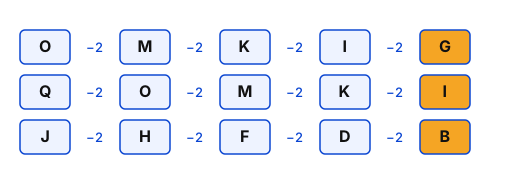
  1. 1st letters: O, M, K, I → G (−2 each)
  2. 2nd letters: Q, O, M, K → I (−2 each)
  3. 3rd letters: J, H, F, D → B (−2 each)

Trick: All three positions move back by 2 together.

Answer: (A) GIB

अवधारणा: हर स्थान के अक्षर अलग-अलग देखें।

  1. पहले अक्षर: O, M, K, I → G (हर बार −2)
  2. दूसरे अक्षर: Q, O, M, K → I (−2)
  3. तीसरे अक्षर: J, H, F, D → B (−2)

ट्रिक: तीनों स्थान एक साथ 2 पीछे जाते हैं।

उत्तर: (A) GIB

RRB NTPC Graduate CBT 1General Intelligence and ReasoningLetter SeriesRRB NTPC Graduate CBT 1 2024 · 14 Jun Shift 2 →
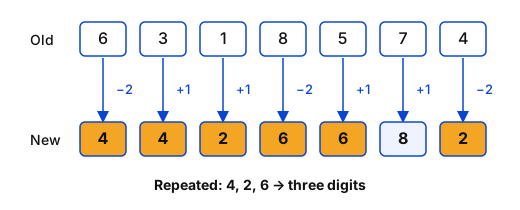
Q2496.
If 1 is added to each odd digit and 2 is subtracted from each even digit in the number 6318574, how many digits will appear more than once in the new number thus formed?
यदि संख्या 6318574 में प्रत्येक विषम अंक में 1 जोड़ा जाए और प्रत्येक सम अंक में से 2 घटाया जाए, तो इस प्रकार बनी नई संख्या में कितने अंक एक से अधिक बार आएँगे?
  1. AThreeतीन
  2. BFourचार
  3. CTwoदो
  4. DOneएक
Show answer

Concept: Odd digit → +1, even digit → −2, then look for repeats.

  1. 6318574 → 6−2, 3+1, 1+1, 8−2, 5+1, 7+1, 4−2
  2. New number: 4426682
  3. Repeated digits: 4, 2, 6 ⇒ three.

Trick: Write the new digits directly under the old ones to avoid mistakes.

Answer: (A) Three

अवधारणा: विषम अंक → +1, सम अंक → −2, फिर दोहराव देखें।

  1. 6318574 → 6−2, 3+1, 1+1, 8−2, 5+1, 7+1, 4−2
  2. नई संख्या: 4426682
  3. दोहराए अंक: 4, 2, 6 ⇒ तीन

ट्रिक: गलती से बचने के लिए नए अंक पुराने अंकों के ठीक नीचे लिखें।

उत्तर: (A) Three

RRB NTPC Graduate CBT 1General Intelligence and ReasoningNumber ManipulationRRB NTPC Graduate CBT 1 2024 · 14 Jun Shift 2 →
Q2497.
Which of the following letter-clusters should replace # and % so that the pattern and relationship followed between the letter-cluster pair on the left side of :: is the same as that on the right side of ::?
# : USO :: LJF : %
निम्नलिखित में से कौन-से अक्षर-समूह # और % को प्रतिस्थापित करने चाहिए ताकि :: के बाईं ओर के अक्षर-समूह युग्म के बीच अनुसरण किया गया पैटर्न और संबंध वही हो जो :: के दाईं ओर है?
# : USO :: LJF : %
  1. A# = IOR, % = IZC
  2. B# = XVI, % = IZC
  3. C# = XVR, % = IGC
  4. D# = ZOR, % = IQV
Show answer

Concept: The pair rule must be the same on both sides: # → USO and LJF → %.

  1. Test option (C): LJF → IGC: L−3 = I, J−3 = G, F−3 = C.
  2. Same rule: XVR → USO: X−3 = U, V−3 = S, R−3 = O. ✓
  3. Other options fail (e.g., LJF → IZC is not a uniform shift).

Trick: Find the rule from the right side (LJF → %) and check the left side.

Answer: (C) # = XVR, % = IGC

अवधारणा: दोनों ओर युग्म का नियम समान होना चाहिए: # → USO और LJF → %.

  1. विकल्प (C) जाँचें: LJF → IGC: L−3 = I, J−3 = G, F−3 = C
  2. वही नियम: XVR → USO: X−3 = U, V−3 = S, R−3 = O ✓
  3. अन्य विकल्प असफल (जैसे LJF → IZC में समान खिसकाव नहीं)।

ट्रिक: दाएँ पक्ष (LJF → %) से नियम निकालकर बाएँ पक्ष पर जाँचें।

उत्तर: (C) # = XVR, % = IGC

RRB NTPC Graduate CBT 1General Intelligence and ReasoningLetter AnalogyRRB NTPC Graduate CBT 1 2024 · 14 Jun Shift 2 →
Q2498.
Select the set in which the numbers are related in the same way as are the numbers of the following sets.
(NOTE: Operations should be performed on the whole numbers, without breaking down the numbers into their constituent digits. E.g. 13 – Operations on 13 such as
adding/subtracting/multiplying to 13 can be performed. Breaking down 13 into 1 and 3 and then performing mathematical operations on 1 and 3 is not allowed.)
(14, 66, 19)
(43, 134, 24)
उस समुच्चय का चयन कीजिए जिसमें संख्याएँ उसी प्रकार संबंधित हैं जिस प्रकार निम्नलिखित समुच्चयों की संख्याएँ संबंधित हैं।
(नोट: संख्याओं को उनके घटक अंकों में विभाजित किए बिना, पूर्ण संख्याओं पर संक्रियाएँ की जानी चाहिए। उदाहरण के लिए 13 – 13 पर संक्रियाएँ जैसे
13 में जोड़ना/घटाना/गुणा करना आदि किया जा सकता है। 13 को 1 और 3 में विभाजित करना और फिर 1 और 3 पर गणितीय संक्रियाएँ करने की अनुमति नहीं है।)
(14, 66, 19)
(43, 134, 24)
  1. A(10, 35, 8)
  2. B(45, 97, 4)
  3. C(6, 42, 15)
  4. D(37, 81, 4)
Show answer

Concept: Find how the middle number comes from the outer two.

  1. (14,66,19): (14+19)×2=66
  2. (43,134,24): (43+24)×2=134
  3. (6,42,15): (6+15)×2=42 ✓; others give 36≠35, 98≠97, 82≠81

Trick: Middle = 2 × (first + third).

Answer: (C) (6, 42, 15)

अवधारणा: बीच की संख्या बाहरी दोनों से कैसे बनती है, देखें।

  1. (14,66,19): (14+19)×2=66
  2. (43,134,24): (43+24)×2=134
  3. (6,42,15): (6+15)×2=42 ✓; अन्य में 36≠35, 98≠97, 82≠81

ट्रिक: बीच वाली = 2 × (पहली + तीसरी)।

उत्तर: (C) (6, 42, 15)

RRB NTPC Graduate CBT 1General Intelligence and ReasoningNumber Analogy – SetsRRB NTPC Graduate CBT 1 2024 · 14 Jun Shift 2 →
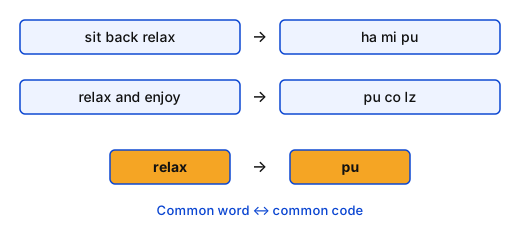
Q2499.
In a certain code language, ‘sit back relax’ is coded as ‘ha mi pu’ and ‘relax and enjoy’ is coded as ‘pu co lz’. How is ‘relax’ coded in the given language?
एक निश्चित कूट भाषा में, ‘sit back relax’ को ‘ha mi pu’ के रूप में कूटबद्ध किया जाता है और ‘relax and enjoy’ को ‘pu co lz’ के रूप में कूटबद्ध किया जाता है। दी गई भाषा में ‘relax’ को किस प्रकार कूटबद्ध किया जाता है?
  1. Ami
  2. Bpu
  3. Cha
  4. Dco
Show answer

Concept: A word common to two sentences gets the code common to both coded sentences.

  1. 'relax' is the only word in both sentences.
  2. 'pu' is the only code in both 'ha mi pu' and 'pu co lz'.
  3. So relax = pu.

Trick: Common word ↔ common code.

Answer: (B) pu

अवधारणा: दो वाक्यों में समान शब्द का कूट दोनों कूटित वाक्यों में समान होता है।

  1. 'relax' दोनों वाक्यों में एकमात्र समान शब्द है।
  2. 'pu' दोनों कूटों 'ha mi pu' और 'pu co lz' में समान है।
  3. अतः relax = pu

ट्रिक: समान शब्द ↔ समान कूट।

उत्तर: (B) pu

RRB NTPC Graduate CBT 1General Intelligence and ReasoningCoding-DecodingRRB NTPC Graduate CBT 1 2024 · 14 Jun Shift 2 →
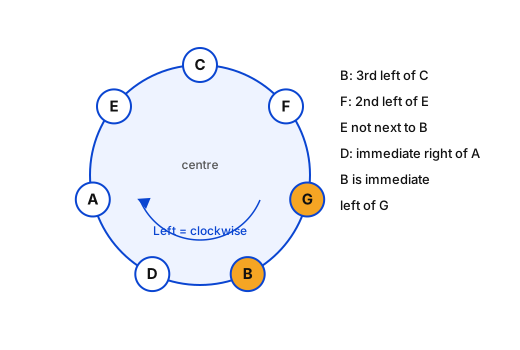
Q2500.
A, B, C, D, E, F and G are sitting around a circular table facing the centre. B sits third to the left of C. F sits second to the left of E. B is not an immediate neighbour of E. D sits to the immediate right of A. What is the position of B with respect to G?
A, B, C, D, E, F और G एक वृत्ताकार मेज़ के चारों ओर केंद्र की ओर मुख करके बैठे हैं। B, C के बाएँ से तीसरे स्थान पर बैठा है। F, E के बाएँ से दूसरे स्थान पर बैठा है। B, E का निकटतम पड़ोसी नहीं है। D, A के ठीक दाएँ बैठा है। G के सापेक्ष B का स्थान क्या है?
  1. ATo the immediate rightठीक दाएँ
  2. BTo the immediate leftठीक बाएँ
  3. CSecond to the leftबाएँ से दूसरा
  4. DThird to the leftबाएँ से तीसरा
Show answer

Concept: Facing the centre: left = clockwise, right = anticlockwise.

  1. Fix C; B is 3rd to the left of C.
  2. F is 2nd to the left of E and E is not next to B ⇒ E sits immediately right of C, F immediately left of C.
  3. D is immediate right of A ⇒ A and D take the two seats after B; G takes the seat between F and B.
  4. Moving clockwise from G, the next person is B ⇒ B is to the immediate left of G.

Trick: After fixing the two 'fixed-gap' pairs, only one seat is left — fill it and read the answer.

Answer: (B) To the immediate left

अवधारणा: केंद्र की ओर मुख: बाएँ = दक्षिणावर्त, दाएँ = वामावर्त।

  1. C को स्थिर करें; B, C के बाएँ तीसरा।
  2. F, E के बाएँ दूसरा और E, B का पड़ोसी नहीं ⇒ E, C के ठीक दाएँ; F, C के ठीक बाएँ।
  3. D, A के ठीक दाएँ ⇒ A और D, B के बाद की दो सीटों पर; G, F और B के बीच।
  4. G से दक्षिणावर्त अगला B है ⇒ B, G के ठीक बाएँ।

ट्रिक: निश्चित अंतर वाले युग्म रखने के बाद केवल एक सीट बचती है — भरें और उत्तर पढ़ें।

उत्तर: (B) To the immediate left

RRB NTPC Graduate CBT 1General Intelligence and ReasoningCircular Seating ArrangementRRB NTPC Graduate CBT 1 2024 · 14 Jun Shift 2 →