Question bank

Q&A: practice questions with answers

Search questions on any topic. Filter by exam category, exam, subject and topic, try the question, then open the answer and explanation.

Courses – airGurukul

7,100 questions found.

Q2541.
A man has invested ₹50,500 at a rate of 6% per annum simple interest for 2 years. Find the amount (in ₹) that he will receive after 2 years.
एक व्यक्ति ने ₹50,500 की राशि 6% वार्षिक साधारण ब्याज की दर पर 2 वर्षों के लिए निवेश की है। 2 वर्ष बाद उसे प्राप्त होने वाली मिश्रधन (₹ में) ज्ञात कीजिए।
  1. A57,560
  2. B6,060
  3. C56,560
  4. D7,060
Show answer

Concept: SI=P×R×T100 and Amount =P+SI.

  1. SI=50500×6×2100=505×12=6060
  2. Amount =50500+6060=56560

Trick: 2 years at 6% means 12% in total: 12% of 50500 =6060. Option ₹6,060 is only the interest, not the amount.

Answer: (C) ₹56,560

अवधारणा: SI=P×R×T100 तथा मिश्रधन =P+SI.

  1. SI=50500×6×2100=505×12=6060
  2. मिश्रधन (Amount) =50500+6060=56560

ट्रिक: 2 वर्ष × 6% = कुल 12%; 50500 का 12%=6060. ₹6,060 केवल ब्याज है, मिश्रधन नहीं।

उत्तर: (C) ₹56,560
RRB NTPC Graduate CBT 1MathematicsSimple InterestRRB NTPC Graduate CBT 1 2024 · 14 Jun Shift 1 →
Q2542.
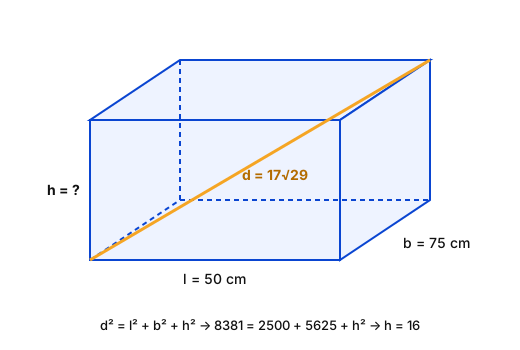
The length and breadth of a cuboid are 50 cm and 75 cm, respectively. If the length of the diagonal is 1729 cm, then what is the volume (in cm3) of the cuboid?
एक घनाभ की लंबाई और चौड़ाई क्रमशः 50 cm और 75 cm हैं। यदि विकर्ण की लंबाई 1729 cm है, तो घनाभ का आयतन (cm3 में) क्या है?
  1. A60,000
  2. B60,002
  3. C60,008
  4. D59,995
Show answer

Concept: Diagonal of a cuboid d=l2+b2+h2, Volume =l×b×h.

  1. d2=(1729)2=289×29=8381
  2. l2+b2=2500+5625=8125
  3. h2=8381−8125=256⇒h=16cm
  4. V=50×75×16=60000cm3

Trick: Square the diagonal first; 172=289 and 289×29=8381.

Answer: (A) 60000

अवधारणा: घनाभ का विकर्ण d=l2+b2+h2, आयतन =l×b×h.

  1. d2=(1729)2=289×29=8381
  2. l2+b2=2500+5625=8125
  3. h2=8381−8125=256⇒h=16cm
  4. V=50×75×16=60000cm3

ट्रिक: पहले विकर्ण का वर्ग करें: 172=289, 289×29=8381.

उत्तर: (A) 60000

RRB NTPC Graduate CBT 1MathematicsMensuration – CuboidRRB NTPC Graduate CBT 1 2024 · 14 Jun Shift 1 →
Q2543.
The nature of the roots of the quadratic equation 3x2 − 5x + 2 = 0 is:
द्विघात समीकरण 3x2 − 5x + 2 = 0 के मूलों की प्रकृति है:
  1. Aequal real rootsसमान वास्तविक मूल
  2. Binfinite number of rootsअनंत मूल
  3. Ctwo distinct real rootsदो भिन्न वास्तविक मूल
  4. Dcomplex rootsसम्मिश्र मूल
Show answer

Concept: For ax2+bx+c=0, discriminant D=b2−4ac: D>0 two distinct real roots, D=0 equal roots, D<0 complex roots.

  1. a=3, b=−5, c=2
  2. D=25−24=1>0
  3. So the roots are real and distinct (x=1, 23).

Trick: a+b+c=0 means x=1 is a root; other root =ca=23 – two different real roots.

Answer: (C) two distinct real roots

अवधारणा: ax2+bx+c=0 के लिए विविक्तकर (discriminant) D=b2−4ac: D>0 दो भिन्न वास्तविक मूल, D=0 समान मूल, D<0 सम्मिश्र मूल।

  1. a=3, b=−5, c=2
  2. D=25−24=1>0
  3. अतः मूल वास्तविक और भिन्न हैं (x=1, 23)।

ट्रिक: a+b+c=0 हो तो x=1 एक मूल; दूसरा मूल =ca=23।

उत्तर: (C) two distinct real roots

RRB NTPC Graduate CBT 1MathematicsQuadratic EquationsRRB NTPC Graduate CBT 1 2024 · 14 Jun Shift 1 →
Q2544.
If the eight-digit number 59044p22 is divisible by 6, then the maximum value of p is:
यदि आठ अंकों की संख्या 59044p22, 6 से विभाज्य है, तो p का अधिकतम मान है:
  1. A6
  2. B8
  3. C7
  4. D3
Show answer

Concept: A number is divisible by 6 if it is divisible by both 2 and 3.

  1. Last digit 2 is even → divisible by 2 for any p.
  2. Digit sum =5+9+0+4+4+p+2+2=26+p.
  3. 26+p must be a multiple of 3 → p=1,4,7.
  4. Maximum p = 7.

Trick: Next multiple of 3 after 26 is 27, then 30, 33 → p=1,4,7; pick the largest single digit.

Answer: (C) 7

अवधारणा: कोई संख्या 6 से विभाज्य है यदि वह 2 और 3 दोनों से विभाज्य हो।

  1. अंतिम अंक 2 सम है → p कुछ भी हो, 2 से विभाज्य।
  2. अंकों का योग =5+9+0+4+4+p+2+2=26+p.
  3. 26+p को 3 का गुणज होना चाहिए → p=1,4,7.
  4. p का अधिकतम मान = 7.

ट्रिक: 26 के बाद 3 के गुणज 27, 30, 33 → p=1,4,7; सबसे बड़ा अंक चुनें।

उत्तर: (C) 7

RRB NTPC Graduate CBT 1MathematicsDivisibility RulesRRB NTPC Graduate CBT 1 2024 · 14 Jun Shift 1 →
Q2545.
Two taps can fill a cistern in 2 hours and 81 hours, respectively. A third tap can empty it in 81 hours. How long (in hours) will it take to fill the empty cistern, if all of the taps are opened together?
दो नल एक टंकी को क्रमशः 2 घंटे और 81 घंटे में भर सकते हैं। एक तीसरा नल उसे 81 घंटे में खाली कर सकता है। यदि सभी नल एक साथ खोल दिए जाएँ, तो खाली टंकी को भरने में कितना समय (घंटों में) लगेगा?
  1. A3
  2. B4
  3. C5
  4. D2
Show answer

Concept: Net work per hour = sum of filling rates − emptying rate.

  1. Rates: +12, +181, −181
  2. Net =12+181−181=12
  3. Time =2hours

Trick: The second filling tap and the emptying tap have the same time (81 h), so they cancel – only the 2-hour tap matters.

Answer: (D) 2

अवधारणा: प्रति घंटे शुद्ध कार्य = भरने वाले नलों की दर − खाली करने वाले नल की दर।

  1. दरें: +12, +181, −181
  2. शुद्ध दर =12+181−181=12
  3. समय =2hours

ट्रिक: दूसरा भरने वाला और खाली करने वाला नल दोनों 81 घंटे के हैं, एक-दूसरे को निरस्त करते हैं – केवल 2 घंटे वाला नल बचा।

उत्तर: (D) 2

RRB NTPC Graduate CBT 1MathematicsPipes and CisternsRRB NTPC Graduate CBT 1 2024 · 14 Jun Shift 1 →
Q2546.
Evaluate: 30 - [30 - {30 - (30 - 30 × 4)}]
मान ज्ञात कीजिए: 30 - [30 - {30 - (30 - 30 × 4)}]
  1. A141
  2. B118
  3. C120
  4. D132
Show answer

Concept: Solve innermost brackets first; inside a bracket do multiplication before subtraction.

  1. 30×4=120, so (30−120)=−90
  2. {30−(−90)}=120
  3. [30−120]=−90
  4. 30−(−90)=120

Trick: The value keeps alternating between −90 and 120 – count the brackets carefully.

Answer: (C) 120

अवधारणा: सबसे भीतरी कोष्ठक पहले हल करें; कोष्ठक के अंदर गुणा, घटाव से पहले।

  1. 30×4=120, अतः (30−120)=−90
  2. {30−(−90)}=120
  3. [30−120]=−90
  4. 30−(−90)=120

ट्रिक: मान बारी-बारी से −90 और 120 होता है – कोष्ठक ध्यान से गिनें।

उत्तर: (C) 120

RRB NTPC Graduate CBT 1MathematicsSimplification (BODMAS)RRB NTPC Graduate CBT 1 2024 · 14 Jun Shift 1 →
Q2547.
Find the value of 385+213+144.
385+213+144 का मान ज्ञात कीजिए।
  1. A23
  2. B20
  3. C19
  4. D24
Show answer

Concept: Evaluate a nested root from the innermost root outward.

  1. 144=12
  2. 213+12=225=15
  3. 385+15=400=20

Trick: Each step should give a perfect square – if not, recheck the previous step.

Answer: (B) 20

अवधारणा: नेस्टेड वर्गमूल को सबसे भीतरी मूल से बाहर की ओर हल करें।

  1. 144=12
  2. 213+12=225=15
  3. 385+15=400=20

ट्रिक: हर चरण में पूर्ण वर्ग आना चाहिए – न आए तो पिछला चरण जाँचें।

उत्तर: (B) 20

RRB NTPC Graduate CBT 1MathematicsSquare Roots – NestedRRB NTPC Graduate CBT 1 2024 · 14 Jun Shift 1 →
Q2548.
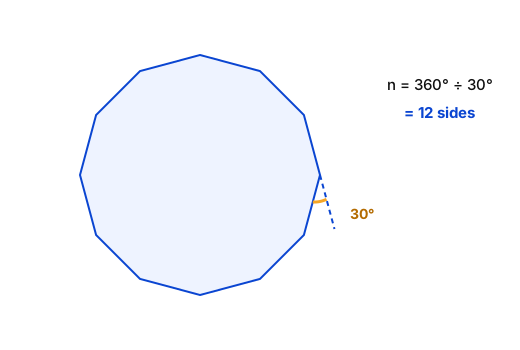
If the measure of each exterior angle of a regular polygon is 30°, then the number of sides of the polygon is:
यदि एक सम बहुभुज के प्रत्येक बाह्य कोण की माप 30° है, तो बहुभुज की भुजाओं की संख्या है:
  1. A14
  2. B16
  3. C12
  4. D10
Show answer

Concept: Sum of exterior angles of any polygon =360∘, so for a regular polygon n=360∘exterior angle.

  1. n=360∘30∘=12
  2. Check: interior angle =180∘−30∘=150∘ (regular dodecagon).

Trick: Exterior angle × sides =360∘ always.

Answer: (C) 12

अवधारणा: किसी भी बहुभुज के बाह्य कोणों का योग =360∘, अतः सम बहुभुज में n=360∘बाह्य कोण.

  1. n=360∘30∘=12
  2. जाँच: अंतः कोण =180∘−30∘=150∘ (सम द्वादशभुज)।

ट्रिक: बाह्य कोण × भुजाएँ =360∘ सदैव।

उत्तर: (C) 12

RRB NTPC Graduate CBT 1MathematicsPolygonsRRB NTPC Graduate CBT 1 2024 · 14 Jun Shift 1 →
Q2549.
David spends 55% of his income. If he saves ₹36,000, then his income (in ₹) is:
डेविड अपनी आय का 55% खर्च करता है। यदि वह ₹36,000 की बचत करता है, तो उसकी आय (₹ में) है:
  1. A80,000
  2. B81,000
  3. C19,800
  4. D79,000
Show answer

Concept: Savings % =100%− expenditure %.

  1. Savings =100%−55%=45% of income
  2. 45% of income=36000
  3. Income =36000×10045=80000

Trick: 3600045=800 is 1%, so 100% = 80,000.

Answer: (A) ₹80,000

अवधारणा: बचत % =100%− व्यय %.

  1. बचत =100%−55%=45% आय का
  2. आय का 45%=36000
  3. आय =36000×10045=80000

ट्रिक: 3600045=800 = 1%, अतः 100% = 80,000.

उत्तर: (A) ₹80,000

RRB NTPC Graduate CBT 1MathematicsPercentage – Income & SavingsRRB NTPC Graduate CBT 1 2024 · 14 Jun Shift 1 →
Q2550.
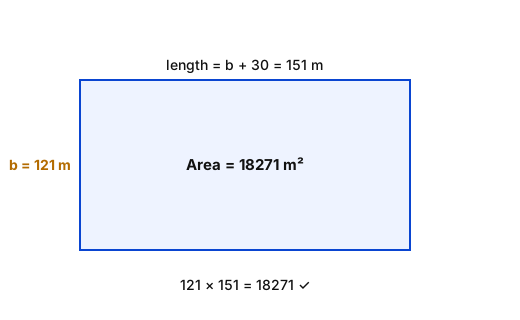
The length of a rectangular pitch is 30 m more than its breadth. Its area is 18,271 m2. Its breadth (in m) is:
एक आयताकार पिच की लंबाई उसकी चौड़ाई से 30 m अधिक है। इसका क्षेत्रफल 18,271 m2 है। इसकी चौड़ाई (m में) है:
  1. A131
  2. B121
  3. C113
  4. D124
Show answer

Concept: Area of rectangle =l×b; here l=b+30.

  1. b(b+30)=18271
  2. Since 18271≈135, b≈135−15=120; try b=121.
  3. 121×151=18271 ✓
  4. So breadth = 121 m.

Trick: Check options by unit digit: b×(b+30) must end in 1 → b ends in 1 → only 131 or 121; 131×161=21091 ✗.

Answer: (B) 121

अवधारणा: आयत का क्षेत्रफल =l×b; यहाँ l=b+30.

  1. b(b+30)=18271
  2. 18271≈135, अतः b≈135−15=120; b=121 जाँचें।
  3. 121×151=18271 ✓
  4. अतः चौड़ाई = 121 m.

ट्रिक: इकाई अंक से विकल्प जाँचें: गुणनफल का अंतिम अंक 1 → b का अंतिम अंक 1 → 131 या 121; 131×161=21091 ✗.

उत्तर: (B) 121

RRB NTPC Graduate CBT 1MathematicsMensuration – RectangleRRB NTPC Graduate CBT 1 2024 · 14 Jun Shift 1 →
Q2551.
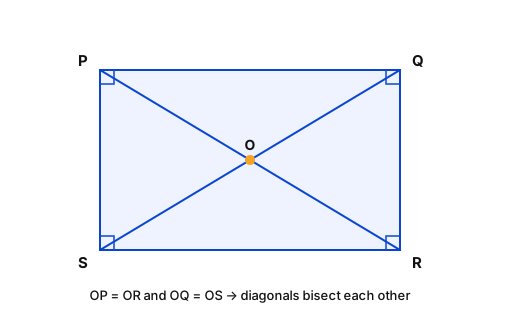
Which of the following statements is FALSE if PQRS is a rectangle?
यदि PQRS एक आयत है, तो निम्नलिखित में से कौन-सा कथन असत्य है?
  1. AThe diagonals of rectangle PQRS do not bisect each otherआयत PQRS के विकर्ण एक-दूसरे को समद्विभाजित नहीं करते हैं
  2. B∠P=∠Q=∠R=∠S=90∘
  3. CDiagonal PR = Diagonal SQविकर्ण PR = विकर्ण SQ
  4. DPQ = RS and PS = QR
Show answer

Concept: A rectangle is a parallelogram with all angles 90°: opposite sides equal, diagonals equal and bisecting each other.

  1. All four angles are 90° – true.
  2. Diagonals of a rectangle are equal (PR = SQ) – true.
  3. Opposite sides are equal (PQ = RS, PS = QR) – true.
  4. Diagonals of every parallelogram, hence of a rectangle, bisect each other – so “do not bisect” is FALSE.

Trick: Every parallelogram’s diagonals bisect each other; rectangle adds “equal diagonals”.

Answer: (A) The diagonals of rectangle PQRS do not bisect each other

अवधारणा: आयत एक समांतर चतुर्भुज है जिसके सभी कोण 90° हैं: सम्मुख भुजाएँ बराबर, विकर्ण बराबर और एक-दूसरे को समद्विभाजित करते हैं।

  1. चारों कोण 90° – सत्य।
  2. आयत के विकर्ण बराबर (PR = SQ) – सत्य।
  3. सम्मुख भुजाएँ बराबर (PQ = RS, PS = QR) – सत्य।
  4. हर समांतर चतुर्भुज (अतः आयत) के विकर्ण एक-दूसरे को समद्विभाजित करते हैं – “नहीं करते” कथन असत्य है।

ट्रिक: समांतर चतुर्भुज के विकर्ण समद्विभाजित करते हैं; आयत में वे बराबर भी होते हैं।

उत्तर: (A) The diagonals of rectangle PQRS do not bisect each other

RRB NTPC Graduate CBT 1MathematicsGeometry – Rectangle PropertiesRRB NTPC Graduate CBT 1 2024 · 14 Jun Shift 1 →
Q2552.
If 18 : A :: A : 128, find the positive value of A.
यदि 18 : A :: A : 128 है, तो A का धनात्मक मान ज्ञात कीजिए।
  1. A50
  2. B48
  3. C45
  4. D47
Show answer

Concept: If a:x::x:b, then x is the mean proportional: x2=ab.

  1. A2=18×128=2304
  2. A=2304=48

Trick: 18×128=(9×2)×(2×64)=36×64, so A=6×8=48.

Answer: (B) 48

अवधारणा: यदि a:x::x:b हो तो x मध्यानुपाती है: x2=ab.

  1. A2=18×128=2304
  2. A=2304=48

ट्रिक: 18×128=36×64, अतः A=6×8=48.

उत्तर: (B) 48

RRB NTPC Graduate CBT 1MathematicsRatio – Mean ProportionalRRB NTPC Graduate CBT 1 2024 · 14 Jun Shift 1 →
Q2553.
The marked price of a touchscreen tablet is ₹500. It sells with two successive discounts of 20% and 25%. An additional 19% discount is given on cash payment. What is the selling price (in ₹) of the touchscreen tablet on cash payment?
एक टचस्क्रीन टैबलेट का अंकित मूल्य ₹500 है। इसे 20% और 25% की दो क्रमिक छूटों पर बेचा जाता है। नकद भुगतान पर 19% की अतिरिक्त छूट दी जाती है। नकद भुगतान पर टचस्क्रीन टैबलेट का विक्रय मूल्य (₹ में) क्या है?
  1. A246
  2. B242
  3. C245
  4. D243
Show answer

Concept: Successive discounts multiply: SP=MP×(1−d1)(1−d2)(1−d3).

  1. 500×0.80=400
  2. 400×0.75=300
  3. 300×0.81=243

Trick: 19% of 300 =57; 300−57=243.

Answer: (D) ₹243

अवधारणा: क्रमागत छूट गुणा होती हैं: SP=MP×(1−d1)(1−d2)(1−d3).

  1. 500×0.80=400
  2. 400×0.75=300
  3. 300×0.81=243

ट्रिक: 300 का 19%=57; 300−57=243.

उत्तर: (D) ₹243

RRB NTPC Graduate CBT 1MathematicsSuccessive DiscountsRRB NTPC Graduate CBT 1 2024 · 14 Jun Shift 1 →
Q2554.
The average price of three items of furniture is ₹15,165. If their prices are in the ratio 3 : 5 : 7, the price of the costliest item (in ₹) is:
फ़र्नीचर की तीन वस्तुओं का औसत मूल्य ₹15,165 है। यदि उनके मूल्य 3 : 5 : 7 के अनुपात में हैं, तो सबसे महँगी वस्तु का मूल्य (₹ में) है:
  1. A5,055
  2. B9,099
  3. C21,231
  4. D7,077
Show answer

Concept: Total = average × number of items; share the total in the given ratio.

  1. Total =15165×3=45495
  2. Ratio sum =3+5+7=15; one part =4549515=3033
  3. Costliest =7×3033=21231

Trick: Average of 3 items = 5 parts (middle term), so 1 part =151655=3033.

Answer: (C) ₹21,231

अवधारणा: कुल = औसत × वस्तुओं की संख्या; कुल को दिए अनुपात में बाँटें।

  1. कुल =15165×3=45495
  2. अनुपात योग =15; एक भाग =4549515=3033
  3. सबसे महँगी =7×3033=21231

ट्रिक: 3 वस्तुओं का औसत = 5 भाग, अतः 1 भाग =151655=3033.

उत्तर: (C) ₹21,231

RRB NTPC Graduate CBT 1MathematicsAverage and RatioRRB NTPC Graduate CBT 1 2024 · 14 Jun Shift 1 →
Q2555.
When the difference between compound interest, compounded annually, and simple interest for three years is ₹217 at 10% interest per annum, the principal is ₹_____.
जब 10% वार्षिक ब्याज दर पर तीन वर्षों के लिए चक्रवृद्धि ब्याज (वार्षिक रूप से संयोजित) और साधारण ब्याज का अंतर ₹217 है, तो मूलधन ₹_____ है।
  1. A8,200
  2. B7,420
  3. C7,000
  4. D6,425
Show answer

Concept: For 3 years: CI−SI=P(R100)2(3+R100).

  1. R=10%: CI−SI=P×1100×3.1=0.031P
  2. 0.031P=217
  3. P=2170.031=7000

Trick: At 10% for 3 years the difference is always 3.1% of P: 2173.1×100=7000.

Answer: (C) ₹7,000

अवधारणा: 3 वर्ष के लिए: CI−SI=P(R100)2(3+R100).

  1. R=10%: CI−SI=P×1100×3.1=0.031P
  2. 0.031P=217
  3. P=2170.031=7000

ट्रिक: 10% पर 3 वर्ष का अंतर सदैव P का 3.1% होता है: 2173.1×100=7000.

उत्तर: (C) ₹7,000

RRB NTPC Graduate CBT 1MathematicsCI – SI DifferenceRRB NTPC Graduate CBT 1 2024 · 14 Jun Shift 1 →
Q2556.
A train overtakes two persons walking along a railway track. The first one walks at 12.6 km/hr. The other one walks at 30.6 km/hr. The train takes 19.8 and 25.8 seconds, respectively, to overtake them. What is the speed of the train if both the persons are walking in the same direction as the train?
एक रेलगाड़ी रेलवे ट्रैक के साथ-साथ चल रहे दो व्यक्तियों से आगे निकलती है। पहला व्यक्ति 12.6 km/hr की चाल से चलता है। दूसरा व्यक्ति 30.6 km/hr की चाल से चलता है। रेलगाड़ी उनसे आगे निकलने में क्रमशः 19.8 और 25.8 सेकंड लेती है। यदि दोनों व्यक्ति रेलगाड़ी की दिशा में ही चल रहे हों, तो रेलगाड़ी की चाल क्या है?
  1. A94 km/hr
  2. B96 km/hr
  3. C90 km/hr
  4. D80 km/hr
Show answer

Concept: Overtaking a person moving in the same direction: train length =(vtrain−vman)×t.

  1. 12.6km/h=3.5m/s, 30.6km/h=8.5m/s
  2. (v−3.5)×19.8=(v−8.5)×25.8
  3. 25.8v−19.8v=219.3−69.3⇒6v=150⇒v=25m/s
  4. 25×185=90km/h

Trick: Option check: 90 km/h gives (25−3.5)×19.8=425.7 and (25−8.5)×25.8=425.7 – same length ✓.

Answer: (C) 90 km/hr

अवधारणा: एक ही दिशा में चल रहे व्यक्ति को पार करना: ट्रेन की लंबाई =(vtrain−vman)×t.

  1. 12.6km/h=3.5m/s, 30.6km/h=8.5m/s
  2. (v−3.5)×19.8=(v−8.5)×25.8
  3. 25.8v−19.8v=219.3−69.3⇒6v=150⇒v=25m/s
  4. 25×185=90km/h

ट्रिक: विकल्प जाँच: 90 km/h पर (25−3.5)×19.8=425.7 और (25−8.5)×25.8=425.7 – लंबाई समान ✓.

उत्तर: (C) 90 km/hr

RRB NTPC Graduate CBT 1MathematicsTrains – Relative SpeedRRB NTPC Graduate CBT 1 2024 · 14 Jun Shift 1 →
Q2557.
The average salary of all the workers in a factory is ₹14,000. The average salary of 80 skilled workers is ₹15,000 and the average salary of the remaining workers is ₹12,000. Find the total number of workers in the factory.
एक कारखाने के सभी श्रमिकों का औसत वेतन ₹14,000 है। 80 कुशल श्रमिकों का औसत वेतन ₹15,000 है और शेष श्रमिकों का औसत वेतन ₹12,000 है। कारखाने में श्रमिकों की कुल संख्या ज्ञात कीजिए।
  1. A140
  2. B150
  3. C110
  4. D120
Show answer

Concept: Weighted average: surplus of one group above the overall average = deficit of the other group.

  1. Skilled: 80 workers, each ₹1,000 above average → surplus = 80×1000=80000.
  2. Others are ₹2,000 below average → number =800002000=40.
  3. Total workers =80+40=120.

Trick: Alligation: 15000 and 12000 around 14000 give ratio 2:1 → 80:40.

Answer: (D) 120

अवधारणा: भारित औसत: एक समूह का औसत से अधिक भाग = दूसरे समूह का कम भाग।

  1. कुशल 80 कर्मचारी, प्रत्येक ₹1,000 अधिक → कुल अधिक =80000।
  2. शेष प्रत्येक ₹2,000 कम → संख्या =800002000=40।
  3. कुल =80+40=120।

ट्रिक: एलिगेशन (alligation): अनुपात 2:1 → 80:40।

उत्तर: (D) 120

RRB NTPC Graduate CBT 1MathematicsAverage (weighted)RRB NTPC Graduate CBT 1 2024 · 14 Jun Shift 1 →
Q2558.
If cotθ=78, then evaluate 8(1+sinθ)(1−sinθ)7(1+cosθ)(1−cosθ).
यदि cotθ=78 है, तो 8(1+sinθ)(1−sinθ)7(1+cosθ)(1−cosθ) का मान ज्ञात कीजिए।
  1. A78
  2. B4964
  3. C6449
  4. D87
Show answer

Concept: (1+sinθ)(1−sinθ)=cos2θ and (1+cosθ)(1−cosθ)=sin2θ.

  1. Expression =8cos2θ7sin2θ=87cot2θ.
  2. cot2θ=4964.
  3. Value =87×4964=78.

Trick: Always reduce (1±sin)(1∓sin) type products to squares first – no need to find sinθ.

Answer: (A) 78

अवधारणा: (1+sinθ)(1−sinθ)=cos2θ तथा (1+cosθ)(1−cosθ)=sin2θ।

  1. व्यंजक =8cos2θ7sin2θ=87cot2θ।
  2. cot2θ=4964।
  3. मान =87×4964=78।

ट्रिक: ऐसे गुणनफल पहले वर्ग में बदलें – sinθ निकालने की ज़रूरत नहीं।

उत्तर: (A) 78

RRB NTPC Graduate CBT 1MathematicsTrigonometric identitiesRRB NTPC Graduate CBT 1 2024 · 14 Jun Shift 1 →
Q2559.
The least number which, when diminished by 5, is divisible by 20, 15, 14 and 22 is:
वह छोटी-से-छोटी संख्या, जिसमें से 5 घटाने पर वह 20, 15, 14 और 22 से विभाज्य हो, है:
  1. A4578
  2. B4612
  3. C4625
  4. D4586
Show answer

Concept: Least number which leaves remainder r on division by several numbers =LCM+r.

  1. 20=22×5, 15=3×5, 14=2×7, 22=2×11.
  2. LCM=22×3×5×7×11=4620.
  3. Required number =4620+5=4625.

Trick: Check options: only 4625−5=4620 ends in 0 and is divisible by 3, 7 and 11.

Answer: (C) 4625

अवधारणा: कई संख्याओं से भाग देने पर r शेष बचे, ऐसी न्यूनतम संख्या =LCM+r।

  1. 20=22×5, 15=3×5, 14=2×7, 22=2×11।
  2. LCM=4620।
  3. अभीष्ट संख्या =4620+5=4625।

ट्रिक: विकल्पों में से 5 घटाकर देखें – केवल 4620 ही सब से विभाज्य है।

उत्तर: (C) 4625

RRB NTPC Graduate CBT 1MathematicsLCMRRB NTPC Graduate CBT 1 2024 · 14 Jun Shift 1 →
Q2560.
A water tank can be filled in 48 minutes by using 4 pipes of the same capacity. In how many minutes (rounded off to two decimal places) will the water tank be filled if we use 26 pipes of the same capacity as above?
समान क्षमता वाले 4 पाइपों का उपयोग करके एक पानी की टंकी को 48 मिनट में भरा जा सकता है। यदि हम उपरोक्त के समान क्षमता वाले 26 पाइपों का उपयोग करें, तो पानी की टंकी कितने मिनट में (दो दशमलव स्थानों तक पूर्णांकित) भरेगी?
  1. A3.17
  2. B16.48
  3. C7.38
  4. D11.99
Show answer

Concept: Pipes × time = constant work (pipe-minutes).

  1. Work =4×48=192 pipe-minutes.
  2. With 26 pipes: time =19226=7.3846…
  3. Rounded to two decimals → 7.38 minutes.

Trick: More pipes → less time (inverse proportion): T2=P1T1P2.

Answer: (C) 7.38

अवधारणा: पाइपों की संख्या × समय = स्थिर कार्य।

  1. कार्य =4×48=192 पाइप-मिनट।
  2. 26 पाइप से समय =19226=7.3846…
  3. दो दशमलव तक → 7.38 मिनट।

ट्रिक: पाइप बढ़ें तो समय घटे (व्युत्क्रम अनुपात): T2=P1T1P2।

उत्तर: (C) 7.38

RRB NTPC Graduate CBT 1MathematicsPipes and cisternsRRB NTPC Graduate CBT 1 2024 · 14 Jun Shift 1 →