Question bank

Q&A: practice questions with answers

Search questions on any topic. Filter by exam category, exam, subject and topic, try the question, then open the answer and explanation.

Courses – airGurukul

7,100 questions found.

Q2661.
A man spends 75% of his monthly salary on house rent. If every month, he also spends ₹653 on conveyance and ₹6,229 on grocery and saves the remaining ₹446, his monthly salary is:
एक व्यक्ति अपने मासिक वेतन का 75% मकान किराए पर खर्च करता है। यदि वह प्रत्येक माह ₹653 परिवहन पर और ₹6,229 किराने के सामान पर भी खर्च करता है और शेष ₹446 बचाता है, तो उसका मासिक वेतन है:
  1. A₹29,312
  2. B₹29,308
  3. C₹29,251
  4. D₹29,230
Show answer

Concept: If 75% goes to rent, the other 25% covers all remaining expenses and savings.

  1. Remaining amount =653+6229+446=7328 rupees.
  2. 25% of salary =7328.
  3. Salary =7328×4=29312.

Trick: 25%=14, so just multiply the leftover by 4.

Answer: (A) ₹29,312

अवधारणा: यदि 75% किराए पर जाता है, तो शेष 25% से बाकी खर्च और बचत होती है।

  1. शेष राशि =653+6229+446=7328 रुपये।
  2. वेतन का 25%=7328।
  3. वेतन =7328×4=29312 रुपये।

ट्रिक: 25%=14, इसलिए शेष राशि को 4 से गुणा करें।

उत्तर: (A) ₹29,312
RRB NTPC Graduate CBT 1MathematicsPercentage – Income & ExpenditureRRB NTPC Graduate CBT 1 2024 · 13 Jun Shift 3 →
Q2662.
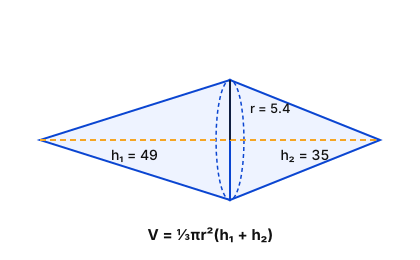
731 metallic cubes with a side length of 3.6 cm are available to be melted and formed into a machine part consisting of two solid cones with a base radius of 5.4 cm, joined at their bases. The heights of the cones are 49 cm and 35 cm, respectively. How many cubes will be surplus after the formation of the two cones? (Take π = 3.14)
3.6 cm भुजा वाले 731 धात्विक घन उपलब्ध हैं, जिन्हें पिघलाकर एक मशीन का पुर्जा बनाया जाना है, जिसमें 5.4 cm आधार त्रिज्या वाले दो ठोस शंकु अपने आधारों पर जुड़े हुए हैं। शंकुओं की ऊँचाइयाँ क्रमशः 49 cm और 35 cm हैं। दोनों शंकुओं के निर्माण के बाद कितने घन शेष बचेंगे? (π = 3.14 लीजिए)
  1. A666
  2. B680
  3. C676
  4. D668
Show answer

Concept: Volume is conserved on melting; number of cubes needed must be a whole number (round up).

  1. Volume of one cube =3.63=46.656cm3.
  2. Two cones =13πr2(h1+h2)=13×3.14×29.16×84=2563.7472cm3.
  3. Cubes needed =2563.747246.656≈54.95, so 55 cubes are used.
  4. Surplus =731−55=676.

Trick: Joined cones with a common base: add the heights, 13πr2(h1+h2).

Answer: (C) 676

अवधारणा: पिघलाने पर आयतन समान रहता है; आवश्यक घनों की संख्या पूर्णांक होगी (ऊपर की ओर पूर्णांकित)।

  1. एक घन का आयतन =3.63=46.656cm3।
  2. दो शंकु =13πr2(h1+h2)=13×3.14×29.16×84=2563.7472cm3।
  3. घन चाहिए =2563.747246.656≈54.95, अर्थात 55 घन।
  4. बचे घन =731−55=676।

ट्रिक: समान आधार वाले दो शंकु: ऊँचाइयाँ जोड़ें, 13πr2(h1+h2)।

उत्तर: (C) 676

RRB NTPC Graduate CBT 1MathematicsMensuration – Cone and CubeRRB NTPC Graduate CBT 1 2024 · 13 Jun Shift 3 →
Q2663.
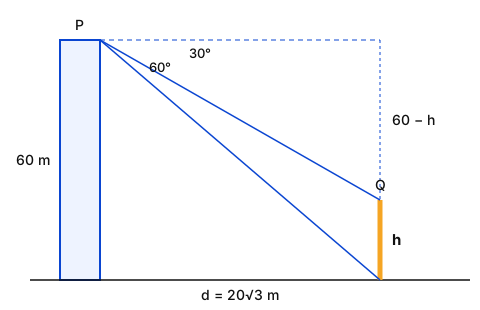
From the top of a 60 m high building, the angles of depression of the top and bottom of a lamp post are 30° and 60°, respectively. Find the height of the lamp post.
60 m ऊँची एक इमारत के शीर्ष से, एक लैंप पोस्ट के शीर्ष और आधार के अवनमन कोण क्रमशः 30° और 60° हैं। लैंप पोस्ट की ऊँचाई ज्ञात कीजिए।
  1. A40m
  2. B60m
  3. C402m
  4. D603m
Show answer

Concept: Angle of depression from the top equals the angle of elevation at that point; use tanθ=oppositeadjacent.

  1. Bottom of post (60°): d=60tan60∘=603=203m.
  2. Top of post (30°): 60−h=dtan30∘=203×13=20.
  3. h=60−20=40m.

Trick: With depressions 30° and 60°, the post is 23 of the building: 23×60=40.

Answer: (A) 40m

अवधारणा: शीर्ष से अवनमन कोण = उस बिंदु पर उन्नयन कोण; tanθ=लंबआधार।

  1. खंभे के आधार (60°): d=60tan60∘=203m।
  2. खंभे का शीर्ष (30°): 60−h=dtan30∘=20।
  3. h=60−20=40m।

ट्रिक: 30° और 60° अवनमन पर खंभा भवन का 23 होता है: 23×60=40।

उत्तर: (A) 40m

RRB NTPC Graduate CBT 1MathematicsHeights and DistancesRRB NTPC Graduate CBT 1 2024 · 13 Jun Shift 3 →
Q2664.
The percentage profit earned by selling an article for ₹3,471 is equal to the percentage loss incurred by selling the same article for ₹2,577. At what price should the article be sold (in ₹) to make a 25% profit?
किसी वस्तु को ₹3,471 में बेचने पर अर्जित प्रतिशत लाभ, उसी वस्तु को ₹2,577 में बेचने पर हुई प्रतिशत हानि के बराबर है। 25% लाभ अर्जित करने के लिए वस्तु को किस मूल्य (₹ में) पर बेचा जाना चाहिए?
  1. A3,783
  2. B3,780
  3. C3,778
  4. D3,781
Show answer

Concept: If profit % = loss % for two selling prices, CP is their average.

  1. CP=3471+25772=60482=3024.
  2. For 25% profit: SP=3024×125100=3780.

Trick: Equal profit and loss % → CP = mean of the two SPs.

Answer: (B) 3,780

अवधारणा: यदि दो विक्रय मूल्यों पर लाभ % = हानि %, तो क्रय मूल्य उनका औसत होता है।

  1. CP=3471+25772=3024।
  2. 25% लाभ के लिए: SP=3024×125100=3780।

ट्रिक: समान लाभ व हानि % → CP = दोनों SP का औसत।

उत्तर: (B) 3,780

RRB NTPC Graduate CBT 1MathematicsProfit and LossRRB NTPC Graduate CBT 1 2024 · 13 Jun Shift 3 →
Q2665.
If 2.5 : 40.6 :: 40.6 : x, then find the value of x.
यदि 2.5 : 40.6 :: 40.6 : x है, तो x का मान ज्ञात कीजिए।
  1. A665.032
  2. B658.357
  3. C655.425
  4. D659.344
Show answer

Concept: In a:b::b:x, b is the mean proportional, so b2=a×x.

  1. 40.62=2.5×x.
  2. 40.62=1648.36.
  3. x=1648.362.5=659.344.

Trick: Dividing by 2.5 = multiplying by 0.4: 1648.36×0.4=659.344.

Answer: (D) 659.344

अवधारणा: a:b::b:x में b मध्यानुपाती है, अतः b2=a×x।

  1. 40.62=2.5×x।
  2. 40.62=1648.36।
  3. x=1648.362.5=659.344।

ट्रिक: 2.5 से भाग = 0.4 से गुणा: 1648.36×0.4=659.344।

उत्तर: (D) 659.344

RRB NTPC Graduate CBT 1MathematicsProportionRRB NTPC Graduate CBT 1 2024 · 13 Jun Shift 3 →
Q2666.
Mahesh borrowed a sum of ₹14,000 at a certain rate of simple interest for 4 years. If he paid an interest of ₹3,500 at the end of the period at x% per annum rate of interest, the value of x is:
महेश ने साधारण ब्याज की एक निश्चित दर पर 4 वर्षों के लिए ₹14,000 की राशि उधार ली। यदि उसने x% वार्षिक ब्याज दर पर अवधि के अंत में ₹3,500 ब्याज का भुगतान किया, तो x का मान है:
  1. A8.25
  2. B6.25
  3. C5.25
  4. D7.25
Show answer

Concept: SI=P×R×T100.

  1. 3500=14000×x×4100=560x.
  2. x=3500560=6.25.

Trick: Total interest is 350014000=25% in 4 years → 254=6.25% p.a.

Answer: (B) 6.25

अवधारणा: SI=P×R×T100।

  1. 3500=14000×x×4100=560x।
  2. x=3500560=6.25।

ट्रिक: 4 वर्षों में कुल ब्याज 350014000=25% → प्रति वर्ष 254=6.25%।

उत्तर: (B) 6.25

RRB NTPC Graduate CBT 1MathematicsSimple InterestRRB NTPC Graduate CBT 1 2024 · 13 Jun Shift 3 →
Q2667.
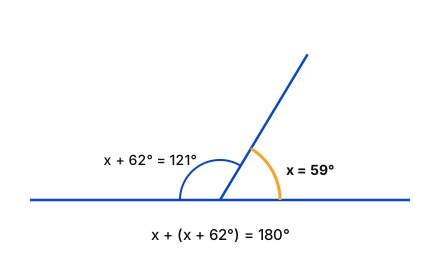
The larger of two supplementary angles is 62° more than the smaller one. The smaller angle (in degree) is:
दो संपूरक कोणों में से बड़ा कोण छोटे कोण से 62° अधिक है। छोटा कोण (डिग्री में) है:
  1. A65°
  2. B59°
  3. C57°
  4. D68°
Show answer

Concept: Supplementary angles add up to 180∘.

  1. Let the smaller angle be x; larger =x+62∘.
  2. x+x+62∘=180∘⇒2x=118∘.
  3. x=59∘ (larger =121∘).

Trick: Smaller =180∘−62∘2=59∘.

Answer: (B) 59∘

अवधारणा: संपूरक कोणों का योग 180∘ होता है।

  1. छोटा कोण x; बड़ा =x+62∘।
  2. x+x+62∘=180∘⇒2x=118∘।
  3. x=59∘ (बड़ा =121∘)।

ट्रिक: छोटा कोण =180∘−62∘2=59∘।

उत्तर: (B) 59∘

RRB NTPC Graduate CBT 1MathematicsGeometry – AnglesRRB NTPC Graduate CBT 1 2024 · 13 Jun Shift 3 →
Q2668.
The marked price of a sofa is ₹578, which is 34% above the cost price. If the profit percentage is 10%, find the discount percentage (rounded off to two decimal places).
एक सोफ़े का अंकित मूल्य ₹578 है, जो क्रय मूल्य से 34% अधिक है। यदि लाभ प्रतिशत 10% है, तो छूट प्रतिशत (दो दशमलव स्थानों तक पूर्णांकित) ज्ञात कीजिए।
  1. A20.61%
  2. B17.91%
  3. C21.84%
  4. D15.83%
Show answer

Concept: Take CP =100: MP and SP become simple percentages.

  1. MP =134 (34% above CP); SP =110 (10% profit).
  2. Discount =134−110=24.
  3. Discount %=24134×100≈17.91%.
  4. (Check: CP =5781.34≈431.34, SP ≈474.48, discount ≈103.52 on 578.)

Trick: Discount %=M−P100+M×100=34−10134×100.

Answer: (B) 17.91%

अवधारणा: CP =100 मानें: MP और SP सीधे प्रतिशत बन जाते हैं।

  1. MP =134 (CP से 34% अधिक); SP =110 (10% लाभ)।
  2. छूट =134−110=24।
  3. छूट %=24134×100≈17.91%।
  4. (जाँच: CP ≈431.34, SP ≈474.48, 578 पर छूट ≈103.52)।

ट्रिक: छूट %=M−P100+M×100=24134×100।

उत्तर: (B) 17.91%

RRB NTPC Graduate CBT 1MathematicsDiscount and ProfitRRB NTPC Graduate CBT 1 2024 · 13 Jun Shift 3 →
Q2669.
M is inversely proportional to N. If M is 18, then N is 10. If N = 9, then what is the value of M?
M, N के व्युत्क्रमानुपाती है। यदि M का मान 18 है, तो N का मान 10 है। यदि N = 9 है, तो M का मान क्या है?
  1. A22
  2. B21
  3. C23
  4. D20
Show answer

Concept: If M∝1N, then M×N is constant.

  1. M×N=18×10=180.
  2. When N=9: M=1809=20.

Trick: Inverse proportion: product stays the same.

Answer: (D) 20

अवधारणा: यदि M∝1N, तो M×N स्थिर रहता है।

  1. M×N=18×10=180।
  2. N=9 पर: M=1809=20।

ट्रिक: व्युत्क्रमानुपात: गुणनफल समान रहता है।

उत्तर: (D) 20

RRB NTPC Graduate CBT 1MathematicsVariationRRB NTPC Graduate CBT 1 2024 · 13 Jun Shift 3 →
Q2670.
2 times the present age of Urvashi is 6 years more than the present age of Ayushi. The present age of Mohan is 4 times the present age of Urvashi, and Ayushi is 8 years younger than Sanju. If the sum of the present ages of Mohan and Sanju is 50 years, then Urvashi's present age (in years) is:
उर्वशी की वर्तमान आयु का 2 गुना, आयुषी की वर्तमान आयु से 6 वर्ष अधिक है। मोहन की वर्तमान आयु उर्वशी की वर्तमान आयु की 4 गुना है, और आयुषी, संजू से 8 वर्ष छोटी है। यदि मोहन और संजू की वर्तमान आयु का योग 50 वर्ष है, तो उर्वशी की वर्तमान आयु (वर्षों में) है:
  1. A8
  2. B7
  3. C14
  4. D15
Show answer

Concept: Express every age in terms of Urvashi's age U.

  1. Ayushi =2U−6; Sanju = Ayushi +8=2U+2; Mohan =4U.
  2. 4U+(2U+2)=50⇒6U=48.
  3. U=8 years.

Trick: Check options: U=8 → Mohan 32, Sanju 18, total 50 ✓.

Answer: (A) 8

अवधारणा: सभी आयु को उर्वशी की आयु U के रूप में लिखें।

  1. आयुषी =2U−6; संजू = आयुषी +8=2U+2; मोहन =4U।
  2. 4U+(2U+2)=50⇒6U=48।
  3. U=8 वर्ष।

ट्रिक: विकल्प जाँचें: U=8 → मोहन 32, संजू 18, योग 50 ✓।

उत्तर: (A) 8

RRB NTPC Graduate CBT 1MathematicsProblems on AgesRRB NTPC Graduate CBT 1 2024 · 13 Jun Shift 3 →
Q2671.
In a certain code language, ‘RIPE’ is coded as ‘5987’ and ‘FIRE’ is coded as ‘8751’. What is the code for ‘F’ in the given code language?
एक निश्चित कूट भाषा में, 'RIPE' को '5987' और 'FIRE' को '8751' के रूप में कूटबद्ध किया जाता है। दी गई कूट भाषा में 'F' के लिए कूट क्या है?
  1. A8
  2. B5
  3. C7
  4. D1
Show answer

Concept: Letters common to both words share the common digits; the leftover letter takes the leftover digit.

  1. RIPE → 5, 9, 8, 7 and FIRE → 8, 7, 5, 1.
  2. Common letters: R, I, E; common digits: 5, 8, 7.
  3. Leftover letter in FIRE is F and leftover digit is 1, so F = 1.

Trick: Cancel common letters with common digits – the odd ones pair up.

Answer: (D) 1

अवधारणा: दोनों शब्दों के सामान्य अक्षरों के कोड भी सामान्य होते हैं; बचा हुआ अक्षर बचे हुए अंक से जुड़ता है।

  1. RIPE → 5, 9, 8, 7 और FIRE → 8, 7, 5, 1
  2. सामान्य अक्षर: R, I, E; सामान्य अंक: 5, 8, 7
  3. FIRE में बचा अक्षर F और बचा अंक 1 है, अतः F = 1

ट्रिक: सामान्य अक्षर और सामान्य अंक काट दें – जो बचें वही जोड़ी।

उत्तर: (D) 1

RRB NTPC Graduate CBT 1General Intelligence and ReasoningCoding-DecodingRRB NTPC Graduate CBT 1 2024 · 13 Jun Shift 3 →
Q2672.
What should come in place of the question mark (?) in the given series?
23 29 35 41 47 ?
दी गई श्रृंखला में प्रश्न चिह्न (?) के स्थान पर क्या आना चाहिए?
23 29 35 41 47 ?
  1. A53
  2. B62
  3. C59
  4. D65
Show answer

Concept: Check the difference between consecutive terms.

  1. 29−23=6, 35−29=6, 41−35=6, 47−41=6
  2. Constant difference +6.
  3. Next term =47+6=53

Trick: Equal gaps → arithmetic series; just add the gap.

Answer: (A) 53

अवधारणा: क्रमागत पदों का अंतर देखें।

  1. 29−23=6, 35−29=6, 41−35=6, 47−41=6
  2. हर बार +6 का अंतर है।
  3. अगला पद =47+6=53

ट्रिक: अंतर समान हो तो बस अंतर जोड़ दें।

उत्तर: (A) 53

RRB NTPC Graduate CBT 1General Intelligence and ReasoningNumber SeriesRRB NTPC Graduate CBT 1 2024 · 13 Jun Shift 3 →
Q2673.
If 1 is added to each odd digit and 2 is subtracted from each even digit in the number 3154872, what will be the difference between the digits which are second from the left and second from the right in the new number thus formed?
यदि संख्या 3154872 के प्रत्येक विषम अंक में 1 जोड़ा जाए और प्रत्येक सम अंक में से 2 घटाया जाए, तो इस प्रकार बनी नई संख्या में बाएँ से दूसरे और दाएँ से दूसरे अंकों के बीच का अंतर क्या होगा?
  1. A5
  2. B7
  3. C4
  4. D6
Show answer

Concept: Change each digit by the rule, then pick the required positions.

  1. 3154872: odd digits +1 (3→4, 1→2, 5→6, 7→8); even digits −2 (4→2, 8→6, 2→0).
  2. New number: 4 2 6 2 6 8 0
  3. Second from left = 2, second from right = 8; difference =8−2=6

Trick: Write the new digits directly under the old ones to avoid mistakes.

Answer: (D) 6

अवधारणा: नियम के अनुसार हर अंक बदलें, फिर आवश्यक स्थान चुनें।

  1. 3154872: विषम अंक +1 (3→4, 1→2, 5→6, 7→8); सम अंक −2 (4→2, 8→6, 2→0)
  2. नई संख्या: 4 2 6 2 6 8 0
  3. बाएँ से दूसरा = 2, दाएँ से दूसरा = 8; अंतर =8−2=6

ट्रिक: नए अंक पुराने अंकों के ठीक नीचे लिखें।

उत्तर: (D) 6

RRB NTPC Graduate CBT 1General Intelligence and ReasoningNumber OperationsRRB NTPC Graduate CBT 1 2024 · 13 Jun Shift 3 →
Q2674.
P, Q, R, S, T, U and V have an exam on different days of the week, starting on Monday and ending on Sunday. S has an exam on Tuesday. Exactly 3 people have an exam between S and V. T has an exam immediately before P and U has an exam immediately after P. Only 1 person has an exam between T and R. Who has an exam on Monday?
P, Q, R, S, T, U और V की परीक्षा सप्ताह के अलग-अलग दिनों में है, जो सोमवार से शुरू होकर रविवार को समाप्त होती है। S की परीक्षा मंगलवार को है। S और V के बीच ठीक 3 लोगों की परीक्षा है। T की परीक्षा P से ठीक पहले है और U की परीक्षा P के ठीक बाद है। T और R के बीच केवल 1 व्यक्ति की परीक्षा है। सोमवार को किसकी परीक्षा है?
  1. AT
  2. BR
  3. CQ
  4. DP
Show answer

Concept: Fix the definite clues first, then place blocks of people.

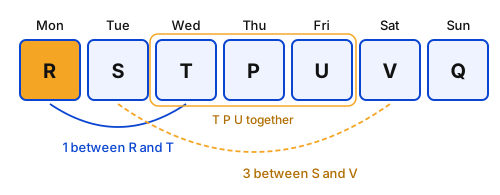
  1. S = Tuesday; 3 people between S and V → V = Saturday.
  2. T, P, U must be consecutive (T–P–U); the only 3 free consecutive days are Wed, Thu, Fri.
  3. One person between T (Wed) and R → R = Monday (Friday is taken by U); Q = Sunday.

Trick: Place fixed persons, then fit the longest block into the only gap left.

Answer: (B) R

अवधारणा: पहले निश्चित सूचनाएँ लगाएँ, फिर व्यक्तियों के समूह (block) रखें।

  1. S = मंगलवार; S और V के बीच 3 लोग → V = शनिवार।
  2. T, P, U लगातार हैं (T–P–U); लगातार 3 खाली दिन केवल बुध, गुरु, शुक्र हैं।
  3. T (बुध) और R के बीच 1 व्यक्ति → R = सोमवार (शुक्र U का है); Q = रविवार।

ट्रिक: निश्चित व्यक्ति रखें, फिर सबसे लंबा समूह बची जगह में फिट करें।

उत्तर: (B) R

RRB NTPC Graduate CBT 1General Intelligence and ReasoningScheduling PuzzleRRB NTPC Graduate CBT 1 2024 · 13 Jun Shift 3 →
Q2675.
Which of the following letter-clusters should replace # and % so that the pattern and relationship followed between the letter-cluster pair on the left side of :: is the same as that on the right side of ::?
# : MLI :: LKH : %
निम्नलिखित में से कौन-से अक्षर-समूह # और % को प्रतिस्थापित करें ताकि :: के बाईं ओर के अक्षर-समूह युग्म के बीच अनुसरित पैटर्न और संबंध वही हो जो :: के दाईं ओर है?
# : MLI :: LKH : %
  1. A# = FRL, % = QHE
  2. B# = UIL, % = IXC
  3. C# = POL, % = IHE
  4. D# = FRL, % = QHE
Show answer

Concept: Find the shift from the given right pair, then apply the same to #.

  1. Try # = POL: P−3 = M, O−3 = L, L−3 = I → MLI ✓
  2. Apply −3 to LKH: L−3 = I, K−3 = H, H−3 = E → IHE
  3. So # = POL and % = IHE.

Trick: Test each option quickly with the same letter-shift on both sides.

Answer: (C) # = POL, % = IHE

अवधारणा: दिए गए जोड़े से अक्षरों का खिसकाव (shift) निकालें और # पर लगाएँ।

  1. # = POL लेने पर: P−3 = M, O−3 = L, L−3 = I → MLI ✓
  2. LKH पर −3: L−3 = I, K−3 = H, H−3 = E → IHE
  3. अतः # = POL और % = IHE

ट्रिक: दोनों ओर एक ही shift से विकल्प जाँचें।

उत्तर: (C) # = POL, % = IHE

RRB NTPC Graduate CBT 1General Intelligence and ReasoningLetter AnalogyRRB NTPC Graduate CBT 1 2024 · 13 Jun Shift 3 →
Q2676.
A, B, C, D, E, F and G are sitting around a circular table facing the centre. A sits third to the right of G. C sits second to the right of D. G is not an immediate neighbour of C. E sits to the immediate left of B. How many people sit between D and B when counted from the left of D?
A, B, C, D, E, F और G एक वृत्ताकार मेज़ के चारों ओर केंद्र की ओर मुख करके बैठे हैं। A, G के दाईं ओर तीसरे स्थान पर बैठा है। C, D के दाईं ओर दूसरे स्थान पर बैठा है। G, C का निकटतम पड़ोसी नहीं है। E, B के ठीक बाईं ओर बैठा है। D के बाईं ओर से गिनने पर D और B के बीच कितने व्यक्ति बैठे हैं?
  1. AThreeतीन
  2. BTwoदो
  3. CNoneकोई नहीं
  4. DFourचार
Show answer

Concept: Facing the centre: right = anticlockwise, left = clockwise.

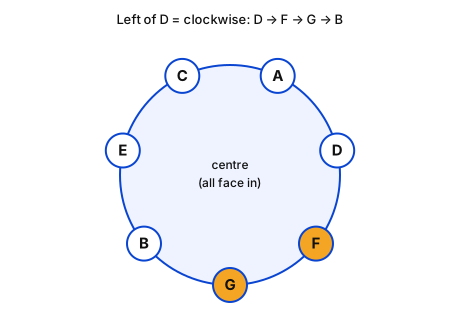
  1. Fix G; A is third to the right of G.
  2. C is second to the right of D and C is not next to G → the only fit is D second to the right of G and C second to the right of D (order G, _, D, A, C).
  3. E is immediately left of B → B and E take the remaining adjacent seats; F sits between G and D.
  4. From D moving left (clockwise): F, G, then B → 2 people between.

Trick: Draw the circle and fix the person with most clues first.

Answer: (B) Two

अवधारणा: केंद्र की ओर मुख: दायाँ = वामावर्त (anticlockwise), बायाँ = दक्षिणावर्त (clockwise)।

  1. G को स्थिर करें; A, G के दाएँ तीसरे स्थान पर।
  2. C, D के दाएँ दूसरे स्थान पर और G का पड़ोसी नहीं → D, G के दाएँ दूसरे स्थान पर और C, D के दाएँ दूसरे स्थान पर (क्रम G, _, D, A, C)।
  3. E, B के ठीक बाएँ → B और E बचे हुए सटे स्थानों पर; F, G और D के बीच।
  4. D से बाएँ (clockwise) चलने पर: F, G, फिर B → बीच में 2 व्यक्ति।

ट्रिक: वृत्त बनाकर सबसे अधिक सूचना वाले व्यक्ति से शुरू करें।

उत्तर: (B) दो

RRB NTPC Graduate CBT 1General Intelligence and ReasoningCircular SeatingRRB NTPC Graduate CBT 1 2024 · 13 Jun Shift 3 →
Q2677.
This question is based on the five, three-digit numbers given below.
(Left) 194 932 446 225 493 (Right)
(Example- 697 – First digit = 6, second digit = 9 and third digit = 7)
(NOTE: All operations to be done from left to right.)
What will be the resultant if the first digit of the highest number is added to the second digit of the lowest number?
यह प्रश्न नीचे दी गई पाँच, तीन-अंकीय संख्याओं पर आधारित है।
(बाएँ) 194 932 446 225 493 (दाएँ)
(उदाहरण- 697 – पहला अंक = 6, दूसरा अंक = 9 और तीसरा अंक = 7)
(ध्यान दें: सभी संक्रियाएँ बाएँ से दाएँ की जानी हैं।)
यदि सबसे बड़ी संख्या के पहले अंक को सबसे छोटी संख्या के दूसरे अंक में जोड़ा जाए, तो परिणाम क्या होगा?
  1. A15
  2. B17
  3. C18
  4. D16
Show answer

Concept: Identify the highest and lowest numbers, then pick the asked digits.

  1. Numbers: 194, 932, 446, 225, 493
  2. Highest = 932 → first digit 9; lowest = 194 → second digit 9
  3. Sum =9+9=18

Trick: Compare only first digits to spot highest/lowest fast.

Answer: (C) 18

अवधारणा: सबसे बड़ी और सबसे छोटी संख्या पहचानें, फिर माँगे गए अंक लें।

  1. संख्याएँ: 194, 932, 446, 225, 493
  2. सबसे बड़ी = 932 → पहला अंक 9; सबसे छोटी = 194 → दूसरा अंक 9
  3. योग =9+9=18

ट्रिक: केवल पहले अंक देखकर बड़ी/छोटी संख्या तुरंत पहचानें।

उत्तर: (C) 18

RRB NTPC Graduate CBT 1General Intelligence and ReasoningNumber ArrangementRRB NTPC Graduate CBT 1 2024 · 13 Jun Shift 3 →
Q2678.
Based on the English alphabetical order, three of the following four letter-cluster pairs are alike in a certain way and thus form a group. Which is the letter-cluster pair that DOES NOT belong to that group?
(Note: The odd one out is not based on the number of consonants/vowels or their position in the letter-cluster.)
अंग्रेज़ी वर्णमाला क्रम के आधार पर, निम्नलिखित चार अक्षर-समूह युग्मों में से तीन किसी निश्चित प्रकार से समान हैं और इस प्रकार एक समूह बनाते हैं। वह कौन-सा अक्षर-समूह युग्म है जो उस समूह से संबंधित नहीं है?
(ध्यान दें: असंगत अक्षर-समूह, उस अक्षर-समूह में व्यंजनों/स्वरों की संख्या या उनके स्थान पर आधारित नहीं है।)
  1. ALK - KJ
  2. BHI - CD
  3. CQR - LM
  4. DPQ - KL
Show answer

Concept: Check the order inside each cluster and the shift between the two clusters.

  1. HI – CD, QR – LM, PQ – KL: each cluster is two consecutive letters in forward order, and the second cluster is 5 letters back (H−5 = C, Q−5 = L, P−5 = K).
  2. LK – KJ: letters are in reverse order and the shift is only 1 (L−1 = K).
  3. So LK – KJ is the odd one.

Trick: First check forward/backward order inside clusters – often enough to find the odd one.

Answer: (A) LK - KJ

अवधारणा: हर क्लस्टर के अंदर क्रम और दोनों क्लस्टरों के बीच का अंतर देखें।

  1. HI – CD, QR – LM, PQ – KL: हर क्लस्टर में दो क्रमागत अक्षर आगे के क्रम में हैं और दूसरा क्लस्टर 5 अक्षर पीछे है (H−5 = C, Q−5 = L, P−5 = K)।
  2. LK – KJ: अक्षर उल्टे क्रम में हैं और अंतर केवल 1 है।
  3. अतः LK – KJ भिन्न है।

ट्रिक: पहले क्लस्टर के अंदर आगे/पीछे का क्रम देखें।

उत्तर: (A) LK - KJ

RRB NTPC Graduate CBT 1General Intelligence and ReasoningLetter Odd One OutRRB NTPC Graduate CBT 1 2024 · 13 Jun Shift 3 →
Q2679.
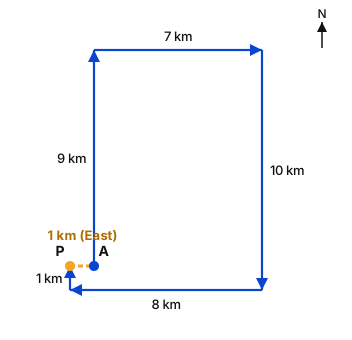
Mukesh starts from point A and drives 9 km towards the north. He then takes a right turn, drives 7 km, turns right and drives 10 km. He then takes a right turn and drives 8 km. He takes a final right turn, drives 1 km and stops at point P. How far (shortest distance) and towards which direction should he drive in order to reach point A again? (All turns are 90 degree turns only unless specified.)
मुकेश बिंदु A से चलना शुरू करता है और उत्तर की ओर 9 km गाड़ी चलाता है। फिर वह दाएँ मुड़ता है, 7 km गाड़ी चलाता है, दाएँ मुड़ता है और 10 km गाड़ी चलाता है। फिर वह दाएँ मुड़ता है और 8 km गाड़ी चलाता है। वह अंतिम बार दाएँ मुड़ता है, 1 km गाड़ी चलाता है और बिंदु P पर रुक जाता है। बिंदु A पर पुनः पहुँचने के लिए उसे कितनी दूरी (न्यूनतम दूरी) तक और किस दिशा में गाड़ी चलानी चाहिए? (जब तक निर्दिष्ट न किया जाए, सभी मोड़ केवल 90 डिग्री के मोड़ हैं।)
  1. A2 km to the eastपूर्व की ओर 2 km
  2. B1 km to the eastपूर्व की ओर 1 km
  3. C2 km to the westपश्चिम की ओर 2 km
  4. D1 km to the westपश्चिम की ओर 1 km
Show answer

Concept: Track the net east–west and north–south displacement.

  1. North–south: +9−10+1=0, so P is on the same level as A.
  2. East–west: +7 east then 8 west → net 1km west of A.
  3. To return, Mukesh must drive 1 km towards the east.

Trick: Add north, subtract south; add east, subtract west – net values give the answer.

Answer: (B) 1 km to the east

अवधारणा: कुल पूर्व–पश्चिम और उत्तर–दक्षिण विस्थापन निकालें।

  1. उत्तर–दक्षिण: +9−10+1=0, अतः P, A की सीध में है।
  2. पूर्व–पश्चिम: 7 km पूर्व, फिर 8 km पश्चिम → A से 1 km पश्चिम।
  3. वापस A पहुँचने के लिए 1 km पूर्व की ओर जाना होगा।

ट्रिक: उत्तर जोड़ें, दक्षिण घटाएँ; पूर्व जोड़ें, पश्चिम घटाएँ।

उत्तर: (B) 1 km पूर्व की ओर

RRB NTPC Graduate CBT 1General Intelligence and ReasoningDirection and DistanceRRB NTPC Graduate CBT 1 2024 · 13 Jun Shift 3 →
Q2680.
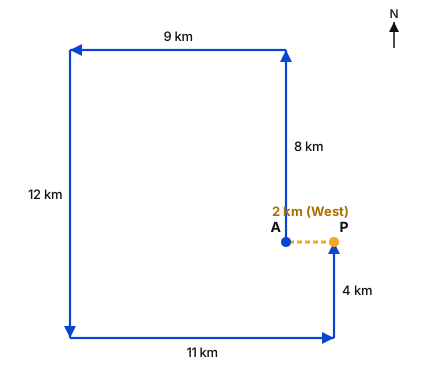
Radhe starts from Point A and drives 8 km towards North. He then takes a left turn, drives 9 km, turns left and drives 12 km. He then takes a left turn and drives 11 km. He takes a final left turn, drives 4 km and stops at Point P. How far (shortest distance) and towards which direction should he drive in order to reach Point A again? (All turns are 90° turns only unless specified)
राधे बिंदु A से चलना शुरू करता है और उत्तर की ओर 8 km गाड़ी चलाता है। फिर वह बाएँ मुड़ता है, 9 km गाड़ी चलाता है, बाएँ मुड़ता है और 12 km गाड़ी चलाता है। फिर वह बाएँ मुड़ता है और 11 km गाड़ी चलाता है। वह अंतिम बार बाएँ मुड़ता है, 4 km गाड़ी चलाता है और बिंदु P पर रुक जाता है। बिंदु A पर पुनः पहुँचने के लिए उसे कितनी दूरी (न्यूनतम दूरी) तक और किस दिशा में गाड़ी चलानी चाहिए? (जब तक निर्दिष्ट न किया जाए, सभी मोड़ केवल 90° के मोड़ हैं)
  1. A3 km to the westपश्चिम की ओर 3 km
  2. B2 km to the westपश्चिम की ओर 2 km
  3. C4 km to the westपश्चिम की ओर 4 km
  4. D1 km to the westपश्चिम की ओर 1 km
Show answer

Concept: Four left turns starting north go: North → West → South → East → North.

  1. North–south: +8−12+4=0 → P is level with A.
  2. East–west: 9 west then 11 east → net 2km east of A.
  3. So Radhe must drive 2 km towards the west to reach A.

Trick: Net east 2 km means the return trip is 2 km west.

Answer: (B) 2 km to the west

अवधारणा: उत्तर से शुरू करके चार बार बाएँ मुड़ने पर: उत्तर → पश्चिम → दक्षिण → पूर्व → उत्तर।

  1. उत्तर–दक्षिण: +8−12+4=0 → P, A की सीध में।
  2. पूर्व–पश्चिम: 9 km पश्चिम, फिर 11 km पूर्व → A से 2 km पूर्व।
  3. अतः A पहुँचने के लिए 2 km पश्चिम जाना होगा।

ट्रिक: शुद्ध 2 km पूर्व हैं तो वापसी 2 km पश्चिम।

उत्तर: (B) 2 km पश्चिम की ओर

RRB NTPC Graduate CBT 1General Intelligence and ReasoningDirection and DistanceRRB NTPC Graduate CBT 1 2024 · 13 Jun Shift 3 →