Question bank

Q&A: practice questions with answers

Search questions on any topic. Filter by exam category, exam, subject and topic, try the question, then open the answer and explanation.

Courses – airGurukul

7,100 questions found.

Q2681.
Select the triad that follows the same pattern as that followed by the two triads given below. Both triads follow the same pattern.
KG-NJ-PR
MI-PL-RT
उस त्रिक का चयन कीजिए जो उसी पैटर्न का अनुसरण करता है जिसका अनुसरण नीचे दिए गए दो त्रिक करते हैं। दोनों त्रिक एक ही पैटर्न का अनुसरण करते हैं।
KG-NJ-PR
MI-PL-RT
  1. APK-RN-TU
  2. BOK-RN-TU
  3. CPK-RM-TU
  4. DOK-RN-TV
Show answer

Concept: Find the letter shifts between the clusters of each triad.

  1. KG-NJ-PR: K+3 = N, N+2 = P; G+3 = J, J+8 = R. MI-PL-RT follows the same.
  2. OK-RN-TV: O+3 = R, R+2 = T; K+3 = N, N+8 = V ✓
  3. Others fail, e.g. OK-RN-TU has N+7 = U.

Trick: Write the pattern as (+3, +2) for first letters and (+3, +8) for second letters.

Answer: (D) OK-RN-TV

अवधारणा: हर त्रिक के क्लस्टरों के बीच अक्षरों का अंतर निकालें।

  1. KG-NJ-PR: K+3 = N, N+2 = P; G+3 = J, J+8 = R. MI-PL-RT भी यही नियम मानता है।
  2. OK-RN-TV: O+3 = R, R+2 = T; K+3 = N, N+8 = V ✓
  3. बाकी विकल्प नहीं मिलते, जैसे OK-RN-TU में N+7 = U।

ट्रिक: पहले अक्षरों का नियम (+3, +2), दूसरे अक्षरों का (+3, +8)।

उत्तर: (D) OK-RN-TV
RRB NTPC Graduate CBT 1General Intelligence and ReasoningLetter TriadsRRB NTPC Graduate CBT 1 2024 · 13 Jun Shift 3 →
Q2682.
Read the given statements and conclusions carefully. Assuming that the information given in the statements is true, even if it appears to be at variance with commonly known facts, decide which of the given conclusion(s) logically follow(s) from the statements.
Statements:
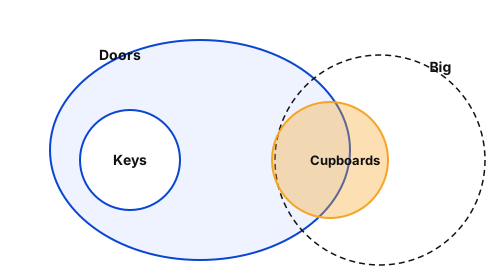
All keys are doors.
Some doors are cupboards.
All cupboards are big.
Conclusions:
(I) Some keys are doors.
(II) All doors are cupboards.
दिए गए कथनों और निष्कर्षों को ध्यानपूर्वक पढ़िए। कथनों में दी गई जानकारी को सत्य मानते हुए, भले ही वह सामान्यतः ज्ञात तथ्यों से भिन्न प्रतीत होती हो, निर्णय कीजिए कि दिए गए निष्कर्षों में से कौन-सा/से निष्कर्ष तार्किक रूप से कथनों का अनुसरण करता है/करते हैं।
कथन:
सभी चाबियाँ, दरवाज़े हैं।
कुछ दरवाज़े, अलमारियाँ हैं।
सभी अलमारियाँ, बड़ी हैं।
निष्कर्ष:
(I) कुछ चाबियाँ, दरवाज़े हैं।
(II) सभी दरवाज़े, अलमारियाँ हैं।
  1. ANeither conclusion (I) nor (II) follows.न तो निष्कर्ष (I) और न ही (II) अनुसरण करता है।
  2. BOnly conclusion (II) follows.केवल निष्कर्ष (II) अनुसरण करता है।
  3. CBoth conclusions (I) and (II) follow.निष्कर्ष (I) और (II) दोनों अनुसरण करते हैं।
  4. DOnly conclusion (I) follows.केवल निष्कर्ष (I) अनुसरण करता है।
Show answer

Concept: Draw the least-overlap Venn diagram satisfying all statements.

  1. All keys are doors → keys circle lies inside doors, so “Some keys are doors” is definitely true – Conclusion I follows.
  2. Only some doors are cupboards, so “All doors are cupboards” is not certain – Conclusion II does not follow.

Trick: “All A are B” always gives “Some A are B” (and “Some B are A”).

Answer: (D) Only conclusion (I) follows.

अवधारणा: सभी कथन मानते हुए न्यूनतम ओवरलैप वाला वेन आरेख बनाएँ।

  1. सभी चाबियाँ दरवाज़े हैं → चाबी वृत्त दरवाज़े के अंदर, अतः “कुछ चाबियाँ दरवाज़े हैं” निश्चित है – निष्कर्ष I अनुसरण करता है।
  2. केवल कुछ दरवाज़े अलमारी हैं, इसलिए “सभी दरवाज़े अलमारी हैं” निश्चित नहीं – निष्कर्ष II अनुसरण नहीं करता।

ट्रिक: “सभी A, B हैं” से “कुछ A, B हैं” हमेशा निकलता है।

उत्तर: (D) केवल निष्कर्ष (I) अनुसरण करता है।

RRB NTPC Graduate CBT 1General Intelligence and ReasoningSyllogismRRB NTPC Graduate CBT 1 2024 · 13 Jun Shift 3 →
Q2683.
Refer to the following number and symbol series and answer the question that follows. Counting to be done from left to right only.
(Left) 2 8 6 $ 4 * € 1 9 5 # 2 % 4 % © # 5 * 7 % * (Right)
How many such numbers are there each of which is immediately preceded by a number and also immediately followed by a number?
निम्नलिखित संख्या और प्रतीक श्रृंखला को देखिए और उसके बाद दिए गए प्रश्न का उत्तर दीजिए। गणना केवल बाएँ से दाएँ की जानी है।
(बाएँ) 2 8 6 $ 4 * € 1 9 5 # 2 % 4 % © # 5 * 7 % * (दाएँ)
ऐसी कितनी संख्याएँ हैं जिनमें से प्रत्येक के ठीक पहले एक संख्या है और ठीक बाद भी एक संख्या है?
  1. A1
  2. B2
  3. C3
  4. D4
Show answer

Concept: Check every number: its left neighbour and right neighbour must both be numbers.

  1. Series: 2 8 6 $ 4 * € 1 9 5 # 2 % 4 % © # 5 * 7 % *
  2. 8 (between 2 and 6) ✓ and 9 (between 1 and 5) ✓
  3. All other numbers have a symbol on at least one side.

Trick: Look only at runs of three or more consecutive numbers: “2 8 6” and “1 9 5” → middle digits count.

Answer: (B) 2

अवधारणा: हर संख्या जाँचें: उसके ठीक पहले और ठीक बाद दोनों ओर संख्या होनी चाहिए।

  1. श्रृंखला: 2 8 6 $ 4 * € 1 9 5 # 2 % 4 % © # 5 * 7 % *
  2. 8 (2 और 6 के बीच) ✓ और 9 (1 और 5 के बीच) ✓
  3. बाकी सभी संख्याओं के कम से कम एक ओर प्रतीक है।

ट्रिक: केवल तीन या अधिक लगातार संख्याओं के समूह देखें: “2 8 6” और “1 9 5” → बीच के अंक।

उत्तर: (B) 2

RRB NTPC Graduate CBT 1General Intelligence and ReasoningNumber–Symbol SeriesRRB NTPC Graduate CBT 1 2024 · 13 Jun Shift 3 →
Q2684.
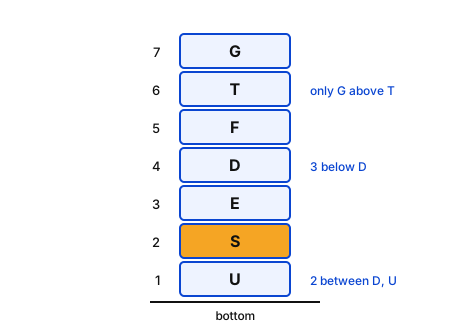
Seven boxes, D, E, F, G, S, T and U, are kept one over the other but not necessarily in the same order. Only three boxes are kept below D. Only two boxes are kept between D and U. Only G is kept above T. E is kept at some place below F and at some place above S. Which box is kept at second position from the bottom?
सात बक्से, D, E, F, G, S, T और U, एक के ऊपर एक रखे गए हैं, परंतु यह आवश्यक नहीं कि इसी क्रम में हों। D के नीचे केवल तीन बक्से रखे गए हैं। D और U के बीच केवल दो बक्से रखे गए हैं। T के ऊपर केवल G रखा गया है। E को F के नीचे किसी स्थान पर और S के ऊपर किसी स्थान पर रखा गया है। नीचे से दूसरे स्थान पर कौन-सा बक्सा रखा गया है?
  1. AS
  2. BU
  3. CD
  4. DF
Show answer

Concept: Number positions 1 (bottom) to 7 (top) and fix definite clues.

  1. Three boxes below D → D at position 4.
  2. Two between D and U → U at 1 or 7; only G above T → G = 7, T = 6, so U = 1.
  3. F above E above S in positions 2, 3, 5 → S = 2, E = 3, F = 5.
  4. Second from bottom = S.

Trick: “Only G above T” fixes the top two at once.

Answer: (A) S

अवधारणा: स्थान 1 (नीचे) से 7 (ऊपर) तक लें और निश्चित सूचनाएँ लगाएँ।

  1. D के नीचे तीन बॉक्स → D स्थान 4 पर।
  2. D और U के बीच दो → U 1 या 7 पर; T के ऊपर केवल G → G = 7, T = 6, अतः U = 1।
  3. F > E > S बचे स्थान 2, 3, 5 में → S = 2, E = 3, F = 5।
  4. नीचे से दूसरा = S

ट्रिक: “T के ऊपर केवल G” से ऊपर के दो स्थान तुरंत तय।

उत्तर: (A) S

RRB NTPC Graduate CBT 1General Intelligence and ReasoningBox Stacking PuzzleRRB NTPC Graduate CBT 1 2024 · 13 Jun Shift 3 →
Q2685.
If ‘P’ stands for ‘÷’, ‘Q’ stands for ‘×’, ‘R’ stands for ‘+’ and ‘S’ stands for ‘−’, then the resultant of which of the following would be 38?
यदि 'P' का अर्थ '÷', 'Q' का अर्थ '×', 'R' का अर्थ '+' और 'S' का अर्थ '−' है, तो निम्नलिखित में से किसका परिणाम 38 होगा?
  1. A32 Q 8 R 30 S 16 P 4
  2. B32 S 8 R 30 Q 16 P 4
  3. C32 P 8 S 30 R 16 Q 4
  4. D32 R 8 S 30 Q 16 P 4
Show answer

Concept: Replace letters with signs and solve using BODMAS.

  1. (C) 32÷8−30+16×4
  2. =4−30+64=38 ✓
  3. Check (A): 32×8+30−16÷4=282 ✗

Trick: Start with the option whose division gives a small whole number.

Answer: (C) 32 P 8 S 30 R 16 Q 4

अवधारणा: अक्षरों को चिह्नों से बदलें और BODMAS से हल करें।

  1. (C) 32÷8−30+16×4
  2. =4−30+64=38 ✓
  3. जाँच (A): 32×8+30−16÷4=282 ✗

ट्रिक: जिस विकल्प में भाग से छोटी पूर्ण संख्या बने, उससे शुरू करें।

उत्तर: (C) 32 P 8 S 30 R 16 Q 4

RRB NTPC Graduate CBT 1General Intelligence and ReasoningMathematical OperationsRRB NTPC Graduate CBT 1 2024 · 13 Jun Shift 3 →
Q2686.
Each of the digits in the number 4917523 is arranged in the ascending order from left to right. Which of the following digits will be third from the left?
संख्या 4917523 के प्रत्येक अंक को बाएँ से दाएँ आरोही क्रम में व्यवस्थित किया जाता है। निम्नलिखित में से कौन-सा अंक बाएँ से तीसरे स्थान पर होगा?
  1. A4
  2. B2
  3. C5
  4. D3
Show answer

Concept: Arrange the digits in increasing order and count from the left.

  1. Digits of 4917523: 4, 9, 1, 7, 5, 2, 3
  2. Ascending: 1, 2, 3, 4, 5, 7, 9
  3. Third from the left = 3

Trick: Third from left in ascending order = third smallest digit.

Answer: (D) 3

अवधारणा: अंकों को बढ़ते क्रम में लगाकर बाएँ से गिनें।

  1. 4917523 के अंक: 4, 9, 1, 7, 5, 2, 3
  2. आरोही क्रम: 1, 2, 3, 4, 5, 7, 9
  3. बाएँ से तीसरा = 3

ट्रिक: आरोही क्रम में बाएँ से तीसरा = तीसरा सबसे छोटा अंक।

उत्तर: (D) 3

RRB NTPC Graduate CBT 1General Intelligence and ReasoningDigit ArrangementRRB NTPC Graduate CBT 1 2024 · 13 Jun Shift 3 →
Q2687.
What should come in place of the question mark (?) in the given series based on the English alphabetical order?
XCH RWB LQV FKP ?
अंग्रेज़ी वर्णमाला क्रम के आधार पर दी गई श्रृंखला में प्रश्न चिह्न (?) के स्थान पर क्या आना चाहिए?
XCH RWB LQV FKP ?
  1. AJZE
  2. BZEJ
  3. CZJE
  4. DJEZ
Show answer

Concept: Track each letter position separately using place values (A = 1 … Z = 26).

  1. 1st letters: X → R → L → F → Z (each −6, F−6 wraps to Z)
  2. 2nd letters: C → W → Q → K → E (each −6)
  3. 3rd letters: H → B → V → P → J (each −6)

Trick: All three positions move −6 – just shift FKP back by 6: ZEJ.

Answer: (B) ZEJ

अवधारणा: हर स्थान के अक्षर को अलग से देखें (A = 1 … Z = 26)।

  1. पहले अक्षर: X → R → L → F → Z (हर बार −6, F−6 घूमकर Z)
  2. दूसरे अक्षर: C → W → Q → K → E (हर बार −6)
  3. तीसरे अक्षर: H → B → V → P → J (हर बार −6)

ट्रिक: तीनों स्थान −6 – FKP को 6 पीछे करें: ZEJ

उत्तर: (B) ZEJ

RRB NTPC Graduate CBT 1General Intelligence and ReasoningLetter SeriesRRB NTPC Graduate CBT 1 2024 · 13 Jun Shift 3 →
Q2688.
What will come in the place of the question mark (?) in the following equation, if ‘+’ and ‘−‘ are interchanged and ‘×’ and ‘÷’ are interchanged?
127 ÷ 7 + 324 × 4 − 47 =?
यदि '+' और '−' को आपस में बदल दिया जाए तथा '×' और '÷' को आपस में बदल दिया जाए, तो निम्नलिखित समीकरण में प्रश्न चिह्न (?) के स्थान पर क्या आएगा?
127 ÷ 7 + 324 × 4 − 47 =?
  1. A855
  2. B755
  3. C795
  4. D885
Show answer

Concept: Interchange the signs first, then apply BODMAS.

  1. New expression: 127×7−324÷4+47
  2. =889−81+47
  3. =855

Trick: Rewrite the whole expression with new signs before calculating.

Answer: (A) 855

अवधारणा: पहले चिह्न बदलें, फिर BODMAS लगाएँ।

  1. नया व्यंजक: 127×7−324÷4+47
  2. =889−81+47
  3. =855

ट्रिक: गणना से पहले पूरा व्यंजक नए चिह्नों के साथ लिखें।

उत्तर: (A) 855

RRB NTPC Graduate CBT 1General Intelligence and ReasoningMathematical OperationsRRB NTPC Graduate CBT 1 2024 · 13 Jun Shift 3 →
Q2689.
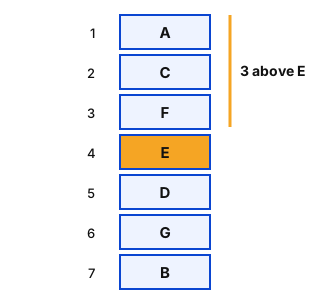
Seven boxes, A, B, C, D, E, F and G, are kept one over the other but not necessarily in the same order. Only A is kept above C. Only F is kept between C and E. Only B is kept below G. How many boxes are kept above E?
सात बक्से, A, B, C, D, E, F और G, एक के ऊपर एक रखे गए हैं, परंतु यह आवश्यक नहीं कि इसी क्रम में हों। C के ऊपर केवल A रखा गया है। C और E के बीच केवल F रखा गया है। G के नीचे केवल B रखा गया है। E के ऊपर कितने बक्से रखे गए हैं?
  1. A4
  2. B3
  3. C1
  4. D2
Show answer

Concept: Fix the positions given by "only" conditions from the top and the bottom first.

  1. "Only A is above C" → A is 1st (top) and C is 2nd.
  2. "Only F is between C and E" → F is 3rd, E is 4th.
  3. "Only B is below G" → B is 7th (bottom), G is 6th; D gets the 5th place.
  4. Boxes above E: A, C, F = 3.

Trick: "Only X above Y" means X is at the very top and Y is just below it.

Answer: (B) 3

अवधारणा: "केवल" वाली शर्तों से पहले ऊपर और नीचे के स्थान तय करें।

  1. "केवल A, C के ऊपर" → A सबसे ऊपर (1), C दूसरे स्थान पर।
  2. "C और E के बीच केवल F" → F तीसरे, E चौथे स्थान पर।
  3. "G के नीचे केवल B" → B सबसे नीचे (7), G छठे; D पाँचवें स्थान पर।
  4. E के ऊपर: A, C, F = 3 बॉक्स।

ट्रिक: "केवल X, Y के ऊपर" का अर्थ है X सबसे ऊपर और Y उसके ठीक नीचे।

उत्तर: (B) 3

RRB NTPC Graduate CBT 1General Intelligence and ReasoningBox ArrangementRRB NTPC Graduate CBT 1 2024 · 13 Jun Shift 3 →
Q2690.
This question is based on the five, three-digit numbers given below.
(Left) 236 758 230 563 263 (Right)
(Example- 697 – First digit = 6, second digit = 9 and third digit = 7)
(NOTE: All operations to be done from left to right.)
What will be the resultant if the first digit of the lowest number is subtracted from the first digit of the highest number?
यह प्रश्न नीचे दी गई पाँच, तीन-अंकीय संख्याओं पर आधारित है।
(बाएँ) 236 758 230 563 263 (दाएँ)
(उदाहरण- 697 – पहला अंक = 6, दूसरा अंक = 9 और तीसरा अंक = 7)
(ध्यान दें: सभी संक्रियाएँ बाएँ से दाएँ की जानी हैं।)
यदि सबसे छोटी संख्या के पहले अंक को सबसे बड़ी संख्या के पहले अंक में से घटाया जाए, तो परिणाम क्या होगा?
  1. A5
  2. B7
  3. C6
  4. D4
Show answer

Concept: Find the highest and lowest of the given numbers, then use their first digits.

  1. Numbers: 236, 758, 230, 563, 263.
  2. Highest =758 (first digit 7); lowest =230 (first digit 2).
  3. 7−2=5.

Trick: Compare first digits first, then the second digits only for a tie (230 vs 236).

Answer: (A) 5

अवधारणा: दी गई संख्याओं में सबसे बड़ी और सबसे छोटी संख्या ज्ञात करें, फिर उनके पहले अंक लें।

  1. संख्याएँ: 236, 758, 230, 563, 263।
  2. सबसे बड़ी =758 (पहला अंक 7); सबसे छोटी =230 (पहला अंक 2)।
  3. 7−2=5।

ट्रिक: पहले अंकों की तुलना करें; बराबरी पर ही अगले अंक देखें (230 बनाम 236)।

उत्तर: (A) 5

RRB NTPC Graduate CBT 1General Intelligence and ReasoningNumber OperationsRRB NTPC Graduate CBT 1 2024 · 13 Jun Shift 3 →
Q2691.
What should come in place of the question mark (?) in the given series based on the English alphabetical order?
MPI KNG ILE GJC ?
अंग्रेज़ी वर्णमाला क्रम के आधार पर दी गई श्रृंखला में प्रश्न चिह्न (?) के स्थान पर क्या आना चाहिए?
MPI KNG ILE GJC ?
  1. AEHA
  2. BEGA
  3. CEGB
  4. DEHB
Show answer

Concept: Check each letter position of the clusters separately.

  1. 1st letters: M, K, I, G, E (−2 each).
  2. 2nd letters: P, N, L, J, H (−2 each).
  3. 3rd letters: I, G, E, C, A (−2 each).
  4. Next term = EHA.

Trick: Every letter moves back by 2 in each step.

Answer: (A) EHA

अवधारणा: समूहों के प्रत्येक स्थान के अक्षर को अलग-अलग जाँचें।

  1. पहले अक्षर: M, K, I, G, E (हर बार −2)।
  2. दूसरे अक्षर: P, N, L, J, H (−2)।
  3. तीसरे अक्षर: I, G, E, C, A (−2)।
  4. अगला पद = EHA।

ट्रिक: हर अक्षर हर चरण में 2 पीछे जाता है।

उत्तर: (A) EHA

RRB NTPC Graduate CBT 1General Intelligence and ReasoningLetter SeriesRRB NTPC Graduate CBT 1 2024 · 13 Jun Shift 3 →
Q2692.
Select the triad that follows the same pattern as that followed by the two triads given below. Both triads follow the same pattern.
NJ-QM-TV
JF-MI-PR
उस त्रिक का चयन कीजिए जो उसी पैटर्न का अनुसरण करता है जिसका अनुसरण नीचे दिए गए दो त्रिक करते हैं। दोनों त्रिक एक ही पैटर्न का अनुसरण करते हैं।
NJ-QM-TV
JF-MI-PR
  1. AGB-ID-LM
  2. BFB-IE-LM
  3. CGB-IE-LM
  4. DFB-IE-LN
Show answer

Concept: Use alphabet positions and track how each letter moves.

  1. NJ-QM-TV: N(14)→Q(17)→T(20) is +3, +3; J(10)→M(13) is +3, M(13)→V(22) is +9.
  2. JF-MI-PR: J→M→P (+3, +3); F(6)→I(9) +3, I(9)→R(18) +9. ✓
  3. FB-IE-LN: F→I→L (+3, +3); B(2)→E(5) +3, E(5)→N(14) +9. ✓
  4. Others fail (e.g., GB-IE: G→I is only +2; IE-LM: E→M is +8).

Trick: Pattern: first letters +3, +3; second letters +3, +9.

Answer: (D) FB-IE-LN

अवधारणा: अक्षरों के स्थानीय मान लेकर प्रत्येक अक्षर का परिवर्तन देखें।

  1. NJ-QM-TV: N(14)→Q(17)→T(20) = +3, +3; J(10)→M(13) +3, M(13)→V(22) +9।
  2. JF-MI-PR: J→M→P (+3, +3); F→I +3, I→R +9 ✓।
  3. FB-IE-LN: F→I→L (+3, +3); B→E +3, E→N +9 ✓।
  4. अन्य विकल्प नियम तोड़ते हैं (जैसे GB-IE में G→I केवल +2)।

ट्रिक: पहले अक्षर +3, +3; दूसरे अक्षर +3, +9।

उत्तर: (D) FB-IE-LN

RRB NTPC Graduate CBT 1General Intelligence and ReasoningLetter TriadsRRB NTPC Graduate CBT 1 2024 · 13 Jun Shift 3 →
Q2693.
Based on the English alphabetical order, three of the following four letter-cluster pairs are alike in a certain way and thus form a group. Which letter-cluster pair DOES NOT belong to that group?
(Note: The odd one out is not based on the number of consonants/vowels or their position in the letter-cluster.)
अंग्रेज़ी वर्णमाला क्रम के आधार पर, निम्नलिखित चार अक्षर-समूह युग्मों में से तीन किसी निश्चित प्रकार से समान हैं और इस प्रकार एक समूह बनाते हैं। कौन-सा अक्षर-समूह युग्म उस समूह से संबंधित नहीं है?
(ध्यान दें: असंगत अक्षर-समूह, उस अक्षर-समूह में व्यंजनों/स्वरों की संख्या या उनके स्थान पर आधारित नहीं है।)
  1. ATX – ZV
  2. BHL – NI
  3. CCG – ID
  4. DMQ – SN
Show answer

Concept: Write alphabet positions and find the common steps.

  1. HL – NI: H(8)→L(12) +4, L→N(14) +2, N→I(9) −5.
  2. CG – ID: +4, +2, −5. MQ – SN: +4, +2, −5.
  3. TX – ZV: T(20)→X(24) +4, X→Z(26) +2, but Z→V(22) is −4, not −5.
  4. So TX – ZV is the odd one.

Trick: Check the last step first; it is where the odd pair usually differs.

Answer: (A) TX – ZV

अवधारणा: अक्षरों के स्थानीय मान लिखकर समान चरण खोजें।

  1. HL – NI: H(8)→L(12) +4, L→N(14) +2, N→I(9) −5।
  2. CG – ID और MQ – SN में भी +4, +2, −5।
  3. TX – ZV: +4, +2, परन्तु Z(26)→V(22) = −4 है।
  4. अतः TX – ZV भिन्न है।

ट्रिक: अंतिम चरण पहले जाँचें, वहीं अंतर मिलता है।

उत्तर: (A) TX – ZV

RRB NTPC Graduate CBT 1General Intelligence and ReasoningOdd One Out – Letter PairsRRB NTPC Graduate CBT 1 2024 · 13 Jun Shift 3 →
Q2694.
6 is related to 42 following a certain logic. Following the same logic, 4 is related to 28. To which of the following is 7 related, following the same logic?
(NOTE: Operations should be performed on the whole numbers, without breaking down the numbers into their constituent digits. E.g. 13 – Operations on 13 such as
adding/subtracting/multiplying to 13 can be performed. Breaking down 13 into 1 and 3 and then performing mathematical operations on 1 and 3 is not allowed.)
एक निश्चित तर्क का अनुसरण करते हुए 6 का संबंध 42 से है। उसी तर्क का अनुसरण करते हुए, 4 का संबंध 28 से है। उसी तर्क का अनुसरण करते हुए, 7 का संबंध निम्नलिखित में से किससे है?
(ध्यान दें: संख्याओं को उनके घटक अंकों में विभक्त किए बिना, संक्रियाएँ पूर्ण संख्याओं पर की जानी चाहिए। उदाहरण के लिए 13 – 13 पर संक्रियाएँ जैसे
13 में जोड़ना/घटाना/गुणा करना आदि किया जा सकता है। 13 को 1 और 3 में विभक्त करना और फिर 1 और 3 पर गणितीय संक्रियाएँ करना वर्जित है।)
  1. A45
  2. B38
  3. C49
  4. D42
Show answer

Concept: Find one operation that works for both given pairs.

  1. 6×7=42.
  2. 4×7=28.
  3. So 7×7=49.

Trick: Both outputs are multiples of 7 → rule is "×7".

Answer: (C) 49

अवधारणा: दोनों युग्मों पर लागू होने वाली एक ही संक्रिया खोजें।

  1. 6×7=42।
  2. 4×7=28।
  3. अतः 7×7=49।

ट्रिक: दोनों उत्तर 7 के गुणज हैं → नियम "×7"।

उत्तर: (C) 49

RRB NTPC Graduate CBT 1General Intelligence and ReasoningNumber AnalogyRRB NTPC Graduate CBT 1 2024 · 13 Jun Shift 3 →
Q2695.
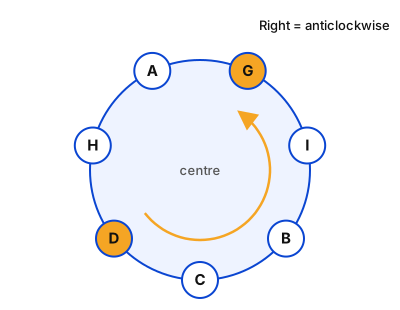
A, B, C, D, G, H and I are sitting around a circular table facing the centre of the table. Only two people sit between H and B when counted from the right of H. Only three people sit between A and C when counted from the right of C. B sits to the immediate right of C. G sits to the immediate right of I. Who sits fourth to the right of D?
A, B, C, D, G, H और I एक वृत्ताकार मेज़ के चारों ओर मेज़ के केंद्र की ओर मुख करके बैठे हैं। H के दाईं ओर से गिनने पर H और B के बीच केवल दो व्यक्ति बैठे हैं। C के दाईं ओर से गिनने पर A और C के बीच केवल तीन व्यक्ति बैठे हैं। B, C के ठीक दाईं ओर बैठा है। G, I के ठीक दाईं ओर बैठा है। D के दाईं ओर चौथे स्थान पर कौन बैठा है?
  1. AG
  2. BI
  3. CC
  4. DA
Show answer

Concept: Facing the centre, "right" means moving anticlockwise. Number seats 0–6 anticlockwise.

  1. Put C at 0; B is immediate right of C → B at 1.
  2. Two people between H and B from the right of H → B is 3rd right of H → H at 5.
  3. Three people between A and C from the right of C → A is 4th right of C → A at 4.
  4. Seats 2, 3, 6 remain; G is immediate right of I → I at 2, G at 3, D at 6.
  5. 4th to the right of D: 6+4=10→3 → G.

Trick: Facing centre: right = anticlockwise, left = clockwise.

Answer: (A) G

अवधारणा: केंद्र की ओर मुख होने पर "दाएँ" का अर्थ वामावर्त (anticlockwise) चलना है। स्थान 0–6 वामावर्त गिनें।

  1. C को 0 पर रखें; B, C के ठीक दाएँ → B = 1।
  2. H के दाएँ से गिनने पर H और B के बीच दो → B, H के तीसरे दाएँ → H = 5।
  3. C के दाएँ से A और C के बीच तीन → A, C के चौथे दाएँ → A = 4।
  4. स्थान 2, 3, 6 बचे; G, I के ठीक दाएँ → I = 2, G = 3, D = 6।
  5. D के चौथे दाएँ: 6+4=10→3 → G।

ट्रिक: केंद्र की ओर मुख: दायाँ = वामावर्त, बायाँ = दक्षिणावर्त।

उत्तर: (A) G

RRB NTPC Graduate CBT 1General Intelligence and ReasoningCircular Seating ArrangementRRB NTPC Graduate CBT 1 2024 · 13 Jun Shift 3 →
Q2696.
IJF is related to PQM in a certain way based on the English alphabetical order. In the same way, RSO is related to YZV. To which of the following is EFB related, following the same logic?
अंग्रेज़ी वर्णमाला क्रम के आधार पर IJF एक निश्चित प्रकार से PQM से संबंधित है। उसी प्रकार, RSO, YZV से संबंधित है। उसी तर्क का अनुसरण करते हुए, EFB निम्नलिखित में से किससे संबंधित है?
  1. AMNJ
  2. BMNK
  3. CLMI
  4. DLMJ
Show answer

Concept: Compare each letter of the first cluster with the corresponding letter of the second.

  1. IJF → PQM: I(9)→P(16), J(10)→Q(17), F(6)→M(13): each +7.
  2. RSO → YZV: each +7. ✓
  3. EFB → E(5)+7 = L(12), F(6)+7 = M(13), B(2)+7 = I(9) → LMI.

Trick: Same shift for all letters: just add 7 to each.

Answer: (C) LMI

अवधारणा: पहले समूह के प्रत्येक अक्षर की दूसरे समूह के संगत अक्षर से तुलना करें।

  1. IJF → PQM: I(9)→P(16), J(10)→Q(17), F(6)→M(13): हर अक्षर +7।
  2. RSO → YZV: हर अक्षर +7 ✓।
  3. EFB → E+7 = L, F+7 = M, B+7 = I → LMI।

ट्रिक: सभी अक्षरों में एक-सा खिसकाव: हर अक्षर में 7 जोड़ें।

उत्तर: (C) LMI

RRB NTPC Graduate CBT 1General Intelligence and ReasoningLetter AnalogyRRB NTPC Graduate CBT 1 2024 · 13 Jun Shift 3 →
Q2697.
In a certain code language, ‘MOVE’ is coded as ‘4826’ and ‘IRON’ is coded as ‘1352’. What is the code for ‘O’ in the given code language?
एक निश्चित कूट भाषा में, 'MOVE' को '4826' और 'IRON' को '1352' के रूप में कूटबद्ध किया जाता है। दी गई कूट भाषा में 'O' के लिए कूट क्या है?
  1. A5
  2. B8
  3. C2
  4. D4
Show answer

Concept: A letter common to both words has the digit common to both codes.

  1. MOVE → 4826 and IRON → 1352.
  2. Common letter: O.
  3. Common digit: 2.
  4. So O = 2.

Trick: Match common letters with common digits.

Answer: (C) 2

अवधारणा: दोनों शब्दों में उभयनिष्ठ अक्षर का कोड दोनों कोडों का उभयनिष्ठ अंक होता है।

  1. MOVE → 4826 और IRON → 1352।
  2. उभयनिष्ठ अक्षर: O।
  3. उभयनिष्ठ अंक: 2।
  4. अतः O = 2।

ट्रिक: उभयनिष्ठ अक्षर ↔ उभयनिष्ठ अंक।

उत्तर: (C) 2

RRB NTPC Graduate CBT 1General Intelligence and ReasoningCoding-DecodingRRB NTPC Graduate CBT 1 2024 · 13 Jun Shift 3 →
Q2698.
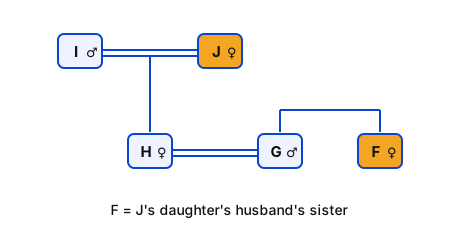
​F is the sister of G. G is the husband of H. H is the daughter of I. I is the husband of J. How is F related to J?
​F, G की बहन है। G, H का पति है। H, I की पुत्री है। I, J का पति है। F का J से क्या संबंध है?
  1. AHusband's sisterपति की बहन
  2. BDaughter's husband's sisterपुत्री के पति की बहन
  3. CDaughter's husband's motherपुत्री के पति की माँ
  4. DHusband's motherपति की माँ
Show answer

Concept: Draw the family tree step by step.

  1. I is the husband of J → J is a female, wife of I.
  2. H is the daughter of I (and J).
  3. G is the husband of H, i.e., J's daughter's husband.
  4. F is G's sister → F is J's daughter's husband's sister.

Trick: Start from the person asked about (J) and walk the tree to F.

Answer: (B) Daughter's husband's sister

अवधारणा: चरण-दर-चरण परिवार वृक्ष बनाएँ।

  1. I, J का पति है → J महिला (I की पत्नी)।
  2. H, I (और J) की पुत्री है।
  3. G, H का पति है, अर्थात J की पुत्री का पति।
  4. F, G की बहन है → F, J की पुत्री के पति की बहन।

ट्रिक: जिसके संदर्भ में पूछा गया है (J) वहाँ से F तक चलें।

उत्तर: (B) पुत्री के पति की बहन (Daughter's husband's sister)

RRB NTPC Graduate CBT 1General Intelligence and ReasoningBlood RelationsRRB NTPC Graduate CBT 1 2024 · 13 Jun Shift 3 →
Q2699.
In a certain code language, ‘FUSE’ is coded as ‘6482’ and ‘SORT’ is coded as ‘3671’. What is the code for ‘S’ in the given code language?
एक निश्चित कूट भाषा में, 'FUSE' को '6482' और 'SORT' को '3671' के रूप में कूटबद्ध किया जाता है। दी गई कूट भाषा में 'S' के लिए कूट क्या है?
  1. A6
  2. B1
  3. C3
  4. D8
Show answer

Concept: A letter common to both words has the digit common to both codes.

  1. FUSE → 6482 and SORT → 3671.
  2. Common letter: S.
  3. Common digit: 6.
  4. So S = 6.

Trick: Match common letters with common digits.

Answer: (A) 6

अवधारणा: दोनों शब्दों में उभयनिष्ठ अक्षर का कोड दोनों कोडों का उभयनिष्ठ अंक होता है।

  1. FUSE → 6482 और SORT → 3671।
  2. उभयनिष्ठ अक्षर: S।
  3. उभयनिष्ठ अंक: 6।
  4. अतः S = 6।

ट्रिक: उभयनिष्ठ अक्षर ↔ उभयनिष्ठ अंक।

उत्तर: (A) 6

RRB NTPC Graduate CBT 1General Intelligence and ReasoningCoding-DecodingRRB NTPC Graduate CBT 1 2024 · 13 Jun Shift 3 →
Q2700.
What should come in place of the question mark (?) in the given series?
952 950 946 940 932 ?
दी गई श्रृंखला में प्रश्न चिह्न (?) के स्थान पर क्या आना चाहिए?
952 950 946 940 932 ?
  1. A922
  2. B918
  3. C919
  4. D921
Show answer

Concept: Look at the differences between consecutive terms.

  1. 952−950=2, 950−946=4, 946−940=6, 940−932=8.
  2. Next difference =10.
  3. 932−10=922.

Trick: Subtract consecutive even numbers: 2, 4, 6, 8, 10.

Answer: (A) 922

अवधारणा: लगातार पदों का अंतर देखें।

  1. अंतर: 2, 4, 6, 8।
  2. अगला अंतर =10।
  3. 932−10=922।

ट्रिक: क्रमागत सम संख्याएँ घटाएँ: 2, 4, 6, 8, 10।

उत्तर: (A) 922

RRB NTPC Graduate CBT 1General Intelligence and ReasoningNumber SeriesRRB NTPC Graduate CBT 1 2024 · 13 Jun Shift 3 →